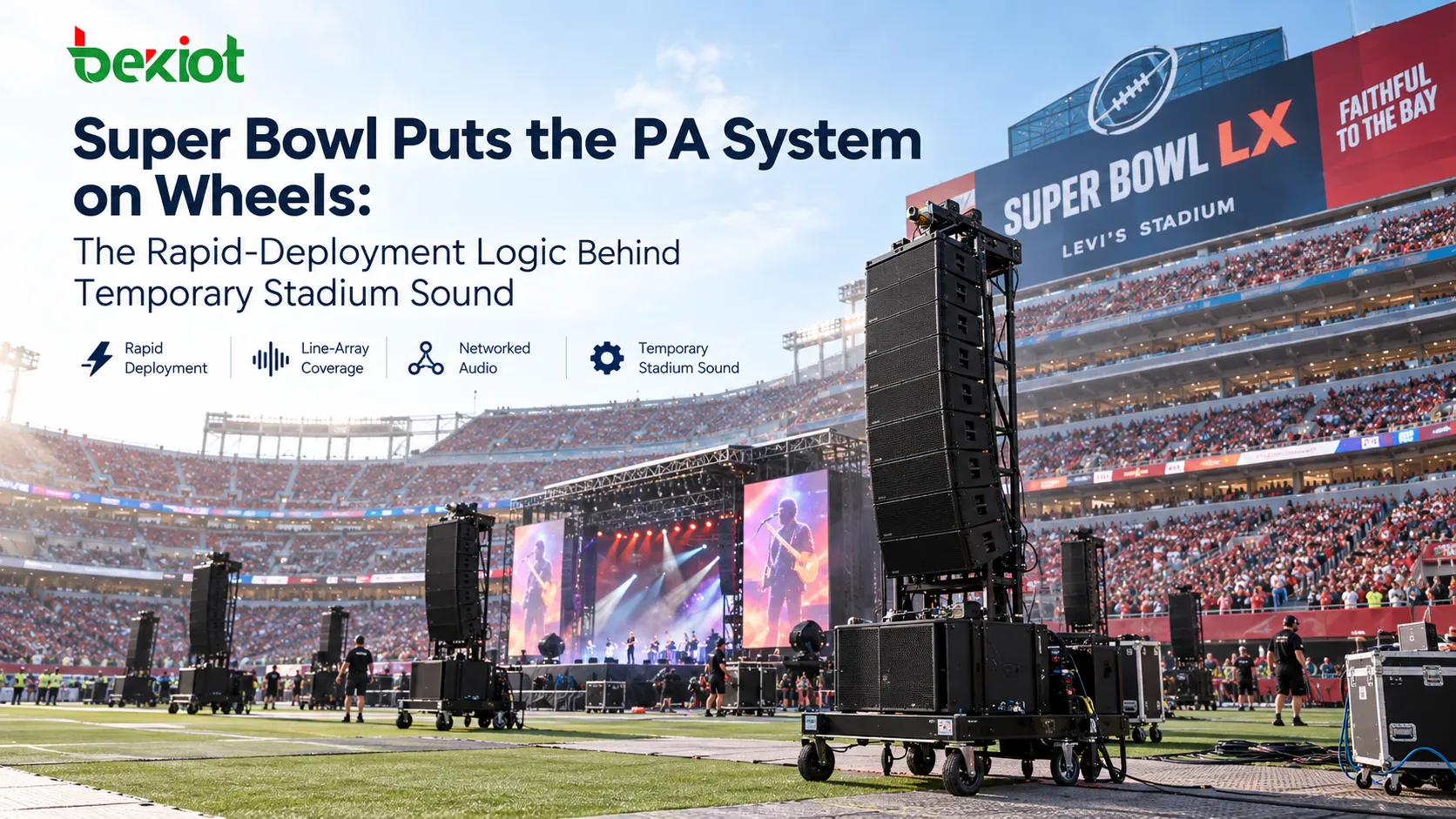
Halftime begins, the players leave the field, and production crews immediately move onto the turf. Mobile carts loaded with line-array loudspeakers and subwoofers are rolled into position around the field. Cables are deployed, networked audio is connected, and the stage, lighting and performance systems are transformed at the same time. Once the show ends, everything has to move out again so the stadium can return to football.
Super Bowl LX at Levi’s Stadium used exactly this type of mobile PA deployment. During several recent Super Bowls held in roofed venues, dedicated halftime sound systems could be flown from overhead rigging. At the open-air Levi’s Stadium, however, the dedicated music PA returned to field-level deployment, with custom-built speaker carts providing the primary audience coverage. The system expanded from the more typical 16 carts to 18 in order to serve approximately 68,500 seats while providing the low-frequency capability required for a high-impact music performance.
At first glance, the difference appears simple: the loudspeakers moved from the roof to wheeled platforms. The engineering implications are much broader. A temporary stadium PA system must deliver concert-level sound without becoming a permanent part of the building. It must cover lower and upper seating tiers without producing excessive SPL on the field, integrate with complex networked-audio infrastructure, and still be deployed and removed within a tightly controlled event window.
For major sporting events, opening and closing ceremonies, stadium concerts and temporary public events, this approach illustrates an important division of roles: the installed PA supports long-term venue operation, while the temporary PA creates a high-performance sound field tailored to a specific event and can be removed when the production ends.
Open-Air Stadium Architecture Changes Temporary PA Deployment
Stadium sound design usually begins with the building before it begins with the loudspeaker model.
In enclosed venues with suitable roof structures and sufficient rigging points, the main entertainment PA can be flown above the field. Greater elevation allows line arrays to reach distant seating more efficiently while reducing the amount of production equipment occupying field level. Several recent Super Bowl halftime systems used this type of flown arrangement in roofed stadiums.
Levi’s Stadium is an open-air venue and does not provide the same overhead rigging environment for a large temporary concert PA. If the event system still needs to cover the full seating bowl, the design team has to find effective acoustic positions closer to field level. Mobile speaker carts therefore become a practical deployment platform.
This does not mean that mobile systems are inherently more advanced than flown arrays. The decision is driven by venue structure, production schedule and operational constraints. A temporary-event design normally starts by identifying available rigging points, field-loading limitations, sideline space, the vertical geometry of the seating bowl and the amount of time available to clear the field.
The same event can therefore require a completely different PA architecture when it moves from one stadium to another. Temporary stadium sound cannot be treated as a fixed layout that is simply copied from venue to venue.
Mobile Speaker Carts Turn Acoustic Design into Deployable Modules
Transportation is not the most difficult part of a temporary PA system. The greater challenge is preserving predictable acoustic performance every time the equipment is moved.
If loudspeakers, amplifiers, support structures and connections arrive on the field as separate components, crews must assemble the system, position it, confirm angles and verify connections during the event window. For a conventional concert, that mainly increases setup time. During a major sports production, the game schedule does not wait for the sound system.
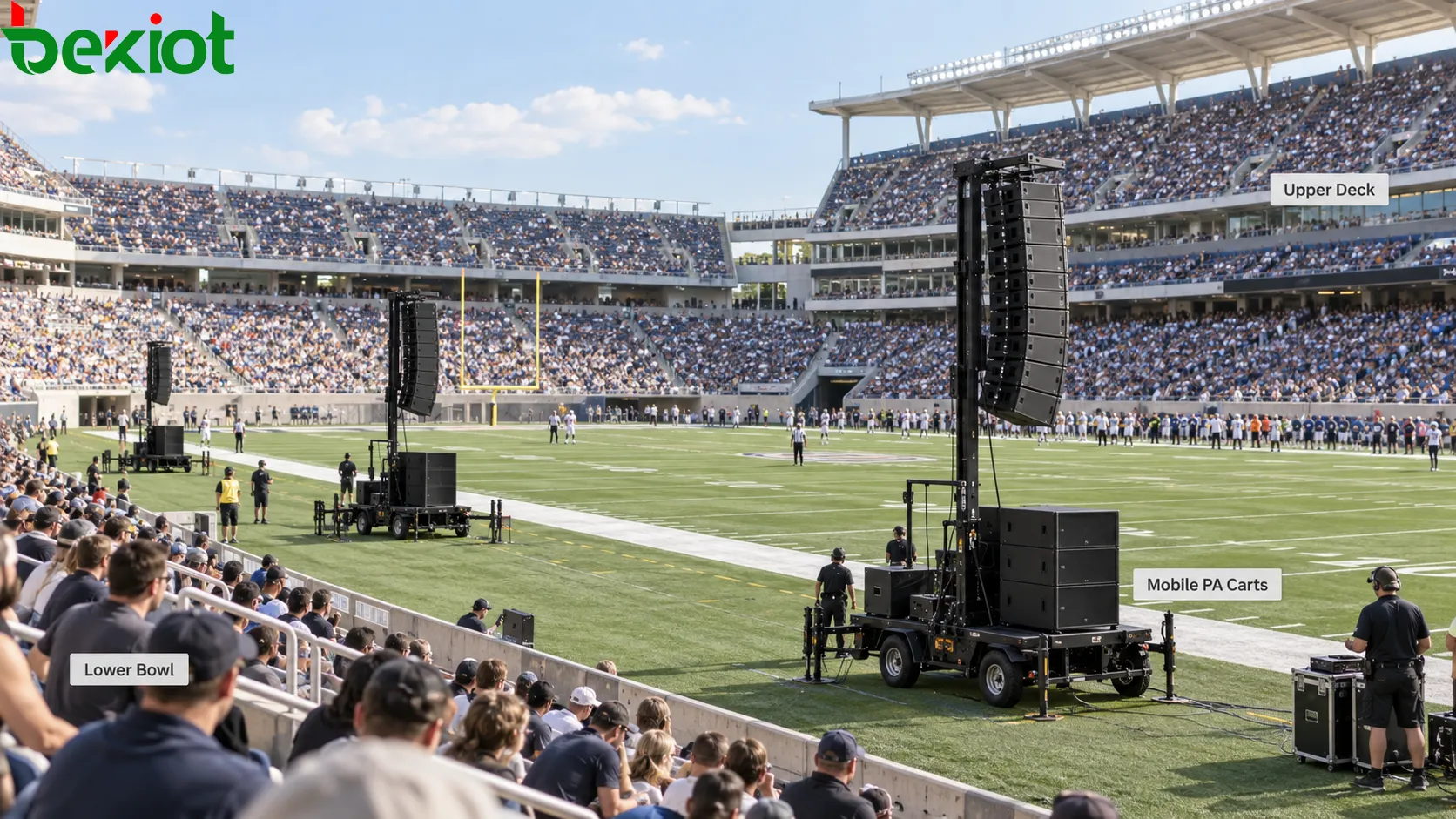
Mobile speaker carts solve part of this problem by turning loudspeaker placement, mechanical support and portions of the cabling into repeatable modules. Once a cart reaches its assigned location, the crew can concentrate on positioning, connecting and verifying the system instead of constructing each array from the ground up.
Super Bowl LX used 18 mobile carts. Depending on their location in the stadium, individual carts carried combinations of four or five L-Acoustics K1/K2 array elements together with KS28 subwoofers. The significant point is not the specific product count. Each cart is configured according to the seating area it is responsible for rather than being an identical copy of every other cart.
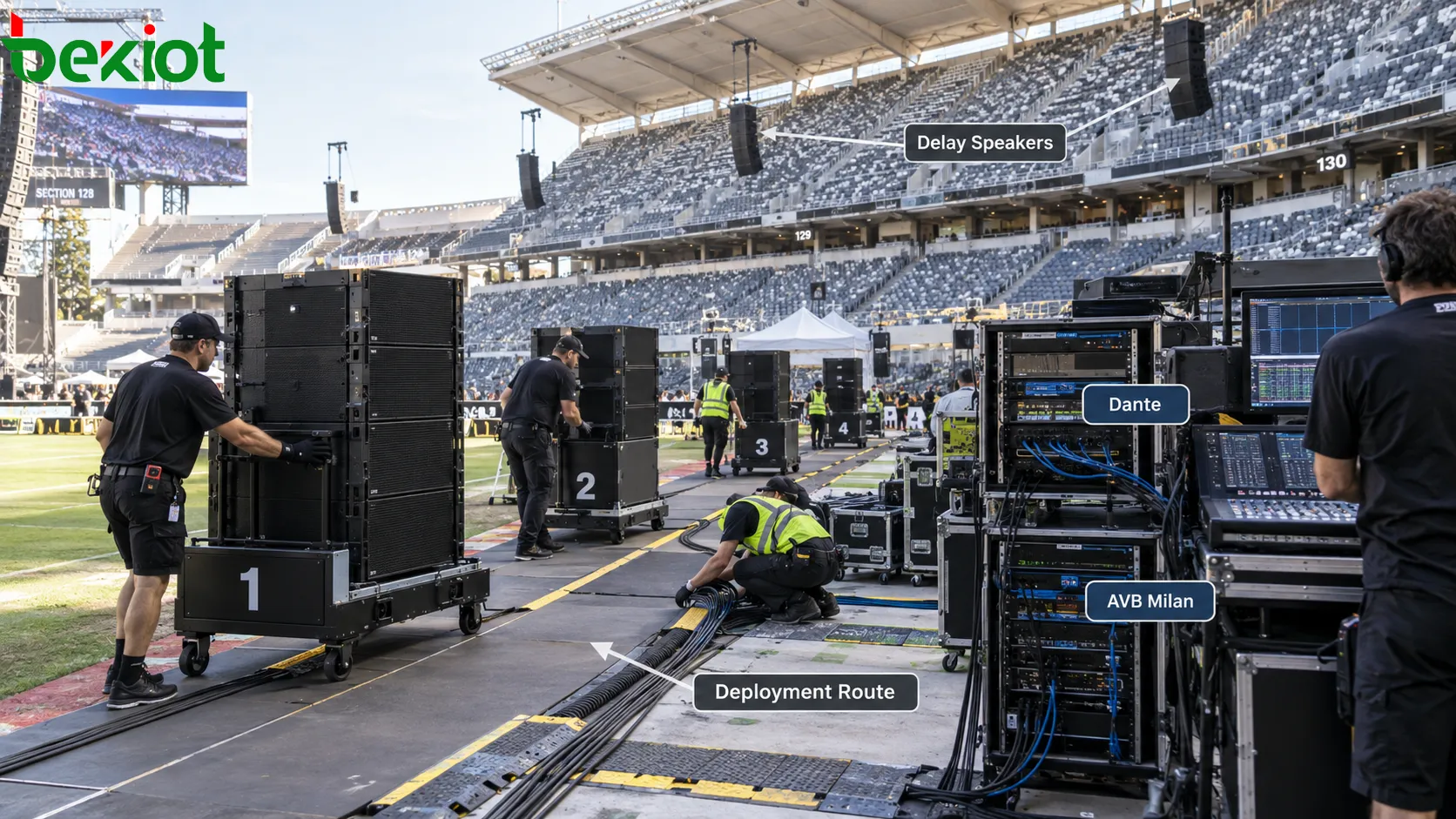
This modular approach also simplifies event operations. Speaker carts can be checked in a staging area before the production begins, moved to numbered field positions according to a defined sequence, connected, used for the performance, and then removed along predetermined routes.
A complex temporary PA deployment therefore becomes less like building a new sound system on the field and more like moving a set of preconfigured acoustic modules into their assigned positions.
Seating Coverage Determines Array Angles and Low-Frequency Capacity
A stadium seating bowl is not a flat listening area. Lower seating, upper decks, end zones and press-box-side sections all present different distances and vertical angles. Placing 18 identical speaker carts in a symmetrical circle would not automatically produce consistent coverage.
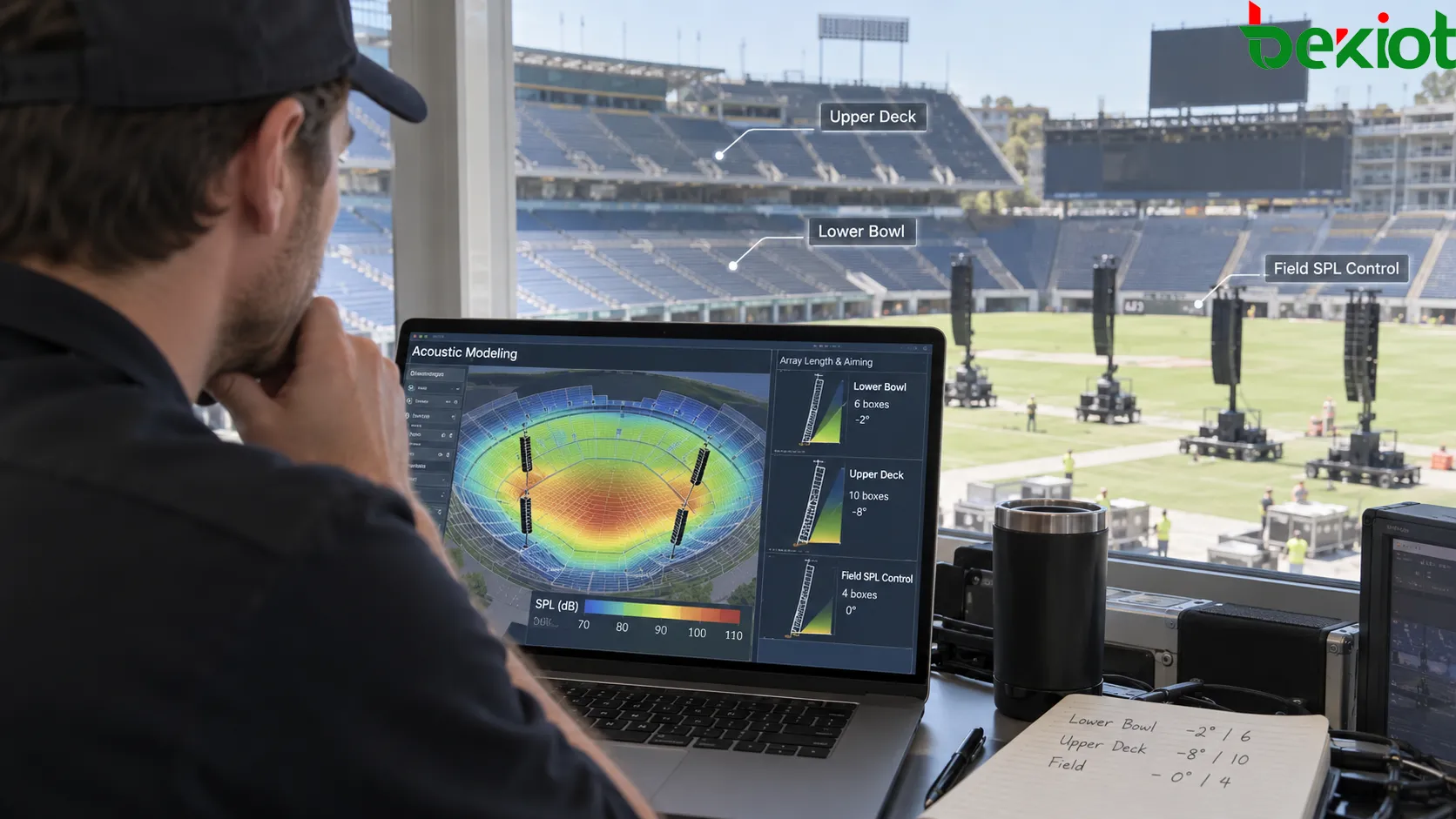
In the Super Bowl LX design, different locations used different array lengths and vertical angles. A position primarily covering the Lower Bowl could use fewer array elements with shallower vertical aiming. Another position facing an Upper Deck required additional elements and a steeper vertical contour to project sound farther upward.
Acoustic modeling software such as Soundvision allows designers to evaluate array position, vertical angles and expected coverage before the equipment reaches the venue. The goal is not simply to generate the highest possible SPL. The design needs to control major level and tonal differences between seating areas.
The halftime show also adds a requirement that does not exist in ordinary voice paging. Music demands significant low-frequency energy and dynamic headroom. Subwoofer capacity therefore has to be designed around program content, stadium openness and low-frequency propagation across a very large audience area, not merely around whether the audience can hear the system.
Field level creates the opposite problem. The center of the playing surface is not the primary audience zone. Excessive acoustic energy on the field may offer little benefit to spectators while increasing spill into stage microphones, monitor systems and broadcast audio.
The temporary PA therefore has to satisfy three competing objectives:
Distant and upper seating must receive adequate level and dynamic headroom;
Near seating should not experience excessive SPL simply because it is closer to the arrays;
Unnecessary acoustic energy should be controlled around the stage, field and broadcast-production areas.
This is why large stadium sound systems increasingly depend on Acoustic Modeling. Loudspeaker output capability is only one design input; the real performance target is what listeners receive in different seating positions.
Temporary Entertainment PA and Installed Venue Sound Must Work Together
A Super Bowl production does not remove the stadium’s installed sound system and replace it entirely with a temporary PA.
The installed venue system continues to support game announcements, public-address functions, in-game production and long-term stadium operation. The mobile halftime PA is optimized for music, higher dynamic range, stronger low-frequency output and more specialized event coverage. The two systems serve different purposes but can work together during a major production.
The upgraded installed loudspeakers at Levi’s Stadium were also used as extension and delay sources for the entertainment system. Areas that could not be covered optimally by the field-level temporary arrays could therefore receive supplementary coverage from existing venue loudspeakers without requiring additional mobile PA positions.
This approach has broader value for temporary-event design. The loudspeakers, amplifiers and network nodes already installed in a major venue do not necessarily have to remain isolated from special-event production. When signal interfaces, latency and control architecture permit, the installed system can become part of the temporary event coverage strategy.
Audio transport also relies heavily on networked infrastructure. The Super Bowl production used technologies including Dante and AVB Milan, with networked audio interfaces distributing signals among consoles, processing systems and amplified controllers.
The benefit of networked audio is not limited to reducing the amount of analog cabling. Major event productions contain many simultaneous audio domains: live music, announcements, opening ceremonies, game sound, monitor systems, broadcast production and installed venue PA. Digital audio networks make it easier to distribute these signals to different destinations, but they also require careful planning for Clock synchronization, network topology, bandwidth and redundancy.
Rapid Field Deployment Depends on Detailed Operational Choreography
Time is one of the defining engineering constraints of a temporary stadium PA system.
Super Bowl halftime is longer than a standard NFL halftime, but the complete transition window is still only around 25 to 30 minutes. The speaker carts, stage, performance equipment and production crews must enter the field, complete the show and then clear the playing surface. The audio team cannot spend extended periods repositioning loudspeakers after the audience is seated, and it cannot remain on the field dismantling equipment after the performance ends.
More than 100 crew members were involved in moving the temporary PA system. Each speaker cart required several people for pulling and steering, while additional crew handled cables and other equipment on the field. With 18 large carts operating in limited sideline space, an undefined deployment sequence could quickly lead to congestion or blocked movement.
A temporary PA design therefore needs more than an acoustic drawing. It also requires an operational movement plan that defines:
Where each mobile unit enters the field;
Which numbered position it occupies;
Where power and audio are connected;
Which cables must be disconnected before movement begins;
In what sequence carts leave the field after the performance;
Whether a failed unit can be bypassed without blocking the rest of the deployment route.
This is a major difference from an installed stadium PA. Fixed systems are designed primarily around long-term reliability and maintainability. Temporary production systems must also treat minute-by-minute deployment efficiency as an engineering parameter.
Temporary PA Commissioning Must Cover Acoustics, Network and Operations
Confirming that every loudspeaker produces sound in an empty stadium is not enough to prove that a temporary event PA is ready for a major production.
Acoustic testing needs to cover multiple seating elevations and distances, including the Lower Bowl, Upper Deck, end zones and locations with significant off-axis relationships to the main arrays. In addition to SPL, commissioning should evaluate tonal consistency, low-frequency distribution, speech intelligibility and Time Alignment between the temporary main system and installed Delay Speakers.
On the network side, engineers need to verify audio-path redundancy, Clock stability, switching behavior, network loading and the effect of individual node failures. Problems in a large networked-audio system do not always look like a conventional analog cable failure. A Clock or network configuration issue can affect multiple devices at the same time.
Temporary outdoor events also face an operating constraint that fixed indoor PA systems encounter less often: rehearsal noise escaping beyond the venue.
An open-air stadium allows more performance audio to travel beyond the seating bowl. For a highly confidential production such as the Super Bowl halftime show, rehearsal audio can reveal songs or guest performers before the event. Production teams may therefore reduce SPL, activate only selected parts of the system during certain rehearsals, and use other audio around the exterior of the venue to make the actual show content more difficult to identify.
This illustrates a broader principle in temporary sound-system design: engineers must consider not only where sound should be heard, but also where it should not be heard. The same issue applies to outdoor concerts near residential areas, city-center events and temporary productions operating under strict noise limits.
Full deployment and removal rehearsals are equally important. A PA system can pass every technical audio test and still fail operationally if a large crew cannot move, connect and remove the equipment within the required event window. For productions of this scale, the acoustic design and the operational plan have to be validated together.
The return of mobile speaker carts at Super Bowl LX does not mean stadium sound has gone backward. Modern mobile PA combines a proven mechanical deployment concept with acoustic modeling, digital processing, networked audio and existing venue infrastructure. The wheels may be traditional, but the architecture behind them is increasingly digital.
The standard for a major temporary stadium PA has therefore become much broader than sound pressure alone. The system must create a consistent listening experience across tens of thousands of seats, move onto and off the field in a very short window, and coexist with the game, stage production and broadcast operation. Meeting all of those requirements is what turns a collection of temporary loudspeakers into a true large-scale event sound system.
FAQ
Why Does a Stadium Need a Temporary PA if It Already Has an Installed Sound System?
Installed stadium PA systems are typically designed to support game announcements, public information, in-venue production and long-term daily operation. A major music performance may require greater dynamic range, more low-frequency output and different coverage geometry. A dedicated temporary PA can handle those requirements while the installed loudspeakers continue to provide supplementary or delay coverage where appropriate.
Are Mobile Speaker Carts Better Than Flown Line Arrays for Every Stadium?
No. The choice depends on building structure, available Rigging Points, field-access conditions, seating geometry and the time allowed for event conversion. Where suitable overhead rigging exists, a Flown PA can offer significant advantages. In open-air stadiums or venues where large temporary systems cannot be suspended safely, Ground-Supported or Mobile PA configurations may be more practical.
Why Would a Temporary PA Use the Stadium’s Installed Delay Speakers?
A temporary main system may not reach every seating area at an optimal angle, especially in complex seating bowls, distant sections or areas affected by structural obstruction. Properly delayed and level-matched installed loudspeakers can extend coverage into these areas, reduce the amount of temporary equipment required and improve consistency between audience zones.
What Should Be Tested When Commissioning a Temporary Stadium PA?
Peak SPL alone is not enough. Commissioning should also include seating-area coverage consistency, frequency response, Speech Intelligibility, low-frequency distribution, time alignment between main and delay systems, networked-audio stability, fault impact and the ability to deploy and remove the entire system within the required event window.
Becke Telcom provides IP PA systems, SIP paging, networked audio access, zone control, paging terminals and unified communications equipment for stadiums, public facilities and large venues. Solutions can be planned around coverage zones, IP network architecture and integration with existing PA infrastructure for fixed paging and supporting communication applications.