
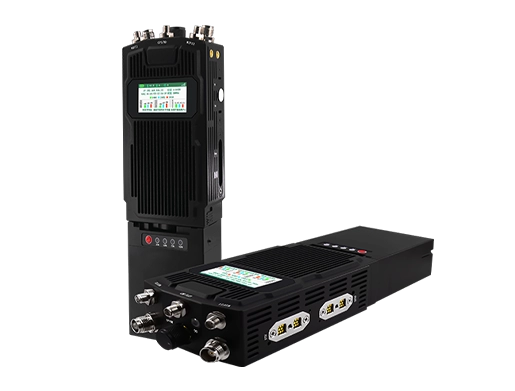

The MEB83 SDR MANET Handheld Radio is a portable broadband Mesh networking terminal designed for emergency response, on-site command, patrol operations, UAV communications, remote engineering, and other mobile applications where traditional network infrastructure may be unavailable or unreliable.
The MEB83-36 radio is built on a software-defined radio architecture and decentralized multi-hop MANET technology. Compatible devices can communicate without relying on a traditional central node, while participating radios dynamically perform routing and relay forwarding as the network topology changes.
With a maximum 40 MHz channel bandwidth, a specified transmission capability of up to 120 Mbps @ 40 MHz, and a Gigabit Ethernet interface, the MEB83-36 is suited for broadband field applications that require voice, real-time video, IP data, and positioning information to be carried over the same mobile wireless network.
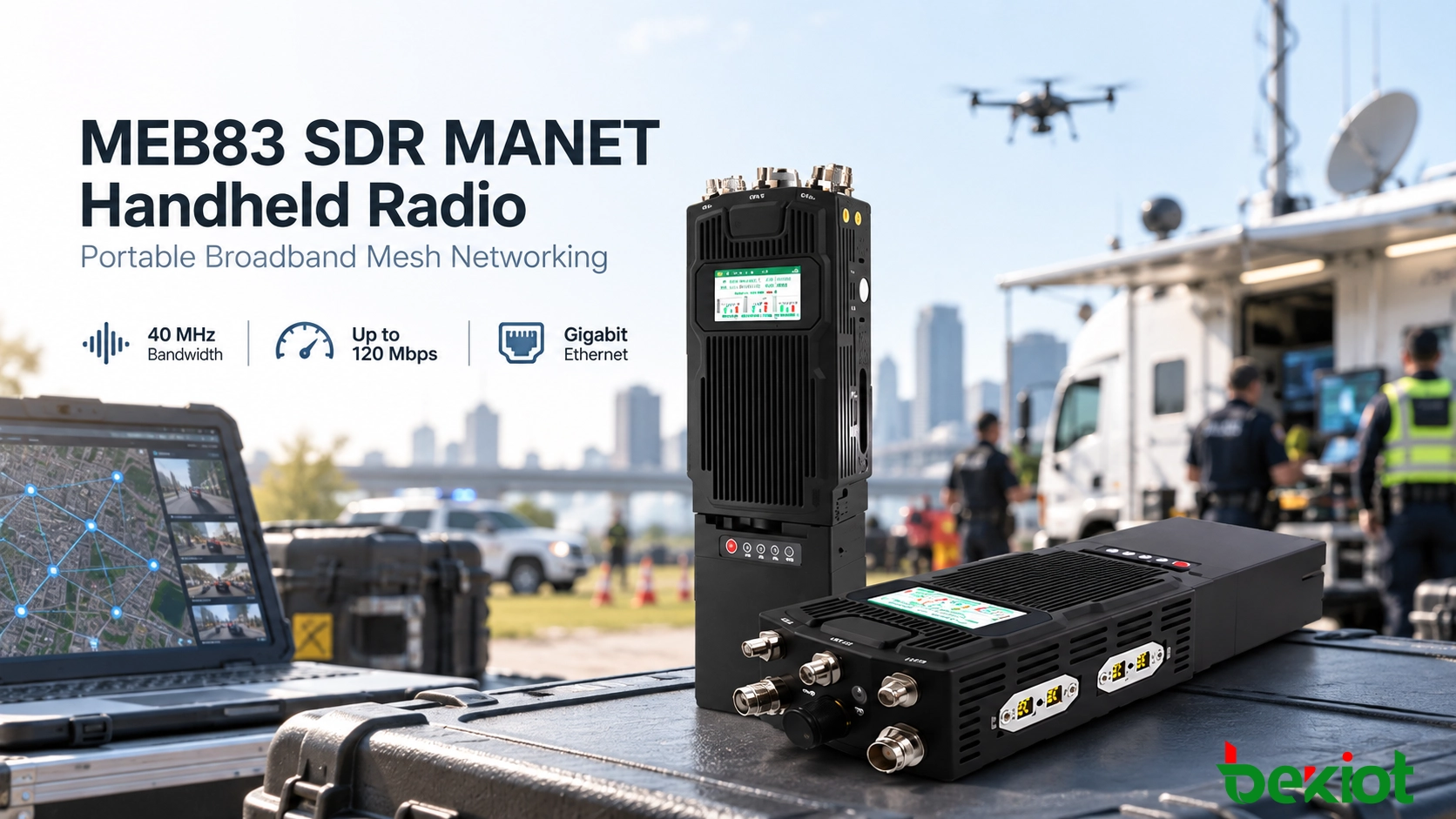
The MEB83-36 adopts a decentralized network architecture that allows compatible devices to communicate without depending on a fixed central base station.
Each participating node acts both as a communications terminal and as a router and relay within the MANET network.
Compatible nodes can establish a wireless multi-hop network within seconds, making the MEB83 suitable for field operations where communications must be deployed quickly after personnel arrive on site.
This is particularly useful for emergency response, temporary command, and remote field operations, which typically do not allow enough time to install permanent communications infrastructure.
During operations, personnel, vehicles, UAVs, and other mobile nodes may continuously change position. The MEB83-36 supports dynamic routing, enabling available network paths to adjust as the topology changes.
When a direct wireless link is not suitable, traffic can be forwarded through other compatible nodes in the MANET network.
One of the main features of the MEB83 is its higher broadband transmission capability. The radio supports up to 120 Mbps at a 40 MHz channel bandwidth.
It is therefore suited to applications that may require greater data capacity, including real-time video, on-site data exchange, and other IP-based communications services.
The nominal 120 Mbps represents the specified wireless transmission capability at 40 MHz. Actual application throughput varies with RF conditions, selected bandwidth, interference, number of relay hops, network topology, and concurrent traffic.
The MANET network can carry voice, data, video, and positioning information over the same wireless infrastructure.
This allows field personnel to use a single broadband communications network to carry multiple operational services, instead of maintaining a separate wireless link for each type of information.
Same-frequency networking supports up to 64 nodes.
Supported network structures include star, line, Mesh, and hybrid dynamic topologies, which can be configured according to the number and mobility of participating devices.
Multiple MEB83-36 radios can form a mobile broadband network among field personnel. Each device can directly exchange information with nearby compatible nodes while participating in the broader routing structure.
As a result, field teams can establish a local communications network without first installing fixed access points or conventional base stations.
When different teams are separated by distance or obstacles, compatible nodes can be added to provide relay forwarding between sections of the operational area.
This makes the network more flexible than a simple point-to-point link, as traffic can be transmitted over multiple available paths.
The product documentation explicitly lists UAV airborne deployment, ground station deployment, and relay operation as supported configurations.
The MEB83 can therefore participate in a broader air-to-ground MANET system, working in coordination with compatible UAV communications equipment and ground nodes.
The MEB83-36 is suited to scenarios where communications nodes must move with personnel or with the operation itself. As participating devices move between locations, the network can adapt dynamically.
The radio is therefore suitable for patrols, emergency response, on-site surveying and mapping, and other operations where the communications structure cannot remain static.
The standard operating frequency is 1350–1450 MHz. Frequency configurations from 350 MHz to 6 GHz can be customized according to project requirements.
A frequency-hopping configuration is also available as an option. The actual operating band should be selected based on project requirements and the applicable spectrum regulations of the deployment country or region.
The MEB83-36 provides 2 W × 2 transmit power through two MESH antenna interfaces.
Transmit power alone does not determine communication range. Antenna, frequency, terrain, mounting position, interference, and network topology also affect actual wireless performance.
Supported channel bandwidths include 1.25, 2.5, 5, 10, 20, and 40 MHz.
The wider 40 MHz configuration provides the bandwidth required to achieve the radio's specified maximum transmission capability of 120 Mbps.
The MEB83 supports adaptive modulation with BPSK, QPSK, 16QAM, 64QAM, and 256QAM.
The different modulation schemes allow the wireless system to adjust transmission according to changing radio link conditions.
Receiver sensitivity is specified as -103 dBm at 5 MHz.
Actual link performance should still be evaluated as part of a complete RF system, including antenna, operating frequency, interference, and deployment environment.
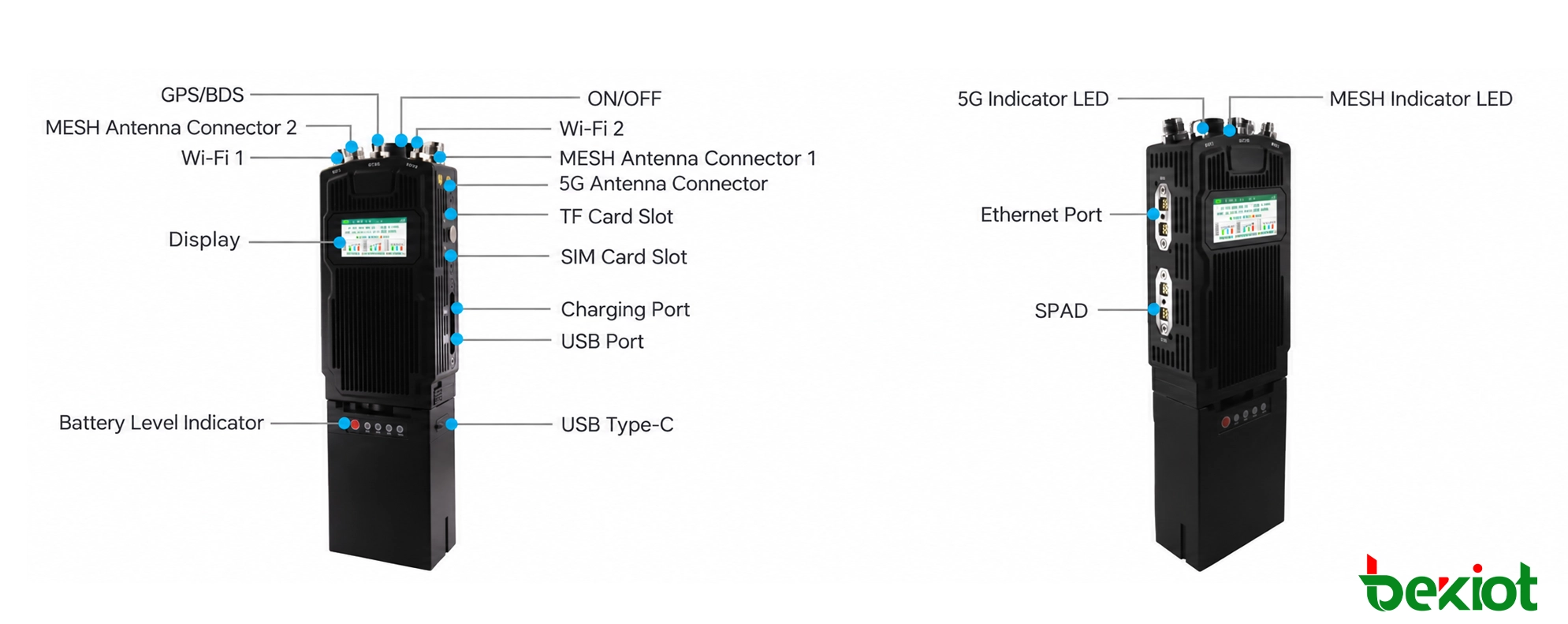
The MEB83 provides two TNC interfaces for MESH antennas.
These interfaces support the broadband MANET wireless connection used by the decentralized multi-hop network.
The device provides two SMA interfaces for Wi-Fi antennas and one SMA interface for GPS.
The device provides one MCX interface for connecting a 5G antenna.
The MEB83 is equipped with one 1000 Mbps Ethernet interface.
The Gigabit Ethernet port provides wired IP connectivity for compatible external devices, and distinguishes the MEB83's interface configuration from handheld models equipped only with lower-speed Ethernet connections.
The device provides one USB interface, one TF card slot, and one SIM card slot.
These interfaces support integration with broader communications and application systems according to project requirements.
The device provides a USB Type-C charging port for charging the handheld radio.
The MEB83 is equipped with an integrated display, along with one 5G status indicator and one MESH status indicator.
The MEB83 can be rapidly deployed when emergency teams require broadband communications and conventional fixed or public network infrastructure is unavailable or insufficient.
Multiple radios can form a mobile multi-hop network to exchange voice, video, data, and positioning information within the incident area.
Rescue teams may need to keep moving in changing environments while maintaining communications with other personnel and command resources.
Decentralized networking and dynamic routing keep compatible nodes part of the field network even as their relative positions change.
The application examples describe MESH personnel terminals, relay devices, and dispatch platforms used to establish decentralized audio-video communications in high-rise residential buildings, underground parking areas, large commercial complexes, and metro environments.
The same IP network can also provide a transparent transmission path for compatible monitoring and sensing devices used by field personnel.
UAV video and data transmission are explicitly listed as target applications for this product.
The MEB83 can participate in a MANET system composed of compatible UAV nodes and ground nodes, enabling broadband information to be transmitted between airborne devices and on-site communications equipment.
Power construction, outdoor surveying and mapping, and remote engineering projects may operate in areas where wired or public mobile network coverage is inconvenient.
The portable MANET radio establishes a temporary broadband connection between field personnel and other compatible nodes without first installing permanent communications infrastructure.
The MEB83 can be used to build a dedicated communications network for urban patrols and routine mobile operations.
The handheld form factor allows an individual to remain part of the network while moving between patrol zones.
The product documentation lists close-range reconnaissance as one of the MEB83's target scenarios.
The higher-bandwidth MANET connection can support the transmission of on-site video and other operational information from mobile personnel to compatible communications nodes.
The application areas described by the manufacturer also include shipboard transmission and maritime rescue.
Compatible MANET terminals may participate in networks formed by vessels, UAVs, helicopters, or other nodes, according to the communications architecture adopted for the operation.
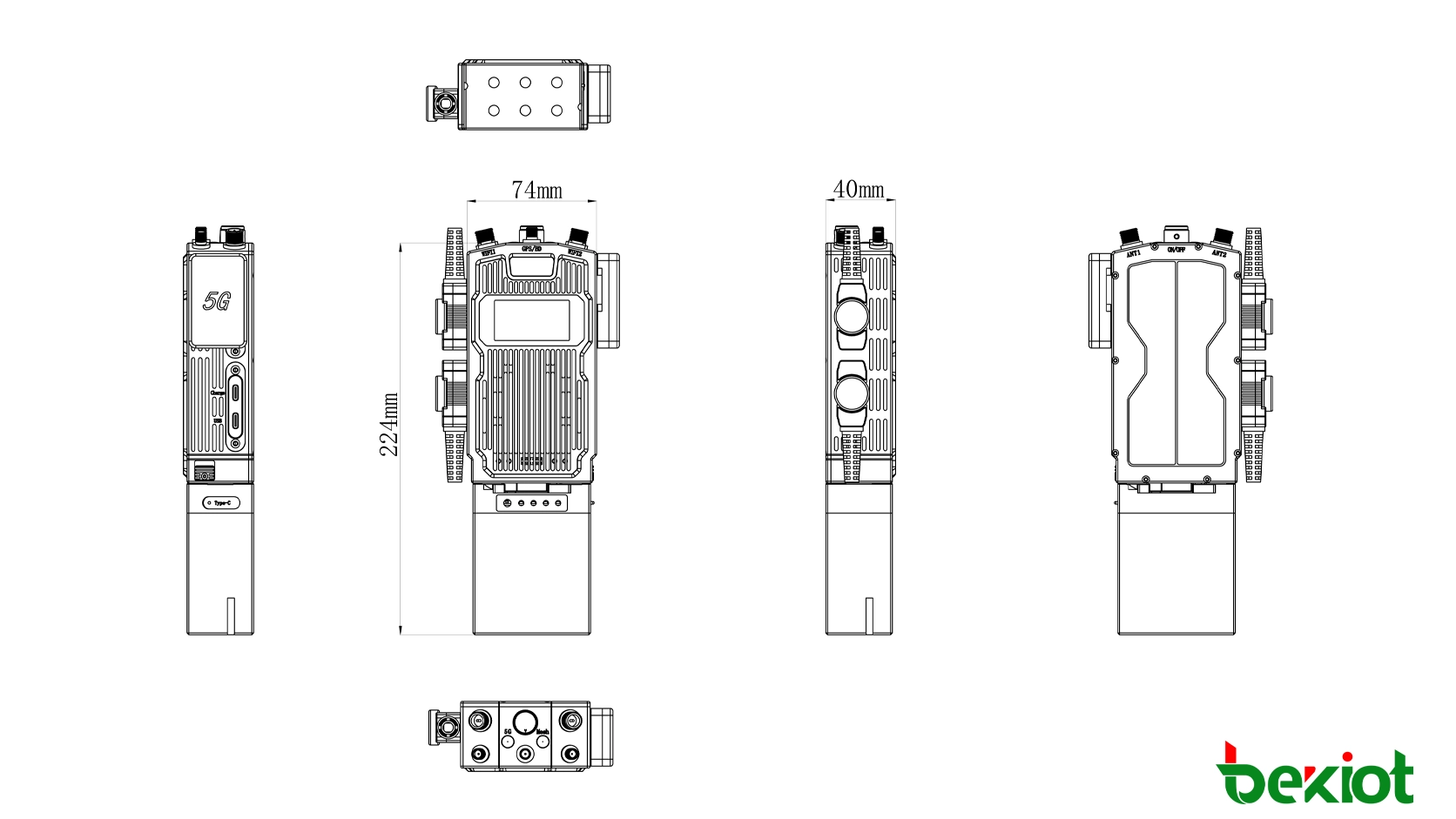
The MEB83 measures approximately 224 × 74 × 40 mm (excluding antennas) and weighs approximately 1060 g (also excluding antennas).
The device uses a 12.6 V / 7 Ah battery. The manufacturer specifies an operating time of approximately 6 hours in the standard configuration and approximately 8–12 hours in the enhanced configuration.
The combination of a 40 MHz channel bandwidth and the specified 120 Mbps wireless transmission capability makes the MEB83 particularly suitable for scenarios where the MANET network must carry higher-bandwidth services.
Video traffic should still be planned based on the number of concurrent video streams, compression bitrate, RF conditions, number of relays, and other network traffic, rather than relying solely on the maximum wireless data rate.
The 1000 Mbps Ethernet interface provides a higher-speed wired connection between the handheld radio and compatible external IP devices.
The traffic that the wireless network can actually carry is still determined by the MANET wireless link and overall network conditions, rather than by the Ethernet port rate alone.
The MEB83 does not need to operate only as an isolated handheld device. It can be part of a broader compatible MANET deployment, working together with ground stations, relays, UAV nodes, and other communications equipment.
This allows handheld personnel to directly participate in a network that can extend beyond simple user-to-user communication and continue to expand.
No. 120 Mbps represents the specified wireless transmission capability at 40 MHz. Actual application throughput varies with RF conditions, interference, network topology, number of relay hops, and concurrent network traffic.
The technical specifications do not provide a fixed communication range. Actual coverage depends on operating frequency, antenna configuration, terrain, obstacles, interference, and the position of other MANET nodes.
Yes. The MEB83 provides one 1000 Mbps Ethernet interface for connecting compatible IP devices. The specific application depends on the IP configuration, protocols, bandwidth requirements of the connected devices, and the overall MANET network design.
The technical specifications list an operating time of approximately 6 hours in the standard configuration and approximately 8–12 hours in the enhanced version. Actual duration varies with transmit activity, traffic load, connected functions, temperature, and battery condition.
Project planning should confirm the permitted operating frequency, required channel bandwidth, expected voice/video/data traffic, number of MANET nodes, antenna configuration, battery requirements, and whether handheld, UAV, relay, or ground station nodes need to operate together.
| Model | MEB83 |
|---|---|
| Radio Model | MEB83-36 |
| Product Type | SDR MANET Handheld Radio |
| Radio Architecture | Software-Defined Radio (SDR) |
| Standard Frequency | 1350–1450 MHz |
| Custom Frequency | 350 MHz–6 GHz, customizable |
| Frequency Hopping | Optional |
| Transmit Power | 2 W × 2 |
| Channel Bandwidth | 1.25 / 2.5 / 5 / 10 / 20 / 40 MHz, adjustable |
| Modulation | BPSK / QPSK / 16QAM / 64QAM / 256QAM, adaptive |
| Transmission Capability | 120 Mbps @ 40 MHz |
| Receiver Sensitivity | -103 dBm @ 5 MHz |
| Network Capacity | Up to 64 nodes in same-frequency networking |
| Network Topology | Star / Linear / Mesh / Hybrid Dynamic |
| MESH Antenna Interfaces | 2 × TNC |
| Wi-Fi Antenna Interfaces | 2 × SMA |
| GPS Antenna Interface | 1 × SMA |
| 5G Antenna Interface | 1 × MCX |
| Ethernet | 1 × 1000 Mbps Ethernet |
| USB | 1 × USB |
| Charging Port | 1 × USB Type-C |
| Additional Interface | 1 × SPAD |
| Storage | 1 × TF Card Slot |
| SIM | 1 × SIM Card Slot |
| Display | Integrated Display × 1 |
| Status Indicators | 5G × 1 / MESH × 1 |
| Operating Temperature | -40°C to +55°C |
| Storage Temperature | -40°C to +85°C |
| Operating Humidity | 5%–95%, non-condensing |
| Dimensions | 224 × 74 × 40 mm, excluding antennas |
| Weight | Approx. 1060 g, excluding antennas |
| Battery | 12.6 V / 7 Ah |
| Battery Operating Temperature | -10°C to +55°C |
| Specified Operating Time | Approx. 6 hours |
| Enhanced Operating Time | Approx. 8–12 hours |
| Average Power Consumption | 15 W |
| Peak Power Consumption | 22 W |