
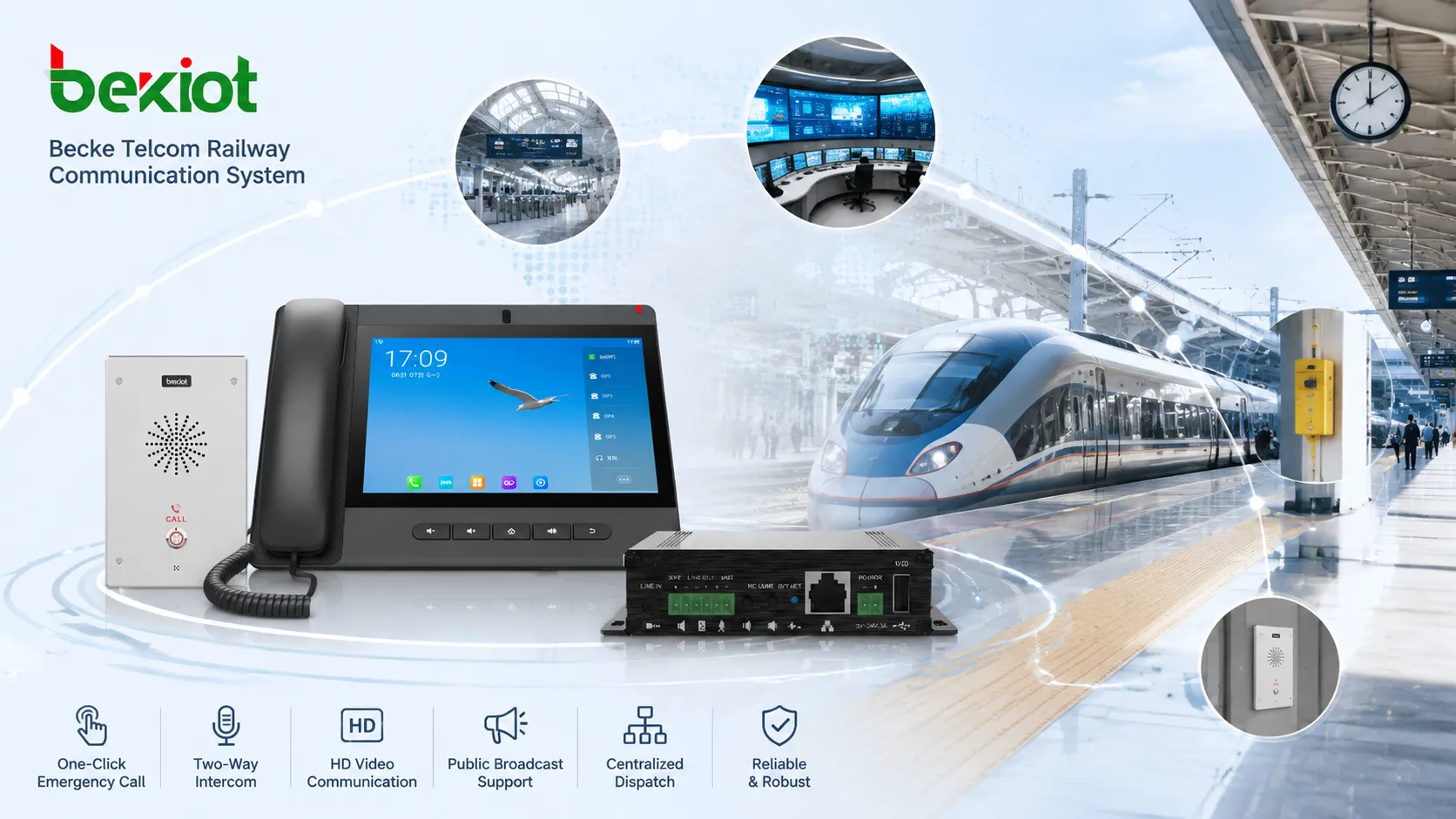
Subway
Becke Telcom Railway Communication System Case Study for Indonesia Station Safety and Dispatch
Railway communication systems must support more than daily announcements. In busy stations, passengers may need help immediately, station staff may need to coordinate across platforms and offices, and the monitoring center must be able to respond to emergencies without delay. This case study reviews a railway communication system project in Indonesia, where Becke Telcom solutions were applied to improve passenger assistance, station emergency reporting, and centralized dispatch communication.
The project used BK-DAB-PA2S intercom modules, BHP-SOS16 SIP intercom terminals, and GP320 dispatch terminals to build a more connected station communication network. The system allowed passengers to request help through SOS points, enabled staff to communicate with the monitoring center, and gave operators a clearer way to answer, dispatch, and manage railway station events.
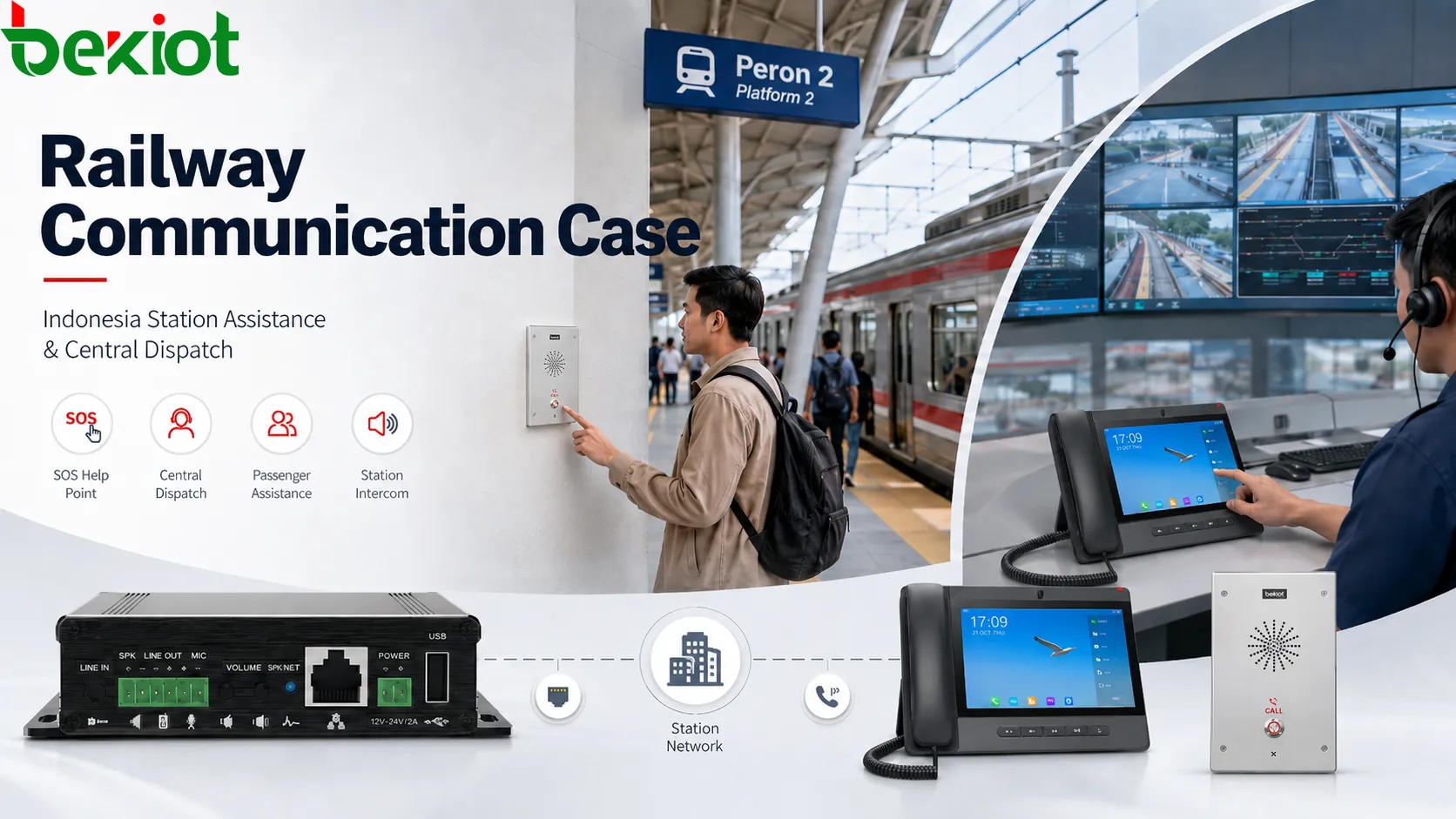
The project was deployed for PT Kereta Commuter Indonesia, also known as KCI. KCI is a commuter railway operator in Indonesia, providing passenger transport services across major urban and surrounding areas. Its rail network covers Jakarta, Bogor, Depok, Tangerang, and Bekasi, with 79 stations and a total operating route length of about 418.5 kilometers.
For a commuter railway network of this scale, station communication is directly related to service quality and public safety. Passengers may need assistance for ticketing issues, platform questions, lost items, medical emergencies, safety incidents, or urgent complaints. Station staff also need a reliable way to coordinate between public areas, police offices, monitoring rooms, and service counters.
Before the communication upgrade, station assistance depended more on staff patrols, manual response, and separated communication methods. This made it difficult to guarantee fast passenger support at every point in the station. In an emergency, even a short delay could affect passenger experience, event handling efficiency, and station operation order.
KCI needed a station communication solution that could allow passengers to contact the monitoring center quickly. The system also needed to support staff-to-center communication, platform-level emergency reporting, clear two-way audio, and central dispatch control. Since railway stations are public environments with heavy passenger flow, the equipment also needed to be visible, easy to operate, and protected inside station-specific installation structures.
The final goal was not simply to install more intercom devices. The project needed a connected railway communication framework that could improve station service efficiency, strengthen passenger safety, and help the monitoring center handle events faster and more consistently.
Railway stations are different from ordinary office buildings. They have large passenger movement, multiple entrances and exits, platform areas, ticketing zones, service rooms, police offices, and operational spaces. Communication points are distributed across the site, and users may not always know where to find station staff when they need help.
Passenger assistance is also time-sensitive. A passenger may need help with boarding direction, a family member may report a lost item, or a person may press an emergency button because of a medical or safety issue. In these moments, the communication system must connect the user to the correct operation center quickly and clearly.
The monitoring center also faces practical pressure. Operators need to know where the call is coming from, what type of situation is happening, and whether station staff need to be dispatched. Without a fixed SOS communication network, the center may need to depend on phone calls, patrol reports, or scattered radio communication, which can slow down response.
Another challenge is equipment protection. Devices installed in public station areas can be exposed to frequent use, accidental impact, dust, humidity, and tampering risk. A railway communication terminal must therefore combine audio performance, SIP compatibility, manageable installation, and strong physical reliability.
The Becke Telcom railway communication system was designed around three main device roles. BK-DAB-PA2S was used for customized SOS intercom points where passengers could request help. BHP-SOS16 was used as a SIP intercom terminal for station public areas and police office communication. GP320 was deployed in the monitoring center as the visual dispatch and communication terminal.
The system followed a field-to-center communication structure. When a passenger pressed an SOS button, the call was routed to the monitoring center. When staff used a BHP-SOS16 station intercom, the call could also be answered by the center. GP320 allowed operators to handle calls, communicate with station points, and coordinate response actions from one central position.
Instead of treating SOS calls, platform intercom, and monitoring-center operation as separate tasks, the system connected them into one railway communication workflow. This helped the customer reduce isolated communication points and improve the consistency of response across station areas.
| Device | Deployment Role | Main Function | Project Value |
|---|---|---|---|
| BK-DAB-PA2S | Customized passenger SOS call point | One-button help request and two-way communication | Allows passengers to contact the monitoring center quickly when assistance is needed |
| BHP-SOS16 | Station public area and police office intercom | SIP intercom, emergency call, audio communication, and system integration | Provides staff and passenger-area communication access across station locations |
| GP320 | Monitoring center dispatch terminal | Call handling, two-way intercom, visual operation, broadcast control, and dispatch support | Helps operators answer, manage, and coordinate railway communication events more efficiently |
The BK-DAB-PA2S was applied as the core communication component for station SOS points. In railway stations, passenger-facing devices must be simple enough for anyone to operate under pressure. The one-button call design allows passengers to request help without searching for a phone number or finding the nearest staff member.
For this project, the SOS unit was assembled into a customized enclosure suitable for station installation. The structure included the BK-DAB-PA2S communication module, a call button, speaker, microphone, and related installation components. The customized housing helped protect the equipment, made the help point easier to identify, and allowed the device to match the station environment.
When a passenger presses the SOS button, the call can be sent to the monitoring center. The operator can answer the call, speak directly with the passenger, and decide whether to provide voice guidance, contact station staff, or escalate the event to security or emergency personnel.
This design is important because it turns a passive station area into an active communication point. Passengers do not need to wait for patrol staff to pass by. The monitoring center receives the request directly, which shortens the first response time and helps operators understand the situation earlier.
BHP-SOS16 was used in station public areas and police office locations to provide SIP-based intercom communication. Compared with a basic analog call point, BHP-SOS16 supports a more integrated IP communication architecture. It can register to SIP platforms, participate in intercom calls, support emergency calling, and connect with other communication resources in the station system.
The uploaded specification shows that the corresponding SIP intercom supports 2 SIP lines, quick dialing, MP3 broadcast, custom DSS keys, mono active speaker connection, intercom recording output, switch signal input and output, TF card interface, and Ethernet power supply. These functions make the terminal suitable for station areas where both calling and local audio linkage may be required.
The terminal also supports auto answer, remote or button-based volume adjustment, network time synchronization, scheduled tasks, dynamic multicast, SIP call-to-multicast conversion, HTTP API, Action URL, and Active URI. In a railway environment, these functions help connect intercom operation with station management rules, scheduled audio tasks, platform messages, and external system events.
For audio quality, the device supports narrowband codecs such as G.711, G.729, iLBC, G.723.1, and G.726-32K, as well as wideband codecs including G.722 and Opus. It also supports full-duplex communication and acoustic echo cancellation. This is useful in stations because background noise, platform announcements, passenger movement, and open spaces can affect call clarity.
The BHP-SOS16 hardware design also fits public station conditions. The corresponding specifications include IP65 protection, IK10 impact resistance, aluminum alloy housing, wall-mounted installation, PoE Class 3, DC12V–24V power input, a tamper switch, two short-circuit input/output interfaces, and operation temperature from -30°C to 60°C. These features support long-term deployment in railway public areas and service environments.
The GP320 was used in the monitoring center as the main dispatch and communication terminal. In a station communication project, the center is where passenger calls, staff calls, and emergency events need to be received and coordinated. The operator terminal must therefore support more than ordinary voice calls. It needs visual operation, flexible contact handling, audio clarity, and integration with the SIP communication system.
The corresponding dispatch terminal specification includes 20 SIP lines, HD voice, video call support, PoE, a 10.1-inch 1280×800 color touch screen, handset, hands-free and headset modes, intelligent DSS virtual keys, and Android-based system capability. These features allow the terminal to serve as a practical operation console for station monitoring rooms.
The GP320 can help monitoring-center staff answer calls from BK-DAB-PA2S SOS points and BHP-SOS16 intercom terminals. Operators can use the touch screen to manage communication more intuitively, speak with field users, and coordinate station response. In a railway environment where many events may happen at different points, a visual dispatch terminal helps reduce confusion and improves handling speed.
The device also supports call records, local and network phonebooks, smart contact search, recording and video recording functions, Wi-Fi, Bluetooth 5.0, Action URL, Active URI, multicast, and standard SIP communication. These features are helpful when a station wants to build a more complete call record, event traceability, and dispatch workflow.
For network integration, the corresponding terminal supports gigabit Ethernet in bridge mode, IPv4/IPv6, DHCP, 802.1x network authentication, VLAN, LLDP, QoS, primary and backup SIP server support, SIP over UDP/TCP/TLS, RTP/RTCP/SRTP, STUN, HTTP/HTTPS, and TR-069. This gives the railway operator more flexibility when deploying the terminal in a managed station network.
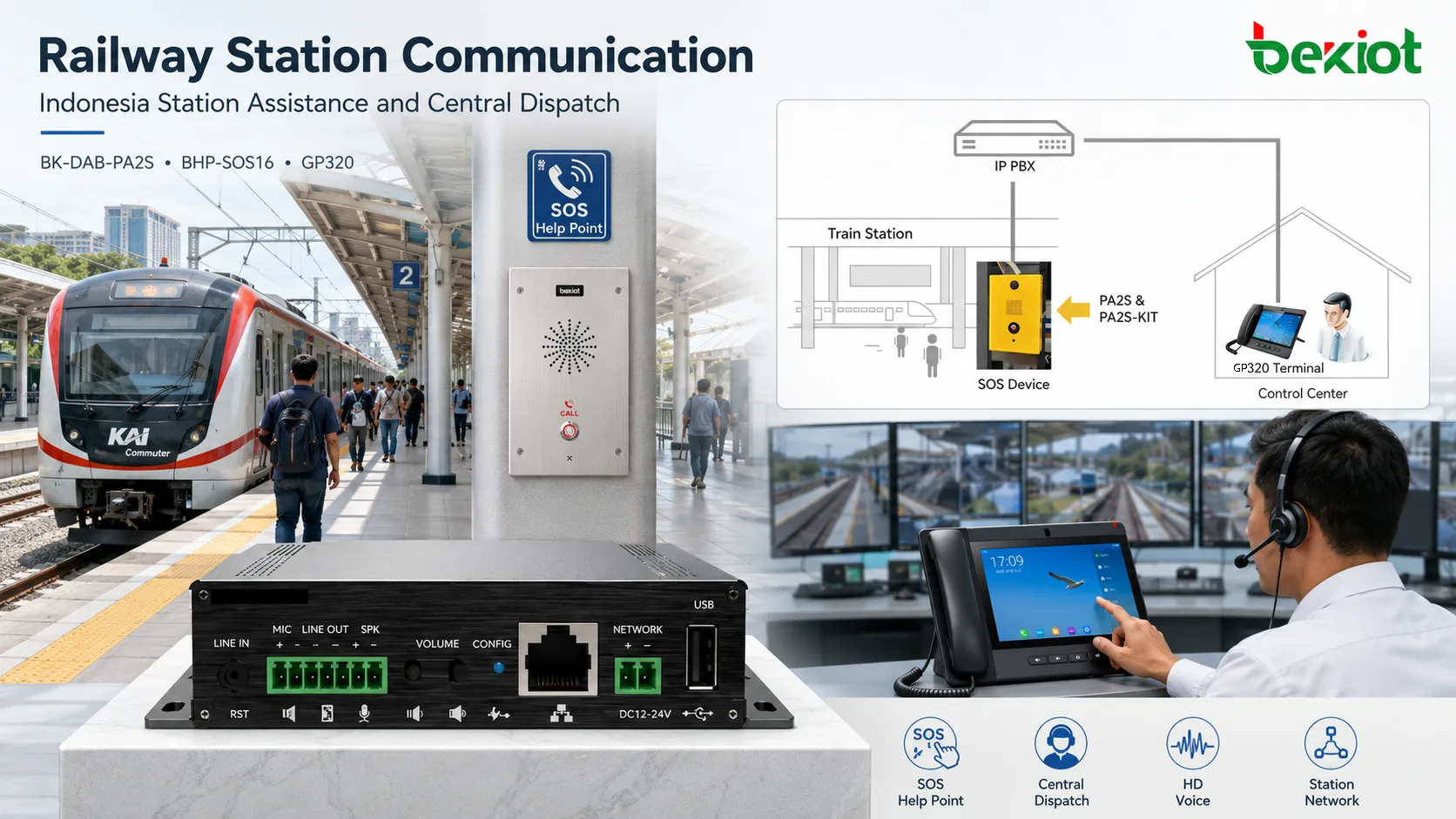
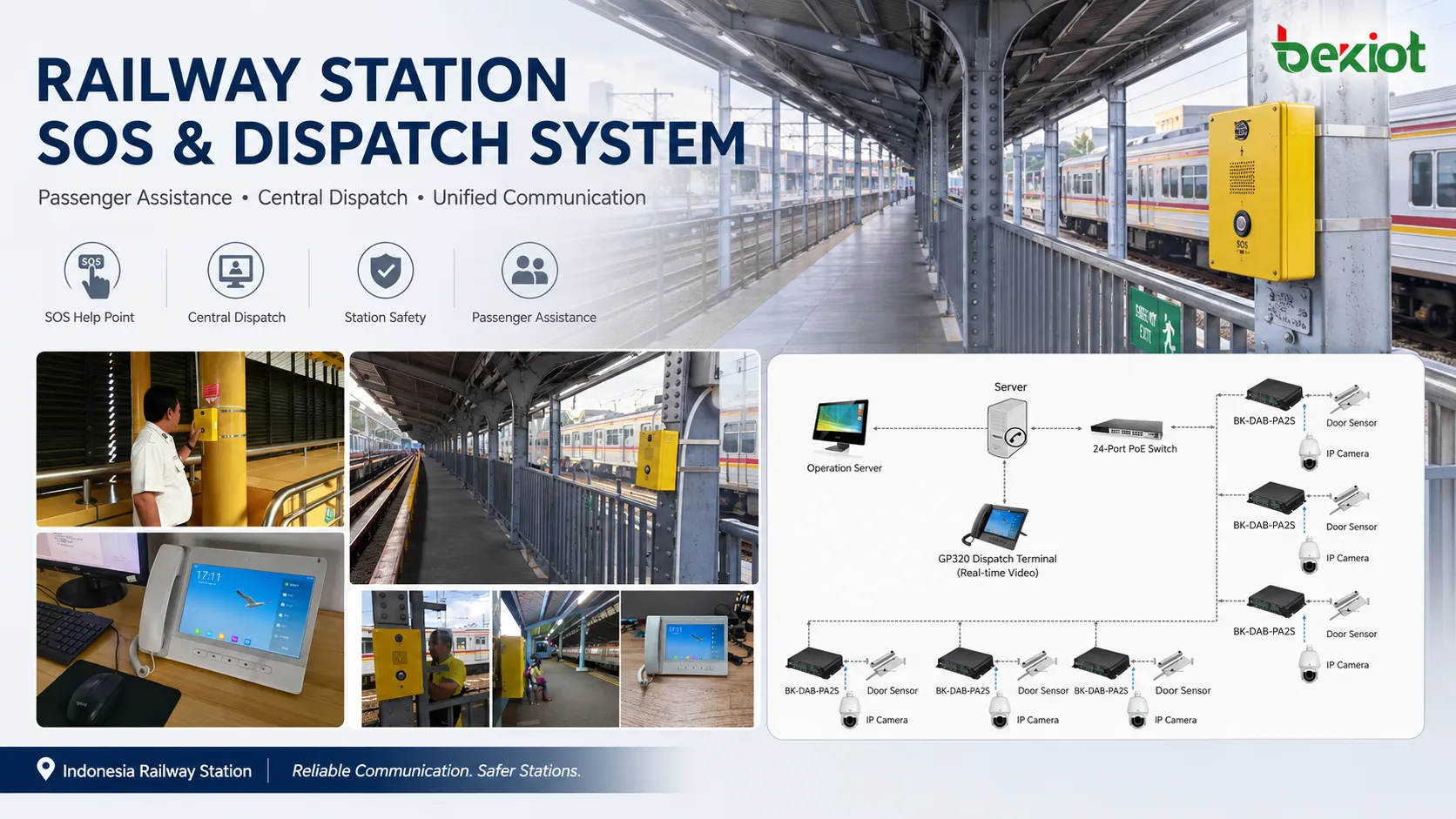
The deployment was built around a practical station service workflow. Passenger-facing SOS points were installed in station areas where help requests were likely to happen. These points created a fixed access channel from the public area to the monitoring center. When passengers needed support, they could press the button and speak with an operator directly.
BHP-SOS16 terminals were installed in public station zones and police office locations. In the station public area, they supported emergency reporting and staff-to-center communication. In the police office, they helped security staff maintain direct contact with the monitoring center or other station communication points.
The GP320 terminal was installed inside the monitoring center. Operators could receive calls, manage station intercom communication, and coordinate response actions. When a call came from a passenger SOS point or station intercom terminal, the operator could speak with the caller immediately and determine the next step.
A typical event may follow this process: a passenger needs help on the platform, presses the SOS call point, the BK-DAB-PA2S routes the call to the monitoring center, the GP320 operator answers, confirms the situation, and then contacts station staff or security personnel. If the event comes from a public area or police office, the BHP-SOS16 terminal provides another communication entrance into the same operational workflow.
This process reduces the gap between incident discovery and response. It also improves coordination because the monitoring center becomes the shared communication hub for passenger assistance, staff contact, and emergency dispatch.
In a railway station, response speed is affected by how quickly information reaches the right person. If passengers can only seek help by walking to a counter, waiting for patrol staff, or using personal mobile phones, the station may lose valuable time. A fixed SOS communication system creates a clearer and more dependable support channel.
Integrated communication also helps the monitoring center maintain better control. Operators can receive calls from multiple station points, identify the source of the call, communicate directly with the user, and coordinate staff response. This improves situational awareness and reduces repeated confirmation.
For passengers, the value is simple: help becomes easier to reach. For station staff, the value is operational: calls can be routed, answered, and handled through a defined system. For the railway operator, the value is managerial: communication records, device planning, and response workflows can be organized more consistently.
This type of system is especially useful for large commuter stations, transfer stations, elevated stations, remote platform areas, and railway networks with many distributed sites. It supports both daily service and urgent communication needs.
The three-device configuration was selected because each product solved a different layer of the station communication problem. BK-DAB-PA2S focused on passenger access. BHP-SOS16 focused on rugged station intercom. GP320 focused on monitoring-center operation. Together, they formed a more complete railway communication system.
| System Need | Device Used | How It Supports Railway Operation |
|---|---|---|
| Passenger help request | BK-DAB-PA2S | Creates a one-button SOS call point for passengers in station public areas |
| Public-area intercom | BHP-SOS16 | Supports SIP intercom, quick dialing, emergency calling, multicast, and station communication linkage |
| Security office communication | BHP-SOS16 | Gives station police or security staff a stable IP communication terminal for direct contact |
| Monitoring-center control | GP320 | Provides call answering, touch-screen operation, video call support, audio communication, and dispatch coordination |
| Event traceability | GP320 and platform integration | Supports call handling, communication records, and more structured incident response |
| Outdoor or public-area durability | BHP-SOS16 | Provides IP65 protection, IK10 impact resistance, aluminum housing, tamper switch, and PoE deployment |
Railway communication systems must be easy to maintain across many stations. With 79 stations in the KCI network, device configuration, troubleshooting, and network management cannot rely only on manual field work. SIP-based communication and IP network access make centralized management more practical.
BHP-SOS16 supports 10/100 Mbps Ethernet, IPv4/IPv6, static IP, DHCP, PPPoE, VPN options such as L2TP and OpenVPN, VLAN, HTTP API, Action URL, and Active URI. These features allow the terminal to be integrated into managed station networks and event linkage workflows.
GP320 adds monitoring-center flexibility with gigabit Ethernet, SIP over UDP/TCP/TLS, RTP/RTCP/SRTP, STUN, DHCP, 802.1x, VLAN, LLDP, QoS, primary and backup SIP server support, HTTP/HTTPS, and TR-069. This gives the operation team more options for network planning, provisioning, and remote management.
For a railway operator, this matters because the communication system should not become difficult to maintain after installation. Devices must be traceable, configurable, and supportable over time. When a station adds new points or changes a communication route, the system should allow expansion without redesigning the entire architecture.
A passenger assistance event usually begins with uncertainty. The passenger may not know the nearest service desk, may not speak clearly with nearby staff, or may face a situation where walking away from the platform is inconvenient. A BK-DAB-PA2S SOS point gives the passenger a direct and visible help entrance.
After the button is pressed, the monitoring-center operator can answer through the GP320 terminal. The passenger explains the issue, and the operator provides instructions or contacts staff. If needed, the operator can coordinate with station security through BHP-SOS16 communication points or other internal channels.
This reduces the need for passengers to search for staff and reduces the chance that an event remains unnoticed. It also helps station managers build a more controlled process for handling passenger requests.
Emergency reporting requires fast connection, clear voice, and predictable routing. BHP-SOS16 can support emergency call access and station intercom communication. Its quick dialing, SIP registration, full-duplex audio, AEC support, and rugged design make it suitable for public station areas and operational rooms.
When an emergency call is initiated from a platform, public area, or police office, the system routes the communication to the monitoring center. The GP320 operator receives the call and can start the response process. If the situation requires local staff, the operator can contact station personnel or security teams based on the station workflow.
The goal is to reduce the time between event occurrence, center awareness, and field response. In railway environments, this can improve safety management for passenger injuries, abnormal platform behavior, lost persons, equipment faults, and public-area disputes.
The monitoring center is the communication hub of the system. GP320 gives operators a dedicated terminal for calls, intercom handling, and dispatch communication. Its large touch screen and programmable functions make it more suitable than a standard desk phone when operators need to handle multiple station communication points.
With GP320, the operator can answer calls from SOS points, communicate with BHP-SOS16 terminals, and coordinate voice communication from one workstation. The support for HD voice, video calls, recording functions, call records, contacts, Wi-Fi, Bluetooth, and multicast gives the center more tools for daily operation and emergency response.
In large station networks, the monitoring center should not only receive calls. It should also understand the event context, coordinate resources, and keep communication organized. GP320 supports this role by combining SIP communication, visual operation, and dispatch-style handling.
After deployment, the station communication system became more direct and easier to operate. Passengers could use SOS points to request help, station staff could communicate through SIP intercom terminals, and monitoring-center operators could answer and manage calls through GP320.
The project improved passenger service efficiency. Instead of waiting for staff patrols or searching for a help desk, passengers could reach the monitoring center through fixed communication points. This allowed the operator to provide immediate voice guidance or dispatch staff more quickly.
The system also strengthened station safety management. BHP-SOS16 provided rugged and reliable intercom access in public and operational areas, while BK-DAB-PA2S SOS points created a passenger-facing emergency channel. GP320 helped centralize communication handling, making the monitoring center more effective during both daily service and urgent events.
From a management perspective, the system reduced communication fragmentation. SOS calls, public-area intercom, and monitoring-center dispatch were no longer separate isolated functions. The station gained a more unified communication workflow that could support passenger assistance, incident reporting, and staff coordination.
The first benefit was faster passenger response. A one-button SOS point allowed passengers to reach the monitoring center directly. This reduced the time needed to report an issue and made the help process more accessible in busy station areas.
The second benefit was clearer station communication. BHP-SOS16 provided a SIP-based intercom channel for station public areas and police offices. With support for full-duplex audio, AEC, and wideband codecs, communication clarity was improved compared with basic call devices.
The third benefit was better monitoring-center coordination. GP320 gave operators a more practical workstation for handling calls, viewing communication records, and coordinating station response. Its SIP lines, touch screen, HD voice, video support, and dispatch functions made it suitable for multi-point station communication.
The fourth benefit was easier system expansion. Because the system was built on IP and SIP communication, additional station points could be planned and added more flexibly. This is important for a railway operator with many stations and long route coverage.
The fifth benefit was stronger traceability. Calls and communication events can be managed more systematically when they are routed through dedicated communication devices and center terminals. This helps with incident review, service quality improvement, and long-term station management.
For railway projects with multiple stations, the communication design should begin with user scenarios rather than devices. The project team should identify where passengers are most likely to need help, where station staff need direct contact, and where the monitoring center needs faster awareness.
Passenger-facing SOS points should be installed in visible and accessible locations. Their housing should protect the equipment and make the call function obvious. Clear labeling, suitable installation height, and reliable audio pickup are important for public usability.
Public-area intercom terminals should be placed where staff or passengers may need urgent communication. For BHP-SOS16, PoE deployment, IP65 protection, IK10 impact resistance, tamper alarm, and SIP compatibility make it suitable for station public areas and operation rooms.
The monitoring center should be equipped with terminals that can handle communication volume and operational complexity. GP320 is useful where operators need more than a standard phone: touch-screen operation, SIP call management, audio clarity, video capability, and quick response functions.
Network planning is also important. Station communication devices should be assigned stable network access, proper VLAN or QoS policy, secure SIP registration, and clear device naming. This makes future troubleshooting easier and helps the system remain manageable as more stations and terminals are added.
This Indonesia railway communication project shows how Becke Telcom products can support passenger assistance, station intercom, and monitoring-center dispatch in one connected system. BK-DAB-PA2S provided the basis for customized SOS call points, BHP-SOS16 created rugged SIP intercom access in station public areas and police offices, and GP320 gave the monitoring center a more efficient dispatch communication terminal.
The value of the project was not limited to installing call devices. It created a practical communication workflow from passenger to monitoring center, from station staff to control room, and from emergency event to response coordination. For a railway network with many stations and high passenger traffic, this kind of integrated communication system can improve response speed, service reliability, and operational safety.
Becke Telcom focuses on industrial communication and integrated security communication solutions for demanding project environments. From railway SOS call points and SIP intercom terminals to dispatch consoles, public address, emergency communication, and platform integration, Becke Telcom helps transport, infrastructure, and public safety projects build more reliable field communication systems.