Fire safety in modern buildings is no longer defined by detection alone. In complex facilities such as commercial buildings, hospitals, campuses, transport hubs, industrial sites, hotels, and mixed-use developments, the real challenge is not simply identifying a fire event. It is turning that event into a fast, orderly, and coordinated response that protects people, reduces confusion, and supports emergency teams under pressure.
That is why an intelligent fire alarm and emergency evacuation solution should not be understood as a stand-alone fire panel with detectors and sounders. In practical deployment, it functions as a broader life safety system that combines early fire detection, audible and visual notification, voice-guided evacuation, building safety linkage, centralized monitoring, and structured command coordination. When emergency conferencing and trunked radio communication are also integrated, the system becomes more capable of supporting real-time decision-making and field response during critical incidents.
A modern solution brings together addressable fire detection devices, manual call points, fire alarm control panels, notification appliances, voice alarm and evacuation functions, public address linkage, emergency command workflows, mobile team coordination, and centralized management. Instead of treating detection, alarm, communication, and response as separate layers, the system connects them into one coordinated emergency process that helps operators detect faster, guide occupants more clearly, and manage incidents with greater control.
In smaller and simpler premises, a fire alarm may only need to alert occupants and notify responders. But in larger or more complex buildings, that approach quickly becomes insufficient. A high-rise tower, a hospital campus, a shopping complex, or a transport facility may contain multiple zones, different occupancy types, changing acoustic conditions, restricted areas, and varying evacuation priorities. A general alarm without clear guidance can create uncertainty, congestion, and unnecessary movement in areas not yet directly affected.
That is why modern fire alarm planning increasingly emphasizes not only detection, but also controlled notification and coordinated evacuation. Occupants need to understand what is happening and what they should do next. Operators need to know where the event originated, which systems have responded, and how to manage the next phase of communication and control. The solution must therefore support both immediate alarm signaling and a broader emergency response workflow.
Once a fire alarm is triggered, time becomes critical, but so does communication quality. Building managers, fire command personnel, security teams, maintenance staff, and mobile responders all need information at the same time. If the system can only sound alarms but cannot support guided messaging, internal conferencing, field-team dispatch, and response coordination, valuable minutes may be lost between detection and effective action.
This is where an integrated solution creates real value. Voice evacuation helps guide occupants calmly and clearly. Emergency conferencing helps command personnel align decisions quickly. Trunked radio integration helps mobile teams receive instructions without delay. Together, these functions turn a fire alarm event into a manageable and better-structured life safety response process.
An intelligent fire alarm solution does more than detect danger. It helps the building communicate, respond, and evacuate in an organized way when every minute matters.
An intelligent fire alarm and emergency evacuation solution is a life safety system designed to detect fire conditions early, notify occupants quickly, guide evacuation clearly, trigger linked safety actions, and support coordinated emergency response across one or more buildings. It typically includes smoke and heat detectors, manual call points, addressable fire alarm control panels, alarm sounders, strobes, voice alarm equipment, paging interfaces, event visualization, and system supervision functions.
In more advanced deployments, the solution can also integrate emergency command workflows, live message broadcasting, emergency conferencing, trunked radio coordination, and centralized monitoring across multi-zone or multi-building environments. This is particularly valuable in sites where life safety depends not only on alarm activation, but also on controlled movement, phased evacuation, and cross-team coordination during unfolding events.
When a detector, manual call point, or other initiating device reports a fire condition, the fire alarm control system identifies the location and begins the configured response sequence. Audible and visual notification devices alert occupants, while voice evacuation messages can deliver more specific instructions to selected zones or the entire facility. Depending on the building strategy, the system may support phased evacuation, delayed relocation of non-affected areas, or live announcements from the command position.
At the same time, the system can trigger linked safety actions such as smoke control, door release, HVAC shutdown, lift recall, or related protective measures. In a more integrated command environment, the event can also initiate emergency conferencing among command staff, notify mobile responders through the radio network, and present alarm, location, and status information through the central management platform. This helps decision-makers move quickly from alarm recognition to coordinated action.
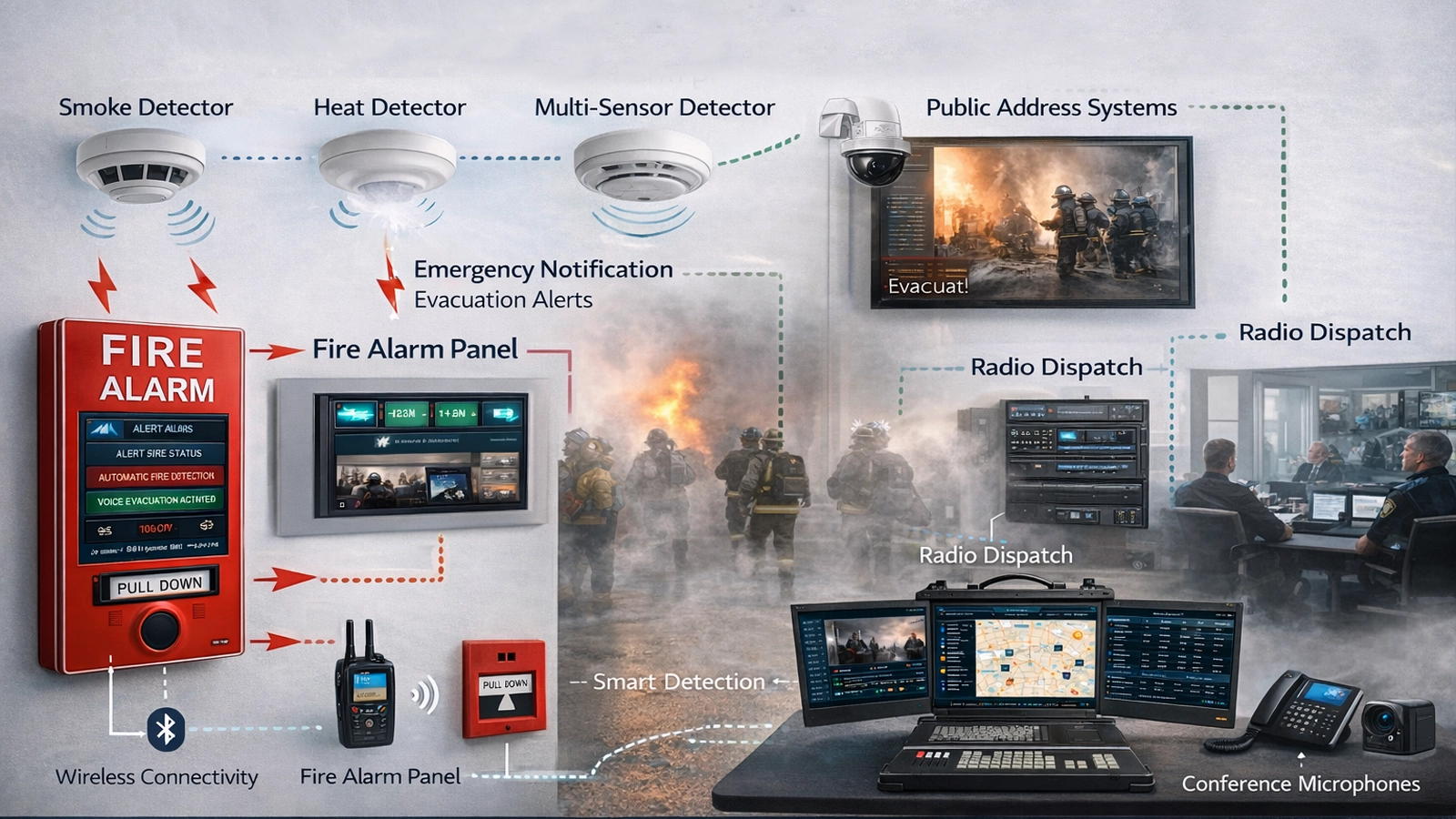
The first layer of the solution is responsible for recognizing fire-related conditions as early and as reliably as possible. Depending on the project, this may include smoke detectors, heat detectors, flame detectors, beam detectors, aspirating detection, and manual call points. In an intelligent addressable system, each device can be individually identified, which improves alarm localization, maintenance visibility, and event interpretation.
This addressable approach is especially important in larger buildings because operators need to know more than the fact that an alarm exists. They need to know where it started, which zone is affected, and how the alarm fits into the overall evacuation and safety strategy of the site.
Once a fire event is recognized, the system must notify people quickly and appropriately. This usually begins with audible and visual alarm appliances such as sounders, horn speakers, beacons, and strobes. In more advanced life safety strategies, voice alarm and emergency evacuation functions become a critical extension of this layer, because spoken instructions can provide clarity that tonal alarms alone cannot offer.
Voice evacuation allows the building to issue pre-recorded or live instructions to specific zones, floors, or the full site. This is particularly useful where phased evacuation is needed, where occupant movement must be controlled carefully, or where different building areas require different guidance based on risk and operational priorities.
The fire alarm control panel remains the operational center of the fire detection and signaling system. It receives initiating signals, manages notification logic, supervises connected circuits and devices, and maintains event records. Power supplies and backup batteries ensure that life safety functions remain available during primary power failure, while system supervision helps detect faults, line issues, and communication interruptions before they create risk during an emergency.
In networked environments, multiple panels may be connected to form a larger building or campus-wide architecture, giving operators a more complete view of the fire safety condition across the site.
Smoke, heat, flame, beam, and advanced detection devices
Manual call points for occupant-initiated alarm reporting
Addressable fire alarm control panels and networked control architecture
Audible and visual alarm appliances for occupant notification
Voice alarm and evacuation equipment for live and pre-recorded messaging
Supervised power supplies and battery backup for continuity
Graphical annunciation and event visualization tools
Interfaces for safety linkage, emergency communication, and central command
The first job of the system is to detect abnormal fire conditions as early as possible and translate them into actionable information. Intelligent detection helps reduce the time between fire development and alarm activation, while addressable device logic improves the operator’s ability to identify the exact source area. In practical operation, this supports faster confirmation, better response preparation, and more accurate evacuation decisions.
In facilities where false alarms can cause major disruption, the ability to manage alarm interpretation more intelligently is also a significant operational advantage. A stronger detection strategy does not only improve safety. It also improves confidence in the system’s day-to-day performance.
Traditional horns and strobes remain essential parts of life safety notification, but they do not always provide enough clarity in complex environments. Voice-guided evacuation helps solve this problem by delivering understandable instructions that can direct people to the correct exits, identify restricted zones, and support more orderly movement through the building.
For high-rise, healthcare, transport, education, and multi-occupancy sites, voice alarm is especially valuable because it supports phased or controlled evacuation rather than a simple undifferentiated alarm response. It also allows command personnel to adapt messages as the situation develops.
An intelligent fire alarm system should not function in isolation. Once a fire event is verified or reaches a defined stage, the system can initiate linked responses across related building safety functions. These may include smoke control activation, fire door release, HVAC shutdown, lift recall, shut-off control for specific hazards, and related protective actions that help contain risk and support evacuation.
This linkage is important because people do not evacuate through electronics alone. They move through real building conditions that must be made safer, clearer, and more controllable during an emergency. Automatic coordination between fire alarm and related building systems helps achieve that.
When a serious fire event affects multiple areas, the response quickly involves more than one person. Fire command staff, facility management, security supervisors, operations teams, and technical support personnel may all need to align decisions in real time. Emergency conferencing supports this by creating a direct communication bridge between key decision-makers without relying on fragmented individual calls.
In practical use, this function is valuable for confirming incident status, coordinating evacuation stages, assigning support tasks, and sharing updates as conditions change. Instead of passing information step by step, the system enables a faster common operating picture among those responsible for leading the response.
While the fire alarm system manages detection and evacuation logic, field response depends heavily on mobility. Fire wardens, security officers, maintenance teams, and site responders are often moving through the building or campus when an alarm occurs. Trunked radio integration allows these teams to receive instructions immediately, coordinate zone access, report status from the field, and stay connected with the command center during active response.
This function is particularly important for large estates, industrial facilities, transport infrastructure, campuses, and multi-building environments where fixed control room communication alone cannot support fast field coordination. By linking the life safety platform with the radio layer, the site creates a stronger connection between alarm intelligence and on-the-ground action.
In a real emergency, fragmented information increases risk. A centralized management platform helps by presenting alarms, zones, system status, linked actions, message flows, and event history in one operational view. Operators can see which devices have triggered, which zones are in alarm, which messages have been broadcast, and what safety actions have already been initiated.
This improves not only live response, but also post-event review. Event logs, recordings, acknowledgement history, and system records help building teams improve procedures, support audits, and strengthen long-term emergency preparedness.
A detector or manual call point reports a fire condition.
The addressable fire alarm system identifies the event location and initiates the programmed response logic.
Audible and visual devices alert occupants, while voice alarm messaging provides evacuation guidance.
Linked building safety actions such as smoke control, door release, or lift recall are activated as required.
Command personnel can open an emergency conference to align decisions and coordinate the response.
Mobile teams receive instructions through the trunked radio communication layer.
The central platform supervises, records, and displays all key actions and status updates.
Life safety response works best when fire detection, evacuation messaging, command discussion, and field communication are connected through one coordinated system instead of separate tools.
Voice alarm is one of the most important extensions of an intelligent fire alarm system because it bridges the gap between warning and action. Occupants do not just need to know that an alarm exists. They need to know whether to evacuate immediately, hold position, relocate horizontally, avoid a specific area, or follow updated instructions from the command team.
By integrating voice evacuation and public address capabilities, the solution supports both automatic and live emergency messaging. It can also continue to serve selected operational communication functions outside alarm conditions, which improves the overall value of the audio infrastructure across the building lifecycle.
Fire emergencies often require quick consultation among different roles. Security may need to confirm access control status. Facility engineers may need to verify smoke control or HVAC operation. Management may need to coordinate phased evacuation or external response support. Emergency conferencing helps bring these participants together without delaying the incident workflow.
Because conferencing is integrated into the wider emergency communication architecture, command-level coordination becomes more immediate and more structured. This is especially helpful in larger sites where multiple departments must act together under time pressure.
Once evacuation and response are underway, field teams need a dependable way to receive updates, confirm actions, and report changing conditions from affected areas. Trunked radio systems provide that mobility, and when integrated with the wider command structure, they support a more unified emergency response model.
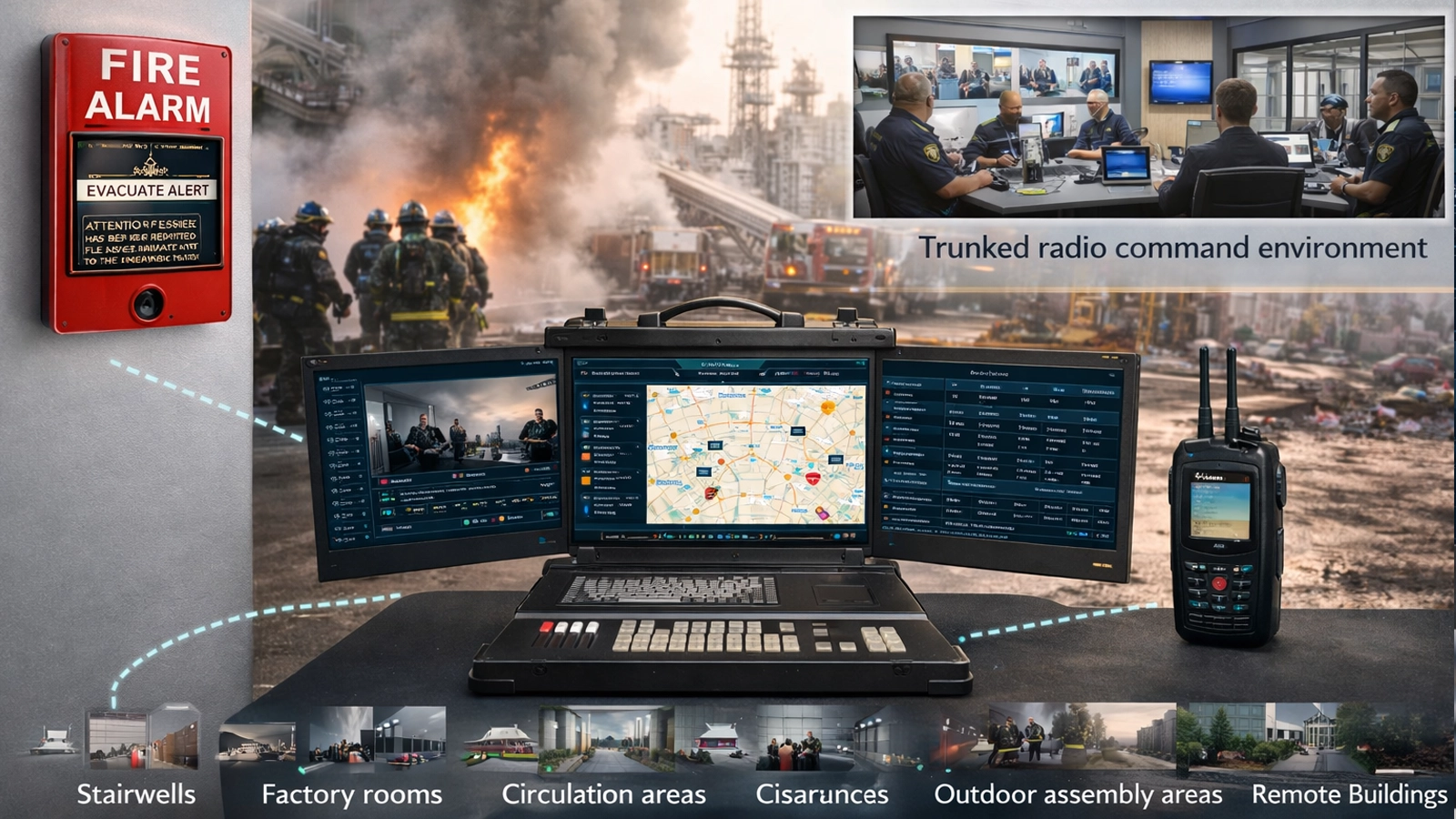
In this approach, the fire alarm system remains the trigger and life safety control core, while the radio layer strengthens command reach into stairwells, plant rooms, circulation areas, outdoor assembly zones, and remote buildings. Together, they help bridge the gap between the command position and the people actually moving through the emergency environment.
Office towers, shopping complexes, business parks, and mixed-use developments often combine different occupancy types, traffic patterns, and evacuation priorities in one site. These environments benefit from addressable fire alarm control, zoned voice messaging, and stronger command coordination because a single alarm event may affect tenants, visitors, security teams, and facility operations in different ways.
In these buildings, emergency conferencing and radio coordination also help maintain a faster and more organized flow of information between central control and distributed support teams.
Healthcare environments present additional complexity because evacuation is not always immediate or building-wide. Patients may require staged relocation, horizontal movement, or continued support during alarm conditions. This makes clear messaging, phased control, and technical coordination especially important.
An intelligent solution helps healthcare facilities combine detection, alarm signaling, guided messaging, and internal response coordination in a way that supports both life safety and clinical continuity.
Transport terminals, education campuses, government buildings, and public facilities often involve large populations, changing occupancy, and broad circulation areas. These sites benefit from networked fire alarm architectures, strong voice communication, and radio-supported field response because emergencies may affect multiple buildings or multiple response teams at the same time.
In these environments, centralized command visibility becomes especially important because operators need to understand the status of the whole site, not just one device or one floor.
Industrial and process facilities often require more than standard occupant notification. Noise, machinery, large footprints, outdoor areas, and mobile response teams make communication more difficult. Here, the integration of fire alarm, voice communication, emergency conferencing, and trunked radio coordination can provide a much stronger emergency response structure.
Instead of relying only on localized alarms, the site gains the ability to combine technical fire signaling with command-level communication and field-team direction across more challenging operational environments.
Commercial offices and mixed-use buildings
Hospitals and healthcare campuses
Schools, universities, and public institutions
Hotels, malls, and high-occupancy public spaces
Airports, stations, and transport infrastructure
Industrial plants, warehouses, and utilities
Multi-building campuses and large estates
Government and mission-critical facilities
The first benefit is speed, but not just in alarm activation. The real value lies in moving faster from detection to meaningful action. Intelligent detection identifies the source area quickly. Voice messaging provides understandable instructions. Linked safety controls improve building conditions. Together, these functions help reduce confusion and support a more orderly response.
For occupants, this means clearer guidance. For operators, it means better control over the emergency process from the first signal onward.
By integrating emergency conferencing and trunked radio communication, the solution extends beyond alarm signaling into coordinated incident management. Command staff can align decisions quickly, while mobile teams receive timely instructions and report back from the field. This is especially important in larger, noisier, or more distributed environments where fixed control room communication alone is not enough.
The result is a stronger connection between the life safety core of the system and the people responsible for acting on it.
Centralized monitoring, event history, message logs, and response records all help improve both real-time operations and post-incident learning. Facilities gain clearer oversight of alarm activity, system health, evacuation actions, and communication flow. Over time, this supports better maintenance, stronger preparedness, and more effective refinement of emergency procedures.
Earlier fire detection and more accurate event localization
Clearer occupant notification through combined alarm and voice messaging
Better support for phased and controlled evacuation strategies
Automatic linkage with related building safety functions
Faster command alignment through integrated emergency conferencing
Improved field response through trunked radio coordination
More complete operational visibility through centralized monitoring
Stronger event traceability for review, training, and system improvement
No two buildings share the same evacuation logic, occupancy pattern, or operational risk profile. A hospital, a hotel, a factory, and a transport hub will each require a different balance of detection coverage, message zoning, safety linkage, command workflows, and field communication. That is why an intelligent fire alarm and emergency evacuation solution should be designed around actual site conditions rather than treated as a standard equipment package.
For projects that need more than basic fire signaling, a broader life safety architecture can provide significant operational value. By combining intelligent fire alarm, voice evacuation, centralized control, emergency conferencing, and trunked radio coordination within one structured framework, Becke Telcom can support a more responsive and more manageable emergency communication environment for complex facilities and multi-zone sites.
An intelligent fire alarm and emergency evacuation solution should be understood as a full life safety response system rather than a stand-alone alarm installation. Its purpose is to detect fire conditions early, notify occupants clearly, support structured evacuation, activate linked safety measures, and help command teams coordinate effectively under pressure. When emergency conferencing and trunked radio coordination are added to this framework, the system becomes even more capable of supporting real-world emergency response.
By connecting fire detection, alarm notification, voice evacuation, safety linkage, centralized monitoring, command consultation, and mobile team communication, the solution creates a stronger bridge between technology and action. The result is a clearer, faster, and more resilient approach to protecting people and managing emergencies across modern buildings and complex sites.
An intelligent system does more than trigger a general alarm. It can identify device locations more precisely, support addressable control logic, integrate voice evacuation, link with other safety systems, and provide better visibility for operators during an emergency.
Voice evacuation provides spoken instructions that help occupants understand what to do, where to go, and which areas to avoid. This is especially useful in large or complex buildings where phased or controlled evacuation is required.
Emergency conferencing helps command staff, security personnel, facility engineers, and operations teams coordinate decisions quickly during a fire event. It supports faster consultation and helps maintain a common operating picture as conditions change.
Trunked radio integration helps mobile responders, fire wardens, security teams, and maintenance personnel receive instructions and report status in real time. This improves field coordination, especially in large, distributed, or operationally complex sites.
Yes. Depending on the project design and local requirements, the solution can interface with functions such as smoke control, fire door release, HVAC shutdown, lift recall, and other related safety actions.
It is especially suitable for commercial complexes, hospitals, campuses, transport hubs, public buildings, industrial facilities, and other multi-zone or high-occupancy environments where evacuation and emergency communication must be managed carefully.