
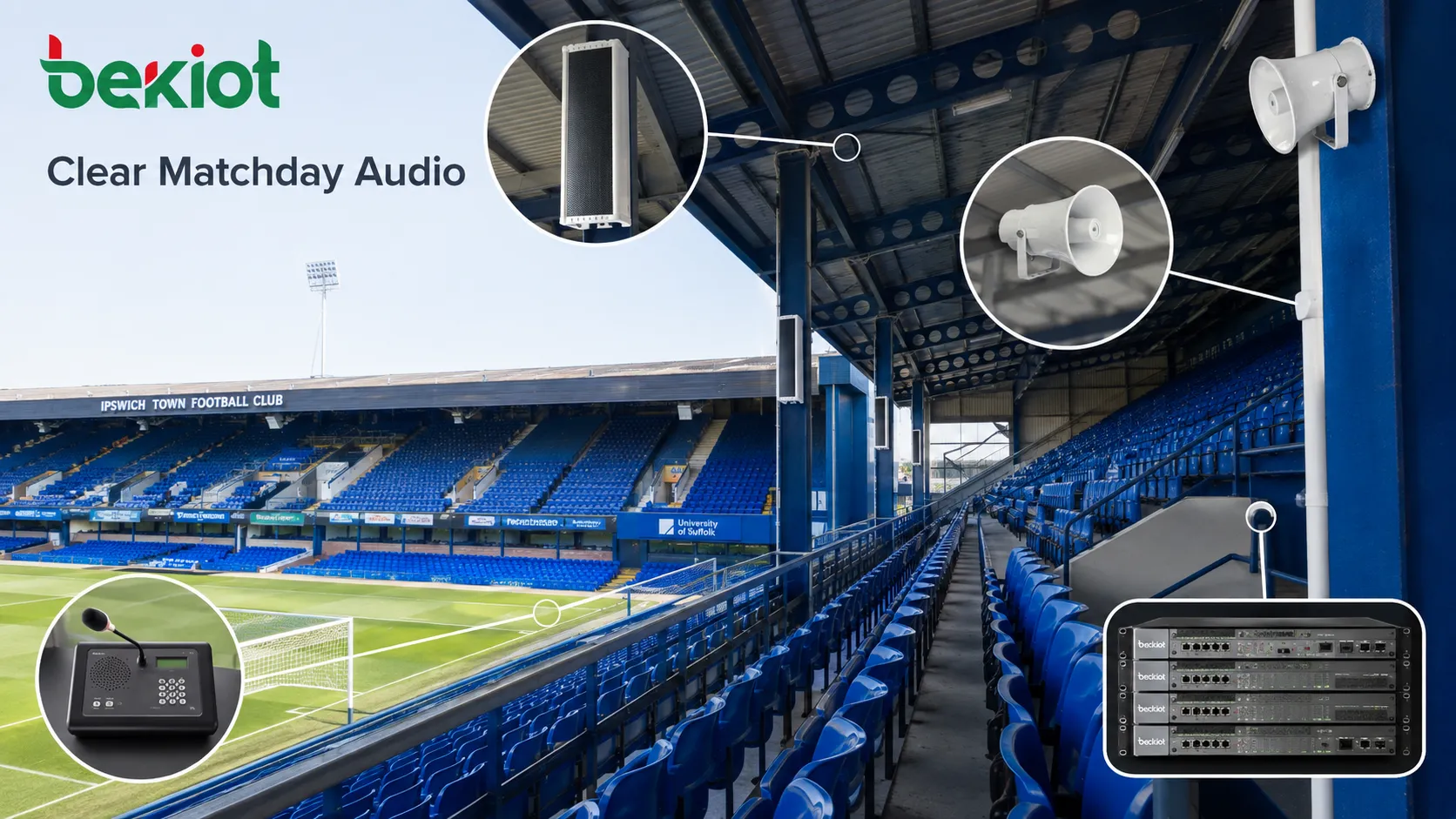
When the starting line-up is announced across the stands at Portman Road, even a small drop in clarity can quickly leave the message buried beneath the roar of the crowd. In a stadium welcoming tens of thousands of supporters on matchdays, the public address system is easy to overlook, yet it has a direct impact on the overall experience. Ipswich Town has now taken an unusually decisive step: rather than adding a few more loudspeakers, the club plans to invest around £1 million in rebuilding the stadium's PA system as a whole. Behind that figure lies a much broader piece of stadium audio engineering than simply making announcements louder.
The planned work at Portman Road is not a routine equipment replacement. Ipswich Town intends to renew the wider sound reinforcement infrastructure before the start of a future season, addressing elements ranging from cabling and signal distribution to amplification and system control. Club chairman and chief executive Mark Ashton explained on the club's TownTV platform that previous attempts to improve the system, including adding new speakers and making adjustments to existing equipment, had failed to solve the underlying problem. The cabling itself, he said, had become a significant issue.
Why Patch Repairs Stop Working
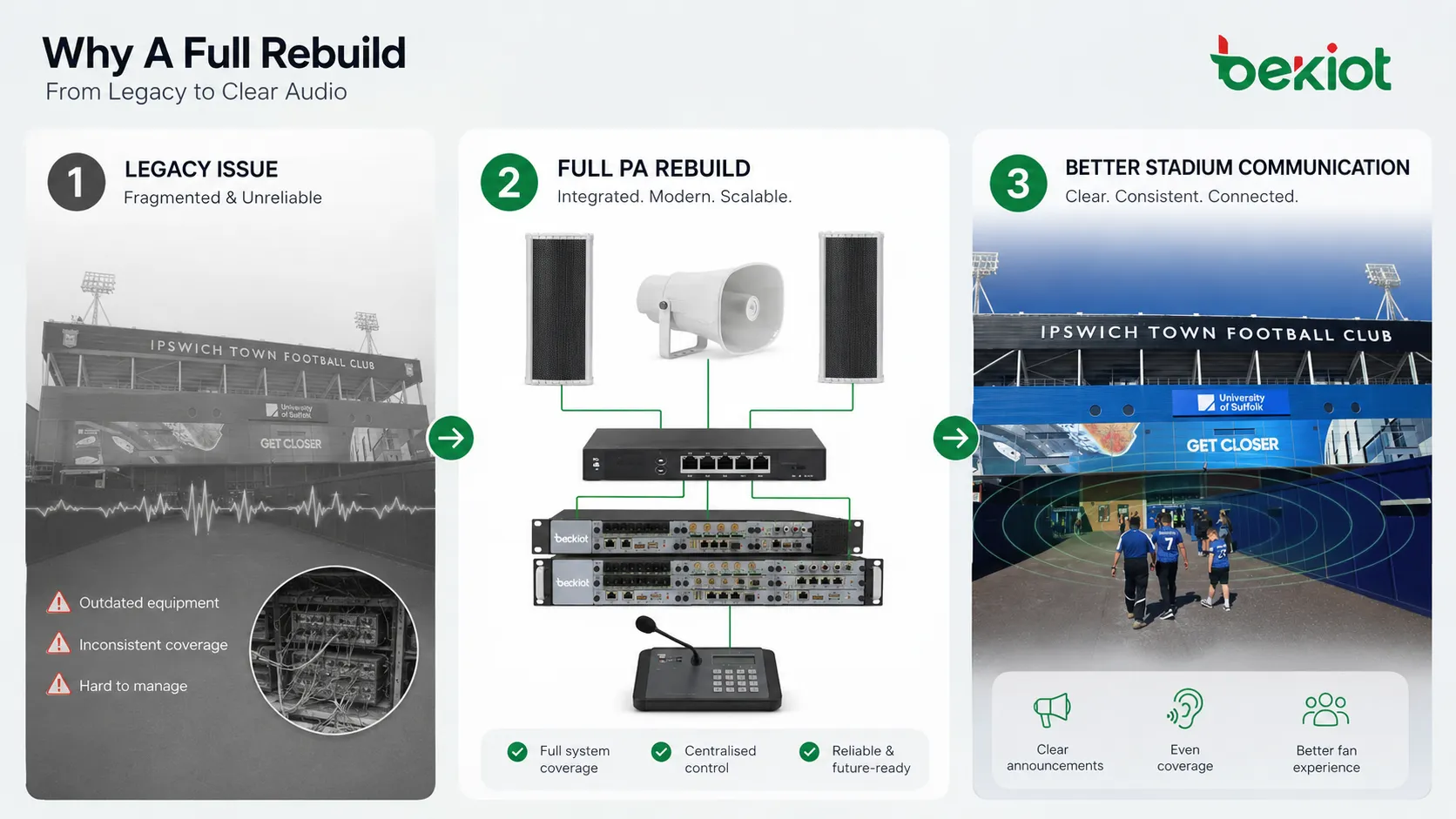
The longer a stadium PA system remains in service, the less effective isolated repairs can become. Loudspeakers are the most visible part of the system, but the audio path from a microphone to the final listening position also depends on cabling, signal distribution, amplifiers, control equipment and connections between different stands and stadium zones. Ageing or unreliable infrastructure anywhere along that chain can limit the benefit of replacing only the equipment at the end of it.
Portman Road appears to be a clear example. The club has already tried installing additional loudspeakers and making targeted adjustments, yet the underlying cabling continued to restrict performance. Continuing to add new equipment around an ageing architecture can also create a more complicated mix of old and new components, making maintenance harder rather than easier. That is one reason some older stadiums repeatedly invest in their PA systems without achieving consistent results: the visible speakers may not be the real problem at all.
Where Does £1 Million Go?
A large stadium audio system is not simply a collection of high-powered loudspeakers. Different stands, concourses and matchday areas have very different acoustic conditions. Equipment positioning, cable routing, signal distribution and commissioning all have to be planned around the stadium itself. The objective is not simply to increase volume, but to ensure that announcements remain stable and intelligible across a much wider area while reducing the operational risks associated with ageing infrastructure.
The budget for a complete stadium PA system can therefore extend well beyond the loudspeakers. Amplifiers, digital signal processors, control systems, cabling, containment, mounting structures and on-site tuning may all form part of the project. More speakers do not automatically produce better sound. Without suitable zoning and delay alignment, sound from different loudspeaker locations can arrive at listeners at different times, creating an echo-like effect that actually makes speech more difficult to understand. In that sense, the £1 million is paying not only for hardware, but also for acoustic planning, infrastructure renewal and system-wide commissioning.
Stadium Acoustics Are More Complex
It is easy to imagine stadium sound in the same way as an indoor sound system, but the two environments present very different challenges. A football stadium is an open or semi-open space without continuous walls and ceilings to provide predictable reflections. Tiered seating, roofs, barriers and different stand geometries all affect the way sound travels. Background noise can also change dramatically as supporters cheer, sing or use drums, while the PA system itself adds another layer of sound into the environment.
Designers therefore have to deliver sufficient coverage to distant seats without making nearby areas uncomfortably loud. This is where speech intelligibility becomes critical. In a space affected by crowd noise, reverberation and overlapping loudspeaker coverage, higher volume alone does not guarantee that supporters will understand an announcement. Modern stadium PA design therefore has to consider coverage, sound pressure level and measures such as the Speech Transmission Index (STI), rather than relying on output level alone.
Atmosphere and Safety in One System
The matchday experience begins long before kick-off. Background music, presenter announcements, team introductions, score updates and event information all contribute to the atmosphere inside the ground. If coverage is uneven or speech is difficult to understand, supporters in different stands can experience the same event very differently. A more consistent sound system gives the club much greater control over how information and entertainment are delivered throughout the stadium.
But a stadium PA system also has a more serious role: communicating safety information. When tens of thousands of people are arriving, moving through the stadium or leaving at the same time, announcements have to compete with crowd noise and the physical complexity of the building. During an incident, clear zoned announcements and emergency messaging can become an important part of crowd management and evacuation. The PA system is therefore not simply a tool for creating atmosphere. It is also part of the wider operational and safety infrastructure of the venue.
From Analogue Cabling to Networked Audio
For decades, stadium PA systems were commonly built around analogue signal paths, with large quantities of copper cabling carrying audio from control rooms to amplifiers and loudspeaker circuits throughout the venue. That approach worked well for many years, but as stadiums expanded and systems grew more complex, long cable runs, signal degradation, interference and maintenance became increasingly difficult to manage. The cabling problems identified at Portman Road illustrate the kind of challenge that can emerge as older infrastructure reaches the limits of its useful life.
New-build and major refurbishment projects are increasingly making use of networked audio architectures. Instead of carrying every audio signal as a dedicated analogue connection, audio can be transported as data across an IP-based network. The benefit is not simply fewer cables. Networked systems can also provide more flexible zoning, remote supervision, easier reconfiguration and improved fault monitoring. For a stadium where future stand alterations are already being considered, that flexibility can make subsequent changes easier to manage without rebuilding large sections of the audio infrastructure each time.
Designing for Future Redevelopment
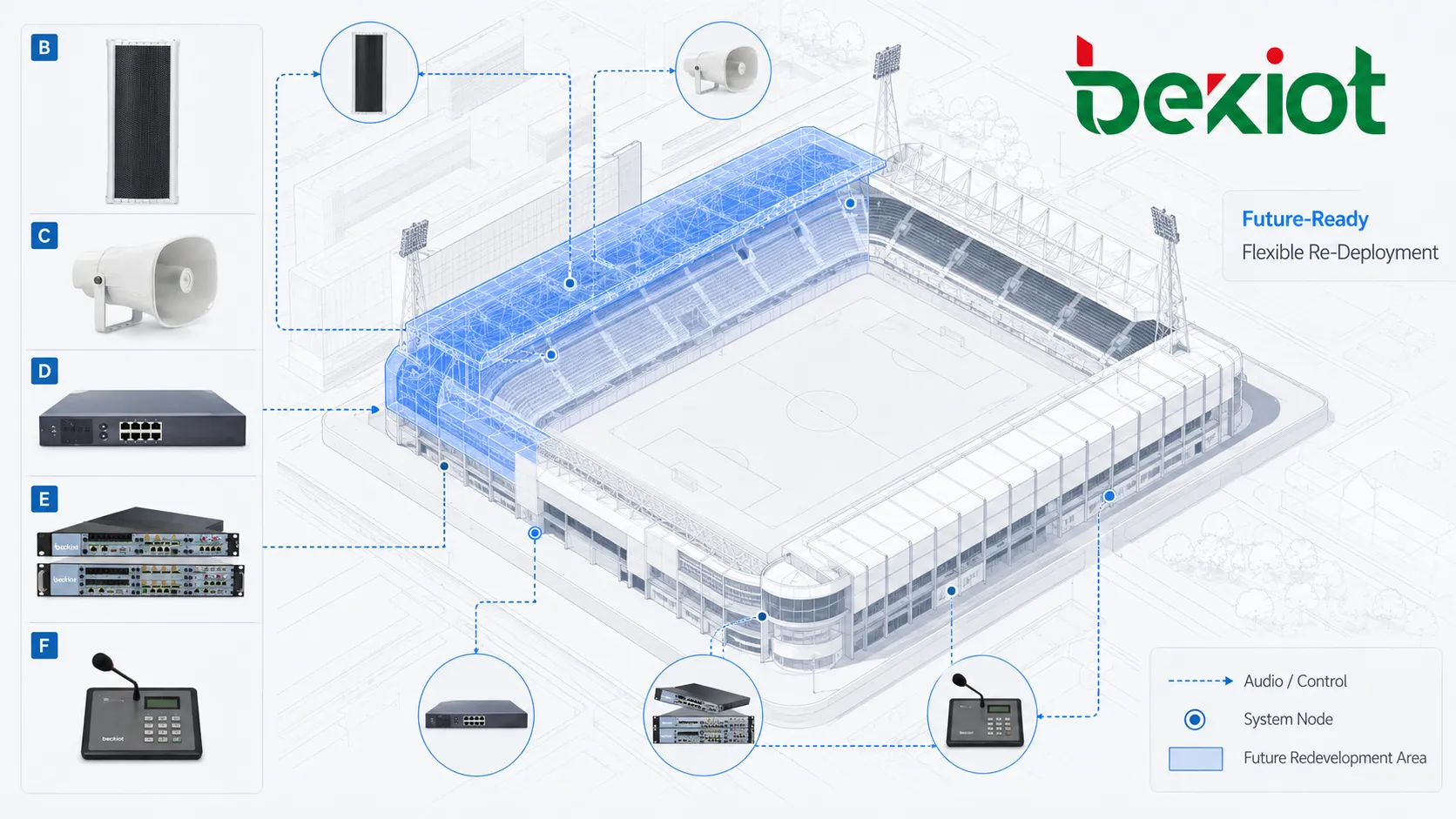
One particularly important aspect of Ipswich Town's plan is that the work is expected to take place during the summer, while also taking the possible future redevelopment of the Cobbold Stand into account. Ashton has previously described expansion of the stand as a medium- to long-term ambition, while the club has also reached an agreement in principle to acquire land behind the stadium. The new PA installation is therefore not being planned on the assumption that every component will remain permanently fixed in its first location.
Under the approach described by the club, equipment serving the Cobbold Stand could potentially be removed and reintegrated when redevelopment takes place. That modular thinking is particularly important for a stadium with future construction plans. If a newly installed PA system can only operate within the current building layout, a later redevelopment may force the club to replace expensive equipment again. Planning for relocation and reintegration from the beginning can help the present investment remain useful as the stadium evolves.
Major Upgrades Start Behind the Scenes
When supporters think about stadium redevelopment, attention naturally tends to focus on new stands, exterior architecture or hospitality facilities. Yet many of the systems that have the greatest impact on matchday operations remain largely invisible. Audio, drainage, lighting and network infrastructure all shape how reliably a modern stadium functions.
Ipswich Town's PA project reflects that reality. Previous targeted improvements at Portman Road did not deliver the required result, pushing the club towards a complete system renewal instead. An investment of around £1 million is substantial, but it is being directed at infrastructure expected to support matchday operations, supporter communication and stadium atmosphere for years to come.
If the work proceeds as planned during the summer, the new PA system will become an important part of the next phase of Portman Road's infrastructure development. The ability to relocate or reintegrate parts of the system when the Cobbold Stand eventually changes also means the project is more than a response to ageing equipment. It is being positioned as part of the stadium's longer-term development.
For most supporters, the result may feel surprisingly simple: announcements become easier to hear and understand. For the club, however, that improvement represents something much larger—a rebuilt communications infrastructure capable of supporting future seasons and adapting as the stadium itself changes. At Portman Road, one of the next major upgrades may begin with something supporters cannot see at all: the sound.
Planning a Stadium or Large-Venue PA Upgrade?
Becke Telcom provides professional communication, paging and public address solutions for stadiums, transport facilities, industrial sites and other large or complex environments. From IP-based audio distribution and paging to system integration and field communication, solutions can be configured around coverage requirements, operational workflows and future expansion plans.
If your existing PA infrastructure is becoming difficult to maintain, or you are planning a new stadium, venue expansion or system-wide audio upgrade, contact Becke Telcom to discuss a scalable communication and PA architecture tailored to the project.