


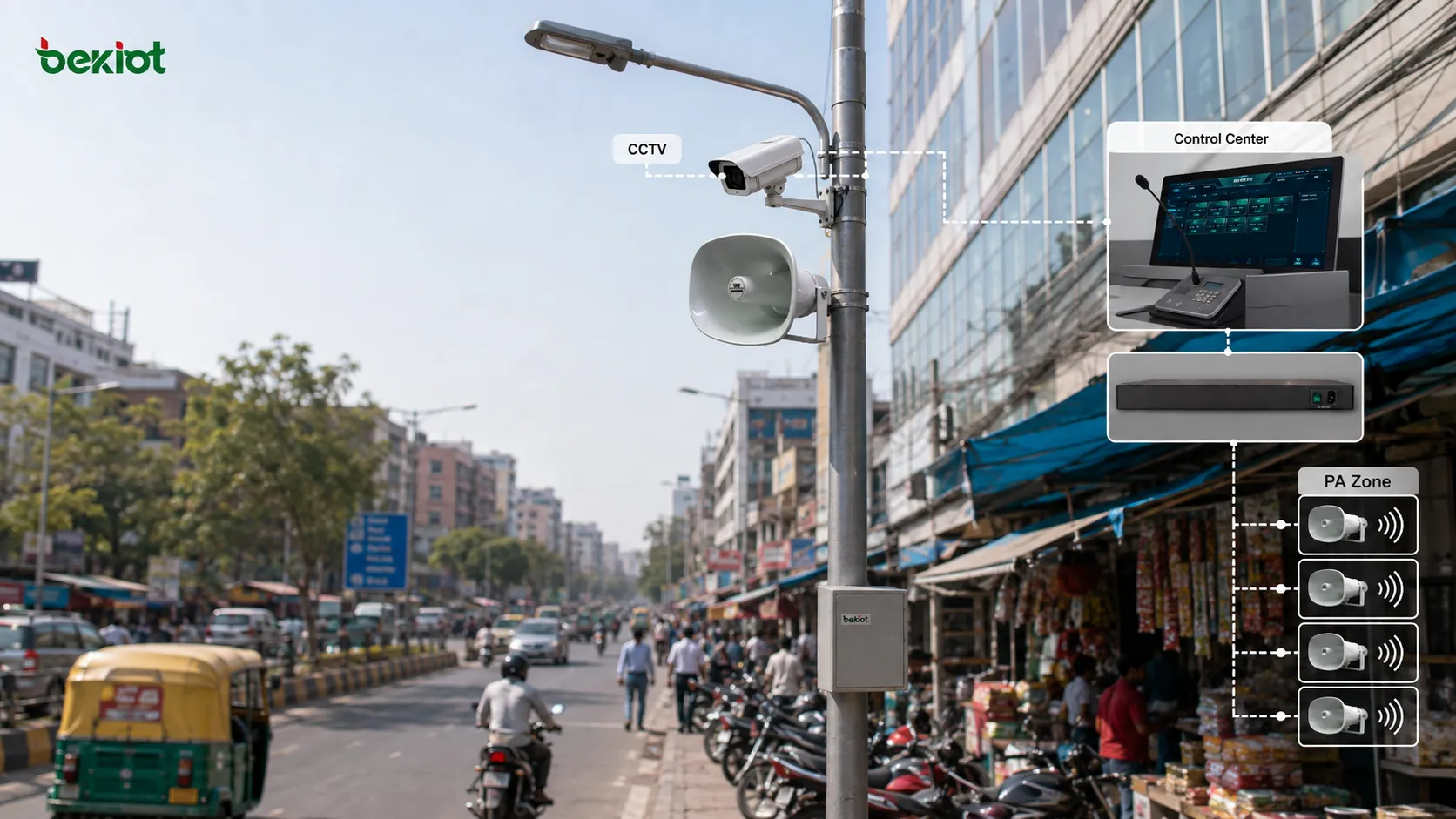
In August 2026, the Municipal Corporation of Gurugram (MCG) floated a tender worth about ₹99.1 lakh for the main road in Sector 46 and the adjoining market area. On paper, the scope looks straightforward: install CCTV cameras and deploy a public address system for announcements and music. The more interesting question is why a Smart Roads pilot would place video surveillance and public audio in the same infrastructure contract. The answer lies in what happens after a city detects a problem.
Project Area: Gurugram Sector 46 main road and adjoining market
Tender Value: ₹99.1 lakh
Core Systems: CCTV + Public Address System
Project Type: MCG Smart Roads pilot
According to the Hindustan Times, the tender covers the supply, installation, testing and commissioning of CCTV equipment and a sound system. MCG executive engineer Sachin Yadav described it as a pilot project intended to upgrade the road and the adjoining market. The CCTV cameras are planned for installation on smart streetlight poles, while the related smart-pole infrastructure is also being developed by MCG.
Taken together, those details reveal the logic behind the project. CCTV carries information from the street back to the management side, while the public address system sends instructions and information in the opposite direction, from the control side back to people on the street. One system listens and observes; the other communicates.
What Does This Tender Actually Change?
If Sector 46 were equipped with CCTV alone, city operators could certainly identify congestion, crowding, illegal parking or disorder around the market more quickly. But there would still be a gap between seeing a problem and influencing what happens next. Staff might need to contact traffic police, dispatch personnel to the site or rely on another communication channel to reach the public.
Adding a public address system shortens that chain. Once operators confirm what is happening, they gain a direct way to communicate with the affected road area. Temporary closures, construction changes, congestion at a market entrance or crowd-control instructions can be announced immediately to the relevant location instead of waiting for the message to be relayed through another party.
That is why the most important part of the tender is not simply that a few loudspeakers are being installed next to CCTV cameras. The road is being given both situational awareness and on-site communication. A road that previously could only be monitored can now, at least in principle, communicate back.
The tender also specifically mentions public announcements and music. Music represents the routine, low-priority use of the infrastructure, while public information is where the harder operational value lies. Both functions can share the same platform, meaning a roadside PA system does not need to operate as a constant announcement channel. It can support everyday audio and switch to priority messaging when conditions require it.
Why Does Public Address Matter Beyond More Cameras?
Smart Roads are not meant to be a contest in how many cameras can be installed. MCG's wider road-upgrade programme also covers roadway infrastructure, pedestrian and cycling facilities, drainage, lighting, streetscape improvements and traffic management, with broader goals around safety and congestion reduction. Within that framework, public address becomes a real-time communication interface between the road-management system and the public.
Consider a simple example. A camera can show that a crowd is building in one area, but it cannot tell people which direction to move. Traffic monitoring can reveal that vehicles are queuing, but it cannot directly warn drivers further back that a temporary restriction lies ahead. Variable message signs and smartphone notifications can help, but they both depend on people looking at the relevant screen.
Public address works differently. Anyone already within the road, market entrance or public area can potentially receive the message without opening an app or checking a display. In incidents, temporary traffic management or crowd-control situations, that gives a PA system an important active-reach capability that visual channels alone cannot fully replace.
For the same reason, the value of roadside PA should not be measured by loudspeaker count. The more important questions are which areas need coverage, which areas should operate as separate zones, whether speech remains intelligible above traffic noise, and whether operators can select the right broadcast area within seconds. Those factors determine whether the system is actually useful when conditions become time-sensitive.
Zoning is particularly important. If every loudspeaker along a road broadcasts every message, large numbers of people may repeatedly hear announcements that have nothing to do with their location. If the system is divided into too many small zones, however, operators may struggle to select the correct one under pressure. Smart-road PA design therefore has to balance acoustic coverage with the way city operators actually manage incidents.
What Can the Sector 46 Pilot Tell Us?
Sector 46 is not an isolated road project. MCG accelerated its model-road programme during 2026, with plans covering about 124.42 km of roads. By March, around 20.6 km had already entered construction, while roughly 70% of the identified projects were still at the planning stage, leaving more road sections likely to move into tendering and implementation.
That makes Sector 46 useful as a test case. It can help show how the equipment should be positioned, how installation should be carried out and how the combined system should be operated. If CCTV and PA prove useful together, the next question will not simply be whether another road should receive public-address coverage. It will be how dozens of roadside audio endpoints can be managed as part of one broader operational environment.
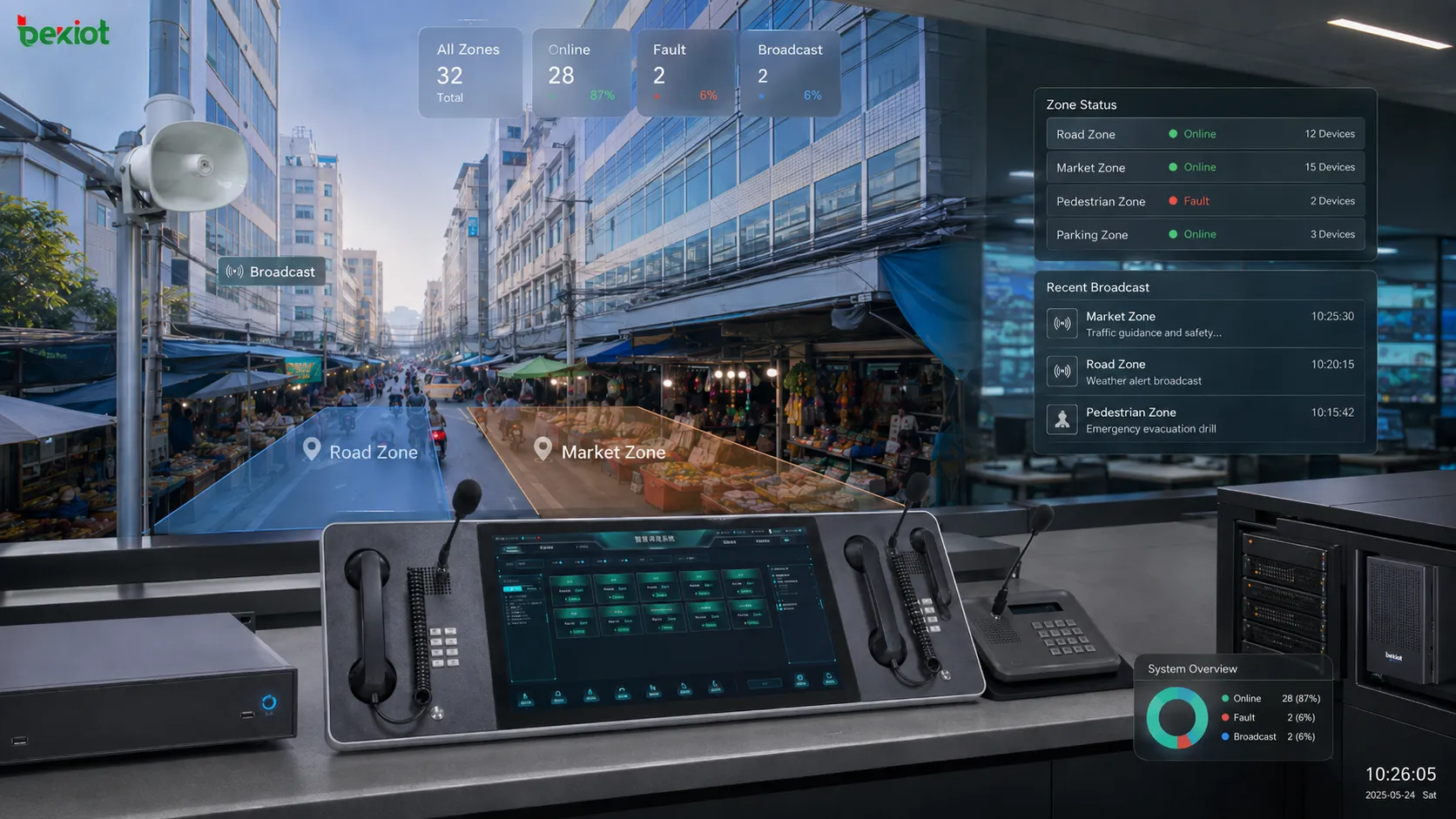
Once deployment grows, the requirements change quickly. A control center needs to know which loudspeakers are online, which zones have faults, who is authorized to broadcast to which roads, when an announcement was issued, how long it lasted and which areas received it. Without centralized status monitoring and broadcast records, adding more equipment can actually make the system harder to manage.
Smart streetlight poles are another important part of the discussion. The Sector 46 plan explicitly places CCTV cameras on smart poles, allowing lighting, surveillance, network connectivity and potentially other roadside devices to share infrastructure. Public address endpoints can also take advantage of street furniture, but they should not simply follow camera-placement rules.
Cameras need a good field of view. Loudspeakers need an effective sound field. Mounting height, orientation, road width, reflections from nearby buildings, traffic noise and the sound environment around a market all affect speech intelligibility. A pole may be physically capable of carrying a loudspeaker without being the best acoustic location for one. Shared infrastructure is convenient, but it is not a substitute for proper audio design.
The Long-Term Value Is in Closing the Loop
The ₹99.1 lakh Sector 46 tender is worth examining because it points to a broader issue in smart-city development. Cities are deploying more and more sensing equipment, but detecting an event is only half of the operational problem. The other half is getting the right information back to the people who are actually on site.
CCTV answers the question what is happening on the road? Public address answers what should people at the scene do now? The two systems are not duplicating each other. They occupy opposite ends of the same incident-management chain: one provides input, while the other provides output.
There is, however, an important limit to what can be concluded from the published project details. The available information does not say that Sector 46 will use automated video analytics to trigger announcements, nor does it confirm a unified CCTV-and-PA control platform. It would therefore be inaccurate to describe the pilot as a fully automated smart-road system. In practice, operator-confirmed zoned announcements may be more appropriate for many complex road incidents anyway.
From a technology-development perspective, however, the pilot does establish the basic ingredients for a closed operational loop. Whether future broadcasts remain manually triggered or are eventually connected to an event-management platform, CCTV, roadside PA, smart poles and the control center could be brought into a shorter and more coordinated information chain.
That is the longer-term value of roadside public address. It is not merely background music along a city street, and it is not just an isolated sound-reinforcement project. Once it is connected with traffic monitoring, road management and city operations, PA becomes a communication outlet through which the management system can reach the public on the ground. That is the most significant reason CCTV and public address belong in the same Smart Roads conversation.
FAQ
Does smart-road public address have to be automatically linked to CCTV?
No. Many projects can use operator verification before a zoned announcement is made, which may be more appropriate for complex road conditions. Whether automation is suitable depends on the event type, the risk of false alarms and the operational workflow rather than on automation for its own sake.
Can roadside loudspeakers simply be installed on every smart streetlight pole?
Not based on pole location alone. Designers still need to consider mounting height, orientation, road width, traffic noise, power and network availability, structural loading and actual speech coverage. Shared poles are useful infrastructure, but they do not replace acoustic planning.
How is a city-road PA system different from a commercial background music system?
Roadside PA places greater emphasis on public-information delivery, zoning, remote operation, outdoor environmental resistance and speech intelligibility. Commercial background music systems are generally more focused on continuous playback and overall listening experience. Some hardware may overlap, but the design priorities are different.
What becomes difficult when roadside PA is deployed at large scale?
As the number of endpoints grows, common problems include undetected offline devices, incorrect zone selection, unclear permissions and slow fault diagnosis. Centralized health monitoring, broadcast logs and role-based access therefore become increasingly important as deployments expand.







