
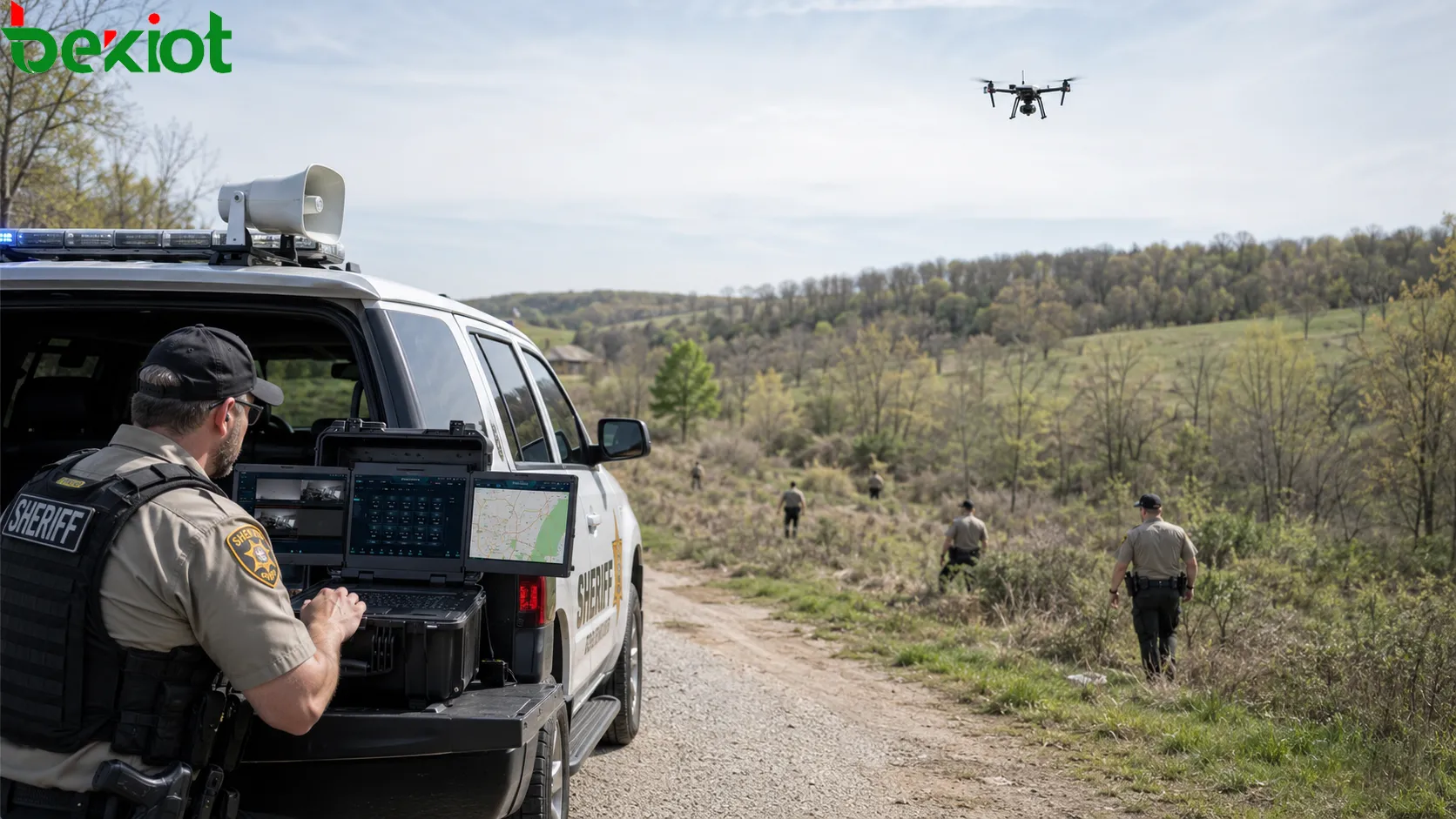
A rural manhunt in Missouri took an unexpected turn when a patrol vehicle's public address system helped officers bring a difficult search to an end. According to the Howell County Sheriff's Office, deputies were searching the Peace Valley area on the morning of August 7 for a wanted man whose exact location remained unknown despite a ground search, drone reconnaissance and information gathered at the scene.
Instead of relying only on officers continuing to narrow the search area, one lieutenant used the patrol vehicle's PA system to broadcast warnings across the surrounding area. He then imitated the sound of a police K9, giving the man in hiding the impression that a dog team was closing in. The tactic worked. The wanted man eventually emerged from a brush-covered area and surrendered to nearby deputies.
The incident attracted attention because of the unusual K9 imitation, but it also illustrates a broader point about field communication. A PA system is not simply a loudspeaker used to make a voice louder. In police operations, emergency response and other time-sensitive situations, it can provide a direct way to communicate with people whose exact location or communication device may be unknown.
That capability is not limited to law enforcement. Similar public address systems are used for emergency evacuation, industrial site management, transportation operations, community warning and large public facilities where information may need to reach an entire area rather than a specific individual.
How a K9 Imitation Changed the Direction of the Search
At approximately 6:30 a.m., deputies received information about the possible location of Brad Freiman, who was wanted on an active arrest warrant related to possession of a controlled substance.
Officers responded to County Road 3490 near Peace Valley. They found a vehicle along the roadway and made contact with Russell Killion, described by authorities as a known associate of Freiman. Killion told deputies that he did not know where Freiman was. Officers believed Freiman may have already left the area on foot, so the search expanded into the surrounding rural terrain.
Deputies searched on foot while also using a drone to look for signs of movement. During the operation, officers received another piece of information. An anonymous caller claimed that Freiman had just been seen at a gas station in Pomona.
Acting immediately on that report could have drawn personnel away from the area they were already searching. Lieutenant Smith, however, suspected that the call might have been intended to misdirect the operation. Officers therefore stayed focused on the existing search area rather than abandoning it for the new lead.
With no direct visual contact and no confirmed hiding location, Smith turned to the patrol vehicle's PA system. He warned Freiman that a K9 unit was at the scene and that remaining hidden could result in a police dog being sent into the area.
To make the warning more convincing, Smith began barking over the PA system, simulating the presence of an approaching K9. The tactic had the intended effect. Freiman emerged from a concealed position in a brush-covered field and surrendered to deputies. Authorities said he later indicated that he did not want to be bitten by a police dog.
Why PA Communication Still Works When the Exact Location Is Unknown
From a communications perspective, one of the most interesting aspects of the incident is that officers did not know exactly where Freiman was hiding. That uncertainty did not prevent them from delivering a message to him.
Telephone calls, text messages and most mobile data communications require a known device, account or destination. Public address communication works differently. It is area-based rather than device-based. If a person is within the effective acoustic coverage of the system, the message can reach that person without the operator knowing what phone, radio or other communication equipment they may be carrying.
This is one reason PA systems remain valuable in searches, evacuations, perimeter control, emergency incidents and large-site operations. In many situations, responders cannot identify the precise location or communication method of every person they need to reach.
That limitation becomes even more important when people are moving, hiding, injured, disoriented or unable to answer a call. A broadcast does not require the recipient to accept a connection, press a button or respond to an incoming message. If the sound reaches the area, the information can still be heard.
In practical terms, a PA system is not designed primarily to "connect to a person." Its purpose is to communicate with an area. That distinction matters when commanders need everyone nearby to evacuate, when officers need a concealed person to hear instructions, or when emergency personnel need crowds to move away from a hazard.

More Than a Loudspeaker: The Role of PA Systems in Field Command
Focusing only on the unusual sound effect risks missing what actually made the tactic effective. The outcome depended on several decisions working together.
Officers did not immediately abandon their original assessment when a new phone tip came in. They compared the information with what they had already observed at the scene and recognized that the new report might conflict with the existing evidence.
They then selected a communication method that did not require them to identify Freiman's exact position. The announcement itself was also action-oriented. It linked the decision to remain hidden with the possibility of a K9 search, changing the way the wanted man assessed the risk of continuing to stay concealed.
For field communication systems, sound pressure level is only one part of performance. A message must also be intelligible, timely and delivered in a way that fits the situation. The same principle applies to vehicle-mounted PA systems, emergency intercoms, radio networks and dispatch platforms.
Equipment rarely produces an operational result by itself. The result comes from how people combine communication tools with situational awareness, command decisions and field procedures.
Modern PA systems can also extend far beyond a microphone connected to a horn speaker. In an IP-based environment, PA equipment may be integrated with dispatch platforms, SIP communication systems, alarm systems and other field devices to support remote paging, zone-based announcements and centralized control.
The value of integration is not simply having more equipment connected to the network. Different communication tools serve different purposes. A dispatch center may coordinate multiple teams, mobile radio may keep officers or field personnel in direct contact, and PA terminals may deliver instructions to people across an area where individual connections cannot be established.
When those functions are designed around the actual operational workflow, they create a more complete field communication chain.
Public Address Systems Are Expanding Beyond Traditional Emergency Use
Public address systems are often associated with routine announcements, warning tones and evacuation messages. Real-time voice communication, however, remains important when conditions are changing too quickly for prerecorded messages to cover every situation.
An operator can adjust instructions immediately as a search area changes, a road is closed, a section of a facility is evacuated or a new hazard is identified. That flexibility gives live paging an important role alongside automated warning systems.
For police departments, fire services, industrial sites, transportation hubs and large public facilities, the design question is therefore not limited to whether a system can produce enough volume. Speech intelligibility, acoustic coverage, ease of operation and availability under difficult conditions are equally important.
The same communication logic can be found in schools, industrial campuses, railway stations, airports, residential communities and large public events. Whenever one message must reach an uncertain group of people in a defined area quickly, public address remains one of the most direct communication methods available.
This is also why PA technology is increasingly being integrated into broader day-to-day management systems rather than being reserved only for police or fire emergencies. A well-designed system may handle routine announcements during normal operations and then switch immediately to emergency paging when conditions change.
In smart campuses, industrial facilities and city emergency communication systems, this dual-purpose role helps PA equipment serve as the final communication link between a command center and people in the field.

The Larger Lesson: Technology Matters, but Judgment Matters More
The investigation continued after Freiman was taken into custody. Authorities later examined the anonymous call claiming that he had been seen at the Pomona gas station.
Investigators said they determined that the caller was Russell Killion, the same associate officers had spoken with earlier near County Road 3490. On August 12, Killion was arrested in Peace Valley on a warrant related to hindering the prosecution of a felony.
Howell County Sheriff Matt Roberts later praised the officers involved, emphasizing that they recognized when information did not appear consistent with the situation and stayed focused on the original objective.
The broader value of the incident is therefore not that barking through a PA system should become a standard law-enforcement tactic. What matters is how officers combined available information, field conditions and communication tools to make a decision.
The PA system was one part of the response. Knowing when to use it, what message to deliver and what effect that message was intended to produce depended on human judgment.
The same lesson applies to emergency communication system design. Technology should support the people using it. Advanced functions have limited value if operators cannot access them quickly or if the system does not match real operational conditions.
Conversely, even a relatively straightforward PA system can become highly effective when it is reliable, easy to operate and used as part of a clear command strategy.
FAQ
Are PA systems and sirens usually part of the same equipment package in emergency vehicles?
It depends on the vehicle configuration. Many police, fire and emergency vehicles combine a microphone, amplifier, external speaker and siren controls within the same vehicle audio system. Other installations use separate PA and warning equipment. The final configuration depends on vehicle type, operational requirements and the equipment selected.
Can a vehicle-mounted PA system operate without cellular service?
A conventional local PA system normally consists of a vehicle power supply, microphone, amplifier and external loudspeaker, so basic voice announcements do not require a cellular network. Features such as remote dispatch control, IP paging or wide-area network integration may require a working data connection.
Why is loudspeaker power alone not enough when specifying an outdoor PA system?
Output power is only one part of system performance. Outdoor deployment also depends on background noise, loudspeaker directivity, mounting position, coverage distance and speech intelligibility. A system may be loud but still ineffective if listeners cannot clearly understand the message.
Can a PA system be integrated with a dispatch platform for wider emergency and daily operations?
Yes, depending on the available interfaces and system architecture. Modern PA systems can connect with dispatch platforms and other communication systems through analog audio, SIP, RoIP gateways or IP-based interfaces to support remote announcements, zone paging and centralized control.
Similar architectures can be used in schools, industrial campuses, transportation hubs and community emergency systems. Protocol compatibility, network conditions, user permissions and failover requirements should be verified during system design and commissioning.