


The MAB82 SDR MANET Airborne Module is a compact broadband wireless networking unit designed for UAVs, robotic platforms, unmanned systems, mobile ground stations and other applications that require rapidly deployable wireless IP connectivity.
The MAB82-36 module is based on a software-defined radio architecture and decentralized multi-hop networking technology. Compatible nodes can establish a wireless network without relying on a fixed central base station, while each node can participate in routing and relay transmission.
Once deployed, multiple MAB82-36 nodes can establish a multi-hop network within seconds. As UAVs, ground vehicles, robots or field teams change position, the network can dynamically adjust available communication paths to maintain voice, data, video and positioning transmission across the operating area.
Its compact enclosure, 24 V power supply and multiple communication interfaces make MAB82 suitable for integration into airborne and mobile platforms where size, weight and networking flexibility are important considerations.
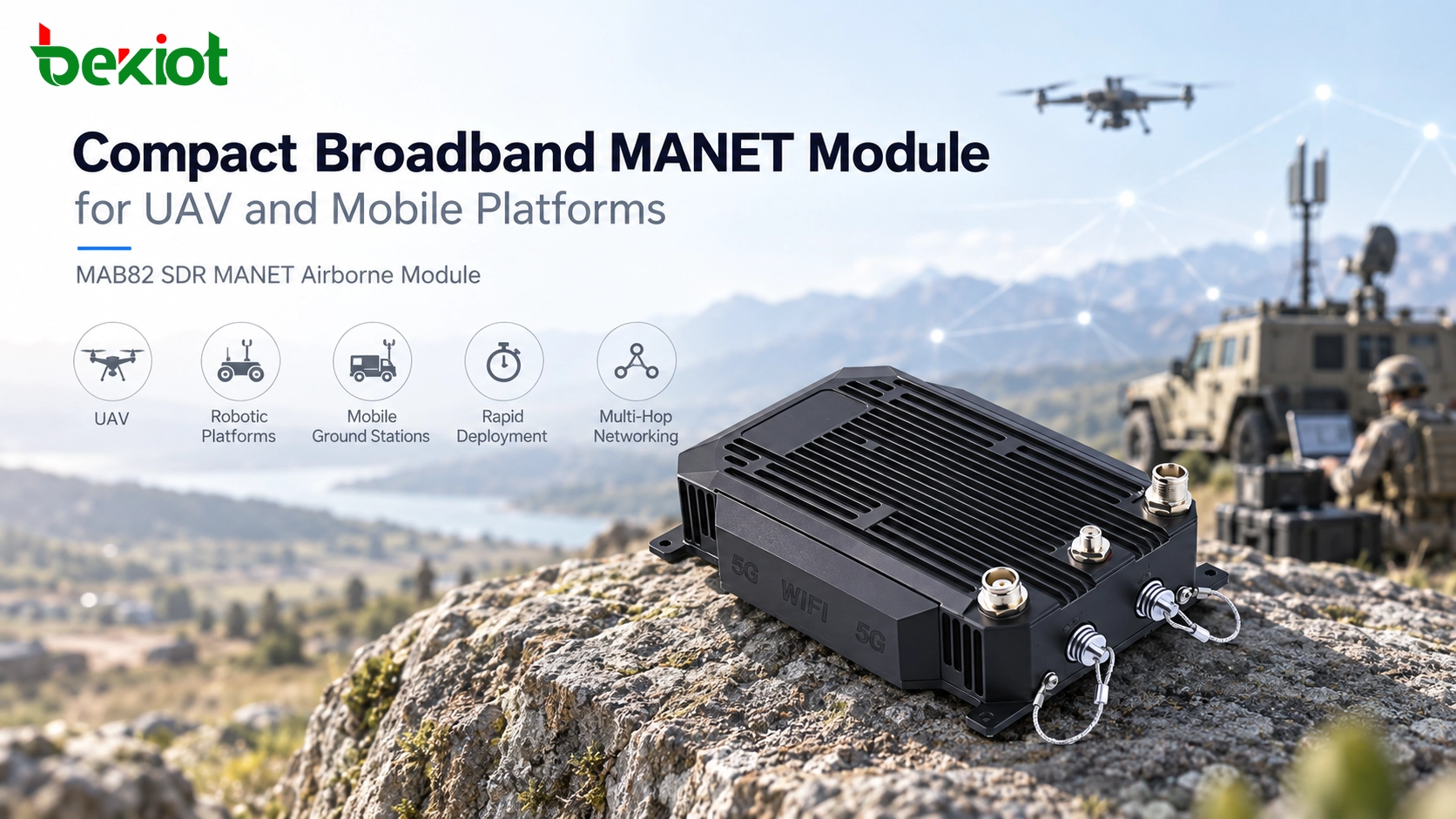
MAB82-36 does not require all communication traffic to pass through one central node. Compatible devices can automatically participate in a decentralized wireless network, allowing airborne and ground platforms to establish communication where fixed network infrastructure is unavailable or unsuitable.
Each compatible node can participate in traffic forwarding. When a direct wireless path between two endpoints becomes unavailable or unsuitable, data can be relayed through other nodes in the network.
This multi-hop architecture is particularly useful when UAVs, robots and ground personnel operate across a large or obstructed area where every endpoint cannot maintain a direct line-of-sight connection.
Airborne and robotic platforms are continuously changing position. MAB82-36 supports dynamic network routing, allowing communication paths to change as nodes move, join or leave the operating area.
Instead of designing the system around one permanent wireless link, the network can adapt to the current position of available nodes.
The broadband MANET network can transport voice, IP data, real-time video and positioning information. This enables the same wireless infrastructure to support UAV video transmission, telemetry, field communication and other IP-based operational services.
MAB82 supports star, linear, mesh and hybrid dynamic network topologies. System designers can therefore adapt the network architecture according to the number of nodes, mobility pattern, relay requirements and operating environment.
Same-frequency networking can support up to 64 nodes, allowing the module to be used in systems ranging from several connected mobile platforms to larger distributed MANET deployments.
MAB82-36 can be integrated into unmanned aerial vehicles to provide a broadband wireless link for video, data, positioning and other IP traffic. Multiple airborne and ground nodes can participate in the same network instead of relying exclusively on a single point-to-point UAV data link.
An airborne node can also provide an elevated relay position. In environments where terrain, buildings or other obstacles restrict ground-level communication, the height of a UAV can help create additional paths between separated network nodes.
The compact module can also be integrated with robotic platforms and unmanned ground vehicles. These platforms can exchange video and operational data with nearby nodes while participating in routing and relay functions across the MANET network.
This architecture is useful for remote inspection, emergency response and other operations where equipment must enter areas that are difficult, dangerous or inconvenient for personnel to access directly.
MAB82-36 can work with compatible ground-based MANET equipment to create an integrated air-ground communication network. A UAV can transmit field video or data toward a ground station while other airborne, robotic or mobile nodes participate in the same network.
A deployment does not need to contain only one type of carrier. Airborne nodes, ground robots, mobile vehicles, portable equipment and command-side systems can be combined according to project requirements.
This allows the wireless architecture to follow the operational structure of the project instead of requiring every platform to use a separate communication network.
The standard operating frequency of MAB82-36 is 1350–1450 MHz. Frequency configurations from 350 MHz to 6 GHz can be customized according to project requirements, with optional frequency-hopping configurations available.
The operating frequency should be selected according to applicable spectrum regulations, available frequency resources, antenna requirements and the RF conditions of the intended deployment area.
MAB82-36 provides 2 W × 2 transmit power and uses two MESH antenna interfaces. This configuration supports broadband wireless networking while maintaining a compact form factor suitable for integration into airborne and mobile platforms.
Available channel bandwidth settings include 1.25, 2.5, 5, 10, 20 and 40 MHz. The bandwidth can be selected according to available spectrum, interference conditions and required network capacity.
Supported modulation modes include BPSK, QPSK, 16QAM, 64QAM and 256QAM with adaptive operation. This allows the wireless link to balance transmission robustness and data capacity as RF conditions change.
The specified transmission capability reaches 50 Mbps at 20 MHz channel bandwidth, while receiver sensitivity is specified at -103 dBm at 5 MHz.
Actual application throughput depends on RF conditions, channel configuration, network topology, relay hops, interference and simultaneous traffic. UAV video and multi-node deployments should therefore be planned according to total network traffic rather than only the maximum radio data rate.
MAB82 provides dedicated interfaces for MANET networking, positioning, IP connectivity and mobile network integration. Two TNC interfaces are provided for MESH antennas, while two SMA interfaces are available for GPS antennas.
The module also includes built-in Wi-Fi and 5G antenna connections, a 100 Mbps Ethernet interface and a SIM card slot. A DC 24 V connection provides power to the module when integrated into UAVs, robots, vehicles or other host systems.
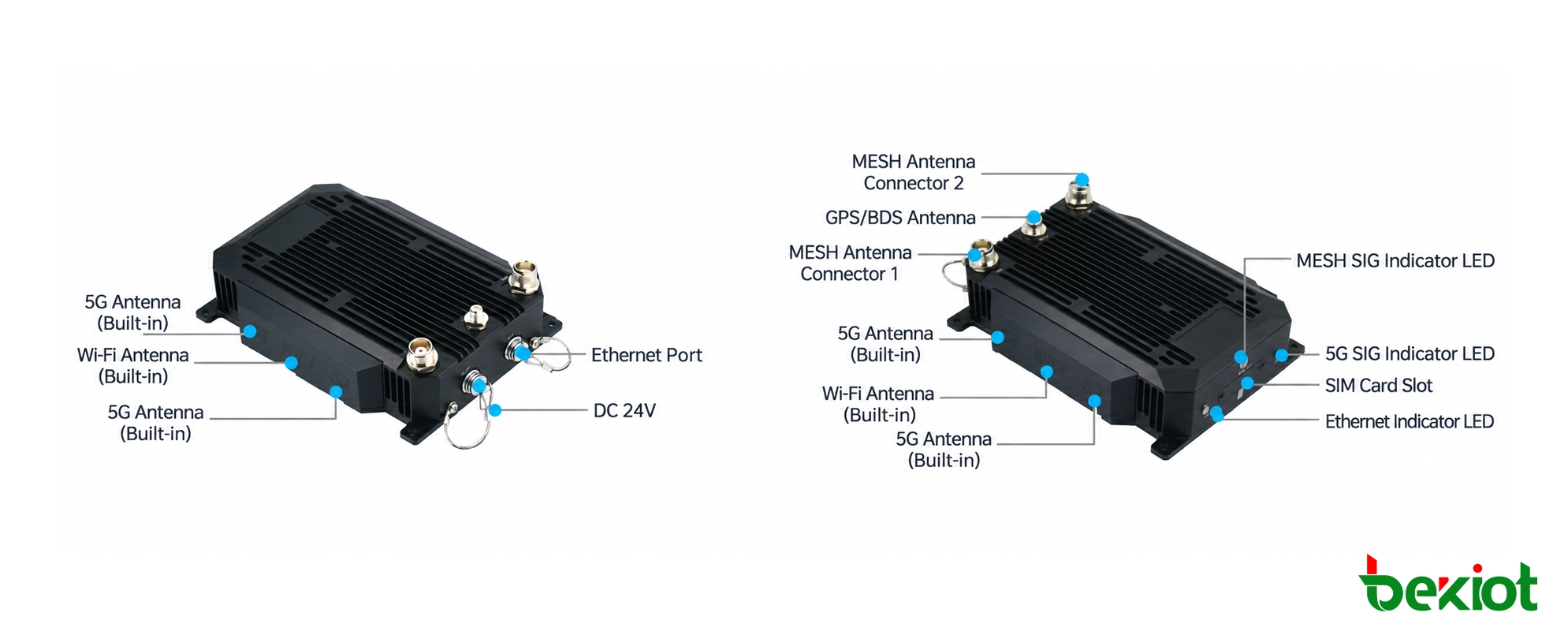
MAB82 can provide broadband wireless connectivity between UAVs and ground communication nodes. Live video, telemetry, positioning information and other IP data can be transported through the MANET network while the aircraft remains mobile.
Additional nodes can extend the network when a direct air-to-ground path is unavailable or when several UAVs need to participate in the same operational network.
During disaster response and emergency operations, communication infrastructure may be unavailable or insufficient for rapidly moving field teams. UAVs equipped with MAB82 modules can provide aerial observation while also participating in a temporary broadband communication network.
Airborne, mobile and ground nodes can work together to move video and operational data from the incident area toward command personnel.
High-rise buildings, underground facilities, industrial sites and large commercial complexes can create challenging wireless conditions. An airborne MANET node can complement portable and ground communication equipment by providing an elevated relay position where appropriate.
The network can support field video, positioning and other IP services used by emergency teams while maintaining decentralized communication between participating nodes.
Robots and unmanned ground systems can carry MAB82-36 to transmit live video and operational data from areas where direct human access is hazardous or difficult. Multi-hop networking allows additional nodes to be introduced as the robot moves farther from the control position.
Utility construction, surveying, remote inspection and infrastructure maintenance often take place across mountainous or sparsely connected areas. UAVs and mobile platforms equipped with MANET radios can establish temporary wireless connectivity without first deploying permanent communication infrastructure.
UAVs and unmanned systems used for patrol, inspection or temporary monitoring can exchange video and data through the same mobile mesh network. This provides greater deployment flexibility where operating locations or communication paths change during the mission.
MAB82 can be integrated into UAVs or other mobile platforms used around vessels, coastal facilities and offshore operating areas. Airborne nodes can participate in a wider MANET deployment connecting mobile assets and temporary command locations where conventional terrestrial coverage is limited.
MAB82 measures approximately 145 × 106 × 33 mm, excluding antennas, and weighs approximately 508 g, excluding antennas. The compact enclosure makes the module suitable for installation on UAVs, robotic platforms and other mobile equipment where available space and payload weight are important design considerations.
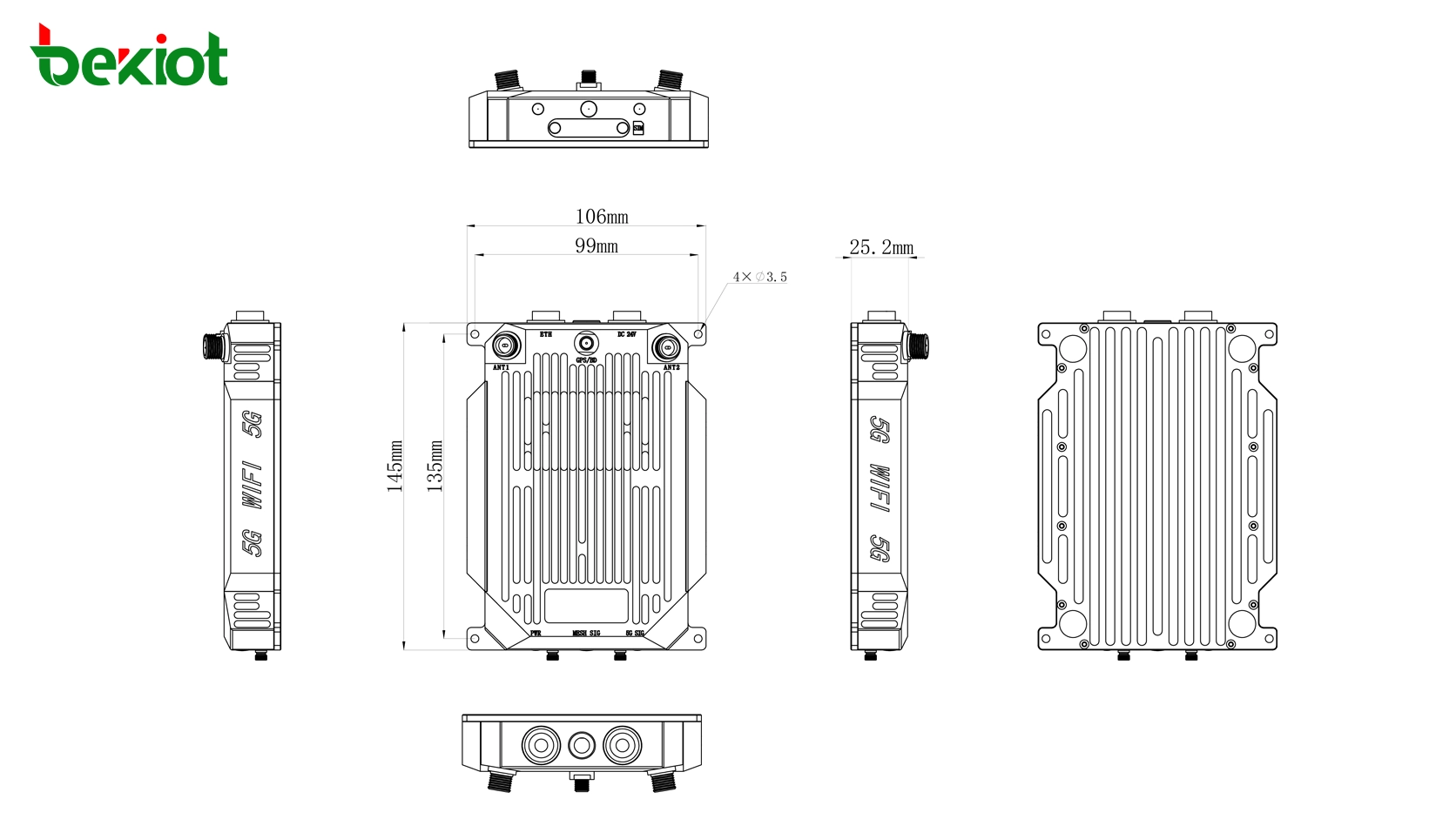
With a weight of approximately 508 g excluding antennas and a compact 145 × 106 × 33 mm enclosure, MAB82-36 can be integrated into UAVs and other mobile platforms without requiring the larger enclosure associated with handheld or vehicle-mounted communication equipment.
A conventional UAV data link normally connects one aircraft with one ground endpoint. MAB82-36 allows compatible airborne and ground devices to participate in a multi-node network where other devices can provide alternative routing and relay paths.
UAVs, robotic platforms, ground stations and other compatible MANET equipment can participate in the same network. This simplifies field architectures where multiple mobile platforms need to exchange information with each other and with command-side systems.
Video, voice, IP data and positioning information can share the same broadband MANET infrastructure, allowing one wireless network to support several operational applications.
A project can begin with a small number of airborne and ground nodes and expand by introducing additional relay or mobile equipment as coverage, topology and operational requirements grow.
No. Although its compact size makes it suitable for airborne integration, MAB82-36 can also be incorporated into robotic platforms, unmanned ground vehicles, mobile communication equipment and ground stations where its power, interfaces and RF configuration meet the project requirements.
A universal fixed communication distance is not specified for the module. Effective range depends on operating frequency, antenna type and gain, antenna installation, flight altitude, terrain, interference, node placement and whether relay nodes are used. Project coverage should therefore be evaluated through RF planning for the intended operating environment.
Integration should consider available payload capacity, equipment mounting, 24 V power availability, antenna position and separation, cable routing, heat dissipation and possible RF interaction with other onboard electronics. Antennas should be installed so that the aircraft structure and other equipment do not unnecessarily obstruct the intended radio path.
MAB82 supports multi-node networking, and same-frequency configurations can accommodate up to 64 nodes. The practical number of simultaneously active UAVs should still be planned according to video bitrate, data traffic, channel bandwidth, relay topology and the capacity required by other nodes in the network.
Yes. Compatible MANET nodes can participate in routing and relay transmission. An airborne node can therefore provide an additional communication path between separated nodes when its position and RF conditions are suitable.
MAB82 includes a 100 Mbps Ethernet interface for compatible IP equipment. Whether a particular camera, controller, computer or sensor can operate through the network depends on its IP configuration, protocols, data rate and overall network design.
Useful project information includes the deployment country, available frequency band, UAV or host platform, required communication area, number of nodes, flight altitude, expected video bitrate, antenna configuration, required interfaces and whether airborne, robotic, vehicle-mounted or ground nodes will operate together.
| Model | MAB82 |
|---|---|
| Module Model | MAB82-36 |
| Product Type | SDR MANET Airborne Module |
| Radio Architecture | Software-Defined Radio (SDR) |
| Standard Frequency | 1350–1450 MHz |
| Custom Frequency | 350 MHz–6 GHz, customizable according to project requirements |
| Frequency Hopping | Optional |
| Transmit Power | 2 W × 2 |
| Channel Bandwidth | 1.25 / 2.5 / 5 / 10 / 20 / 40 MHz, adjustable |
| Modulation | BPSK / QPSK / 16QAM / 64QAM / 256QAM, adaptive |
| Transmission Capability | Up to 50 Mbps @ 20 MHz |
| Receiver Sensitivity | -103 dBm @ 5 MHz |
| Network Capacity | Up to 64 nodes in same-frequency networking |
| Network Topology | Star / Linear / Mesh / Hybrid Dynamic Network |
| MESH Antenna Interfaces | 2 × TNC |
| GPS Antenna Interfaces | 2 × SMA |
| Wi-Fi | 2 × built-in |
| 5G | 4 × built-in |
| Ethernet | 1 × 100 Mbps Ethernet |
| SIM | 1 × SIM card slot |
| DC Connection | 1 × DC 24 V |
| Status Indicators | MESH SIG × 1 / 5G SIG × 1 / PWR × 1 |
| Ingress Protection | IP67 |
| Operating Temperature | -40°C to +55°C |
| Storage Temperature | -40°C to +85°C |
| Operating Humidity | 5%–95%, non-condensing |
| Dimensions | 145 × 106 × 33 mm, excluding antennas |
| Weight | Approx. 508 g, excluding antennas |
| Power Supply | 24 V / 3 A |
| Average Power Consumption | 15 W |
| Peak Power Consumption | 22 W |