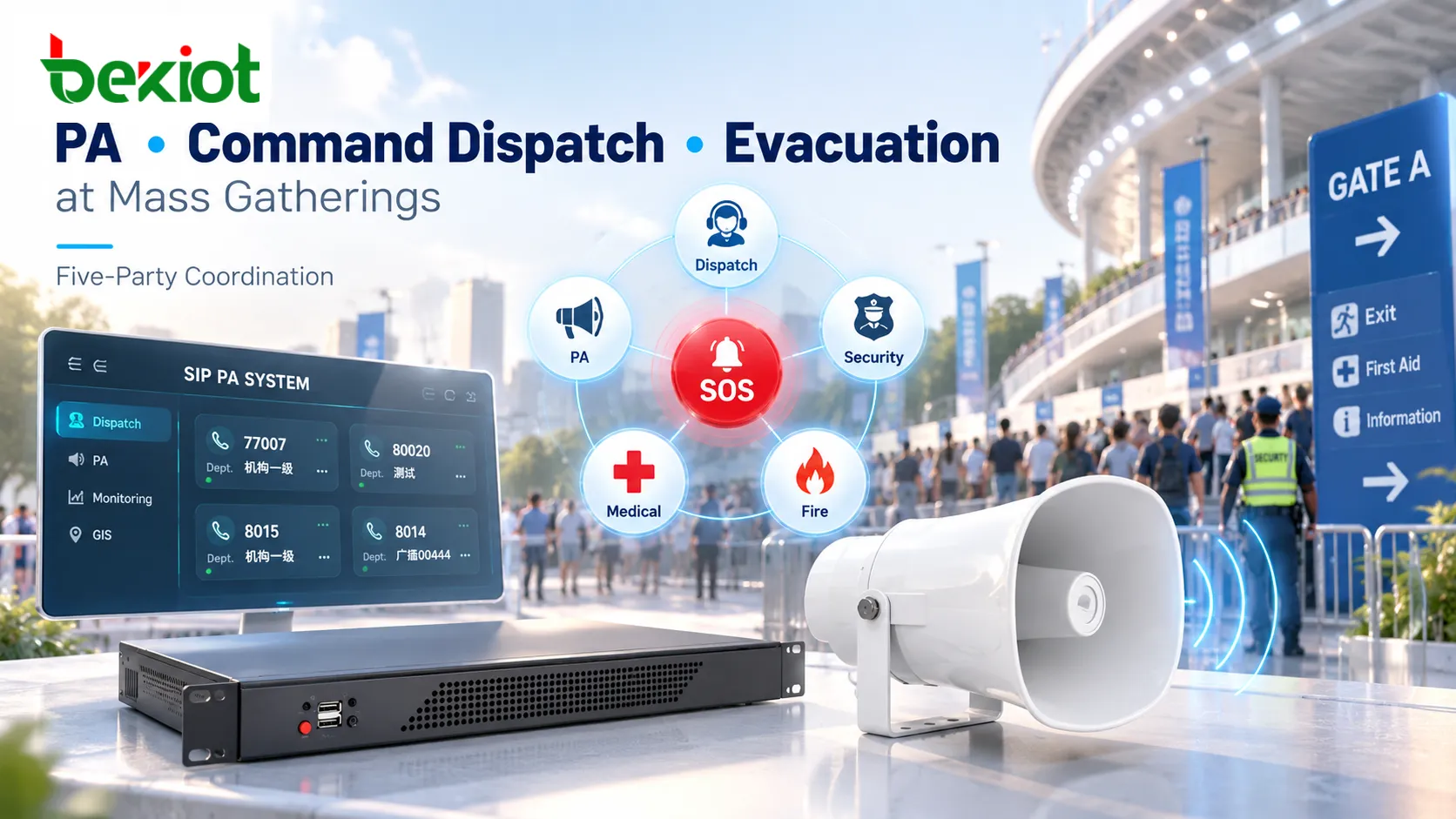
On October 17, 2026, a serious crowd-crush incident occurred at a major Durga Puja event in Chorbagan, Kolkata. A large crowd had already gathered when heavy rain began. A warning was then broadcast over the PA system stating that the structure might be unsafe and asking people to leave. Public reporting identified the announcement as one of the factors associated with the sudden movement of the crowd, while subsequent investigations still needed to determine who authorized the message and what information it was based on.
When an emergency develops at a mass gathering, a PA system gives event operators one of the fastest ways to reach thousands of people at the same time. That capability is difficult to replace with other forms of communication. But a public announcement does not end at the loudspeaker. Once people hear a warning, they may turn around, search for an exit, move toward family members or begin heading in the same direction at the same time. An emergency message is therefore not only information; it can quickly become a driver of crowd movement.
The main lesson for the communications industry is not that PA systems should avoid emergency announcements. On the contrary, once the PA delivers an early warning, the emergency response plan should begin operating immediately.
The critical questions for the wider response are: who verifies the hazard, who authorizes the announcement, which zones receive the message, how field personnel respond, whether exits can absorb the sudden increase in pedestrian flow, and whether fire, medical, police and security resources are already moving into action. If these elements operate independently, even a clear announcement completes only the first stage of the response. A complete emergency command and dispatch system is what allows multiple response teams to coordinate effectively.
How PA Fits into the Wider Emergency Response System
Traditional public address projects often focus heavily on equipment-level questions: Are there enough loudspeakers? Is the sound pressure level sufficient? Are there coverage gaps? Is amplifier redundancy available?
These questions matter, but in an environment containing thousands or tens of thousands of people, PA is only one node in a much longer communications chain.
Once operators detect an abnormal situation, the response may also require incident verification, video monitoring, crowd-density assessment, exit-status checks, security deployment, police coordination, medical support, fire response and traffic management. If any one of these elements is not synchronized, the announcement may already have reached the public while the site still lacks the operational capacity to respond.
The Kolkata incident is especially relevant because the emergency announcement was made when the venue was already dealing with a large crowd, rainfall and pressure around entry and exit points. A message asking people to leave therefore did not occur in isolation; it was introduced into an already stressed crowd environment.
Emergency communications at major events should therefore be viewed as three layers operating at the same time:
Public Warning: telling the public what is happening and what action they should take;
Command & Dispatch: coordinating security, medical teams, fire services, police and field personnel;
Crowd Evacuation: turning broadcast instructions into controlled crowd movement and practical evacuation actions.
If any of these layers is missing, the emergency response chain can develop a critical gap.
How a Single Broadcast Can Change the Direction of Crowd Movement
The main difference between PA and channels such as SMS, app notifications or post-event notices is that PA can influence the immediate behavior of a large number of people within the same physical space.
A routine announcement that an event is about to begin may draw people toward a main stage. A message that one exit has opened may cause part of the crowd to move toward that location. A warning that a structure may be unsafe and that people should leave immediately can change the movement objective of a large crowd within seconds.
In a dense and highly anxious crowd, the impact cannot be judged only by whether the message is factually accurate. Operators also need to consider whether the physical space can absorb the resulting movement. UK HSE guidance on crowd management at events highlights how weather changes, sudden shifts in crowd direction, entry and exit points, and physical bottlenecks can rapidly change crowd-flow pressure. This is why entrances, exits, queues, narrow passages and potential pinch points need continuous monitoring.
It also explains why emergency broadcasting cannot rely on a single generic instruction such as “Please evacuate immediately.”
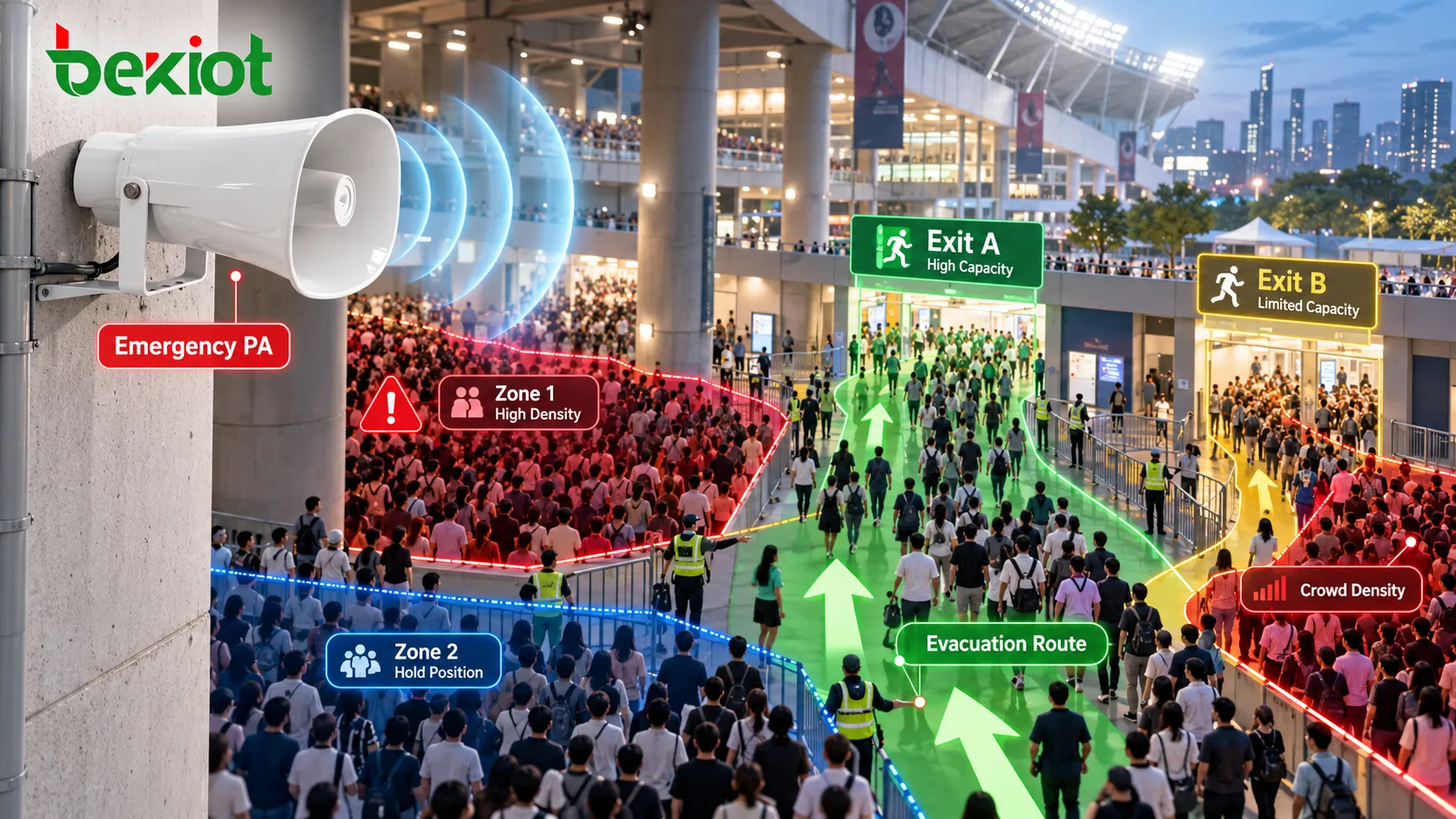
At a large venue with multiple exits, more useful information may need to specify:
which area is at risk;
which people need to move;
which exit or route should be used;
which zones should temporarily remain in place;
when the next instruction will be issued.
The purpose of PA is not simply to generate the highest possible sound level. It is to guide crowd behavior toward a more controlled state.
Four Questions to Resolve Before an Emergency Announcement Is Made
When a potential hazard appears, “broadcast as quickly as possible” may sound like the safest approach. In practice, effective emergency communication requires verification, authorization, targeting and actionable instructions to be clear at the same time.
Who Verifies the Incident?
The control center first needs to know where the information originated. Was the abnormal condition identified through CCTV, reported by security personnel, triggered by a sensor or fire system, or based on an observation from a field worker?
Different sources carry different levels of confidence and urgency. Some conditions may justify an immediate predefined alarm, while others require rapid confirmation by the command team or safety officer.
Who Has the Authority to Broadcast?
An Emergency Microphone should not be treated in the same way as a standard Paging Microphone.
Major events should clearly define which roles are authorized to initiate high-priority announcements, such as Event Control, the Safety Officer or an authorized Incident Commander. Security personnel may report an incident from the field, but whether they can directly initiate a venue-wide evacuation announcement should be defined in the emergency plan.
Which Areas Should Receive the Message?
If the hazard is limited to one area, does the entire venue need to move at the same time? If Exit A is already congested, should nearby zones continue to be directed toward it?
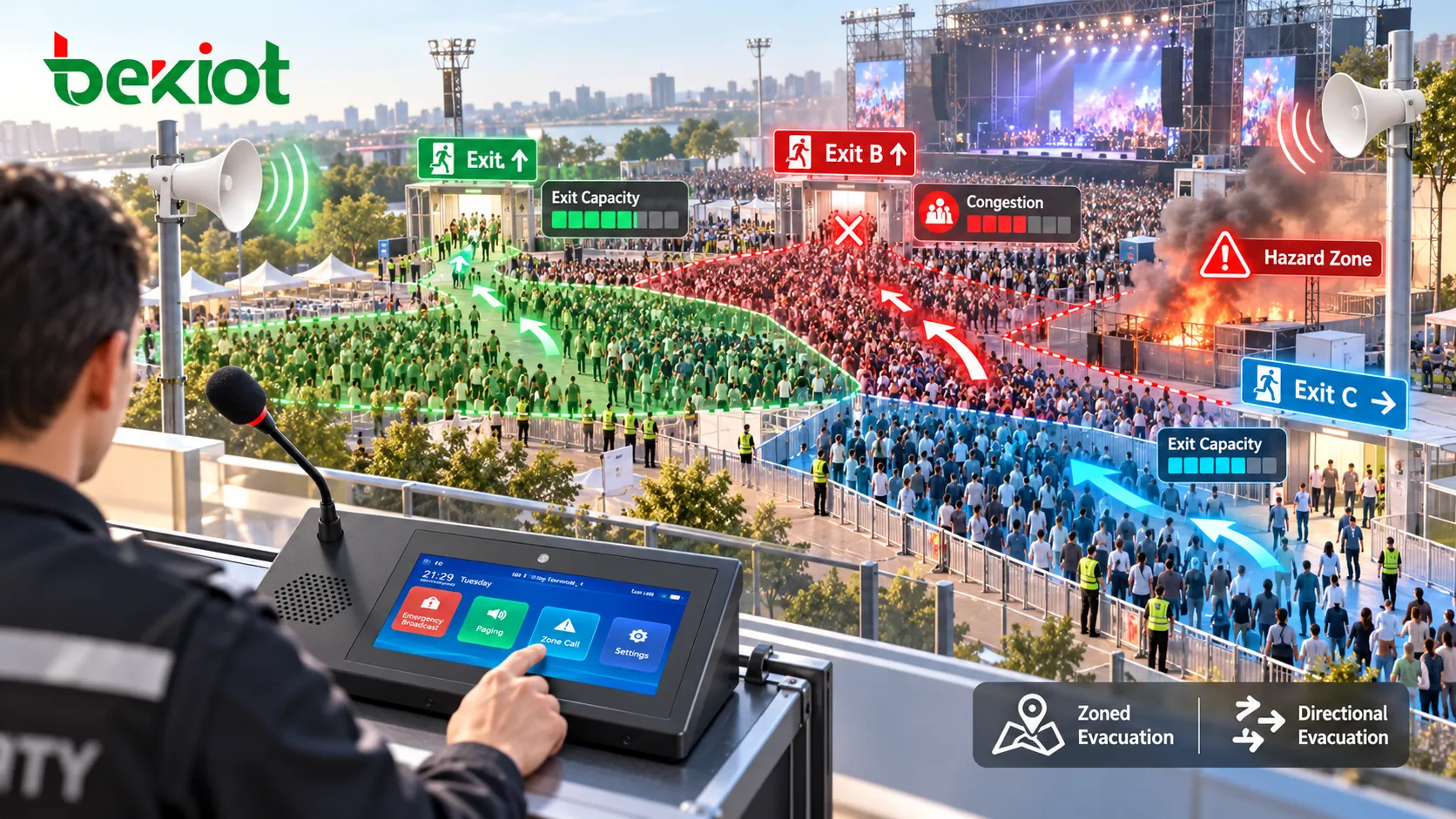
This is the operational value of zoned broadcasting: different areas can receive different instructions according to the current risk and crowd-flow conditions.
What Action Should the Message Require?
ISO 22322:2022 treats Public Warning as a process that must be managed before, during and after an incident. In practical terms, the public needs more than confirmation that a hazard exists; people need information they can act on.
For example, “An emergency has occurred, please evacuate” is often less operationally useful than “People in the East Zone should leave through Exits 2 and 3. The West Zone should remain in place and wait for the next announcement.”
How to Organize Precise Evacuation
In everyday language, evacuation is often understood as moving everyone out as quickly as possible. From a crowd-management perspective, however, large-scale simultaneous movement can create new pressure.
Exits have fixed widths, corridors have finite capacity, and pedestrian flow changes as people move from open spaces into narrower passages. If several zones begin moving toward the same exit at the same time, the area in front of that exit can quickly become a bottleneck.
This is why large venues and mass gatherings may need to consider zoned evacuation, phased evacuation and directional evacuation.
| Evacuation Method | Operating Logic | Information Required from PA |
|---|---|---|
| Zoned Evacuation | Different actions for different risk zones | Clearly identify the zone, exit and required action |
| Phased Evacuation | Different areas leave in stages | Specify who moves first and who waits |
| Directional Evacuation | Redirect crowd flow according to exit capacity and hazard location | Clearly specify the exit and movement route |
This does not mean that every emergency should use phased evacuation. If fire, structural failure or another life-safety threat requires immediate full evacuation, protecting life takes priority.
What should be avoided is a system that offers only one option—“broadcast to everyone”—without the ability to adapt messages to the actual risk area, available routes and crowd conditions.
The Dispatch System Must Respond Immediately After the PA Announcement
Once an emergency announcement has been issued, the control center should become the busiest part of the response.
Field personnel need to know which zone is evacuating. Security teams may need to move toward bottlenecks. Medical teams may need to position themselves near areas where casualties are likely to occur. At the same time, access routes must remain available for fire engines, ambulances and police vehicles.
This is one of the main differences between a command-and-dispatch system and ordinary PA control software. PA communicates instructions to the public, while dispatch answers the operational questions: who needs to act, where should they go, and what is the current status?
Once a major-event incident reaches the control center, several tasks may need to run in parallel:
Incident Verification: use CCTV, field reports or alarm systems to confirm the location and severity of the incident;
Broadcast Decision: determine message content, priority and target zones;
Personnel Dispatch: send stewards, security teams and event staff to critical locations;
Resource Dispatch: coordinate police, fire, medical and ambulance resources;
Traffic Control: prevent emergency vehicle access routes from conflicting with evacuation routes;
Status Feedback: continue receiving reports on congestion, exit conditions and casualties;
Instruction Update: adjust subsequent broadcasts and dispatch tasks according to the latest field conditions.
At this point, PA is no longer an isolated audio system. It becomes part of the wider Incident Management process.
CCTV, GIS and Radio Create a Real-Time Feedback Loop
One of the most dangerous conditions during a large-scale evacuation is when the control center issues an instruction but has no visibility into what happens next.
For example, the control center may tell people in the East Zone to use a particular exit. But that exit may already be blocked by vehicles, barriers or another crowd stream. If the system continues repeating the same announcement, an instruction that was initially correct may become unsuitable as conditions change.
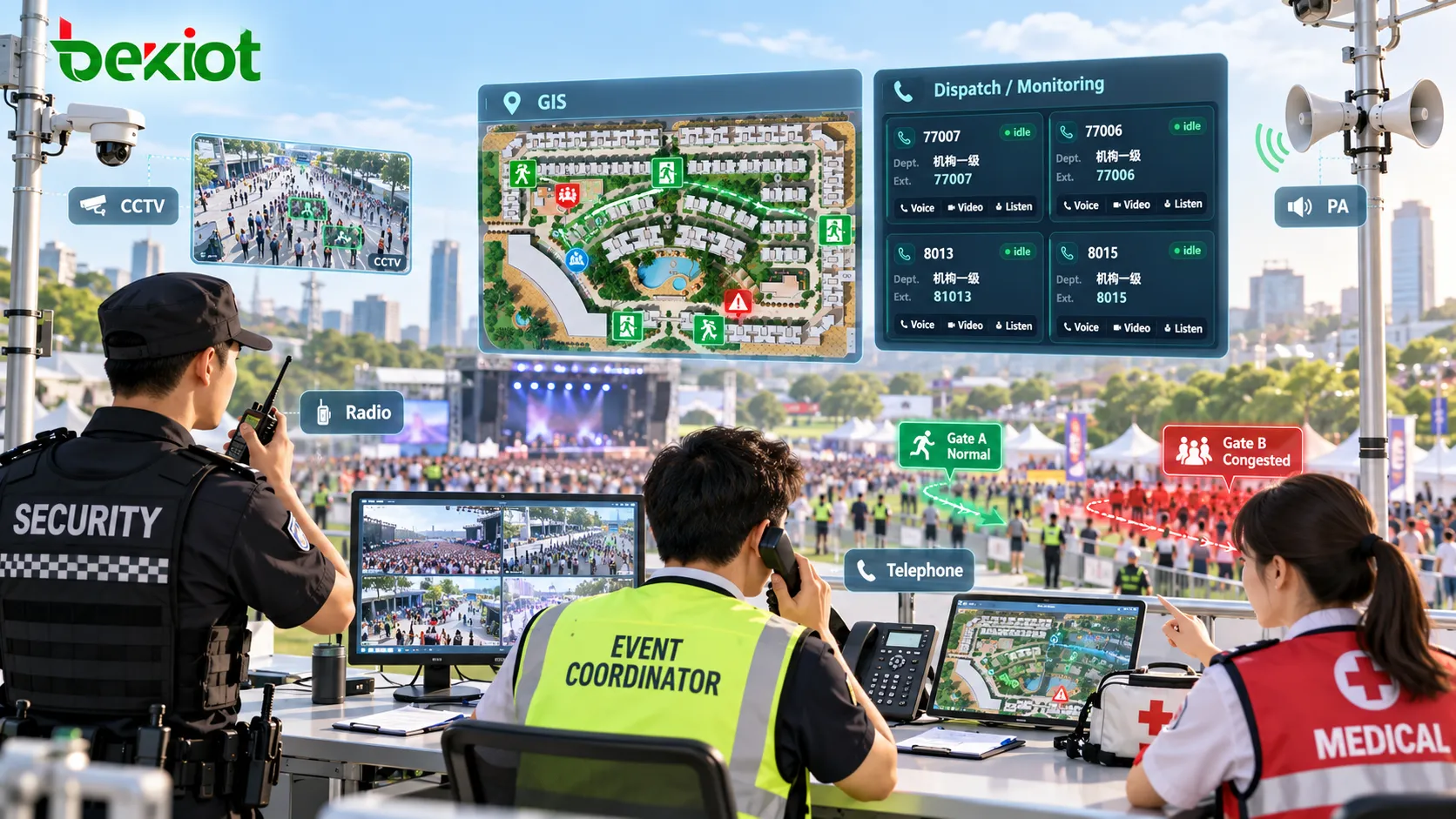
This is why command and dispatch at mass gatherings needs a reliable feedback channel. CCTV can monitor exits and main corridors; GIS or site maps can show zones, devices and resource locations; Radio allows field personnel to report conditions quickly; and Telephone and Intercom provide continuous communications between fixed posts and the control center.
These systems do not all have to come from the same manufacturer, but operators need rapid access to several critical status indicators:
which zones still contain high-density crowds;
which exits remain available;
which routes are becoming congested;
whether field personnel have reached their assigned positions;
where medical and fire resources are currently located;
whether the next PA announcement needs to be changed.
HSE guidance for major events also emphasizes the importance of a central control point. The control position needs an overview of the site, the ability to coordinate crowd-management personnel, and a way to work with emergency services and other external organizations.
Emergency Planning Must Be Completed Before the Incident
Another important question raised by the Chorbagan incident is whether emergency responders can reach the scene quickly enough once something goes wrong.
Public reporting raised questions about the availability of trained rescue personnel, medical support and ambulances on site, while some casualties were reportedly transported by local residents and event attendees using whatever transport was available.
For a major event, this is not only a question of whether ambulances are present. The broader issue is whether emergency resources have already been incorporated into the Event Communication Plan.
Medical and fire resources should at least have four location-related questions resolved in advance:
Standby Location: where vehicles and response personnel are positioned before an incident;
Emergency Access Route: which route they use to enter after an incident occurs;
Casualty Collection Point: where casualties are gathered and initially treated;
Hospital Transport Route: how ambulances leave the site without conflicting with evacuation traffic.
If these resources are not in communication with the command center, even an ambulance already positioned on site may lose valuable time because crews do not know which route is open or where congestion has developed.
The value of emergency response communications therefore goes beyond connecting different communications devices. It is about bringing alarms, dispatch, field response and resource status into one continuous operational workflow.
What Architecture Should Support Emergency Communications at Mass Gatherings?
When PA, command dispatch and evacuation are treated as one integrated system, the architecture can be divided into five functional layers.
| System Layer | Typical Devices or Platforms | Main Function |
|---|---|---|
| Incident Detection Layer | CCTV, alarms, sensors, field personnel | Detect congestion, hazards and abnormal events |
| Command Decision Layer | Dispatch Console, CAD, GIS, incident management platform | Verify incidents and determine response levels and action plans |
| Public Warning Layer | PA, PAGA, IP Speaker, Mass Notification | Deliver warnings and evacuation instructions to selected zones |
| Field Execution Layer | Radio, SIP Phone, Mobile Terminal, Intercom | Dispatch security teams, event staff and emergency responders |
| Feedback and Recording Layer | CCTV, recording, GIS status, incident logs | Confirm response results and support the next command decision |
From an architectural perspective, the goal is not necessarily to force every system into a single software interface. The more important requirement is that critical information can move between the different layers.
If CCTV shows crowd density increasing rapidly at Exit A, for example, the dispatch console should be able to send staff to that location while preventing additional zones from being directed toward the same exit. PA can then use the updated command decision to guide the next group of people toward an alternative route.
This is the principle of closed-loop emergency communication: an alert creates action, action produces feedback, and feedback changes the next command decision.
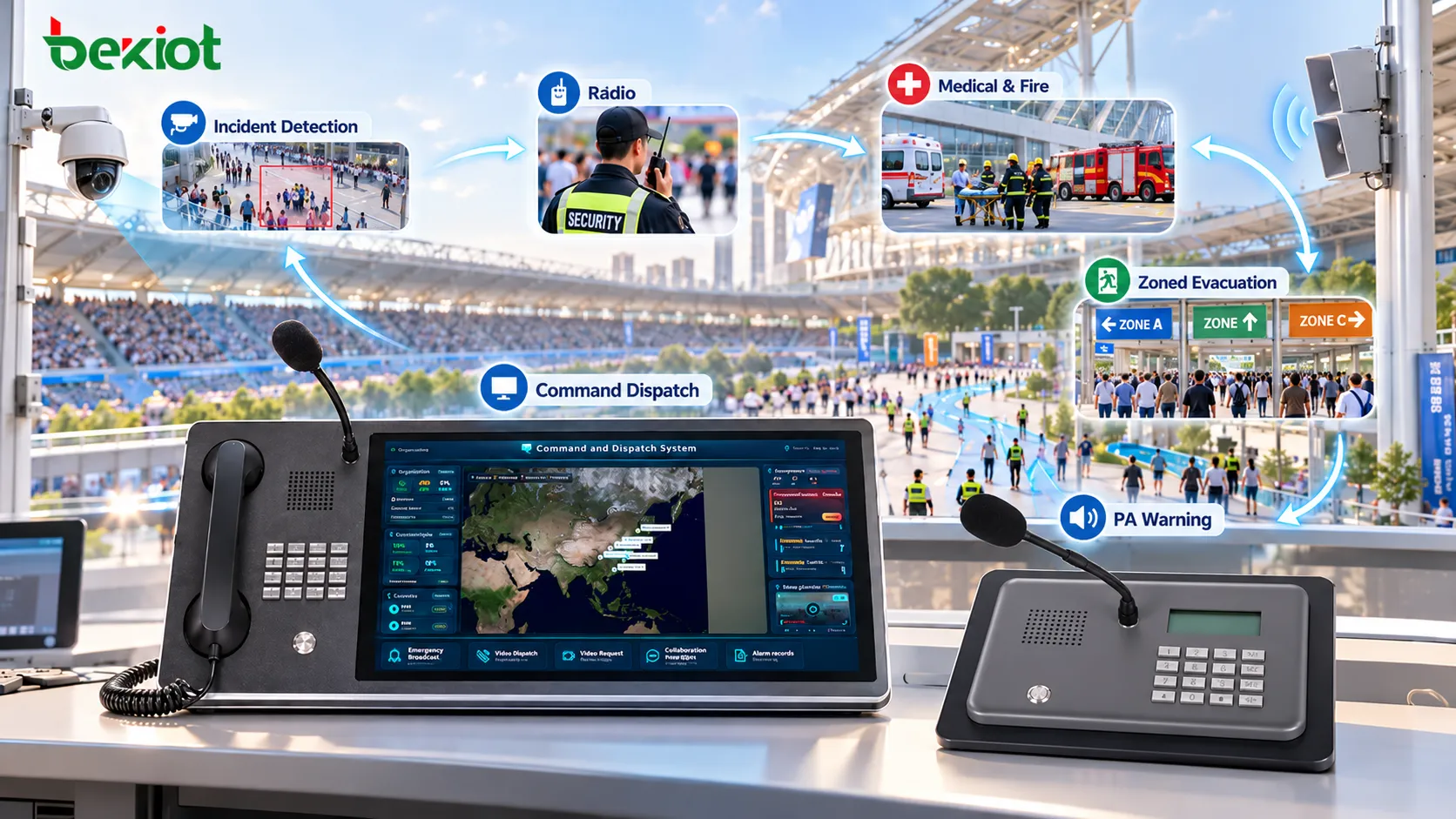
For PA at major events, the design should consider backup power, amplifier redundancy, loudspeaker-line monitoring and alternative means of amplification. Command and dispatch systems should also retain multiple communications paths. If the IP network fails, radio may still be available. If public mobile networks become congested, dedicated on-site radio or wired telephones may provide a more dependable channel.
A truly resilient emergency system should not be designed only for normal operation. It also needs a defined degraded mode.
From the Kolkata Incident Back to System Design: Someone Must Act After the Broadcast
The most important communications lesson from the Chorbagan crowd-crush incident is not whether the PA system should have issued a warning.
The more important question is whether a complete operational system was ready to manage what happened after a message capable of influencing thousands of people had been broadcast.
PA needs to be intelligible, but intelligibility is only the starting point. Announcements need to be fast, but speed cannot replace incident verification. People may need to evacuate, but evacuation cannot be separated from exit capacity and real-time crowd flow. The control center needs to issue commands, but it must also continue receiving updated information from the field.
For sports events, festivals, religious gatherings, concerts, exhibitions, city celebrations and other large public events, PA, command dispatch and Crowd Evacuation should no longer be treated as three independent projects.
A more effective objective is to create a continuous Operational Chain:
A field abnormality is detected, the control center verifies the incident, PA delivers actionable instructions to the correct zones, field personnel guide crowd movement, the dispatch platform coordinates security and rescue resources, CCTV and field communications provide continuous status feedback, and command personnel determine the next broadcast and operational action.
Once this chain is established, PA is no longer simply about making sound louder, command and dispatch is no longer just about making calls or viewing maps, and evacuation is no longer simply opening the exits and asking everyone to leave at once.
PA can act as the first public-facing response channel, but only coordinated emergency dispatch can connect warnings, field actions, resource deployment and live feedback into a complete emergency-response loop. Together, these elements form an emergency communications system designed around real crowd behavior and the operational demands of complex public incidents.
FAQ
Why Is a PA System Alone Not Enough for a Mass Gathering?
PA can deliver information to the public quickly, but it cannot independently verify incidents, dispatch personnel, control exits, coordinate medical response or receive field feedback. Major events need PA to operate together with command dispatch, video surveillance, radio communications and on-site evacuation management.
Should an Emergency Always Trigger an Immediate Venue-Wide Evacuation Announcement?
It depends on the type of hazard and the conditions on site. Life-safety incidents requiring immediate full evacuation should take priority, while localized events may be better managed through zoned or phased evacuation. The decision should consider the hazard area, exit capacity and crowd distribution rather than applying the same broadcast strategy to every incident.
Why Is Zoned Broadcasting Important at Large Events?
Zoned broadcasting allows different areas to receive different instructions. A high-risk zone can be evacuated first while other areas remain temporarily in place, or separate zones can be directed toward different exits to reduce the likelihood of large numbers of people converging on the same route.
What Does a Command-and-Dispatch System Do During an Evacuation?
A command-and-dispatch system brings together field information, response teams, resource status, task assignment and incident records. It connects public instructions issued through PA with the actual actions of security teams, medical staff, fire services, police and event personnel.
What Is Commonly Overlooked When Testing Emergency Communications for Major Events?
In addition to loudspeaker coverage and voice communications, testing should verify broadcast authority, zoning logic, backup power, fallback communications, on-site radio coverage, dispatch procedures when exit conditions change, and whether reliable feedback is available after an announcement has been made.
Becke Telcom provides IP PA, PAGA, SIP communications, command-and-dispatch and emergency communications solutions for major public events, transportation hubs, stadiums and critical facilities. Public address, telephone, radio, video, GIS and field terminals can be integrated into a unified communications environment supporting incident verification, zoned alerting, field dispatch and crowd evacuation.