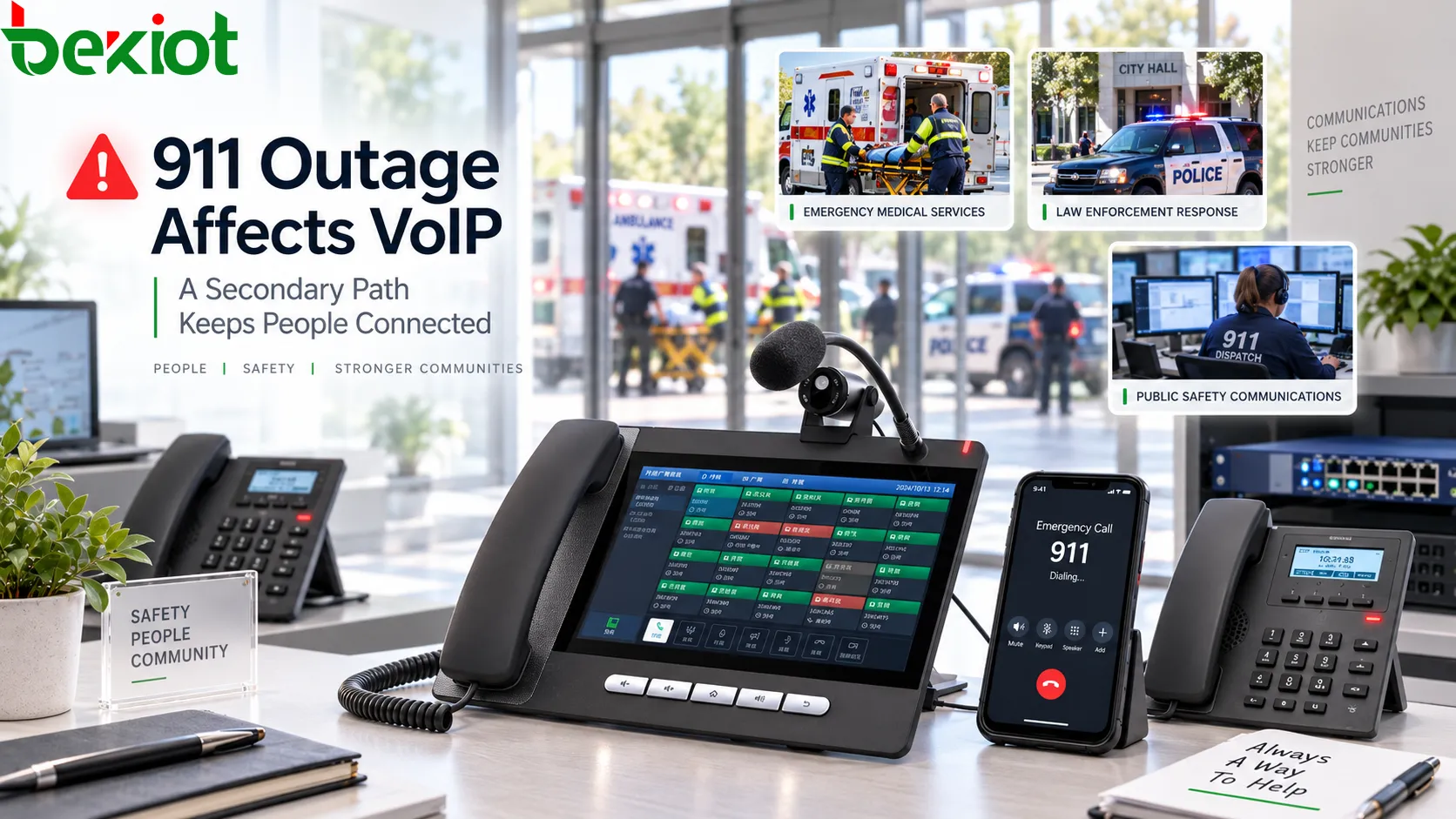
The 911 number had not changed, and emergency call centers were still operating, yet some users were unable to complete emergency calls.
On September 17, 2026, intermittent 911 service disruptions were reported in parts of Canada, affecting some wireless and VoIP users. Emergency management officials in Nova Scotia indicated that the issue appeared to involve telecommunications carrier networks rather than the provincial 911 system itself. Residents having difficulty reaching 911 were advised to try a landline, Wi-Fi Calling, another carrier's network, or published alternative emergency contact numbers.
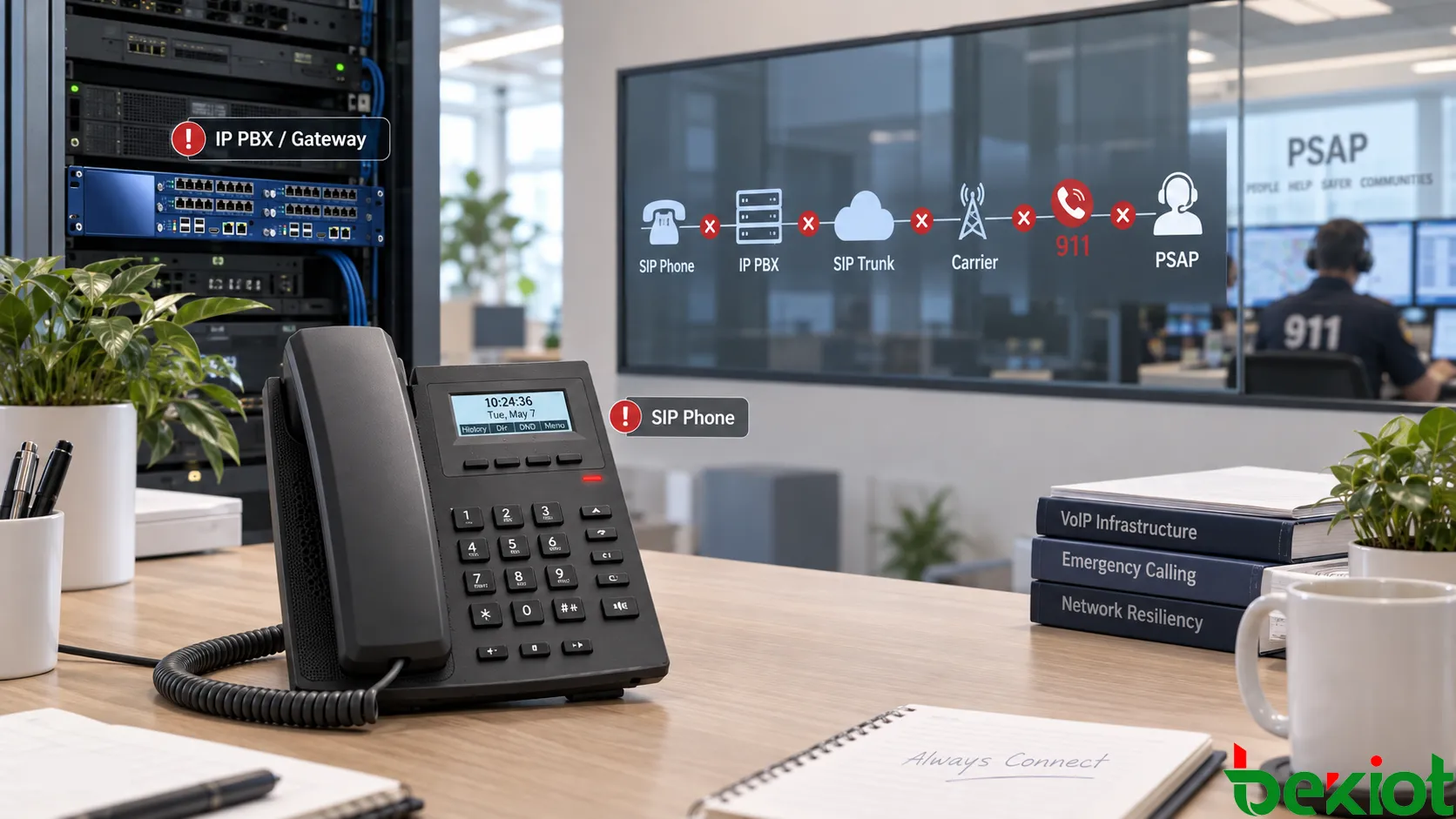
The incident highlights a communications risk that is easy to underestimate: a valid emergency number, a registered SIP phone, a functioning IP PBX and an operational 911 answering center still do not guarantee that an Emergency Call will complete successfully. Between the moment a user dials "911" and the moment a call taker answers, the call may pass through the local endpoint, access network, carrier infrastructure, emergency call routing and the public safety answering system. A failure anywhere along that path can interrupt the request for help.
Service Disruption Reveals an End-to-End Call Path Problem
To the caller, 911 is only three digits. To the network, it is a real-time communications path that crosses multiple administrative and technical domains.
Consider an enterprise VoIP phone. After a user dials 911, the call must first leave the local endpoint. The enterprise IP PBX, cloud voice platform or SIP Trunk Service must recognize it as an Emergency Call and route it according to the configured emergency calling policy. The carrier then needs to hand the call to the appropriate Emergency Services Network, which ultimately delivers it to the Public Safety Answering Point (PSAP) responsible for that geographic area.
Each layer is managed by different systems and organizations, and failures may appear in different ways. A local network problem may result in SIP registration failure or loss of media. A carrier-side problem may cause a call to be rejected, time out or reach the wrong PSAP. Problems in the emergency services network may affect how a call is delivered or handled. From the user's perspective, however, all of these conditions may look the same: the 911 call does not go through.
The intermittent Canadian outage is especially useful as a reference because initial information pointed to carrier-network issues rather than a failure of the provincial 911 platform. This means an enterprise can confirm that its PBX, SBC and Internet connection are operating normally and still not eliminate the possibility of an emergency calling failure. The routing path between the carrier and the 911 network is also part of end-to-end emergency call availability.
VoIP Emergency Calling Risks Extend Beyond Internet Failure
When VoIP reliability is discussed, one of the most common concerns is that "if the Internet goes down, the phones stop working." That is a valid risk, but for 911 it represents only part of the problem.
Everything inside the enterprise may appear normal. SIP phones may show Registered, extension-to-extension calls may work, and ordinary external calls may complete. But if the special 911 route, upstream carrier or Emergency Services Interconnection is unavailable, the emergency call can still fail. The September 2026 Canadian incident illustrates this type of dependency: the local enterprise equipment may show no obvious alarm while the problem exists farther upstream in the carrier network.
Another risk involves the relationship between telephone identity and physical location. Ordinary business calling mainly needs to answer "can the caller reach the other party?" Emergency calling also needs to answer "where should responders be sent?" Fixed office phones usually have stable locations, but Softphones, remote workers and Nomadic VoIP users may sign in through different Internet connections while using the same enterprise account.
An employee may work from the office today, call from home tomorrow and stay in a hotel in another city the following week. If the Emergency Location remains permanently associated with the office address, the call may successfully enter the 911 system while the PSAP receives location information that does not match the actual emergency. In a dispatch situation, that mismatch can delay the arrival of police, fire or medical responders.
VoIP emergency calling therefore has at least three separate availability dimensions:
Call Reachability: Can the 911 call actually be established?
Call Routing: Does the call enter the correct Emergency Services path and reach the PSAP responsible for that location?
Location Accuracy: Does the location information received by the PSAP match the actual location of the emergency?
Failure in any one of these areas can reduce the effectiveness of the emergency call.
A Secondary Emergency Path Should Avoid the Same Failure Domain
The alternatives suggested during the Nova Scotia disruption are representative: landlines, Wi-Fi Calling, another carrier's network and published alternative emergency numbers. They all follow the same principle—when the primary path is impaired, provide another route that may not depend on the same point of failure.
For enterprises and public facilities, this principle should become a clear design rule: the value of a backup path comes from reducing shared dependencies with the primary path, not simply from adding more devices.
Consider a common example. A facility uses fiber Internet access, a cloud IP PBX and a SIP Trunk from Carrier A. Its "backup phone" is simply another SIP phone connected to the same switch, the same Internet circuit and the same voice carrier. There is now one more device, but almost no additional resilience. A fiber failure, Carrier A outage or cloud-platform problem could affect both phones at the same time.
A more effective secondary path should come from a different technical or network domain, for example:
Maintain an independent cellular voice device outside the primary VoIP path and, where appropriate, use a carrier different from the primary SIP Trunk provider;
Provide control rooms and security centers with communications service from more than one mobile carrier;
Retain a fixed voice route using an independent Carrier Route where technically and commercially available;
Maintain direct emergency contact numbers published by local police, fire or medical authorities as a supplementary option when 911 is unavailable;
In industrial and critical-infrastructure environments, retain Radio, SIP Intercom or local dispatch communications for on-site emergency coordination.
A different endpoint does not automatically mean an independent communication path. A mobile phone switching to Wi-Fi Calling changes the Radio Access method, but the call may still traverse parts of the same carrier core or emergency calling infrastructure. Whether it actually bypasses the failure depends on where the fault is located.
Emergency communications planning should therefore go beyond a simple Backup Device list. Each call path should be mapped against its Carrier, Internet connection, PBX, SBC and Emergency Routing dependencies so that shared single points of failure can be identified.
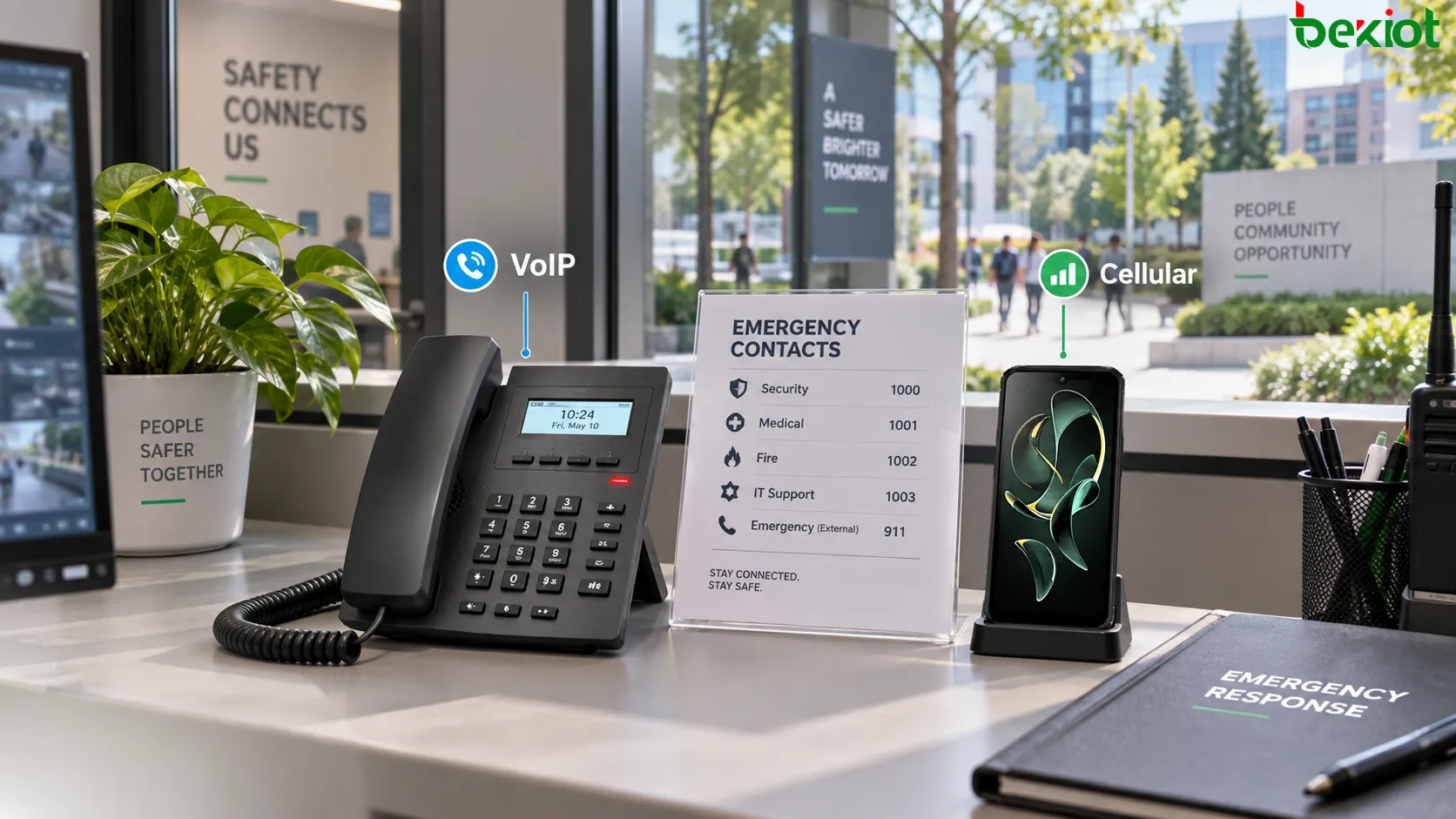
Enterprise Emergency Calling Plans Must Manage Numbers, Locations and People
Once a technical secondary path exists, another issue remains: who should use it, when should they use it and how will they know what to do?
Many organizations already maintain fire-department numbers, security desk numbers, medical emergency contacts and internal emergency extensions. But if that information exists only on page 37 of an emergency response manual, employees are unlikely to find it quickly during a high-stress incident.
For control rooms, reception desks, security centers, hazardous-area duty stations and other critical positions, alternative contact details should be incorporated into a fixed Emergency Call Plan. They can be posted beside communications equipment or integrated into a dispatch interface. Changes should be centrally maintained, with each number clearly associated with its intended use and service area.
Location Management is especially important in multi-site organizations. A 911 configuration designed for headquarters cannot simply be copied to every branch. A SIP phone in a New York office and another in a Los Angeles warehouse may register to the same Cloud PBX, but each needs an emergency location appropriate to its actual site. Incorrect configuration can send the call toward the wrong PSAP or present an address hundreds of miles from the incident.
Softphones are more difficult because users move. The same employee may work from the office, home or another city while keeping the same business identity. Ordinary calls can continue using one enterprise number, but Emergency Calling cannot permanently assume that every user is physically located at headquarters.
A location-update mechanism is therefore required. Depending on the platform and regulatory requirements, this may involve user confirmation, network-based location information or another supported method of associating the endpoint with its current location.
Internal notification should also be part of the design. When someone places a 911 call from a multi-line telephone system, on-site security, reception or duty personnel can benefit from knowing who placed the emergency call and from which location. They can then meet police, fire or medical responders at the entrance and direct them to the correct building, floor or work area. Many IP PBX and cloud communications platforms support some form of Emergency Call Notification for this purpose.
Alternative Emergency Numbers Require Prior Verification
Published alternative emergency numbers can provide a practical option when 911 service is impaired. For an enterprise, however, printing a number on a wall does not automatically make it a reliable emergency path.
Each alternative number should have clear ownership and scope. Which agency maintains it? Which geographic area does it serve? Is it answered 24 hours a day? Who updates the number when it changes? Which employees are authorized or expected to use it? Does it require an outside-line prefix or special call routing?
The enterprise Dial Plan is an easy technical detail to overlook. Some telephone systems require users to dial "9" for an outside line. Others use custom short codes, number translation or SIP Route rules. If an employee enters a published emergency number during an incident, the PBX must be able to route it as expected. Emergency contact numbers should not be unintentionally blocked by normal Class of Service restrictions, Call Admission Control or Fraud Prevention policies.
At the same time, emergency contacts should not be mapped to shortcuts that are too easy to trigger accidentally. Repeated non-emergency calls consume Emergency Services resources and can become particularly disruptive during an actual service incident.
During the Canadian disruption, residents were specifically advised not to call 911 simply to test whether service had been restored. The same principle applies to enterprises: emergency calling tests should be planned and controlled rather than repeatedly using live 911 service during an actual outage.
A more appropriate approach is to coordinate testing with the voice provider, systems integrator and applicable public-safety procedures, or to use platform-supported test mechanisms for validating Emergency Location, Caller ID and routing behavior. Where supported, test services can help validate emergency calling configuration without placing unnecessary demand on live 911 operations.
Acceptance Testing Should Extend Beyond a Successful 911 Call
When a new VoIP system is commissioned, placing one emergency call from one office phone and confirming that it connects proves very little. It only demonstrates that, under those specific conditions, from that endpoint and through that particular route, the call can reach an emergency answering destination.
A more complete Emergency Calling acceptance process should cover different sites, endpoint types and failure conditions.
Fixed SIP phones should be checked to confirm that telephone identity and physical location match. Remote Softphones should be tested to verify that the location-management process works when users move. Multi-site systems should confirm that calls from each facility are associated with the appropriate local emergency services. Where multiple Carriers or SIP Trunks exist, the project should also define what happens to 911 calls when the primary route fails—whether the call fails over automatically, requires manual intervention or cannot be completed on the alternate route.
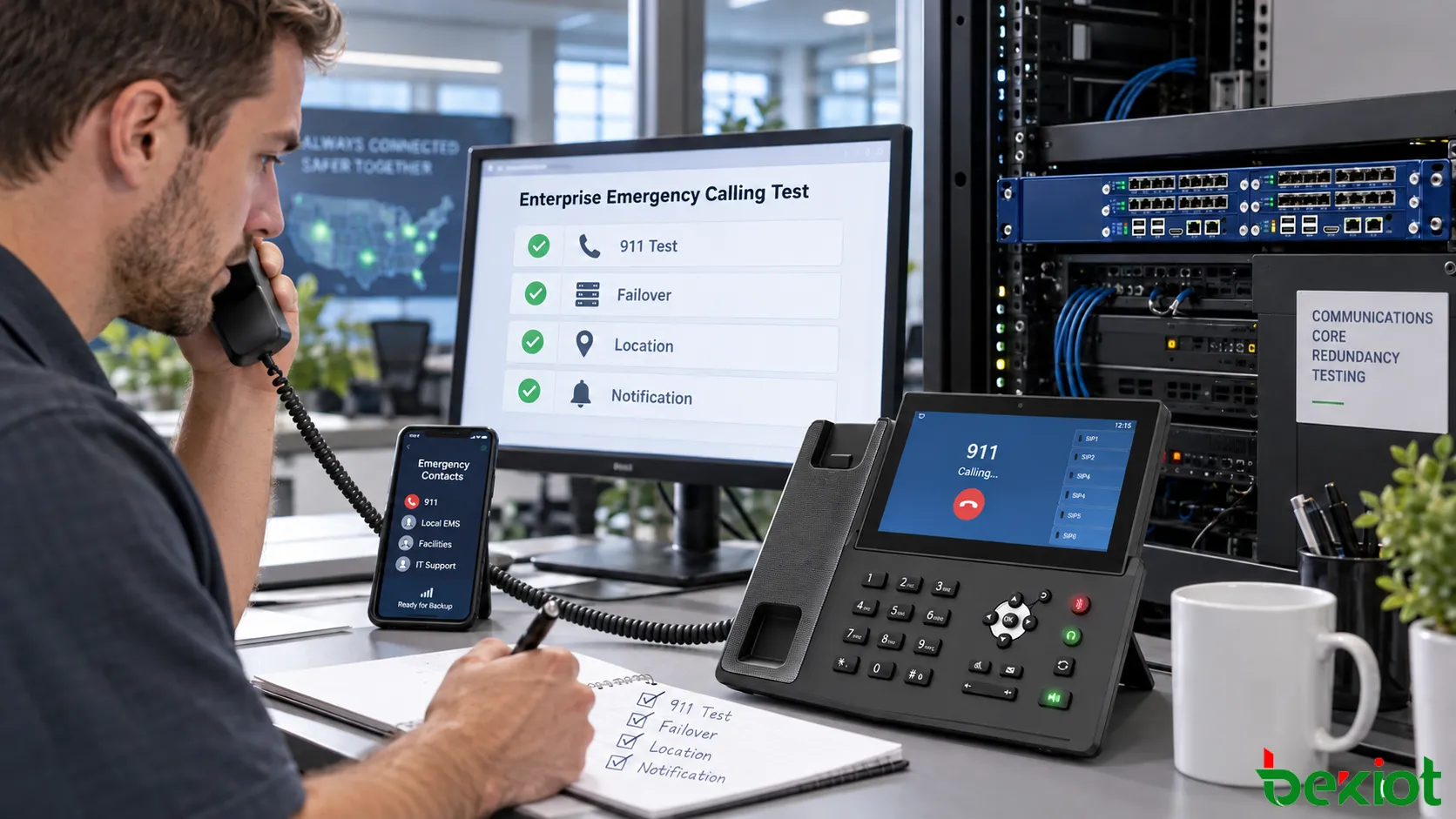
Controlled failure simulation is one of the most valuable parts of commissioning and one of the easiest to omit. The project can test how ordinary calls and emergency calls behave when the primary SIP Trunk is unavailable, whether the Emergency Route remains valid after a Backup WAN takes over, and whether Emergency Location, Caller ID and routing policies remain intact when the Primary PBX fails over to a Backup Server.
Alternative communications should be validated independently as well. A device showing Online does not prove that it can complete an Emergency Call. Cellular signal conditions, carrier coverage, SIM status and account status can all affect real-world availability.
A practical acceptance checklist can include:
Whether each fixed endpoint's Emergency Location matches its physical location;
Whether calls from different sites are associated with the correct local emergency-service area;
Whether an independent emergency contact path remains available after the primary Carrier fails;
Whether 911 routing remains correct after Backup WAN or SIP Server failover;
Whether local alternative emergency numbers are current and can be dialed successfully through the enterprise system;
Whether personnel in critical positions know what to do if 911 cannot be reached;
Whether security or duty personnel receive timely notification when an emergency call is placed;
Whether a Softphone user's emergency location is updated when the user changes work location.
The lesson from this intermittent 911 disruption is not that VoIP is unsuitable for Emergency Calling. IP communications can provide flexible routing, location management, emergency notifications and multiple failover options that are difficult to achieve with traditional telephony. Those capabilities, however, only become part of a reliable emergency communications system after they have been verified under failure conditions.
One of the most dangerous Emergency Calling designs is not a system with no backup capability at all. It is a system where everyone assumes an independent backup exists, only to discover during a real incident that the primary and backup paths share the same point of failure.
FAQ
Why Can 911 Fail Even When the IP PBX Is Working Normally?
The IP PBX is only one part of the Emergency Call path. A 911 call may also depend on the SIP Trunk, voice carrier, emergency call routing network and PSAP. A healthy enterprise telephone system does not prove that every segment between the carrier and Emergency Services is available. The intermittent Canadian 911 disruption is an example of how problems farther upstream can affect emergency calling even when local systems remain operational.
Can Wi-Fi Calling Be Used as a Reliable Backup When 911 Service Fails?
Wi-Fi Calling can provide an alternative access method when the cellular Radio Access Network is unavailable or impaired. Whether it actually bypasses the failure depends on where the problem exists. If the issue is located in the carrier core or emergency call routing infrastructure, Wi-Fi Calling may still rely on some of the same systems. It is better treated as one option within a broader emergency communications plan rather than as an automatically independent second 911 path.
Is One Backup Mobile Phone Enough for an Enterprise?
It depends on whether the backup phone shares the same carrier and failure domain as the primary communication path. If the main VoIP system uses Carrier A for SIP Trunking and the backup mobile phone also uses Carrier A, a carrier-side Emergency Calling failure could affect both. Critical facilities should evaluate whether backup methods use genuinely separate Carriers, Access Networks or Call Routes.
What Is One of the Most Commonly Overlooked VoIP Emergency Calling Configurations?
Emergency Location is a common weak point. In multi-site, remote-work and Softphone environments, the business identity can move with the user while the physical emergency location changes independently. The organization needs a process for keeping endpoint identity, emergency location and actual user location aligned. Otherwise, even a successfully completed emergency call may send responders toward the wrong address.
Becke Telcom provides IP PBX systems, SIP phones, voice gateways, SBCs and unified communications equipment, with solutions for primary and backup voice paths, network redundancy and emergency communications access across enterprise, multi-site and critical-facility environments.