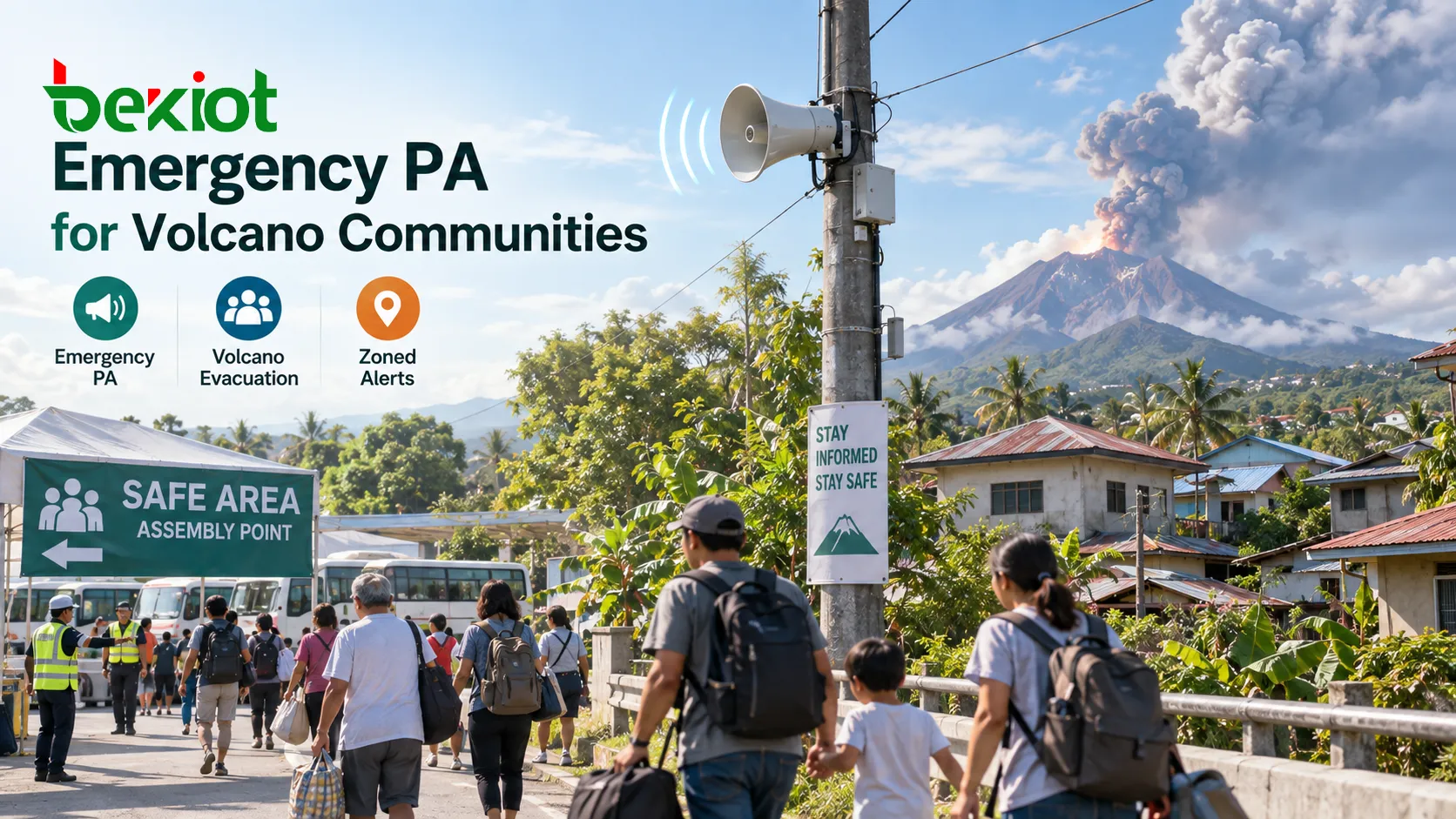
Imagine this scenario: At 2:00 a.m., seismic activity around Kanlaon Volcano suddenly intensifies. Most residents in nearby villages are still asleep. Phones are on silent, doors and windows are closed, and mobile networks begin slowing as emergency traffic rises. At that moment, the question facing an emergency operations center is not simply whether the volcano will erupt, but whether an evacuation instruction can travel across several kilometers of dark roads and reach enough people in time.
In September 2026, Barangay Cabagna-an in La Castellana, Negros Occidental, at the foot of Kanlaon Volcano in the Philippines, completed deployment of a public address system. The system is expected to serve 1,601 households and 4,473 residents, supporting faster delivery of community announcements, public advisories and emergency information.
It may be tempting to view the project as simply adding more loudspeakers to the village. For communities living within the influence zone of an active volcano, however, the more important questions are operational: can residents hear the warning immediately? Should people in different locations receive different instructions? Can the system continue broadcasting if the main network or power supply is disrupted? Once an alert is issued, do residents know where to go, which areas to avoid and when to expect the next update?
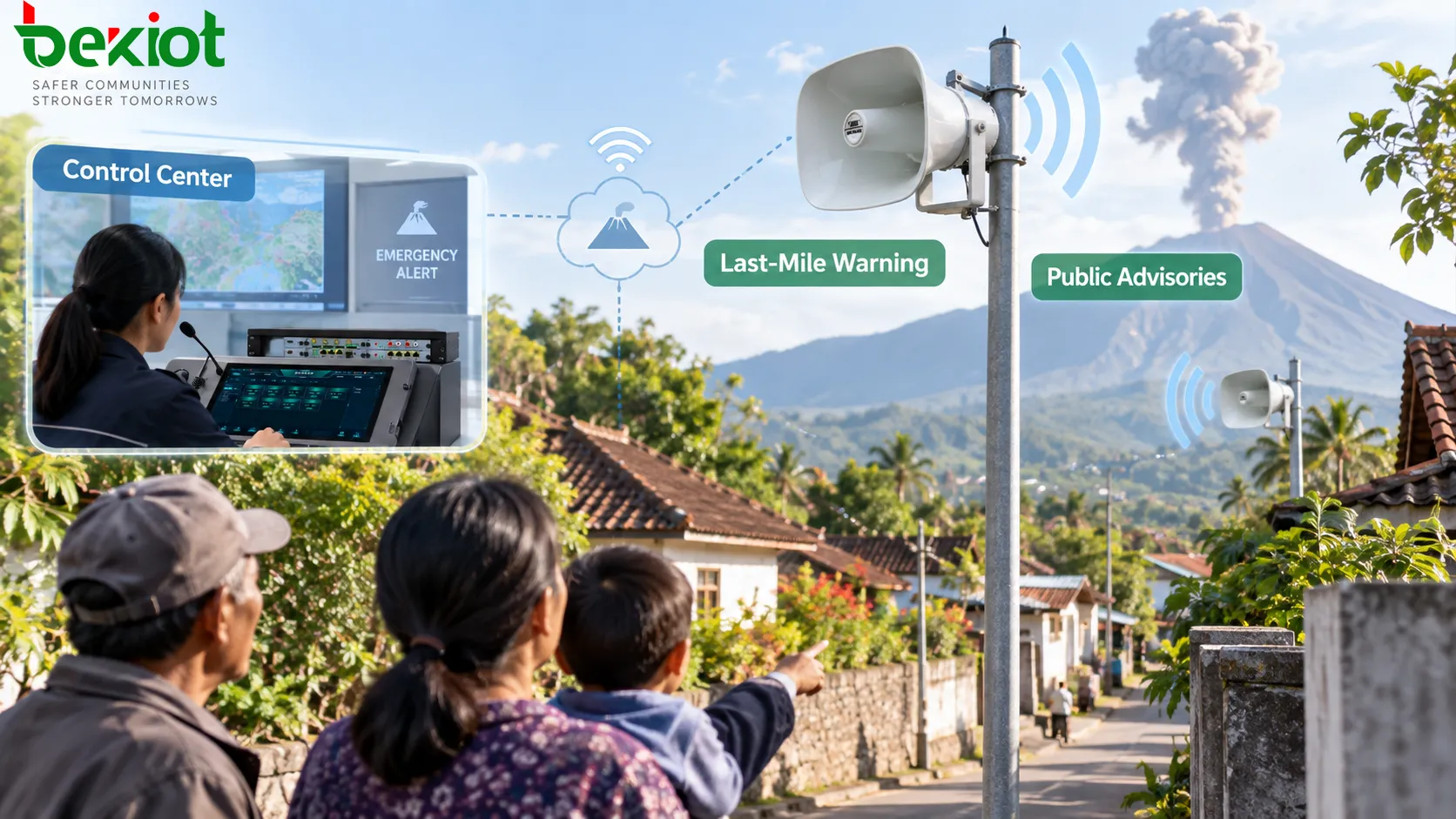
A public address system is not a disaster-monitoring system and cannot determine whether a volcano will erupt. What it can do is provide the final communication link between an emergency command point and the people who need to act. The deployment near Kanlaon Volcano brings attention to a problem that is often underestimated: risk information only becomes useful when it actually reaches people and is clear enough to turn into action.
Public Address at the Foot of a Volcano Solves the Last-Mile Communication Problem
The reason for deploying public address in Cabagna-an is straightforward. The community sits near Kanlaon Volcano, and during a disaster, public safety incident or large-scale emergency response, door-to-door notification, group chats or staff driving through streets with handheld megaphones are unlikely to reach thousands of residents quickly enough.
Telephone calls, SMS and mobile applications can all contribute to public warning, but each depends on individual devices and user behavior. Phones may be muted, messages may be ignored, and mobile networks can become congested during a sudden emergency. Outdoor public address works differently: it does not require residents to first open an application or check a device. The same spoken message is delivered directly into the shared physical environment.
The value of the PA system therefore goes beyond making announcements faster. It fills one of the most fragile gaps between the moment risk information becomes available and the moment residents begin to act:
Risk or incident information reaches the operations center → Affected areas are identified → Message content and priority are selected → Public address covers the target community → Residents receive clear action instructions → Later broadcasts update those actions as conditions change
In events such as volcanic activity, typhoons, floods or landslides, where the level of danger can vary sharply by location, the biggest failure is not always insufficient volume. It may be the wrong message reaching the wrong zone, instructions that are too vague to act on, or a system that fails at exactly the moment it is needed.
Emergency PA Deployment Starts with Deciding Where Messages Must Be Heard
Installing a public address system does not automatically mean the entire community will clearly understand an emergency message. The first design task is coverage planning, not deciding how many loudspeakers to purchase.
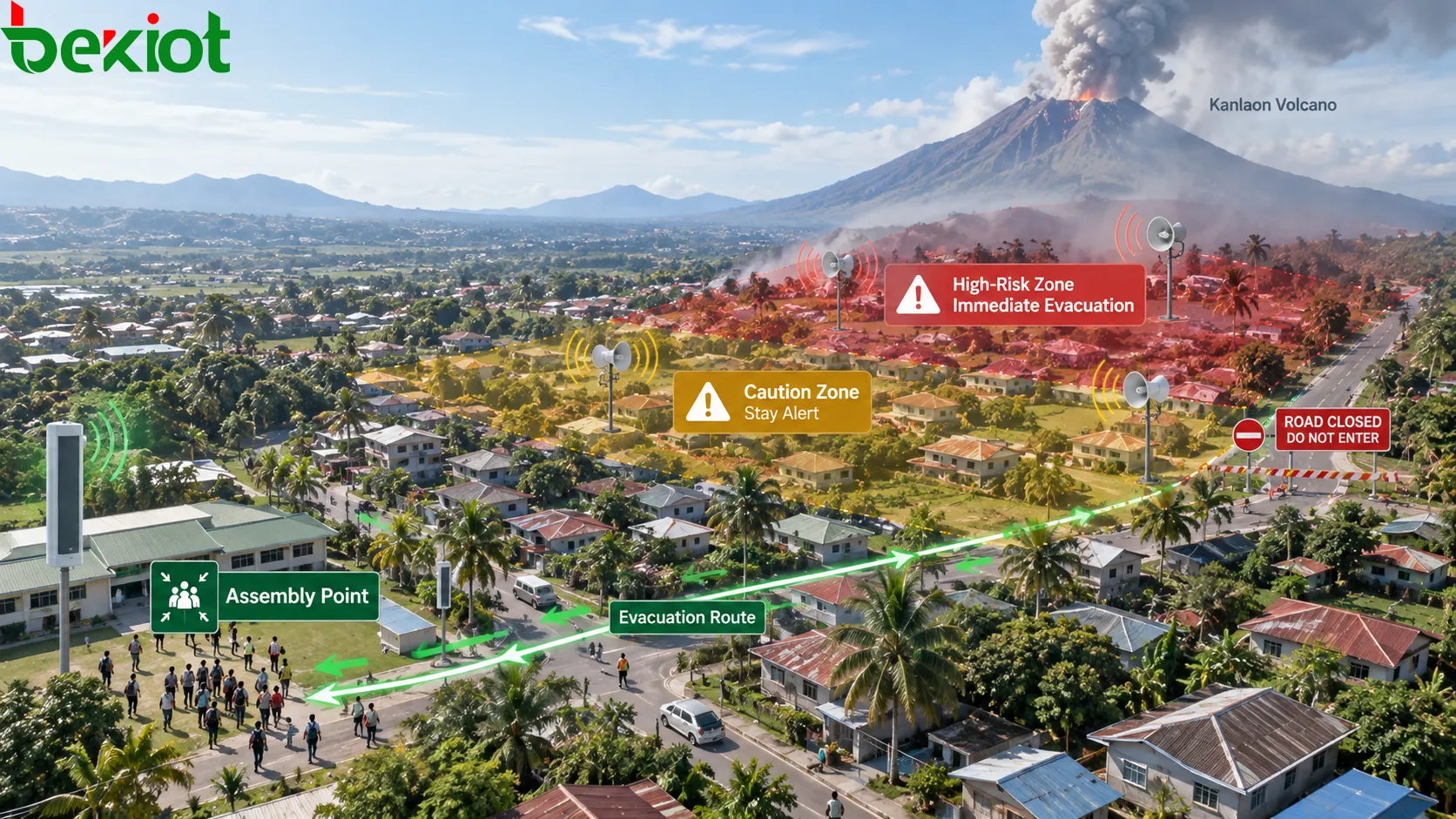
In a dispersed residential area near Kanlaon Volcano, dense housing, main roads, schools, community facilities, temporary assembly points and possible evacuation routes do not all require the same acoustic treatment. Residential clusters need blind spots controlled. Open roads require attention to propagation distance and wind conditions. Assembly points place greater emphasis on speech intelligibility than on sound pressure alone.
For that reason, the system is better divided into multiple Broadcast Zones according to geography and emergency-response requirements rather than treating the entire area as one permanent paging zone. Areas closest to the volcano, outer communities, major roads and evacuation centers can each be assigned separate coverage.
Zoning also allows residents in different areas to receive different instructions during the same emergency. People closer to the hazard may need to evacuate immediately, while those farther away may only need to remain alert or avoid entering a particular road. Broadcasting exactly the same message everywhere can create unnecessary movement and confusion.
Loudspeaker placement should also be checked against actual site conditions, including sound pressure, ambient noise, building obstruction and weather exposure. After installation, standing directly below a loudspeaker and confirming that it is audible provides little useful information. More meaningful testing takes place at residential boundaries, intersections and evacuation routes to verify that speech can actually be understood.
Emergency Broadcasts Must Tell People What to Do Next
The Kanlaon-area project emphasizes the timely delivery of Emergency Alerts and important information, but an emergency PA system only becomes useful when the message itself leads to action.
A warning tone can tell residents that something is wrong. What influences behavior is the spoken message that follows: which areas are affected, what action is required, where people should gather, which locations should be avoided and when another update will be issued.
A useful emergency announcement should answer several direct questions whenever possible: What happened? Which areas are affected? What should people do now? Where should they move? Which roads or directions should they avoid? Where will the next official update come from?
Communities near a volcano can prepare different Pre-recorded Messages in advance for alerting, evacuation readiness, immediate evacuation, route changes and all-clear notifications. When an actual incident occurs, duty personnel can issue an approved standard message first and then add Live Paging as conditions change.
This combination is generally more reliable than relying entirely on improvised speech under pressure. Pre-recorded messages can be reviewed beforehand so that locations, directions and required actions are expressed consistently. Live paging can then address the details that continue to change during the incident.
Emergency messages also need higher Priority. If the system is playing routine announcements, background audio or normal paging when an emergency begins, the critical message should be able to interrupt lower-priority activity immediately.
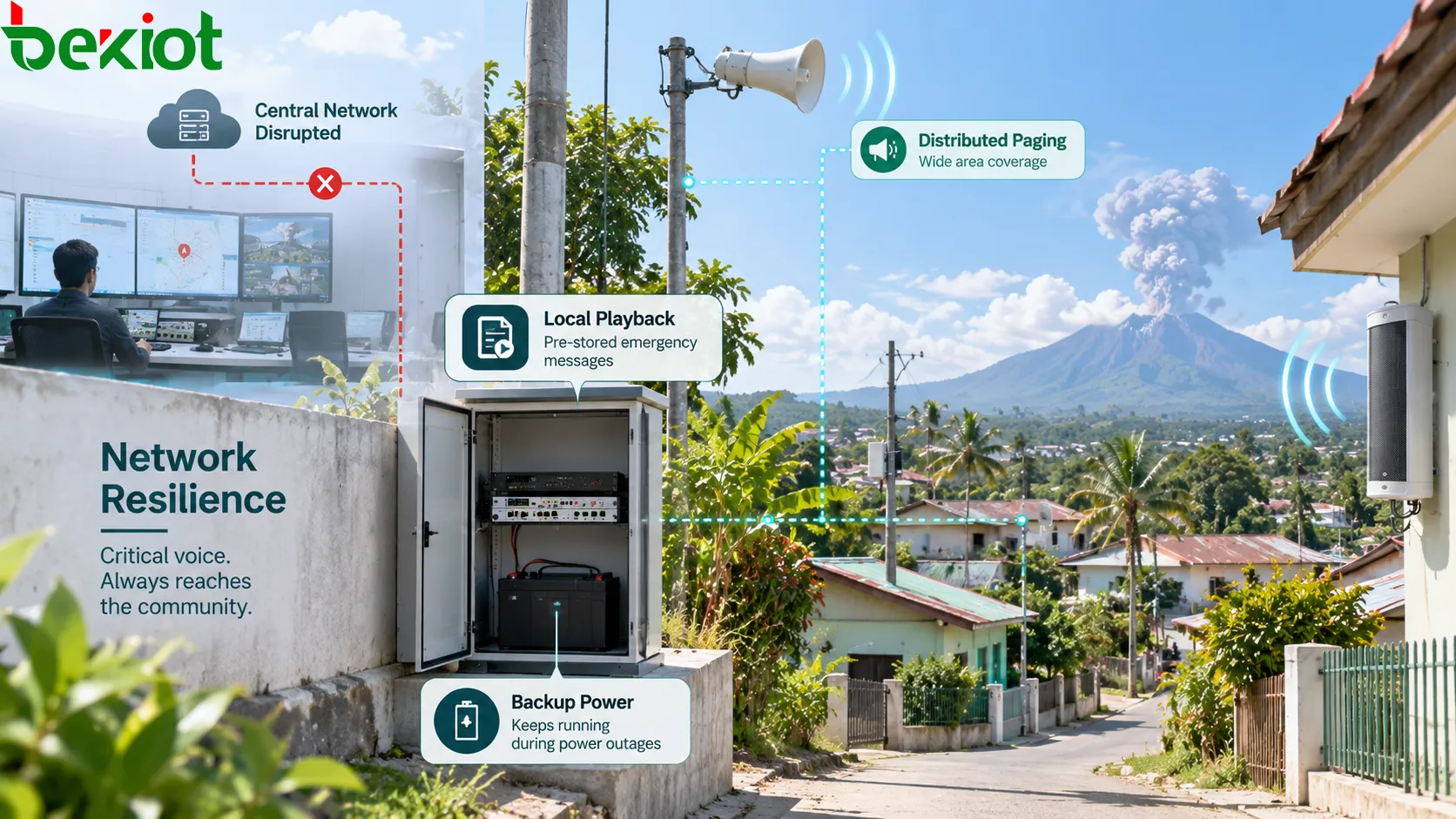
A Real Emergency Can Disrupt the Network and Power Supply at the Same Time
Under normal conditions, sending audio from a control center to multiple areas over an IP network is relatively straightforward. The harder question is what remains available after a natural disaster begins affecting local infrastructure.
If every loudspeaker depends continuously on one central server, one network path and one power source, failure of any critical node may silence a large part of the system. This is one of the clearest differences between an emergency public address system and an ordinary background music installation.
For communities around Kanlaon Volcano, a more resilient approach is to divide the system into areas capable of maintaining basic broadcasting locally. The central platform can handle normal administration and system-wide control, while regional endpoints retain essential Local Playback capability and stored emergency messages. If the connection to the central server is temporarily lost, selected emergency instructions can still be played locally.
Power resilience needs separate planning as well. Control servers, network switches, SIP amplifiers, IP paging endpoints and critical loudspeaker paths should be supported by UPS systems or other backup power according to the site's risk level. Backup duration should not be calculated only around a routine outage. It should reflect how long evacuation or community coordination may need to continue, how quickly normal power can realistically be restored and whether portable power sources are available.
Single points of failure should also be reduced where practical. Important areas can use separate network paths, regional amplifiers or distributed endpoints so that failure of one central amplifier does not silence every loudspeaker at once.
The objective is not to guarantee that every device will operate continuously under every possible disaster condition. It is to preserve the most important emergency voice capability when part of the network or central infrastructure becomes unavailable.
Broadcasting the Message Is Only Half of the Response Loop
Public address is naturally a one-to-many communication method, but emergency response cannot remain a one-way process. The operations center also needs to know which areas received the message, whether roads remain passable, whether residents are stranded and whether the next broadcast should be changed.
If a community system such as the one in Cabagna-an is expanded in the future, PA can be complemented by SIP telephones, emergency intercoms, mobile radios, video monitoring or dispatch platforms. Public address can handle rapid mass notification, while two-way communication equipment returns field information to the operations center.
A more complete emergency communication cycle looks like this:
Incident confirmed → Affected Broadcast Zone selected→ Pre-recorded or live emergency message issued→ Field teams report road, population and area conditions → Operations center adjusts the next broadcast→ Updates continue until the incident stabilizes
This is why extending public address coverage to 1,601 households near Kanlaon Volcano has practical value, while the PA infrastructure itself remains only one part of the response system. Its role is to make sure large numbers of residents hear the message at the same time. Whether that message produces effective action still depends on evacuation routes, community organization, duty personnel and other communication channels working together.
The Most Important Acceptance Test Is Not Whether the PA Works, but Whether It Still Works During Failure
A system tested only once during handover with a full-area broadcast provides limited evidence of how it will perform during a real emergency. This is especially true in volcanic zones, mountainous areas and communities where homes are widely dispersed.
Each Broadcast Zone should first be tested independently, and speech intelligibility should be checked from multiple representative listening positions. Residents need to understand the message, not simply hear that a loudspeaker is producing sound.
Emergency Priority should also be verified against ongoing routine audio. Operators should test how quickly the system can switch between pre-recorded messages, Live Paging and different zones during an incident.
Failure testing is even more important. The central network can be disconnected intentionally to check whether local endpoints still play the required stored messages. Main power can be removed to confirm which devices remain active and for how long. One paging node can be taken offline to verify whether other zones continue operating normally.
Community drills matter as much as equipment testing. The system near Kanlaon Volcano is intended to serve 4,473 residents. If people do not recognize different alert tones or do not know where to go after hearing an evacuation instruction, even a well-designed loudspeaker network cannot complete the emergency response by itself.
A reliable deployment therefore combines system testing with operational procedures:
Coverage testing→ Speech intelligibility checks→ Zone and priority verification→ Network and power failure testing→ Backup path verification → Message template review→ Community drills→ Coverage and procedures adjusted from the results
The lesson from the public address deployment at the foot of Kanlaon Volcano is clear: the value of an emergency PA system is not measured by how many routine announcements it can play. Its value appears when residents urgently need one clear instruction and the system can deliver the right information to the right area within a limited window of time, in language that tells people what to do next.
FAQ
Are More Loudspeakers Always Safer in Volcanic or Disaster-Prone Areas?
No. Loudspeaker quantity is only one part of coverage design. Blind spots, speech intelligibility, zoning boundaries, mounting positions, ambient noise and real evacuation routes all need to be considered. Adding more loudspeakers without proper placement and power planning can still leave some residents unable to understand announcements and may even create overlapping audio that reduces intelligibility.
Can an Emergency PA System Still Broadcast if the Network Fails?
It depends on the system architecture. If regional endpoints support Local Playback and store essential emergency audio locally, critical announcements may still be triggered even when the central server or part of the network is unavailable. The design stage should clearly define which functions depend on the central platform and which emergency capabilities must remain available at the edge.
Can Public Address Replace SMS or Mobile Emergency Notifications?
No single communication channel should normally be treated as the only method of emergency notification. Public address is effective for quickly reaching people in a physical area, while SMS and mobile alerts can deliver more detailed information to individual devices. Radio, telephone, intercom and other communication channels can provide additional paths. Disaster communications are stronger when multiple methods complement one another rather than when one technology is expected to replace all others.
How Often Should an Emergency PA System Be Drilled?
There is no universal interval for every project. The schedule should reflect local risk levels, operating procedures, staff turnover and environmental conditions. In addition to planned drills, critical workflows should be tested again after system expansion, zoning changes, evacuation-route changes or major platform upgrades.
Becke Telcom provides IP paging systems, SIP amplifiers, IP horn speakers, column speakers, paging microphones, PAGA systems and unified dispatch equipment for communities, industrial parks, energy facilities, transportation environments and other critical sites. Emergency PA architectures can be planned around broadcast zoning, acoustic coverage, backup power, network resilience and emergency coordination requirements. For projects that need to preserve critical voice notification during an incident, Becke Telcom can combine centralized control, regional paging and local emergency playback with the site's existing communications network.