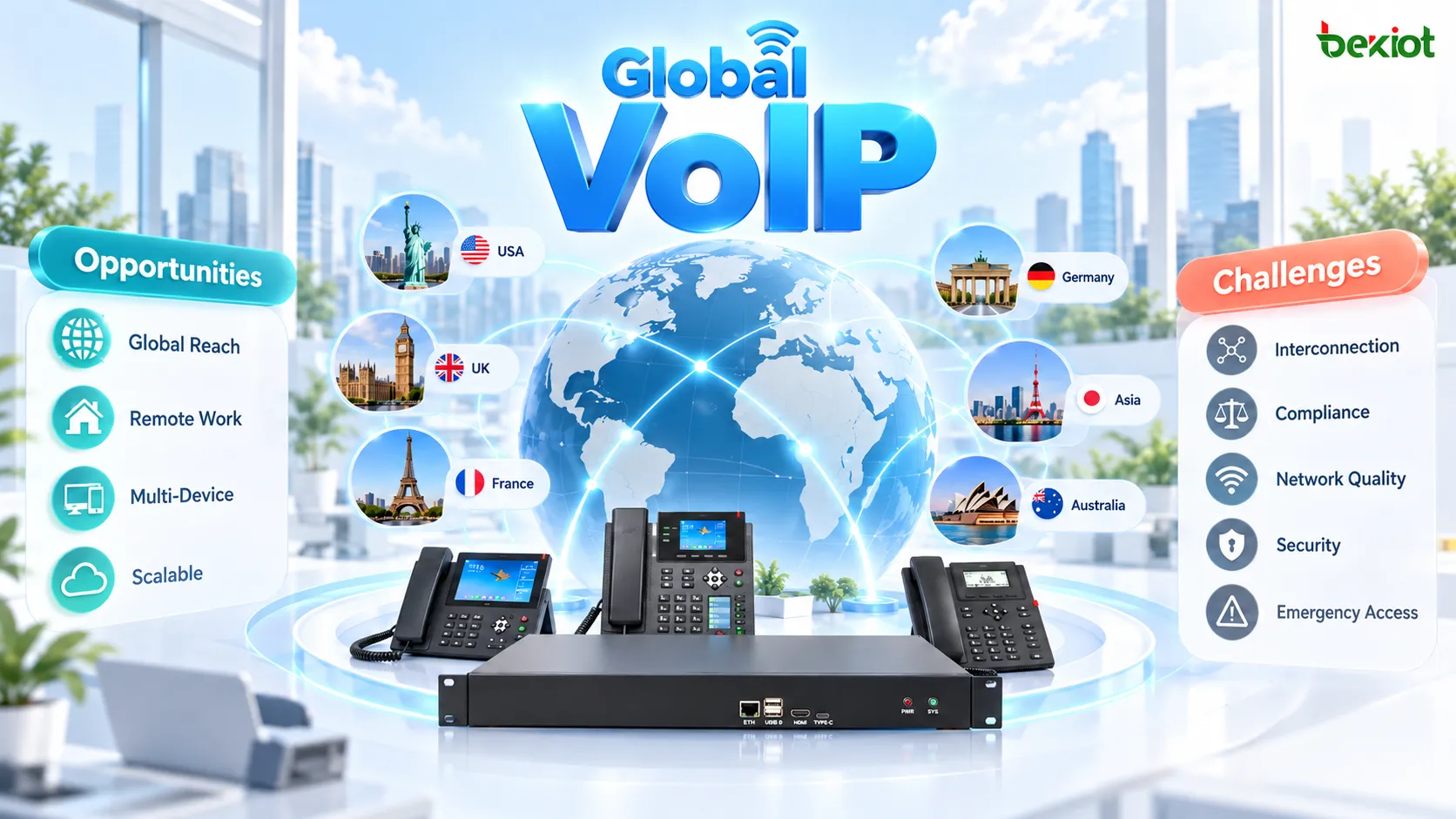
As business becomes increasingly global, growth opportunities no longer come only from the local market. Customers, partners and employees may be spread across several countries, but those opportunities also introduce a new set of communication challenges.
A customer in Europe wants to reach a sales representative but has to dial an international number. An employee is traveling in Germany, while calls to the company line still ring on a desk phone in Shenzhen. An Australian customer calls during the afternoon, but headquarters is already in the middle of the night. These situations may look like an international-calling problem, but the deeper issue is that traditional telephony ties phone numbers, physical lines, offices, devices and business hours too closely together.
The real change brought by VoIP is not simply converting analog voice into IP packets. It allows phone numbers, users, devices and call-routing rules to be reorganized through software. For companies building international customer bases, distributed teams and multi-region service operations, this directly affects how customers reach the business, where employees can answer calls and how much communications infrastructure is required when entering a new market.
So which everyday communication barriers can VoIP actually remove, and which limitations still depend on carriers, network infrastructure, regulation and the company's own system design?
Why Does Global Expansion Expose the Limits of Traditional Telephony?
Traditional business telephony is built around a clear physical relationship: a phone number belongs to a carrier line, that line terminates at an office, and a PBX delivers the call to a fixed extension. For a business operating from one location, this model can remain stable for years. Once operations spread across countries and time zones, however, that fixed relationship becomes increasingly restrictive.
When a company opens a second international location, it may need to order local telephone lines, deploy another phone system, create a new numbering plan and then find a way to connect that office back to headquarters. Employees can use their extensions while sitting at their desks, but once they leave the office they may need call forwarding, a mobile number or a separate application. Customers may also end up with a growing list of different contact numbers for different offices and regions.
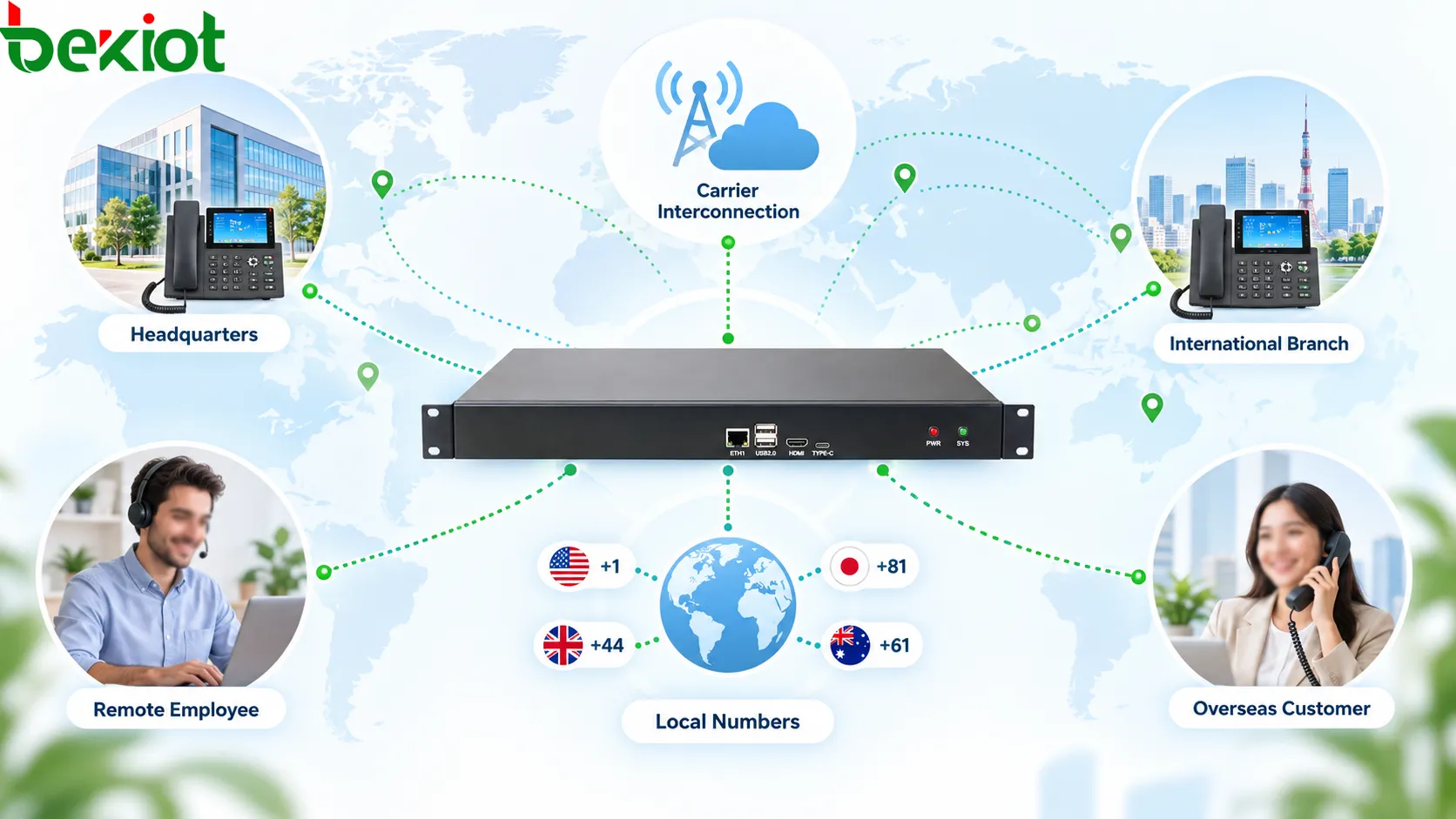
VoIP changes this physical dependency. Business numbers can be managed centrally by an IP PBX or cloud communications platform, while SIP phones, desktop softphones, mobile apps and browsers can all act as communication endpoints for the same user. The office still matters, but the business number no longer has to exist only on a telephone connected to one wall socket.
This is one of the most important benefits of VoIP for global operations: communications resources can be organized around users and business workflows rather than being defined entirely by physical lines and locations.
International Calling Savings Go Beyond the Per-Minute Rate
International calling cost is often the first reason a business considers VoIP, but comparing only the price per minute can underestimate the broader difference.
A traditional multinational telephone environment may include monthly line rental, PBX hardware, international calling charges, inter-office trunks and local maintenance costs. Once internal voice moves onto an IP network, communications between headquarters and branches can use the corporate WAN, VPN, private links or a cloud platform instead of treating every inter-office conversation as a conventional public telephone call.
External calls that must reach the PSTN or mobile networks still require a SIP Trunk, cloud voice carrier or local telecommunications provider. VoIP therefore does not make every international call free. Charges can still vary by country, destination, number type and service plan.
What changes is the business's ability to choose how calls are routed. A New York office calling a customer in the United States can use an appropriate U.S. voice route, while a UK employee calling a UK customer can use a UK number and local carrier resources instead of sending every call back through another country before it reaches the PSTN.
Once a business operates in several regions, this routing flexibility can matter more than finding the absolute lowest per-minute rate because it can influence cost, Caller ID presentation, call completion and how customers perceive the origin of the call.
Why Do Local Numbers Make a Global Business Feel Closer to Customers?
When a company headquartered in China, the UK or the United States wants to serve customers in another country, one of the first communication barriers is often not the quality of the sales team. It is the unfamiliar international number the customer sees before the conversation even begins.
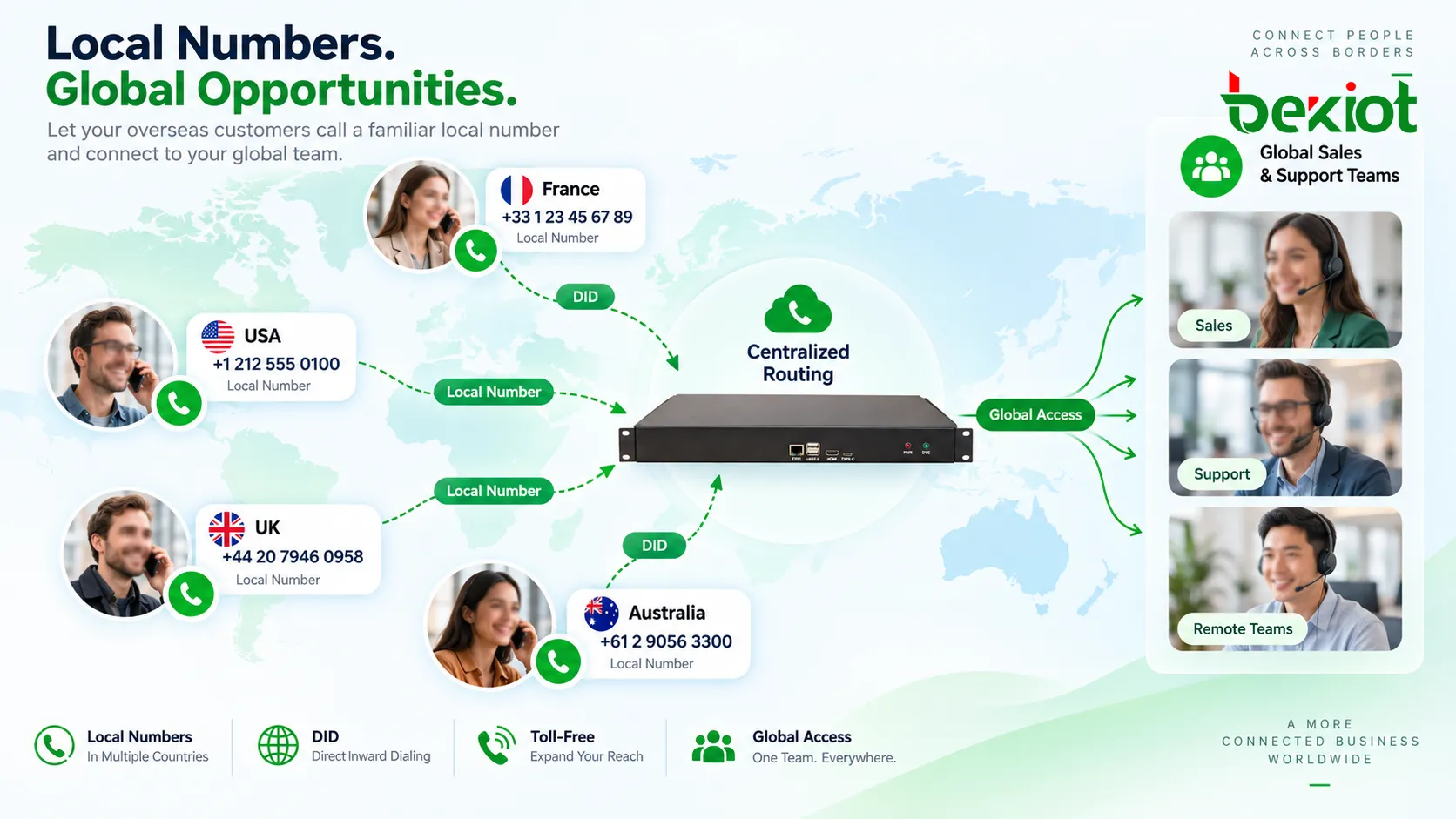
VoIP platforms can often bring Local Numbers, DIDs or Toll-Free Numbers from different regions into one communications environment. Customers dial a familiar number in their own country, while the destination behind that number might be a local office, a customer-service team in another country, a call queue or a remote agent.
This allows a company to create a local telephone entry point without necessarily installing a separate PBX behind every local number. A customer in France may call a French number, a U.S. customer may call a U.S. number and a UK customer may call a UK number, while all three calls can still enter the same customer-service operation according to centralized routing policies.
For the customer, the benefit is easier dialing and a more familiar point of contact. For the business, it separates the question of where the number is located from where the employee answering the call is physically sitting.
There is, however, an important limitation: virtual numbering does not mean a business can automatically obtain any number in any country. Numbering regulations differ by jurisdiction. Some countries or number types may require business identification, a local address, end-user documentation or other regulatory information. International numbering remains subject to local telecommunications rules rather than being determined solely by VoIP technology.
What Changes When the Business Number Follows the User?
Traditional telephony often treats an employee's number as something attached to a phone on a desk. Once the employee works from home, travels internationally or moves temporarily to another branch, customers may need a mobile number, call forwarding or an entirely different contact method to reach the same person.
VoIP separates the business number from a single physical endpoint. The same business identity can appear on a desk SIP phone, laptop softphone, mobile app or browser. An employee traveling overseas does not necessarily need to give every customer a temporary contact number.
For users, this benefit is more tangible than the technical phrase "Internet telephony." A salesperson can return customer calls using the company number after leaving the office. A customer-service supervisor at another site can continue participating in the same call queue. A manager can review missed calls and voicemail on a laptop instead of returning to a physical desk phone.
More importantly, the external identity remains under company control. Employees can change devices, offices or working patterns without forcing customers to keep updating the business phone number stored in their contacts.
This mobility still depends on proper authentication, endpoint permissions and network quality. The number is not permanently attached to an employee's personal phone. Instead, the platform determines which authorized devices are allowed to use that business identity.
How Can Time-Zone Routing Turn Distributed Teams into One Service Window?
One of the most practical challenges of global business is simple: telephone calls are real-time, but the world does not work the same hours.
When a U.S. customer calls in the afternoon, headquarters in Asia may already be closed. When an Australian customer starts the working day, a European support team may not yet be online. If every international number ultimately rings the same reception desk at headquarters, the company may have global numbers without delivering a genuinely global customer experience.
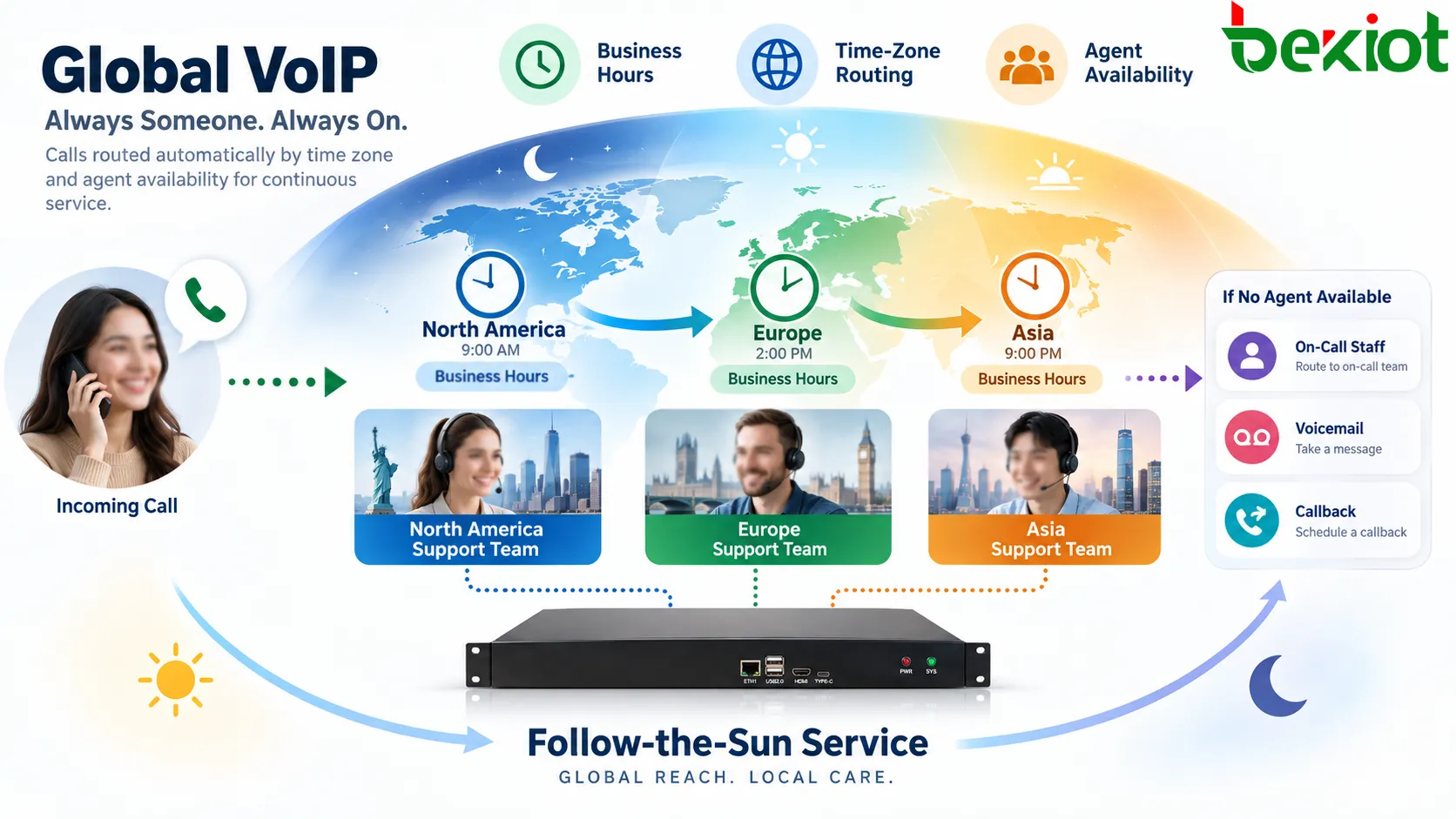
VoIP Call Routing allows time to become one of the routing conditions. Incoming calls can be directed according to Business Hours, Time Zone, queue status, user availability and geographic region.
A global service number, for example, could operate like this:
Asian Business Hours → Asia Support Team
European Business Hours → Europe Support Team
North American Business Hours → North America Support Team
No Agent Available → On-Call Staff / Voicemail / Callback Workflow
This operating model is often described as Follow-the-Sun Service. Customers continue using one number or a familiar local entry point, while the platform decides which team is best positioned to answer at that moment.
AI can add intent recognition, language detection, summaries and more advanced routing, but the foundation of cross-time-zone service remains the ability to coordinate phone numbers, time policies, user presence and call queues within one communications environment.
Why Doesn't Entering a New Market Require Another Complete Phone System?
Traditional multi-site expansion can easily produce a familiar pattern: headquarters has one PBX, the second office gets another, and a third country receives a third system. Each environment has its own numbers, voicemail, administrators and carrier lines. A few years later, the company is managing several separate telephone islands.
IP-based communications make it possible to centralize more of these capabilities. Adding an overseas sales team may primarily require new users, phone numbers, permissions and endpoints rather than another complete voice core.
This makes it easier to test a new market. A company can begin with a small number of local numbers and remote agents, validate demand and customer volume, and then expand users, seats and on-site endpoints as the business grows. Communications can scale with the organization without requiring a major hardware deployment before each stage of growth.
The same flexibility applies in the opposite direction. When an employee leaves, a department changes or a temporary project ends, administrators can reclaim numbers, accounts and permissions without rewiring the office.
VoIP scalability therefore means more than simply supporting a large number of extensions. More importantly, adding or removing communications resources becomes much closer to a software configuration task than a physical infrastructure project.
The Biggest Convenience Often Happens Before and After the Call
Once voice becomes part of an IP communications platform, the user experience can extend beyond the act of placing or receiving the call itself.
When a customer calls, a CRM system may use the calling number to display the customer record. An unanswered voicemail can be transcribed and sent to the appropriate employee. After a sales call, call records and notes can be attached to the customer history. A complex conversation can also continue from voice into a video meeting or messaging session.
The purpose is not to force every application into one screen. The real benefit is reducing repeated searches and manual handoffs during a communication workflow. An employee does not have to write down a caller's number and then manually search the CRM. A manager does not need to wait until someone returns to the office to know whether an important customer has called back.
Asynchronous capabilities are especially useful for international teams. If a customer leaves a voicemail in another time zone, transcription and notification can become an actionable item when the local team begins work the next morning. Teams in different regions can also work from the same customer communication context.
These capabilities are not automatically included in every VoIP system. Voicemail Transcription, CRM Integration, Recording, Video and Messaging depend on the platform, licensing model and integration architecture. Businesses should therefore distinguish between what VoIP technology can support and what the purchased communications platform actually provides.
Which Problems Do Not Disappear Just Because Voice Moves to IP?
One of the biggest misconceptions about VoIP is that once communications use Internet Protocol, the traditional constraints of telecommunications somehow disappear. Several important limitations remain.
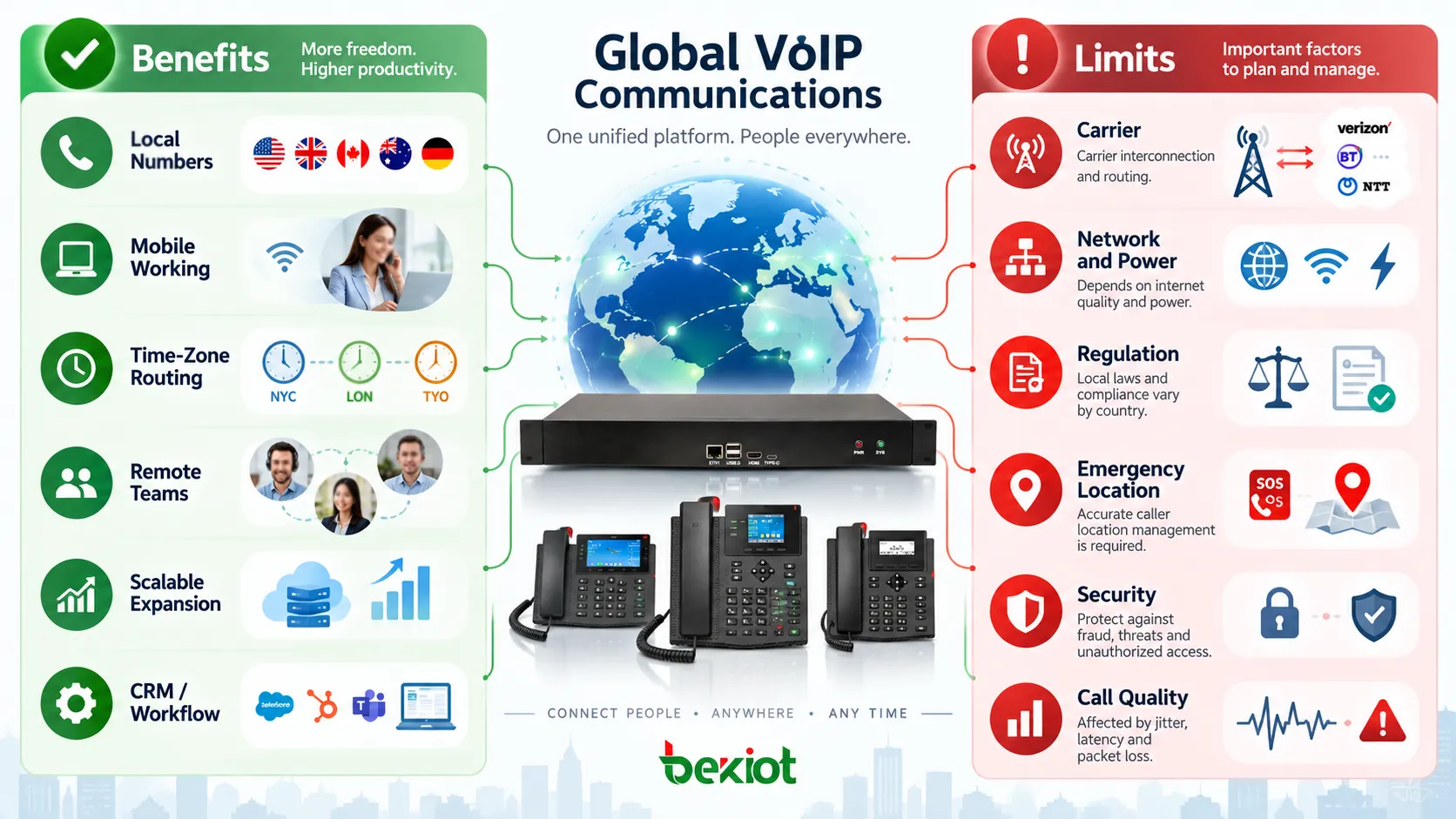
The first is carrier interconnection. Internal users can reach the communications platform over IP, but calls to ordinary landlines, mobile phones, international destinations and toll-free numbers still require a SIP Trunk, cloud voice carrier or another PSTN interconnection service. VoIP changes how the business reaches the telephone network; it does not eliminate the public telephone network.
The second is network and power dependency. Traditional analog phones can, in some environments, receive power from the carrier line. VoIP depends on routers, switches, Internet or WAN connectivity, servers and endpoint power. If these components fail, calling can be affected. Important sites may therefore still require dual WAN connections, mobile-network backup, UPS power and Fallback Routing.
The third is local regulation. Businesses can obtain numbers in many countries, but not every jurisdiction allows every number type to be used without a local company, address or identity documentation. Caller ID presentation, call recording, data retention and cross-border communications can also be subject to local rules.
The fourth is emergency calling location. An employee may carry a Softphone from the office to a hotel, home or another country while continuing to use the same business number. Emergency services, however, need the user's actual current location. VoIP deployments therefore need to handle Emergency Calling and Caller Location correctly rather than relying blindly on the registered office address.
The fifth is security and call quality. Once voice moves onto an IP network, it becomes exposed to issues such as account compromise, SIP scanning, abnormal routing, jitter, latency and packet loss. Convenience does not remove the need for SBCs, access controls, TLS/SRTP, QoS, logging and operational monitoring.
How Can a Business Verify That These VoIP Benefits Work in Practice?
When evaluating VoIP, businesses can easily be attracted by feature lists: international numbers, mobile apps, AI, CRM integration and video. What ultimately determines the user experience, however, is whether those capabilities work reliably in real operating conditions.
If global expansion is the objective, acceptance testing should use realistic scenarios. A business can call an overseas local number from the actual public telephone network and confirm which team receives the call. Employees can move between office Wi-Fi, home broadband and mobile networks to verify that the company number remains usable. Calls can also be simulated across different time zones to confirm that Business Hours and fallback rules work as designed.
International outbound calling should also be checked for Caller ID presentation, number formatting, call completion and actual pricing rather than simply confirming that a call can connect. For number migrations, the company should confirm Number Portability, number ownership and whether the business retains control of the number after the previous service is cancelled.
Failure conditions should be tested intentionally as well. What happens when the primary Internet connection fails? Is there an alternative route for critical numbers if the cloud platform becomes unreachable? Does emergency-location information need to be updated when remote employees move? If a local number in one country becomes temporarily unavailable, can customers be redirected to another service path? When these questions have clear answers, the convenience of VoIP becomes a real business experience rather than a feature listed on a product page.
From this perspective, a global business does not simply need "cheaper international calling." It needs a communications environment capable of reorganizing numbers, users, devices, regions, time zones and business workflows as the organization changes.
This is where VoIP creates the most value. Customers do not need to know where an employee is sitting. Employees do not lose their business identity simply because they leave the office. A company entering a new market does not necessarily need to reproduce an entire traditional telephone infrastructure before it can begin operating.
VoIP can reduce communication friction, but it does not remove the boundaries of telecommunications. Carriers, numbering regulation, network quality, emergency services and security still matter. A mature deployment takes advantage of VoIP's flexibility while designing around the constraints that do not disappear.
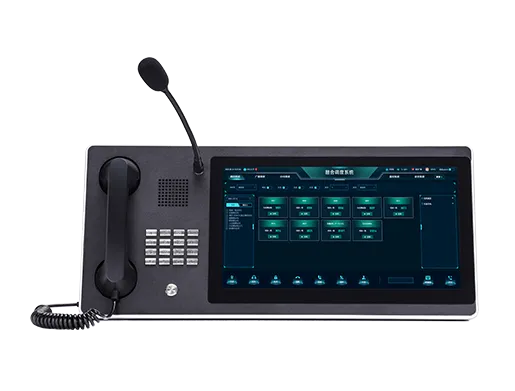
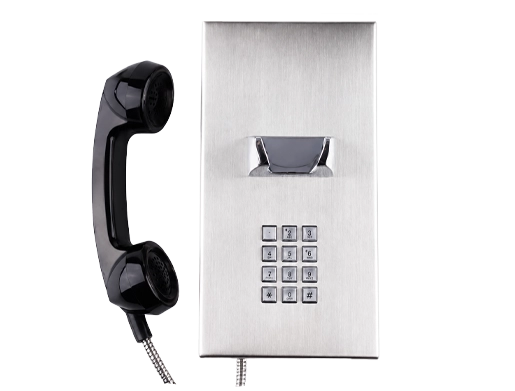
For businesses building multi-site, cross-regional or global communications environments, Becke Telcom provides IP PBXs, SIP phones, voice gateways and unified communications platforms for connecting headquarters, branch offices and remote employees, with support for centralized numbering, call routing and multi-device access.
FAQ
Can a Business Always Obtain a Local VoIP Number Without Having an Office in That Country?
No. Requirements vary by country and number type. Some numbers may be available to overseas businesses, while others may require a locally registered company, proof of address, end-user information or other regulatory documentation. The specific rules should be confirmed before planning an international numbering strategy.
Can a Business Always Port Its International Numbers When Changing VoIP Providers?
No. Number Portability depends on the country, number type, existing carrier, new provider and ownership arrangement. Before signing a service agreement, a business should confirm whether the number is registered to the company or the provider, whether Port Out is supported and how incoming calls will be protected during migration.
Can a Global VoIP Platform Completely Replace Local Mobile Phones and SIM Cards?
Usually not. VoIP is well suited to centralizing business numbers and communications, but mobile networks still provide local wireless coverage, SMS, mobile data and other region-specific capabilities. Multinational businesses commonly use VoIP as the unified business communications layer while continuing to work with local fixed and mobile carrier services.
Can Employees Continue Using the Company Number When Taking a Softphone to Another Country?
Technically, an authorized user can often continue signing in over an Internet connection. Whether a specific number may be used, which Caller ID can be presented, how emergency calling is handled and what data-compliance rules apply still depend on the provider, company policy and local regulation. Cross-border mobile use should therefore be tested before formal deployment rather than being judged only by whether the client can log in successfully.