Could a routine “free broadband upgrade,” “network optimization,” or “equipment maintenance” visit become an entry point for telecom fraud? Could a small device connected to power and Ethernet help disguise overseas scam calls as local numbers? As businesses and individuals rely more heavily on VoIP, is Caller ID alone still enough to determine whether a call can be trusted?
In a recent anti-fraud case, China Unicom's Fushun branch detected suspicious communication activity during routine monitoring and later discovered a hidden VoIP device associated with telecom fraud. The important point was not simply the presence of a so-called “black box,” but the fact that such equipment could use ordinary broadband access, network interfaces and voice-conversion functions to hide unauthorized communications inside otherwise normal IP traffic.
The case highlights a security problem that has become more significant as VoIP adoption has expanded: once telephony moves from fixed lines onto IP networks, communications security can no longer focus only on phone numbers and physical circuits. It must also protect user accounts, endpoints, gateways, SIP trunks, call routing and the entire voice trust chain.
The real issue is not whether VoIP itself is secure or insecure. VoIP is already a core technology behind business phone systems, cloud PBXs, contact centers, remote work and unified communications. What needs to change is the security architecture around it. An organization should be able to determine which devices are allowed to connect, which accounts may register, what destinations users are permitted to call, which gateways a call may traverse, and what communication behavior should trigger an immediate security alert.
Control Which Devices Are Allowed onto the Voice Network
One of the most overlooked layers of VoIP security exists before SIP registration even begins. An IP phone, ATA, voice gateway or other network-connected voice device only needs access to a switch port, an IP address and a reachable network path before it can potentially establish communications.
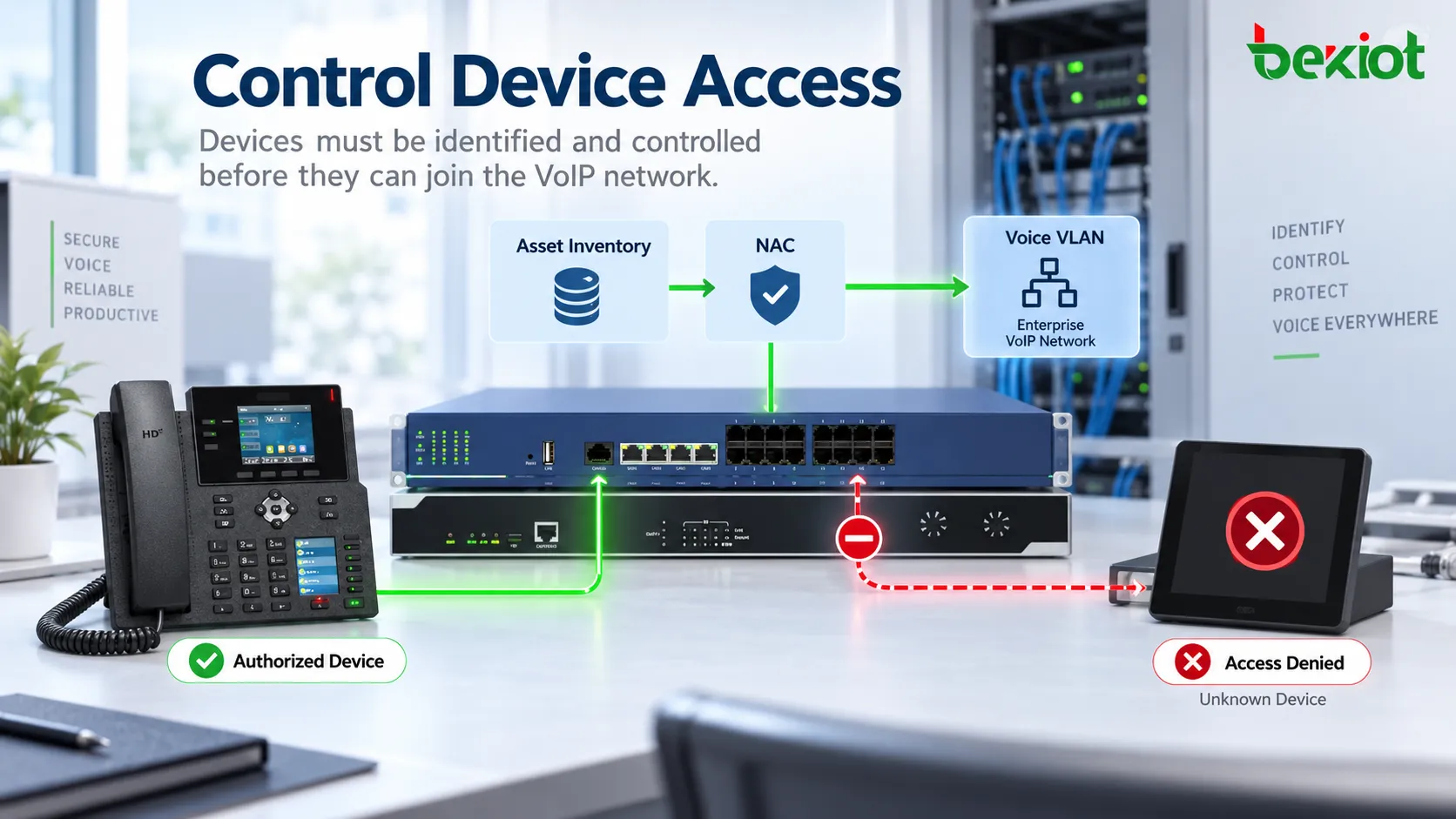
Organizations should therefore maintain a complete Voice Asset Inventory. Every IP phone, SIP gateway, SBC, IP PBX, conference endpoint and related voice device should have a documented model, MAC address, IP address, installation location, owner and business purpose. New devices should require approval rather than becoming trusted simply because they were plugged into the network.
In larger environments, VoIP endpoints can be placed in dedicated Voice VLANs and combined with 802.1X, NAC, MAC Authentication or switch-port policies to restrict unknown devices. The fact that an office computer is allowed Internet access does not mean that the same physical port should also allow an arbitrary voice gateway to reach external SIP servers.
Branch offices, unattended equipment rooms, wiring closets and network ports exposed in public areas deserve particular attention. Recent fraud schemes involving “on-site maintenance” or “free network upgrades” show that communications security now involves both Cyber Security and Physical Access Control.
The first line of defense should be able to answer a very simple question: Who installed every voice device currently connected to the network, and why is it there?
Move SIP Account Security Beyond Password Management
Once devices are connected to the network, the next layer of risk involves SIP accounts. Many VoIP attacks do not require an advanced software exploit. A long-lived extension password, a default administrator account or an active softphone account belonging to a former employee may be enough to create an entry point.
A SIP extension should therefore not be managed as nothing more than “a phone number and a password.” It should become part of the organization's identity lifecycle. Account creation, authorization, use and deactivation all need clearly defined controls. When employees leave, change roles or complete a contractor assignment, their voice permissions should change accordingly.
Internet-facing softphones, remote agents and administrative accounts can be protected further through multi-factor authentication, device binding, client certificates, source-address restrictions or VPN access. Administrative accounts used to manage an IP PBX or SBC through a web interface should also be kept separate from ordinary SIP extensions, with management access limited to trusted networks.
Password policy should not focus only on complexity. Organizations should also avoid allowing multiple endpoints to share the same long-term credentials and should monitor abnormal registration behavior. If one account suddenly registers from several countries, unfamiliar autonomous systems or multiple unknown devices, that alone should justify additional investigation.
The objective is not to make SIP registration unnecessarily complicated. It is to create a traceable relationship between the account, the user and the authorized device.
Put All External Voice Traffic Behind a Controlled Boundary
Enterprise phone systems commonly connect to carrier SIP trunks, cloud UC services, remote branches and mobile users. If an IP PBX exposes a broad range of SIP services directly to the public Internet, the attack surface of the internal voice environment can expand quickly.
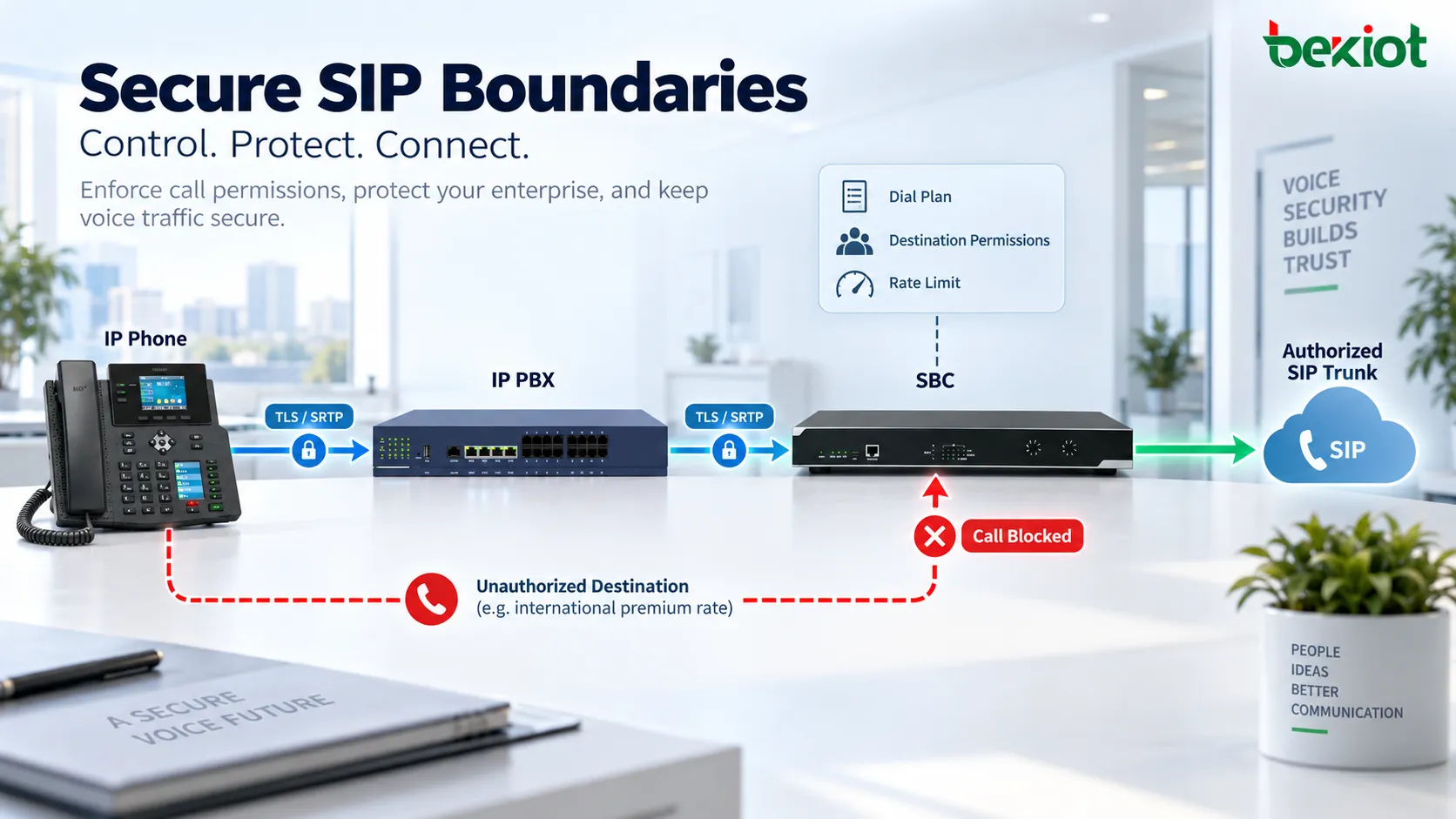
An SBC should therefore act as a major control point at the voice perimeter. It can determine which SIP sessions are allowed to enter or leave the enterprise, inspect source addresses, SIP methods, concurrency, session rates and number ranges, and conceal internal SIP topology from external networks.
A sensible perimeter design should also include firewall ACLs, rate limiting and DoS protection. Management ports with no public business requirement should not be exposed. If SIP services only need to communicate with specific carriers or cloud platforms, there is little reason to accept sessions from the entire Internet.
One common mistake deserves particular attention: opening a large number of ports temporarily to “get the phones working,” then leaving those rules in place after the system goes live. A short-term troubleshooting exception can easily become a permanent security weakness.
The real value of an SBC is not merely that it makes SIP easier to pass through NAT. It gives the organization a defined voice-security boundary:
Internal Voice Network
→ Controlled SIP Perimeter
→ Authorized Carrier or Cloud Platform
→ PSTN and External Communication Networks
Any external voice session that needs to bypass this path should have a clear and documented business reason.
Apply Least Privilege to Call Permissions
Many organizations protect their accounts and networks but still overlook one of the most direct VoIP risks: once an account has registered successfully, what destinations is it actually allowed to call?
If every extension is allowed to place domestic long-distance calls, international calls, premium-rate calls and arbitrary SIP URI calls by default, then compromising one ordinary user account effectively gives an attacker access to the organization's entire outbound voice capability.
A better approach is to define Class of Service according to department and business role. Administrative users who only need domestic calling do not need international routes. Contact-center agents serving a fixed market can be restricted to relevant number ranges. Unattended terminals that only need to reach a designated control room can use a Destination Whitelist.
Time and usage limits can add another layer of protection. If an office extension that normally makes only a small number of calls suddenly places hundreds of international calls in the middle of the night, the system should not continue allowing the activity simply because the credentials are valid.
Dial Plans and SIP Trunk Routing should also be reviewed regularly. As business requirements change, routing rules tend to accumulate. Years later, the system may still contain unused trunks, test prefixes or temporary international routes that no one remembers.
Every call policy should be able to answer at least three questions:
Why does this user have this calling permission?
Why is this destination allowed through this trunk?
At what point should the system block the call or generate an alert?
The closer call permissions match real business requirements, the smaller the potential impact if an account is compromised.
Protect SIP Signaling and Voice Media with Encryption
After device identity, account access and routing controls are in place, the communication itself still needs protection. Unencrypted SIP signaling can expose phone numbers, Call-IDs and other session information, while unencrypted RTP can leave voice media vulnerable to interception.
Where supported, enterprises can use TLS to protect SIP Signaling and SRTP to secure media streams. These protections are particularly important for remote employees, branch offices and cloud voice connections that traverse public networks.
Deploying TLS, however, is more than changing the port from 5060 to 5061. Certificate trust, expiration, server-identity validation, private-key protection and encryption support across different SIP trunks all need to be considered.
SRTP also requires attention to key negotiation and interoperability. If an SBC, media proxy or carrier interconnect sits in the call path, a single end-to-end call may be divided into several security segments. A handset displaying “Secure Call” does not automatically prove that the entire path through the PSTN is protected with the same level of encryption.
One boundary should remain clear: encryption protects signaling, media and transport. It does not replace account authentication, device authorization or call permissions. A stolen but otherwise valid account can still establish an encrypted malicious call.
Monitor Whether Communication Behavior Is Normal
Traditional security controls are effective at identifying scanning, brute-force registration attempts, malformed SIP messages and excessive connection attempts. Real-world VoIP fraud, however, can increasingly operate through communications that appear completely valid at the protocol level.
In recent fraud cases involving unauthorized voice devices, suspicious activity was detected through ongoing communication monitoring rather than waiting for a device failure or a user complaint. The same principle is relevant to enterprise VoIP.
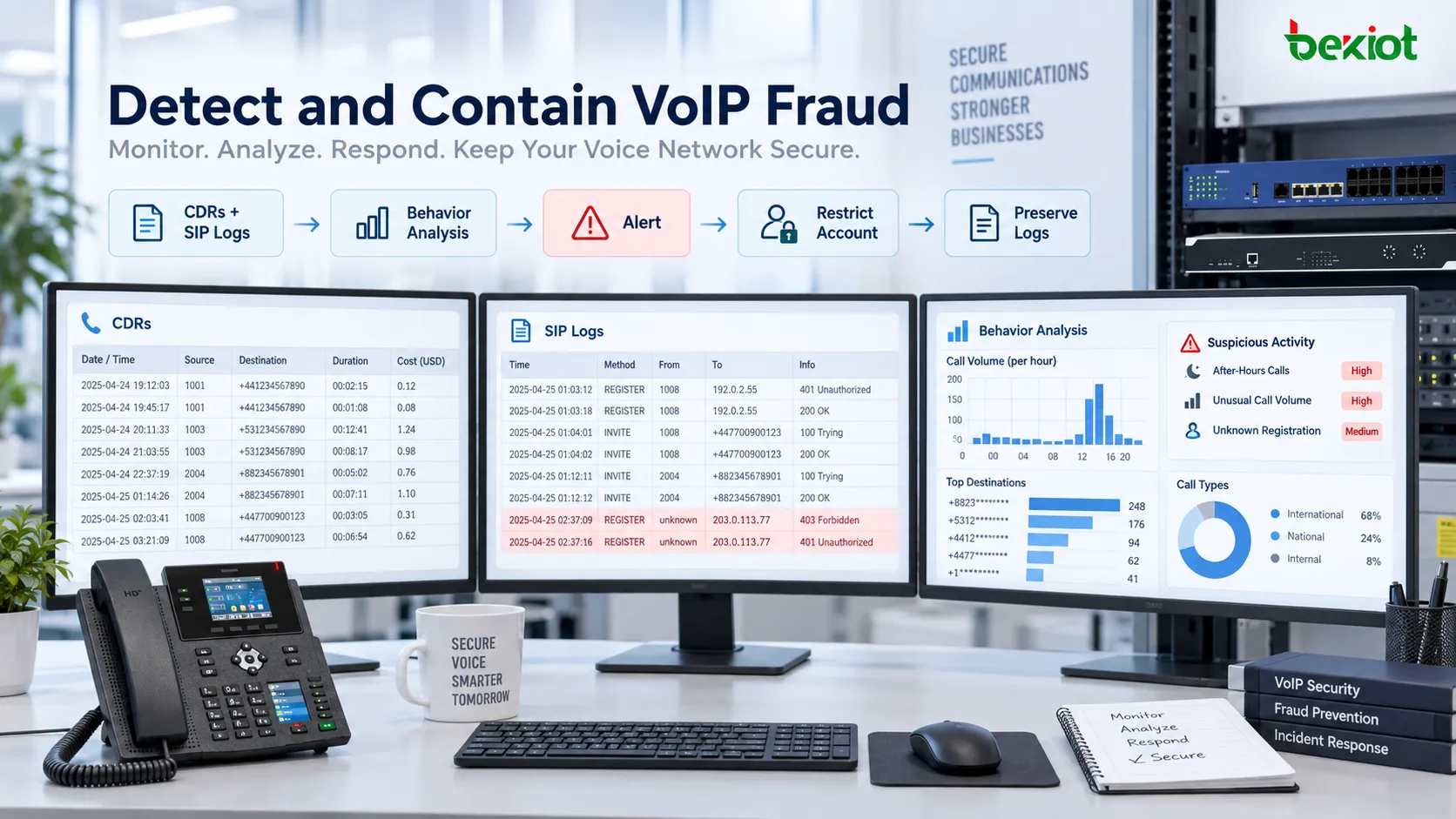
Security systems can continuously analyze CDRs, SIP registration logs, calling numbers, called numbers, call duration, concurrency, failure rates, time-of-day patterns and endpoint sources. When these indicators deviate significantly from historical business behavior, they should enter a fraud-investigation workflow.
For example, an extension that normally places a dozen calls during business hours may suddenly begin dialing continuously after midnight. A fixed office phone may appear from an unusual network location. One account may switch repeatedly between several devices within a short period. A rarely used international trunk may suddenly carry a large volume of short-duration calls.
None of these signals alone necessarily proves fraud. Combined, however, they can provide valuable evidence of abnormal behavior.
AI and anti-fraud models are well suited to this layer of defense. Their role is not simply to determine whether a SIP INVITE is syntactically valid, but to determine whether a collection of apparently legitimate calls makes sense in the context of normal business activity.
The next generation of VoIP security therefore needs two complementary capabilities:
Protocol Security determines whether a communication session is technically allowed to establish, while Behavior Security determines whether that communication should exist in the first place.
Use Logs, Alerts and Incident Response to Limit Damage Quickly
Once suspicious activity occurs, the first challenge is often not “How do we fix it?” but “What exactly happened?” If a phone system keeps only basic call records and no SIP registration history, account login records or routing-change logs, reconstructing an incident can become extremely difficult.
CDRs should at minimum allow investigators to correlate the calling party, called party, timestamp, call duration, trunk and result code. SIP platforms should retain necessary registration and authentication records, while SBCs, firewalls and management systems should preserve relevant security and administrator activity logs.
All systems should also use synchronized NTP time. If the IP PBX records an event at 10:03, the SBC shows 10:07 and the firewall reports 09:59, investigators may struggle to reconstruct the actual sequence of events.
More importantly, alerts need to lead to action. When unusual international spending exceeds a threshold, does the system merely send an email, or does it immediately restrict international calling for the account? If abnormal registration is detected, does the extension remain active or require re-authentication? If an unknown voice gateway is discovered, who is responsible for verifying it on site?
High-risk environments can establish an incident-response workflow in advance:
Detect Suspicious Activity
→ Temporarily Restrict the Account or Trunk
→ Preserve Logs and Site Evidence
→ Verify Device and User Identity
→ Assess the Scope of Impact
→ Remove Unauthorized Configuration
→ Restore Service and Review Security Controls
Many communication incidents become expensive not because they were impossible to detect, but because the organization failed to contain the activity quickly enough after detection.
Social Engineering Must Be Treated as Part of Voice Security
Recent VoIP fraud cases also highlight a problem that technical controls alone cannot solve: even a well-protected network can be exposed if someone voluntarily allows an unknown device to be installed.
Impersonating a carrier technician, equipment vendor or network-service engineer is not a new form of social engineering. What has changed is that widespread use of VoIP and other connected devices makes it easier for such tactics to create a persistent network entry point.
On-site maintenance should therefore correspond to a legitimate service ticket. Employees should not rely only on uniforms, badges or a phone number provided by the visitor. The service request should be verified through an official carrier support channel, a known vendor contact or the organization's internal IT department.
Third-party engineers entering wiring closets, server rooms or connecting equipment to enterprise switches should also be recorded and supervised. Temporary test gateways, laptops, ATAs and diagnostic devices should be removed when the work is complete.
This is one of the harder parts of communications security. A network control can block an unauthorized IP address, but it cannot stop an employee from opening the equipment room for someone they believe is a legitimate technician. Technical controls and operational procedures therefore need to be designed together.
VoIP Security Must Operate as a Continuous Defense System
VoIP has transformed traditional telephony into a complete IP communications environment, so communications security cannot depend on a single product. Deploying an SBC, enabling TLS or changing SIP passwords addresses only one part of the problem.
A more complete security model should form a continuous chain:
Devices Are Identifiable
→ Network Access Is Controlled
→ User Identity Is Trusted
→ SIP Boundaries Are Defined
→ Calling Permissions Follow Least Privilege
→ Signaling and Media Are Protected
→ Communication Behavior Is Continuously Monitored
→ Logs Support Traceability
→ Suspicious Activity Can Be Isolated Quickly
For an enterprise, the value of this approach is not a promise that nothing abnormal will ever happen. The goal is to reduce three probabilities: that unauthorized equipment can enter the environment, that suspicious communications can obtain excessive privileges, and that abnormal activity can continue for a long time without detection.
Recent anti-fraud cases show that future voice security must look beyond whether someone is directly attacking the IP PBX. A legitimate network port, an Internet-connected device and a technically valid voice route can still create serious risk when they are combined in an unauthorized way.
A dependable VoIP security architecture should therefore achieve two things at the same time: normal business communications should continue with minimal disruption, while communications that deviate from expected identity, device, routing or behavior patterns should be detected, contained and traced as early as possible.
FAQ
Is VoIP Security Fully Managed by the Provider When a Business Uses a Cloud PBX?
No. A cloud provider typically secures the platform infrastructure and some perimeter functions, but the customer still controls user accounts, administrator privileges, endpoint devices, calling permissions and many internal network settings. The security responsibilities of both parties should be clearly defined in service and operations agreements.
How Often Should a VoIP System Undergo a Security Review?
There is no single interval that applies to every environment. Organizations that frequently add extensions, SIP trunks or remote endpoints should include regular configuration audits and perform additional reviews after major software upgrades, network redesigns, carrier migrations or security incidents.
How Should Remote Access Be Granted to a Third-Party Vendor Maintaining an IP PBX?
A safer approach is to use temporary accounts, VPN access or a controlled jump host, with restrictions on source, time window and administrative scope. Access should be disabled when maintenance is complete, and login activity and configuration changes should be retained for audit purposes. Long-term shared administrator passwords should be avoided.
Does an Enterprise Need to Store Complete VoIP Packet Captures Long Term?
Usually not. Continuously storing all voice traffic can create significant storage, privacy and compliance concerns. A more practical approach is to retain the necessary logs and CDRs over the long term, then perform controlled packet captures on specific interfaces, sessions or time windows when troubleshooting or investigating a security event.