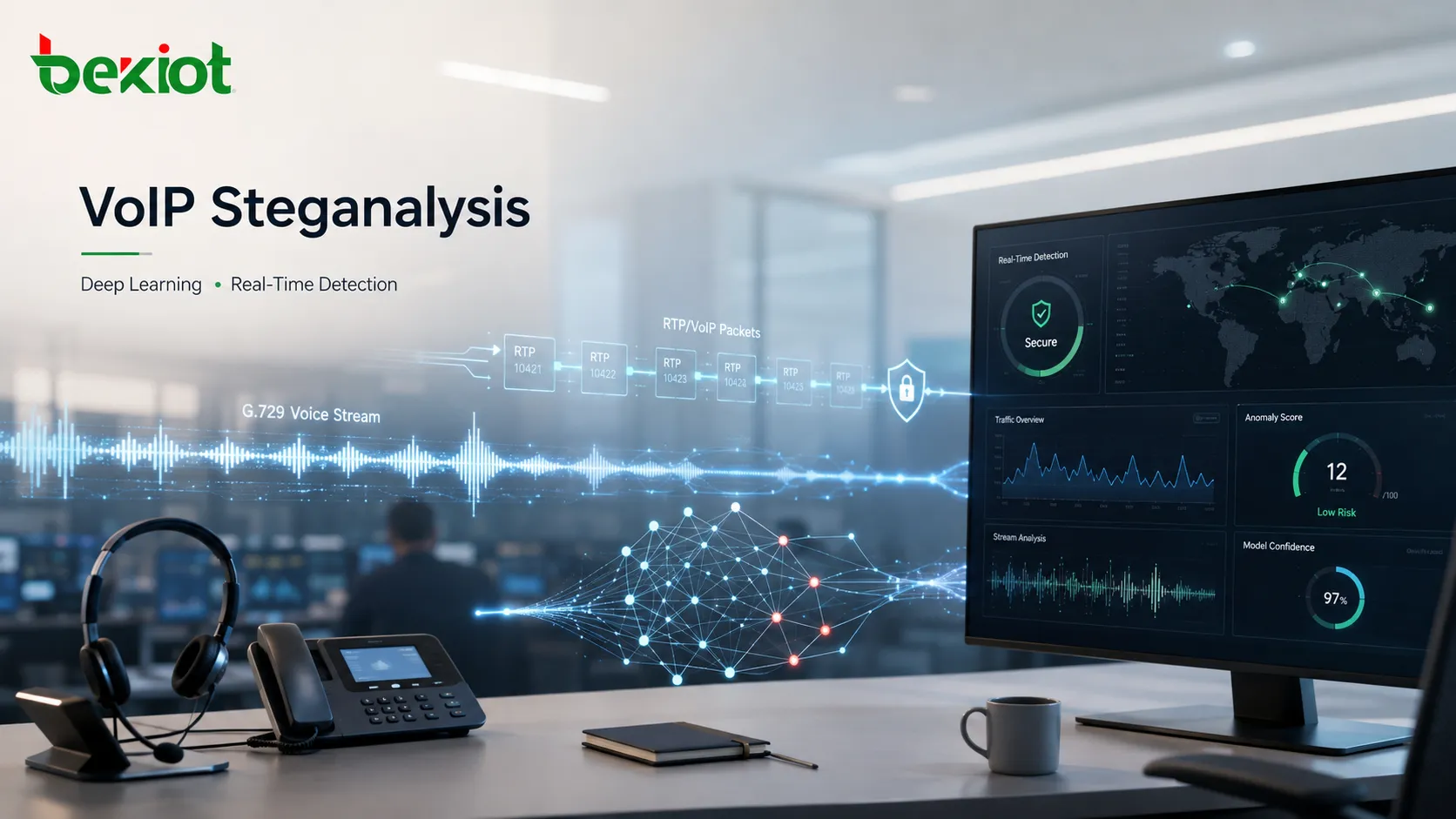
A VoIP call may sound completely normal while still carrying hidden information inside its compressed speech stream. That is what makes voice steganography difficult to detect. The attacker does not need to send an obvious file, open a suspicious transfer channel, or visibly change the call process. Instead, secret data can be embedded into codec parameters, codeword choices, pitch delay values, or other low-level speech-coding elements.
To a human listener, the call may remain clear enough. To a basic network monitor, the packets may look like ordinary voice traffic. The real disturbance often appears only when the compressed speech structure is examined statistically. This is why VoIP steganalysis requires a different kind of security thinking. It must understand both the communication protocol environment and the internal behavior of the speech codec.
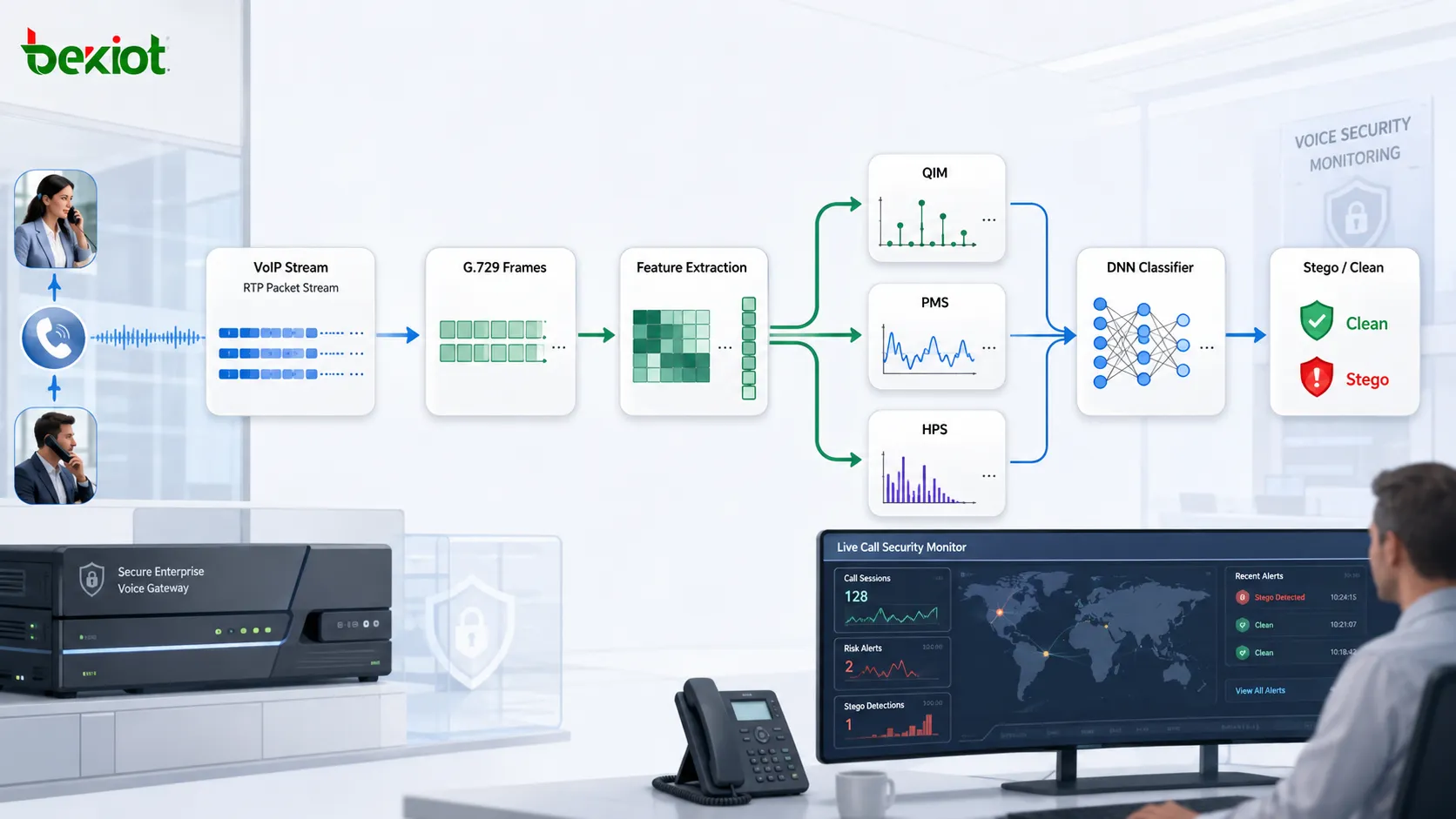
G.729 is a useful case for this kind of analysis because it compresses speech into a compact and structured bitstream. Each 10 ms speech frame is processed by a CS-ACELP model and represented through prediction coefficients, codebook indices, pitch parameters and gains. When hidden data is inserted into this structure, it may leave small but measurable traces. Combining statistical feature extraction with deep neural network classification can make those traces easier to detect while keeping response time low enough for real-time use.
Why Voice Hiding Is Hard
Steganography is not the same as encryption. Encryption protects message content by making it unreadable to unauthorized parties, but it does not necessarily hide the existence of communication. Steganography tries to hide the fact that a secret message exists at all. In VoIP, this means a normal voice stream can become a covert channel without changing the apparent purpose of the call.
A strong hiding method usually tries to balance three goals: transparency, capacity and robustness. Transparency means the modified voice should not sound suspicious and should not create obvious statistical artifacts. Capacity refers to how much secret data can be embedded. Robustness describes whether the hidden information can survive compression, noise, packet handling or other distortions.
For a detection system, the problem is reversed. It must find weak patterns that the hiding method tries to conceal. Traditional network security tools may identify unusual ports, traffic bursts or signaling attacks, but codec-level hidden data can remain below that visibility layer. A detector must inspect speech-frame behavior, not only packet headers or call metadata.
Real-time voice traffic adds another constraint. VoIP communication is delay-sensitive, so detection cannot depend on slow offline processing. A practical steganalysis model must work on short audio windows, produce results quickly and avoid adding noticeable latency to the call path. Accuracy matters, but speed is equally important when the goal is live monitoring.
G.729 Creates Detectable Traces
G.729 encodes speech at 8 kbit/s. At an 8000 Hz sampling rate, each 10 ms frame contains 80 samples. Instead of transmitting the original waveform, the codec analyzes the speech signal and sends a compact set of model parameters that allow the decoder to reconstruct intelligible speech.
Several parts of this coding process are relevant to steganalysis. Linear prediction analysis extracts short-term spectral information. The resulting coefficients are transformed into LSP or LSF-related representations and then quantized through vector quantization. In G.729, this LSP-related quantization uses an 18-bit structure containing L0, L1, L2 and L3 values.
The L1, L2 and L3 codebook indices are especially important for QIM-based hiding. L1 is represented by a 7-bit index, while L2 and L3 are represented by 5-bit indices. These values do not simply carry arbitrary data; they are part of a statistical speech-coding structure. When a hiding algorithm manipulates codeword selection, it may disturb the natural relationship among these values.
Pitch analysis provides another detection area. G.729 divides each 10 ms frame into two 5 ms subframes. The encoder estimates pitch delay values for these subframes. The first subframe uses 8 bits for pitch delay encoding, while the second subframe uses 5 bits with differential coding. PMS-based hiding can modify pitch-related behavior, making P1, P2 and their integer and fractional parts useful features for detection.
QIM, PMS And HPS Differ
VoIP steganalysis becomes more effective when different hiding methods are treated separately. QIM, PMS and HPS do not disturb the same codec features in the same way. A model that understands these differences can extract more meaningful evidence than a detector that treats all stego speech as one generic anomaly.
Quantization Index Modulation, or QIM, is related to LSP coefficient quantization. In simplified terms, codewords inside the codebooks can be divided into groups that represent hidden bit values. To embed a secret bit, the encoder selects a suitable codeword from the group associated with that bit. This may keep the speech acceptable, but it can change the distribution and correlation of L1, L2 and L3 codeword choices.
Pitch Modulation Steganography, or PMS, uses pitch-delay information as the embedding area. Because G.729 estimates pitch behavior for subframes, small changes in pitch delay parameters can carry hidden data. PMS detection therefore focuses more on P1 and P2 features, including their integer and fractional components.
Heterogeneous Parallel Steganography, or HPS, is more difficult because it combines QIM and PMS. One frame may follow QIM-style behavior, while another may follow PMS-style behavior. This makes the signal less stable from a detection perspective. A model must recognize mixed and alternating traces rather than rely on a single feature family.
| Hiding Method | Main Codec Area | Detection Focus |
|---|---|---|
| QIM | LSP quantization codewords | L1, L2 and L3 codeword differences and correlation changes |
| PMS | Pitch delay parameters | P1 and P2 integer and fractional feature variations |
| HPS | Mixed QIM and PMS embedding | Combined feature disturbance and frame-to-frame pattern changes |
Statistical Features Build The Model
Deep learning does not remove the need for careful feature design. In VoIP steganalysis, preprocessing is one of the most important steps. The model should not only receive a reconstructed audio waveform. It should receive the codec parameters most likely to be affected by hidden-data embedding.
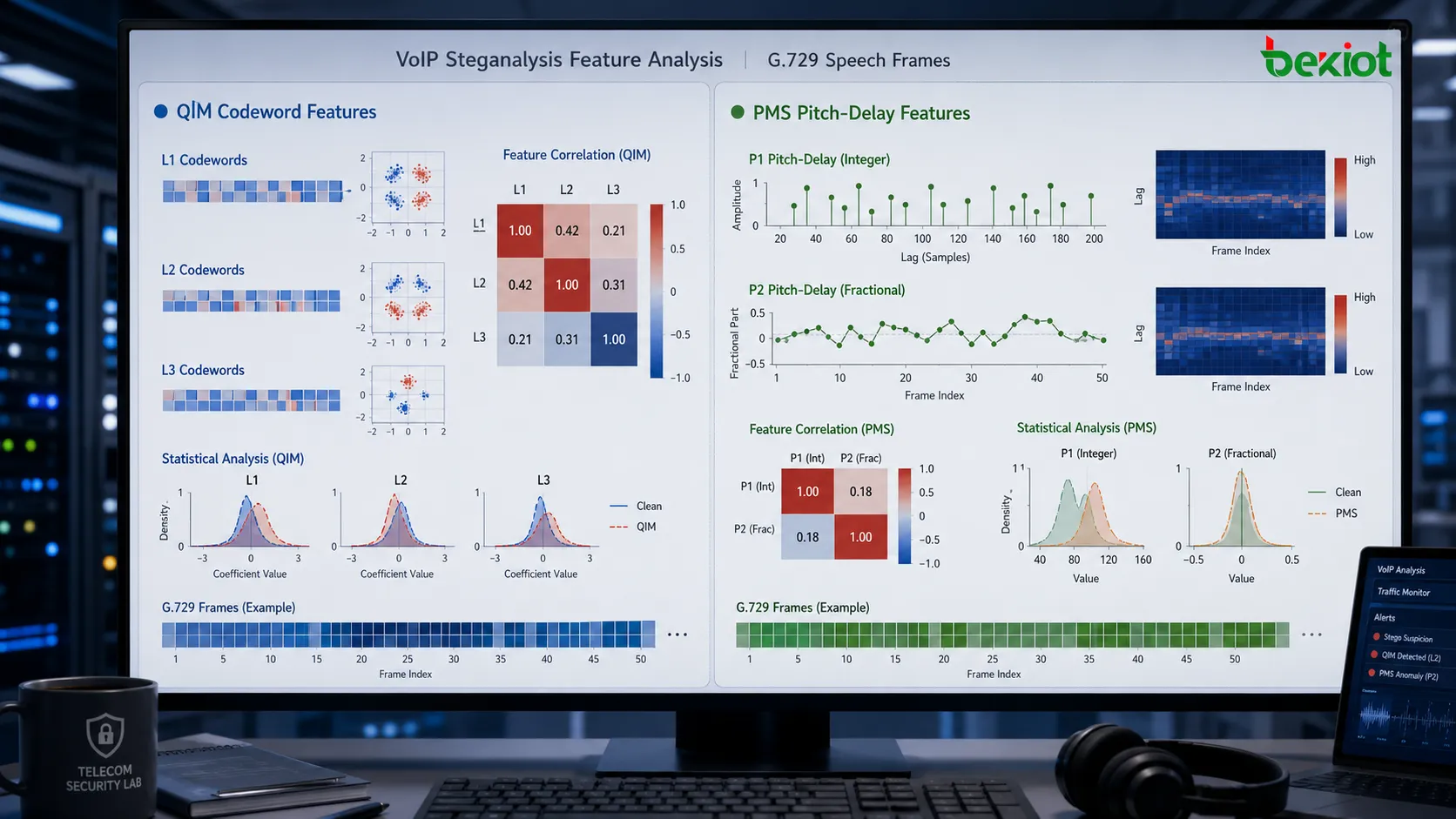
For QIM detection, L1, L2 and L3 are key inputs. Statistical analysis can compare the absolute differences between cover speech and stego speech in these codeword features. As the embedding rate changes, the disturbance pattern also changes. At higher embedding rates, localized changes in L1 and L2 can become more visible, while L3 may also show stronger distortion in some conditions.
For PMS detection, the integer and fractional parts of P1 and P2 become more useful. The disturbance does not always behave in a simple linear way. Some embedding conditions may affect the integer part more clearly, while others may influence fractional behavior. A single value is often not enough. Combining multiple pitch-related dimensions gives the model a stronger basis for classification.
Inter-frame relationships matter as much as single-frame features. A single speech frame may look nearly normal, but a sequence of frames can reveal changed correlation patterns. Natural speech coding creates relationships among neighboring frames, codebook values and pitch parameters. Hidden data can weaken or reshape those relationships. Heat maps, correlation matrices and multi-dimensional feature analysis help expose these subtle changes before the neural model performs classification.
Neural Classification Adds Speed
In a practical workflow, G.729 speech files can be converted into structured text-like feature representations. Each 10 ms frame corresponds to encoded bit-level information. A 1-second sample contains about 100 frames, which is enough to capture short-term statistical behavior without requiring long offline analysis.
A well-designed model can use separate learning paths for QIM-related and PMS-related features. This makes sense because the two feature families come from different codec mechanisms. If all features are mixed too early, the model may lose important detail. Separate feature branches allow the network to learn codeword behavior and pitch behavior more clearly before combining them for final classification.
During training, the classifier learns to distinguish cover data from stego data. Cover data represents normal compressed speech, while stego data represents speech modified by QIM, PMS or related embedding methods. The dataset design should avoid allowing the model to memorize speaker-specific or sample-specific traits. Separating speakers and speech sources between training and testing helps evaluate whether the detector is learning hidden-data traces rather than voice identity.
Training parameters also affect reliability. Dropout can reduce overfitting. Adam optimization can improve training stability. Batch size, number of epochs and network depth need to be balanced against available computing resources and deployment goals. A very large model may improve laboratory accuracy but become impractical for real-time monitoring if inference becomes too slow.
Real-Time Results Matter
The evaluated method shows why statistical preprocessing and deep neural networks are valuable together. For 1000 ms audio samples, reported detection accuracy reached about 98.85% for QIM, 96.94% for PMS and 91.90% for HPS. The testing response time was below 5 ms, which is important for real-time steganalysis applications.
The lower accuracy for HPS is understandable. Mixed hiding behavior creates a more complex feature distribution. The model must recognize both QIM and PMS disturbances and understand how they appear across different frames. Compared with single-method hiding, HPS is closer to a difficult security scenario because it reduces the reliability of one-feature detection.
From an engineering point of view, real-time VoIP steganalysis can be useful in controlled voice gateways, enterprise voice-security platforms, laboratory forensic systems or carrier-grade monitoring environments. It can complement SIP security, RTP traffic analysis, SBC policy control, call-recording governance and anomaly detection.
Deployment still requires caution. Packet loss, jitter, transcoding, endpoint variation, background noise, silence suppression, encrypted media and codec negotiation can all affect feature extraction. A model trained around G.729 should not be assumed to work directly with AMR, Opus, G.711 or other codecs. Each codec has its own structure, so feature extraction and model training usually need to be redesigned.

Security Use Needs Boundaries
VoIP steganalysis is a security capability, but it also involves voice communication data. Any operational deployment should define monitoring scope, authorization rules, data retention, access permissions and audit procedures. Detecting covert channels should not become uncontrolled voice surveillance.
A safer design focuses on codec parameters, statistical patterns and anomaly indicators wherever possible, rather than unrestricted access to call content. When forensic analysis is required, it should be handled with role-based permissions, logging and approval workflows. This approach improves voice-network security while reducing privacy and compliance risks.
The future direction of VoIP steganalysis will likely move toward lighter models, faster response, better cross-codec generalization and stronger resistance against adaptive hiding methods. Statistical analysis will remain important because it explains where codec behavior is being disturbed. Deep learning will also remain important because it can learn complex relationships that are difficult to define manually.
FAQ
How is VoIP steganalysis different from voice quality monitoring?
Voice quality monitoring checks delay, packet loss, jitter and audio clarity. VoIP steganalysis looks for hidden-data patterns inside codec parameters and compressed speech behavior.
Why is G.729 often used in this type of research?
G.729 has a clear low-bit-rate frame structure, defined codebook indices and pitch parameters, making it useful for studying how hidden data changes compressed speech features.
Does high laboratory accuracy guarantee commercial readiness?
No. A practical system must still be tested against different endpoints, network impairments, codec settings, transcoding paths, false-positive rates and compliance requirements.
Why is HPS harder to detect than QIM or PMS alone?
HPS combines two different embedding behaviors, so the model must recognize mixed codeword and pitch-delay disturbances rather than one stable feature pattern.
What should enterprises check before deployment?
They should evaluate authorization scope, privacy rules, retention policy, processing delay, codec compatibility, false positives, system load and integration with existing VoIP security platforms.
Deep learning improves VoIP steganalysis when it is guided by codec-aware statistical analysis. The strongest approach begins by identifying which G.729 features are likely to be disturbed, transforms those features into structured model inputs and then uses fast classification to support real-time security monitoring. For organizations that depend on IP voice communication, this type of detection can help reveal hidden communication risks that ordinary network inspection may miss.