


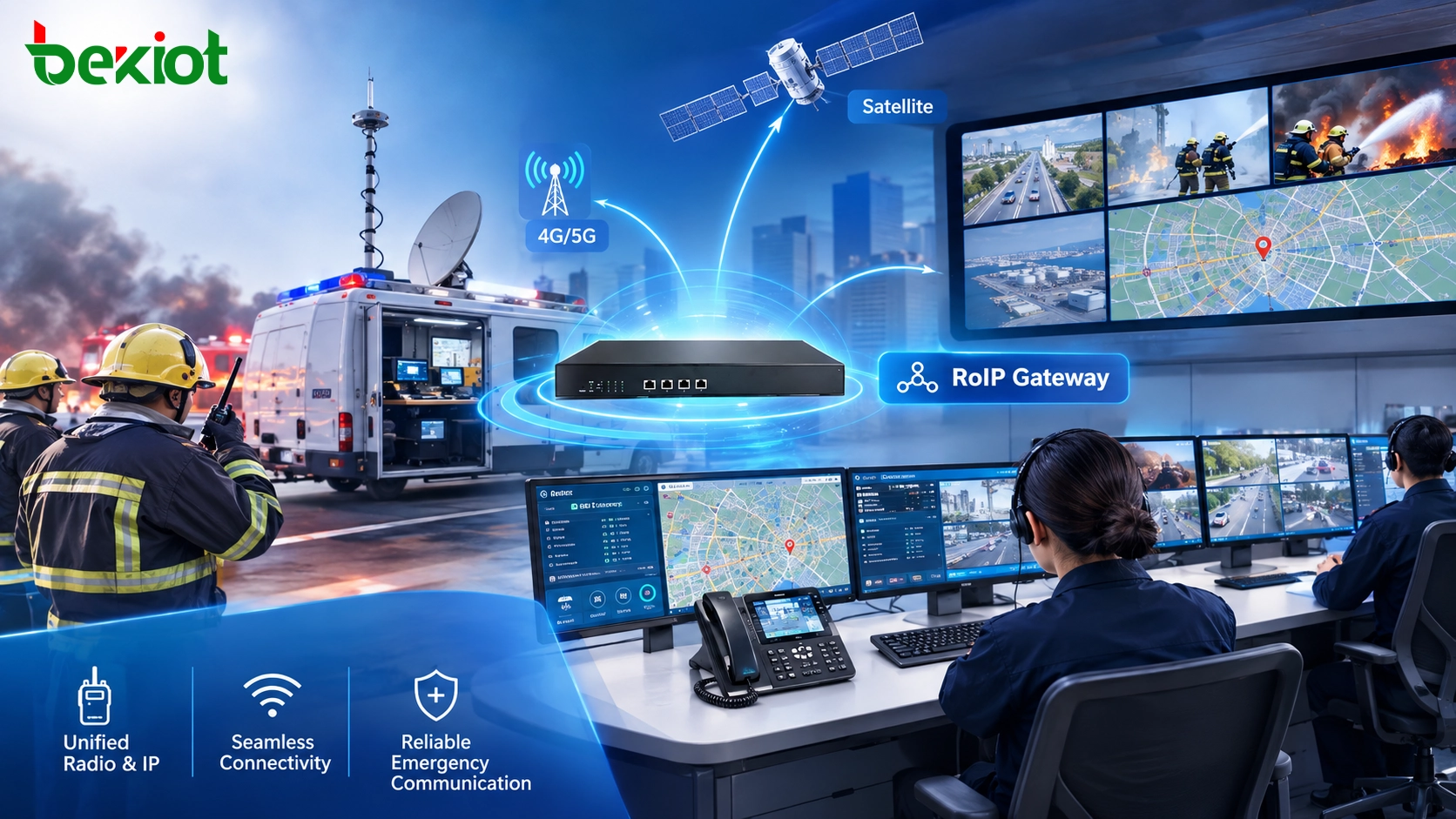
Portable and vehicle-mounted radios remain essential communication tools at emergency scenes because responders can establish direct voice contact without depending entirely on public mobile services. Their limitation is coverage. A radio network that works well around a rescue site, temporary command post or operational team may not provide a direct communication path back to a remote command center. The problem becomes more complicated when police, fire, rescue, engineering, medical and other response groups arrive with radios operating on different systems or channels.
An emergency command vehicle can bridge this gap. By combining field radio resources with IP networking, 4G/5G transmission, satellite communication and a RoIP gateway, the vehicle becomes a mobile communication hub between personnel at the incident site and operators at the command center. Instead of replacing existing radios, the solution connects them to a broader dispatch environment so that local radio communication can participate in remote command, cross-system coordination and centralized emergency operations.
Why Field Radio Needs a Wider Communication Path
Two-way radios are highly practical at emergency sites. Firefighters, rescue teams, security personnel and field commanders can communicate quickly by selecting a channel and pressing the push-to-talk key. This simplicity is one of the reasons radio remains important even when smartphones and broadband applications are widely available.
However, conventional radio communication is normally designed around a limited local coverage area. Terrain, buildings, underground spaces and the location of base stations can further affect how far a field radio network can reach. Personnel working near the incident may be able to communicate with one another, while a command center located many kilometers away cannot directly hear the same channel.
During emergency response, this creates an information gap. The central command team needs to understand what frontline personnel are reporting, while field teams need to receive decisions, deployment instructions and safety information from the command structure. Relying on personnel to manually repeat every radio message through a telephone or another communication system adds unnecessary steps to the communication chain.
Emergency command vehicles are therefore commonly equipped with several communication methods rather than a single network. Depending on the project, the vehicle may carry handheld radios, vehicle radios, broadband ad hoc networking equipment, 4G/5G data transmission equipment and satellite communication resources. These systems provide different forms of local and long-distance connectivity, but they still need a practical method for bringing field radio voice into the wider command network.
The Vehicle Becomes a Mobile Communication Hub
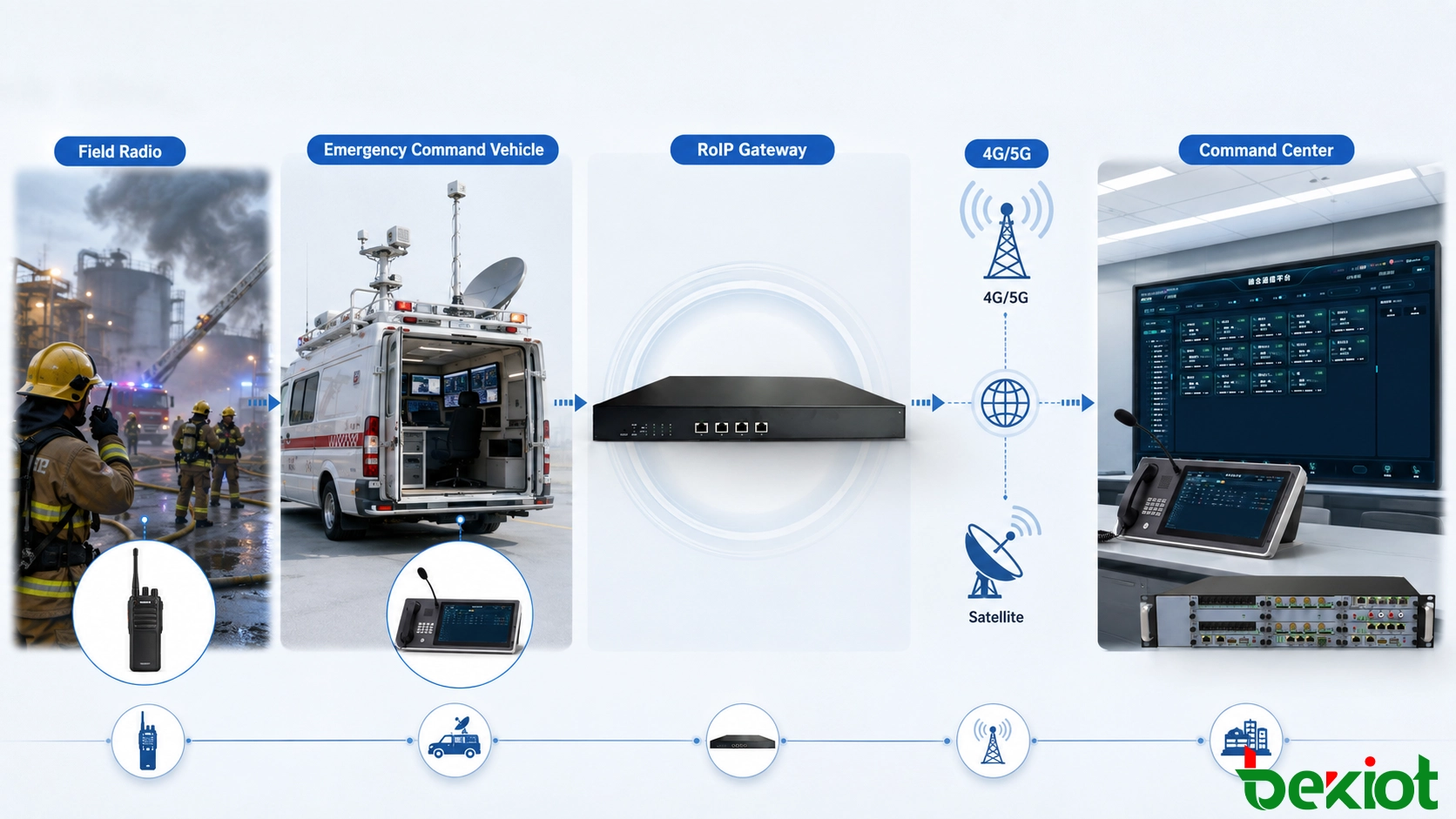
The basic architecture is straightforward. Radio equipment used around the incident site connects to radio equipment installed in the emergency command vehicle. A RoIP gateway then provides the integration point between these radio resources and the vehicle's IP-based communication environment.
From there, voice can be carried over the available long-distance transmission network. When terrestrial mobile coverage is available, a 4G/5G connection can provide the backhaul between the command vehicle and the emergency command center. When public mobile infrastructure is unavailable, damaged or unsuitable for the operational area, the vehicle may use its satellite communication link as another path between the scene and the command center.
The important point is that the field responder does not need to abandon the radio workflow already used by the team. Personnel can continue communicating through their assigned radio channels while the gateway extends those channels into the command and dispatch environment.
This architecture also separates local field communication from the long-distance transport network. The radio system continues serving responders near the incident, while 4G/5G or satellite communication carries selected voice traffic between the mobile command vehicle and the remote command center.
As a result, the command vehicle is no longer only a place where operators sit and observe the incident. It becomes a mobile communications node capable of connecting local tactical communication resources with the wider command structure.
Related Product: Becke Telcom RoIP Gateway
Connecting the Scene With the Command Center
Once field radio traffic has been introduced into the vehicle communication network, the next task is to make that resource available to the central command center. The uplink can use the communication path already installed in the command vehicle, particularly 4G/5G or satellite transmission.
At the command center, operators can access the corresponding field radio communication through the dispatch environment. This gives central personnel a more direct way to monitor frontline reports and participate in operational communication instead of receiving information only through secondary telephone calls or verbal relays.
The communication path can therefore be understood as a continuous chain:
Field Radio → Vehicle Radio → RoIP Gateway → Vehicle Communication Network → 4G/5G or Satellite Link → Command Center Dispatch System
The same path also supports communication in the opposite direction. A command-center operator can issue instructions through the dispatch system, transmit them over the long-distance link to the emergency command vehicle and reach personnel monitoring the corresponding radio channel at the incident site.
This two-way connection is particularly important in emergency operations because information cannot flow in only one direction. The command center needs reports from the field, but frontline teams also need timely instructions about resource deployment, evacuation, rescue priorities and changes to the operational plan.
The solution therefore addresses what is often the final communication gap between centralized command and personnel carrying radios at the edge of the incident scene.
Linking Vehicle and Central Dispatch Systems
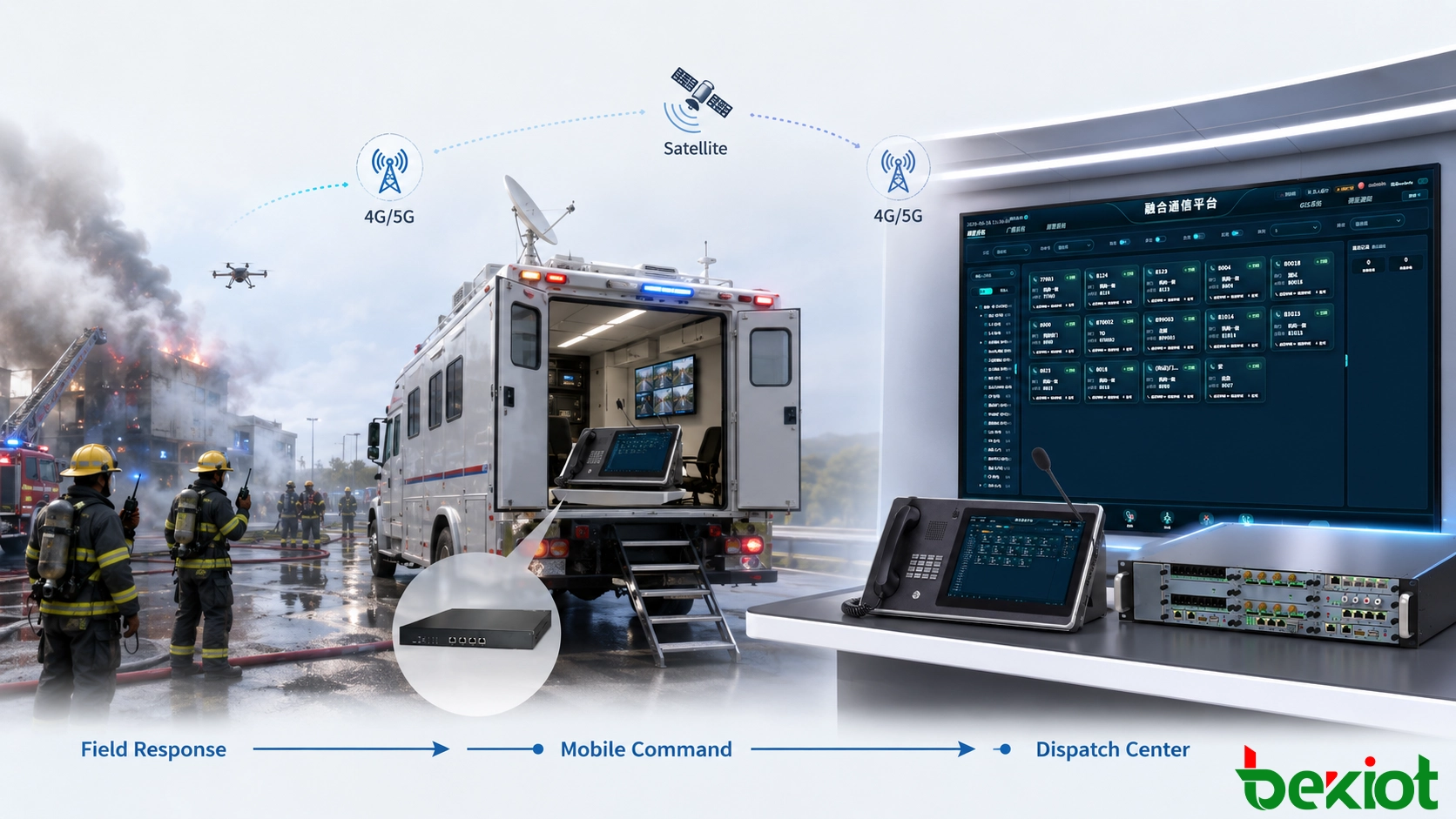
Some emergency command vehicles operate mainly as communication relay platforms, while larger vehicles may contain a complete vehicle-based emergency command system. The RoIP integration method can support both architectures.
In a simpler deployment, the gateway provides the connection between the vehicle's radio resources and the communication path toward the central command center. Operators at the center can then access the radio resource through the central dispatch system.
When the vehicle has its own command and dispatch platform, the gateway can first connect field radio resources to the vehicle-based command system. The vehicle system and the central emergency command platform can then form a wider network, allowing both local vehicle operators and central dispatch personnel to work with communication resources at the incident site.
This arrangement is valuable during incidents where the command vehicle must remain operationally independent while also maintaining contact with headquarters. Local commanders can coordinate personnel around the scene without routing every action through a remote center, while significant information and high-level instructions can still move between the vehicle and the central command organization.
The architecture can therefore support different levels of command. Frontline personnel use radios, the vehicle provides on-site coordination, and the remote command center provides broader resource allocation and centralized decision support. The RoIP connection helps keep these communication layers connected.
Solving Cross-System Radio Communication
Extending radio coverage to a command center is only part of the requirement. Emergency scenes often involve multiple organizations, and those organizations may not use identical radio systems.
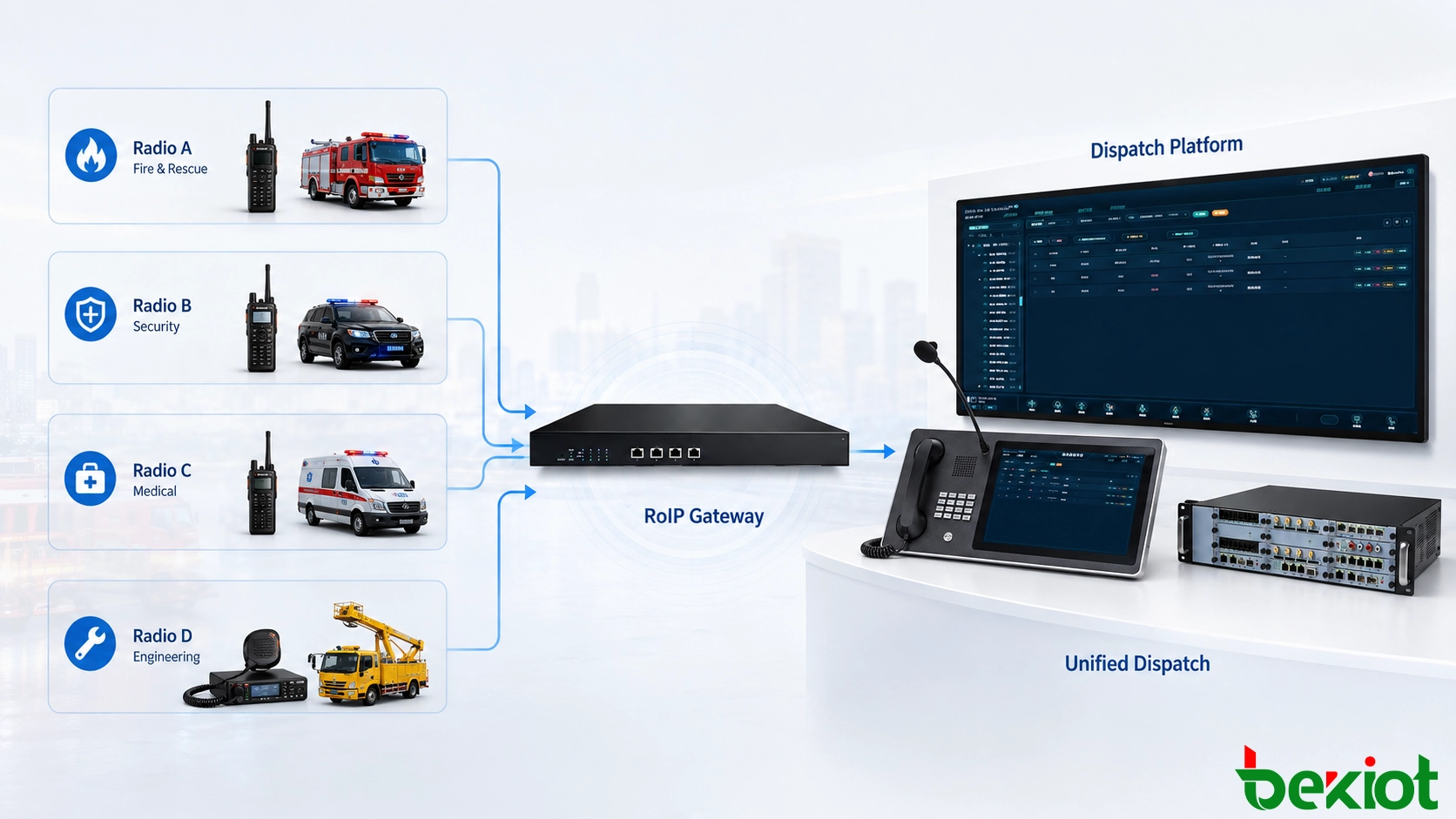
A rescue team may arrive with one radio network, security personnel may use another, while engineering or support teams operate on separate channels. Each network may work correctly on its own, yet direct communication between groups can still be difficult.
A RoIP-based integration architecture can place these independent radio resources under the coordination of the dispatch system. Instead of requiring every radio network to become technically identical, selected channels can be connected through gateway interfaces and managed as communication resources by the command platform.
This changes the role of the gateway. It is not simply extending a radio channel over an IP link. It also becomes a bridge between otherwise isolated communication domains.
During an emergency, the commander can organize communication according to the actual response task. Teams that normally work on separate radio systems can be brought into a coordinated communication process when necessary. Once the incident is completed, each organization can continue operating its own radio network independently.
This is especially useful when temporary cooperation is more realistic than replacing all existing radio equipment. Emergency organizations often already have established radios, frequencies, operating procedures and user habits. A gateway-based approach allows these existing resources to participate in a unified command environment without requiring every field user to change devices.
Designing for Uncertain Network Conditions
Emergency communication architecture should assume that network conditions may change during an incident. A command vehicle may begin operations in an area with reliable 4G/5G coverage and later move to a location where terrestrial connectivity becomes weak. A disaster may also damage public communication infrastructure.
For this reason, the communication path between the vehicle and the command center should not be treated as inseparable from the radio integration itself. The radio gateway provides the connection between field radio and the IP communication domain, while the vehicle can use the most suitable available backhaul for long-distance transmission.
In normal conditions, 4G/5G can provide convenient data connectivity. In areas where public networks cannot provide the required connection, satellite communication can maintain a path between the mobile command point and the remote center when the vehicle is equipped for satellite access.
This layered approach makes the architecture more adaptable. The field radio workflow can remain stable even when the wide-area transmission method changes. Responders do not need to understand which long-distance link is currently being used; that decision belongs to the communication infrastructure inside the command vehicle.
Network planning should also distinguish between local communication and headquarters connectivity. Radios solve the immediate communication requirement around the scene, while the vehicle's wide-area network extends information beyond the incident perimeter. Combining the two layers is what creates an end-to-end command communication path.
Where the Architecture Delivers Value
The same design principle can be applied beyond a single type of emergency vehicle. Mobile command vehicles, command cabins and temporary field command posts all face a similar integration problem: personnel near the scene depend on radio, while decision-makers may be located elsewhere and rely on an IP-based dispatch environment.
In disaster rescue operations, the architecture can connect rescue-team radio communication with a regional command center. During major public events, it can help coordinate security, traffic management, medical support and temporary response teams. In large industrial emergencies, the vehicle can serve as an intermediate command node between plant communication resources and external emergency organizations.
The same concept also has value in defense and other mission-critical mobile command environments where multiple radio resources need to participate in a broader command network.
The main design objective is not to build another isolated communication system inside the vehicle. It is to make the command vehicle the connection point between existing field communication, mobile and satellite backhaul, local dispatch operations and the remote command center.
When these layers are planned together, radio communication becomes more than short-range voice contact. Existing radios can become accessible command resources, field reports can reach decision-makers more directly, and central instructions can be delivered closer to frontline personnel.
Conclusion
Emergency response depends on communication across very different distances. At the incident site, two-way radios provide fast and practical communication between frontline personnel, but their local coverage does not automatically provide a path to a distant command center. Emergency command vehicles solve part of this problem by bringing together radios, broadband ad hoc networks, 4G/5G connectivity and satellite communication.
Adding a RoIP gateway completes the connection between local radio resources and the wider command network. Field radio channels can be introduced into a vehicle-based or central dispatch system, while 4G/5G and satellite links extend communication beyond the immediate scene. More importantly, different radio systems can be coordinated through the dispatch layer when cross-department communication is required.
For emergency command vehicles and mobile command cabins, the practical value of this architecture is therefore not simply radio extension. It creates a bridge between frontline communication, mobile networking and centralized command, allowing existing communication resources to work together within a more unified emergency response structure.
FAQ
Does every responder need an IP radio for this architecture?
No. The purpose of the gateway architecture is to integrate existing field radio resources with the IP-based command environment. Frontline personnel can continue using the radio equipment assigned to their teams.
Can the command vehicle continue local coordination if the headquarters link is interrupted?
Local radio communication does not inherently depend on the long-distance connection to headquarters. Where a vehicle-based command system is deployed, local coordination can be designed as a separate operational layer from the wide-area backhaul.
Is this architecture limited to permanent emergency command vehicles?
No. The same integration model can be adapted to command cabins, temporary mobile command posts and other field deployments where radio resources need to connect with a remote dispatch environment.
Should every radio channel be permanently interconnected?
Not necessarily. Cross-system communication can be organized according to the incident, participating departments and operational requirements. Keeping independent radio groups separate until coordination is required can make the communication structure easier to manage.







