


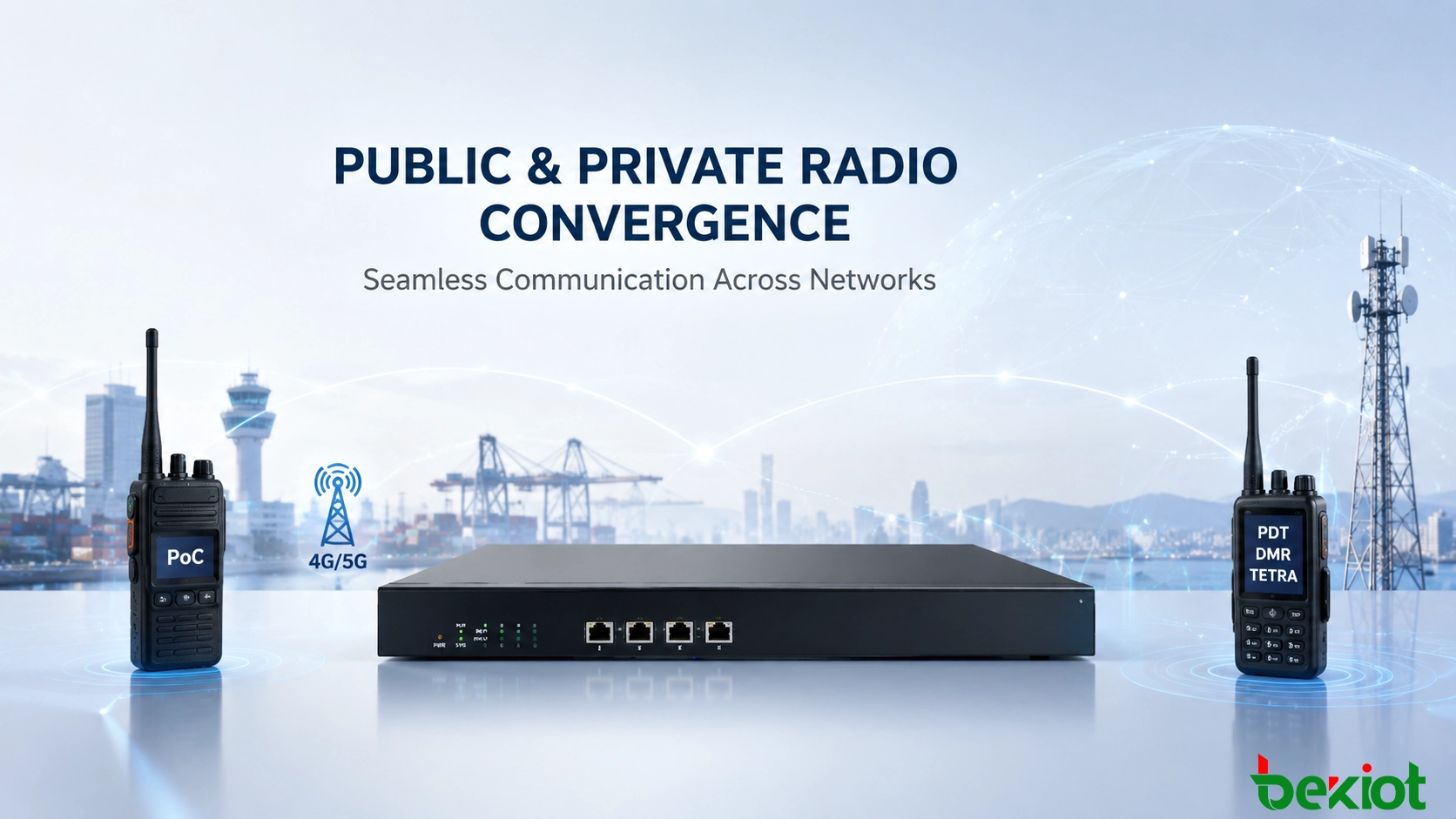
Public-network push-to-talk services have developed rapidly with the expansion of 4G and 5G mobile networks. Often referred to as PoC, these systems can provide group communication and broadband capabilities without requiring an organization to build its own radio base-station network. At the same time, professional private radio systems remain essential for critical communications in public safety, airports, ports, factories, transportation and energy operations. The practical challenge is therefore not choosing one network to replace the other, but enabling both to communicate when users, coverage areas and operational tasks cross network boundaries.
A public-private radio convergence solution creates an interoperability layer between these two communication environments. Depending on the systems already deployed, integration can be implemented through back-to-back radio connections or through direct protocol-level access to the PoC platform. Each method has different requirements for compatibility, voice quality, latency, deployment complexity and future expansion.
Related Product: RoIP Gateway
Why Both Networks Still Matter
Public and private radio systems have developed around different technical and operational priorities. PoC communication takes advantage of the coverage provided by mobile operators. A terminal can communicate through an available 4G or 5G connection without requiring the organization to deploy a dedicated radio infrastructure across every operating area.
This makes public-network push-to-talk attractive when rapid deployment, broad geographic coverage and lower infrastructure investment are important. PoC terminals can also support broadband services beyond basic narrowband voice, giving enterprises more flexibility when communication needs extend across branches, remote workers or geographically dispersed sites.
Private trunked radio serves a different role. Systems based on technologies such as PDT, DMR and TETRA continue to be widely used for critical communications. Their low latency, high reliability and security characteristics make them difficult to replace in applications where communication availability directly affects operations or emergency response.
Public safety organizations, airports, ports, industrial plants, transportation operators and energy companies may therefore use private radio as their operational core while introducing PoC as an extension of coverage or as an additional communication layer.
In this type of environment, operating the two systems independently creates communication islands. A private-radio user may not be able to speak directly with a PoC user even when both are supporting the same incident or operational task. Public-private convergence addresses this gap by creating controlled voice paths between the networks.
The Main Interoperability Challenge
Connecting the two environments is not simply a matter of placing them on the same IP network. Private trunked radio technologies already include several different standards, while the PoC market is even more fragmented.
Unlike a single standardized radio environment, public-network push-to-talk platforms can differ significantly between suppliers. Many systems are developed according to the vendor's own platform architecture, signaling logic and application requirements. As a result, terminal interfaces and software interfaces are not always consistent from one PoC system to another.
This lack of a completely unified interface creates the main difficulty in convergence projects. An integration method that works with one PoC platform may not automatically work with another. Existing private-radio equipment, gateway interfaces, platform software and the required number of interconnected channels all need to be considered before selecting an architecture.
Two integration approaches are currently the most practical. The first uses physical radio terminals on both sides of a gateway. The second connects the gateway directly to the PoC software platform through a protocol interface while retaining radio-based access on the private-network side.
Back-to-Back Access for Broad Compatibility
Back-to-back integration is the more universal approach when the two systems use different standards or when a direct software interface is unavailable.
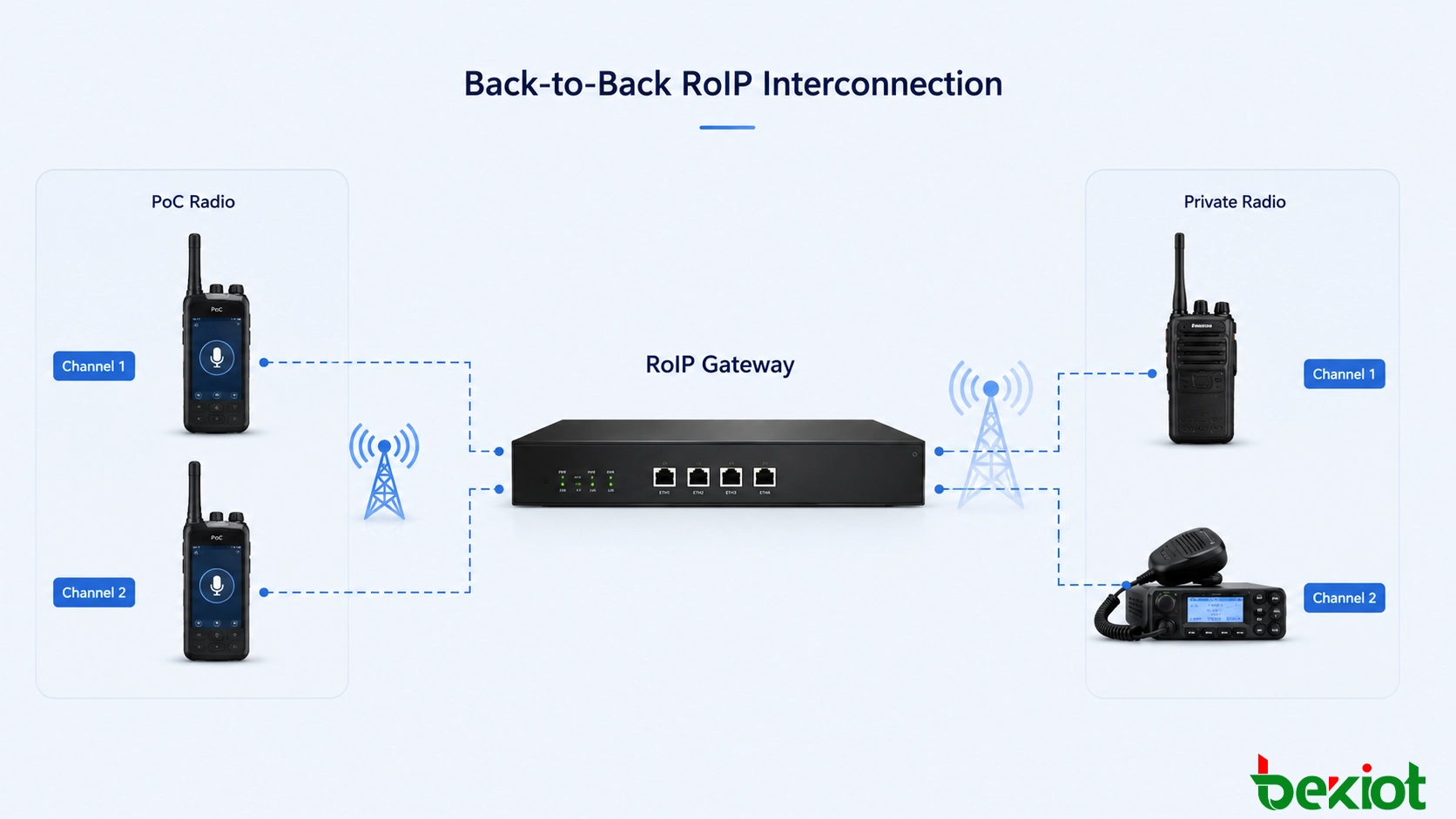
In this architecture, one gateway interface is connected to a PoC radio terminal and another interface is connected to a private-radio terminal. The gateway creates an audio and control path between the two ports. When communication is received on one side, it can be transferred to the other side so that users on both networks participate in the same voice channel.
For a single channel, the structure can be simplified as:
PoC Radio → Interoperability Gateway → Private Radio
If several channels need to be interconnected, the same concept can be expanded. A PoC radio and a private-network radio are paired for each required channel, and multiple pairs are connected to separate gateway ports. The gateway configuration then determines which ports communicate with one another.
This design has an important practical advantage: it relies primarily on the radio terminals themselves rather than requiring deep software development between two proprietary platforms. It can therefore be used when system interfaces are unavailable, when protocols are incompatible or when a project needs a relatively direct method of connecting existing equipment.
It is especially useful for retrofit projects where both radio networks are already operational and replacing either platform would be impractical.
Where Terminal-Based Bridging Has Limits
The broad compatibility of the back-to-back method comes with trade-offs. Because communication passes through physical terminals, the final result depends partly on the behavior and audio performance of those terminals.
On the private-radio side, professional handheld and vehicle radios are generally designed for integration with accessories and external communication equipment. Mature private-radio products commonly provide interfaces that make them relatively suitable for gateway connection.
The PoC side can be less predictable. Public-network push-to-talk products cover many platform designs and terminal types, and there is no single external-access implementation common to all of them. The quality of a terminal-based connection can therefore depend on how a specific PoC radio handles audio, push-to-talk control and external interfaces.
Latency is another consideration. In a back-to-back configuration, communication is transferred through a terminal on one system, processed by the gateway and then transmitted through another terminal on the second system. This additional relay process introduces more delay than a direct software-level connection.
The method remains valuable because of its compatibility, but projects should evaluate actual voice performance instead of assuming that every PoC terminal will behave identically.
Direct Platform Access Reduces Relay Steps
A second approach is available when the PoC platform provides an interface that can be integrated directly with the convergence gateway.
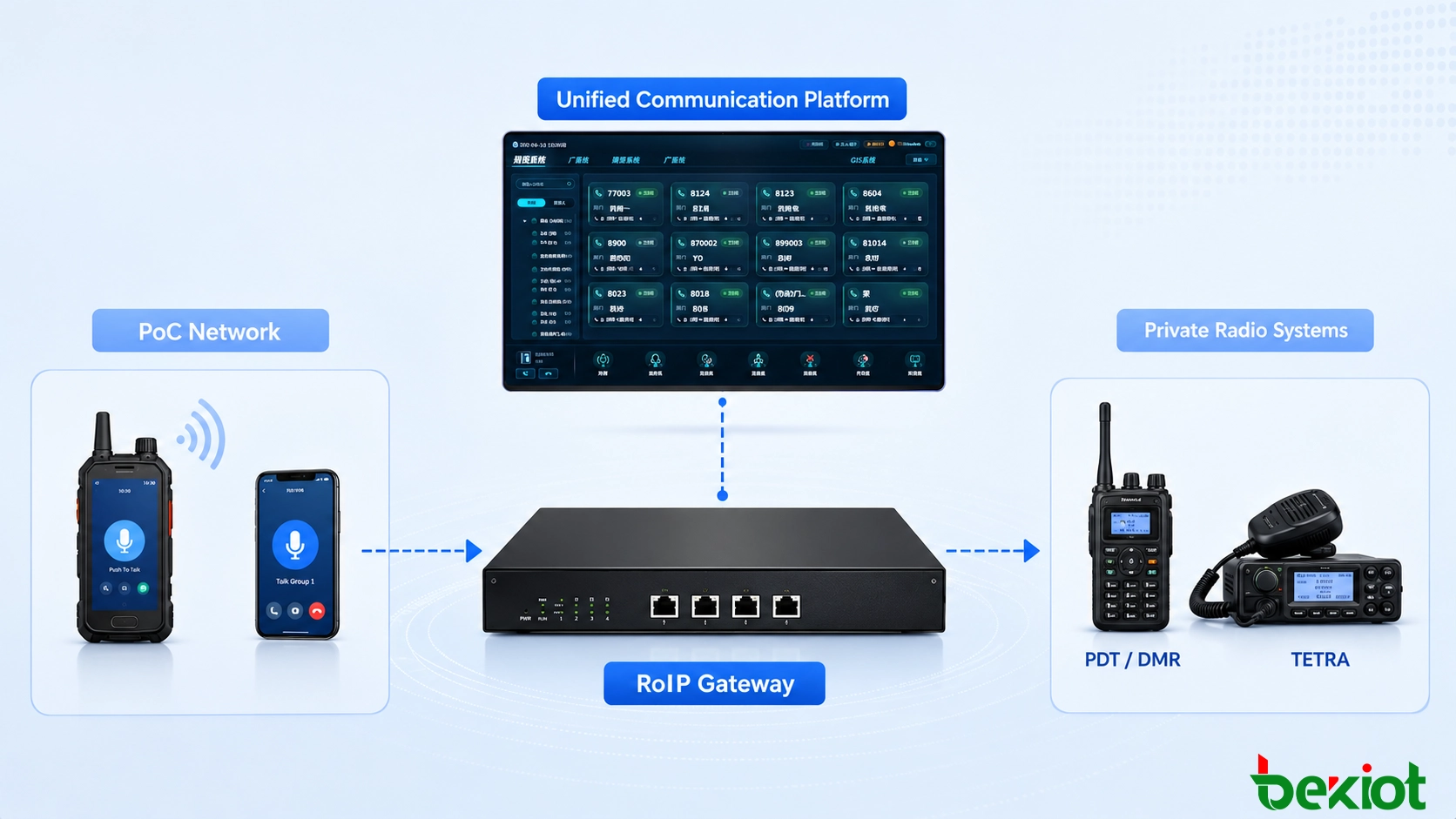
Public-network push-to-talk systems are software-based platforms, and many use signaling architectures derived from or related to SIP. A convergence gateway equipped with SIP and API integration capabilities can therefore connect directly to a compatible PoC platform rather than relying on a physical PoC radio for every interconnected channel.
The architecture then changes to:
PoC Platform ↔ SIP/API ↔ Convergence Gateway ↔ Private Radio or Mobile Radio
On the private-radio side, the gateway can continue connecting to an existing handheld or vehicle-mounted radio using the interfaces provided by the radio equipment. On the public-network side, signaling and voice are exchanged directly with the PoC software platform.
Removing the PoC radio from the relay path can improve several aspects of the system. There are fewer terminal-dependent stages in the communication chain, which can improve voice consistency and reduce additional transmission delay. Direct platform access can also provide a more controlled integration point than an external connection through a physical PoC terminal.
The source architecture also identifies security and call quality as advantages of direct protocol integration. Because communication is handled between software interfaces instead of being relayed entirely through radio terminals, the PoC side can provide a cleaner path for system-level interoperability.
Choosing Between the Two Approaches
Neither architecture should be treated as universally superior. The correct choice depends on the interfaces available in the existing systems and the operational goals of the project.
Back-to-back integration is appropriate when compatibility is the primary concern. It is useful when the PoC supplier does not provide an accessible software interface, when the platform protocol is proprietary or when the project needs to interconnect existing systems without deeper software modification.
Direct protocol integration is more attractive when a compatible SIP or API interface is available. By connecting directly to the PoC software platform, the design can reduce terminal relay stages and achieve lower communication delay and better call performance on the public-network side.
The number of channels also affects the decision. In a back-to-back system, multiple simultaneous or independent channels normally require corresponding terminal pairs and gateway ports. As the number of channels grows, the hardware structure becomes more complex. A platform-level interface can offer a cleaner architecture where the PoC system supports the required software integration.
A project assessment should therefore examine:
The private-radio technology in use, such as PDT, DMR or TETRA.
The PoC platform and whether it provides SIP, API or another usable software interface.
The number of radio channels that need to be interconnected.
Whether existing handheld or vehicle radios provide suitable gateway interfaces.
The acceptable level of communication latency.
The required voice quality and operational reliability.
Whether future expansion is expected to add additional channels or systems.
Reviewing these items before deployment prevents the gateway from becoming an isolated hardware component and ensures that it is selected as part of a complete interoperability architecture.
Why Full Protocol Integration Is Less Common
In theory, public and private systems can also be interconnected through deeper protocol-to-protocol development. Instead of connecting radio terminals or using a readily available SIP/API interface, both platforms can be modified or integrated at a deeper software level.
The source material identifies this approach as less common in practical projects. Deep protocol integration can require extensive customization and coordination between different system suppliers. Development risk and project cost are higher, and commercial cooperation between vendors can become another obstacle.
For these reasons, full custom protocol integration has seen fewer practical deployments than the two gateway-based approaches.
Gateway integration provides a more manageable boundary between the systems. Each network can continue performing its original role, while the convergence layer deals with the communication path required between them.
Building a Practical Convergence Solution
Public-private convergence is most valuable when it extends communication capability without weakening the strengths of the existing private network.
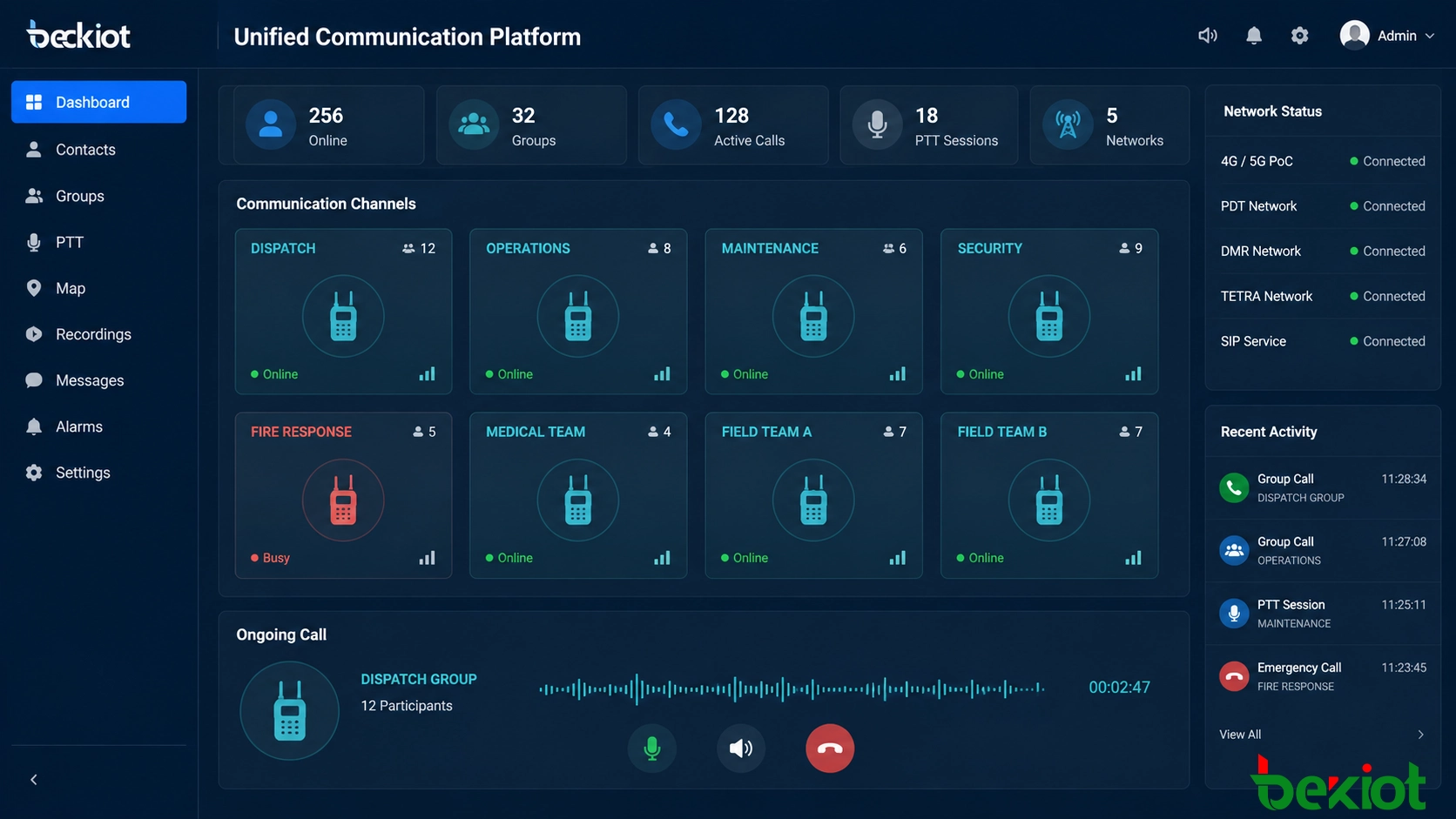
The private trunked system can remain the critical communication foundation for users who require predictable low-latency and reliable radio operation. PoC communication can then extend coverage through operator 4G and 5G networks, allowing additional users or remote locations to participate without requiring private-radio infrastructure everywhere.
The interoperability gateway sits between these environments and creates the required communication bridge. Where direct platform interfaces are unavailable, back-to-back radio access provides a broadly applicable connection method. Where the PoC platform supports SIP or API integration, direct software access can simplify the public-network side and reduce unnecessary relay stages.
This approach is suitable for organizations that need to preserve an existing professional radio network while gradually introducing broadband push-to-talk services. Rather than forcing a complete migration from one technology to another, the solution allows the public and private networks to complement each other.
Conclusion
Public-network PoC and private trunked radio solve different communication problems. PoC uses existing 4G and 5G operator infrastructure to provide rapid deployment, broad coverage and broadband communication capabilities, while PDT, DMR and TETRA systems continue to play an important role in critical communications where low latency, high reliability and security are essential.
A practical convergence solution therefore focuses on interoperability rather than replacement. Back-to-back gateway integration provides broad compatibility by connecting a PoC radio and a private radio through paired gateway ports. Direct SIP or API integration removes the physical PoC terminal from the communication path when the platform provides an appropriate software interface, improving voice performance and reducing relay latency.
For most projects, these two architectures offer a more practical route than deep custom protocol development. The final design should be based on the radio standards already deployed, PoC platform interfaces, channel requirements, latency expectations and the amount of future expansion planned for the communication system.
FAQ
Can an organization introduce PoC without shutting down its existing private radio system?
Yes. The convergence approach described here is specifically intended to allow an existing private trunked network and a PoC system to operate together rather than requiring immediate replacement of the private-radio infrastructure.
Is a single gateway channel sufficient for every deployment?
Not always. A back-to-back design uses paired public and private radio terminals for the channels that need to communicate. Projects requiring several independent channels must plan the gateway connections accordingly.
Does every PoC platform provide the same SIP interface?
No. The source material emphasizes that PoC platforms have not formed one unified implementation standard. Compatibility must therefore be confirmed with the specific software platform used in the project.
Can handheld radios and vehicle radios both participate in private-side integration?
Private-radio handheld and vehicle equipment can be used where the devices provide suitable external interfaces for gateway connection. The exact implementation depends on the interfaces available on the installed radio equipment.
Why might a project avoid a fully customized protocol connection?
Deep protocol development can involve higher customization effort, development risk, implementation cost and coordination between different suppliers. These factors have limited its use compared with gateway-based integration methods.







