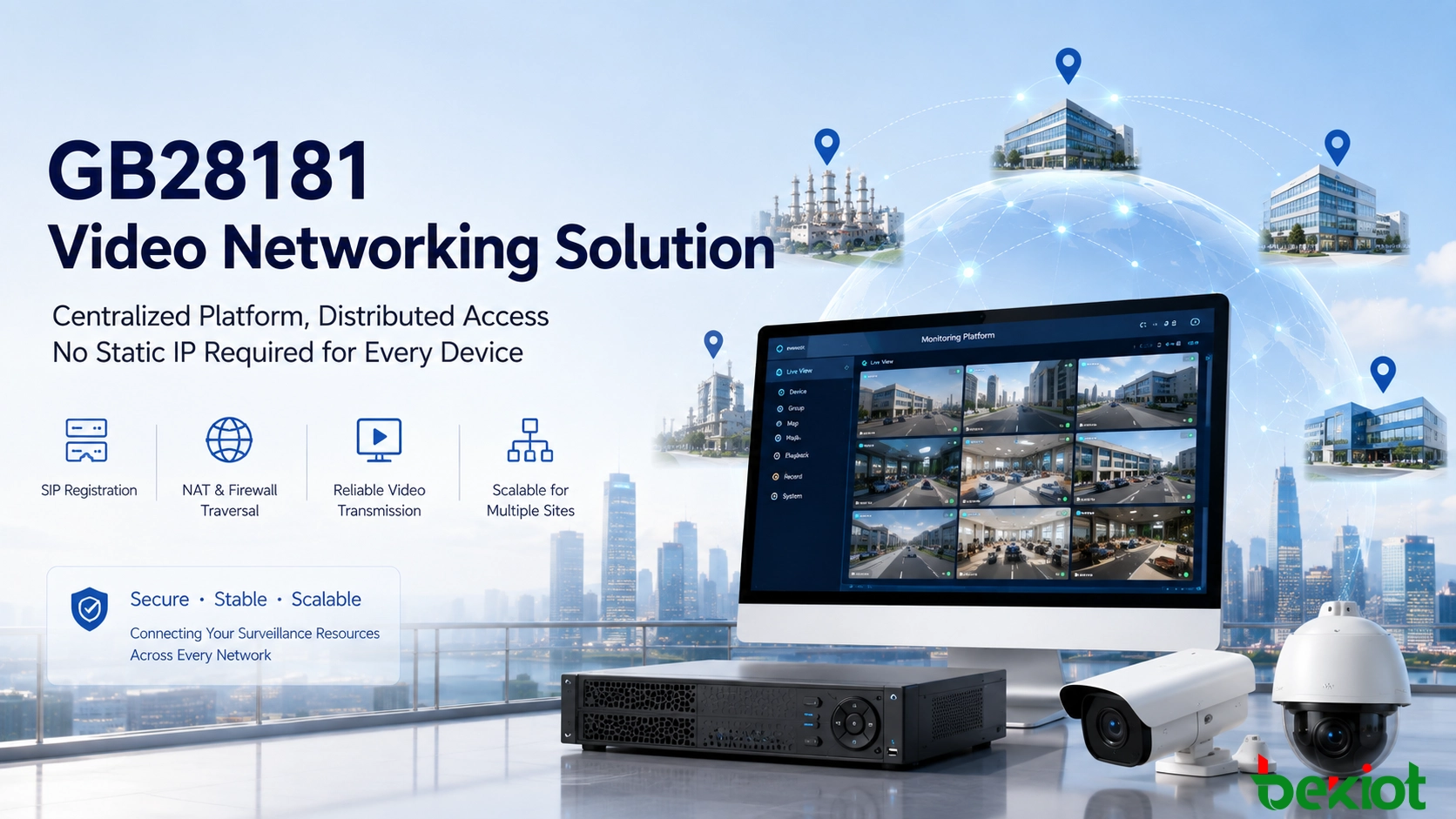
GB28181 is widely used to connect video surveillance resources across different networks and management platforms. In practical deployments, especially when cameras, NVRs and video platforms communicate over the Internet, one question appears repeatedly: does every device participating in a GB28181 network need a fixed public IP address?
In most deployments, the answer is no. The central GB28181 platform, or the gateway acting as the stable registration endpoint, normally needs a fixed and reachable network address. Cameras, NVRs and other front-end devices can usually remain behind routers, firewalls or NAT gateways as long as they can establish communication with that platform and the required signaling and media paths are correctly configured.
This architecture is possible because GB28181 uses a registration model derived from SIP. Instead of requiring the central platform to locate every camera by a permanent public IP address, front-end devices actively register with the server and maintain their communication state. This makes large-scale cross-network video integration more practical, particularly when surveillance equipment is deployed in branch offices, industrial sites, transportation facilities, campuses, warehouses or other distributed locations.
For project design, the more useful question is therefore not simply whether a static IP is required. Engineers should determine which node needs to provide a stable service address, how remote devices reach that node, where NAT occurs, and whether both signaling traffic and video streams can pass through the selected network path.
How the Registration Architecture Works
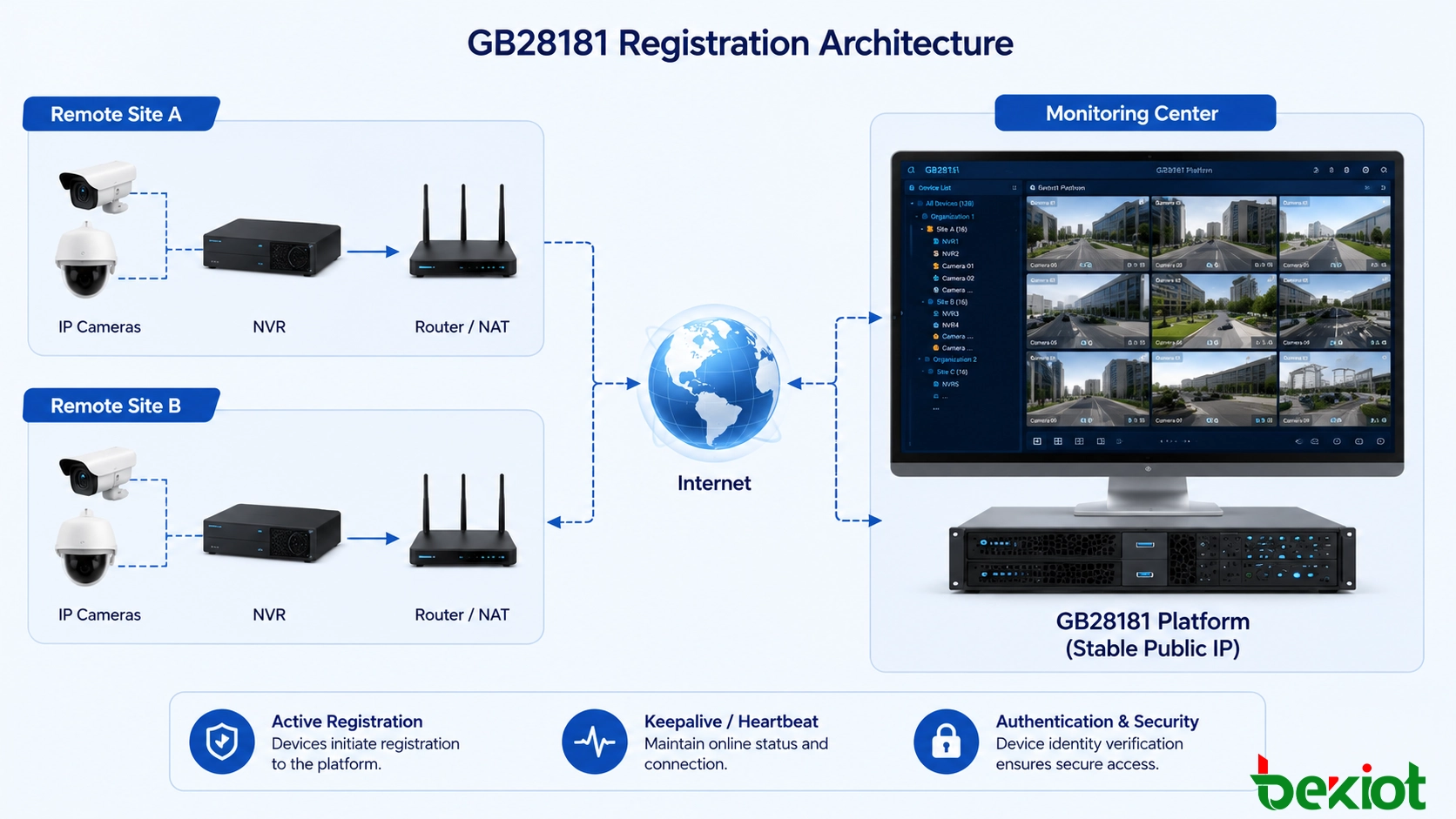
A useful way to understand the network requirement is to compare the GB28181 architecture with a SIP communication system. The central GB28181 platform performs a role similar to a SIP server, while NVRs, cameras, video gateways and other access devices behave like registered endpoints.
When an endpoint comes online, it initiates registration toward the configured platform. The platform identifies and authenticates the device using the configured device identity, authentication information, server address and communication port. Once the registration process succeeds, the platform can maintain a logical relationship with that endpoint without requiring the endpoint itself to expose a permanent public Internet address.
After registration, the device continues to maintain its online state through periodic communication. In a distributed deployment, this is important because a camera or NVR may be operating behind a router whose external network information changes over time. As long as the endpoint can re-establish communication with the known platform address, the central system can continue managing it as a registered resource.
This changes the basic networking model. The important requirement is not that every camera has a globally fixed address, but that the device can reach the GB28181 server and maintain a usable communication path.
Why Front-End Devices Usually Do Not Need Public Addresses
Most surveillance devices are originally designed to operate inside a local area network. A camera may use a private address assigned by the local router, while an NVR may manage dozens of cameras on the same private network. Giving every device an independent public IP address would add unnecessary network complexity and would often be impossible because many Internet connections do not provide public static addresses for individual devices.
This becomes particularly important in distributed surveillance projects. A central monitoring platform may need to connect video resources from many locations, but those locations may use ordinary broadband, enterprise Internet access, private networks or firewalls. Their public addresses may change, and some sites may not expose the surveillance subnet directly to the Internet at all.
With the registration-based architecture, the front-end device establishes communication toward the known GB28181 server. The server therefore does not need to discover the device by continuously tracking its changing external IP address. As long as the registration state remains valid and the network permits the necessary communication, the endpoint can continue participating in the system.
This also provides a cleaner security boundary. Cameras can remain inside the surveillance LAN instead of being individually exposed as Internet-accessible devices. Network administrators can then control external communication at the router, firewall, gateway or site edge rather than maintaining separate public-address policies for every camera.
In practical terms, this means an NVR, camera or access gateway normally needs reliable network connectivity rather than its own dedicated static public IP.
Signaling and Video Traffic Are Different Paths
One of the most common mistakes in GB28181 deployment is assuming that successful device registration proves that the entire video connection is working. Registration mainly confirms that the signaling path between the device and the central platform is available. Actual live video transmission introduces a separate media path that must also be reachable.
A camera or NVR can therefore appear online in the platform while live video cannot be opened. In this case, the registration process may be functioning correctly, but media traffic may be blocked by a firewall, translated incorrectly by NAT, routed to an unreachable address or restricted by an incorrectly configured port range.
This distinction is important when troubleshooting cross-network projects. Engineers should verify the complete sequence from device registration and authentication to stream request, media session establishment and continuous video transmission. Treating signaling and media as separate but related network paths makes fault isolation much faster.
The same principle applies when video is transmitted across multiple network boundaries. A headquarters platform may communicate with a branch NVR through the Internet, while the NVR obtains video from cameras inside a completely private subnet. The camera itself may never communicate directly with the public network, yet its stream can still become available to the central platform through the NVR or access gateway.
NAT and Firewalls Must Still Be Planned Carefully
Removing the requirement for a fixed IP on every surveillance device does not mean network design can be ignored. Many field devices sit behind NAT routers or enterprise firewalls, and both signaling traffic and video media must pass through the network correctly.
SIP-style registration helps the platform maintain knowledge of registered endpoints. Periodic registration, keepalive and heartbeat mechanisms can also help maintain communication state between the endpoint and the server. This is particularly useful when cameras or NVRs are located behind routers whose external addresses may change over time.
However, NAT traversal should not be treated as an automatic solution to every network problem. A deployment still needs to verify firewall policies, address translation behavior, signaling ports, media ports and routing between the field network and the platform.
Different sites can also behave differently even when the same surveillance equipment is used. One branch may use a simple enterprise router, another may operate behind a multilayer firewall, while a third may access the platform through a private WAN. The GB28181 configuration can be similar at the device level, but the required routing and security policies may differ substantially.
For example, a device may successfully register with the platform while live video still fails because the media path is blocked. Registration testing therefore confirms only part of the system. A complete commissioning process should also verify live viewing, stream establishment, device control and recovery after a temporary network interruption.
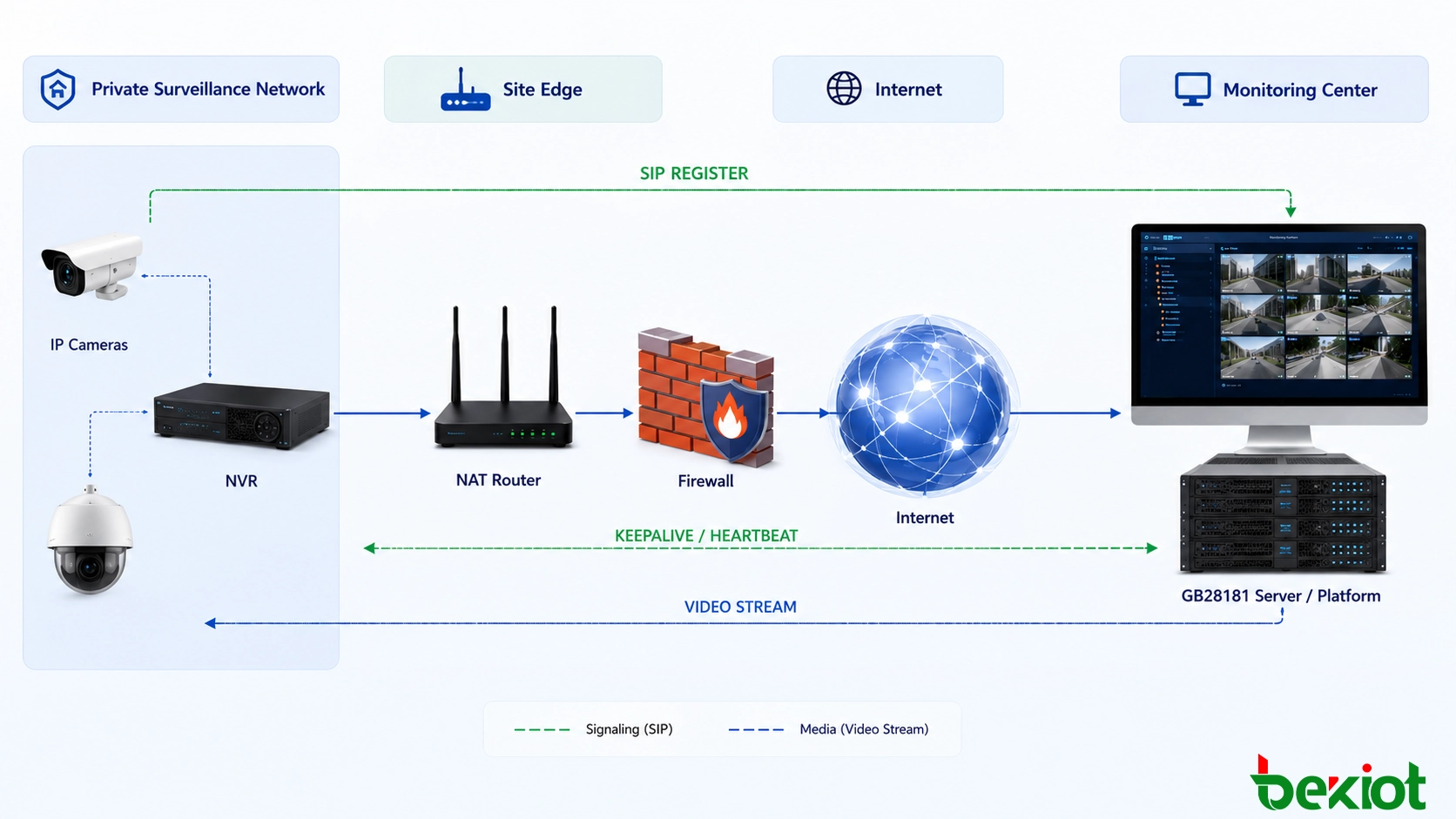
A Practical Architecture for Distributed Sites
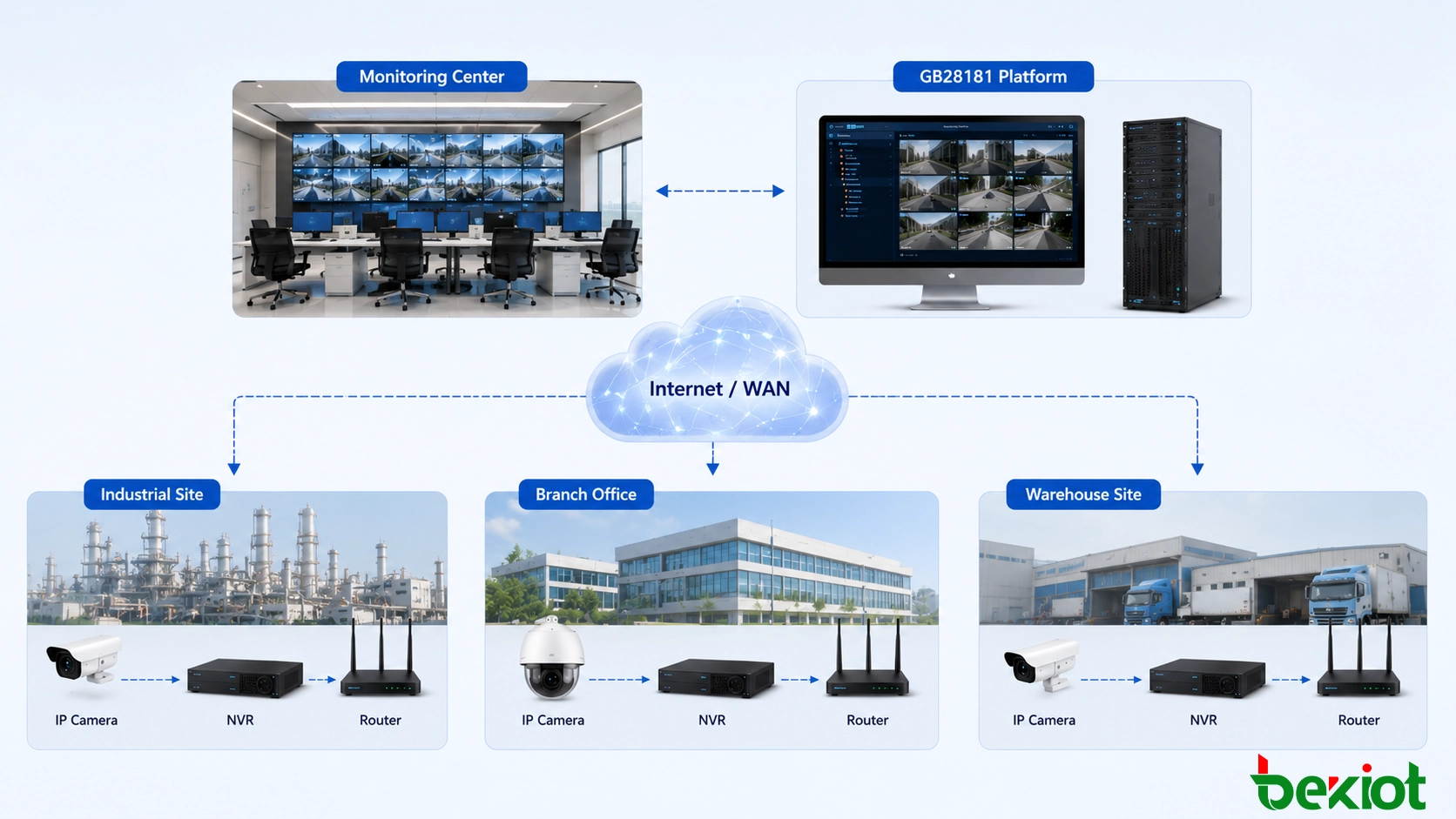
For Internet-based deployment, the simplest architecture is normally to provide the central GB28181 platform, or the GB28181 access gateway acting as the central connection point, with a stable network address that remote devices can continuously reach.
The platform address is configured into remote NVRs, cameras or gateways. Each endpoint then initiates registration from its local network toward the central system. Because the connection is initiated from the device side, the local surveillance network does not need to expose every individual camera directly to the public Internet.
A typical deployment can therefore be divided into three areas:
Central platform: provides a stable and reachable GB28181 registration endpoint and manages device registration, authentication, signaling and video access.
IP network: provides communication between distributed sites and the central system through enterprise networks, the Internet or other routable connections.
Field surveillance networks: contain NVRs, cameras and related equipment using local addressing behind routers or firewalls.
In a small project, a remote site may register one NVR containing multiple camera channels. In a larger project, several NVRs, video gateways or directly connected GB28181-compatible devices may register independently. The correct structure depends on how the surveillance resources are organized and how much control the central platform needs over individual devices.
For industrial parks, transport facilities and organizations with multiple branches, the site-level access model is often easier to operate because local devices remain within their existing LAN architecture. Network administrators only need to ensure that the required access node can communicate reliably with the central system.
This model is much more scalable than assigning a public IP address to every surveillance endpoint. When new sites are added, the main task is to provide network reachability to the central platform and correctly configure device registration rather than redesigning public addressing for every camera.
Network Capacity Matters Beyond IP Addressing
A correct IP architecture does not guarantee good video performance if the available network capacity is insufficient. GB28181 projects may involve many channels transmitting video toward a central location, so bandwidth planning should be considered together with addressing, routing and firewall configuration.
If several high-resolution streams are requested simultaneously from the same remote site, the site's upstream bandwidth can become the real bottleneck. The platform may show all devices as online while operators experience delayed stream opening, packet loss, unstable playback or interrupted video.
For this reason, system planning should consider the number of simultaneously viewed channels rather than only the total number of registered cameras. A site containing hundreds of cameras may place little load on the WAN if only a small number of streams are transmitted externally at the same time. Conversely, a much smaller site can require significant bandwidth if many channels must be viewed continuously at the monitoring center.
Projects involving remote command centers, centralized recording or continuous cross-network monitoring should therefore evaluate available uplink capacity, network quality and expected concurrent streams during the design stage.
When a Static Public IP Is Actually Needed
In a conventional centralized GB28181 deployment, the most important fixed address is normally the address of the platform or gateway receiving device registrations. Remote endpoints must know where to send registration requests, so this server-side address should remain stable and consistently reachable.
If the platform's public address changes frequently, remote equipment may continue attempting to register with an outdated destination. That creates additional requirements for address discovery or network management. A fixed public IP therefore simplifies platform deployment and reduces uncertainty at the central connection point.
By contrast, an NVR or camera that actively registers with the platform does not normally require the same treatment. It can remain inside a private network as long as it has Internet or routed-network access and the necessary GB28181 communication can pass through the local network infrastructure.
Some projects use private leased networks, VPNs or enterprise WANs rather than the public Internet. In these environments, a public IP may not be required at all because both the platform and field devices communicate through routable private addresses. What matters is that the platform provides a stable destination within the selected network architecture.
The resulting design principle is straightforward: keep the central service endpoint stable, while allowing field devices to use practical local-network addressing wherever the deployment permits.
Deployment Recommendations
For a new GB28181 networking project, IP planning should be performed at the system level rather than device by device. Start by determining which component will act as the stable registration endpoint. Then confirm how every field network reaches that endpoint and whether signaling and video media can pass through the network path.
The design should also identify where address translation occurs. If both the central platform and field equipment are positioned behind different NAT devices, communication may become more complicated than in a topology where the central endpoint is directly reachable. Understanding the complete route before configuring individual devices can prevent repeated troubleshooting later.
During commissioning, test more than basic registration. Verify live video access, stream stability, reconnection after network interruption and long-duration device status maintenance. When multiple remote sites are involved, test representative network environments because different routers and firewall policies can produce different results.
It is also useful to simulate realistic operating conditions. Open several streams simultaneously, disconnect and restore the WAN connection, restart an NVR and confirm that the endpoint automatically returns to the platform. These tests reveal problems that may not appear during a short single-channel demonstration.
For larger systems, maintain a clear record of platform addresses, site network ranges, device IDs, registration relationships, signaling policies and media-port requirements. This documentation makes later expansion and troubleshooting significantly easier when hundreds or thousands of surveillance resources are connected.
This approach avoids unnecessary public-IP allocation while keeping the architecture suitable for expansion. New NVRs, cameras or remote sites can be added through the same registration model without requiring every surveillance device to become a directly exposed Internet endpoint.
Conclusion
GB28181 video networking does not normally require every NVR or surveillance camera to have a fixed public IP address. Because the system uses a SIP-derived registration mechanism, remote devices can actively register with a central platform and maintain communication through registration and heartbeat processes.
In a typical Internet-based architecture, the GB28181 platform or central access gateway should provide a stable, reachable address. NVRs and cameras can remain behind local routers, NAT devices and firewalls as long as they can reach the platform and the required signaling and media paths are correctly configured.
For large-scale projects, the real design priority is therefore not assigning static IP addresses to every device. It is building a stable central endpoint, predictable routing, correct firewall policies, adequate bandwidth and reliable registration and media communication across all participating networks.
FAQ
Can a domain name be used for the central GB28181 platform?
This depends on whether the connecting equipment supports domain-name configuration and handles DNS resolution reliably. Where interoperability is uncertain, a stable IP endpoint generally provides a simpler deployment model.
What happens if the central platform is placed behind carrier-grade NAT?
A platform that cannot be directly reached from remote networks may require additional network arrangements such as a public-facing gateway, dedicated routing or another controlled connection method. The important requirement is that participating devices can consistently reach the registration service.
Can the central system use redundant network addresses?
Redundant deployment is possible when supported by the system architecture, but failover behavior must be planned together with endpoint registration rules. Devices should know how they reconnect when the primary service endpoint becomes unavailable.
Is cloud deployment suitable for a GB28181 platform?
A cloud environment can provide the required network reachability if its public addressing, routing, firewall and media-port policies are configured for the surveillance system. The same connectivity principles apply whether the platform runs in a local data center or cloud infrastructure.
Does using an NVR reduce the number of GB28181 registrations?
It can. Where an NVR exposes multiple camera channels through one GB28181-compatible device, the central platform may manage those channels through the NVR rather than requiring each camera to establish an independent cross-network registration. The actual behavior depends on the equipment and project architecture.