
In fast-paced industrial environments, if a dispatch instruction takes half a second or longer to reach the handset, the problem is more than simply feeling “a little slow.” Operators may miss a critical moment. A control room may issue a shutdown command while equipment on site continues operating; maintenance personnel may report a fault only for the dispatcher to hear a delayed, noisy, or broken message; or both sides may speak at the same time and fail to understand each other. What appears to be a call-quality issue can directly affect dispatch accuracy, equipment coordination, and site safety, making reliable communication a critical part of industrial operations.
Reducing voice transmission latency in industrial telephones cannot be achieved by focusing only on telephone specifications. From microphone pickup and audio encoding to packetization, network switching, platform routing, jitter buffering, decoding, and speaker output, every stage can add tens or even hundreds of milliseconds of delay. Effective optimization requires the terminal, network, platform, and operating environment to be treated as one complete voice path rather than solving only a single part of the system.
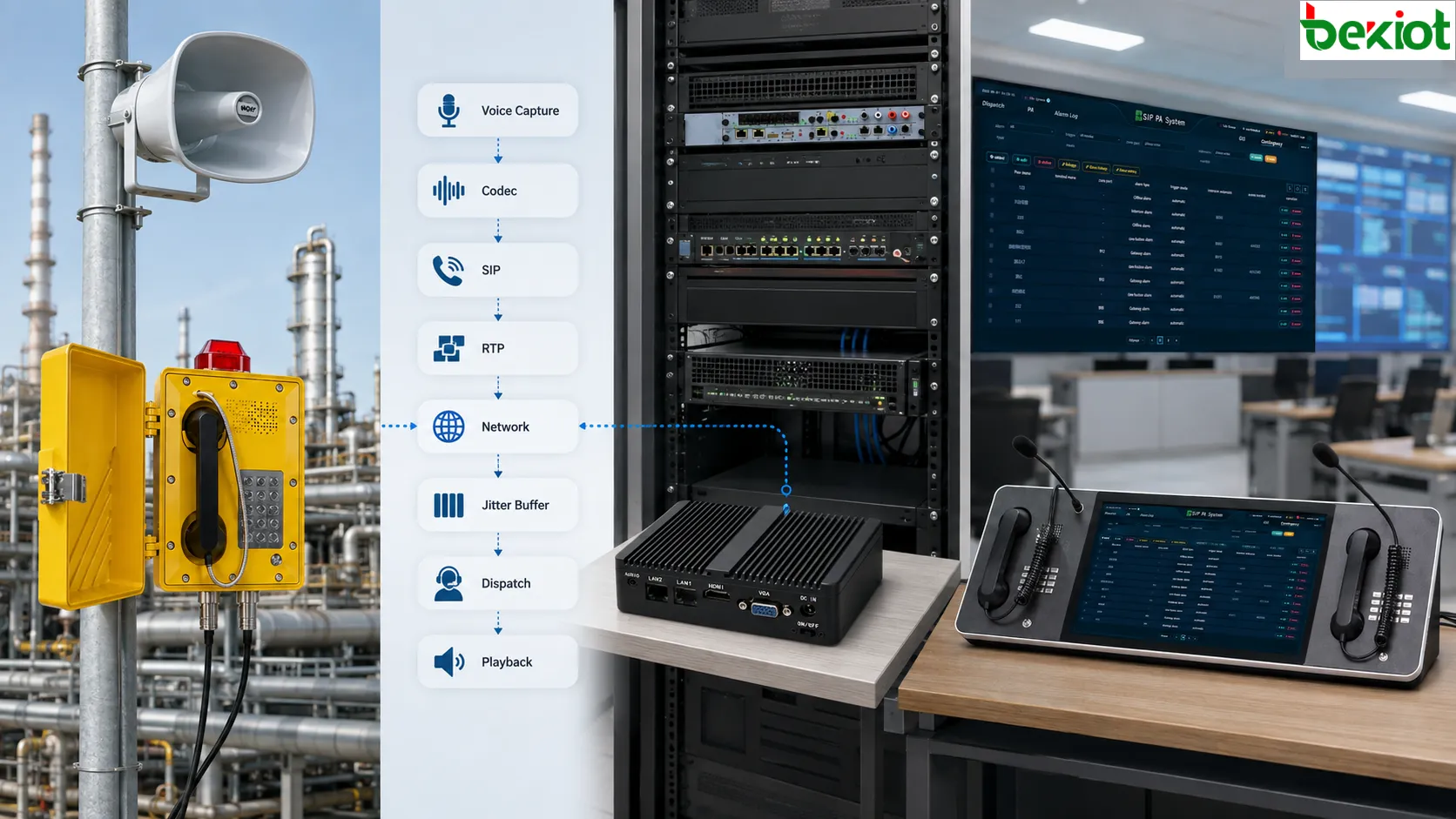
Latency Exists Across the Entire Voice Path
Voice delay in an industrial telephone is rarely caused by one isolated component. It is the cumulative result of multiple processing stages. Microphone capture requires processing time, voice codecs introduce computation and packetization delay, network devices add forwarding and queuing time, jitter buffers create additional waiting time, and dispatch platforms may introduce extra routing hops. If any one of these stages is poorly designed, the overall conversation can develop noticeable lag.
In a normal office environment, a difference of several dozen milliseconds may be difficult to notice. In industrial dispatching, emergency communication, equipment coordination, tunnel operations, mine sites, and petrochemical inspections, however, voice needs to feel as close to real time as possible. Personnel are not speaking in quiet offices at a relaxed pace. They may be confirming instructions quickly while surrounded by ventilation fans, alarms, vehicles, machinery, and other high-level background noise. Industrial telephone systems therefore cannot simply follow the same design assumptions as ordinary office phones.
For latency analysis, the voice path can be divided into five main stages: sound capture, audio processing and encoding, IP network or line transmission, dispatch platform or PBX routing, and receiving-side buffering, decoding, and playback. The key objective is to prevent any one of these stages from becoming an invisible waiting point.
Terminal Design Should Minimize Front-End Delay
The first part of the voice path is inside the telephone terminal. Microphone pickup, voice gain, echo control, noise reduction, codec processing, and packetization strategy can all affect front-end latency. If excessive delay is introduced during audio processing at the terminal, even a very fast network cannot fully compensate for it later.
Industrial sites often present a practical tradeoff: speech must remain clear, but audio processing cannot become too heavy. Noise reduction, echo suppression, automatic gain control, and speech enhancement can improve intelligibility, yet overly complex processing may introduce additional latency. A well-designed industrial telephone does not simply stack more audio functions into the signal chain. It balances speech clarity with real-time performance.
Codec configuration also influences transmission delay. Voice codecs typically divide continuous audio into short frames before packaging them into network packets. Longer packetization intervals can reduce packet overhead, but they also increase waiting time. Shorter intervals improve real-time responsiveness but place greater demands on network quality and device processing capacity. Industrial telephone parameters should therefore be configured according to the actual network environment, platform capabilities, and communication requirements.
Handset design also affects the practical efficiency of communication. In a high-noise environment, users may need to repeat themselves if speech pickup or listening volume is poor, increasing what can be described as effective communication latency. A close-talking handset, properly positioned microphone, sufficient receiver volume, and reliable cable connection can reduce repeated confirmations and improve the speed of real-world communication.
In hazardous areas such as petrochemical plants, oil and gas facilities, and mines, selection should not focus only on the explosion-proof enclosure. Voice pickup, keypad operation, handset design, line stability, and coordination with the dispatch platform should also be evaluated. The Becke Telcom EX-BH621 explosion-proof telephone can serve as a reference terminal for this type of application.
Network Quality Defines the Real-Time Experience
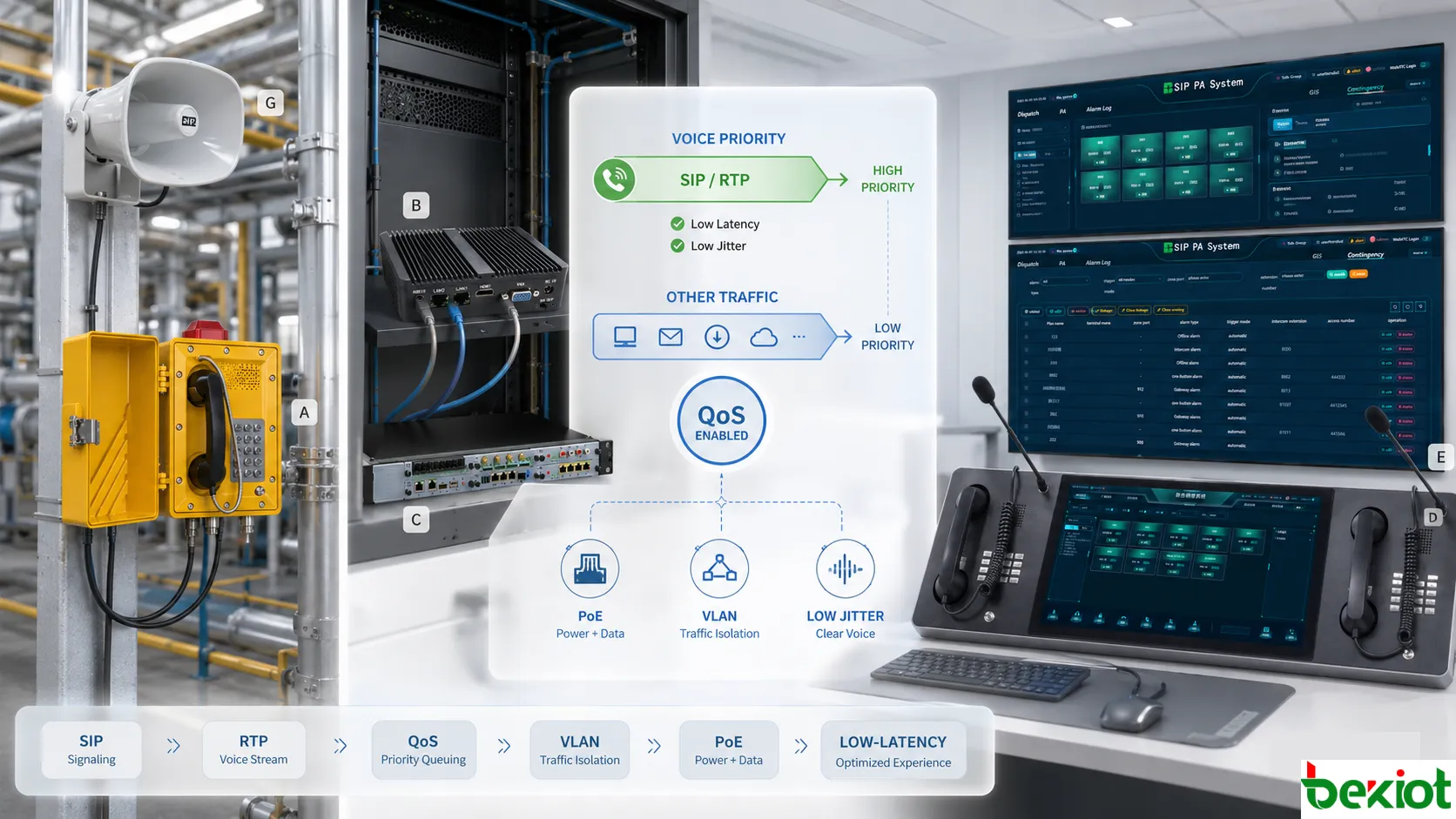
Once voice enters the IP network, latency is primarily affected by bandwidth, packet loss, jitter, switching paths, network congestion, and traffic-priority policies. Industrial telephones commonly use SIP for session control and RTP for real-time voice transport. SIP establishes, maintains, and terminates the call, while RTP continuously carries the actual voice stream between endpoints. In practice, the quality of RTP transmission is often what determines whether a conversation remains smooth and responsive.
A common problem in industrial networks is that voice traffic shares infrastructure with video surveillance, production data, office traffic, equipment telemetry, and remote maintenance services. Without proper VLAN segmentation, QoS prioritization, and bandwidth planning, voice packets may be forced to wait at switches, routers, or congested links. The result can be noticeable delay, audio dropouts, or unstable speech timing.
QoS is not simply a feature that can be enabled with one switch. It needs to be planned consistently across terminals, switches, routers, servers, and communication platforms. Voice traffic should be identified and given suitable forwarding priority, while critical dispatch and emergency calls should be protected from being crowded out by high-bandwidth video streams, file transfers, or other non-real-time traffic. For long-distance deployments such as tunnels, mines, industrial campuses, and oil and gas fields, path stability and network redundancy are equally important.
Jitter buffering is another area that requires careful balance. Network packets do not always arrive at perfectly consistent intervals, so the receiving device typically buffers a small amount of audio to smooth out timing variations. If the buffer is too small, speech may become choppy. If it is too large, the conversation develops noticeable delay. Industrial telephones and communication platforms should therefore use jitter-buffer settings appropriate to actual network conditions rather than simply targeting the lowest possible value.
Power and cabling can also affect latency indirectly. Unstable PoE power, poor-quality Ethernet cabling, aging connectors, faulty switch ports, or improperly designed long-distance links can all contribute to packet loss, retransmission, or unstable terminal registration. Voice optimization is not achieved only through software settings. Physical cabling and power infrastructure are also part of overall transmission quality.
Platform Architecture Affects Dispatch Response
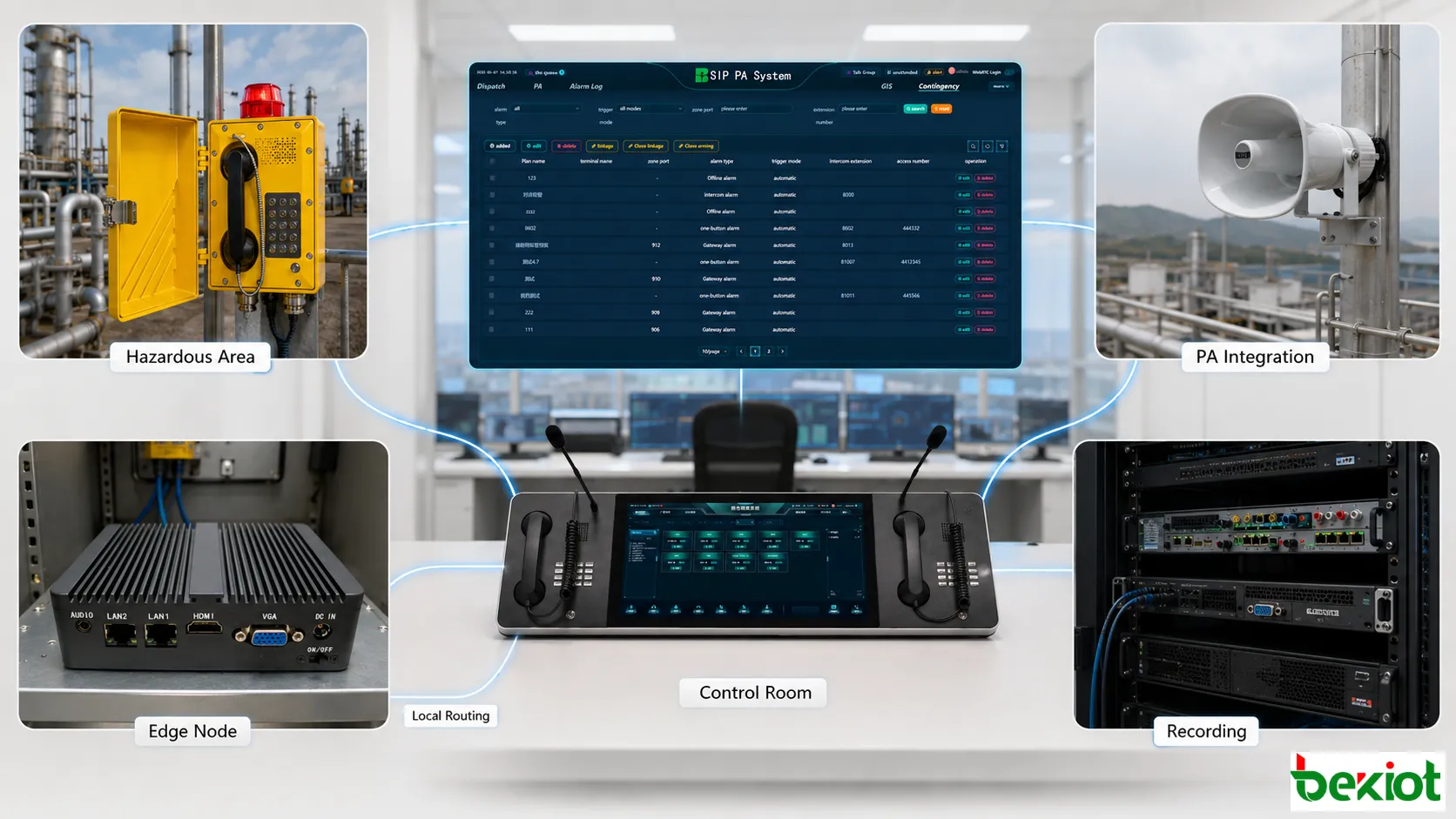
Industrial telephones are rarely used as standalone devices. They are typically connected to an IP PBX, SIP server, dispatch platform, recording system, public address system, or emergency communication platform. The simplicity and efficiency of the platform architecture can directly influence voice routing latency. For example, if a local field telephone calling a local control room is unnecessarily routed through a remote server before returning to the same site, a short voice path can become much longer than necessary.
Large-scale projects should therefore consider local processing. Industrial plants, mines, tunnels, ports, and oil and gas stations can use local servers, dispatch controllers, or edge access nodes depending on the scale of the system. This allows local calls to remain within the local communication zone whenever possible. It reduces network hops while also helping maintain local communication if the upstream connection becomes unavailable.
Dispatch applications also require carefully designed call routing. Standard office telephony may allow multiple levels of transfer, while industrial communication places greater emphasis on rapid confirmation. Routing rules between dispatch consoles, duty positions, and field telephones should therefore remain clear: who can call whom, where hotline calls should terminate, whether emergency calls receive priority, where recordings are stored, and whether PA or broadcast activation requires additional confirmation. These rules directly influence practical communication response time.
Recording architecture should also be designed carefully. Some systems insert a separate recording process into every call path. If the platform lacks sufficient capacity or the recording topology is poorly designed, this can add unnecessary processing overhead. A better approach is to coordinate recording, dispatching, call routing, and status monitoring within an integrated architecture rather than chaining several temporary or isolated systems together.
Low-Latency Voice Ultimately Improves Dispatch Reliability
The purpose of reducing voice transmission latency in industrial telephones is not simply to make conversations sound smoother. The real objective is to deliver dispatch instructions faster, confirm field conditions sooner, and reduce repeated communication during abnormal events. In petrochemical, oil and gas, mining, tunnel, power, port, and other high-noise industrial environments, even improvements measured in tens of milliseconds can contribute to faster execution of safety-critical instructions.
Effective optimization requires terminal selection, network planning, platform architecture, and on-site testing to be handled together. Replacing only the telephone will not remove an existing network bottleneck. Adjusting QoS alone will not eliminate excessive terminal-processing delay. Upgrading the platform will not solve packet loss and jitter caused by poor cabling or unstable power. Only an end-to-end approach can keep voice latency within an acceptable operating range.
For projects that require industrial telephones, explosion-proof telephones, or dispatch voice terminals in hazardous areas, Becke Telcom provides industrial communication products including the EX-BH621 explosion-proof telephone. Final equipment selection should consider site noise levels, network architecture, communication protocols, dispatch platforms, explosion-protection requirements, and long-term maintenance plans rather than relying only on protocol support listed in a specification sheet.
Frequently Asked Questions
Where does industrial telephone voice latency mainly come from?
It mainly comes from sound capture, audio processing, codec packetization, network forwarding, platform routing, jitter buffering, decoding, playback, and network congestion. Voice latency is generally the result of several factors rather than a single component.
Is a SIP telephone always lower latency than an analog telephone?
No. SIP telephones provide stronger platform integration and management capabilities, but actual latency depends on network quality, QoS configuration, server deployment, terminal settings, and routing design. The protocol type alone does not determine the final voice delay.
What does QoS do for industrial voice communication?
QoS allows voice packets to receive higher forwarding priority during periods of network congestion. This helps reduce queuing delay, jitter, and packet loss, making it particularly important for stable, low-latency real-time communication.
Is a smaller jitter buffer always better?
No. A buffer that is too small can cause choppy or interrupted audio, while an excessively large buffer increases conversation delay. The appropriate buffer size should be determined by actual network conditions rather than by pursuing the lowest possible setting.
Why is on-site testing important?
Specification sheets cannot fully reflect real operating conditions. Machinery, ventilation noise, vehicle movement, long-distance links, network congestion, and platform load can all affect actual voice latency and intelligibility. On-site testing is therefore necessary to confirm whether the communication system meets real dispatch requirements.