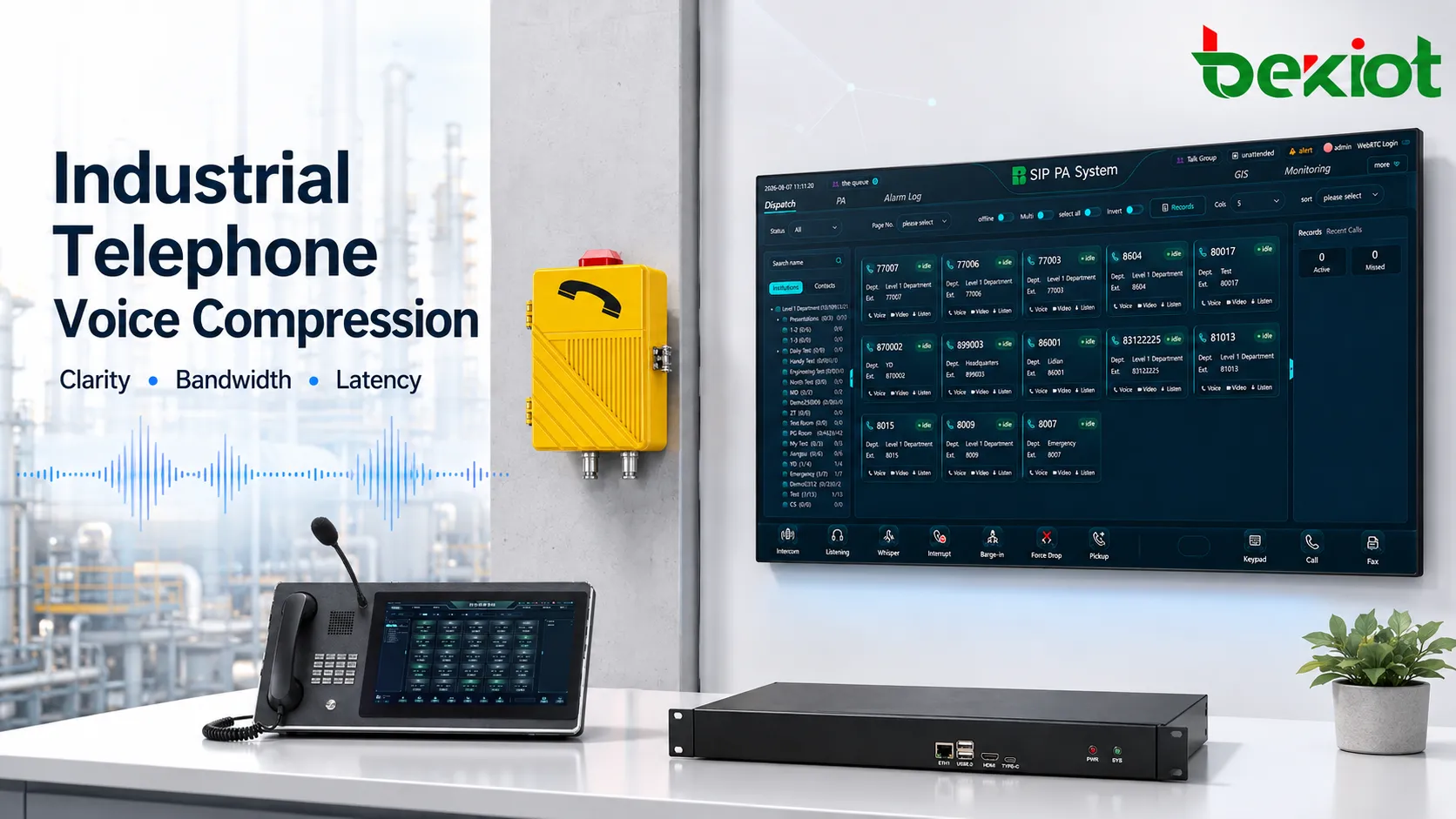
Before a voice signal leaves an industrial telephone handset, a series of trade-offs has already taken place. The system must convert continuous speech into data that can be transmitted efficiently while preserving enough detail for the listener to understand every instruction. Compress too little and bandwidth consumption increases. Compress too aggressively and speech can become thin, muffled or harder to distinguish, forcing field workers and dispatchers to repeat critical information.
Voice compression in industrial telephones may look like a codec and networking issue, but in practice it directly affects field usability. Petrochemical plants, mines, tunnels, ports, power stations, utility corridors and high-noise production areas do not all place the same demands on speech communications. Some projects prioritize maximum intelligibility, others need to operate over limited-bandwidth links, while many must also support recording, dispatch, paging and interoperability with multiple terminal types. The right codec therefore depends on the real operating environment rather than on one specification alone.
What Problem Does Voice Compression Actually Solve?
The basic purpose of a speech codec is to convert human voice into a form that can be transmitted efficiently over a network or communication link. Uncompressed audio requires considerably more bandwidth and also increases storage and processing demands. By compressing the audio stream, an industrial telephone system can support real-time calls, call recording, dispatch transfers and multi-site communications while using network resources more efficiently.
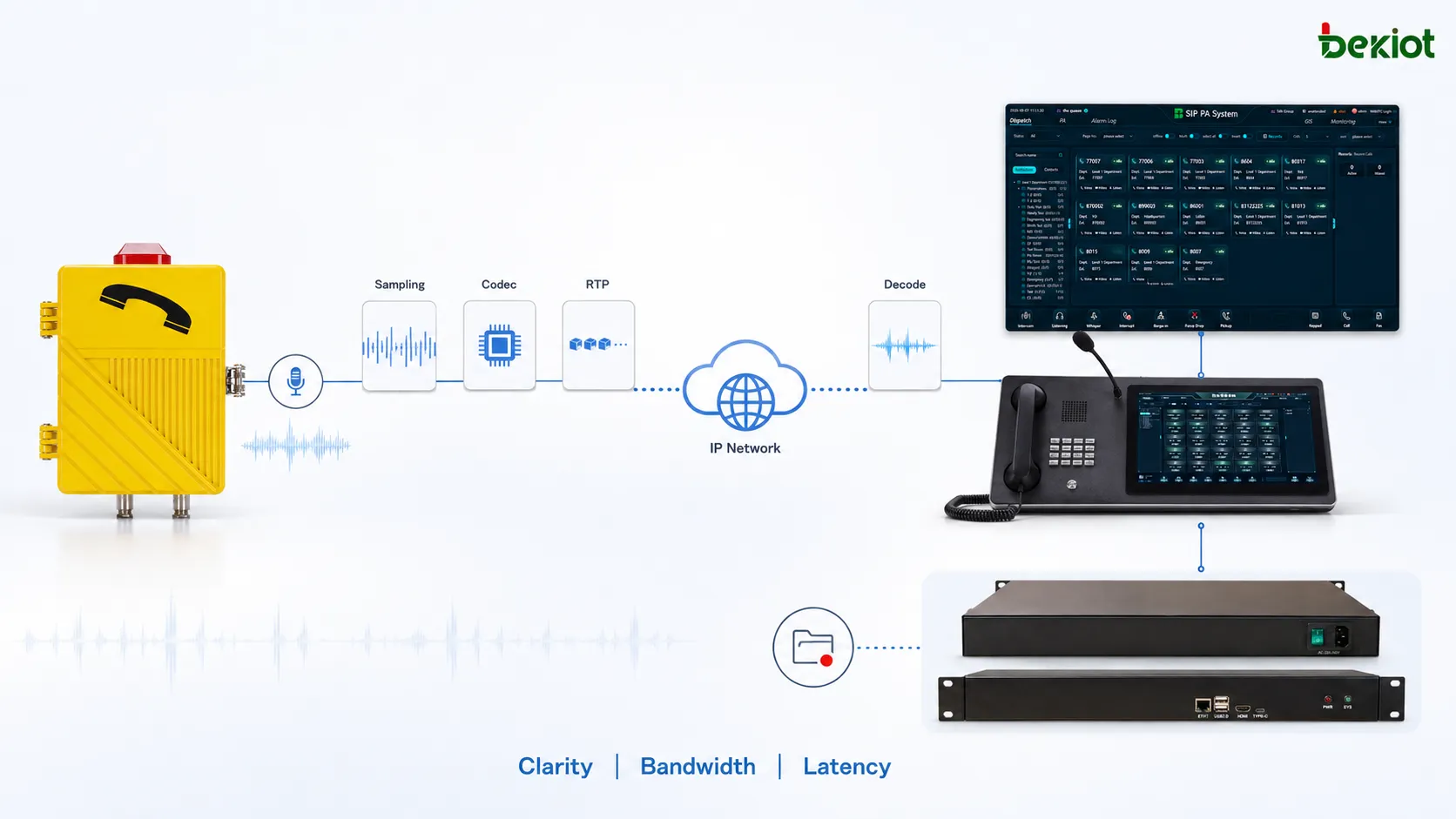
Compression, however, is not simply about making an audio file smaller. Telephone speech is real-time traffic. The codec must perform sampling, analysis, encoding, packetization and transmission within a very short time window, while the receiving side must decode and reproduce the audio just as quickly.
If the codec introduces too much processing delay, the bandwidth savings may come at the cost of conversation quality. This is especially noticeable in industrial dispatch. If a control room issues a stop-work instruction, even a few tens of milliseconds of additional encoding and decoding delay can become significant once network transmission and jitter buffering are added. The result is slower conversational rhythm and a greater chance of people talking over each other.
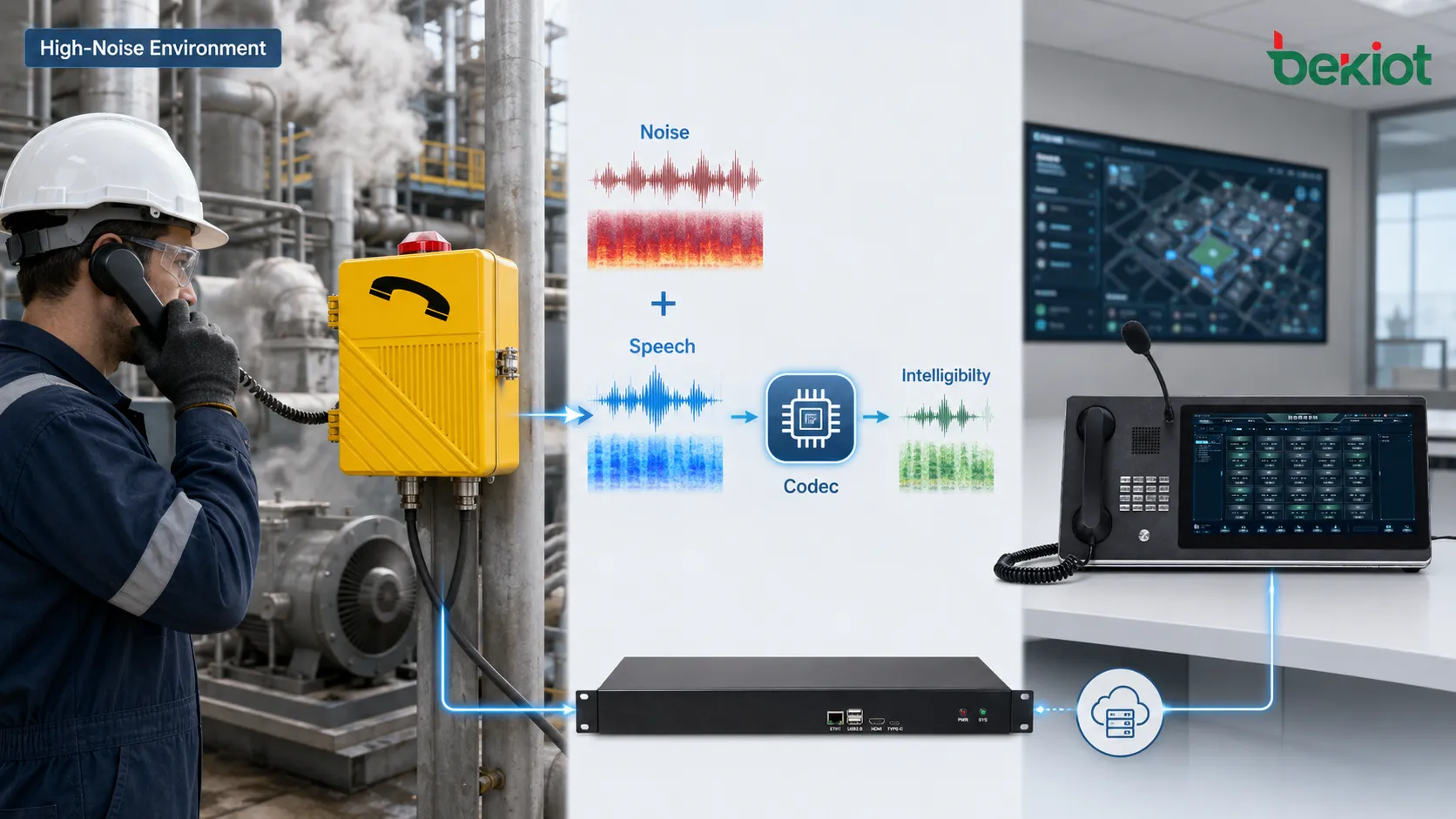
Industrial telephones place more emphasis on reliability and intelligibility than typical office phones. A field worker may be standing beside pumps, fans, conveyors, compressors, vehicle lanes or tunnel walls while speaking. Background noise masks important speech details, so the codec must preserve not just the sound of the voice but the acoustic information required to understand equipment numbers, location names and short operational commands.
A codec that sounds perfectly acceptable in a quiet office may perform very differently in a noisy industrial environment. For that reason, codec selection should not be based on bit rate alone. Site noise, network bandwidth, dispatch platform compatibility, recording quality, terminal interoperability, system scale and maintenance requirements all need to be considered. In practice, codec selection is a system-level engineering decision.
How Should Common Voice Codecs Be Compared?
Voice codecs used in industrial telephone systems make different trade-offs between speech quality, bandwidth consumption, processing complexity and interoperability. Higher-bit-rate codecs generally preserve more voice detail and are well suited to environments where network capacity is sufficient and speech quality is important. Lower-bit-rate codecs reduce bandwidth demand but place greater pressure on compression efficiency, packet-loss handling and distortion control.
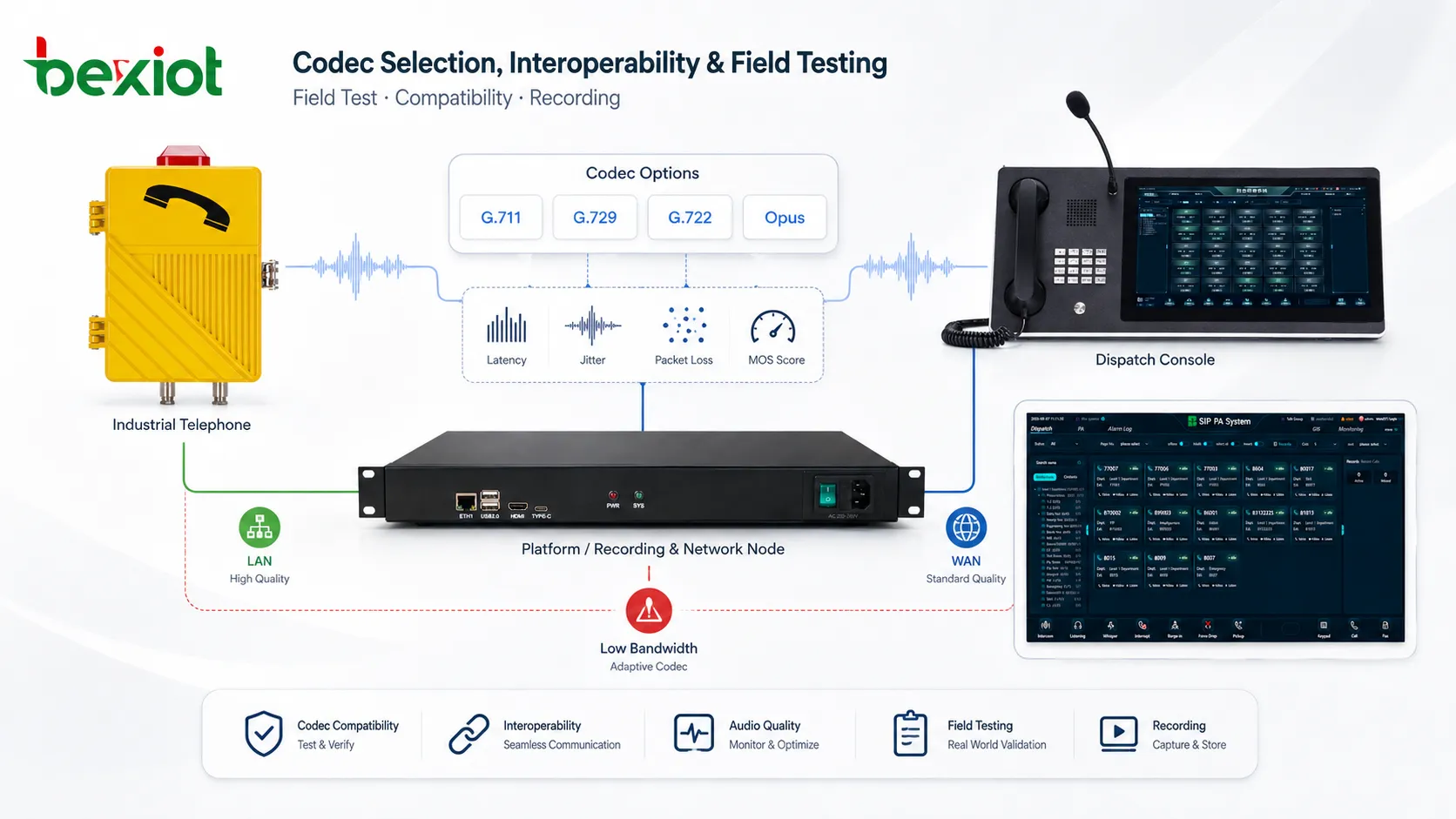
Common codecs found in SIP industrial telephones and IP dispatch systems include G.711, G.729, G.722, iLBC and Opus. Not every project enables every codec. Actual use depends on what is supported by the endpoints, dispatch platform, gateways, recording system and network architecture.
In engineering terms, one of the first questions is whether the calling endpoint, called endpoint, dispatch system, recorder and any intermediate gateway can negotiate a codec they all support. SDP negotiation failures or incompatible codec lists can cause call problems long before bit rate becomes the limiting factor.
G.711 is widely used because of its broad compatibility and relatively low processing complexity. Its main drawback is higher bandwidth consumption. On a stable LAN, industrial Ethernet network or control-room network where bandwidth is readily available, G.711 can be a practical choice because it preserves speech naturally and avoids unnecessary transcoding.
Lower-bit-rate codecs such as G.729 are useful when bandwidth is constrained or many concurrent calls must share the same link. The trade-off is stronger compression and some loss of speech detail. For remote facilities, mining networks, wireless backhaul or systems with high call concurrency, a lower-bit-rate codec may significantly reduce network load, but real-world intelligibility should always be verified before deployment.
Wideband codecs provide a wider speech frequency range, making voices sound more natural and helping preserve additional detail. They can be particularly useful in control rooms, command centers and other locations where high-quality speech is desirable. However, wideband performance requires support across the entire call path. If one device or platform does not support the selected codec, the call may fall back to a more widely supported narrowband format.
Opus is attractive in more complex environments because it can support both narrowband and wideband speech and adapt its operating bit rate to different network conditions. This flexibility can be valuable in industrial projects that combine multiple device types and different network links.
In Industrial Environments, Intelligibility Matters More Than Sound Quality
Industrial voice quality should not be judged only by whether the audio sounds pleasant or natural. The more important question is whether the listener can understand the message correctly.
Dispatchers need to distinguish equipment numbers, area names, alarm conditions and field reports. Workers need to hear commands such as stop work, evacuate, wait for inspection, close a valve or restart equipment. In these situations, speech intelligibility is more important than studio-like audio quality.
Codec behavior directly affects intelligibility. Some codecs sound good in quiet conditions but may lose subtle speech features when the background noise rises. This becomes especially important when workers speak quickly, wear protective equipment, stand at inconsistent distances from the microphone or work near continuous machinery noise.
One detail that is easy to overlook is that aggressive compression can reduce acoustic components that may not sound prominent but are important for understanding speech, especially the friction and plosive characteristics of consonants. In a noisy environment, these are often the first details to be masked.
Front-end audio processing also interacts with the codec. Noise reduction, automatic gain control, echo cancellation and speech enhancement all alter the signal before encoding. If these features are configured too aggressively, the original speech characteristics may already be distorted before compression begins. The codec then compresses an already modified signal, which can make the final audio sound unnatural or difficult to understand.
Good system tuning therefore does not mean enabling every audio-processing feature at its maximum setting. It means balancing them according to the site's actual noise profile and communication objectives.
Short-phrase intelligibility is particularly important in emergency and dispatch communications. Many field instructions are not long sentences. They are short, direct phrases containing critical keywords. The codec should preserve those keywords as clearly as possible.
Packet-loss concealment also matters here. When several voice packets are lost, a capable decoder can smooth over the missing audio rather than allowing an important word to be cut in half. In critical operations, avoiding even one repeated instruction may be more valuable than a small difference in nominal bit rate.
For this reason, industrial telephone projects should include testing under real operating conditions. Test cases can include two-way calls while machinery is running, calls over low-bandwidth links to remote sites, multiple simultaneous calls, dispatch recording playback, paging integration and side-by-side comparisons of different codecs.
Network Transport and Platform Configuration Determine the Final Result
A voice codec does not operate in isolation. Industrial telephones typically use SIP to establish the call and RTP to carry the real-time media stream. Once encoded, voice packets may pass through switches, routers, servers, dispatch platforms, recording systems and voice gateways. Each element can affect the final user experience.
If the network suffers from significant jitter, packet loss or congestion, even a high-quality codec may produce choppy audio, dropouts or excessive delay. Conversely, a stable network can allow a properly selected lower-bit-rate codec to maintain acceptable voice quality with much lower bandwidth consumption.
Codec selection should therefore always be evaluated together with network performance.
Jitter buffering is closely related to codec behavior. When voice packets arrive at irregular intervals, the receiving endpoint uses a jitter buffer to smooth playback. If the buffer is too small, audio may break up. If it is too large, conversational delay increases.
Different codecs react differently to packet loss, latency and jitter, so platform settings need to be tuned for the actual network. On wireless backhaul or long-distance inter-site links, jitter-buffer configuration can sometimes have more influence on perceived call quality than the codec itself.
VAD, or Voice Activity Detection, also interacts with codec operation. It can reduce bandwidth usage by stopping or reducing transmission during periods of silence. In a high-noise industrial environment, however, incorrect VAD thresholds may clip the beginning of words or cause background noise to switch in and out unnaturally.
Whether VAD should be enabled, and how its threshold should be configured, depends on the site's acoustic environment. Default settings should not automatically be assumed to be suitable.
Recording systems are another factor. Some systems store the incoming media stream directly, while others transcode the audio before saving it. Repeated transcoding can degrade voice quality and increase server processing load.
For projects that depend on recordings for incident investigation, shift review or dispatch replay, playback intelligibility should be included in codec evaluation. A call that sounds clear in real time but becomes difficult to understand in the recording still represents a system-quality problem.
Gateway interoperability is equally important. An industrial site may combine SIP telephones, analog phones, dispatch consoles, paging systems, radio gateways and wireless communication systems. If these systems do not support the same codec, transcoding may be required.
Transcoding adds processing overhead and can reduce speech quality. System designers should therefore minimize unnecessary codec conversions and, in particular, avoid multiple consecutive transcoding stages that gradually degrade the original voice.
Codec Selection Should Be Verified in the Field
Choosing a voice codec for an industrial telephone should ultimately be based on field testing rather than on a datasheet alone. A product specification can show which codecs an endpoint supports, but it cannot determine which codec will perform best with the specific plant network, noise environment and dispatch platform.
Testing can be divided into three broad categories.
The first is basic interoperability testing. Confirm that each codec can support call setup, answering, transfer, dispatch functions and recording without negotiation problems.
The second is real-environment testing. Run the system while machinery is operating, vehicles are passing, fans are running, outdoor wind or rain is present, or tunnel reverberation is significant. The goal is to evaluate intelligibility under the same conditions users will actually encounter.
The third is system-load testing. Evaluate simultaneous calls, inter-site traffic, remote links and recording behavior under realistic concurrency.
Test results should record more than whether the call connected successfully. Useful observations include how often instructions must be repeated, whether dispatchers can identify key words correctly, whether recordings remain intelligible, whether latency affects conversational rhythm and whether dropouts, robotic audio or clipping occur.
A practical test method is to prepare a fixed list of short phrases containing equipment numbers, locations and operational commands. Field personnel can read the same phrases under different codec configurations while control-room personnel record how accurately they understand them. This produces more meaningful information than a purely subjective rating such as “sounds good.”
Where bandwidth is plentiful, the LAN is stable and speech clarity is the priority, a codec that preserves more voice detail may be preferable. For remote sites, wireless backhaul, constrained links or systems with high concurrency, lower-bit-rate codecs can be evaluated, provided that field intelligibility and recording quality remain acceptable.
Critical dispatch positions may also use a prioritized codec strategy so that high-value communications receive the most appropriate voice quality while less critical traffic uses a more bandwidth-efficient option.
Codec configuration should also be checked during long-term maintenance. Platform upgrades, endpoint replacement, gateway integration or recording-system changes can alter the codec negotiation result.
After a system change, it is good practice to capture several representative calls and verify that the codec negotiated in production still matches the original design intent. This prevents a system from silently falling back to an unsuitable default configuration.
Conclusion
Voice compression in an industrial telephone determines far more than packet size. It affects whether field conversations are intelligible, whether dispatch interactions remain responsive, whether recordings can be used later, whether remote links remain stable and whether different communication systems can interoperate reliably.
The codec sits at the intersection of endpoint audio, network transport, dispatch platforms and the physical working environment, making it an important part of overall industrial communications quality.
There is no single codec that is best for every industrial project. A higher bit rate is not automatically the right answer, and a lower bit rate does not automatically mean poor performance. The right choice depends on site noise, network conditions, system architecture and the communication task.
A reliable approach is to define the codec strategy during system design, validate it under real operating conditions during commissioning and continue checking the negotiated configuration as the system evolves.
For projects involving industrial telephones, explosion-proof telephones, dispatch terminals or field voice communication systems, Becke Telcom can provide communication products and system solutions matched to site noise conditions, network architecture, dispatch-platform requirements and long-term operational needs.
Frequently Asked Questions
Why Do Industrial Telephones Need Voice Compression?
Real-time voice must be transmitted and often recorded efficiently. Voice compression reduces bandwidth consumption and system load while preserving enough speech information for reliable communication.
Does a Lower-Bit-Rate Codec Always Reduce Call Quality?
Not necessarily. Lower-bit-rate codecs save bandwidth, but the actual result depends on the codec design, background noise, network stability, endpoint performance and platform configuration.
Which Voice Codecs Are Commonly Used in Industrial Telephone Systems?
Common examples include G.711, G.729, G.722, iLBC and Opus. The codec used in a specific deployment depends on whether the telephones, dispatch platform, gateways and recording system support the same format.
Which Codec Is Best for a High-Noise Industrial Site?
There is no universal answer. High-noise environments should be evaluated based on real speech intelligibility, especially whether field workers and control-room operators can correctly understand critical keywords and short instructions.
Why Should Codec Configuration Be Checked Regularly?
Platform upgrades, endpoint replacement, gateway integration and recording-system changes can alter codec negotiation. Periodic verification helps ensure that the live system is still using the codec strategy intended for the operating environment.