


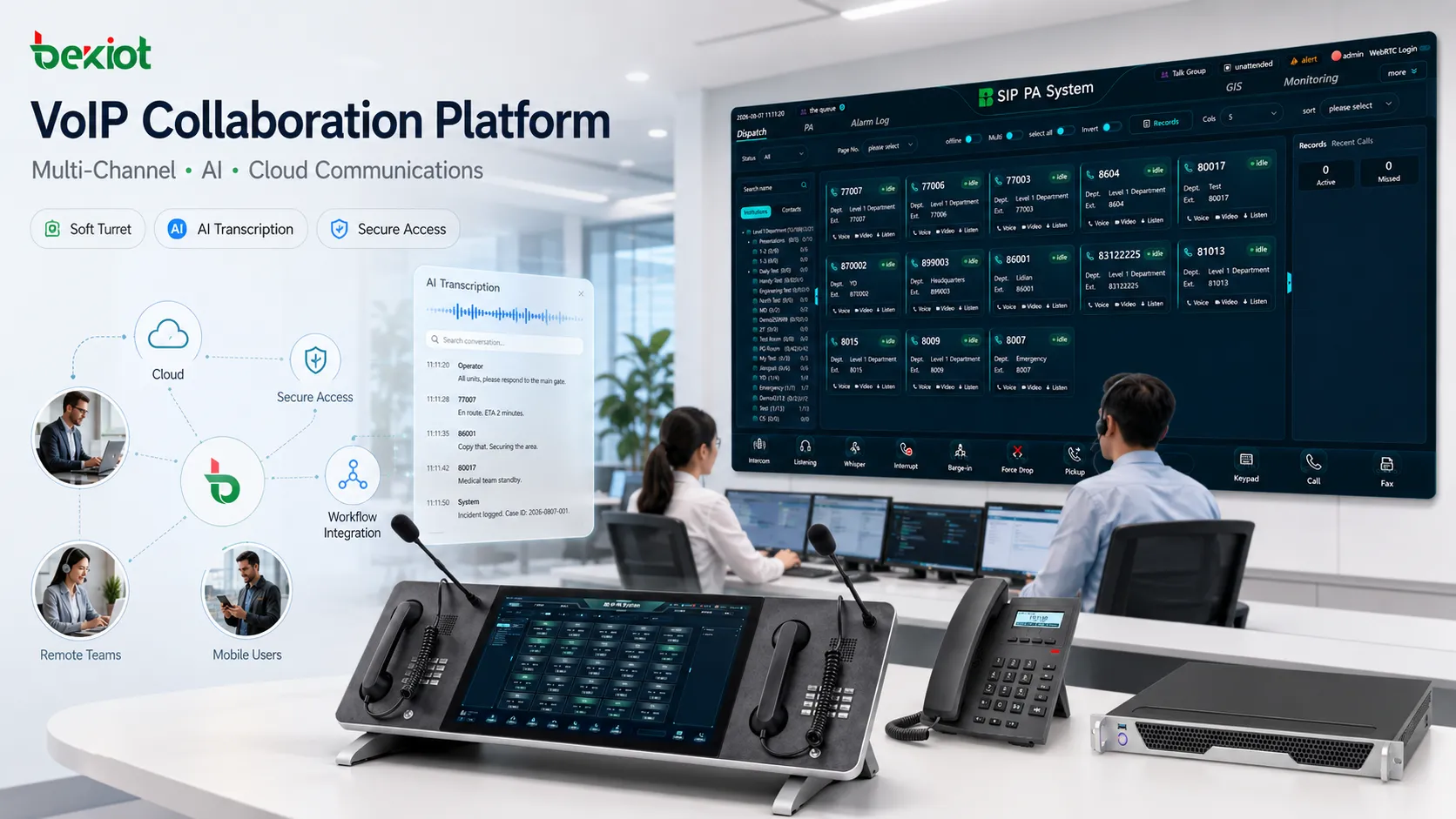
A recent announcement involving a VoIP and collaboration patent portfolio entering the market raised a broader question that matters far more than the patent transaction itself: how is enterprise voice communication changing? In the past, the main purpose of a VoIP platform was to move telephone calls onto IP networks. Today, enterprise buyers are increasingly asking about concurrent multi-channel calling, real-time speech transcription, software-based dispatch and turret interfaces, cloud deployment, cross-device control, and communications compliance. Voice has not disappeared. Instead, it is becoming a real-time data source inside a much broader collaboration workflow.
This shift is especially visible in financial trading, contact centers, emergency dispatch, remote operations, and enterprise collaboration. An operator may need to monitor several voice channels at the same time and immediately join one when an event becomes critical. A call may need to generate text in real time for search, quality monitoring, or compliance records. Remote users may also need access to the same communication environment from different locations and devices. The traditional model of “one user, one phone, one call” is increasingly difficult to apply to these workflows.
What Is Changing as VoIP Moves Toward Multi-Channel Communication?
Traditional enterprise telephony follows a familiar interaction model: go off-hook, dial, connect, and hang up. Even after businesses migrated to IP PBX systems, most platforms retained the same basic operating pattern. A user typically handles one primary call at a time, while call transfer, hold, conferencing, and queues are added around that core session.
Some communications-intensive roles, however, have never worked that way. A financial trading desk may need to monitor several voice channels simultaneously. A dispatcher may listen to multiple departments or incident groups. A contact center supervisor may monitor several queues, while an operations or command position may need to move quickly between different communication groups. For these users, the requirement is not simply a more polished softphone. They need an interface capable of managing multiple real-time communication relationships at the same time.
This is one reason Soft Turrets, software dispatch consoles, and multi-channel communication clients are receiving more attention. They move the operating model of traditional hardware turrets or professional dispatch consoles into a unified software environment where users can see multiple lines, talk groups, contacts, and session states without constantly opening new windows or redialing destinations.
Multi-channel communication is also more complex than simply playing several audio streams at once. The platform must manage monitoring, mute states, priority, barge-in, hold, conferencing, transfer, and independent volume control. One channel may be listen-only, another may require immediate talk access, while a third may receive a higher priority because an incident has escalated. A mature multi-channel platform is therefore managing multiple simultaneous communication contexts, not just multiple audio streams.
These capabilities were historically concentrated in financial trading and professional dispatch environments, but they are now moving into broader enterprise collaboration. The reason is straightforward: more roles now deal with telephony, meetings, customer service, instant messaging, and remote collaboration at the same time. A single-channel communication model no longer reflects how many users actually work.
Why Is Real-Time AI Transcription Becoming Part of the Voice Workflow?
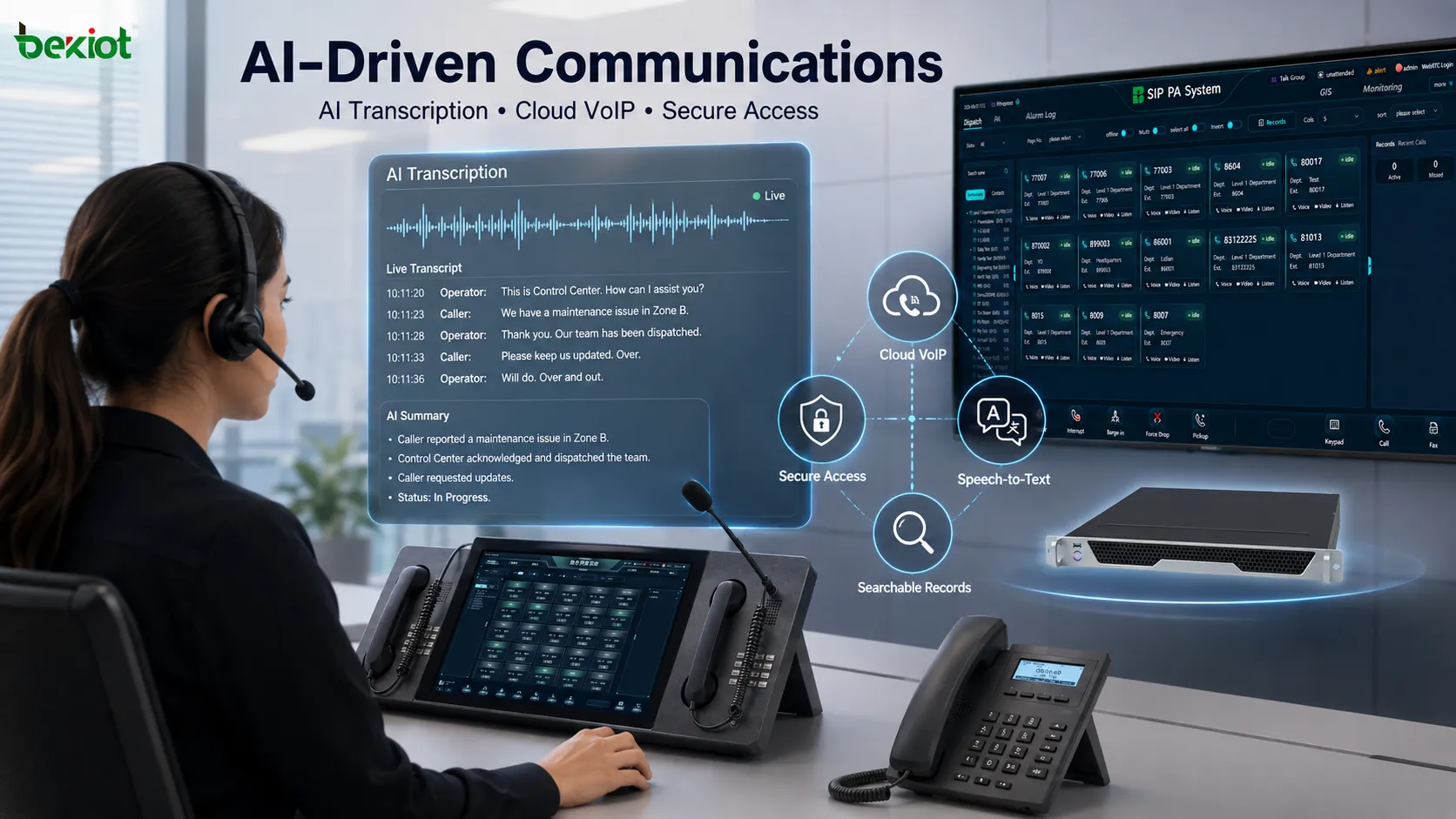
One of the first practical uses of AI in enterprise communications is not meeting summarization, but turning voice into searchable, structured text. Traditional call recordings are usually indexed by phone number, time, agent, or extension. If someone needs to verify a specific statement, they often have to replay the entire recording. Real-time transcription changes that workflow.
Once a call produces text alongside the audio, organizations can search by keyword, identify specific business phrases, generate summaries, or trigger quality and compliance rules. For financial services, customer service, insurance, dispatch, and other environments where communications must be reviewed later, this has much greater operational value than simply converting speech into text.
Real-time transcription becomes more complicated once it moves from a demonstration into a production system. The first question is whose voice should be transcribed. In a multi-party meeting, concurrent voice environment, or multi-channel workstation, not every participant has the same speaking state. If every audio stream is sent into the same recognition pipeline without context, the final transcript may be difficult to attribute and may consume unnecessary processing resources.
This is why the voice platform and AI layer need much tighter session-state integration. Information such as who is speaking, who is muted, which channel is currently active, and which participants need to be recorded can all influence the transcription workflow. This combination of communication control and AI processing is much closer to a real enterprise deployment than simply sending a completed recording to a transcription service afterward.
The second issue is latency. Enterprises do not always need word-by-word zero-latency output, but if transcription is used for live collaboration, keyword alerts, or compliance prompts, excessive delay quickly reduces its value. The platform therefore has to balance codec processing, network latency, media handling, and AI inference time.
The third issue is data governance. Voice conversations may contain customer information, trading data, internal instructions, or other sensitive content. Real-time transcription introduces another processing layer into the communication path, so organizations must decide who can access the text, how long it is retained, and whether it can cross regional or organizational boundaries.
Why Do Security and Session Control Become Harder in Cloud VoIP?
Cloud migration is no longer a new trend in enterprise VoIP. Compared with a traditional on-premises PBX, cloud deployment can simplify multi-site operations and allow users in offices, homes, and remote locations to access the same communication platform. But once voice communication moves beyond a closed local network, the security boundary changes as well.
Traditional telephone systems inherited many restrictions from physical wiring. Cloud VoIP relies much more heavily on identity, network policy, and software permissions. Organizations must clearly control who can register to the platform, which endpoints can establish sessions, where media traffic is routed, and how remote users connect.
SIP environments require particular attention at the network edge. Public Internet access, remote work, and multi-site connectivity can expose SIP services to a wider range of networks. Enterprises therefore commonly combine SBCs, access controls, TLS, SRTP, VPNs, and other security mechanisms to separate the core communication platform from untrusted networks.
VPNs still have practical value in certain cross-site communication environments. They can allow branch users, remote workstations, or selected endpoints to enter a controlled network before accessing internal VoIP services. However, a VPN does not replace application-layer authorization. Once a user is on the network, the communication platform still needs to decide whether that user can dial a particular destination, join a voice group, or invoke a specific control function.
Multi-channel communication makes this even more important. A standard softphone may only control its own extension, while a Soft Turret or dispatch position can potentially access multiple channels, monitor groups, and privileged control functions. If that identity is compromised or misused, the impact can be much greater. These positions therefore need more granular role-based access and stronger operational auditing.
Cloud deployment also means service continuity cannot depend on a single server. Communication platforms need to consider multi-node deployment, network redundancy, remote access failures, and even cloud-region outages. Enterprises are not simply buying “a phone interface in the cloud.” They are buying a communication service that is expected to preserve critical functionality under a wide range of network conditions.
How Should Enterprises Build the Architecture from Soft Turrets to Collaboration Platforms?
Enterprises building a next-generation VoIP collaboration system do not need to deploy every AI, multi-channel, and cloud feature at once. A more practical approach is to begin by defining who communicates with whom and how those workflows actually operate.
Identify Which Roles Truly Need Multi-Channel Communication
A standard office user may handle only a small number of calls each day and may be perfectly well served by a conventional softphone. Traders, dispatchers, contact center supervisors, and command positions may need to manage several simultaneous communication streams. The platform should therefore provide different communication capabilities based on role rather than forcing every user into the same complex interface.
Decide How Voice Should Enter the AI Workflow
If transcription is mainly used for post-call search, asynchronous processing of stored recordings may be sufficient. If the organization needs live prompts, keyword detection, captions, or compliance notifications, AI must be placed directly into the real-time media workflow. These two models have very different requirements for compute resources, latency, and cost.
Connect Communication Control with Business Systems
Once VoIP becomes part of a broader collaboration platform, a call should no longer be treated as an isolated event. Customer service calls can be associated with tickets, dispatch voice traffic can be linked to incident IDs, financial communications can be tied to trading positions, and Helpdesk calls can be connected with customer records.
This relationship turns voice from raw audio into something the business system can understand. Call time, participants, channel, recording, transcript, and user actions can all be organized around the same business event instead of being stored separately across multiple systems.
This is one of the clearest differences between a traditional IP PBX and the next generation of VoIP platforms. A traditional PBX primarily manages numbers and calls. A modern collaboration platform increasingly has to manage identity, sessions, data, and business context.
What Should Enterprises Evaluate in a Next-Generation VoIP Platform?
Terms such as “AI communications,” “cloud collaboration,” and “multi-channel voice” can easily turn into long feature lists. In practice, the long-term value of a platform still depends on a few fundamental engineering questions.
First, verify whether the platform genuinely supports standard SIP and interoperates with existing IP PBXs, SBCs, carrier trunks, and endpoints. A collaboration platform that only operates inside a closed ecosystem may be easy to deploy initially but can become difficult to expand later.
Second, test the concurrency model. A vendor stating that a system “supports multiple calls” is not the same as one operator independently managing several active channels at the same time. Projects should test monitoring, joining, muting, holding, transferring, and the user experience when multiple channels are active simultaneously.
AI capabilities should also be evaluated according to the actual data flow rather than the presence of a “Transcription” button. Organizations need to understand where voice is processed, where transcripts are stored, who can view them, how recognition errors are handled, and whether transcription affects real-time media performance.
Security should be assessed across identity authentication, network boundaries, media encryption, remote access, and operation auditing. Particularly in cross-site and cloud deployments, enabling TLS alone or adding a VPN alone does not mean the entire communication environment is secure.
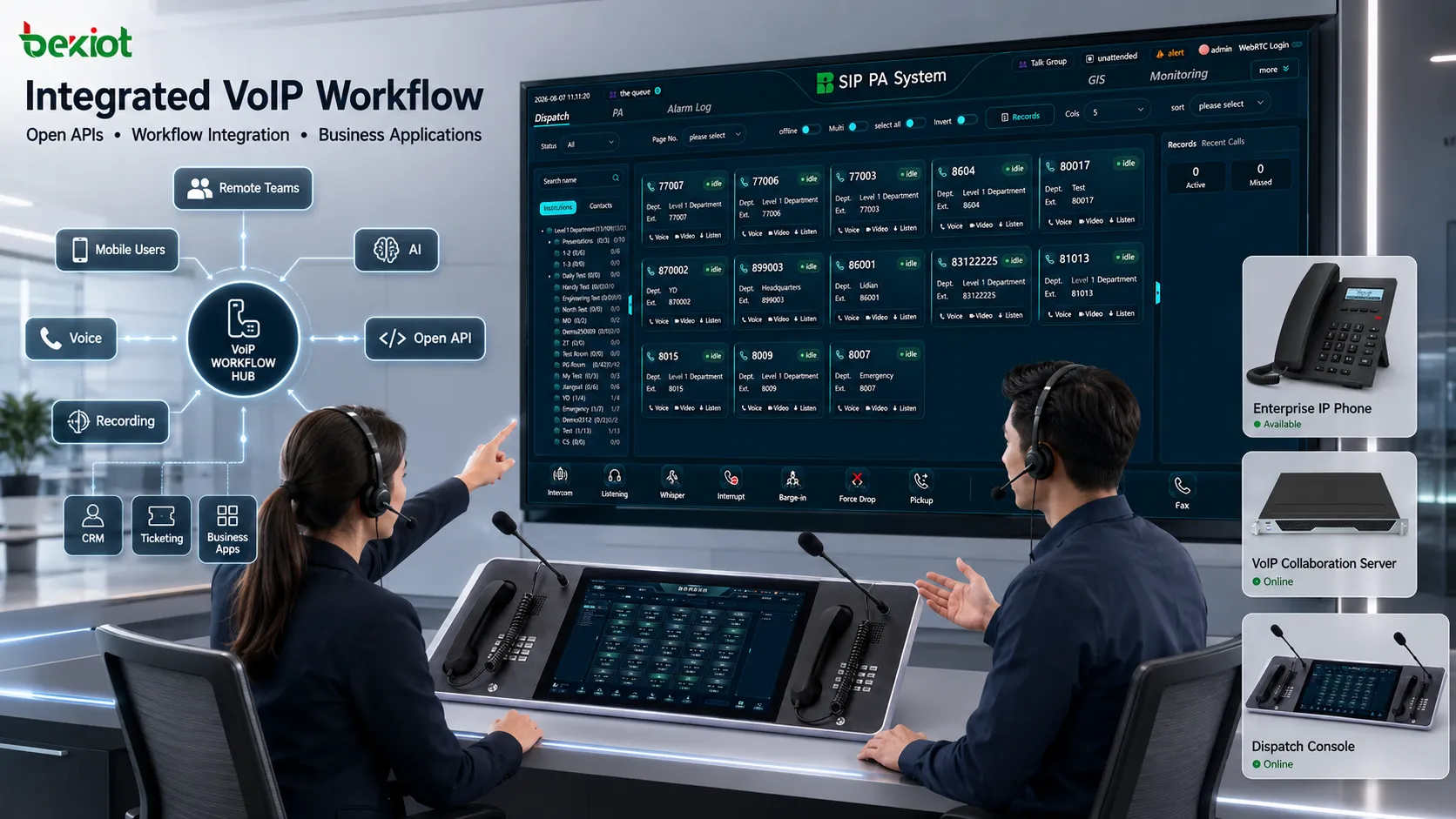
Openness is another important factor. VoIP collaboration platforms are increasingly expected to integrate with CRM systems, ticketing platforms, recording services, AI engines, dispatch systems, monitoring platforms, and analytics tools. Clear APIs and event interfaces usually make future expansion easier than relying heavily on custom development.
The growing market interest around VoIP and collaboration technologies reflects a broader shift in enterprise voice competition. SIP remains an important foundation, but differentiation is increasingly moving toward multi-channel control, software-based workstations, real-time AI processing, secure cloud access, and integration with business applications.
Telephony will not disappear because collaboration software and AI are becoming more capable. Instead, voice is becoming another real-time data stream within a larger collaboration environment. The value of the next generation of VoIP systems is therefore no longer limited to connecting two users. It lies in allowing users, devices, and business roles across multiple locations to communicate simultaneously under common rules while making every important conversation manageable, traceable, and usable.

So Why Are Multi-Channel, AI and Cloud Becoming the Next Step for VoIP?
Taken together, the move toward multi-channel communication, AI, and cloud deployment is not simply the result of several new features appearing at the same time. It reflects a deeper change in how enterprises communicate and how many communication relationships users are expected to manage. Traditional telephone systems were largely designed to answer the question “Who is calling whom?” Modern users increasingly operate across several simultaneous communication contexts. Dispatchers monitor multiple workgroups, supervisors watch several queues, financial and operations staff may manage concurrent voice channels, and remote employees need to access the same communication environment from different devices. The single-call model is therefore becoming less suitable for a growing number of enterprise workflows.
The move toward AI follows the same logic. Enterprises already have enormous volumes of recorded voice, but historically that information has been difficult to search and reuse. Real-time transcription, keyword detection, summarization, and quality analysis are turning voice from a one-time conversation into data that can be searched, analyzed, and linked to business processes. The real value is not adding an “AI button” to a phone. It is placing communication state, participants, recordings, transcripts, and business events within the same operational context.
Cloud deployment extends the same capabilities beyond the boundaries of the local PBX. Users may be located in headquarters, branch offices, homes, or mobile environments while the communication platform itself may run across cloud infrastructure. That flexibility requires stronger identity management, SIP boundary control, media security, authorization, and service continuity. Cloud architecture answers the question of how communications can move with users and business processes, while security determines whether that mobility remains controlled.
The direction of next-generation VoIP can therefore be summarized as a shift from a “call system” to a “real-time communications workspace.” SIP will continue to provide a reliable foundation for voice connectivity, but platform differentiation will increasingly depend on multi-channel control, AI processing, secure cloud access, open APIs, and integration with CRM, ticketing, dispatch, and compliance systems. For enterprises evaluating these platforms, the more important question is no longer simply how many simultaneous calls the system supports, but whether it can bring real-time voice into complete business workflows while remaining manageable, traceable, and scalable as the organization grows.
FAQ
Does Every Enterprise User Need a Multi-Channel Softphone?
No. Multi-channel capabilities are most useful for roles that need to monitor or manage several real-time sessions simultaneously, such as dispatchers, financial traders, contact center supervisors, and command-center personnel. Standard SIP softphones are usually sufficient for everyday office users.
Can AI Transcription Completely Replace Call Recording?
Usually not. Transcripts are useful for search, analysis, and rapid review, but speech recognition can contain errors. For environments that require evidence retention, compliance auditing, or incident reconstruction, the original audio recording remains important. Transcription is more effective as a searchable and analytical layer on top of the recording.
Is a Soft Turret Only Useful for Financial Trading?
No. Soft Turrets became particularly valuable in trading environments because of their need for highly concurrent voice communication, but the same multi-channel monitoring, rapid join, and centralized control model can also support emergency dispatch, operations centers, contact center supervisors, and other roles that manage several real-time voice sessions.
If Cloud VoIP Has High Voice Latency, Should Server Performance Be Checked First?
Not necessarily. End-to-end voice latency can also be affected by network RTT, jitter buffers, packet loss, media routing, VPNs, and cross-region network paths. Troubleshooting should first identify where the delay is being introduced before determining whether the root cause is the network, media server, or endpoint processing.







