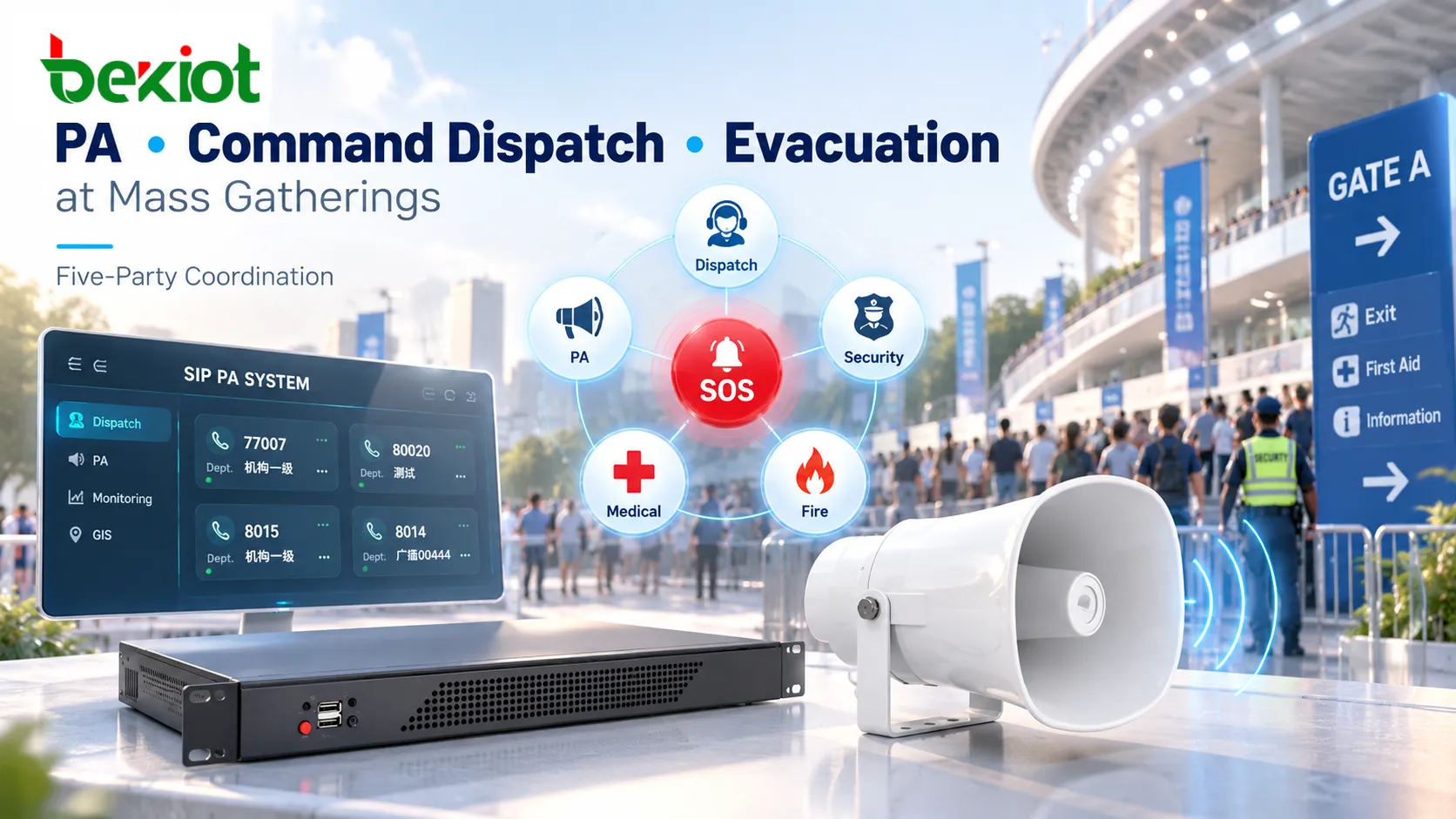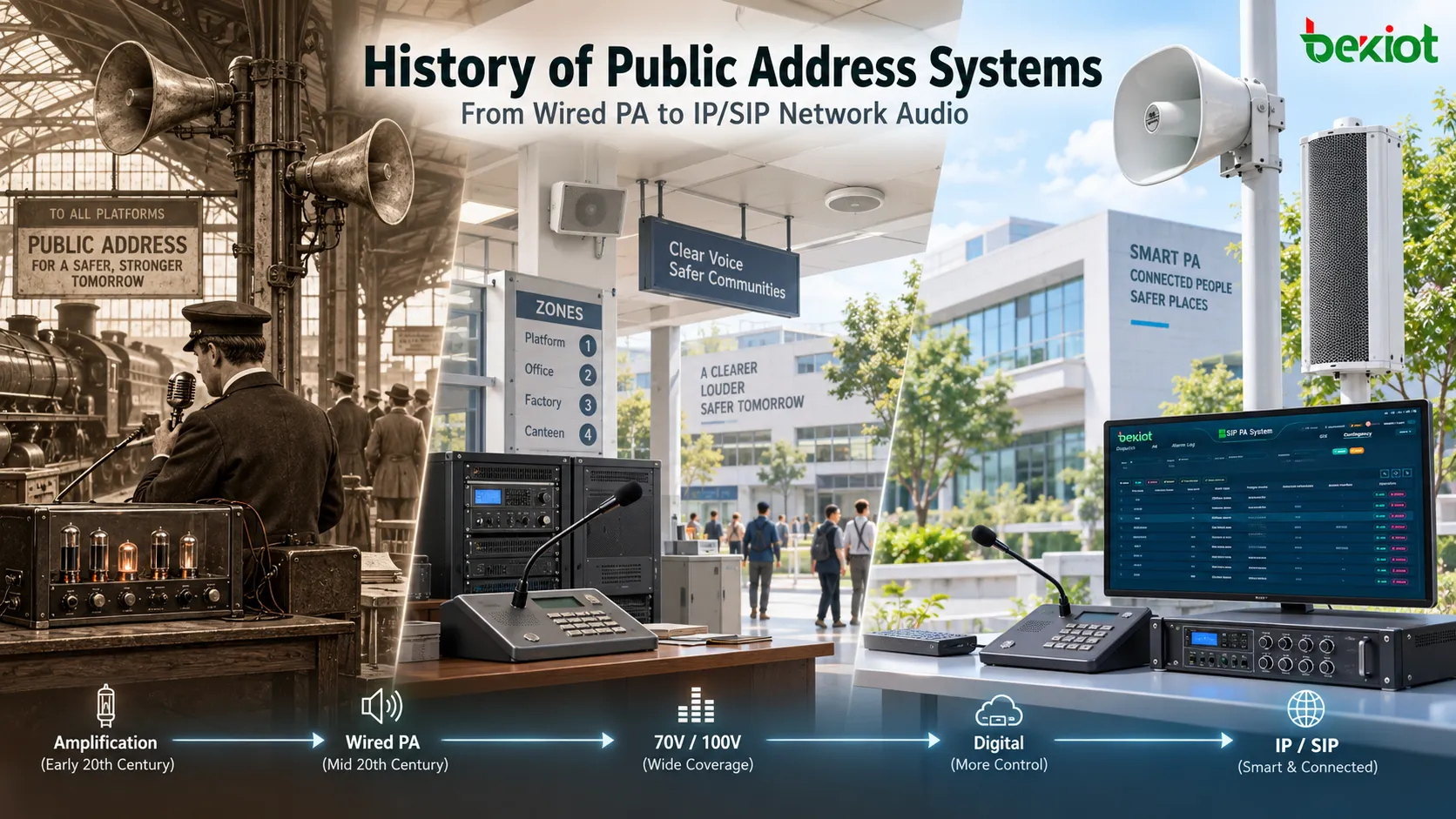
The evolution of public address systems over the past century has involved much more than making loudspeakers louder or amplifiers more powerful. What has really changed is the way audio is organized, transported and controlled. Early systems focused on making one voice audible to a larger audience. The next stage introduced the ability to send different audio to different areas. With digital audio and IP networking, public address systems began to address a broader challenge: how to manage multiple buildings or sites from a common platform while coordinating paging with telephony, intercom, alarms and emergency communications. Although China and other parts of the world followed somewhat different development paths, the technology has gradually converged on the same objective—delivering the right message to the right area at the right time, with sufficient clarity and reliability.
The Early Years of Public Address: From Electronic Amplification to Wired PA
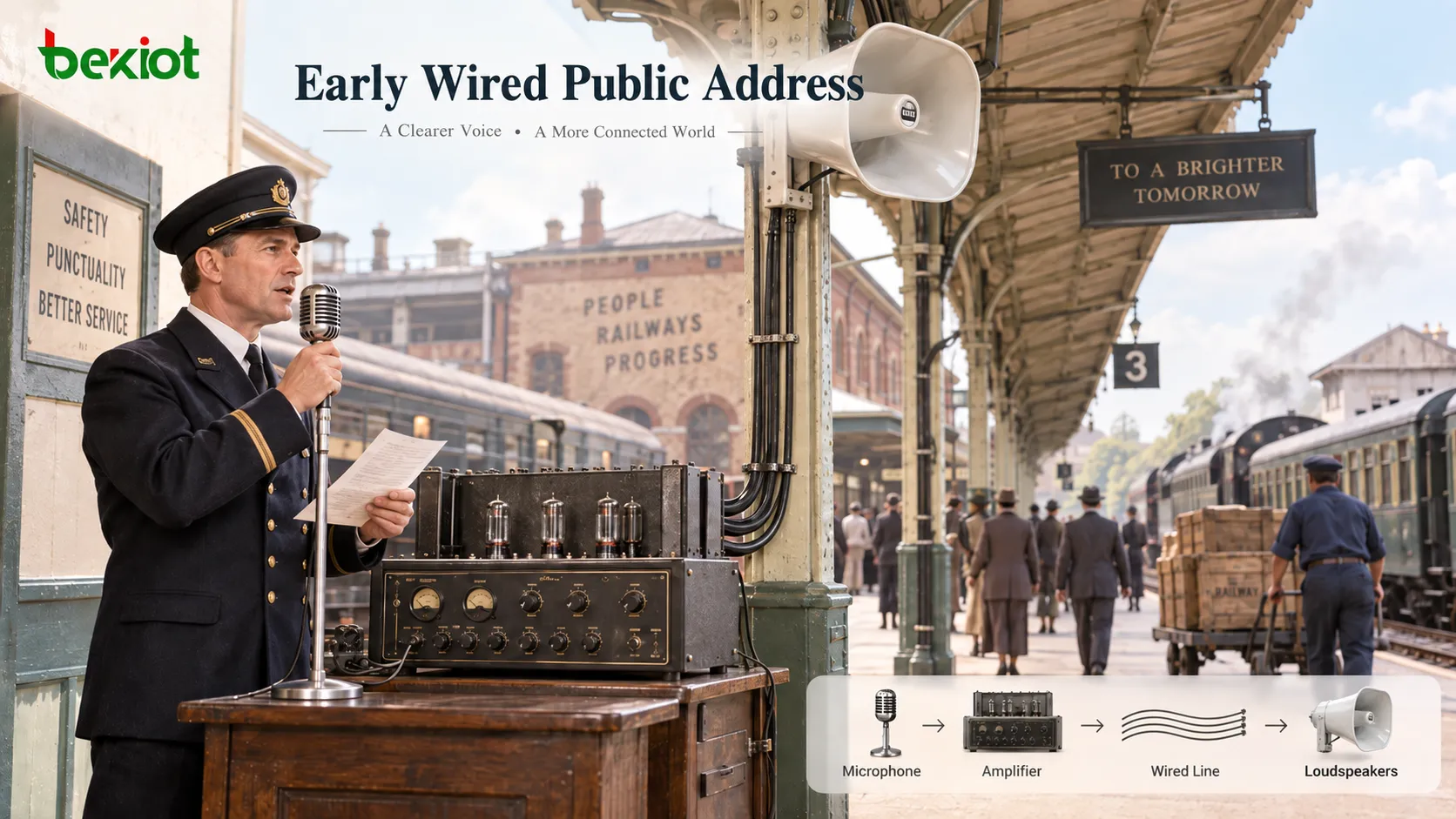
Modern public address became possible with the development of electroacoustic technology. Before electronic amplification, sound had to be extended through bells, horns, speaking tubes and architectural acoustics. These methods could increase the distance over which a signal or voice was heard, but they could not reliably carry intelligible speech to large groups spread across different locations. Advances in telephony, microphones, electroacoustic transducers and electronic amplification changed that. A microphone converted speech into an electrical signal, an amplifier increased its power, and a loudspeaker converted that signal back into audible sound. This established the basic signal path still recognizable in PA systems today.
During the early decades of the 20th century, electronic sound reinforcement began appearing in railway stations, stadiums, factories, auditoriums and large public venues. These systems had no software control or network management. A typical arrangement was simply Microphone → Amplifier → Audio Line → Loudspeaker. Power amplifiers of the period commonly used vacuum tubes and were considerably larger and less efficient than modern equipment, but they made it possible to drive multiple loudspeakers from a central source. High-efficiency horn loudspeakers also became important outdoors and in noisy environments because they could project speech over greater distances. This helped establish a principle that remains fundamental to public address design: speech intelligibility comes before high-fidelity music reproduction when the primary purpose is communication.
As the number of loudspeakers and the size of coverage areas increased, amplification alone was no longer enough. Audio also had to be transported over greater distances. Wired public address therefore became an important early architecture. Microphones, program sources and amplifiers could be centralized, while copper lines carried audio to loudspeakers installed at remote points. Compared with deploying a separate sound system in every location, this allowed one control point to serve multiple areas. Public address began to take on a network-like structure: Central Audio Source → Wired Distribution → Distributed Loudspeakers. It was not an IP network, but the basic concept of centralized control, transmission infrastructure and distributed endpoints had already been established.
How Public Address Developed Differently in China and Other Countries
The underlying technologies of public address were similar around the world, but their early applications did not develop along exactly the same path. In regions that industrialized and urbanized earlier, public address was widely adopted in railway stations, stadiums, factories, large commercial buildings and public venues. The main requirement was often the management of large spaces: railway stations needed to announce train information, factories needed to communicate with multiple production areas, and stadiums needed to deliver speech and event information to large audiences. As a result, early PA development outside China was closely associated with large-space sound reinforcement, transportation, industrial operations, commercial buildings and public-safety announcements. As these applications became more complex, zoning, priorities, fault monitoring and voice alarm functions gradually became more important.
China followed a path with a stronger emphasis on wired broadcasting. In addition to public address systems used in urban railway stations, factories, schools and public venues, wired broadcasting networks also played a major role in distributing public information to towns, villages, schools, production units and community areas. A central broadcasting station could send programs and announcements over wired infrastructure to loudspeakers installed throughout a local area. The familiar outdoor “big loudspeaker” used in many communities was, from a system perspective, based on the same fundamental principle: One Control Center → One Wired Distribution Network → Many Distributed Loudspeaker Endpoints. This gave public broadcasting in China both a sound-reinforcement role and a broader public-information role for a substantial period of its development.
As hotels, schools, airports, rail systems, industrial parks and large public facilities expanded, public address in China also moved toward more specialized building, campus and industrial applications. The main early difference between China and other markets was therefore not the use of amplifiers or loudspeakers, but the application emphasis. Outside China, PA developed earlier around transportation, industrial facilities, commercial buildings and public safety; China experienced those applications as well, but also went through a large-scale wired public broadcasting phase. Once public address systems began serving more complex buildings and operational environments, however, both development paths started to converge. The systems had to solve the same problem: every loudspeaker could no longer be expected to play the same program at the same time. Audio had to be controlled according to area, task and event.
The Middle Stage: Constant-Voltage Distribution and Zoned Public Address
As public address systems grew from dozens of loudspeakers to hundreds or even thousands, the early approach of directly driving low-impedance loudspeakers over long distances became increasingly impractical. Low-impedance speaker connections work well over shorter distances, but in a large campus, factory, railway station or commercial complex, long cable runs increase current and transmission losses while making the connection of multiple loudspeakers more complicated. This led to the widespread adoption of 70V and 100V constant-voltage distribution. The amplifier transmits audio at a higher line voltage, while transformers at the loudspeaker end provide power matching. This reduces current over long cable runs and makes it easier to connect many loudspeakers, often at different power taps, to the same circuit.
A typical architecture of this period became Audio Source → Preamplification/Control → Constant-Voltage Amplifier → 70V/100V Speaker Line → Multiple Loudspeakers. Constant-voltage distribution solved the problem of transporting audio over longer distances and connecting more loudspeakers, but it did not solve another increasingly important requirement: why should every area always receive the same audio? A hotel lobby may need background music while other areas do not. A railway waiting area may need passenger announcements without sending the same message into offices. A production notice may be relevant to one plant area without needing to interrupt the entire facility.
From Site-Wide Broadcasting to Zoned Control
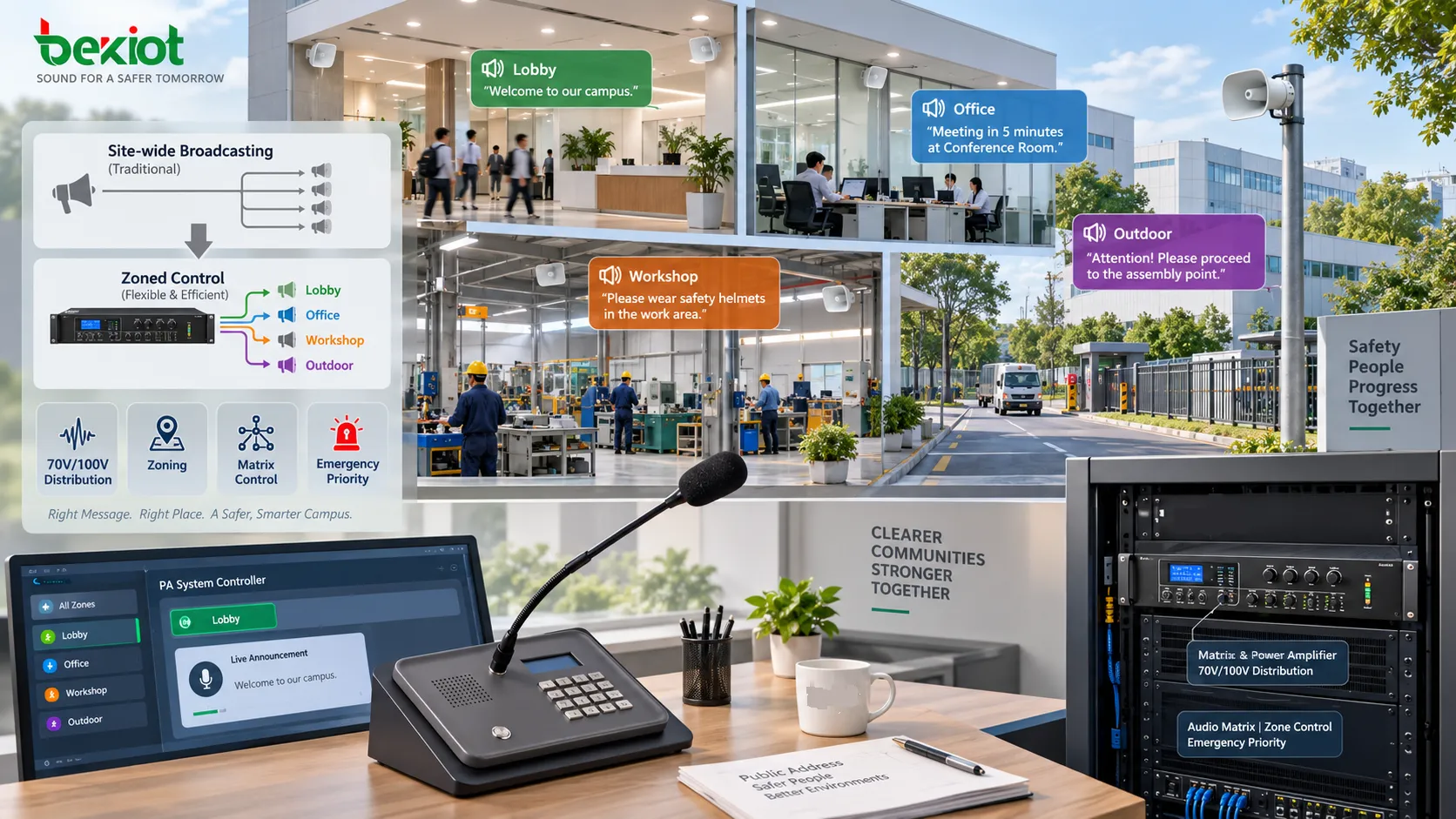
As buildings and sites became larger, loudspeaker circuits were increasingly divided into functional zones such as offices, production areas, warehouses, parking areas, outdoor roads, public halls and equipment spaces. Operators could page one zone, several zones or the entire site. Zone selectors, multi-channel amplifiers, paging microphones and audio matrices became standard elements in professional PA systems. The key question was no longer simply “Can the system broadcast?” but increasingly “Where should this message be heard?”
Audio Matrices Shifted PA from Line Control to Task Control
When a system has only a few zones, simple switches can be sufficient. Once it grows to dozens of zones, several audio sources and multiple operator positions, routing becomes much more complex. Audio matrix systems made it possible to route different inputs to different outputs according to operational requirements. Background music could be sent to lobbies and corridors, business announcements to office areas, production paging to selected workshops, and emergency messages could override normal audio in affected zones. Public address was no longer just a collection of amplifiers and loudspeakers; it had become a structured system with zones, priorities and control logic.
Emergency Voice Became Part of the PA System
As PA systems became common in transportation hubs, commercial buildings and industrial facilities, emergency communication became increasingly important. An interruption to background music is usually inconvenient rather than dangerous, but a failure to deliver evacuation instructions during a fire, accident or other emergency can directly affect safety. Public address systems therefore began adopting clearer priority structures, such as Emergency Voice > Live Paging > Operational Announcements > Background Music, together with functions such as backup power, loudspeaker-line monitoring, amplifier supervision and emergency controls. In many international markets, conventional PA evolved toward Voice Alarm and PAVA (Public Address and Voice Alarm), while public address systems in China also became increasingly integrated with fire alarm and emergency voice applications.
How Did Digital Technology Create a Transition Toward Networked PA?
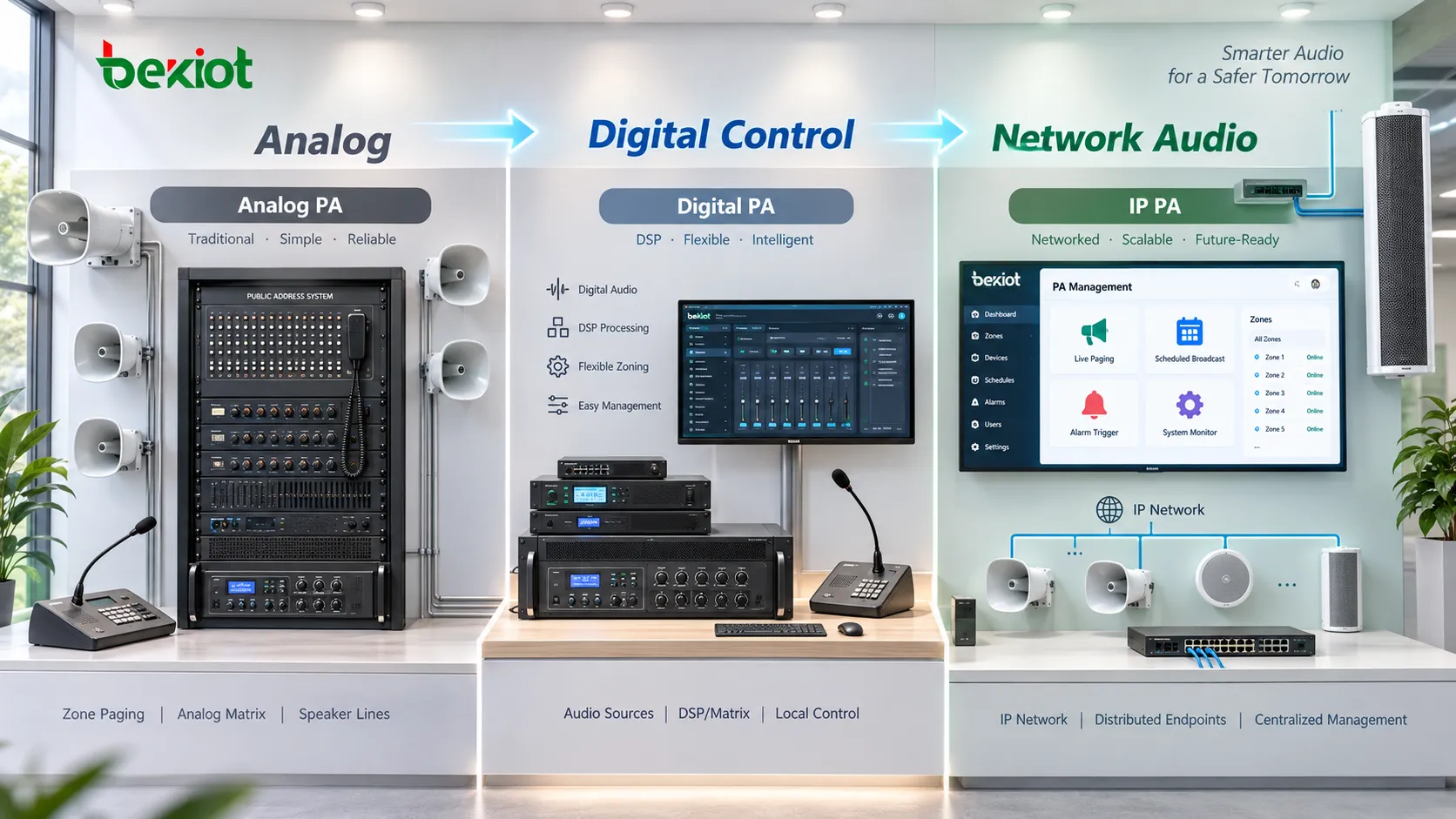
The move toward digital public address did not immediately replace analog speaker lines with full IP networks. A more accurate way to view digitalization is as a transition between conventional analog PA and networked audio. One of the first changes occurred at the program-source level. Tape machines, records and manually operated playback equipment were gradually replaced by CDs, digital audio files and computer-based playback systems. Scheduled music, school bells, playlists and prerecorded announcements could now be managed automatically, reducing dependence on manual operation and mechanical media.
Digital signal processing and digital audio matrices then moved into the control layer. DSP systems could provide equalization, level control, delay, mixing, dynamic processing and audio routing, while digital matrices replaced many complex analog switching circuits. Relationships between multiple sources and multiple broadcast zones could increasingly be configured in software. A typical system of this stage might use Digital Audio Source → DSP/Digital Matrix → Amplifier → 100V Speaker Line → Loudspeakers. The control layer had become digital, but the final distribution stage could still rely heavily on conventional constant-voltage speaker circuits.
This distinction is important because “digital PA” and “IP PA” are not the same thing. Digitalization first changed how audio was stored, processed and controlled. IP networking later changed how audio was transported between devices and locations. At the same time, zone assignments, volume levels, priorities and scheduled tasks increasingly became software-defined rather than hardwired. This software-based control model laid much of the groundwork for later IP-based public address systems.
Modern Public Address: Why Did IP Networking Change the Architecture?
When IP networking entered public address, the most important change was not simply that audio became digital. Long-distance audio no longer had to depend entirely on dedicated speaker or audio lines running from a central equipment room to every remote area. A conventional system might use Central Audio Source → PA Matrix → Central Amplifiers → Long 100V Speaker Lines → Loudspeaker Zones. This architecture remains effective within a building or compact site, but as a project expands across multiple buildings, campuses or remote facilities, the amount of cabling and centralized equipment can increase rapidly.
An IP-based PA system can encode audio at the server or control-platform level and transport it over Ethernet/IP to remote locations, where an IP amplifier, network audio interface or IP loudspeaker decodes and reproduces the audio. The architecture becomes PA Server → Ethernet/IP Network → IP Amplifier/Network Endpoint → Local Loudspeaker Zone. Long-distance transport moves from dedicated analog audio circuits to the data network, and public address begins to evolve from a line-based system into a network-based system.
Zones Became Software-Defined Rather Than Purely Physical
In conventional PA systems, zones usually correspond directly to amplifier outputs, relays and speaker circuits. In IP systems, network endpoints can also be assigned to logical groups. An industrial campus, for example, can organize broadcast groups by plant, workshop, building, floor, production line or emergency zone. If the grouping needs to change, the system may only require a software configuration update rather than physical rewiring. This provides considerably more flexibility than traditional circuit-based zoning.
Different Areas Can Run Different Audio Tasks at the Same Time
Once audio is carried as network streams, different areas can receive different audio simultaneously. An office building can continue playing background music while a warehouse receives loading instructions, a production area receives live paging, and another zone plays a prerecorded safety message. Public address therefore evolves from a largely single-program distribution system into a network audio platform capable of handling multiple simultaneous tasks.
PA Systems Entered the Era of Centralized Operations and Maintenance
IP networking also makes status reporting and remote management easier. A management platform can monitor whether network endpoints are online, whether IP amplifiers are connected, and whether supported devices are reporting faults. Configuration and maintenance can also be performed remotely. For campuses, airports, transport networks, industrial parks and large enterprises, this means multiple remote sites no longer need to operate as completely isolated PA systems. A central platform can manage many locations while still allowing local operators to retain appropriate control.
Why Did SIP Move Public Address from Audio Playback Toward Communications?
IP-based PA solved the problem of transporting audio over a network, while SIP further changed the relationship between public address equipment and other communication devices. Traditional public address is primarily one-way: an operator sends a message and people in the field hear it. Modern industrial, transportation and public-safety environments often require two-way communication as well. A worker may first call a control room using an industrial telephone or intercom, after which the dispatcher sends a message to a selected paging zone. An emergency call point may also initiate a voice call while a nearby area receives an automatic or operator-triggered announcement.
When SIP paging consoles, SIP PA endpoints, IP phones, industrial telephones and dispatch platforms use compatible signaling, devices that once operated as separate systems can establish much more direct communication relationships. A SIP telephone can, for example, call a paging group and send live voice to loudspeakers in a selected area. An emergency intercom can first reach the dispatch console, after which the dispatcher initiates a zone page based on the reported incident. Public address therefore begins to function as part of a broader communications environment rather than as a standalone playback system.
This transition is particularly relevant in industrial sites, where operational announcements, safety paging, emergency calls, personnel dispatch and alarm-triggered events may originate from different systems. If public address remains completely isolated, operators have to switch between multiple consoles and interfaces. SIP/IP provides a more unified communications foundation for paging, telephony, intercom and dispatch. SIP is not necessary for every PA application, however. A small system used only for background music and scheduled announcements may still be well served by a conventional architecture. SIP becomes more valuable where cross-system calling, two-way communication and coordinated dispatch are required.
Why Has 100V Distributed Audio Survived the Rise of IP PA?
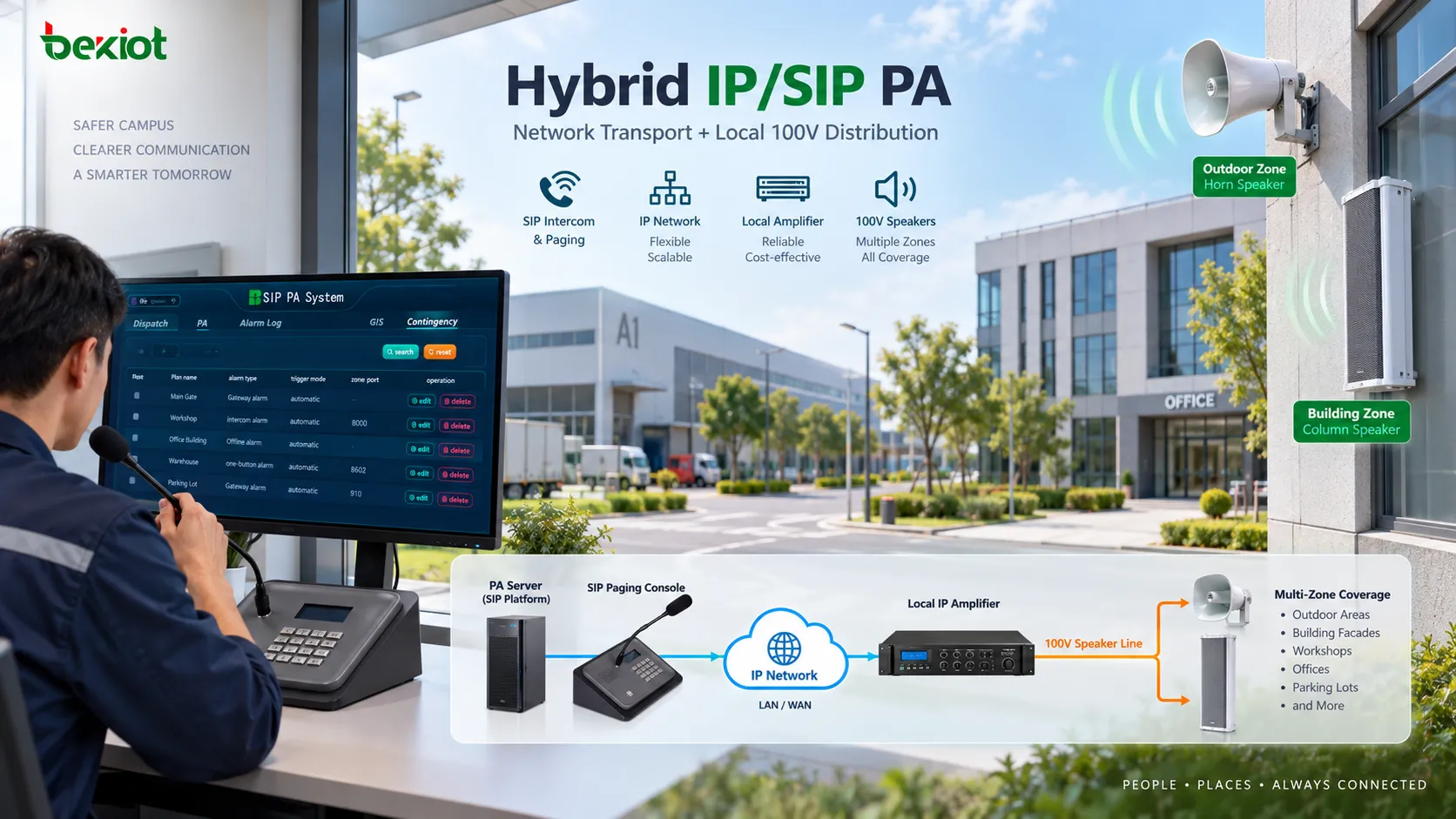
Whenever a new communications technology appears, it is tempting to assume that the previous generation will disappear. Public address has not evolved in such a simple way. IP networking has significantly changed system transport and management, yet 70V and 100V distributed speaker systems remain widely used because the two technologies address different parts of the problem. IP networking is well suited to long-distance transport between buildings, centralized multi-zone management, software-defined groups, parallel audio tasks and endpoint management. Constant-voltage speaker lines remain highly effective for connecting many loudspeakers to a single amplifier and distributing audio within a local zone using a simple and proven architecture.
As a result, many modern large-scale systems use a hybrid architecture rather than replacing 100V distribution completely: PA Server → IP Network → Local IP Amplifier → 100V Speaker Line → Multiple Loudspeakers. IP carries digital audio and control information over the long-distance portion of the system, while 100V distribution handles the final loudspeaker coverage within a local area. If only one or two endpoints are required, direct IP loudspeakers may be practical. If a workshop or outdoor zone requires dozens of horns, column speakers or ceiling loudspeakers, a local IP amplifier feeding a 100V speaker circuit can often be more economical and easier to maintain.
This reflects one of the most important patterns in the history of public address: new technology does not always eliminate older technology; it often relocates it to the part of the system where it remains most effective. Loudspeakers have not disappeared, amplifiers have not disappeared, and constant-voltage distribution has not disappeared. What has continued to change is the transport, control and management architecture above them. The overall technical evolution can be summarized as Electronic Amplification → Wired PA → 70V/100V Distributed Audio → Zoning and Matrix Control → Digital Audio and DSP → IP-Based PA → SIP Communications Integration.
The questions public address systems need to answer have changed over time. Early systems focused on whether sound could reach the audience at all. Later systems had to determine which areas should receive which messages. Modern systems increasingly need to decide how a paging event is triggered, how audio is transported across networks, whether endpoints are available, and how public address should coordinate with other communication systems. The technology continues to evolve, but the fundamental purpose remains the same: to ensure that the people who need information can hear clear, accurate and reliable voice messages when they are needed.
FAQ
Are Public Address Systems and Radio Broadcasting the Same Thing?
No. A public address system usually refers to PA, paging, background music and emergency voice equipment installed within buildings, campuses, industrial facilities, transport sites or public spaces, with audio delivered to loudspeakers in defined areas. Radio broadcasting transmits programs over radio frequencies to large numbers of receivers. China's historical wired broadcasting networks share some technical and operational continuity with later public address systems, which is why they are often discussed together when examining the development of public audio systems.
Which Stage of PA Development Does Wired Broadcasting Belong To?
Wired broadcasting belongs mainly to the early stage of public address development. It solved the problem of distributing audio from a central source to many remote loudspeakers and established the basic structure of centralized control, wired transmission and distributed endpoints. This laid the foundation for later constant-voltage and zoned PA systems.
When Did Zoning Become a Core Public Address Function?
Zoning became increasingly important as PA expanded from individual halls into schools, hotels, railway stations, factories and large buildings. Once every area no longer needed the same program, 70V/100V distribution, zone selection, audio matrices and multi-channel amplification allowed public address to move beyond simple sound reinforcement into structured area-based communication.
What Is the Difference Between Digital Public Address and IP Public Address?
Digitalization first changed audio sources, DSP processing, matrix control and program management. A digital PA system can still use conventional 100V speaker lines for final distribution. IP public address goes a step further by transporting audio between devices over Ethernet/IP, changing the long-distance distribution architecture of the system itself.
Is IP Public Address Always Better Than a Traditional 100V System?
They solve different problems. IP is well suited to multi-building systems, remote sites, software-defined zoning and centralized management, while 100V distribution remains highly effective for connecting many loudspeakers within a local area. Large PA systems often combine the two rather than choosing one architecture exclusively.
Why Are More Modern Public Address Systems Using SIP?
SIP allows paging systems to establish more direct communication relationships with IP PBXs, SIP phones, industrial telephones, intercom endpoints and dispatch systems. In industrial and public-safety environments where paging, telephony, intercom and dispatch need to work together, SIP helps public address become part of a broader converged communications architecture.
Will Traditional Loudspeakers and Power Amplifiers Remain in Future PA Systems?
Yes. Whether the upper-layer architecture is analog, digital, IP or SIP, electrical audio still has to be converted into sound that people can hear. Horn loudspeakers, column speakers, ceiling speakers and power amplifiers will continue to handle the final acoustic coverage. Future changes are more likely to focus on network transport, software management, fault supervision and system integration than on eliminating conventional sound-reinforcement equipment.
Becke Telecom provides IP public address servers, network paging consoles, IP amplifiers, SIP paging endpoints and related industrial communication products. Solutions can be configured for campuses, industrial facilities, transportation environments and public-safety applications where public address needs to operate as part of a reliable, networked communications system.