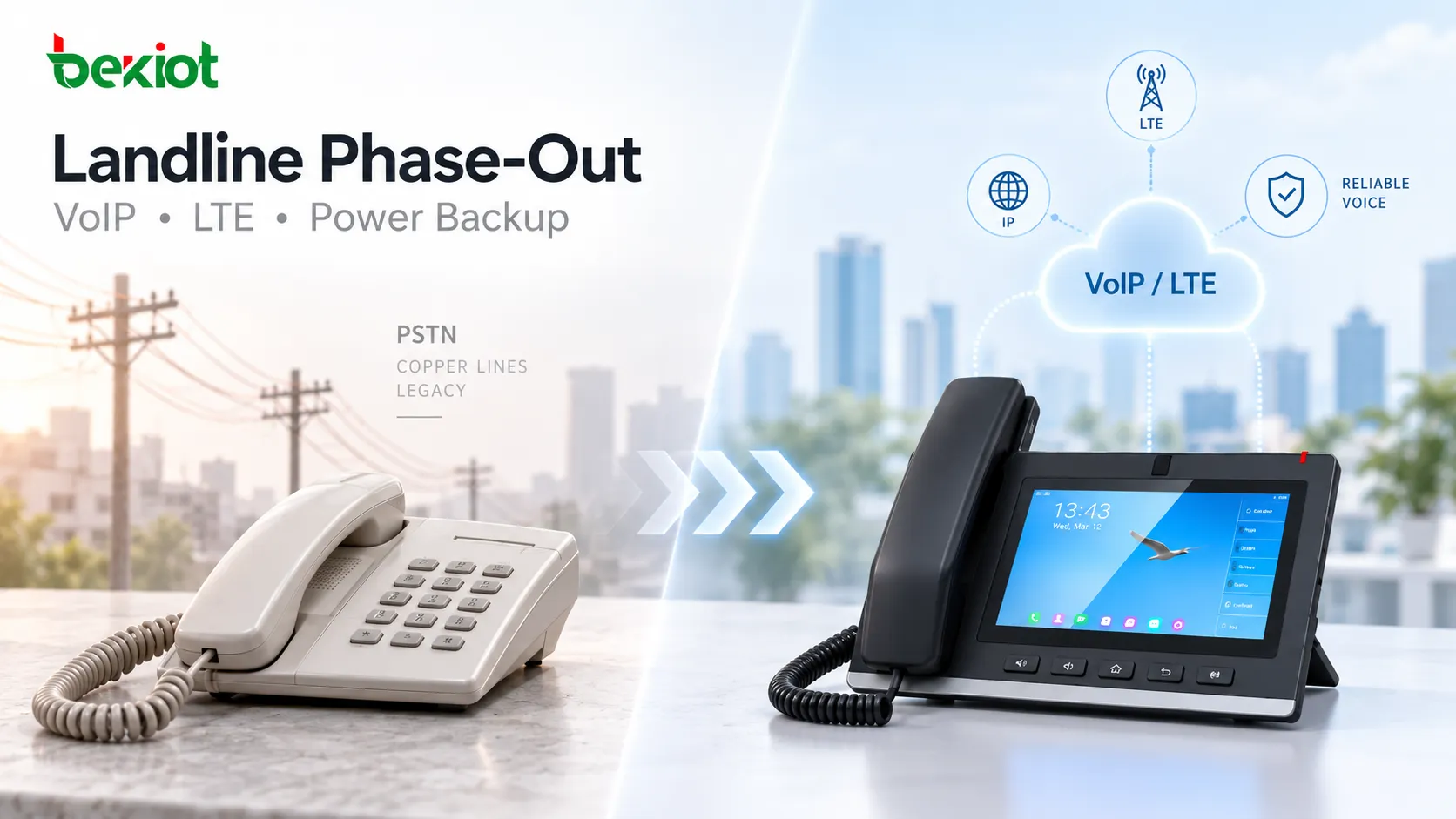
As communications networks continue to modernize, the retirement of traditional landline service is no longer just a long-term technology trend. In September 2026, CenturyLink began notifying some traditional landline customers in Iowa that certain copper-based voice services would gradually be discontinued, with customers being directed toward newer voice services based on VoIP and cellular networks.
For people already accustomed to mobile phones and internet calling, the change may look like a routine network upgrade. But for households, older users, and organizations that still depend on landlines for elevator phones, alarm systems, medical alert devices, and other analog equipment, the more important issue is not simply whether they will still be able to make calls. The underlying conditions required to keep the communication service working are changing.
Traditional POTS service has long been associated with simplicity: connect a telephone to a pair of copper wires, lift the handset, and make a call. After migration to VoIP, LTE, or another IP-based voice service, the handset may remain the same and the telephone number may be retained, but the network, power supply, and equipment behind that call are completely different.
That brings a previously less visible question to the foreground: if utility power fails, how long will the replacement phone service continue to work?
What Really Changes When Legacy Landlines Are Retired?
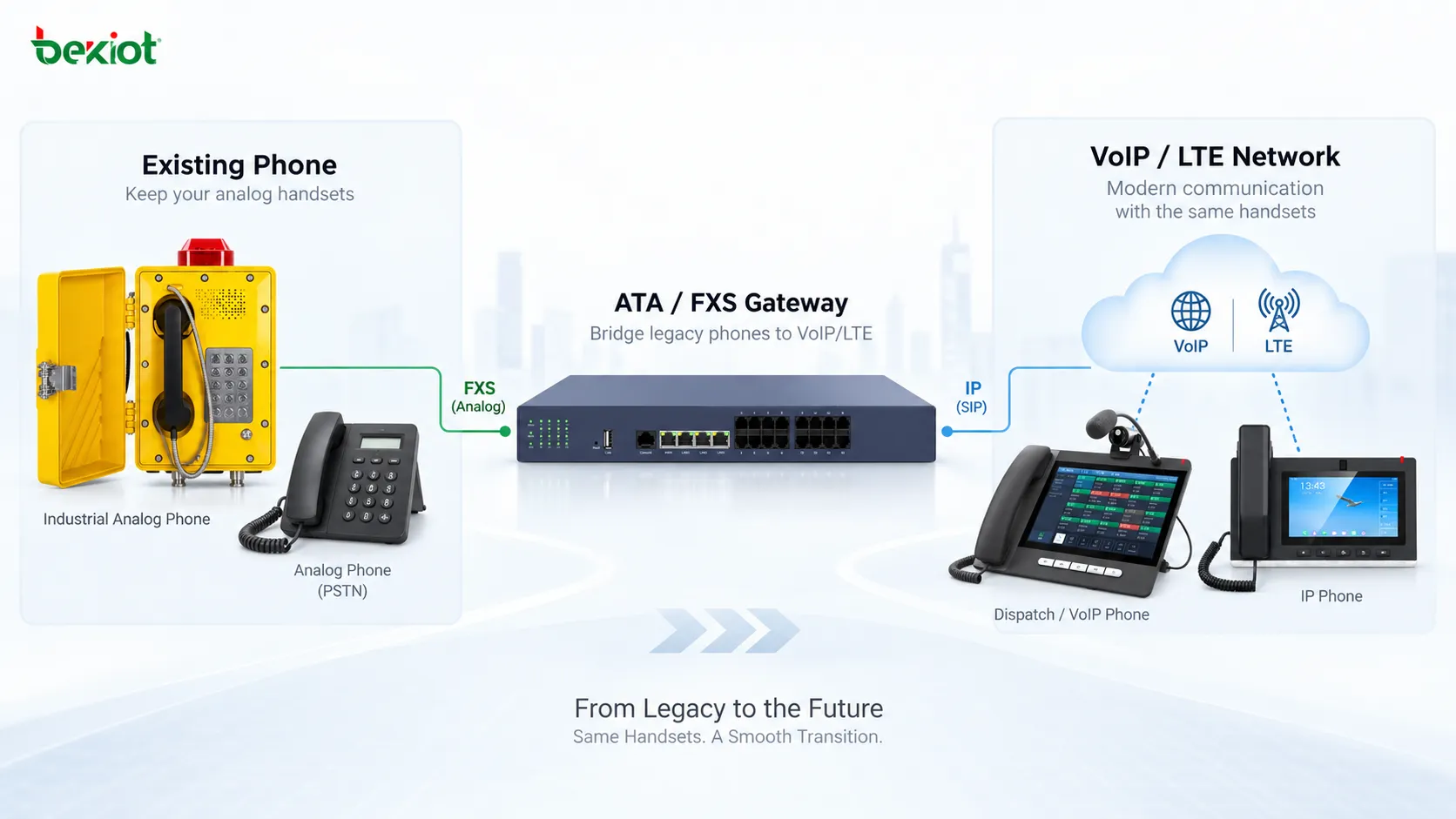
From the user's point of view, the migration may not look very different. A standard RJ11 telephone can still be connected to a voice adapter, users can continue making and receiving calls, and in many cases the existing telephone number can be retained.
The real change happens behind the telephone.
Traditional POTS lines connect customers to the telephone network over copper infrastructure. In many installations, a basic corded telephone can draw the power it needs directly from the telephone line. With VoIP, voice is converted into IP traffic and carried over broadband, fiber, Ethernet, or cellular LTE networks.
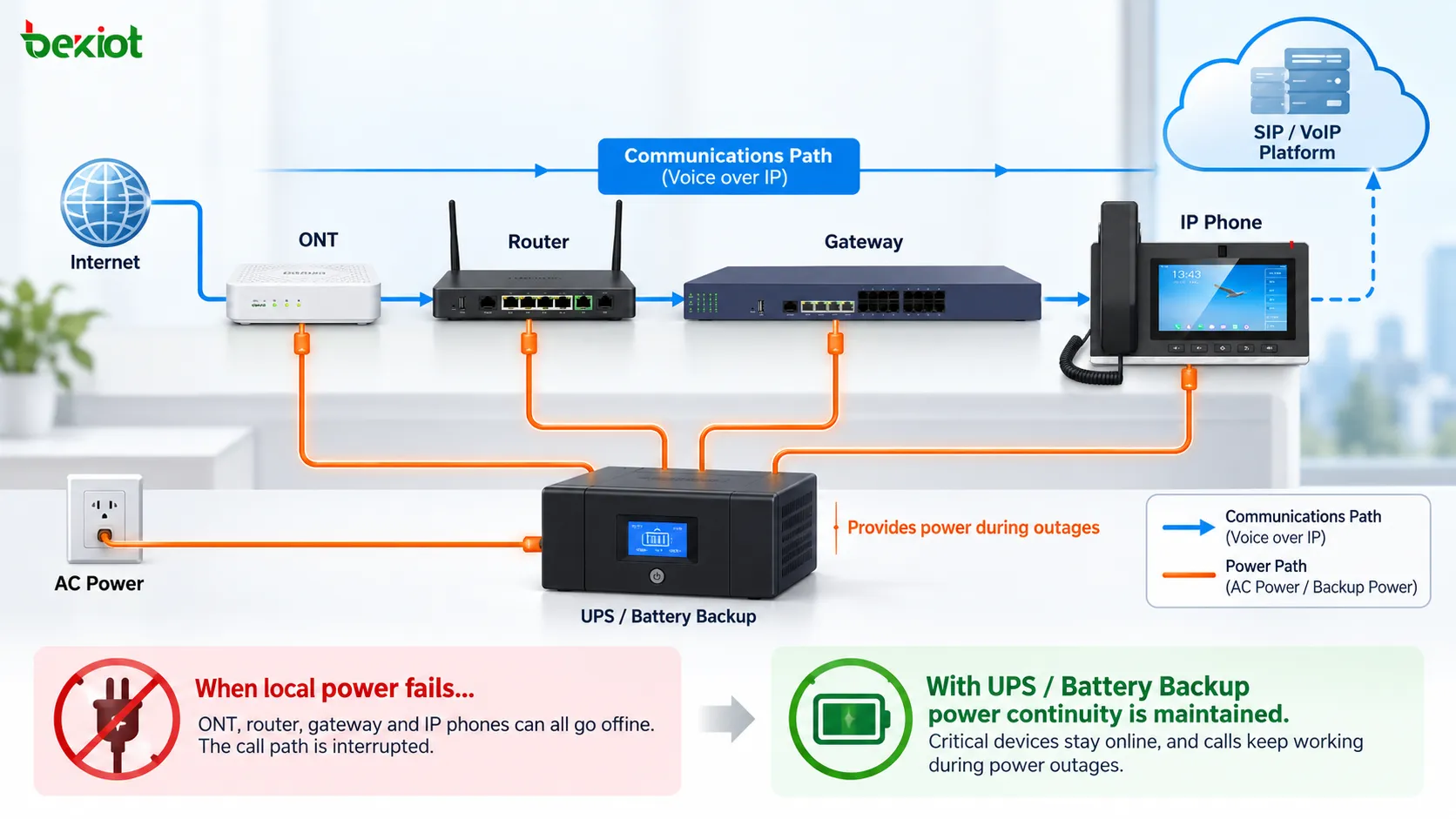
As a result, a call that appears simple to the user may now depend on several components:
An optical network terminal or broadband modem;
A router or residential gateway;
An ATA voice adapter;
An IP PBX or service-provider VoIP platform;
Ethernet switches or PoE power;
LTE or 5G cellular coverage;
Local AC power and backup batteries.
Copper retirement is therefore more than a change from one transmission medium to another. In practical terms, part of the reliability that was previously concentrated within the carrier telephone network moves closer to the customer, where local networking equipment, power systems, and endpoints become part of the service chain.
Why Do Power Outages Become a New Risk After VoIP Migration?
VoIP is not inherently unreliable. A properly designed IP voice system can support server redundancy, dual network paths, automatic route failover, device monitoring, and more flexible disaster-recovery options.
The difference is that IP voice typically relies on more active equipment, and most of that equipment requires local power.
For example, a VoIP telephone using a residential broadband connection may be fully functional under normal conditions. But if the ONT, modem, router, or ATA loses power, the entire call path may become unavailable even though the telephone handset itself is not faulty.
Using LTE as the transport path does not eliminate the issue completely. Cellular connectivity can remove dependence on a fixed broadband connection, but an LTE voice adapter still requires power. Without a battery or UPS, the device may stop working as soon as local power is lost.
The reliability question therefore changes from:
"Is this telephone line working?"
to:
"How long can every device required for this phone service continue operating after utility power fails?"
Which Devices Are Most Likely to Be Missed During POTS Retirement?
Residential phones are the most visible part of landline retirement, but for businesses, public facilities, and industrial sites, the greater risk often comes from devices that are rarely treated as "phones" during normal IT asset management.
Many buildings and facilities were originally equipped with dedicated analog lines for specific systems. Those circuits may have remained unchanged for years, to the point that current IT personnel may not even know they are still in service.
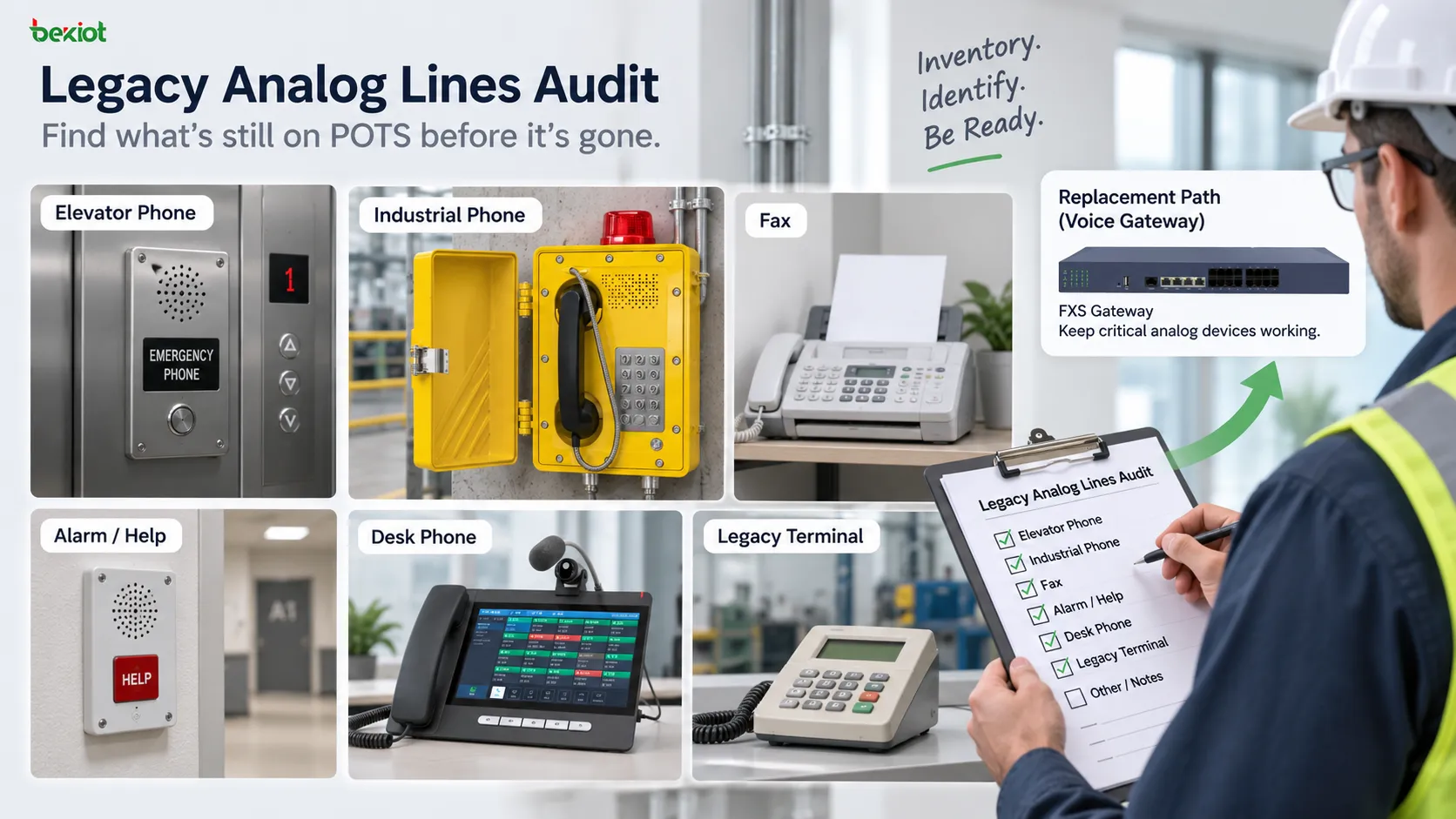
Typical examples include:
Elevator emergency phones — passengers press an emergency button and the unit calls a monitoring center over an analog line;
Fire and alarm communication equipment — some older systems still report events to a monitoring center over telephone lines;
Medical alert and senior emergency devices — many legacy units were designed around residential landline service;
Access control, gate, and remote-control systems — some older installations use analog telephone circuits for communication;
Fax machines — certain business processes still depend on traditional fax transmission;
Industrial telephones and unattended hotlines — these may still connect through an analog PBX or carrier line;
Modem-based remote equipment — some legacy monitoring systems still transfer data over telephone circuits.
If an organization identifies landlines only by reviewing office telephone bills, these hidden dependencies can easily be missed.
For that reason, the first step in a POTS migration should not be buying new VoIP phones. It should be creating an analog line inventory: where each number is located, what equipment it serves, who maintains it, whether it performs a safety-related function, and what happens if the line becomes unavailable.
Why Must 911 and Emergency Communications Be Tested Separately?
After an ordinary home phone is migrated, many users consider the transition complete once incoming and outgoing calls work. That level of testing is not enough for 911, medical alerts, elevator phones, or other public-safety applications.
A replacement service should verify at least three areas.
Can the Emergency Number Actually Be Reached?
Testing should not be limited to ordinary telephone numbers. The service needs to confirm that emergency calls follow the intended emergency-service path and that number configuration and service-area settings are correct.
Can Emergency Services Receive the Correct Location?
Traditional fixed lines are usually associated with a specific installation address. IP voice is more flexible, and an endpoint, ATA, or account may potentially be used at different locations. Emergency location information therefore needs to be reviewed again as part of the migration.
How Long Will Emergency Calling Continue During a Power Failure?
If a replacement voice device has only a few minutes of backup power while users assume the phone will remain available throughout an extended outage, a dangerous expectation gap can develop.
Emergency voice acceptance testing should therefore include more than a call under normal utility power. Where appropriate, utility power should be removed to confirm that the backup power system actually takes over and to document how long the communication service remains available.
How Can a Replacement System Avoid Losing Every Phone During One Power Failure?
There is no single migration design that fits every environment. A residential user, a normal office, and a safety-critical facility have very different continuity requirements.
For general office communications, IP phones, cloud PBX services, or SIP trunks can be used, with UPS systems protecting the critical network equipment. Where existing analog endpoints still need to remain in service, ATA devices or FXS gateways can connect those telephones to a SIP platform.
Where reliable wired connectivity is unavailable, LTE or 5G voice access can provide a more flexible replacement path. Cellular VoIP is particularly useful for remote locations, temporary sites, or environments where installing new cabling would be expensive.
For elevator phones, emergency call points, and other critical communication devices, a more complete design should consider:
Whether the primary and backup communication paths are genuinely independent;
Whether the service can switch to cellular connectivity if fixed broadband fails;
Whether switches, gateways, and endpoints all have backup power;
Whether the system can generate an alarm when a backup battery fails;
Whether the backup route has been tested using an actual call.
A good replacement system does not necessarily require two communication paths for every endpoint. But the more critical the service, the less acceptable it is for the power supply, network connection, and voice platform to share the same single point of failure.
How Should a POTS Migration Project Be Accepted and Tested?
As copper infrastructure is retired, acceptance criteria also need to change. With a traditional carrier line, testing often focused on whether dial tone was present. A modern replacement requires validation of the complete communication path.
| Acceptance Item | What Should Be Verified |
|---|---|
| Number and Endpoint | Whether the original number is retained and whether telephones, alarm devices, or other endpoints remain compatible |
| Incoming and Outgoing Calls | Two-way calling, DTMF, ringing, and voice quality |
| Network Path | Stability of broadband, Ethernet, LTE, or 5G connectivity |
| Power Failure Test | Whether the UPS or battery takes over and whether the actual backup duration meets requirements |
| Emergency Calling | Whether 911 or other designated emergency numbers can be reached correctly |
| Special Devices | Actual compatibility of elevator phones, medical alarms, fire systems, fax machines, and other legacy equipment |
| Fault Alarms | Whether terminal, gateway, battery, or network failures can be detected promptly |
| Backup Path | Whether the service switches as designed when the primary communication path fails |
One of the most important rules is not to treat "device registered" as proof that the migration is complete. SIP registration, an LTE online indicator, or a green gateway status light only confirms part of the system state. An actual call is still required to prove that the full communication path works.
Will Fixed Telephones Really Disappear After Copper Networks Are Retired?
The phrase "landline retirement" can create the impression that the familiar desktop telephone will disappear as well. These are two different things.
What many users actually depend on is the fixed location, fixed number, and lift-the-handset-and-dial experience, rather than the fact that the audio travels over copper.
That is why modern replacement services can still allow customers to use familiar analog telephones. An adapter converts analog voice to VoIP, and the call is then carried over an IP or cellular network to the service provider.
The part disappearing more quickly may therefore not be the fixed telephone itself, but the dedicated copper circuit running from the customer premises back into the traditional telephone network.
For businesses and users, the more important question is not whether VoIP can reproduce every technical characteristic of legacy POTS. It is whether the replacement design restores the same level, or a higher level, of communications continuity. The network path can be modernized and the existing handset may remain, but power backup, alternate routes, emergency calling, and equipment monitoring all need to be reconsidered.
FAQ
Does the Existing Telephone Handset Have to Be Replaced When the Landline Is Retired?
Not necessarily. A standard analog telephone can often continue to be used through a compatible ATA or FXS device connected to a VoIP or cellular voice service. Actual compatibility should still be tested for dialing, ringing, DTMF, and any other required functions.
Does VoIP Always Stop Working During a Power Outage?
No. Whether VoIP continues operating during a power failure depends on whether the supporting equipment has backup power. If the ONT, router, switch, ATA, IP phone, or cellular voice adapter remains powered by a UPS or battery, and the upstream network is still available, the VoIP service can continue to operate.
Does an LTE Voice Replacement for POTS Still Require Fixed Internet Broadband?
Not necessarily. Some voice adapters use an LTE cellular network as the IP transport path and therefore do not require a separate fixed broadband connection at the customer site. They still depend on adequate cellular coverage and local power.
Why Should Fax Machines, Alarm Systems, and Elevator Phones Not Be Assumed to Work Automatically over VoIP?
These devices may depend on specific analog line characteristics, signaling methods, dial tone behavior, DTMF, modem transmission, or certification requirements. A normal voice call working correctly does not prove that every legacy analog device will behave correctly, so each device type should be tested in its actual operating scenario.
What Is the Most Commonly Overlooked Step in a POTS Migration?
The most commonly missed task is not selecting a VoIP provider. It is finding every device that still depends on a legacy analog line. Many organizations have elevator phones, alarm circuits, fax machines, industrial telephones, or remote-control equipment that have not been included in IT asset inventories for years. Completing a line and device inventory before copper service is disconnected is essential to avoid discovering critical dependencies after the migration.