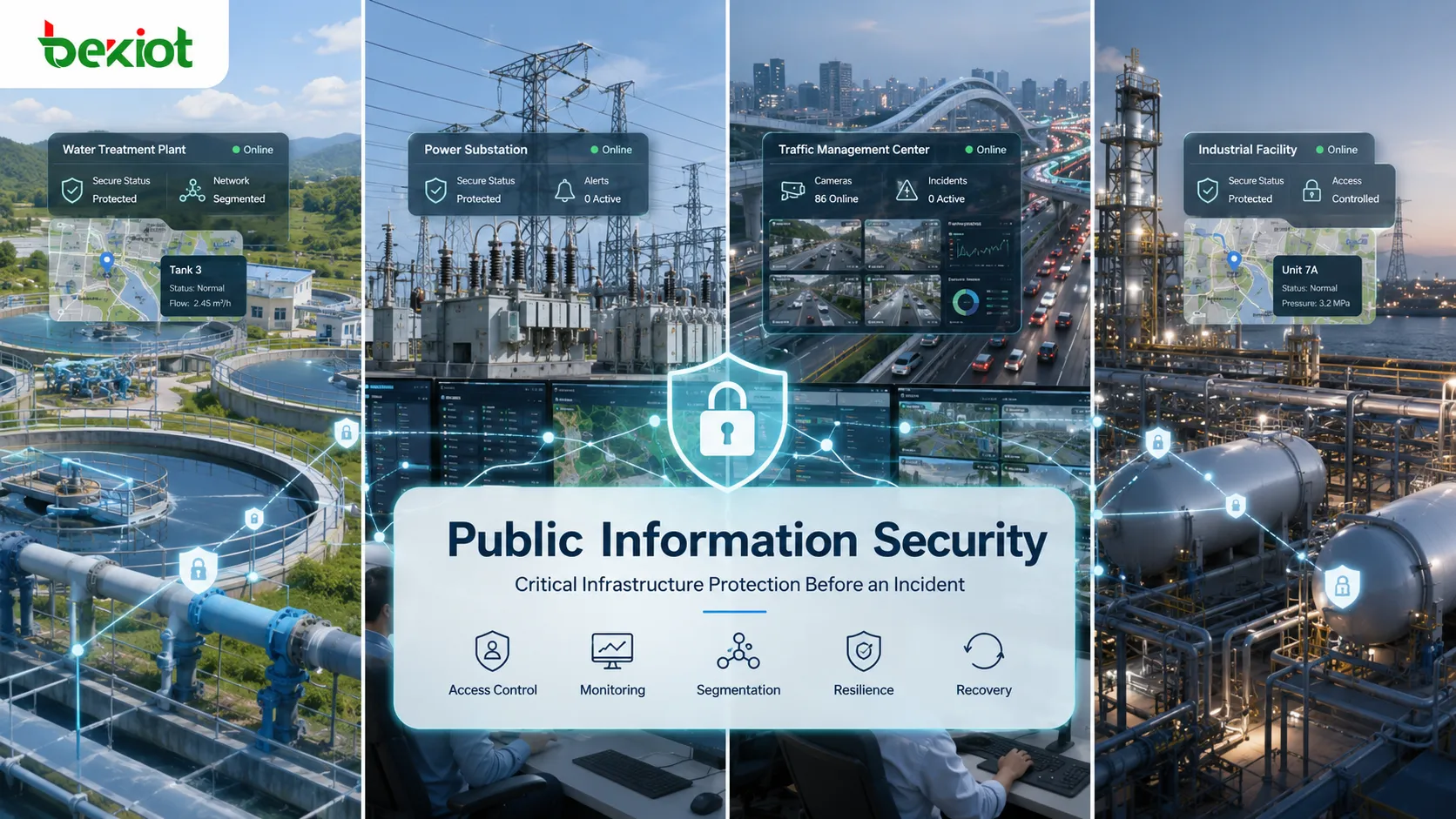
In an increasingly connected society, public information security has a direct bearing on whether a city can continue supplying water and electricity, keep transportation moving, maintain essential services during an emergency, and protect public health and daily life. Digital networks have made public services more efficient, but they have also tied operational systems, control platforms and emergency coordination more closely together. A disruption in one part of that environment can quickly affect services far beyond the original point of failure.
For that reason, public information security can no longer be treated simply as a matter of preventing data leaks, website defacement or office-network outages. It needs to be designed into public services before an incident occurs, with security controls, operational procedures and recovery capabilities treated as part of normal infrastructure planning rather than added only after a serious failure.
Public reports from state and water-sector authorities indicated that in August 2026, drinking-water or wastewater facilities in at least seven U.S. states, including Minnesota and Michigan, were affected by cyberattacks. Although Pennsylvania had not confirmed a similar local attack at the time, its Department of Environmental Protection still issued a security advisory urging drinking-water and wastewater organizations to reduce unnecessary public-internet exposure and update account passwords. The response highlights an important point: the absence of a confirmed incident does not mean existing security practices should remain unchanged.
Public information security should also extend beyond government websites, databases and personal information. For water utilities, power systems, transportation networks, communications infrastructure, healthcare and emergency-management services, network connections, device accounts, operational control systems, service data and business continuity all form part of the security picture. Once these systems are disrupted, the impact can move beyond information loss and into interruption of essential public services.
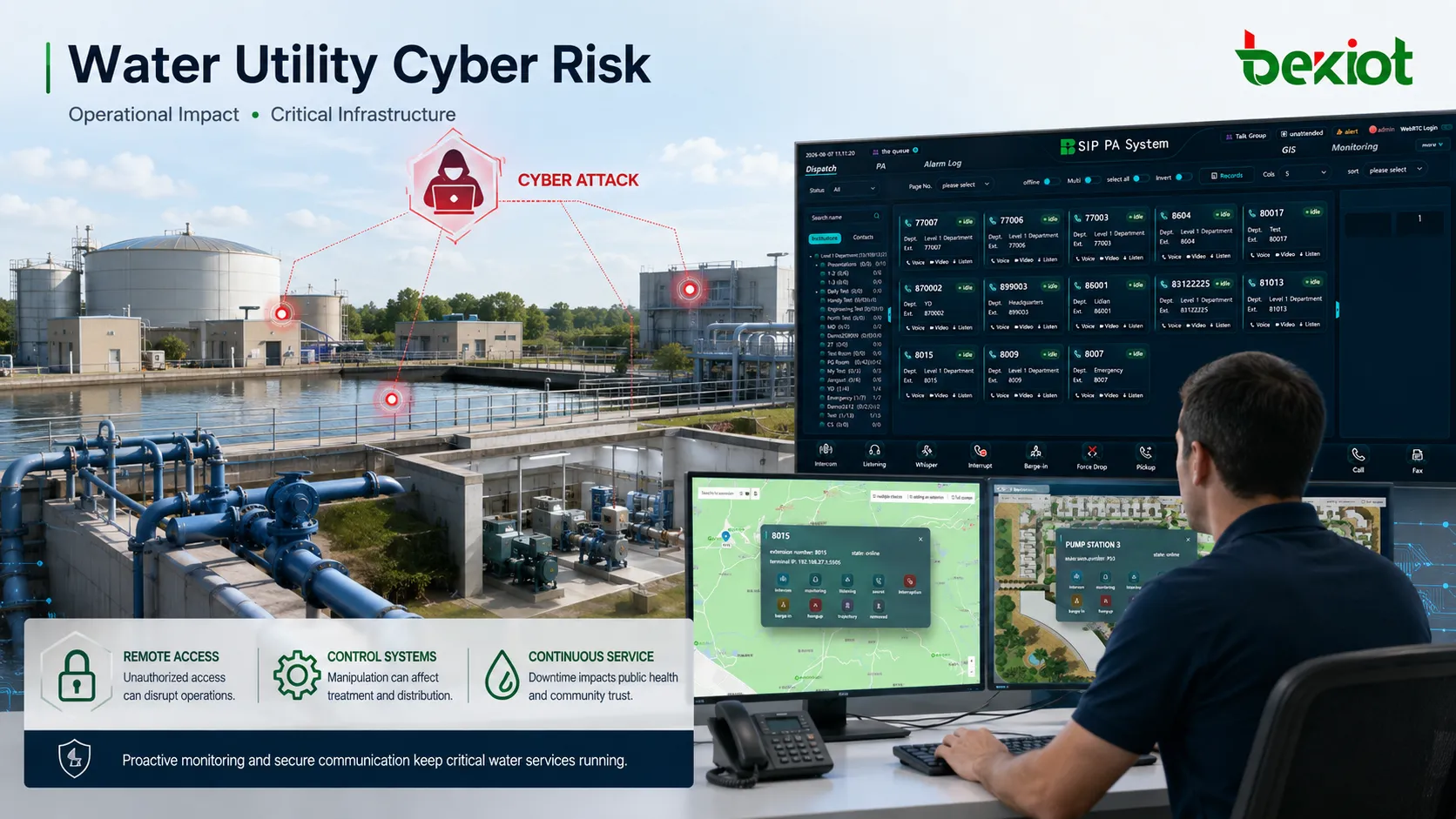
Why Does a Water-System Cyberattack Become a Public Information Security Issue?
When a conventional enterprise network is attacked, the immediate consequences may include inaccessible files, compromised accounts, unavailable applications or exposed data. Critical public infrastructure is different because its digital systems are connected directly to real-world service delivery. Once an attack reaches the operational layer, the affected assets are no longer limited to servers and data. Pumps, treatment processes, control equipment, dispatch workflows and field operators can also be involved.
Water utilities are a clear example. Monitoring platforms, remote-control devices, pumping stations, treatment facilities and operator terminals are expected to support continuous operation. If a cyber incident forces automated control systems offline, operators may have to move to local or manual operation. In 2023, a water authority in Aliquippa, Pennsylvania, switched to manual operation following a cyber intrusion and temporarily halted part of its pumping operation. Customers were not reported to have suffered a major service impact, but the incident demonstrated how a cybersecurity problem can move beyond the office network and affect physical operations.
For critical infrastructure, the objective of public information security therefore cannot be reduced to "keep hackers out." A more realistic objective is to prevent unauthorized access while ensuring that essential services can continue if an attack succeeds, and that normal operation can be restored as quickly as possible. Cybersecurity, business continuity, emergency coordination and field operating procedures need to support one another.
The Risk Is No Longer Limited to Whether Data Will Be Leaked
Traditional information-security programs often begin with servers, databases, email systems and corporate networks. Those assets still matter, but digital transformation has expanded the attack surface of public utilities considerably. An attacker may not need immediate access to a core control system. A forgotten remote-management interface, an outdated account or an improperly secured internet-facing device may provide enough access to begin moving further into the environment.
A public-service organization may operate corporate IT networks, business applications, remote-maintenance connections, operational technology networks, video surveillance, communication systems and large numbers of connected field devices at the same time. These systems may exchange data or depend on one another, while their security controls can vary significantly. Compromise of a peripheral device can become more serious if internal trust relationships allow an attacker to move toward more sensitive systems.
This is why modern critical infrastructure cybersecurity increasingly focuses on the complete attack surface rather than asking whether an individual server has security software installed. Water, energy and other essential-service operators need to consider at least three different outcomes:
Could sensitive data or system configurations be viewed, altered or deleted?
Could critical equipment or operating platforms lose control or become unavailable?
If digital systems are disrupted, can operators still provide essential public services?
The third question is often the least discussed, but it is one of the clearest differences between ordinary enterprise IT and critical public infrastructure. The ultimate requirement is not simply that every information system remains online. It is that essential services remain available to the public even when some digital systems are degraded.
Why Do Internet Exposure and Account Security Remain Priority Risks?
Reducing unnecessary public-internet exposure and updating passwords were among the basic precautions emphasized in the recent security guidance. These recommendations are not new, but they remain relevant because many successful attacks begin with relatively straightforward weaknesses rather than highly sophisticated techniques.
Attackers routinely look for internet-facing management interfaces, known vulnerabilities, default credentials and poorly protected remote-access services. Public utilities can be particularly exposed when equipment has been in service for many years and remote-maintenance methods have accumulated over time.
A web management page, VPN gateway, remote desktop service or device-maintenance port may originally have been opened for temporary commissioning or support. Years later, it may still be reachable from the internet simply because no one remembered to remove it from the network design.
Account management creates a similar risk. Default passwords, shared administrator accounts, former employees whose credentials remain active, or the same password reused across several systems can undermine much stronger network-security controls.
For this reason, a public information security review should begin by answering two deceptively simple questions:
Which systems can actually be reached from the public internet?
Who currently has permission to access them?
If an organization cannot answer those questions accurately, it is likely to have blind spots elsewhere as well. A reliable understanding of internet exposure and access rights is the foundation for network segmentation, controlled remote access, monitoring and incident response.
What Should Public Information Security Reviews Examine First?
Improving security in critical infrastructure does not always begin with purchasing more security appliances. In many environments, the more urgent task is to understand existing assets, accounts, network relationships and emergency procedures. If an organization cannot clearly identify what systems exist, who can reach them and who is responsible when something goes wrong, additional tools will not automatically solve the problem.
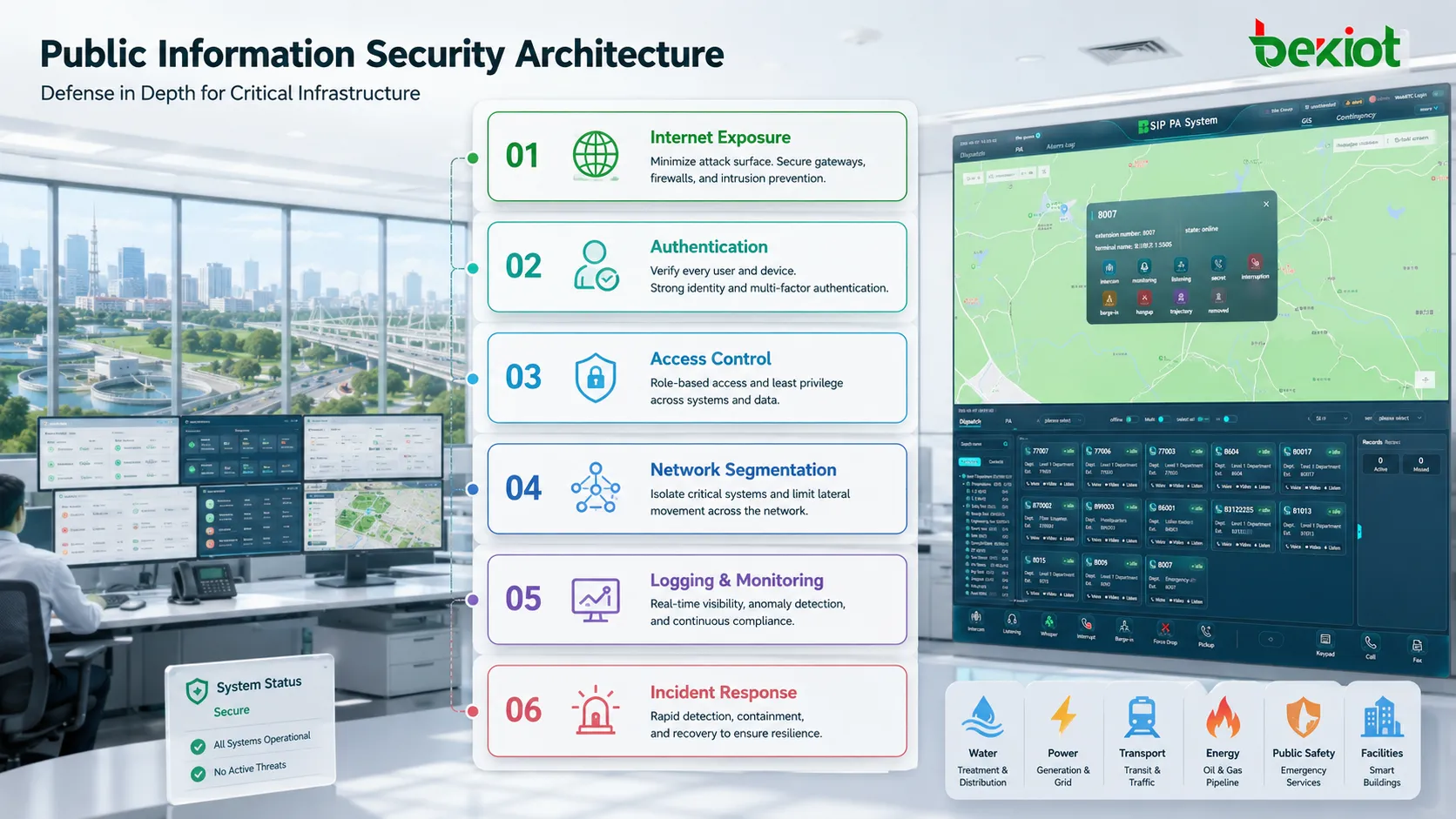
Internet-facing services and identity management should be reviewed first. Management interfaces, field devices and remote-access services can remain directly exposed for historical reasons even when that exposure is no longer necessary. Default passwords, shared administrator accounts and credentials that have not been rotated for years can create an equally serious weakness. Organizations should therefore confirm that every externally reachable service has a legitimate operational purpose, remove unnecessary exposure, use individual accounts, strengthen authentication, apply least-privilege permissions and promptly revoke access when personnel change roles or leave.
Network boundaries and asset management are equally important. If corporate IT and operational control networks are not properly separated, a phishing attack against a normal office endpoint may create a path toward more sensitive operational systems. Incomplete asset inventories create another problem: servers, controllers and field terminals can remain online without a clear owner or current maintenance status. Segmenting networks according to business function and security level, while maintaining an up-to-date inventory of hardware and software, makes it easier to understand how systems are connected and which paths should be isolated first during an incident.
Finally, logging, backup and incident response determine how effectively an organization can act once suspicious activity is detected. Without sufficient logs, investigators may not know how an attacker entered, what was changed or whether malicious activity is still present. Without tested backups, damaged systems may take much longer to restore. Another common weakness is organizational rather than technical: teams may not know who has authority to investigate, isolate equipment, declare an incident or begin recovery. Centralized records of logins, configuration changes, alarms and abnormal network activity, combined with regular backup restoration tests and clearly assigned response responsibilities, should therefore be established before an emergency.
None of these measures appears particularly advanced, yet they largely determine whether an organization can detect an incident early, contain it and recover without prolonged disruption. They also provide the foundation on which more sophisticated cybersecurity technologies can later be deployed effectively.
Why Must Critical Infrastructure Combine Cybersecurity with Operational Continuity?
One of the most common misconceptions in public information security is that a secure system is one that can never be compromised. No connected environment can guarantee that vulnerabilities, stolen credentials, configuration errors or previously unknown attacks will never occur.
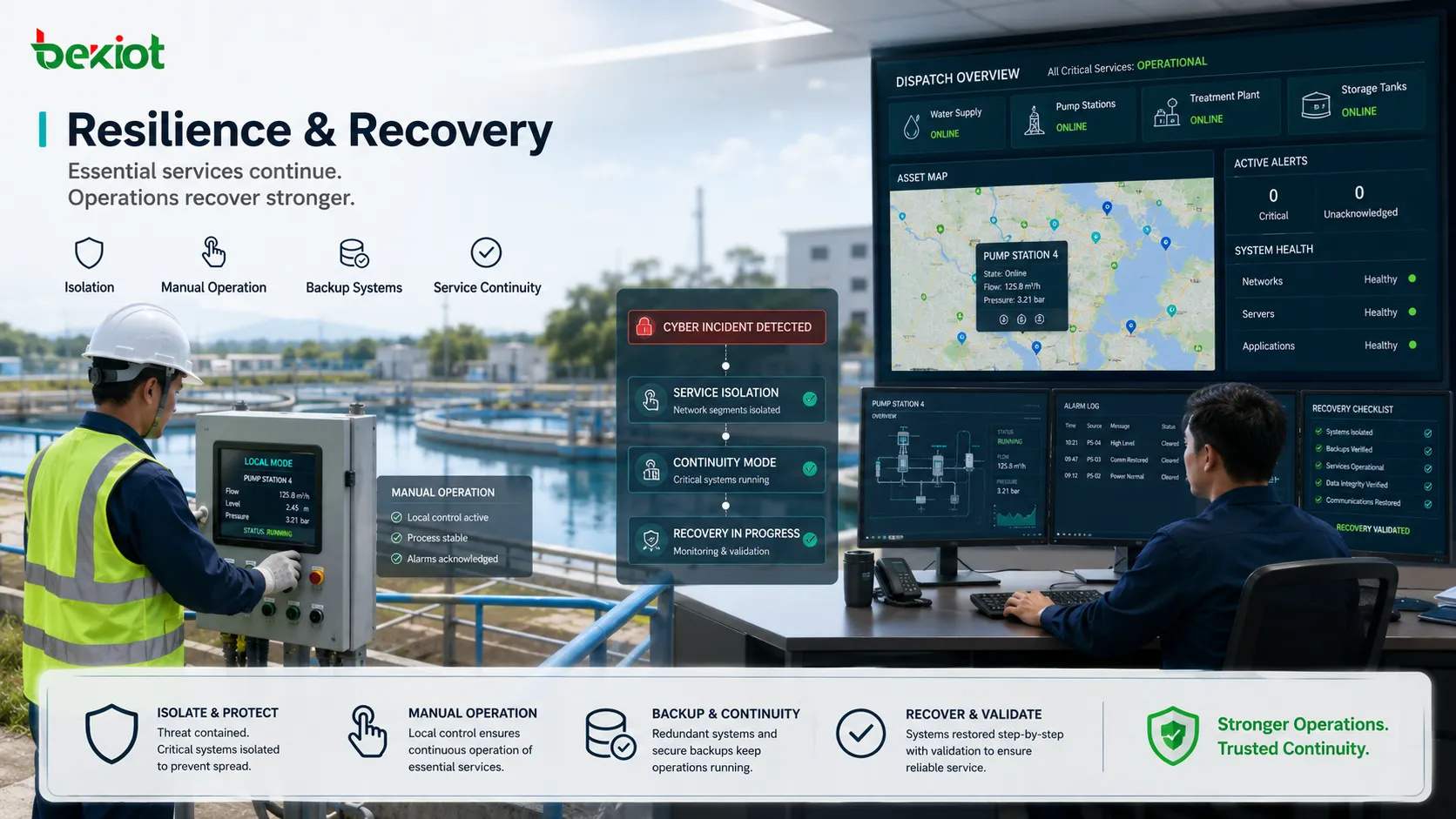
Critical infrastructure therefore needs a second layer of protection: if part of the network, server environment or automated control system becomes unavailable, essential operations should still have a viable way to continue.
This can take many forms. Are critical configurations stored in an offline backup? Can a secondary platform take over if the primary system becomes unavailable? Can field operators continue using local controls if remote control is lost? Is there an independent communication method when the main network fails? Do dispatchers, duty staff and emergency teams know how to enter a degraded operating mode?
This is not the same as assuming that every system will eventually be compromised. It is simply recognition that complex infrastructure will experience abnormal conditions. Resilient public systems are designed so that a technology failure does not immediately become a service failure.
For a water utility, the ability to switch to manual operation can itself be an important resilience measure. But that capability has little value if it exists only in a procedure manual. Personnel need to know how to use it, alternative workflows need to be tested, and critical teams must still be able to communicate while normal digital systems are unavailable.
Why Is Continuous Monitoring More Important Than Investigating After an Outage?
Pennsylvania authorities continued monitoring for possible attacks even though no confirmed local incident had been reported at the time, while maintaining coordination with federal, state and local security partners. That approach reflects another important principle of public information security: threat intelligence cannot remain trapped inside a single organization.
The same water-treatment equipment, industrial controllers, remote-management software or network products may be used by utilities in many cities and regions. If one operator identifies unusual login activity, malicious scanning or a new attack technique and that information is shared quickly, other organizations have an opportunity to check their own systems before they are targeted in the same way.
Public information security should therefore not rest solely with the IT department. Operations personnel, cybersecurity teams, equipment-maintenance staff, emergency managers and external partners all need a clear process for reporting and sharing security information.
Continuous monitoring also needs to look beyond whether a device is simply online or offline. Logins at unusual times, repeated authentication failures, unexpected configuration changes, unknown devices appearing on the network, unusual outbound connections and remote operations that do not match normal working patterns can all provide early indicators of a problem.
Moving from post-incident investigation to continuous situational awareness gives operators a better chance of detecting suspicious activity while it is still developing, instead of discovering the problem only after a public service has already been disrupted.
What Does an Effective Public Information Security Program Actually Need to Build?
Cyberattacks on water systems are one entry point into a much broader issue. As more public services depend on IP networks, cloud platforms and remote management, public information security is becoming inseparable from service reliability.
The key question is no longer whether an organization has purchased enough security products. It is whether the organization actually understands how its systems are connected, who is allowed to access them, how suspicious activity will be detected, how an attack will be contained and whether essential operations can continue while digital systems are being restored.
For critical infrastructure, a mature public information security program should provide at least six capabilities: reduce unnecessary exposure, control access, continuously monitor activity, limit the spread of an intrusion, maintain essential operations and recover services quickly.
Technology supports these capabilities, but technology alone is not enough. Policies, staff awareness, operating procedures, training and cross-department coordination all determine whether security measures work when a real incident occurs.
Operating for years without a major cyberattack is a normal condition, not evidence that protection can be relaxed. Much of the value of cybersecurity is difficult to see during normal operation. Its importance becomes visible when an abnormal event occurs and the organization is able to limit the impact, preserve essential services and restore normal operation without unnecessary delay.
That is the real purpose of public information security: not to claim that public systems will never fail, but to make sure that when something does go wrong, essential services for the city and the public can continue.
FAQ
How Is Public Information Security Different from Ordinary Enterprise Cybersecurity?
Many of the underlying technologies are the same, but public information security places greater emphasis on continuity of essential services. If a water, transportation, energy or emergency-management system stops operating, the effect can extend far beyond employees inside one organization. Security planning therefore needs to consider network protection, physical operations and emergency recovery together. An enterprise may primarily measure cybersecurity risk in terms of data and financial loss, while critical public infrastructure must also account for public safety and social impact.
Does the Absence of a Current Cyberattack Mean a Region Is Secure?
No. The absence of a confirmed incident only means that no specific attack has been confirmed at that point in time. It does not prove that internet-facing services, weak passwords, outdated systems or configuration risks are absent. Security reviews should continue according to the organization's assets and risk profile rather than beginning only after an attack is detected. Some intrusions may also remain unnoticed for an extended period before creating visible operational effects.
Why Should Public Utilities Reduce Direct Internet Exposure?
Every internet-facing management interface or device increases the number of systems that can be discovered, scanned and tested by external actors. Where remote access is operationally necessary, it should be provided through controlled access paths with appropriate authentication and authorization rather than by leaving unnecessary management services permanently exposed. Reducing direct exposure removes opportunities for attackers before more complex security controls are even considered.
Why Do Critical Facilities Still Need Manual or Local Operating Capability?
If a network, server or remote-control platform is disrupted by a cyber incident or technical failure, local and manual controls can provide a degraded mode of operation for essential services. These capabilities do not replace cybersecurity, but they reduce the risk that failure of a single digital system will stop the entire operation. For critical infrastructure, digital systems should improve efficiency and visibility without becoming the only possible way to keep an essential process running.