
Software rankings usually create a short burst of attention and then disappear into the next quarterly report. Crexendo's latest G2 results are more interesting when viewed as a signal of how buyers are beginning to judge cloud communications platforms.
In its September 2026 announcement, Crexendo reported Number 1 positions in G2's AI Text Generation and AI Text Summarization categories. The company also received recognition around user adoption and market momentum for VoIP and UCaaS, while continuing a long run of strong customer satisfaction and usability ratings. Its cloud communications platform now supports more than eight million end users.
The important point is not that another communications vendor has added AI. The market already has plenty of AI feature announcements. What stands out is that AI recognition is appearing alongside adoption, usability, customer relationships and traditional communications categories. That combination suggests that enterprise buyers are moving beyond the question of "Does the platform have AI?" and toward a more practical one: "Do people actually use it, and does it improve the way they work?"
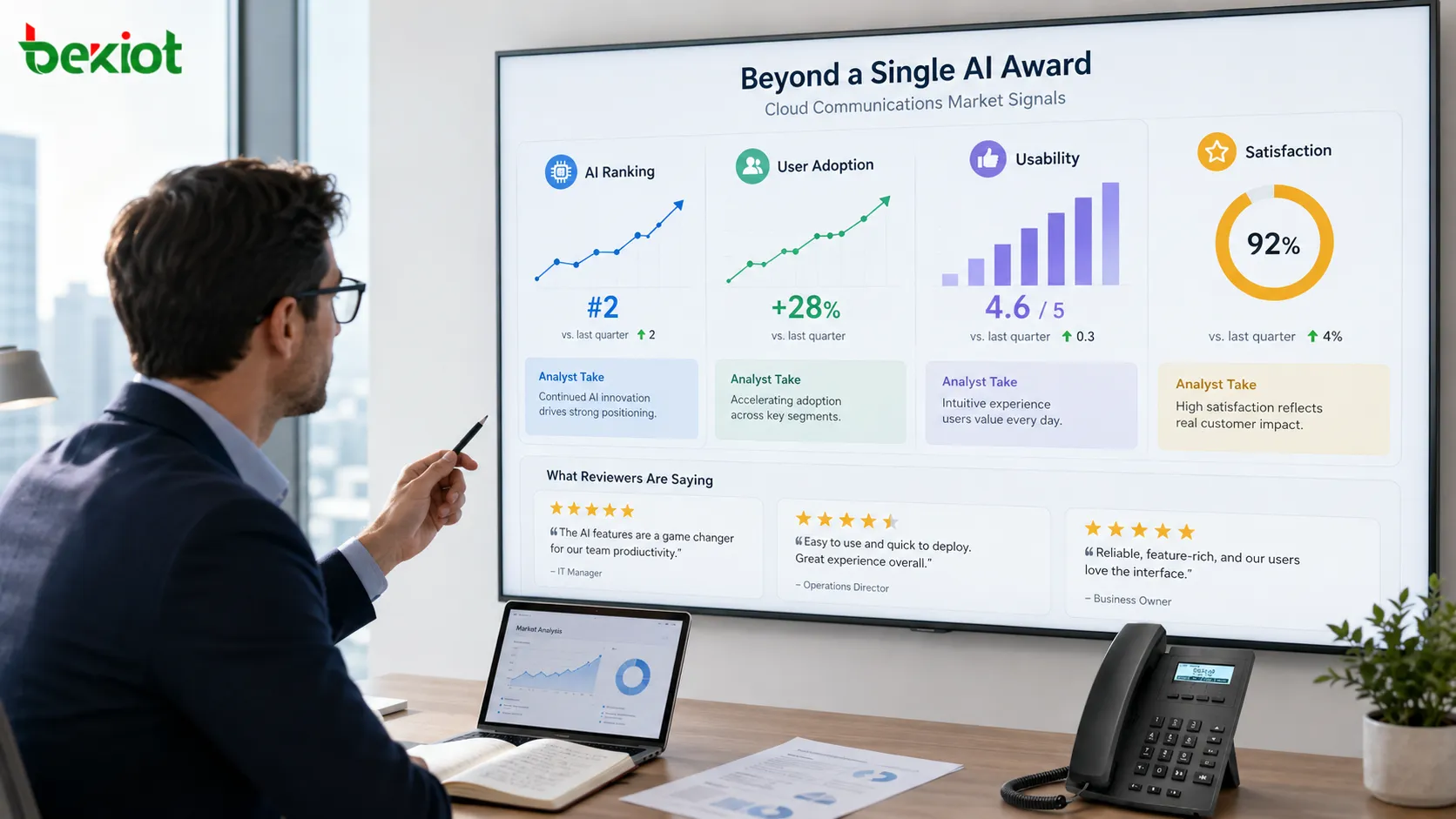
Why Do Cross-Category Rankings Matter More Than a Single AI Award?
A Number 1 ranking in an AI category is useful publicity, but it says relatively little about whether a communications platform works well as a complete business system. UCaaS is not purchased as an isolated AI application. It still has to support calling, users, endpoints, administration, collaboration and day-to-day communications.
That is why recognition across several categories is more useful to examine than one AI badge alone.
Crexendo's Fall 2026 results combine AI Text Generation and AI Text Summarization recognition with VoIP and UCaaS adoption-related awards, along with continuing usability and customer satisfaction results. For a buyer, those signals describe different parts of the same question.
AI rankings indicate where newer capabilities are receiving positive user feedback.
User adoption provides a clue about whether employees are actually using the platform.
Usability matters because communications software is used repeatedly throughout the working day.
Customer satisfaction and recommendation provide a broader view of the experience beyond individual features.
No single metric proves that a platform is suitable for every organization. Taken together, however, they are more informative than a feature checklist that simply counts how many AI tools are available.
Is User Adoption Becoming a More Important UCaaS Buying Signal?
Enterprise software has always had a gap between what a product can technically do and what employees actually use. AI makes that gap easier to see.
A platform may offer call summaries, writing assistance, meeting intelligence and automated follow-up, but those functions create limited value if employees ignore them or need several extra steps to access the results.
For UCaaS, adoption is particularly important because the software sits directly inside everyday work. Employees do not occasionally use a phone system in the way they might open a specialist analytics tool once a month. They answer calls, join meetings, send messages and switch devices throughout the day.
That changes the way AI functionality should be evaluated.
| Evaluation Signal | What It Can Tell a Buyer | What Still Needs to Be Checked |
|---|---|---|
| User Adoption | Whether employees are actively using the platform | Which features are actually being adopted and by which teams |
| Usability | Whether common communication tasks are easy to complete | Administrative complexity and real workflow friction |
| AI Capability | Whether the platform can automate or assist communication tasks | Accuracy, workflow integration and practical business value |
| Customer Satisfaction | How existing customers evaluate the overall experience | Whether reviews reflect businesses with similar requirements |
| Recommendation | Whether users would suggest the product to others | Why users recommend it and what limitations they report |
For this reason, user adoption may become one of the more useful indicators in the next stage of AI-enabled UCaaS. It helps separate features that look impressive in demonstrations from features that fit naturally into real communication workflows.
Why Are Customer Reviews Influencing the Buying Process Earlier?
The traditional enterprise communications sales process often started with a vendor presentation, followed by product comparisons, demonstrations and technical discussions. Buyers now have access to much more information before that first conversation takes place.
Software review platforms, technical articles, product documentation, community discussions and AI-assisted research can all become part of the shortlist process.
G2's model is based on verified customer reviews, which gives buyers a different type of information from a vendor's own feature page. A product page explains what a system is designed to do. Customer reviews can reveal whether deployment, usability, support and day-to-day operation match those expectations.
Neither source should be used alone.
Vendor documentation remains important for technical facts such as APIs, supported endpoints, security controls, deployment architecture and integrations. Third-party feedback is more useful for identifying recurring experience patterns that may not be obvious from specifications.
The strongest buying process therefore combines both types of evidence instead of treating product marketing or review scores as a complete answer.
How Should Buyers Evaluate AI Without Returning to a Feature Checklist?
AI can easily recreate the same problem that enterprise software buyers have faced for years: long comparison tables full of checkmarks that reveal very little about actual usefulness.
A more practical evaluation starts with the workflow rather than the AI label.
For example, instead of asking whether a UCaaS platform includes call summarization, a buyer can ask:
When is the summary generated?
Where does the employee see it?
Can the user review or correct it?
Can it be written directly into CRM or service records?
Who is allowed to use the feature?
Where is communication data processed and retained?
Can administrators disable AI processing for selected users or conversations?
These questions move the discussion away from whether a feature exists and toward whether it can operate safely and efficiently inside a real organization.
The distinction is important. Two UCaaS platforms may both claim to provide AI summaries, yet the business impact can be very different if one requires several manual steps while the other fits into the existing call and customer-management workflow.

What Should Enterprises Compare in an AI-Enabled UCaaS Platform?
The growing visibility of AI does not mean traditional communications criteria should move to the bottom of the procurement list. In many projects, they remain the first filters.
A useful evaluation can be organized around six areas.
1. Communications Reliability
Calling quality, service availability, endpoint compatibility, failover and network performance remain fundamental. AI cannot compensate for a communications platform that is unreliable during normal business use.
2. User Adoption
Look beyond licenses purchased or accounts created. The more useful question is whether employees actually use the platform and whether new features become part of their normal workflow.
3. Usability
Common tasks should remain straightforward even as additional AI functions are introduced. More intelligence should not automatically mean more menus, additional applications or unnecessary steps.
4. Business Integration
AI-generated information becomes more valuable when it can move into CRM, ticketing, customer service, collaboration or reporting systems rather than remaining isolated inside the communications application.
5. Governance and Data Control
Enterprises need to understand permissions, retention, processing locations, administrative controls and how generated content is reviewed before it becomes part of a business record.
6. Measurable Workflow Value
The final question is whether the feature saves time, improves consistency, reduces repetitive work or provides information that employees could not previously access efficiently.
This evaluation method also helps prevent AI from dominating the entire procurement decision. AI is one layer of the platform, not a substitute for the communications service underneath it.
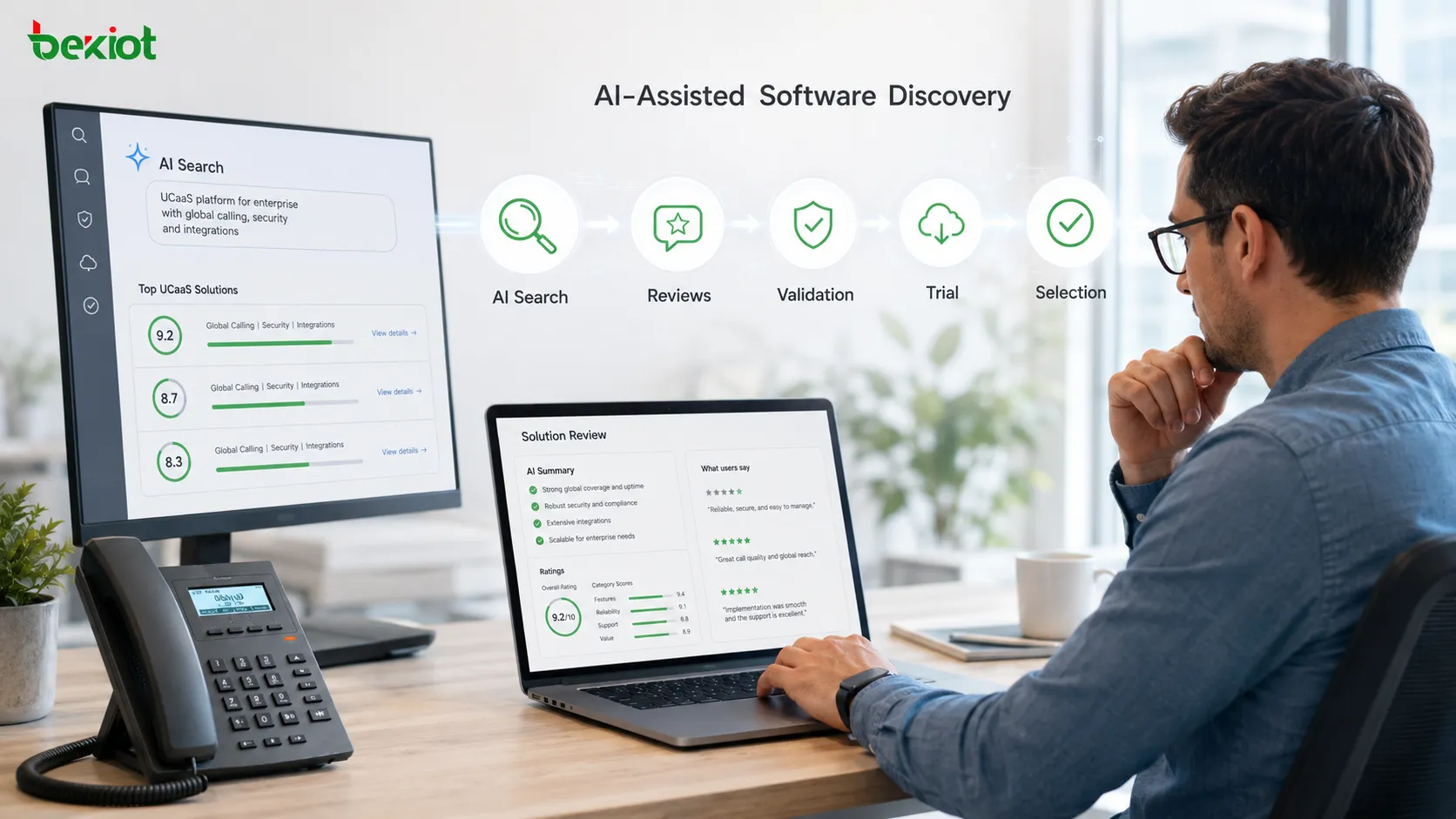
How Is AI-Assisted Search Changing Software Discovery?
The Crexendo announcement also points to a change happening before product evaluation begins: software discovery itself is moving into AI-assisted channels.
Buyers increasingly ask systems more detailed questions than they once typed into a conventional search box. Instead of searching only for "UCaaS software," a buyer may ask:
Which UCaaS platforms have strong user adoption?
Which cloud phone systems integrate AI with CRM workflows?
What should a company compare before replacing a VoIP platform?
Which UCaaS vendors receive strong usability reviews?
How should an enterprise evaluate AI call summaries?
This matters because AI-assisted research tends to reward information that can be clearly extracted, compared and supported.
A page filled with broad statements such as "industry-leading AI communications" gives a search system very little concrete information to work with. A page that explains deployment requirements, integrations, administrative controls, limitations and measurable use cases provides far more useful context.
The same applies to third-party review data. When software research takes place across vendor websites, review platforms and AI-generated answers, a vendor's reputation becomes increasingly distributed across multiple information sources.
What Do the Fall 2026 Results Suggest About the Next Phase of UCaaS Competition?
The most useful interpretation of the latest G2 results is not that every communications vendor now needs another group of AI features.
The stronger signal is that cloud communications platforms are increasingly being judged across several dimensions at the same time. AI capability matters, but so do adoption, usability, customer experience and the ability to turn new functions into practical workflows.
For vendors, that creates a harder competitive environment. Adding an AI function is relatively easy to announce. Building one that employees continue to use, administrators can govern and businesses can connect to existing systems is much more difficult.
For buyers, this may actually make product evaluation clearer. Instead of asking which vendor has the most AI, they can focus on whether the platform has a strong communications foundation, whether users adopt it and whether newer capabilities remove meaningful work from existing processes.
That is where the significance of cross-category rankings becomes more useful. The market is beginning to connect product capability with real usage. For UCaaS, the next competitive advantage may come less from adding another feature and more from proving that customers can successfully use the features already there.
FAQ
Does a Number 1 G2 ranking mean a UCaaS platform is the best choice for every business?
No. Rankings and customer reviews are useful inputs, but they do not replace a requirements-based evaluation. A platform that performs well with one customer group may not meet another organization's needs for integrations, geographic coverage, endpoints, security, administration or deployment architecture.
Why is user adoption especially important when evaluating AI features?
AI features only create operational value when employees actually use them. Strong adoption can indicate that functionality fits naturally into existing workflows, while low usage may suggest that a feature adds complexity or does not solve a frequent enough problem.
What should buyers check beyond the number of AI features?
Useful criteria include communications reliability, usability, workflow integration, administrative control, permissions, data handling, human review options and measurable time savings. These factors provide more information about practical value than feature count alone.
How should businesses use third-party software reviews?
Reviews are most useful for identifying repeated patterns around usability, support, deployment and customer experience. Technical claims should still be confirmed through product documentation, demonstrations, trials and direct validation against the organization's own requirements.
Why does AI-assisted software discovery matter for UCaaS vendors?
Buyers can now research software through AI tools before visiting a vendor or contacting sales. This increases the importance of clear technical information, structured answers, independent reviews and consistent product descriptions across multiple sources.