As a professional broadcast-audio equipment manufacturer and systems solution provider, we have observed that sound reinforcement requirements in today's small and mid-sized performance venues have shifted from basic sound-pressure coverage to a complete, venue-wide listening experience. Live at Hub City Vinyl, located in the historic Arts and Entertainment District of Hagerstown, Maryland, is a representative example of this industry trend. Built around an established local vinyl-culture identity, the venue includes two performance spaces with clearly differentiated roles. Clair Global Integration's Cleveland team completed the system design and integration, using RCF professional loudspeakers as the core sound reinforcement components, together with Allen & Heath and Midas digital mixing consoles and Powersoft and Lab Gruppen amplification platforms. The project applies different system configurations according to the acoustic limitations, programming formats, and operating roles of the two rooms, providing a repeatable engineering model for professional sound reinforcement in small and mid-sized cultural venues.
From an industry perspective, this is not a routine equipment purchase for a new venue. It is a notable example of professional sound reinforcement technology moving into smaller cultural spaces. As venue operators begin to treat sound quality as a core brand asset, system design is shifting away from equipment stacking and toward a systematic evaluation of room acoustics, operating scenarios, and long-term maintenance. This change creates new requirements for product development, system design capabilities, and service delivery across the professional audio industry.
Vinyl Culture Raises Sound Expectations
What makes Live at Hub City Vinyl distinctive is its close connection with an established record retail business. Vinyl buyers are generally more sensitive to sound quality than typical event audiences. Their listening habits place greater emphasis on frequency-response accuracy, detail retrieval, and dynamic performance, while their tolerance for distortion and uneven coverage is relatively low. The continuous customer journey from record browsing to live performance creates a direct point of comparison: the studio-produced sound experienced through physical recordings becomes an implicit standard for evaluating the venue's live reinforcement quality.
This business model means the sound system cannot be treated as ordinary supporting equipment. Restaurants and casual leisure spaces may be able to use ambience to reduce the perceived impact of acoustic weaknesses. In a venue where music is the primary content, however, problems such as vocals being masked by instruments, loss of detail in the rear audience area, excessive sound pressure near the stage, or low-frequency buildup caused by room modes will be directly associated with the venue itself. Even when performers deliver a strong show, inconsistent sound-field coverage can significantly reduce the audience's overall impression.
The central technical challenge for the design team was to make the systems accommodate two distinctly different types of programming. Intimate acoustic performances require transparent midrange reproduction, natural imaging, and detailed sound at lower listening levels. Regional touring bands require sufficient dynamic headroom, strong low-frequency impact, and consistent sound pressure throughout the room. Attempting to handle both requirements with one oversized system would inevitably create a two-way compromise, producing coarse sound for smaller shows and insufficient headroom for larger productions.
The final dual-room system design uses spatial separation to match system performance more precisely to each application. It is also a typical example of the scene-first principle in professional sound reinforcement design. The value of a sound system is never determined by the number of devices installed, but by how closely its performance limits match the room geometry, audience capacity, and programming structure.
Two Rooms Use Different Architectures
The two performance spaces use completely different system architectures. Each design responds to its own room dimensions, architectural acoustic characteristics, and programming role rather than simply using a lower-specification version of the same equipment.
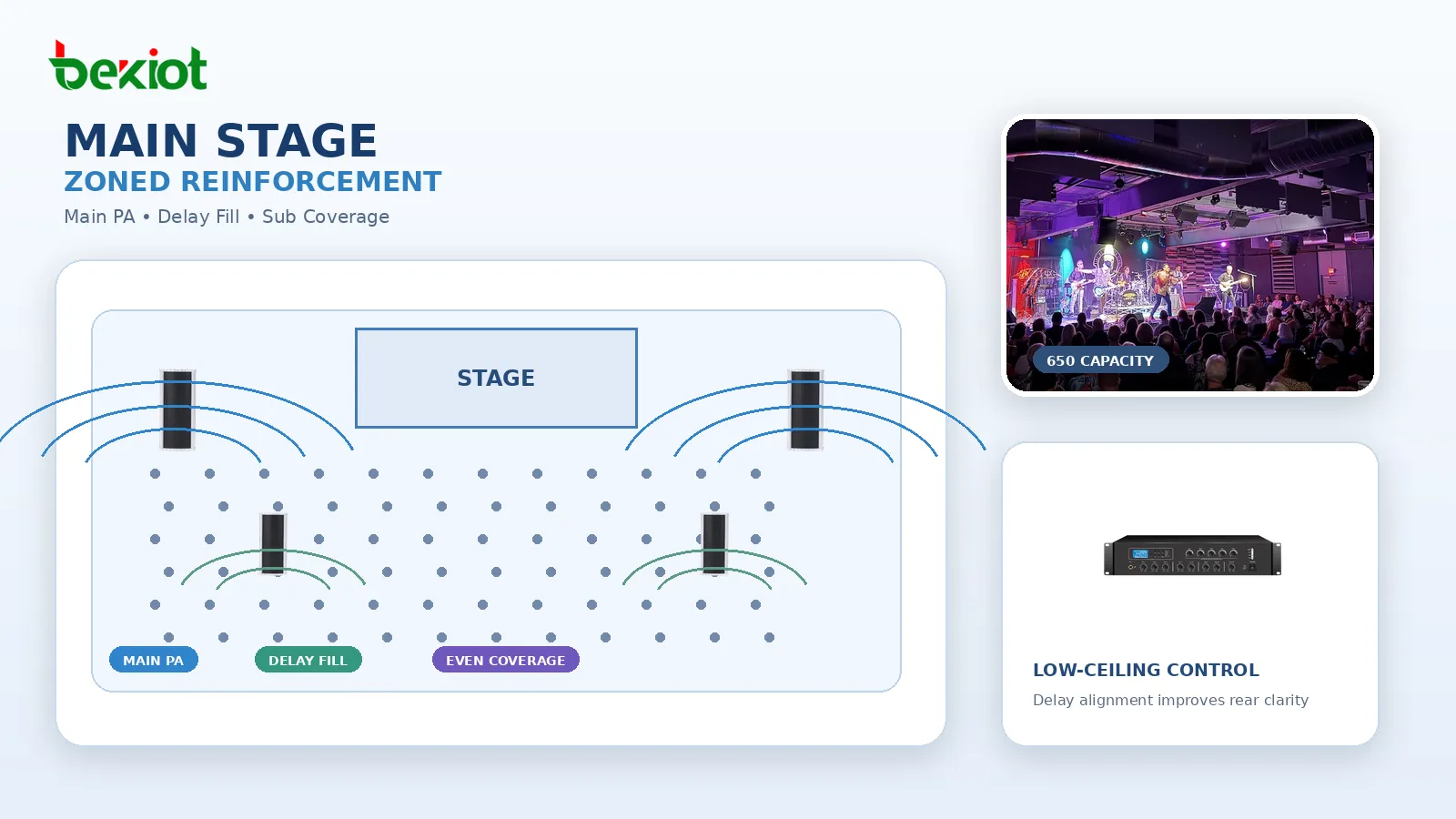
Main Stage Uses Zoned Reinforcement
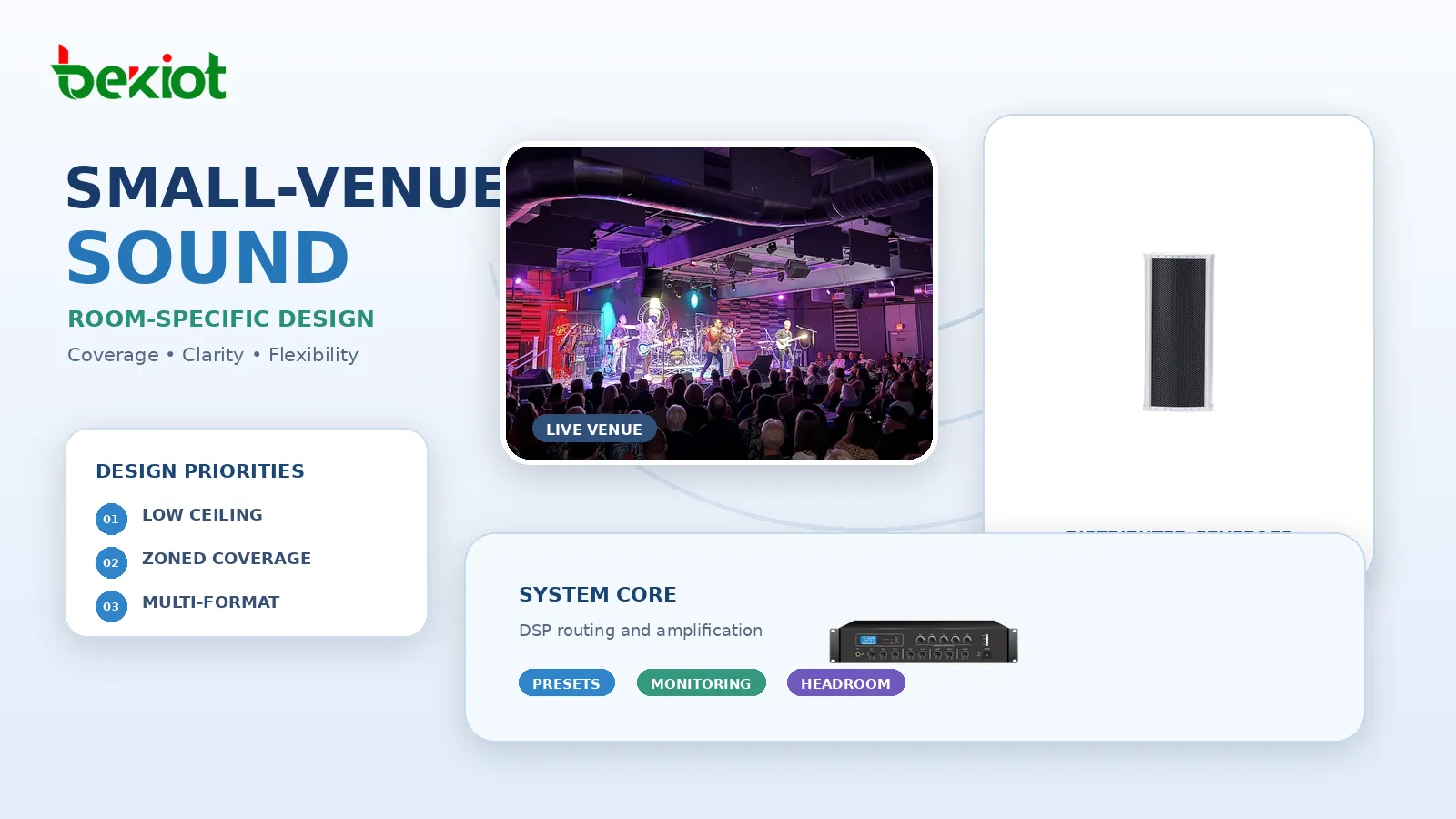
The Main Stage has a rated capacity of 650 people, and its main acoustic limitation is the low ceiling. A low ceiling directly reduces the available suspension height for a line-array system and restricts the adjustment range of its vertical coverage angle. It can also increase early reflections from the ceiling, creating the common condition in which the front of the room feels excessively loud while the rear sounds dull and unclear. This is a widespread technical problem in small and mid-sized indoor venues.
To address this limitation, the design team moved away from the conventional approach of relying on a single main system to cover the entire room. Instead, it adopted a zoned reinforcement architecture based on main line arrays and distributed delay fills.
The Sidebar Uses Point Sources
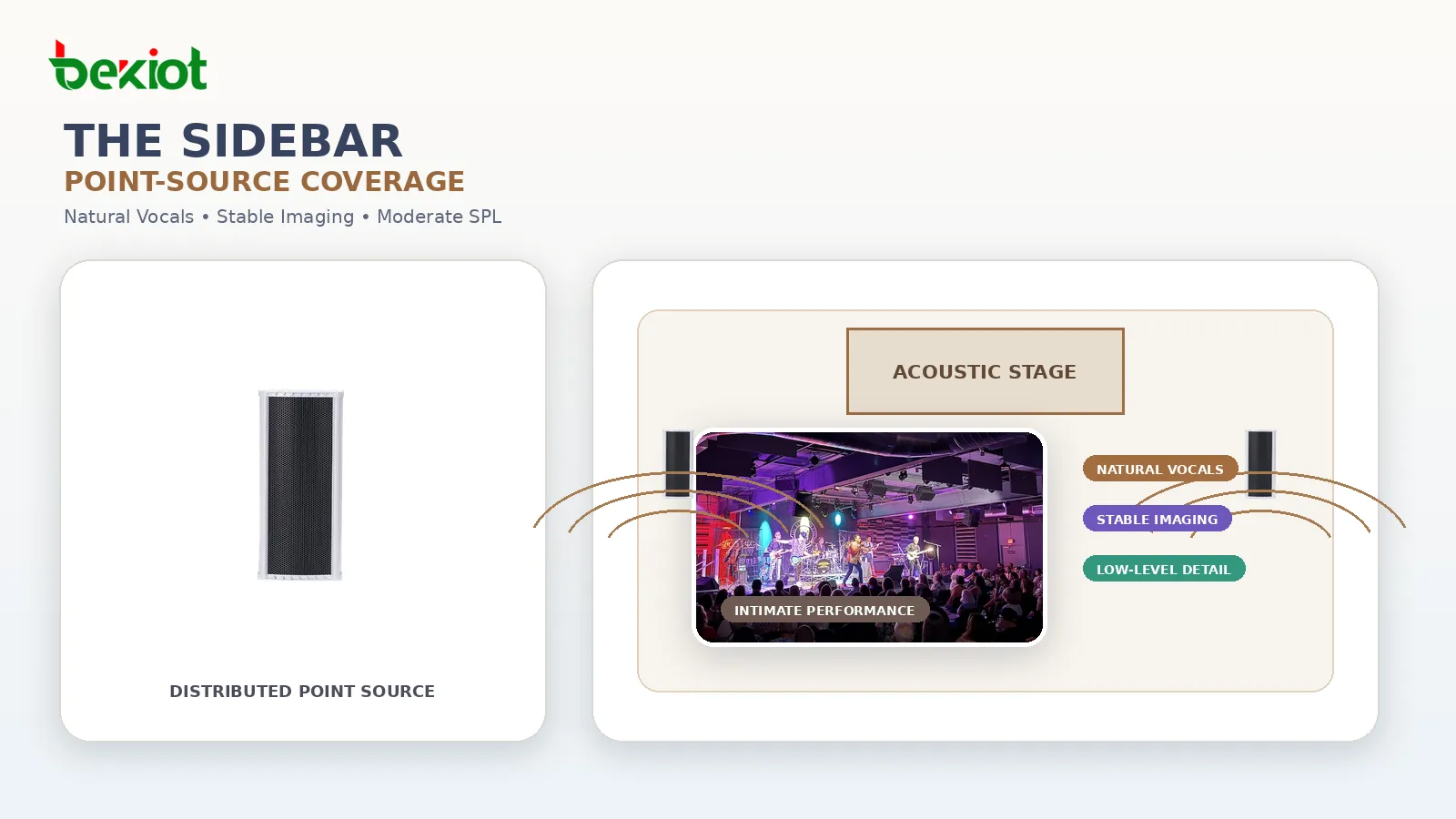
The adjacent Sidebar has a rated capacity of 220 people and is positioned for acoustic performances, small salon-style events, and lighter live-music programming. The room has a more enclosed layout, with programming centered on vocals and acoustic instruments. Its main design goals are midrange clarity, natural imaging, and strong sound quality at lower sound-pressure levels.
Rather than reproducing the line-array architecture used in the Main Stage, this room uses a distributed point-source coverage system that is better suited to a smaller space.
Three Industry Trends Are Emerging
As a professional broadcast-audio manufacturer, we see three clear industry trends in this project, each of which creates new requirements for product development and system design.
Professional Design Is Moving Downmarket
First, professional acoustic design is moving rapidly into smaller venues, bringing an end to the era in which these spaces were expected to settle for basic solutions. Distributed arrays, delay alignment, and zoned fill systems were once used mainly in large theaters, stadiums, and similar projects. Today, venues with capacities of only a few hundred people are also adopting systematic acoustic design methods.
This shift is being driven by a general increase in audience expectations. Sound-quality standards established through premium home audio, music festivals, and major touring productions are now pushing smaller venues to upgrade. Manufacturers therefore need to develop more compact and cost-effective professional products that suit the installation conditions and budget ranges of smaller spaces.
Multi-Format Operation Requires Flexibility
Second, multi-format operation requires stronger system adaptability. Modern performance venues are no longer single-purpose spaces. The same room may host a band performance, stand-up comedy show, corporate event, and acoustic salon within a single week.
The sound reinforcement system must provide enough dynamic headroom for larger productions while maintaining refined sound quality at lower levels. A dual-room configuration is one solution, while multiple digitally optimized presets for a single room represent another important direction. Manufacturers need to provide greater support through DSP preset templates and flexible system routing, helping venues switch quickly between parameter sets for different operating scenarios.
Sound Is Becoming a Brand Asset
Third, the listening experience is becoming a core competitive advantage for venues. For a location such as Hub City Vinyl, which has a strong cultural identity, sound quality is no longer a background technical specification. It is part of the brand itself.
A well-designed sound reinforcement system can build positive word of mouth, attract high-quality performers and targeted audiences, and support related revenue from record sales, merchandise, and other customer spending. This means purchasing priorities are shifting from cost-first decisions toward experience-first decisions, with greater attention being paid to long-term system value and the ability of audio quality to strengthen the venue brand.
It is also important to recognize that professional equipment does not automatically create a professional listening experience. System design establishes the fundamental acoustic conditions, but the final result still depends on daily mixing accuracy, stage-management standards, artist technical coordination, and equipment maintenance. Even a well-designed coverage structure can produce inconsistent results if delay parameters are changed without proper control, operating levels are not managed, or engineers follow different working practices.
Lifecycle Management Defines System Value
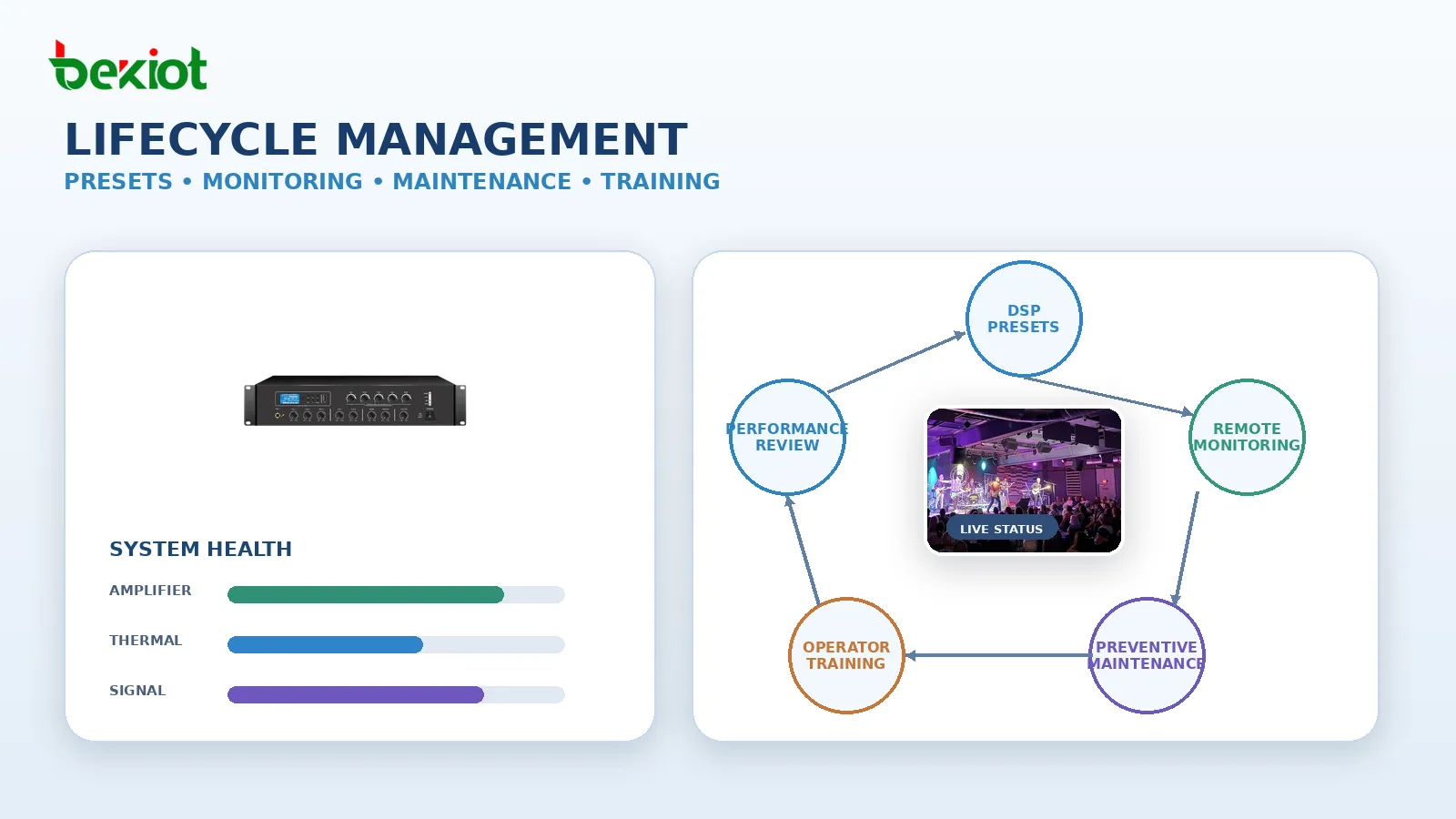
For professional audio manufacturers, project delivery is only the beginning of the service relationship. Long-term system stability and the preservation of sound quality are the real measures of solution value. For small and mid-sized commercial performance venues, lifecycle management should focus on three main areas.
Scene-Based Presets Need Refinement
The first is the continuous refinement of scene-based presets. Different performance formats and audience attendance levels change the acoustic behavior of the room during normal operation. Differences in absorption between an empty room and a sold-out show, together with the mixing preferences of different bands, can all affect the final sound.
Manufacturers should work with venue operators to create standardized preset templates for different types of programming and periodically optimize those settings using audience feedback and engineer reports, helping the system remain properly matched to each application.
Equipment Requires Routine Maintenance
The second is routine maintenance for equipment reliability. Professional sound reinforcement systems use high-power electronic equipment that may experience connector aging, cooling-system wear, and gradual changes in driver performance after extended operation.
Venues should establish regular inspection procedures covering loudspeaker drivers, amplifier cooling, cable connections, and digital processor calibration. Manufacturers can also use remote monitoring technology to track system status and provide early fault warnings, reducing the risk of system failure during important events.
Technical Training Protects Performance
The third is the development of technical capability within the operating team. Even the best system requires professional operation and adjustment. Manufacturers should provide structured technical training that helps venue engineers understand the core logic of the system, troubleshooting procedures, and scene-based operating techniques.
This allows the installed equipment to perform as intended and avoids the waste created when advanced hardware is used with limited technical understanding.
Overall, the value of the Live at Hub City Vinyl project does not come from the number of premium products installed. Its real value lies in the practical application of a professional design principle that places room limitations first and operating requirements at the center of the solution.
Distributed arrays address coverage consistency in the low-ceiling main room, point-source loudspeakers preserve natural sound in the smaller space, and separate systems allow the two rooms to support different programming formats. This problem-specific approach is the central value of professional audio system design.
For the wider industry, the project indicates that sound reinforcement in small and mid-sized performance venues is entering a more refined stage. Professional broadcast-audio manufacturers must continue improving product performance and system design capabilities to provide genuinely suitable solutions for venues of different sizes and operating positions, making high-quality sound a standard feature of cultural spaces.
Frequently Asked Questions
How should a low-ceiling venue choose between line arrays and point-source loudspeakers?
The decision primarily depends on the relationship between suspension height and room depth, together with the required vertical coverage angle. When suspension height is limited and the room is relatively deep, a compact line array combined with delayed reinforcement is a common solution because the array's directional control can reduce ceiling reflections. When the room is shallower, distributed wide-coverage point-source loudspeakers may provide better value. Venue capacity alone should not determine whether a line-array system is appropriate.
What is required for a delay system to sound natural?
The essential requirements are time alignment, level matching, and phase consistency. Professional acoustic measurement tools should be used to calibrate delay times accurately, ensuring that the arrival-time difference between the direct sound from the main system and the delayed reinforcement remains within the Haas-effect window for listeners in the rear area.
Levels must also be matched to prevent image shift or audible double arrivals in the delay zone. The final objective is to improve direct-sound energy and speech clarity in the rear audience area without moving the perceived sound image away from the stage.
How can one venue support very different event formats?
There are two main technical approaches. The first is spatial separation, as demonstrated by the independent systems in the two rooms, where spaces with different roles receive systems with different performance characteristics.
The second is the use of digital presets within a single room, with multiple configurations stored in the signal processor so that crossover, equalization, delay, and limiter parameters can be changed for concerts, meetings, salons, and other scenarios. The appropriate approach should be selected according to the venue's operating schedule and available budget.
Which operating data should be monitored over time?
Four main categories of operating data should be monitored. The first is sound-pressure level and limiter-activation records, which indicate whether the system has sufficient headroom or is exposed to long-term overload. The second is amplifier temperature and load status, which can reveal potential cabling or loudspeaker faults.
The third is parameter consistency within the system processor, helping prevent preset changes caused by incorrect operation. The fourth is the frequency response at important audience positions, which should be checked periodically to maintain consistent coverage. A standardized maintenance log can extend system life and reduce the risk of unexpected failures.