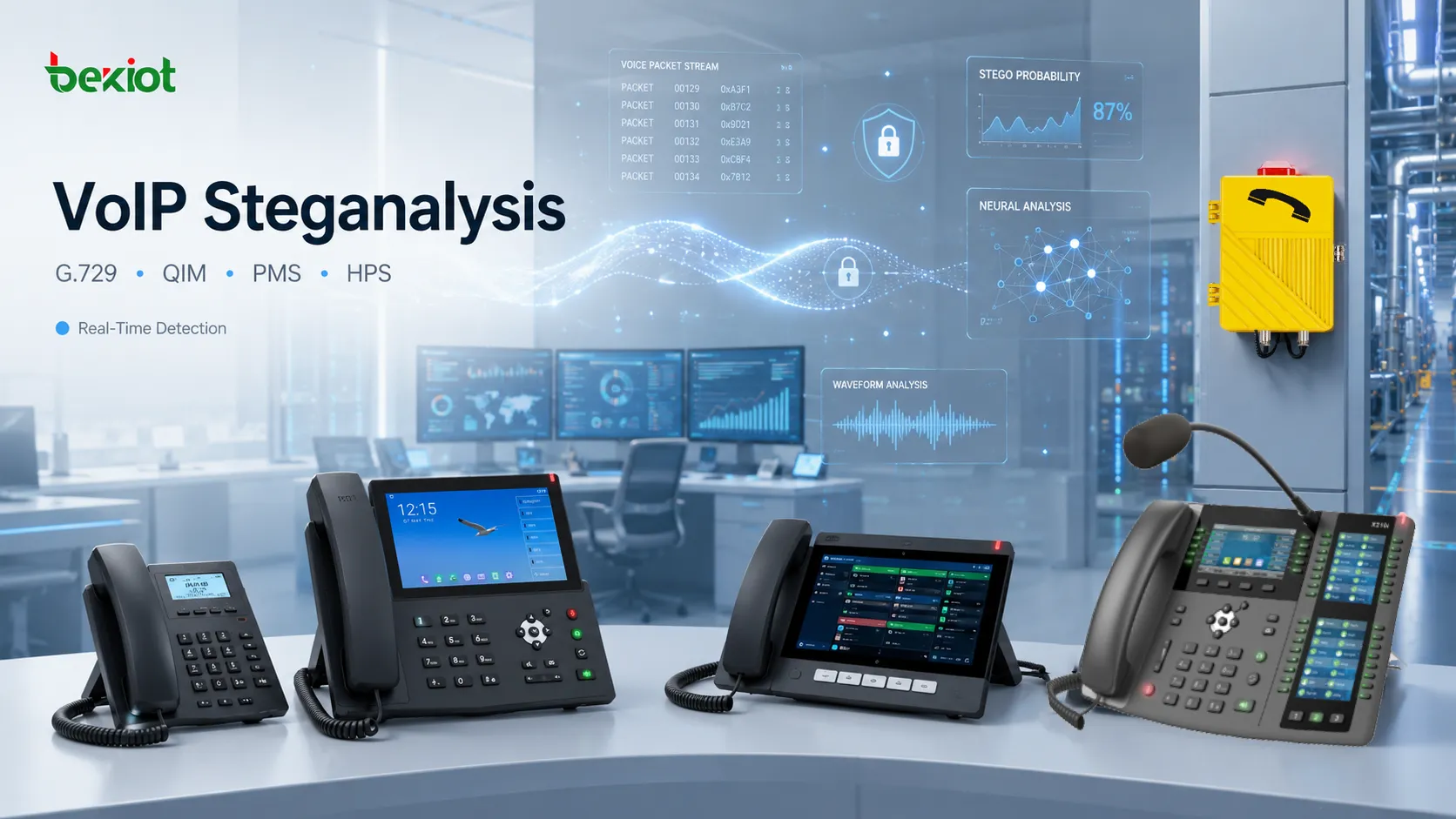
A normal VoIP call may sound ordinary to the human ear, yet its compressed speech frames can still carry subtle hidden changes. This is the security problem behind VoIP steganography. Instead of attacking the call openly, a covert channel can hide information inside codec parameters, codeword choices, pitch behavior, or other speech-coding details. The call continues to function, the audio may remain acceptable, and the hidden payload can move through the voice stream without looking like a separate file transfer.
This makes VoIP steganalysis a different challenge from ordinary network intrusion detection. A firewall may see packets, ports, protocols, and traffic volume, but it may not understand the statistical structure of compressed speech. A call recorder may preserve the audio, but it may not reveal whether codec-level values were slightly modified to embed secret bits. Detection therefore needs to look deeper into the voice coding process itself.
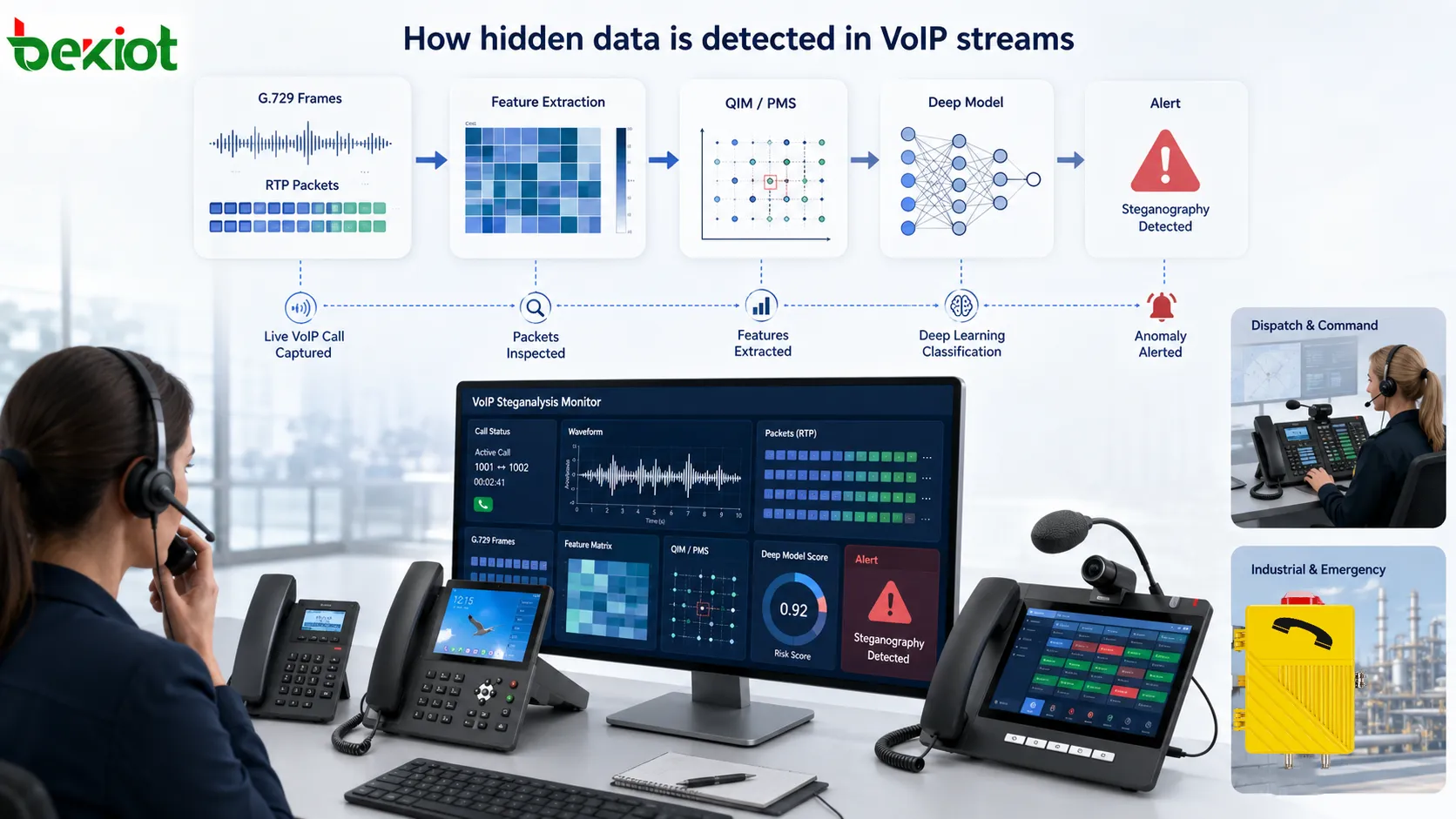
Modern detection methods increasingly combine speech signal processing with deep learning. The practical idea is straightforward: extract meaningful codec-side features from compressed speech, observe how clean and modified frames differ, and train a neural model to separate normal speech from stego speech. When this process is optimized well, it can support real-time VoIP security monitoring without introducing unacceptable delay.
Why Hidden Voice Traffic Matters
VoIP is widely used because it is efficient, flexible, and easy to integrate with enterprise communication systems. The same qualities also make it attractive for covert communication. Voice packets are expected to move continuously during a call, and small variations in compressed parameters may not appear suspicious unless the system is designed to inspect them.
Steganography differs from encryption. Encryption protects content by making it unreadable to outsiders, while steganography attempts to hide the existence of the message itself. In a VoIP environment, this hidden message may be embedded into the speech stream so that the call appears to be a normal conversation. That is why security teams cannot rely only on traditional traffic inspection when codec-level hiding is a concern.
The main difficulty is transparency. A good steganographic method tries to avoid audible degradation and statistical suspicion. It must carry enough payload to be useful, but not so much that it noticeably damages voice quality or creates obvious abnormal values. For steganalysis, the task is reversed: the detector must identify small, structured changes that may be spread across many frames.
Real-time communication adds another constraint. VoIP calls cannot wait for heavy offline analysis before packets are forwarded. A detection model must make fast decisions on short audio windows. If the model is too slow, it may be interesting in a laboratory but difficult to use in live communication security. This is why detection speed matters almost as much as detection accuracy.
G.729 Creates The Clues
G.729 is a low-bit-rate speech codec used in many VoIP systems. It encodes speech at 8 kbit/s using a CS-ACELP structure. Each 10 ms frame contains 80 samples when the sampling rate is 8000 samples per second. Instead of sending the full waveform, the codec represents speech through model parameters that allow the receiver to reconstruct intelligible audio.
This coding process creates several important feature areas for steganalysis. The encoder analyzes the short-term spectral envelope through linear prediction. The LP coefficients are converted into line spectral pair or line spectral frequency representations, then quantized through vector quantization. In G.729, the LSP-related quantization uses an 18-bit structure that includes L0, L1, L2, and L3 values.
The pitch side also matters. G.729 divides each 10 ms frame into two 5 ms subframes. Pitch delay values are estimated and encoded for those subframes. The first subframe uses 8 bits for pitch delay, while the second uses 5 bits with differential encoding. These pitch-related values provide another place where subtle changes can be introduced and later detected.
From a security point of view, G.729 is interesting because its compression reduces redundancy while still preserving structured relationships between codec parameters. Steganography may disturb those relationships. A human listener may not notice the disturbance, but statistical analysis and neural models may detect it if the right features are extracted.
QIM And PMS Leave Patterns
Two important hiding families in this area are Quantization Index Modulation and Pitch Modulation Steganography. They operate on different parts of the compressed speech representation, which means they leave different clues.
QIM is linked to vector quantization of LSP-related parameters. In simplified terms, the codewords inside the codebooks can be divided into groups representing hidden bit values. When a secret bit needs to be embedded, the encoder selects a suitable codeword from the corresponding group. This creates changes in codeword selection behavior, especially around L1, L2, and L3 features.
PMS focuses on pitch-related behavior. Since pitch delay estimation is part of the G.729 coding process, small modifications can be used to carry hidden information. The related detection features include values connected with the first and second subframes, often represented through integer and fractional pitch components.
HPS, or heterogeneous parallel steganography, is more complicated because it combines QIM and PMS behavior. Instead of applying only one hiding method consistently, it may use one of the two approaches across frames. This makes detection harder because the model must recognize mixed statistical patterns rather than one stable signature.
| Method | Main Feature Area | Detection Focus |
|---|---|---|
| QIM | LSP quantization and codeword indices | Changes in L1, L2 and L3 codeword behavior |
| PMS | Pitch delay estimation | Integer and fractional pitch-related features |
| HPS | Mixed QIM and PMS behavior | Combined and alternating hidden-data patterns |
The key lesson is that different hiding methods should not be treated as one generic anomaly. A good detector needs enough codec knowledge to understand where each hiding method is likely to disturb the speech representation.
Feature Design Drives Accuracy
Deep learning is powerful, but it still needs meaningful input. In VoIP steganalysis, the preprocessing stage is where raw compressed speech is turned into features that a model can use. Instead of feeding only a reconstructed waveform, a stronger approach looks at the codec parameters that are most likely to show embedding traces.
For QIM detection, feature extraction can focus on L1, L2, and L3 values linked to codeword selection. For PMS detection, pitch-related features such as P1 and P2 can be separated into integer and fractional components. These values can then be arranged into structured inputs that preserve both frame-level detail and relationships across neighboring frames.
This distinction between intra-frame and inter-frame behavior is important. A single frame may show a slight change, but a sequence of frames may reveal a stronger pattern. Hidden data often modifies the natural statistical relationship between codec parameters. When a model can see both the current frame and surrounding context, it has a better chance of detecting those distortions.
A practical preprocessing pipeline may include segmenting speech into short samples, converting or compressing audio into G.729 format, generating cover and stego versions, extracting QIM-related and PMS-related features, splitting training and testing data, and creating mixed samples for HPS evaluation. This turns a voice-security problem into a structured machine learning problem.
Dataset separation also matters. If the same speakers or waveforms appear in both training and testing, the model may learn speaker-specific traits instead of hidden-data traces. A stronger evaluation keeps training and testing speech sources separate so the detector must generalize across voices rather than memorize examples.
Neural Models Improve Speed
A strong VoIP steganalysis model must balance accuracy with inference time. In real communication, a detector that takes too long to evaluate each audio window cannot support live monitoring. This is why parallel feature handling and efficient network design are important.
One effective model structure is to learn QIM-related and PMS-related features through separate feature-learning branches, then combine them for final classification. This makes sense because QIM and PMS disturb different codec parameters. Separate learning paths allow the network to specialize before the final classifier decides whether the sample is clean or modified.
In a two-branch design, one feature model can focus on QIM patterns, while another focuses on PMS patterns. Classification subnetworks can train these branches separately before a final classifier combines the learned information. The result is a model that is better prepared for both single-method hiding and mixed HPS-style cases.
Reported testing outcomes for 1000 ms audio samples show why this direction is useful. The evaluated model achieved accuracy levels of about 98.85% for QIM, 96.94% for PMS, and 91.90% for HPS, while keeping response time below 5 ms per 1-second sample. HPS remains harder because it mixes hiding behavior, but the performance still indicates practical value for real-time analysis.
The speed advantage comes from how the computations are organized. When features are handled in a matrix-oriented and parallel-friendly way, the testing stage can avoid some of the heavier sequential processing found in other designs. For deployment, this matters because detection may need to run continuously across many calls or gateways.

Real-Time Use Still Needs Care
High accuracy in controlled testing does not automatically solve every operational challenge. Live VoIP environments include packet loss, jitter, transcoding, endpoint variation, background noise, silence suppression, encryption, codec negotiation, and network impairments. These conditions may affect feature extraction and model confidence.
Deployment should therefore begin with a clear operating point. A carrier-grade monitoring platform, an enterprise SBC, a lawful security inspection system, and a laboratory forensic tool will not have the same requirements. Some environments need low false positives. Others need fast alerting. Some can analyze recorded calls offline, while others need live detection on short windows.
Codec scope is another limitation. A model trained around G.729 features should not be assumed to work directly on AMR, Opus, G.711, G.723.1 or other codecs. Each codec has its own parameters, frame structure, bit allocation and compression behavior. Extending the method to another codec usually requires redesigning feature extraction and retraining the model.
Privacy and compliance also need attention. VoIP steganalysis is a security function, but voice communication may contain sensitive personal or business content. Detection systems should be designed around authorized monitoring, clear retention rules, access control, audit logs and lawful operation. The goal is to detect hidden channels without creating uncontrolled surveillance risk.
The practical value is strongest when steganalysis becomes part of a wider VoIP security strategy. It can complement SIP security, SBC policy control, RTP monitoring, call recording governance, anomaly detection and incident response. On its own, it detects hidden-data behavior. Together with other controls, it helps build a more complete view of voice-network risk.
FAQ
Can VoIP steganalysis replace encryption?
No. Encryption protects communication confidentiality, while steganalysis looks for hidden-data behavior. They solve different security problems and can be used together in a broader voice-security design.
Why is HPS harder to detect than QIM or PMS alone?
HPS mixes different embedding behaviors, so the detector must recognize combined or alternating traces instead of one stable pattern. This usually makes classification more difficult.
Can the same model work on every voice codec?
Not directly. Codec-specific parameters are central to the detection process, so another codec would usually require new feature extraction, retraining and validation.
Where should real-time detection be deployed?
It can be placed where authorized systems can access suitable media or codec features, such as controlled VoIP gateways, monitoring platforms, lab systems or security inspection points.
What should be checked before operational use?
Engineers should test codec compatibility, false positives, processing delay, hardware capacity, privacy controls, encrypted call handling and performance under packet loss or jitter.
Conclusion
Deep learning gives VoIP steganalysis a practical path forward because it can combine codec-aware feature extraction with fast classification. The strongest results come from understanding the speech codec first, then designing the neural model around the places where hidden data is most likely to disturb normal structure. For G.729 VoIP streams, QIM, PMS and HPS detection show that real-time analysis is possible when statistical preprocessing, feature separation and efficient model design work together.