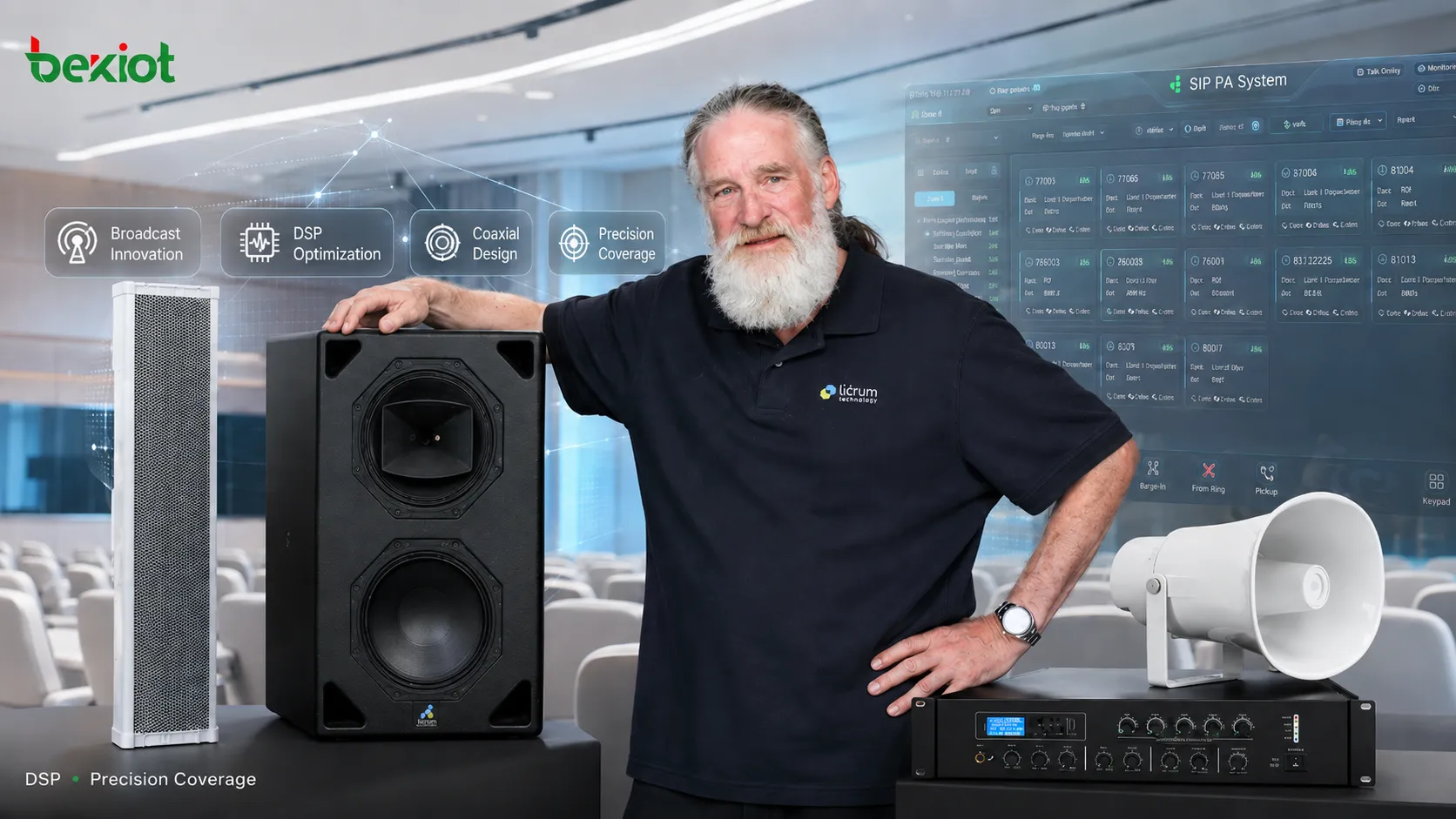
Professional broadcast and sound reinforcement systems are going through a quiet but significant shift in priorities. In the past, conversations often started with questions such as, “How far can this loudspeaker throw?” or “Is the maximum SPL high enough?” Today, engineers are increasingly focused on whether sound can be delivered precisely where it is needed, whether different loudspeaker models maintain consistent tonality, and whether unnecessary reflections can be reduced in acoustically challenging spaces. Looking back on his engineering career, American audio engineer David Gunness points to one major factor behind this change: digital signal processing, or DSP, is not only changing the loudspeaker itself, but also rewriting the design logic of complete broadcast and PA systems.
Gunness has an extensive background in professional audio. He spent 11 years at Electro-Voice, followed by 12 years at EAW, and co-founded Fulcrum Acoustic with Stephen Siegel in 2008. More important than the résumé itself, however, is the engineering philosophy he has consistently followed: loudspeaker design should not be separated from DSP, pattern control, and system-level integration. In today's public address, venue sound reinforcement, fixed-installation, and multi-zone broadcast projects, that philosophy is increasingly becoming an engineering necessity rather than an optional design preference.
From a DIY PA to System-Level Acoustics
Gunness entered the professional audio world in a very practical way. As a college musician playing regular gigs, he could not afford a proper PA system, so he bought plywood, cut it with a table saw in his basement, and built his first pair of loudspeakers using Radio Shack components. It was an impressive DIY effort, but the limitations quickly became obvious. A simple second-order passive crossover could not solve every acoustic problem he was hearing.
The recurring question of “Why doesn't this sound quite right?” soon pushed his interest beyond assembling cabinets and wiring components toward deeper acoustic and system engineering. He began studying AES publications extensively and used university audio technology courses to turn scattered technical knowledge into a more structured understanding of sound.
That experience still carries a useful lesson for modern broadcast system design. Many projects are still initially reduced to a hardware list of microphones, amplifiers, and loudspeakers, while acceptance testing may focus heavily on whether a required sound-pressure level has been achieved. In real operation, however, effective information delivery depends on coverage angle, frequency response, room reflections, tonal differences between loudspeakers, and unwanted acoustic energy moving between zones.
This becomes especially important in large buildings, venues, transportation hubs, and multi-zone public address systems. Simply increasing amplifier power does not automatically improve intelligibility. If directivity is poorly controlled, raising the level can send even more acoustic energy toward walls, glazing, and ceilings. Once those reflections build up, the result may be louder but considerably less intelligible.
Broadcast system design is therefore moving from simple equipment selection toward more deliberate sound-field design. The loudspeaker is no longer an isolated playback device; it is one part of a wider acoustic control chain within the space.
DSP Makes the Loudspeaker Part of a System
From Gunness' perspective, the rapid growth of digital signal processing has been one of the most significant changes in professional audio since he entered the industry in 1984. Processing technologies he helped develop while at EAW later became known as Gunness Focusing, while Fulcrum Acoustic further developed the concept through Temporal Equalization, or TQ.
One particularly important point is that Fulcrum Acoustic was never built around the idea of producing loudspeakers that were simply connected directly to an amplifier and expected to operate as completely independent products. From the beginning, its loudspeaker design philosophy assumed that DSP would be part of the signal chain, allowing the system to correct and optimize time-domain, frequency-domain, and overall response characteristics.
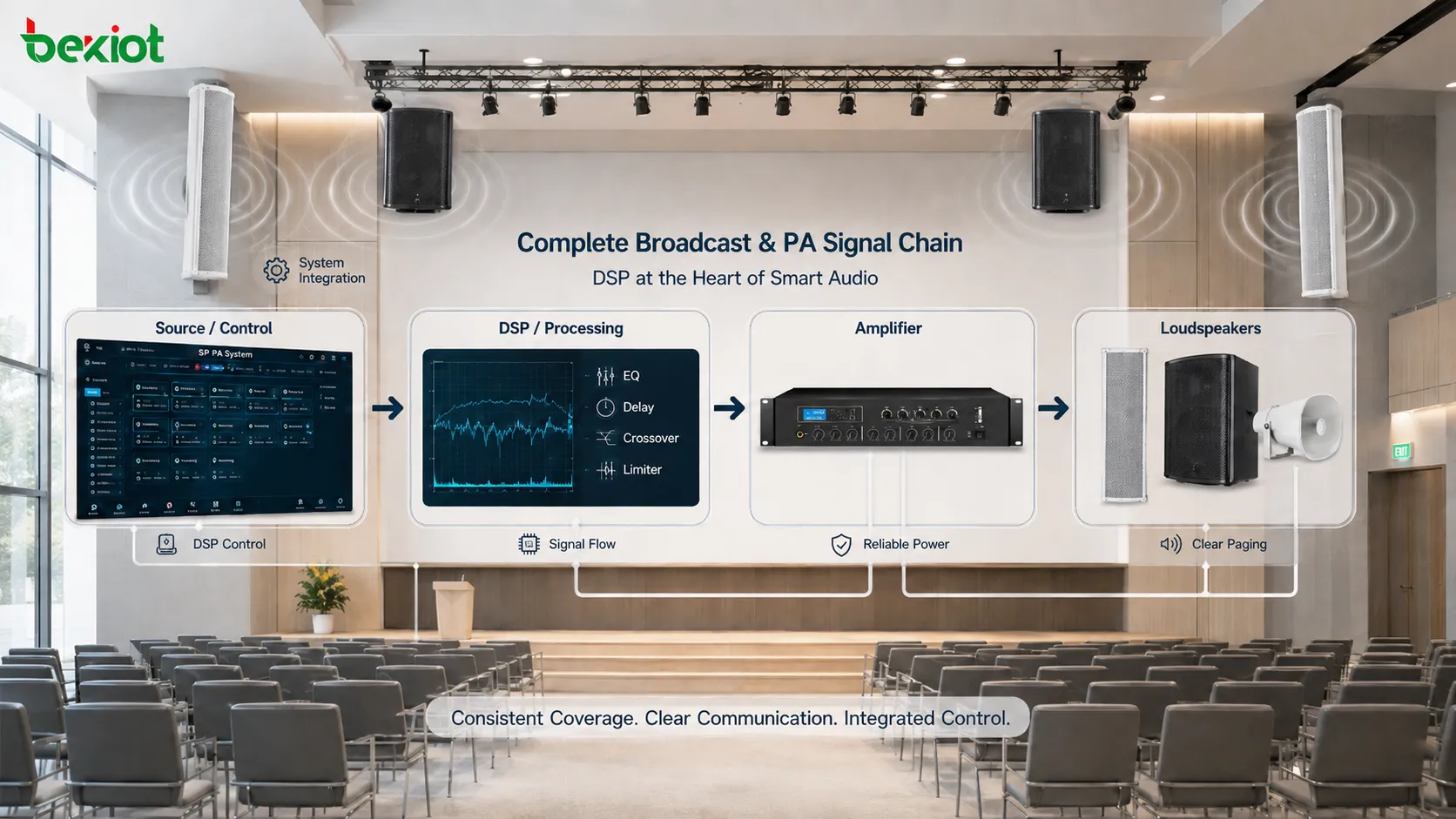
For today's broadcast systems, this DSP-first approach means the relationship between loudspeakers and processors is much tighter than before. A traditional workflow might select the loudspeaker first and leave equalization and correction until the final commissioning stage. A more mature design considers native loudspeaker response, crossover points, delay, equalization, limiting, and zone coverage together from the beginning of the project.
DSP is also about much more than making a system sound subjectively better. In long-distance paging, distributed loudspeaker systems, and synchronized multi-zone broadcasting, delay alignment is critical. If front and rear loudspeakers reach the listener at noticeably different times, the result can be audible doubling, smearing, or the impression that the sound is arriving from multiple directions. Proper digital delay allows delayed loudspeakers to align more closely with the primary source and maintain a more natural acoustic image.
In emergency paging and spoken announcements, this directly affects speech intelligibility. The value of a broadcast message is not simply that the system played it; the real question is whether people in the space actually understood the instruction.
Pattern Control Is Rewriting Coverage Rules
Beyond DSP, another area Gunness has pursued for decades is coaxial loudspeaker design and directivity control. Fulcrum Acoustic has developed a broad range of coaxial products with different coverage patterns while placing particular emphasis on maintaining a consistent sonic character across different sizes.
Gunness has described this consistency in very practical terms: a large 30-inch coaxial horn and a small 5-inch fill loudspeaker can maintain a highly similar tonal character. That kind of consistency matters enormously in large systems because a real installation rarely relies on only one loudspeaker type.
A main coverage area may use high-output loudspeakers, corridors may use compact wall-mounted units, near-field areas may rely on smaller fills, and side zones or difficult spaces may require completely different coverage angles. If those loudspeakers have significantly different tonal characteristics, the system can sound noticeably different as a listener moves through the space, forcing the commissioning engineer to compensate repeatedly with EQ.
When loudspeakers of different sizes and coverage patterns share a similar tonal foundation, the system becomes much easier to integrate. For public address applications, that means a more continuous listening experience between mains, delays, and near-field fills, and a better chance of maintaining consistent speech clarity throughout the facility.
Passive Cardioid Design Controls Unwanted Low Frequencies
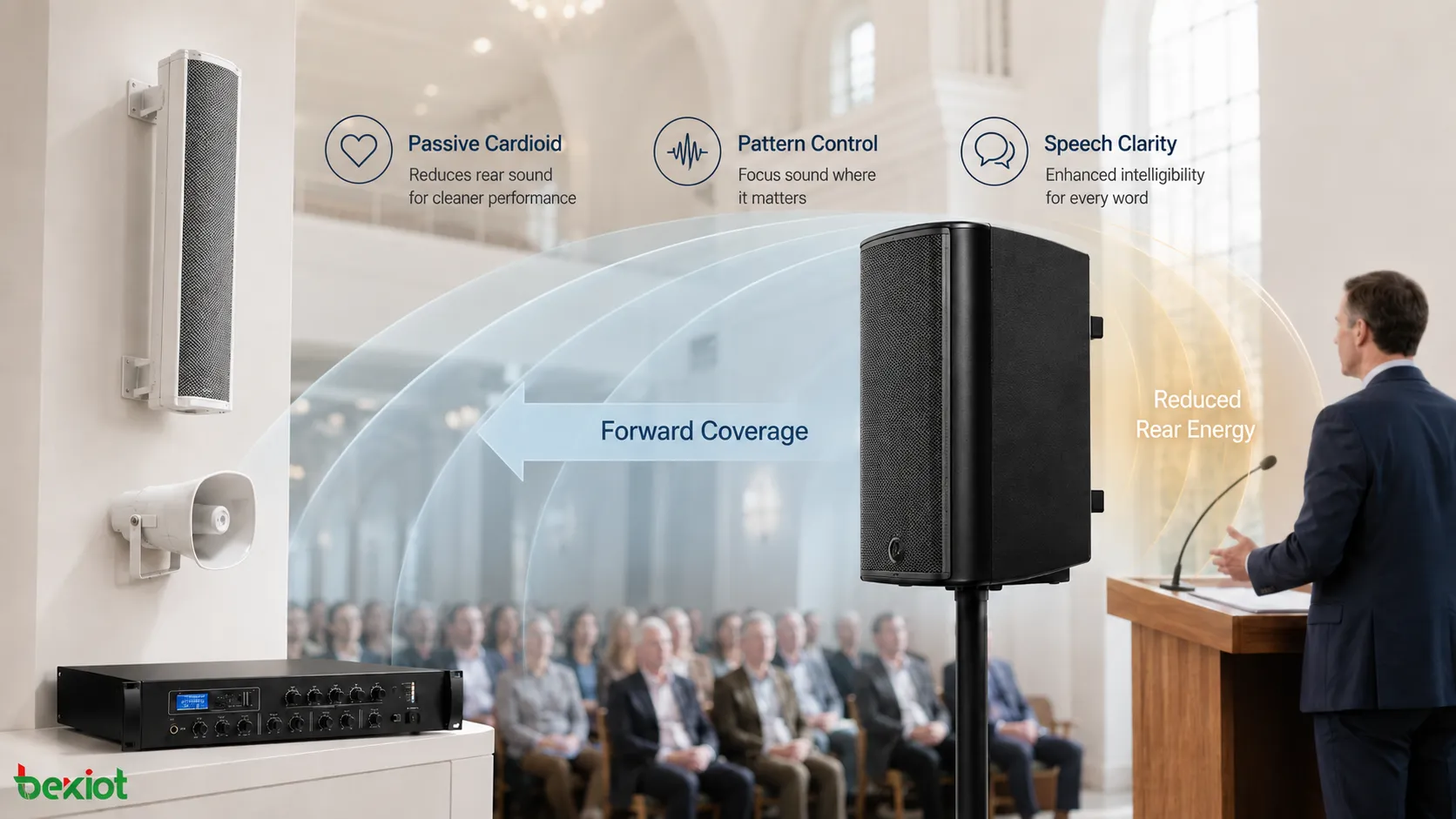
Gunness has also highlighted passive cardioid loudspeaker technology. Fulcrum Acoustic now offers passive cardioid subwoofers, mains, and fill loudspeakers, and approximately 40% of its loudspeaker range follows this design direction.
The engineering value lies in controlling low-frequency energy that would otherwise radiate toward the rear of the loudspeaker. Gunness has used a church application as an example: placing a CCX passive cardioid loudspeaker halfway down the room can reduce low-frequency energy traveling back toward the front rows, keeping more of the acoustic energy focused on the intended listening zone.
This is highly relevant to broadcast system design. Many coverage problems are not caused by insufficient level in the target area, but by excessive sound in areas that should receive less energy. In reverberant halls, houses of worship, transportation waiting areas, multipurpose rooms, and open architectural spaces, uncontrolled rearward low-frequency energy can continuously excite room reflections and make announcements sound muddy or indistinct.
For that reason, loudspeaker selection is increasingly about more than power rating, sensitivity, and maximum SPL. Directivity and pattern control are becoming much more important. An efficient system is not one that simply injects more sound energy into the room; it is one that delivers the right energy to the people who actually need to hear it.
Broadcast System Selection Logic Is Changing
When Gunness' comments on DSP, coaxial loudspeakers, and directivity are viewed through the lens of today's broadcast system engineering, one trend becomes clear: professional audio is moving away from competing primarily on individual hardware specifications and toward competing on system control.
First, tonal consistency between loudspeakers is becoming increasingly important. Large projects commonly require terminals with different power levels, cabinet sizes, and installation methods. If products within the same system have very different acoustic signatures, commissioning becomes more difficult and long-term system behavior becomes less predictable.
Second, DSP should not be treated as a last-minute rescue tool. The design stage should already identify which zones need delay, which loudspeakers require independent equalization, which channels need limiting, and how timing should be coordinated between different broadcast areas.
Third, coverage design should shift from asking “Is the SPL high enough?” to asking “Where is the acoustic energy going?” A wider coverage angle is not automatically better. The more complex the space, the more carefully horizontal and vertical directivity should be matched to the actual audience area, while unnecessary energy hitting walls, glass, ceilings, and non-target zones should be minimized.
Fourth, consistency across a product family directly affects long-term maintenance. Broadcast systems often remain in service for many years, and some loudspeakers will eventually need to be replaced or added. When products within the same family maintain stable tonal characteristics, system expansion becomes easier without requiring major retuning every time hardware changes.
Gunness' views on running an audio company are also relevant to the systems-integration market. In his view, customers need more than a great-sounding product. They also need reasonable lead times, on-time delivery, and dependable support before and after the sale. That is especially true in broadcast engineering, where product specifications represent only one part of the project. System design, commissioning, field support, and long-term maintenance ultimately determine whether the customer can rely on the installation.
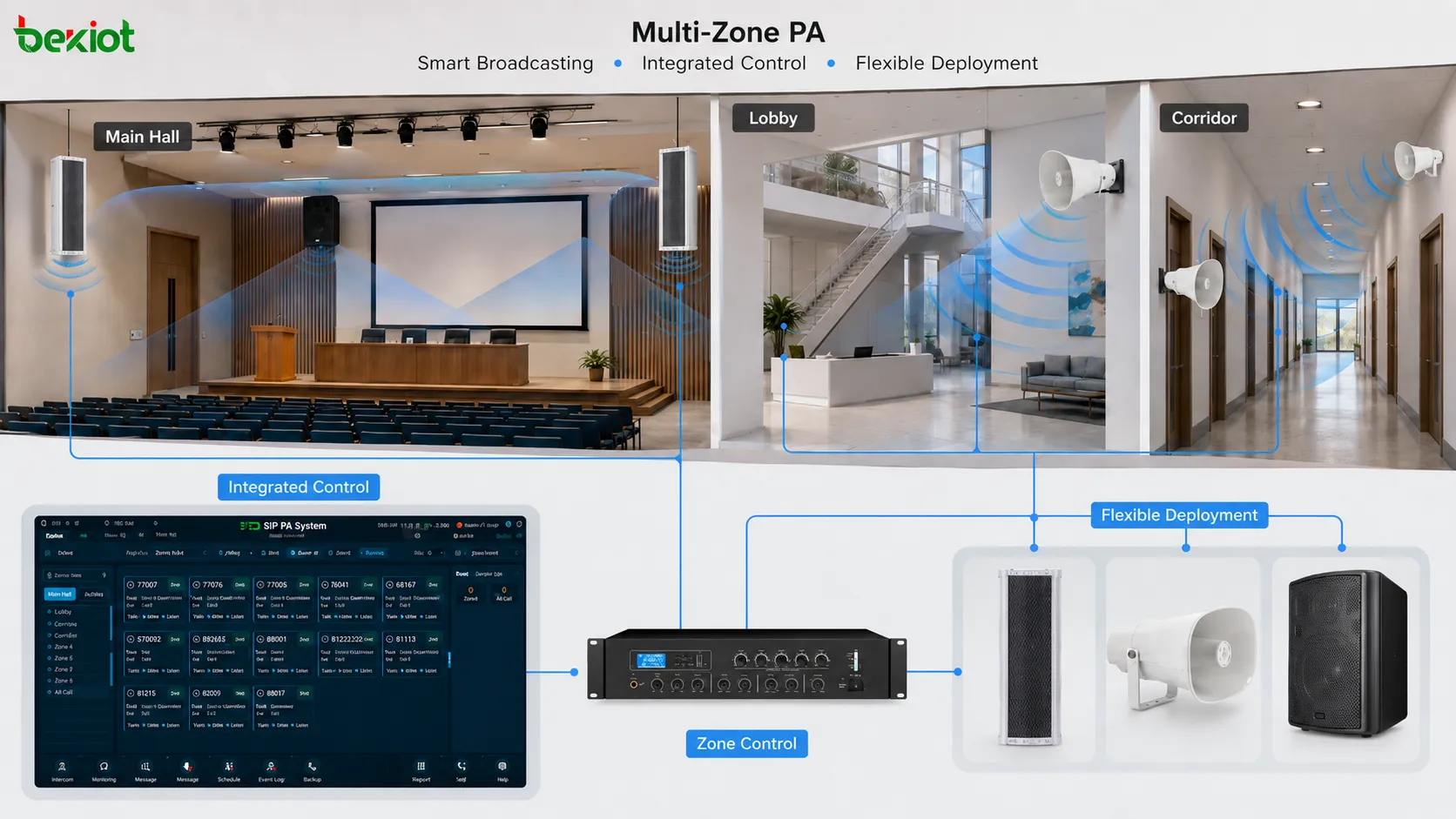
This also reflects a broader reality: modern broadcast systems are increasingly difficult to solve with one or two standout products. Loudspeakers, amplifiers, DSP, control platforms, loudspeaker placement, and room acoustics must work as an integrated structure. A mature solution allows different components to serve the same coverage objectives instead of forcing engineers to spend commissioning time correcting incompatible behavior between devices.
From building his first homemade PA to spending decades refining coaxial horns, digital processing, and passive cardioid technology, Gunness' career reflects one of the defining trends in professional audio: sound systems increasingly depend on precision control rather than simply greater power.
For today's public address, professional sound reinforcement, and fixed-installation audio projects, that shift has direct engineering consequences. Whether a loudspeaker can technically reach an area is one question. Whether it can provide stable, intelligible, tonally consistent coverage throughout that area is a much more demanding one. Increasingly, the second question is becoming the more meaningful measure of broadcast system quality.
Frequently Asked Questions
Is on-site acoustic measurement still necessary when DSP is used?
Absolutely. DSP provides tools such as equalization, delay, and filtering, but the correct settings still depend on the actual acoustic environment. Measurement microphones, frequency-response testing, and critical listening help engineers evaluate timing relationships, coverage differences, and unwanted room reflections.
Are coaxial loudspeakers always better than conventional two-way designs for broadcast systems?
No. Coaxial designs can offer advantages in source coherence and compact installation, but the final choice still depends on coverage requirements, mounting position, required SPL, and the acoustic conditions of the space.
Do passive cardioid loudspeakers require additional multi-channel DSP control?
It depends on the product design. One of the key characteristics of a passive cardioid system is that part of the directional control is achieved through the loudspeaker's acoustic and enclosure design. This differs from active cardioid arrangements that rely on independently driven transducers and more complex external DSP processing.
Can adding DSP immediately transform an older broadcast system?
It can improve performance, but the extent of the improvement depends on the existing loudspeakers, amplifiers, placement, and room conditions. If the main problems come from poor loudspeaker positioning, unsuitable coverage angles, or severe acoustic deficiencies, DSP alone cannot solve everything.