


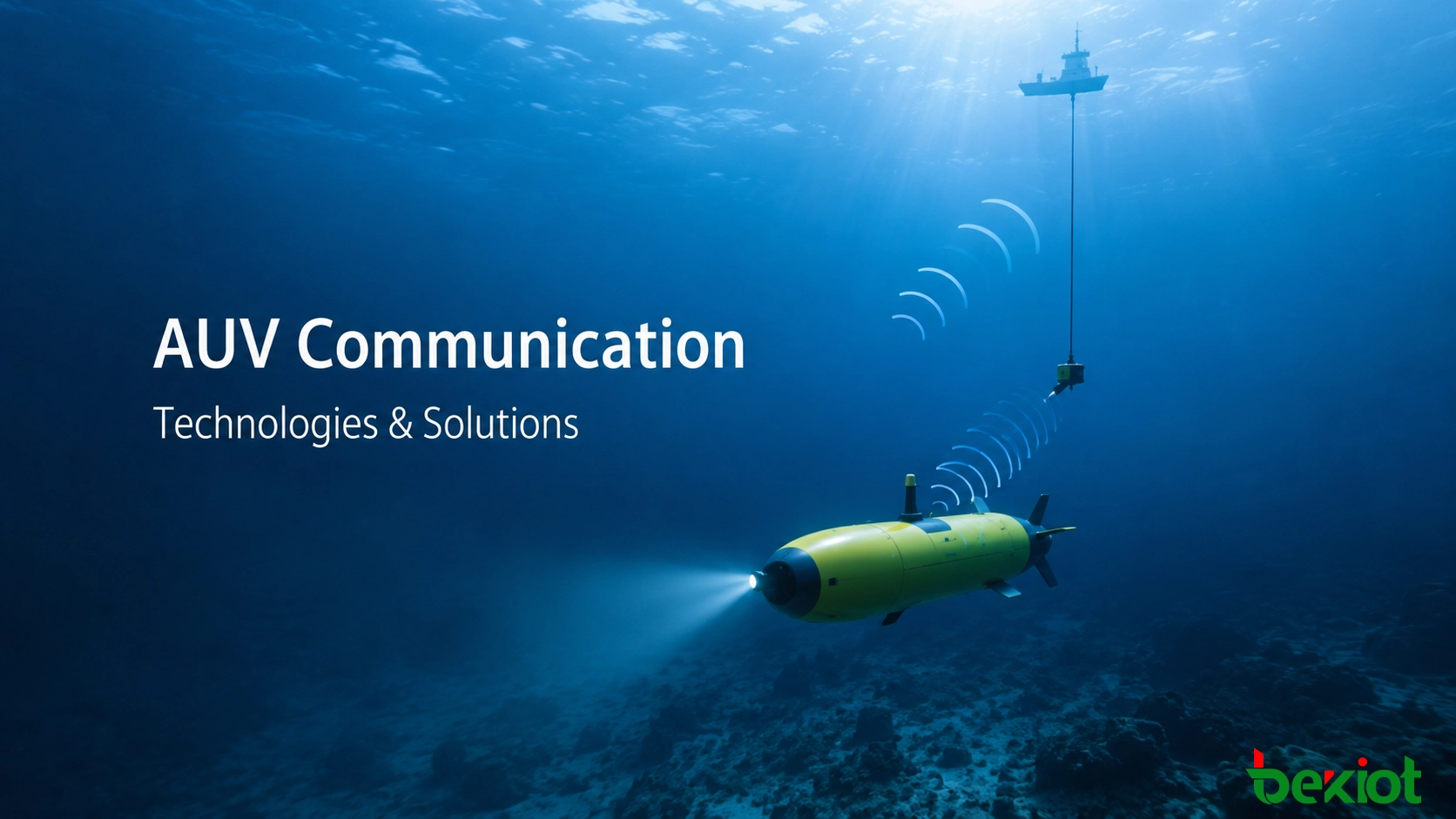
Autonomous Underwater Vehicles (AUVs) can navigate, inspect, survey and collect data without a continuous physical connection to an operator, but communication remains one of the most difficult parts of an underwater mission. An AUV may be capable of travelling through a large underwater area, yet sending commands to the vehicle or returning sensor data, images and video to a control station is far more difficult underwater than in the air.
There is no single communication technology that delivers long range, high bandwidth, low latency and strong environmental adaptability at the same time. Practical AUV communication systems therefore need to select or combine different transmission methods according to mission range, water conditions, required data rate and operating architecture.
Why Is Underwater Data Transmission So Difficult?
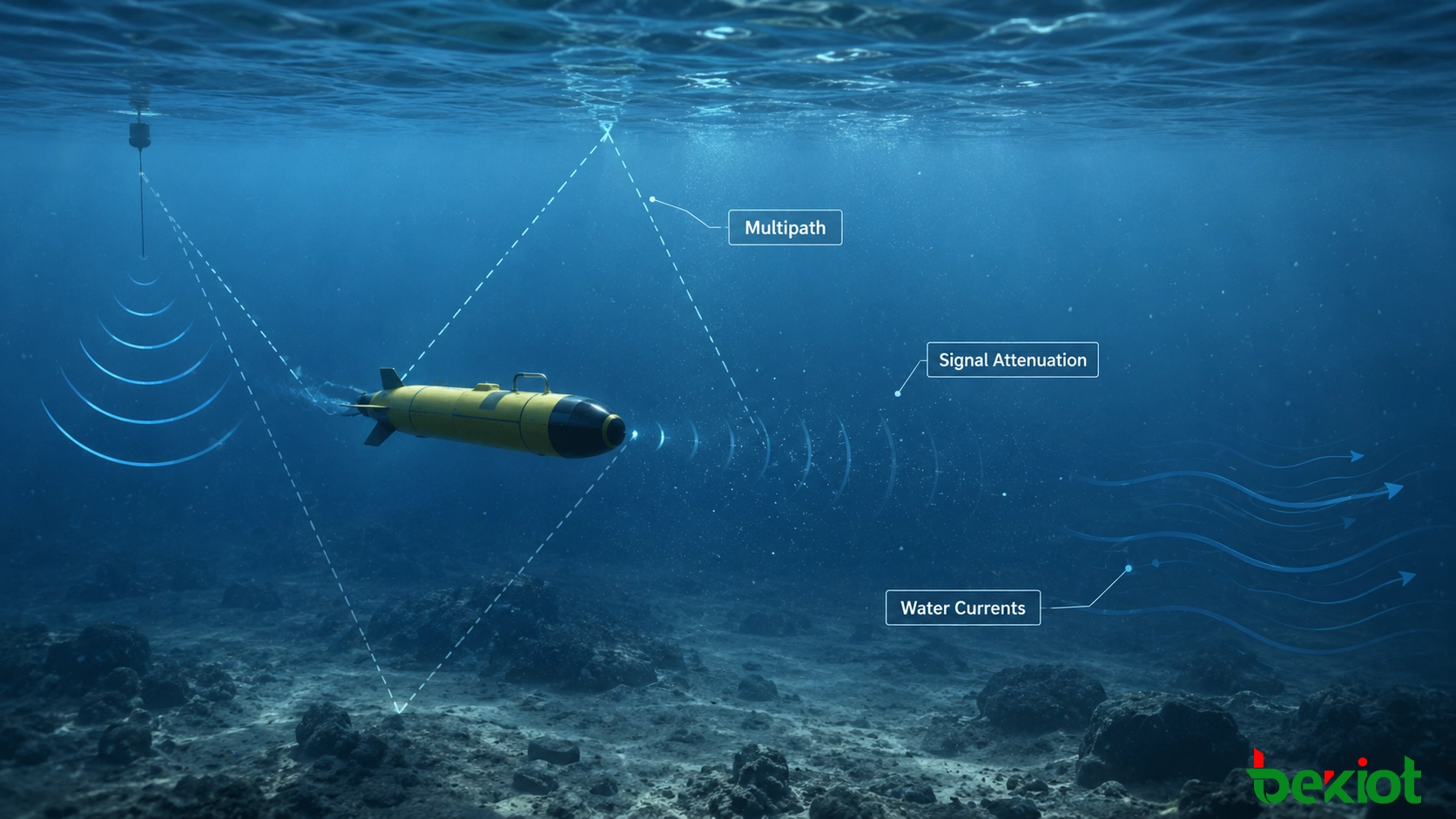
Radio communication works extremely well for aircraft, unmanned aerial vehicles and terrestrial mobile systems because electromagnetic waves can propagate efficiently through the atmosphere. Underwater conditions are fundamentally different. Water absorbs and scatters electromagnetic energy, making conventional long-range radio transmission difficult, especially in seawater.
Signal performance is also affected by changes in salinity, water temperature and suspended particles. These variables can alter propagation characteristics and increase attenuation, reducing the usable communication distance.
The problem is not limited to simple signal loss. Underwater signals may be reflected, refracted and scattered by the water surface, seabed and other structures. Multiple versions of the same signal can therefore reach the receiver through different propagation paths.
This multipath environment may introduce distortion, interference and Doppler effects. Tides, waves, currents and vehicle movement can further change channel conditions while an AUV is operating. As a result, a communication link that performs well under one set of underwater conditions may behave differently when water depth, vehicle position or environmental conditions change.
When Does a Wired Link Make Sense?
Cable-based communication is one of the most mature ways to create a reliable underwater data link. A vehicle or underwater node can be connected to a surface platform or control station through an electrical or optical cable. Fine optical fiber is particularly useful where large amounts of data must be transmitted with consistent performance.
A wired optical connection offers several important advantages. It can provide high transmission bandwidth, stable signal quality and strong resistance to external electromagnetic interference. Because the communication channel is physically constrained, it can also provide a comparatively controlled data path.
For applications involving high-resolution cameras, sonar data, sensor information or other bandwidth-intensive payloads, a fiber connection can provide substantially greater data capacity than a long-range underwater acoustic channel.
The main limitation is mobility. Underwater cables must withstand pulling forces, bending, corrosion and long-term ageing. Cable length also limits the operating area of the vehicle. A tether can create additional deployment and recovery requirements and may become difficult to manage when the vehicle operates over a large area or around complex underwater structures.
For this reason, wired communication is often more suitable for controlled operating zones, fixed underwater infrastructure, inspection around a support vessel or applications where high bandwidth is more important than unrestricted vehicle movement.
Where Can Blue-Light Optical Links Be Used?
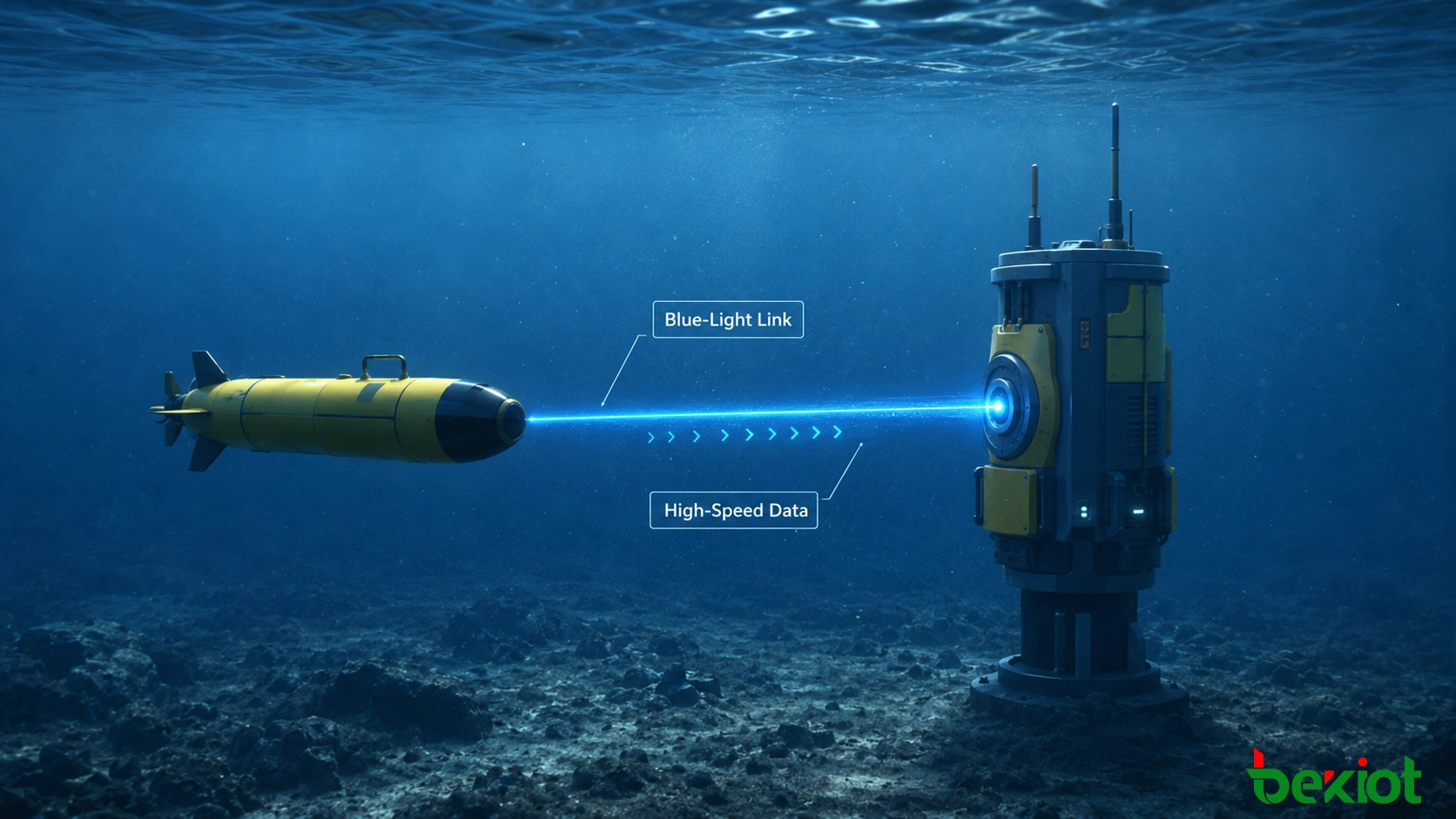
Underwater optical communication provides another approach when a mission requires much higher data rates over relatively short distances. Blue light is particularly important because wavelengths around 450 nm can provide useful transmission characteristics in water compared with many other optical wavelengths.
The primary advantage is bandwidth. Compared with conventional acoustic communication, an underwater blue-light link can support much higher transmission rates, making it attractive for rapid transfer of images, sensor datasets and other large files.
Development targets in this field have demonstrated the potential for underwater optical systems to approach 1 Gbit/s data rates over distances on the order of 100 meters under suitable conditions. These figures illustrate why optical communication is receiving attention for high-speed underwater networking, although actual performance depends heavily on water quality, alignment and system design.
Optical communication also introduces strict environmental requirements. The transmitter and receiver generally need a clear optical path and suitable alignment. Suspended particles and plankton can scatter the transmitted light and reduce received signal strength.
Ambient light from the water surface and light generated by underwater organisms can also influence the optical receiver. Turbid water, vehicle movement and changing orientation make long-distance optical communication considerably more difficult.
As a result, blue-light communication is best considered a high-bandwidth, relatively short-range technology rather than a direct replacement for long-range acoustic communication.
Why Does Acoustic Communication Remain Essential?
Acoustic communication remains one of the most mature methods for wireless underwater communication. Unlike conventional radio signals, sound waves can travel relatively long distances through water with manageable attenuation, which makes acoustic links suitable for communication between mobile underwater platforms, remote underwater nodes and surface support systems.
Depending on operating frequency, environmental conditions, equipment design and required data rate, acoustic communication can cover distances ranging from hundreds of meters to tens of kilometers. This range advantage explains why acoustic technology remains important for AUV operations that cannot depend on a cable or maintain a short optical path.
The trade-off is bandwidth and latency. Acoustic attenuation generally increases significantly as frequency rises. The relationship between usable range and frequency therefore becomes a fundamental design consideration. At very high acoustic frequencies, attenuation can become severe; for example, the referenced technical comparison indicates that an acoustic signal around 10 MHz may experience attenuation approaching 30 dB per meter.
Long-range acoustic systems consequently tend to operate at lower frequencies, but lower frequency normally means less available communication bandwidth.
Sound also travels through water far more slowly than electromagnetic or optical signals. Long-distance acoustic communication therefore introduces noticeable propagation delay. In addition, ocean background noise can lower the signal-to-noise ratio, while multipath propagation may cause frequency-selective fading and inter-symbol interference.
These characteristics mean that an acoustic channel is generally better suited to commands, status information, positioning-related data, telemetry and selected sensor data than to continuously transmitting large volumes of real-time high-resolution video.
How Should the Technologies Be Combined?
A practical underwater communication solution does not necessarily need to choose only one of these technologies. In many AUV projects, a hybrid architecture can provide a better balance between operating range, bandwidth and reliability.
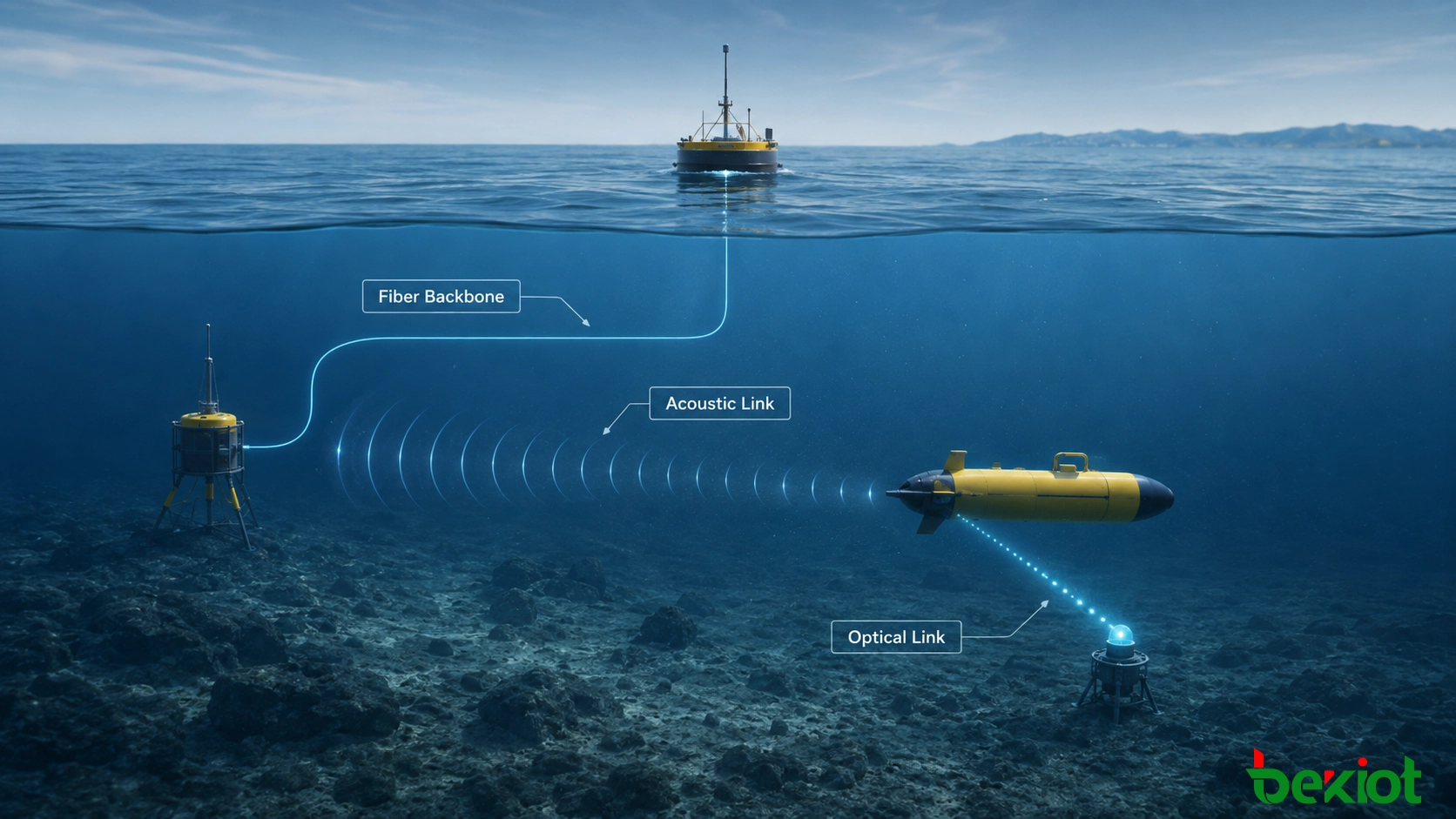
One possible architecture uses an optical fiber connection between the surface control platform and an underwater communication station. The underwater station then communicates wirelessly with the AUV through an acoustic or optical link. This reduces the length of the wireless underwater path while allowing the vehicle to operate without a continuous tether.
Another configuration can use acoustic communication during long-range navigation and switch to an optical link when the vehicle approaches a docking station or data collection point. Large sensor files can then be transferred through the higher-bandwidth optical channel.
The communication method should therefore be selected according to the role of each link rather than by comparing only maximum transmission speed.
| Communication Method | Typical Strength | Main Limitation | Suitable Role |
|---|---|---|---|
| Wired / Optical Fiber | High bandwidth and stable transmission | Vehicle movement restricted by cable | High-data-rate operation in controlled areas |
| Blue-Light Optical | Very high short-range data rate | Requires suitable water clarity and alignment | Fast data transfer near an underwater station |
| Acoustic | Long underwater transmission range | Limited bandwidth and higher latency | Long-range command, control and telemetry |
| Hybrid Architecture | Balances range and bandwidth | More complex system integration | Multi-stage AUV missions and underwater networks |
What Should Be Considered During System Design?
An AUV communication system should begin with the mission profile instead of simply selecting the technology with the highest advertised data rate. Range, data volume and environmental conditions often have a greater impact on actual performance.
For long-distance missions, maintaining a stable command and telemetry channel may be more important than transmitting large files continuously. An acoustic link can therefore provide the primary wireless communication path while data-intensive information is stored locally on the vehicle.
For inspection, mapping or scientific missions that generate large image and sensor datasets, the vehicle can collect information during the mission and transfer it later through a short-range optical or wired connection.
Water conditions should also be evaluated before deployment. Salinity, temperature, suspended material, background noise and vehicle motion can all influence link performance. A communication architecture developed for clear, calm water may not achieve the same results in coastal water, industrial harbors or areas with strong currents.
The following design questions are particularly useful during planning:
How far will the AUV travel from the nearest communication node?
Does the mission require continuous control or mainly periodic status updates?
How much sensor, image or video data will the vehicle generate?
Is real-time transmission required, or can large files be stored onboard?
What level of water clarity and background acoustic noise is expected?
Can underwater relay stations or docking points be deployed?
Does the operating area allow the use of a tether or fiber connection?
Answering these questions helps determine whether a project should prioritize range, data rate, mobility or a combination of all three.
A Layered Architecture Offers Greater Flexibility
The fundamental challenge of underwater communication is that range and bandwidth are difficult to maximize simultaneously. Wired fiber provides excellent data capacity but restricts mobility. Blue-light optical communication offers high-speed wireless transmission but works best over relatively short distances and under suitable optical conditions. Acoustic communication reaches much farther but provides lower bandwidth and greater latency.
For many AUV applications, the most practical approach is therefore a layered communication system. A long-range acoustic channel can support commands and telemetry, an optical connection can handle high-volume data transfer at close range, and fiber can connect fixed underwater infrastructure to a surface or shore-based control network.
This architecture allows each technology to perform the task for which it is best suited instead of forcing one underwater link to meet every requirement. As underwater sensing, autonomous navigation and subsea infrastructure continue to develop, this type of hybrid communication design will become increasingly important for building reliable and scalable AUV operating networks.
FAQ
Can an AUV continue working when the communication link is temporarily unavailable?
Yes. An autonomous vehicle can be designed to continue a predefined mission when communication is temporarily interrupted. Important mission data can remain onboard until the vehicle restores a connection or reaches a data-transfer point.
Should an AUV continuously transmit all of its sensor data?
Not necessarily. Continuous transmission can place unnecessary demands on a limited underwater channel. A common system strategy is to transmit essential status and control information first while storing larger datasets locally for later transfer.
Why are underwater relay stations useful?
Relay stations can shorten the distance between communication nodes. Instead of forcing an AUV to maintain one long direct connection with a surface station, a network can divide communication into several shorter links and connect them to a higher-capacity backbone.
Does a higher communication frequency always provide better AUV performance?
No. Higher frequencies may provide additional bandwidth, but underwater attenuation can increase significantly with frequency. The correct operating frequency must therefore balance required data capacity with transmission distance and environmental conditions.
What should be tested before deploying an underwater communication network?
Field testing should reflect the actual mission environment, including operating depth, vehicle movement, water clarity, acoustic noise, expected communication distance and seasonal changes in water conditions. Laboratory specifications alone cannot fully represent a changing underwater channel.







