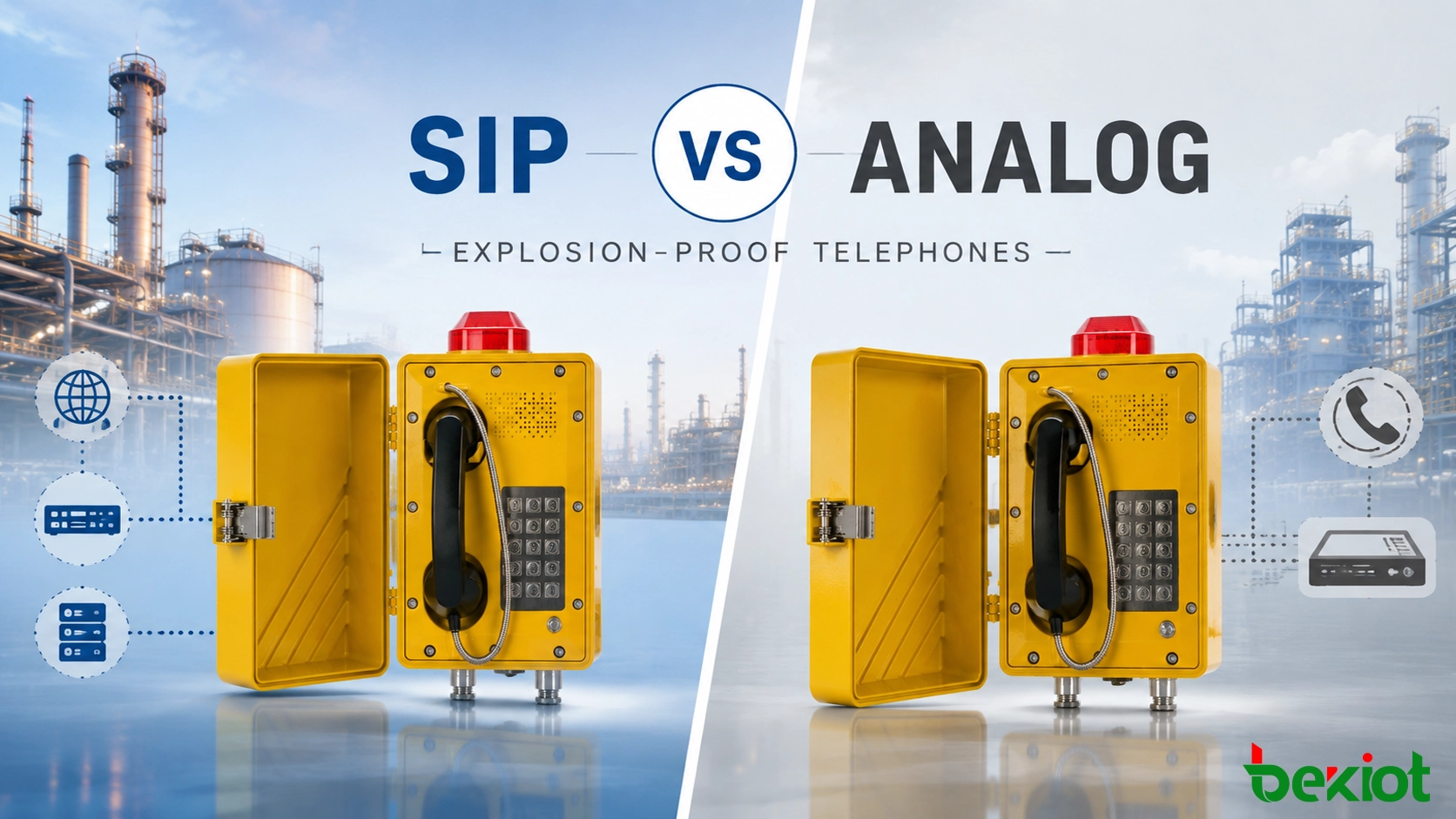
Explosion-proof telephones used in petrochemical plants, refineries, oil and gas facilities, mines, tank farms, power and energy sites, and other hazardous industrial environments are commonly available with either analog or SIP interfaces. From the outside, the two versions may use the same enclosure, handset, keypad, cable glands, and mounting structure, but they connect to the communication system in very different ways.
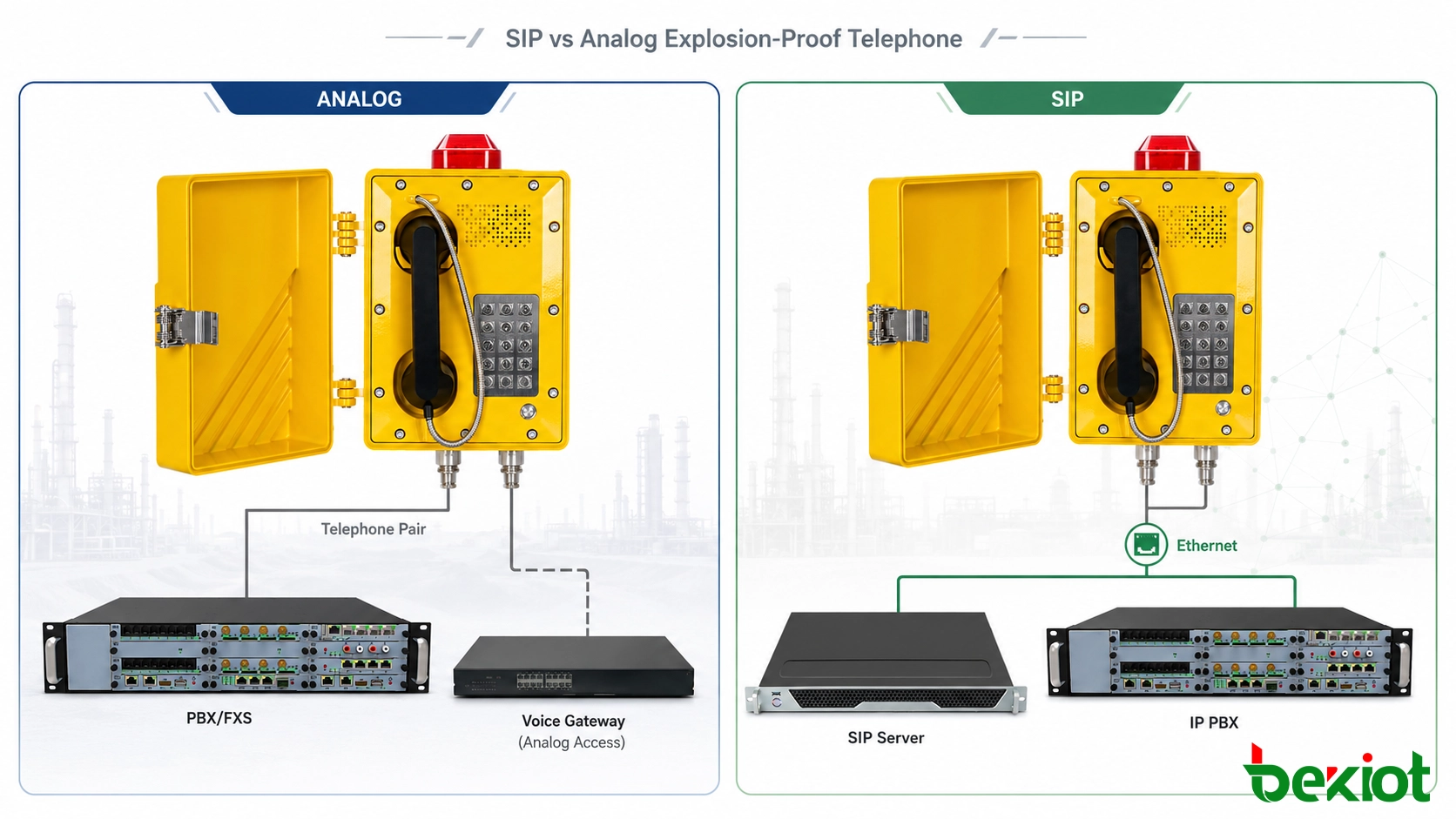
An analog explosion-proof telephone works as a conventional subscriber terminal connected to a PBX, PABX, or FXS interface through a telephone pair. Most call control is handled by the switching equipment. A SIP explosion-proof telephone works as an IP endpoint: it connects to Ethernet, has its own network parameters, and registers with an IP PBX or SIP server.
The difference affects more than the cable entering the telephone. It changes how field points are powered, how extensions are assigned, how the network is planned, how new endpoints are added, and how multiple production areas or remote sites are managed.
For industrial projects, SIP should not simply be treated as the replacement for analog. Existing cabling, plant network coverage, available power, project scale, future expansion, and the cost of modifying operating areas all influence which interface is more appropriate.
1. Key Architectural Differences
The two architectures differ mainly in how communication control is divided between the field telephone and the central system.
An analog telephone is relatively simple at the endpoint. Extension numbering, ringing, call routing, and most telephone services are handled by the PBX or FXS equipment. The field telephone is closely associated with the physical cable pair and the subscriber port serving that line.
A SIP telephone carries more configuration at the endpoint. It has a network identity, SIP account, server information, codec settings, and other parameters required to operate on the IP network. Instead of using a dedicated analog voice circuit back to the PBX, voice and signaling share the plant's IP infrastructure.
| Item | Analog Explosion-Proof Telephone | SIP Explosion-Proof Telephone |
|---|---|---|
| Voice transport | Analog electrical voice signal | Packet-based voice over IP |
| Call control | Mainly handled by PBX or FXS equipment | SIP signaling between endpoint and server |
| Field connection | Telephone pair | Ethernet |
| System interface | PBX, PABX, or FXS port | IP PBX or SIP server |
| Endpoint identity | Extension associated with a line or subscriber port | SIP account and IP network identity |
| Endpoint configuration | Usually limited | IP, SIP, codec, DTMF, VLAN, and related parameters |
| Expansion | Depends on available cable pairs and FXS capacity | Depends on network access and SIP platform capacity |
| Management | Mainly concentrated at the PBX | Supports more endpoint-level and network-based management |
SIP and analog describe the communication interface, not the explosion-protection capability of the telephone. A SIP model is not inherently more suitable for a hazardous area than an analog model. Explosion-protection type, equipment group, temperature class, environmental protection, certification, and installation requirements still need to match the conditions specified for the field location.
2. Call Control and Voice Handling
To the operator, both versions may provide the same basic experience: lift the handset, dial an extension, speak with the control room, and hang up. The communication process behind that handset is quite different.
Analog Call Control
An analog telephone normally connects to an FXS subscriber interface provided by a PBX, telephone exchange, or analog gateway. The FXS side supplies the telephone interface and detects changes in the line when the handset goes off-hook or returns on-hook.
Dialed digits are sent over the same telephone pair and interpreted by the switching equipment. The PBX determines the destination, generates the required ringing, applies the configured call permissions, and establishes the voice connection.
Most of this logic stays in the equipment room rather than in the field terminal. The telephone itself normally does not need an IP address, user account, SIP password, or codec configuration.
The physical subscriber loop is therefore an important part of the analog design. Cable conductor size, loop resistance, connection quality, distance, the characteristics of the FXS port, and the requirements of the selected telephone all need to be considered when designing long industrial telephone circuits.
SIP Call Control
A SIP explosion-proof telephone is both a telephone and an IP network endpoint. Once connected and powered, it normally registers an extension or SIP account with an IP PBX or SIP server.
SIP handles session signaling. Registration tells the platform where the endpoint is available, while call establishment uses SIP messages such as INVITE and the corresponding responses. Once the call is established, voice media is normally carried separately through RTP.
This separation gives SIP systems more flexibility, but it also means the telephone and platform need compatible settings. Depending on the project, engineers may need to confirm the SIP server, extension account, authentication method, codec list, DTMF method, registration behavior, and transport settings.
Codec and DTMF Considerations
Voice codec selection matters when SIP equipment from different manufacturers shares the same system. G.711 is widely used on industrial LANs because of its broad compatibility and straightforward voice handling, while other codecs may be selected where bandwidth or project requirements make them useful.
The final codec should be supported at both ends of the call. The fact that two devices both support SIP does not automatically mean that every voice configuration will be interoperable.
DTMF is another small but important detail. Hotline applications, IVR systems, access control, or other services may depend on keypad tones. Depending on the equipment, DTMF may be handled through RFC 4733, SIP INFO, or other supported methods. These parameters are normally confirmed during system integration rather than treated as part of the hazardous-area rating.
Related Products: EX-BH621 Explosion-Proof SIP Telephone
3. Cabling, Distance and Power
In large industrial sites, field infrastructure can have a greater impact on project cost than the price difference between analog and SIP telephone models. Telephone points may be distributed across process units, pump rooms, substations, workshops, tank areas, tunnels, and remote operating buildings.
Analog Field Cabling
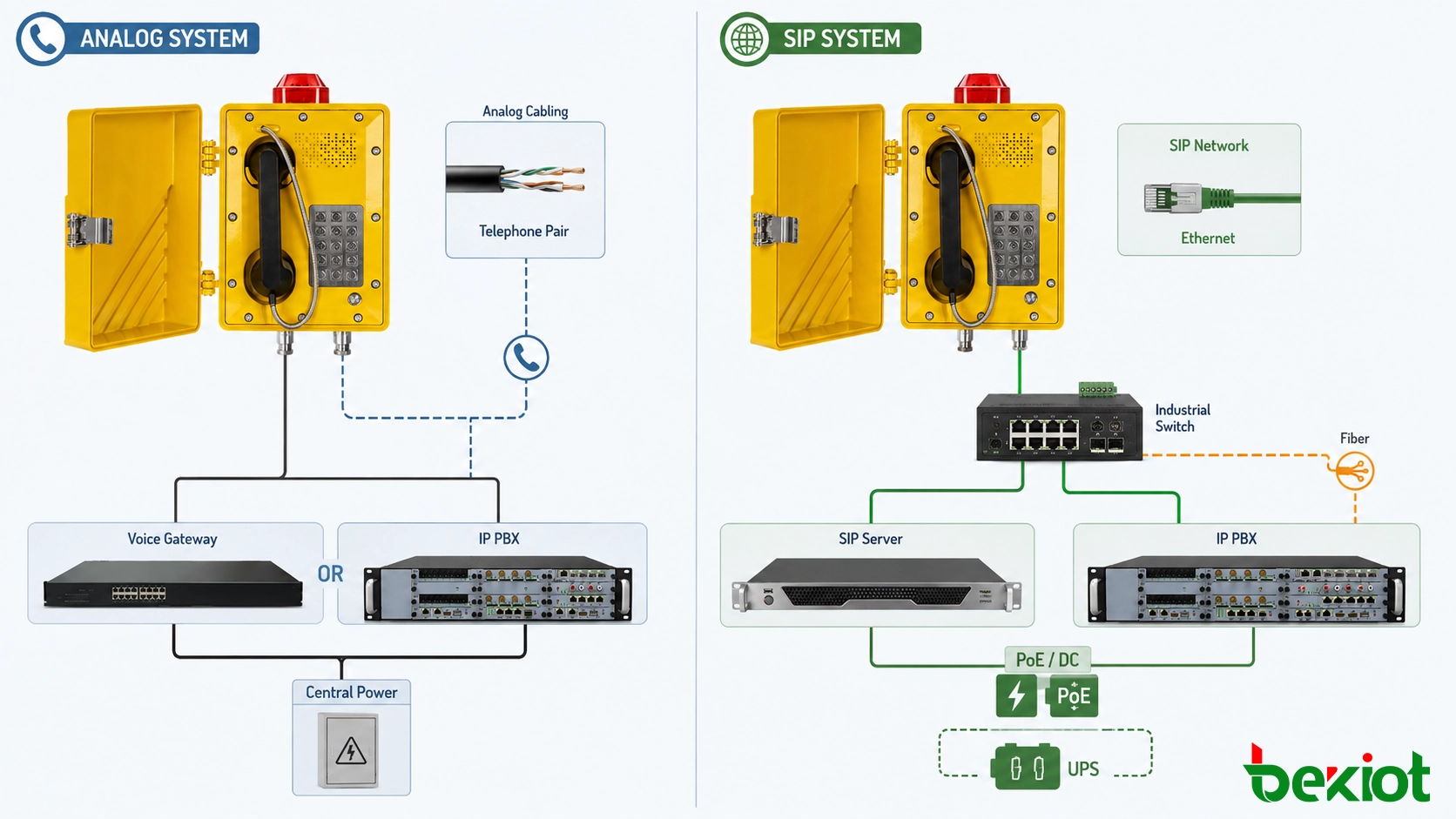
Analog telephones normally use copper telephone pairs. Many established industrial plants already have telephone distribution frames, multicore cables, junction boxes, underground routes, and spare pairs extending through production areas.
Where those cable routes remain suitable, they can continue to serve fixed telephone points without requiring a separate Ethernet connection at each location. This is one reason analog telephones remain relevant in brownfield industrial projects.
Long analog runs still require engineering checks. Maximum usable distance is not a single universal value; it depends on conductor size, total loop resistance, the FXS interface, telephone electrical characteristics, intermediate connections, and the requirements defined by the equipment manufacturer.
SIP Network Infrastructure
SIP terminals use Ethernet, so large plants normally need a different field topology. Copper Ethernet serves local connections, while fiber is often used for backbone links between buildings, process areas, or remote communication cabinets.
Industrial switches may be installed closer to groups of communication endpoints, allowing SIP telephones to share the site's wider network infrastructure rather than requiring individual telephone pairs back to a central PBX room.
This makes switch placement, fiber routes, network cabinets, uplink redundancy, and backup power part of the telephone system design. A SIP telephone should therefore be considered together with the industrial network rather than specified as an isolated field device.
Power Architecture
Analog and SIP systems can also place power dependencies in different locations.
Depending on the telephone and PBX design, an analog subscriber interface may supply the required line conditions from centrally powered equipment. Where the PBX or FXS system is backed by UPS power, field telephone availability may be maintained without installing an individual network power source beside every endpoint.
SIP models may use PoE, DC, or another approved power arrangement depending on the product. When PoE is used, the Ethernet switch becomes part of the telephone's power path. Critical sites therefore need to consider backup power for switches, SIP servers, gateways, and other active network equipment.
The interface type alone does not determine system availability. What matters is whether all required components in the communication path have been designed with the appropriate level of power and network resilience.
4. Configuration and Network Design
Analog systems and SIP systems also create different commissioning and management workloads.
With a conventional analog system, engineers perform most configuration at the PBX. Extension numbers, call permissions, trunk access, dialing rules, and other telephone services are associated with subscriber ports and the physical distribution system.
The field terminal itself remains relatively simple. This can be convenient at installations where maintenance teams already work with telephone distribution frames, copper pairs, and conventional switching systems.
A SIP telephone requires both network and telephone configuration. Depending on the terminal and platform, common settings can include:
Static IP or DHCP;
Subnet mask and default gateway;
Primary and secondary SIP server addresses;
SIP extension and authentication credentials;
Codec priorities;
DTMF method;
VLAN settings;
NTP or time synchronization;
Dialing rules;
Hotline or automatic answering settings;
Provisioning parameters where supported.
Once a project grows from several field telephones to dozens or hundreds of endpoints, configuration consistency becomes important. Where supported by the selected devices and platform, centralized provisioning, configuration templates, endpoint inventories, and controlled firmware management can reduce repetitive commissioning work.
VLAN and QoS
Industrial Ethernet rarely carries telephone traffic alone. CCTV streams, engineering workstations, business applications, access control, wireless infrastructure, and other services may use parts of the same network.
A dedicated voice VLAN can make communication devices easier to manage and separate them from unrelated traffic. QoS policies can also give real-time voice appropriate priority where shared links may experience higher utilization.
For example, a plant network carrying multiple camera streams and large engineering-data transfers may still have sufficient average bandwidth, but temporary congestion can affect real-time voice more noticeably than ordinary file transfers. Network segmentation and traffic prioritization help keep telephone performance predictable under changing network loads.
Network Security
Once a telephone becomes an IP endpoint, it also becomes part of the site's network-security architecture.
SIP accounts should use controlled credentials, management access should be restricted to the required network segments, and unused services should be disabled where the product allows it. Voice networks may also be separated from other plant services by VLANs, routing policies, firewalls, or access-control rules.
Firmware and configuration management become part of the equipment lifecycle as well. The exact security functions vary between products, so requirements such as secure management access, account control, firmware maintenance, and network segmentation should be reviewed during product selection.
5. Expansion and Multi-Site Use
The difference between analog and SIP becomes especially noticeable when a plant adds new buildings, process units, substations, warehouses, or remote operating areas.
An additional analog extension requires an available cable pair between the field point and an FXS interface. When spare pairs and unused subscriber ports were reserved during the original design, expansion can be straightforward. If not, new cabling or additional analog interface equipment may be required.
A SIP endpoint is less dependent on a dedicated voice cable back to the main communication room. Where an industrial network and suitable power already exist at the new location, expansion mainly involves an available switch connection, network configuration, and capacity on the SIP platform.
Multi-Site Communication
This difference becomes more useful when communication extends beyond a single plant.
An organization may operate a refinery, storage terminal, compressor station, remote warehouse, and central operations center at different locations. If these sites are already linked by a private IP network, SIP extensions can operate within a common numbering and communication environment without building a separate physical telephone circuit between every location.
Analog field telephones can still participate. Their subscriber lines terminate locally on PBX or FXS equipment, while the IP network carries communication between sites beyond that point.
Numbering and Endpoint Location
SIP also changes the relationship between an extension number and its physical location.
In many SIP systems, an extension is associated with an account rather than permanently tied to one physical subscriber pair. If an endpoint is moved to another permitted network location, the same extension can often be retained without changing the central copper distribution.
Analog systems are normally more closely linked to physical ports and cable pairs. For fixed industrial telephone points this may be perfectly acceptable, but SIP offers additional flexibility where workshops, temporary operating centers, or remote sites change over time.
6. Modernizing Existing Plants
Industrial communication upgrades do not always require a complete field replacement. Before selecting a migration strategy, it is useful to separate three questions: whether the existing telephones remain suitable, whether the field cabling is still usable, and whether the existing PBX meets future system requirements.
Retaining the Existing Analog System
Where the PBX, telephone cabling, and explosion-proof field terminals continue to meet operational requirements, there may be little benefit in replacing them solely to change the communication protocol.
Fixed points with stable numbering and limited expansion requirements are often well suited to this approach.
Upgrading the Core While Keeping the Field
Another option is to retain analog field telephones while moving the core communication platform to IP.
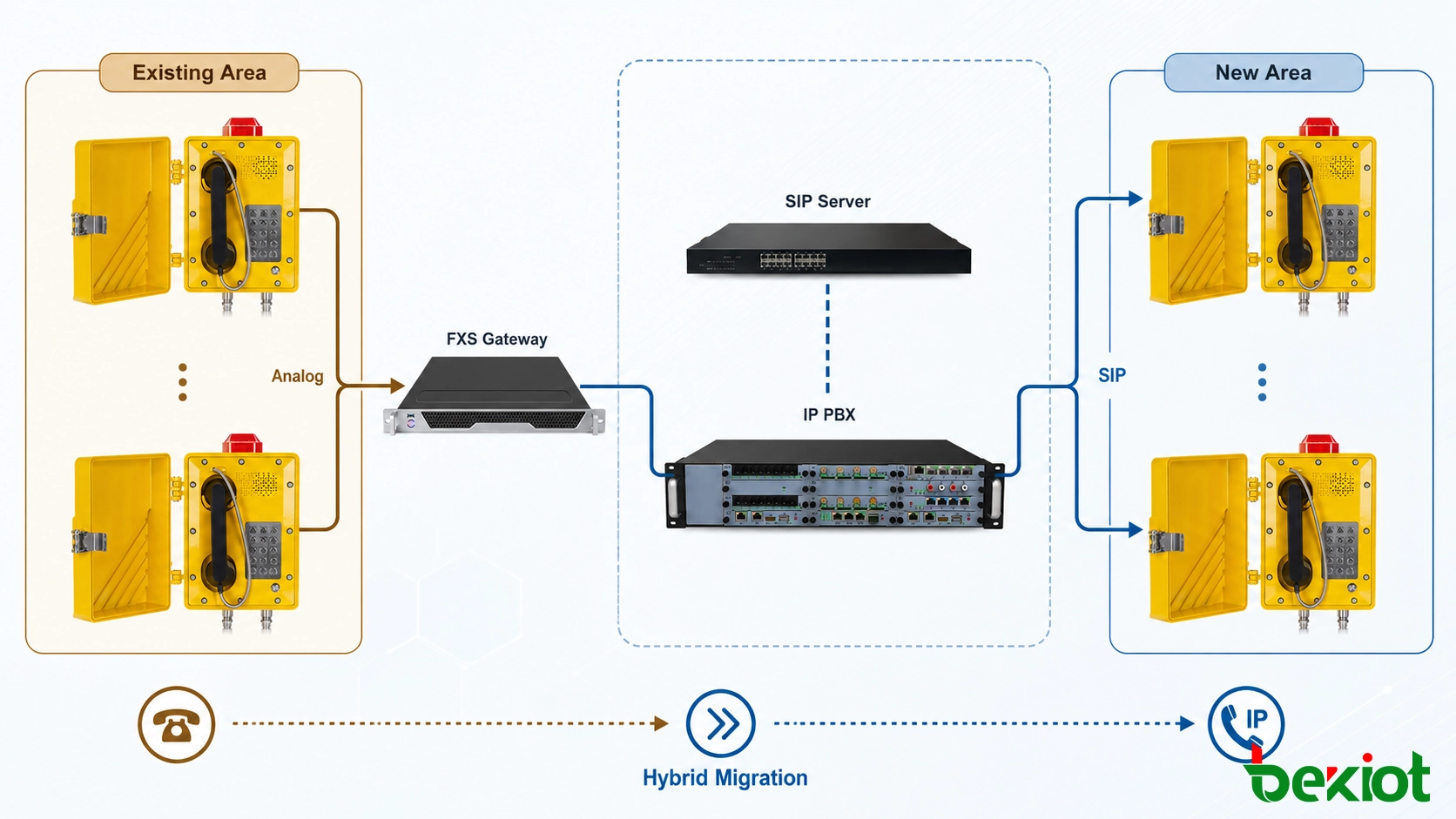
FXS gateways provide the subscriber interfaces required by standard analog telephones and convert calls to SIP on the network side. This allows the equipment room to adopt an IP PBX or SIP-based platform without requiring an immediate replacement of every field endpoint.
The distinction between FXS and FXO is important in this application. A standard analog telephone normally connects to an FXS port because that interface provides subscriber-side telephone service. An FXO port is intended for a different role, such as connecting equipment to an analog exchange or trunk line.
For brownfield projects, this approach can reduce changes in hazardous production areas, where new cable installation, additional junction boxes, access permits, and shutdown coordination may add considerably more work than changes made inside the communication room.
Hybrid Migration
Many plants are expanded in phases rather than rebuilt at one time. Older units may continue using analog telephones while new production areas are equipped with SIP terminals from the beginning.
An IP PBX combined with suitable analog gateways can place both endpoint types under the same overall numbering plan. New SIP points can then be introduced as the industrial network expands, while existing analog terminals are replaced only when equipment condition or project requirements make replacement worthwhile.
This phased model also allows communication upgrades to follow planned plant construction and maintenance windows instead of requiring a single large cutover.
7. Choosing the Right Interface
The practical choice usually becomes clearer when the project team evaluates infrastructure first and the telephone interface second.
| Project Condition | What to Evaluate |
|---|---|
| Existing plant with extensive usable telephone cabling | Evaluate whether the existing analog infrastructure should remain in service |
| New facility with plant-wide industrial Ethernet | SIP endpoints normally align well with the network design |
| Field telephones remain suitable but the PBX requires replacement | Evaluate FXS gateways with an IP communication core |
| Old and new production areas operate together | Consider a hybrid analog and SIP architecture |
| Frequent expansion is expected | Give more weight to network availability and SIP scalability |
| Several sites already share a private IP network | Evaluate centralized SIP numbering and inter-site communication |
| Ethernet availability near field points is limited | Existing analog cabling may remain the simpler field connection |
Greenfield projects often favor SIP when the communication system is designed together with fiber, industrial Ethernet, network cabinets, and centralized IP services. Brownfield projects require a different calculation because existing cable routes, shutdown windows, installed equipment, field construction, and power availability may have a larger impact on total project cost.
For this reason, selection should be based on the complete communication infrastructure and lifecycle requirements rather than on the purchase price or age of either telephone technology.
FAQ
Does a SIP explosion-proof telephone need Internet access?
No. A SIP telephone can operate entirely within a plant LAN, industrial Ethernet network, private WAN, or other isolated IP environment. It only needs network access to the IP PBX or SIP server used by the communication system.
Can an analog explosion-proof telephone be used with an IP PBX?
Yes. An FXS gateway can provide the analog subscriber interface required by the telephone and connect the extension to an IP PBX through SIP. This is a common option when the field equipment remains usable but the core communication platform is being modernized.
What is the difference between an FXS and FXO gateway?
FXS and FXO serve different sides of an analog telephone interface. An FXS port normally connects to a standard analog telephone and provides subscriber-side service. An FXO port normally connects to an analog exchange or telephone line. Analog explosion-proof telephones therefore generally require FXS interfaces.
Does every SIP explosion-proof telephone support PoE?
No. SIP defines the communication method, not the power method. Some models support PoE, while others use DC or another approved supply. The required power arrangement should be checked against the specific terminal and its certified installation conditions.
Is SIP more explosion-proof than analog?
No. Communication interface and explosion protection are separate design characteristics. Hazardous-area suitability depends on the certified protection concept, equipment group, temperature class, enclosure, installation requirements, and other parameters specified for the telephone.
Can SIP and analog explosion-proof telephones share the same numbering system?
Yes. An IP PBX can manage SIP endpoints directly while analog telephones connect through compatible FXS gateways. Both can then use extensions within the same overall numbering plan.
Can existing analog telephone cable be reused for a SIP telephone?
Not automatically. A standard SIP telephone requires a suitable IP network connection. Whether existing cabling can be reused depends on the cable type, topology, distance, and networking technology selected for the project. Existing analog telephone pairs should not simply be assumed to support standard Ethernet.
Are analog explosion-proof telephones obsolete?
No. Analog telephones remain practical where reliable copper telephone infrastructure, fixed field points, and suitable PBX or FXS equipment already exist. In many industrial projects, replacing a functioning analog endpoint provides little benefit unless the wider communication architecture also requires a change.
SIP and analog explosion-proof telephones are two different ways of connecting hazardous-area field communication to the wider plant communication system. Neither interface is automatically suitable for every project.
Becke provides explosion-proof telephones and related industrial communication equipment for SIP and analog applications. SIP, analog, and hybrid deployments can therefore be matched to the communication infrastructure already available at the site.