A mobile command vehicle is more than a control room installed on wheels. It must collect information from the incident site, connect personnel using different communication methods, display live video, transmit selected feeds to an upper-level command center and keep dispatch operations available while the vehicle is moving or working in areas with unstable network conditions.
For this reason, a converged communication system designed for a fixed command center should not simply be transferred to a vehicle without adaptation. Fixed facilities normally operate with stable power, sufficient rack space, permanent network connections and relatively predictable terminal types. A mobile command vehicle faces a very different operating environment: limited installation space, changing network quality, temporary field devices and a much stronger requirement for real-time audio and video processing.
Why Fixed Architectures Behave Differently
Many conventional converged communication platforms are built around SIP-based call control. Some deployments also use communication platforms such as FreeSWITCH to connect telephone terminals, SIP devices, gateways and dispatch applications. This architecture is effective when the main objective is voice communication, telephone interconnection and centralized dispatch in a fixed control center.
A mobile command vehicle, however, must process far more than voice calls. During an emergency operation, the vehicle may need to receive live feeds from fixed surveillance cameras, PTZ cameras, portable surveillance units, body-worn devices, drones and other temporary video sources. Radio users and telephone users may also need to communicate through the same dispatch workflow.
If a system is designed mainly around SIP communication, several limitations can appear when it is moved into this environment. Different video sources may use different protocols and encoding methods, making direct access difficult. Video streams may also need to be reformatted, compressed or distributed differently depending on whether they are being shown on a vehicle display, transmitted through a limited-bandwidth link or forwarded to a remote command center.
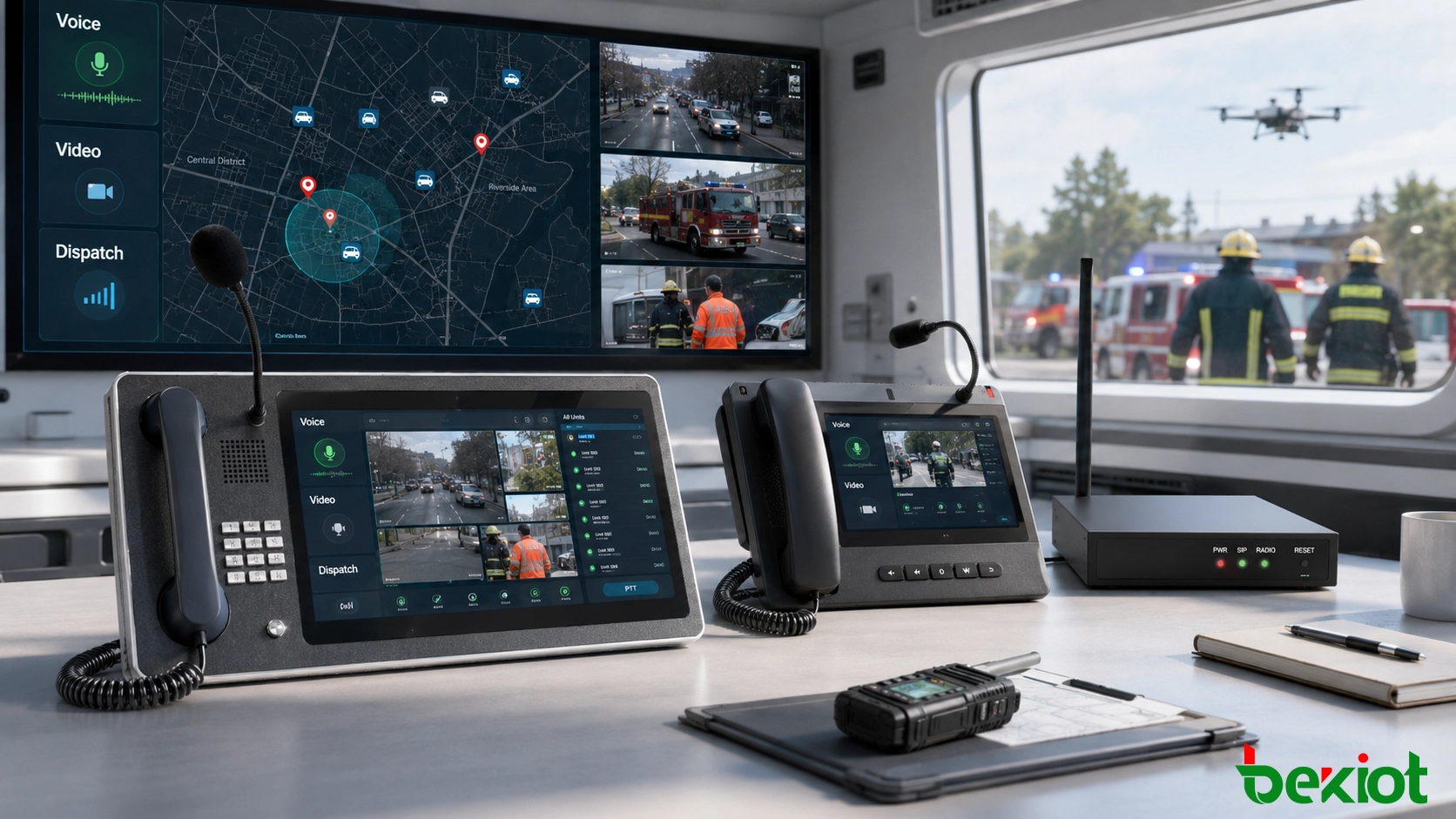
Traditional fixed-site architectures may additionally separate video conferencing, video decoding, screen control and communication dispatch into different subsystems. That division is manageable in a permanent equipment room, but it can increase space requirements, wiring complexity and operating steps inside a vehicle.
Design Priorities for Mobile Operations
The design objective should therefore change from simply bringing communication services into the vehicle to creating a compact mobile command environment capable of handling both communication and media resources.
The first priority is broad field-device access. Emergency operations rarely use only one type of terminal. Depending on the project, information may come from surveillance cameras, portable video equipment, drones, mobile applications, SIP terminals, telephones or radio communication systems. A practical command vehicle should be able to gather these resources without forcing every field device into one communication format.
The second priority is integrated audio and video processing. Video should not be treated only as an attachment to a voice communication system. The platform should be able to receive video streams, select sources, distribute images and adapt transmission according to the destination and available network conditions.
The third priority is simplified operation. During an incident, operators should not have to repeatedly switch between unrelated applications simply to call personnel, select a camera, display a live image and forward information to another command center. Bringing these functions into a unified dispatch workflow reduces operational steps and makes the vehicle easier to use under time pressure.
The fourth priority is compact deployment. Equipment inside a command vehicle competes for rack space, power capacity and installation space. Consolidating communication, media processing and dispatch functions wherever practical helps reduce unnecessary external devices and makes later maintenance more manageable.
Creating One Voice and Video Workflow
A vehicle-based converged communication solution should allow operators to work with voice and video resources from one operational environment. The objective is not to force every device to use exactly the same protocol, but to provide a common dispatch layer above different field resources.
For voice communication, SIP remains valuable because it provides a standardized method for connecting IP telephones, dispatch endpoints and other SIP-compatible systems. Existing telephone resources can also be integrated through suitable interfaces when a project needs to retain established communication infrastructure.
Video access requires a broader approach. PTZ cameras, fixed surveillance systems, portable monitoring equipment, drones and field video terminals may generate streams using different standards. The vehicle platform therefore needs media-processing capability in addition to traditional call control.
Once connected, selected video feeds can be displayed inside the command vehicle for incident assessment. Operators may view different sources, compare the scene from several angles and select the most useful images for remote transmission. This allows the mobile unit to function as a local information-processing point instead of merely forwarding every stream without control.
The same concept applies to dispatch. A field report may begin as a telephone call, radio message or video feed. The operator can use the information to contact another team, organize a temporary communication group or send selected visual information to the responsible command organization.
Multi-Network Links and Remote Coordination
A command vehicle cannot assume that one network connection will always be available. It may operate near a fixed communication network during routine events and then move into an area where only limited mobile or temporary communication links remain usable.
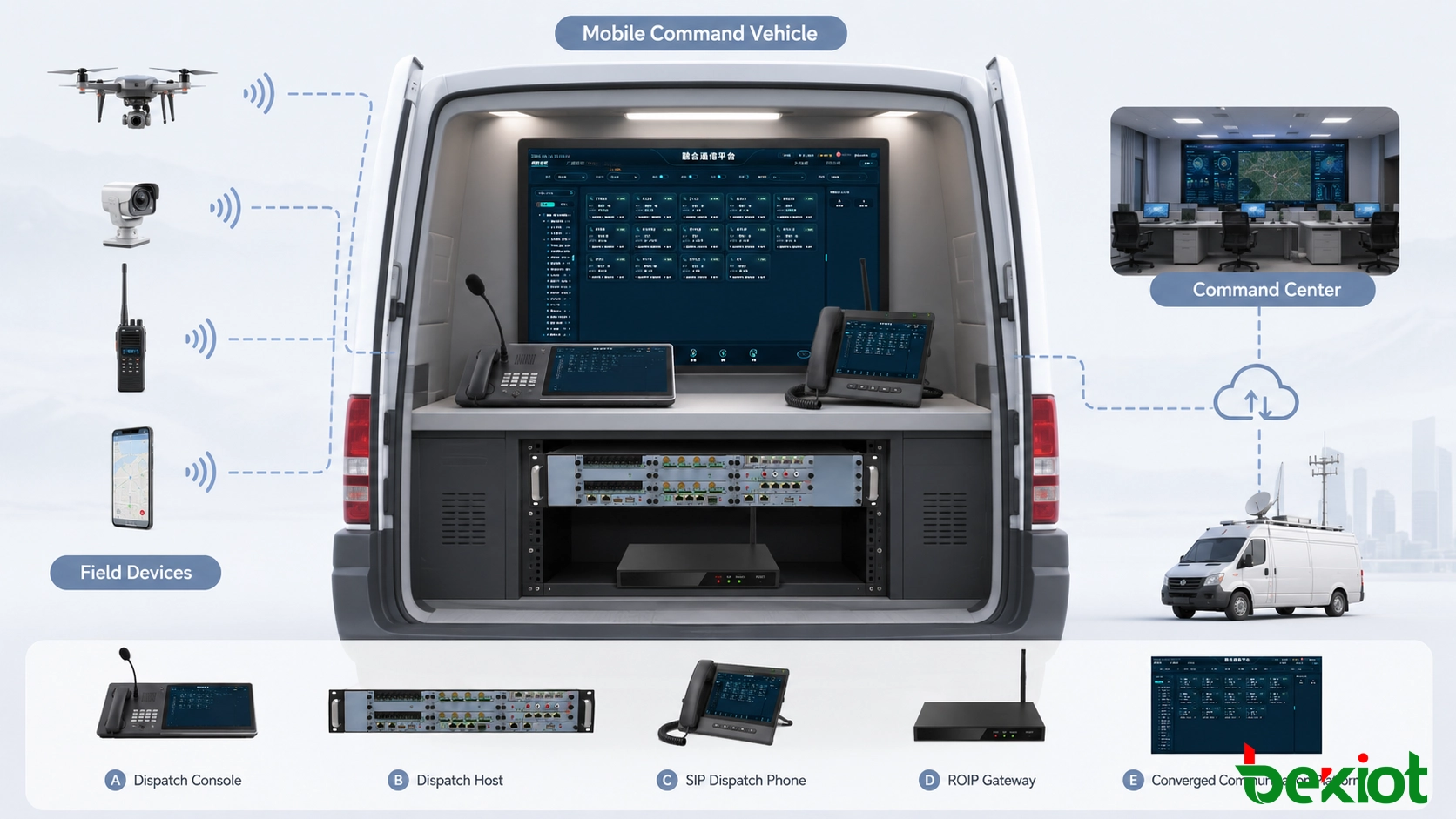
For that reason, the communication architecture should support multiple methods of connecting the mobile unit with the fixed command center. The original design concept identifies several important interoperability methods, including GB/T 28181, SIP, RTMP and WebRTC. Each can serve a different type of communication or media workflow.
SIP is commonly used for real-time voice sessions and communication-system interconnection. GB/T 28181 can be relevant when the project needs to exchange compatible video-surveillance resources. RTMP can support streaming-oriented transmission, while WebRTC can provide browser-based real-time audio and video communication in suitable applications.
Supporting several protocols gives system designers more flexibility than relying on a single SIP connection for every task. A vehicle may use one interface for voice dispatch, another for video-platform interconnection and another for selected real-time media services.
The relationship between the vehicle and the command center should also be bidirectional. The vehicle may receive images, instructions or other information from an upper-level platform while simultaneously sending local field video and communication information upstream.
This is especially useful when a mobile command vehicle is deployed as an extension of a permanent emergency operations center. Headquarters can maintain overall coordination while the vehicle works closer to the incident and manages local resources.
Handling Video Under Weak Networks
Network quality is one of the largest differences between a permanent command center and a mobile command vehicle. A fixed center normally has predictable network bandwidth. A vehicle may depend on mobile, wireless or temporary links whose available bandwidth changes as location and radio conditions change.
Simply transmitting original video streams at their highest available quality can create unnecessary bandwidth pressure. A vehicle-based system should therefore provide the ability to adapt video transmission to the actual communication link.
Video-processing functions can be used to control stream characteristics such as encoding format, frame rate and bitrate when required by the application. This allows the same source to serve different purposes. A relatively high-quality stream may be retained for local display, while a more bandwidth-efficient version is forwarded through a constrained network.
Multi-source images can also be combined when operational requirements call for several camera views to be transmitted together. Instead of sending every original channel separately, the system can organize selected visual information before upstream transmission.
This approach is important because the objective of emergency video transmission is not simply to produce the highest possible image quality. The more practical objective is to deliver useful situational information continuously within the bandwidth that is actually available.
Practical Vehicle Deployment Structure
A mobile command vehicle solution can be planned around four functional areas rather than a long list of independent devices.
Field Resource Access
This layer connects communication and information sources used near the incident. Depending on the project, these may include SIP communication terminals, telephones, radio resources, fixed or portable cameras, PTZ equipment, drones, body-worn terminals and mobile applications.
Converged Processing
The central platform handles communication sessions, media access, dispatch operations and the coordination of different audio and video resources. The emphasis is on reducing isolated subsystems and giving operators a consistent way to control the resources connected to the vehicle.
Local Command and Presentation
Inside the vehicle, operators need access to communication status, live video and dispatch controls. Important images can be selected for the vehicle's display system so that personnel can assess the incident and coordinate actions without relying on a separate workflow for every source.
External Interconnection
The vehicle then exchanges required information with the permanent command center or other cooperating platforms. Voice, video and selected operational information can be transmitted according to the interfaces supported by the project.
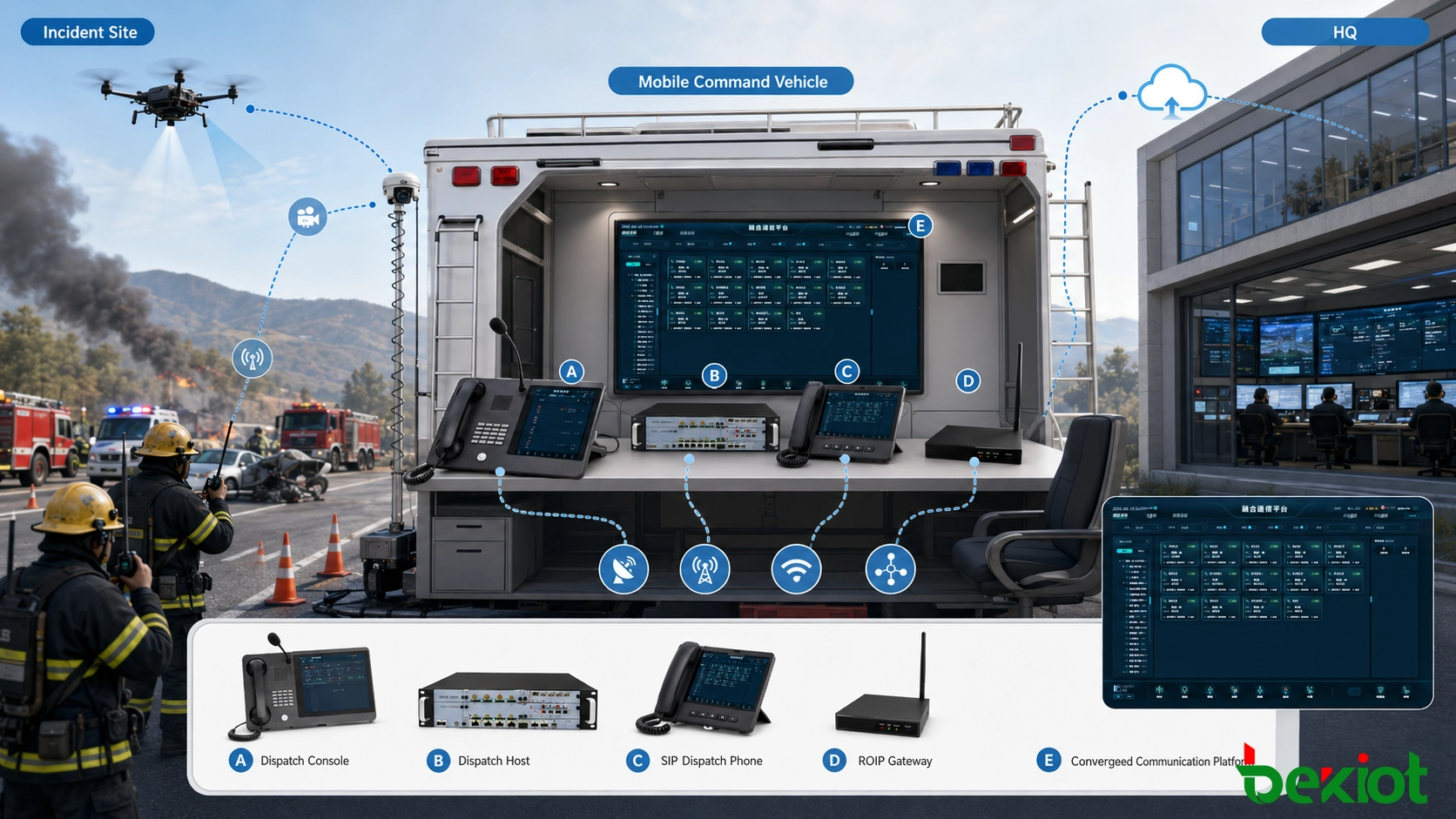
This layered approach also makes expansion easier. A project does not need to replace every existing communication resource simply because a mobile command vehicle is being introduced. Existing SIP systems, field terminals, surveillance resources and other compatible infrastructure can be connected according to actual interface requirements.
For projects that require unified voice communication, dispatch, interconnection and integration with existing communication resources, the Becke platform can be used as part of the overall system architecture.
Related Systems: Becke Converged Communication System
The final configuration should still be determined by the vehicle's actual role, available communication networks, field terminal types, video sources and required interfaces with the fixed command center rather than by copying a standard control-room configuration.
Final Notes
A converged communication system can be used in a mobile command vehicle, but successful deployment requires more than physically relocating a fixed-site communication platform. The system architecture needs to reflect the operational characteristics of the vehicle itself.
Traditional SIP-based communication remains important for voice and dispatch integration, but a modern mobile command vehicle also needs practical video access, media processing, direct visual presentation, multi-protocol interconnection and bandwidth-aware transmission.
The vehicle should ultimately function as a mobile command post: collecting information near the incident, helping operators understand the situation, connecting different personnel and communication resources, and delivering useful information back to the main command center.
When communication and video processing are designed together from the beginning, the result is a system that is easier to install in limited vehicle space, easier to operate during an incident and better suited to changing field networks than a direct copy of a fixed command-center architecture.
FAQ
Does every command vehicle need satellite communication?
No. Satellite connectivity depends on the operating area, required resilience and project budget. Some vehicles rely mainly on public or private mobile networks, while others add satellite communication as an additional link for remote locations or major emergencies.
Should the vehicle use the same user directory as the fixed command center?
That depends on the management model. Sharing selected organizational information can simplify coordination, while separate permissions may be preferable for temporary teams, external agencies or locally managed field resources.
What should be tested before a mobile command system is accepted?
Acceptance testing should reproduce actual operating conditions rather than test only individual functions. Typical checks include startup after vehicle power changes, communication between different terminal types, simultaneous audio and video operation, network switching, upstream transmission and recovery after link interruption.
How should communication records be managed on the vehicle?
Recording and event records should follow the project's operational and data-management requirements. Projects may store selected information locally, synchronize it with a central platform or use a combination of both depending on network availability and retention policies.