Managing explosion-proof telephones at a single plant is usually straightforward. Field telephones connect to the local telephone system, and the control room handles routine production calls and emergency communication.
The situation becomes more complicated when the same company operates several refineries, chemical plants, mines, tank farms, power facilities, or remote industrial sites. One plant may already use SIP explosion-proof telephones, another may still depend on analog field wiring, while a third site may have its own legacy PBX and independent dispatch system.
Each system can work perfectly well on its own. The difficulty appears when headquarters needs to contact a specific field location, coordinate several plants during an incident, review recordings, or manage communication permissions across sites. At that point, separate telephone systems become an operational issue rather than just a technical one.
A practical multi-site design does not require every telephone to be replaced or registered directly to one central server. The main task is to establish a common numbering, routing, dispatch, and network framework while allowing each plant to continue handling its own local communication.
Why Separate Plant Telephone Systems Become Difficult to Manage
Large industrial communication networks are rarely built at one time. Plants are expanded, control rooms are upgraded, new production lines are added, and communication equipment is replaced in stages. Over time, different sites naturally end up with different technologies.
A typical group may have SIP telephones and an IP PBX at one plant, analog explosion-proof telephones at another, and a conventional telephone exchange at a third. Some sites may also operate separate PA, recording, or dispatch systems.
| Existing Situation | Operational Problem |
|---|---|
| Independent numbering at each plant | Operators need separate directories for cross-site calls |
| Multiple PBXs operating independently | Headquarters cannot manage calls from one dispatch position |
| Analog and SIP terminals mixed across sites | Legacy and IP communication resources require interconnection |
| Separate recording systems | Incident records have to be searched in several platforms |
| Local PA systems isolated from telephony | Field reports and emergency announcements remain separate processes |
| Dispatch permissions managed locally | Headquarters and plant responsibilities may be unclear during a major event |
Centralized dispatch solves these problems by creating a common communication layer above the existing plant systems. It does not mean that every routine production call has to be handled by headquarters.
How a Multi-Site Dispatch Architecture Can Be Structured
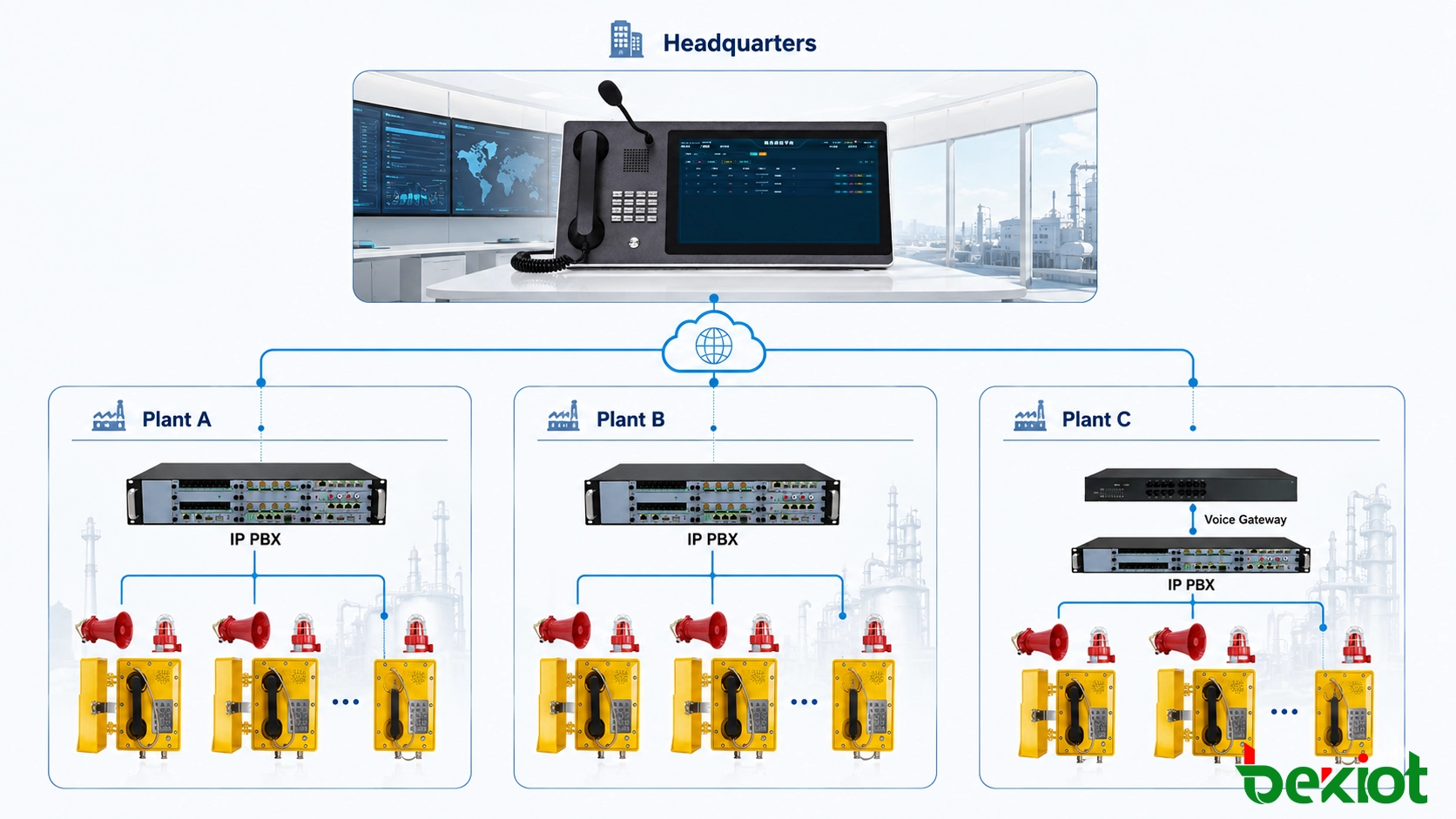
A multi-site industrial communication system is easier to manage when headquarters, plant-level communication, and field terminals are treated as separate layers.
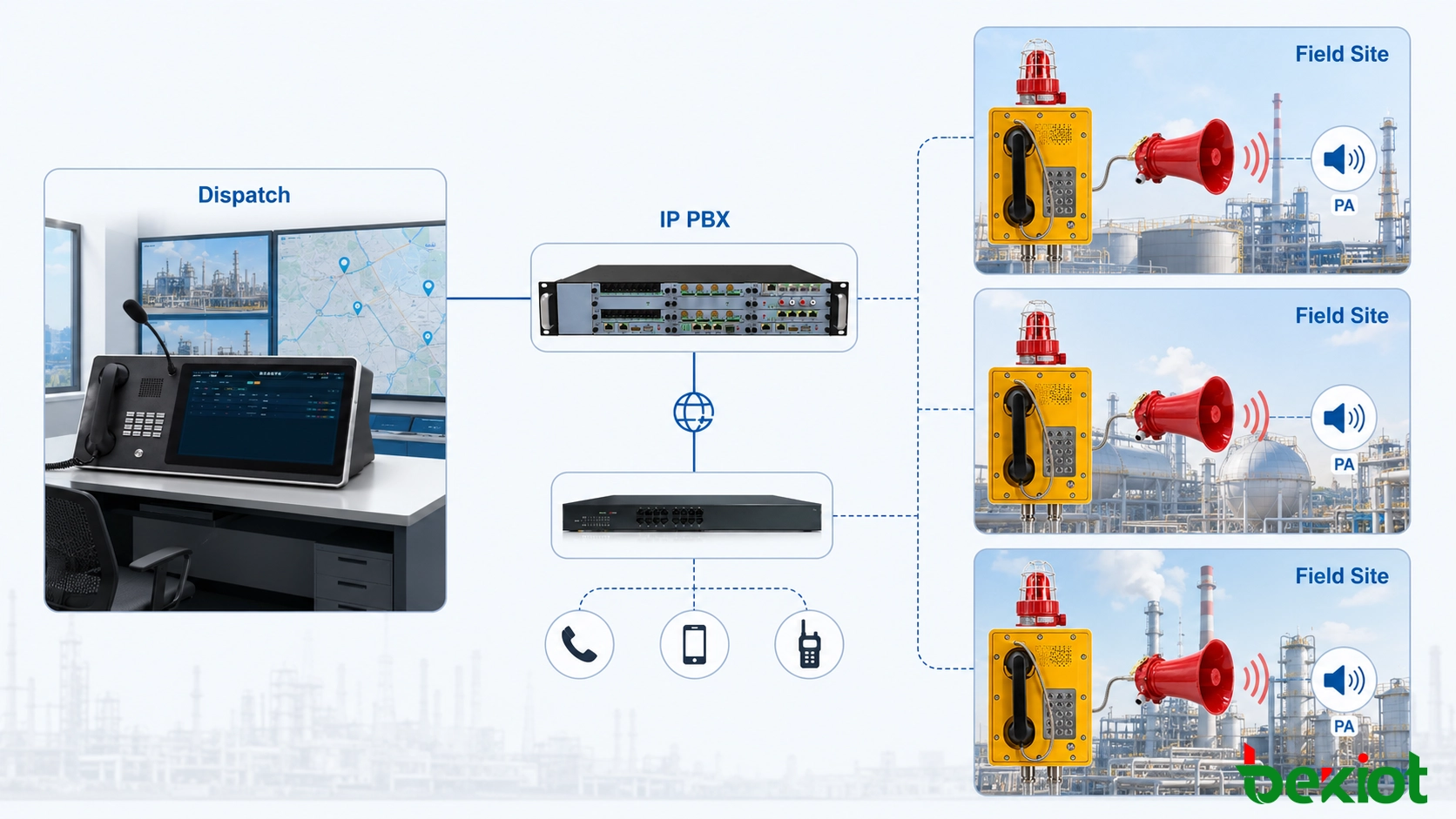
The headquarters or regional control center normally hosts the main command and dispatch platform, dispatcher consoles, recording resources, and the routing functions required for communication between sites.
Each production facility keeps the equipment needed for its own local telephone service. Depending on what is already installed, this may be an IP PBX, SIP server, conventional PBX, or a combination of voice gateways and existing telephone exchanges.
The sites are then interconnected through the company's existing IP infrastructure. A private WAN, carrier circuit, VPN, SD-WAN, or another managed IP connection can be used as long as routing, security, capacity, and voice quality are suitable for the required traffic.
| Layer | Typical Equipment | Main Responsibility |
|---|---|---|
| Headquarters / Central Control | Command and dispatch platform, dispatcher console, recording server | Cross-site dispatch, conferencing, routing, permissions, and communication records |
| Plant Communication Layer | IP PBX, SIP server, legacy PBX, voice gateway | Local extension service and interconnection with headquarters |
| Field Communication | SIP or analog explosion-proof telephones, industrial telephones, PA terminals | Production communication, incident reporting, and emergency calling |
Headquarters handles cross-site coordination
Once the systems are interconnected, dispatchers at headquarters no longer need to log in to several unrelated telephone platforms. A plant, department, control room, or permitted field terminal can be selected from a common dispatch interface.
For events involving more than one facility, the central dispatcher can bring relevant control rooms or duty positions into the same communication process instead of relaying information through several separate phone calls.
Plants continue to handle their own production calls
Local communication remains important. Routine calls between field personnel, plant operators, and the local control room do not need to travel through headquarters. Keeping local call handling at the plant also reduces unnecessary WAN traffic and simplifies day-to-day operation.
Related Product:Becke Command & Dispatch System
How Different Existing Telephone Systems Can Be Connected
The main challenge in a brownfield project is usually not the central dispatch software. It is the variety of communication systems already operating at different plants.
Trying to force every site onto the same hardware at the same time can increase construction work, commissioning risk, and downtime. A staged integration is usually more practical.
Sites already using SIP explosion-proof telephones
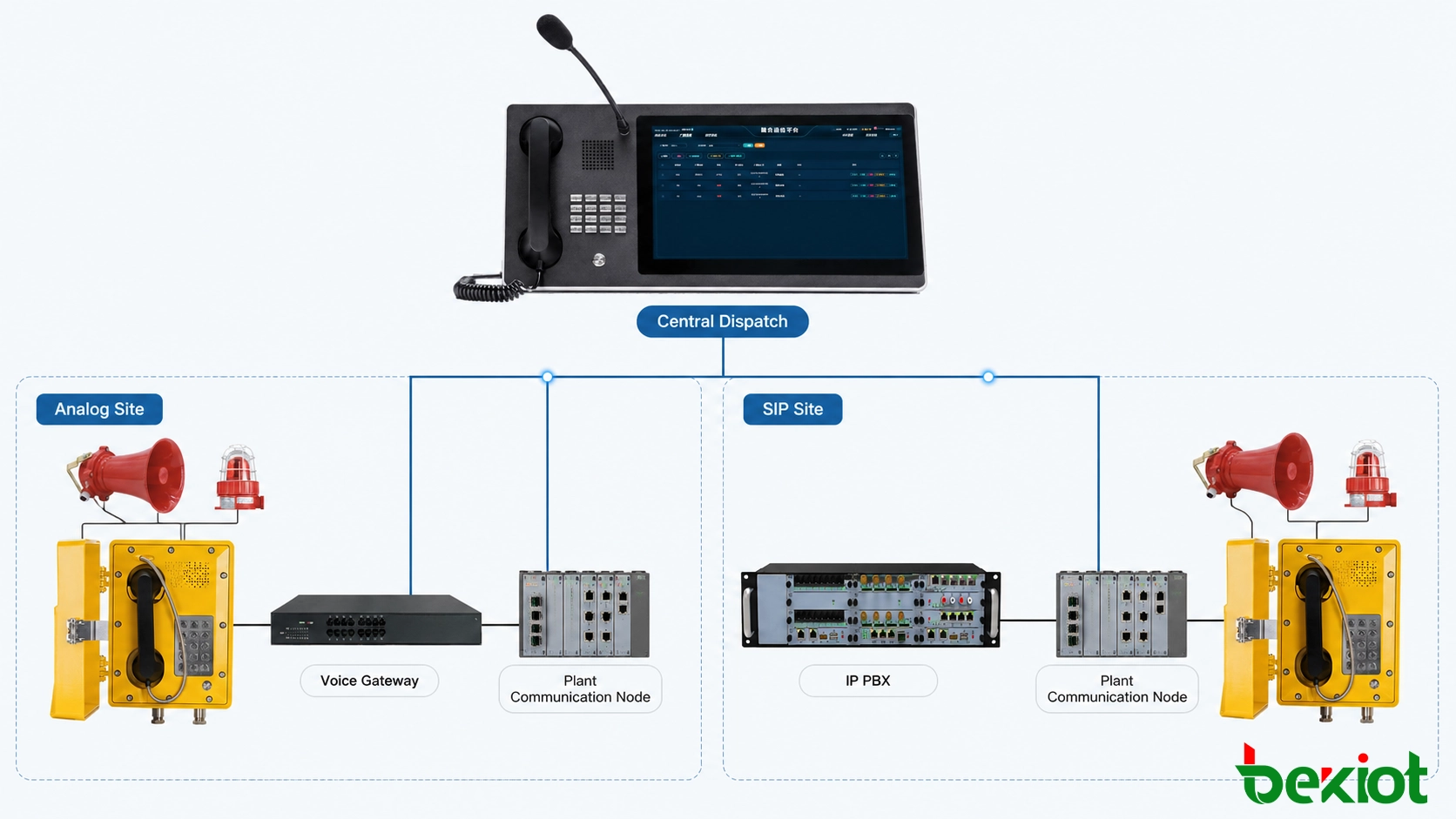
A plant that already uses SIP field telephones can keep its existing industrial network and local IP PBX. The plant telephone system is then interconnected with the central dispatch platform, typically through SIP-based routing.
Field terminals remain under local administration, while headquarters gains the ability to reach authorized extensions and dispatch positions across the site.
Plants with analog explosion-proof telephones
Many refineries, chemical plants, mines, and utility facilities still have copper telephone pairs running to field locations. If those cables remain serviceable, replacing them only to support centralized dispatch may offer little practical benefit.
An FXS voice gateway can be installed in the telecom room to bring the existing analog extensions into the IP communication environment. The field telephone and copper pair remain in place, while the central side gains SIP connectivity.
This approach is particularly useful when the field cabling passes through operating process areas where new construction would be expensive or disruptive.
Plants that still depend on a legacy PBX
A conventional PBX may support hundreds of office, control-room, and industrial extensions in an existing plant. Removing it simply to introduce a new dispatch platform can create more risk than value.
Where suitable interfaces are available, the existing exchange can remain in service and interconnect with the newer system through SIP Trunk, FXO, E1, or another supported interface. Field equipment can then be upgraded gradually as part of the normal replacement cycle.
Numbering, Permissions, and Dispatch Workflows Matter as Much as Hardware
A technically connected system can still be difficult to operate if every site keeps an unrelated numbering plan.
Before integration, existing extensions should be reviewed for duplicate numbers, local short codes, emergency extensions, and reserved ranges. Some organizations keep the original plant numbers and add a site prefix, while others assign separate number ranges to each facility.
There is no universal numbering format. What matters is that a dispatcher can identify the site and destination quickly and that enough number space remains available for future plants or production areas.
Dispatch permissions should follow operational responsibility
A central dispatcher does not necessarily need access to every office telephone or workshop extension. Headquarters can be limited to plant control rooms, emergency points, key field telephones, and other positions required for group-level coordination.
Plant dispatchers can retain broader access to local production extensions. Permissions can also be divided further by department, process area, or user role.
Field calls can become part of a larger response workflow
When an operator reports an abnormal condition from an explosion-proof telephone, the local control room can first confirm the location and situation. If wider support is required, headquarters or another facility can then be added to the call or contacted through the same dispatch environment.
Where a plant already has an IP or SIP-based PA system, the dispatcher may also issue announcements to the relevant production zone after the event has been verified. The broadcast scope should follow the site's operating procedure; a field call should not automatically trigger a plant-wide announcement unless the emergency plan specifically requires it.
Operational and emergency calls can also be recorded according to site policy. Central and local users can then be given different permissions for playback and incident review.
WAN Quality and SIP Media Routing Need Careful Testing
A SIP telephone that works correctly inside one plant LAN may behave differently when calls cross firewalls, routers, VPNs, or carrier networks.
Registration does not guarantee working audio
SIP signaling handles registration and call setup, while RTP normally carries the actual audio. A telephone can therefore ring and answer correctly even when the media path is blocked.
For one-way audio or no-audio problems, it is usually more useful to check RTP ports, NAT behavior, firewall rules, ACLs, and routing between the two sites than to repeatedly change the extension account.
Voice quality should also be checked under realistic network load. Packet loss, jitter, and excessive delay can produce broken or delayed speech even though the call remains connected.
Industrial WAN links often carry CCTV, production data, office traffic, remote access, and other services at the same time. QoS and capacity planning therefore matter when several sites may have concurrent voice traffic.
Local communication should not disappear with a WAN failure
A central platform is useful for cross-site coordination, but a plant should not lose all internal communication simply because its connection to headquarters has failed.
Central dispatch and local plant communication solve two different problems: one provides cross-site coordination, while the other supports production continuity.
Depending on the importance of the site, the design may include a local PBX or SIP node, UPS backup, redundant servers, or alternative network paths. The level of redundancy should follow the operational requirements of the facility rather than being applied identically to every project.
How to Commission a Multi-Site Explosion-Proof Telephone System
A successful call from headquarters to one field telephone is not enough to verify a multi-site system. Commissioning should cover the actual communication paths that operators are expected to use.
| Test | What to Check |
|---|---|
| Local plant calling | Field telephone, local control room, and local dispatch operation |
| Cross-site calling | Routing, caller ID, audio in both directions, and numbering conflicts |
| Headquarters dispatch | User permissions and access to authorized plants or field extensions |
| Dispatch functions | Conference, recording, group calling, PA, or priority features actually included in the project |
| WAN failure | Which local telephone services remain available when the central link is unavailable |
| Network recovery | SIP trunks, registrations, routes, and dispatch status after connectivity returns |
Third-party SIP devices deserve particular attention during commissioning. Two products may both support SIP and still handle priority, paging, GPIO, call control, or vendor-specific dispatch functions differently.
Testing should therefore follow the functions that operators will actually use rather than relying only on protocol labels in product data sheets.
Conclusion
The difficult part of multi-site explosion-proof telephone management is rarely the telephone itself. The real work is organizing numbering, routing, permissions, legacy interfaces, and network behavior across plants that were built at different times.
A good system does not need every factory to use identical hardware. It needs clear boundaries between local plant communication and group-level dispatch, along with tested interfaces between the systems already in service.
Becke Telecom provides explosion-proof and industrial telephones, voice gateways, communication platforms, and command and dispatch equipment for new installations and brownfield upgrades. System integration can be planned around the cabling, PBXs, IP networks, and operational responsibilities already present at each site rather than requiring a complete replacement of the existing communication infrastructure.
Frequently Asked Questions
Do all plants need to use the same IP PBX?
No. Different plants can retain their own local PBXs or SIP servers as long as the systems provide compatible interconnection and routing. A distributed design is often more practical for large industrial groups.
Can explosion-proof telephones from different manufacturers be centrally dispatched?
Basic voice interoperability is often possible when compatible SIP or analog interfaces are available. Advanced functions such as priority control, group calling, alarm pop-ups, GPIO control, or paging should be tested separately.
Can headquarters call a specific explosion-proof telephone inside a process area?
Yes, provided that the number is routable between the two systems and the dispatcher has permission to access that extension. Some organizations intentionally restrict direct headquarters access to selected emergency or operational terminals.
Can an existing analog telephone network be added without replacing the field phones?
In many cases, yes. FXS gateways can connect existing analog field extensions to an IP-based communication system while leaving usable field cabling and telephones in service.
How should a new plant be added to an existing multi-site dispatch network?
If the original numbering and routing plan reserved capacity for additional sites, the new plant can normally be assigned its own number range and connected through the existing inter-site communication framework. This is one reason future expansion should be considered when the first multi-site numbering plan is created.
Should recording be centralized or kept at each plant?
Either model can be used. Central recording simplifies group-level access and incident review, while local recording may better suit plant-specific retention or network requirements. In larger deployments, the decision is often based on bandwidth, storage, access permissions, and the organization's operational policy.