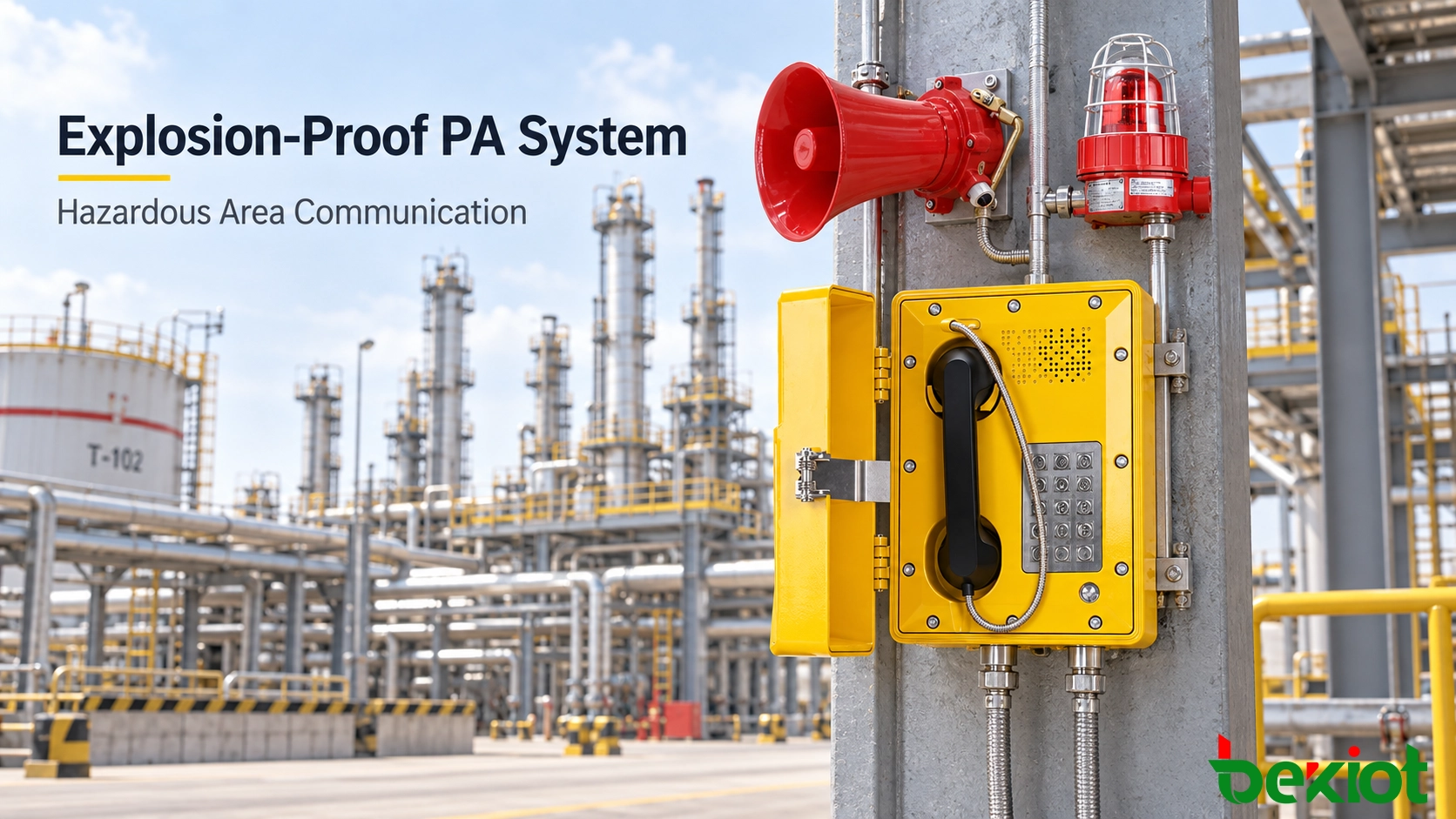
In hazardous industrial environments, a telephone call does not always provide enough warning. Pump stations, compressor areas, tank farms, processing units, mines, and other production areas may have high background noise, large operating zones, and personnel working away from fixed communication points.
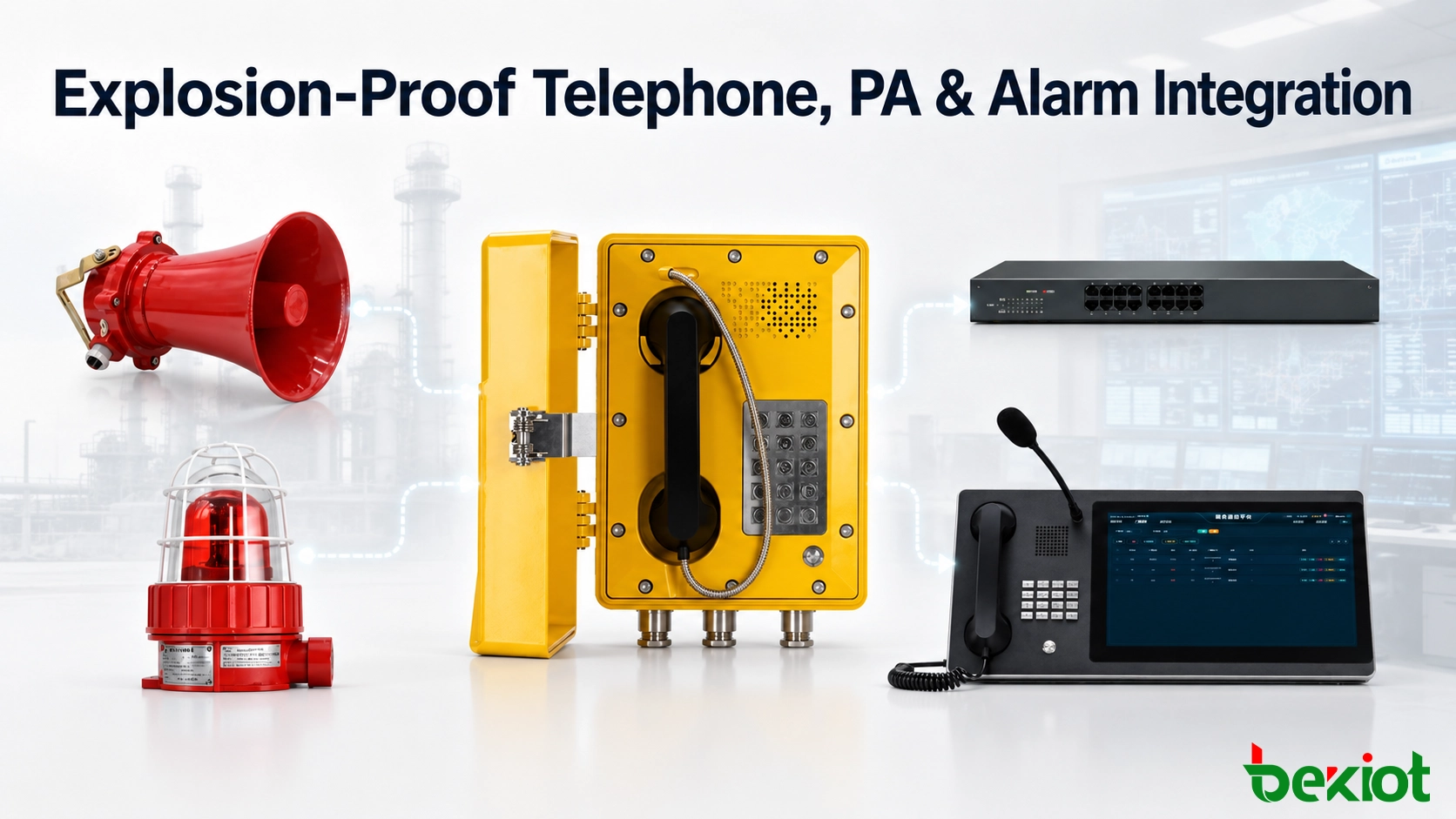
For this reason, explosion-proof telephones are often deployed together with PA speakers and audible and visual alarm devices. The telephone provides two-way communication with the control room, the alarm attracts attention at the field location, and the PA system distributes instructions to personnel across one or more zones.
The main engineering task is deciding how these devices should respond to the same event. Depending on the site, linkage may be handled by relay contacts, SIP signaling, I/O gateways, paging gateways, or a centralized dispatch platform.
1. Why Link the Systems?
Explosion-proof telephones, PA systems, and alarm devices serve different communication purposes.
Explosion-proof telephone: provides direct two-way communication between field personnel and the control room.
PA system: distributes live or prerecorded voice messages to selected areas.
Audible and visual alarm: gives an immediate sound and light warning in noisy or visually complex environments.
Dispatch system: coordinates calls, paging, alarms, recording, and operator actions.
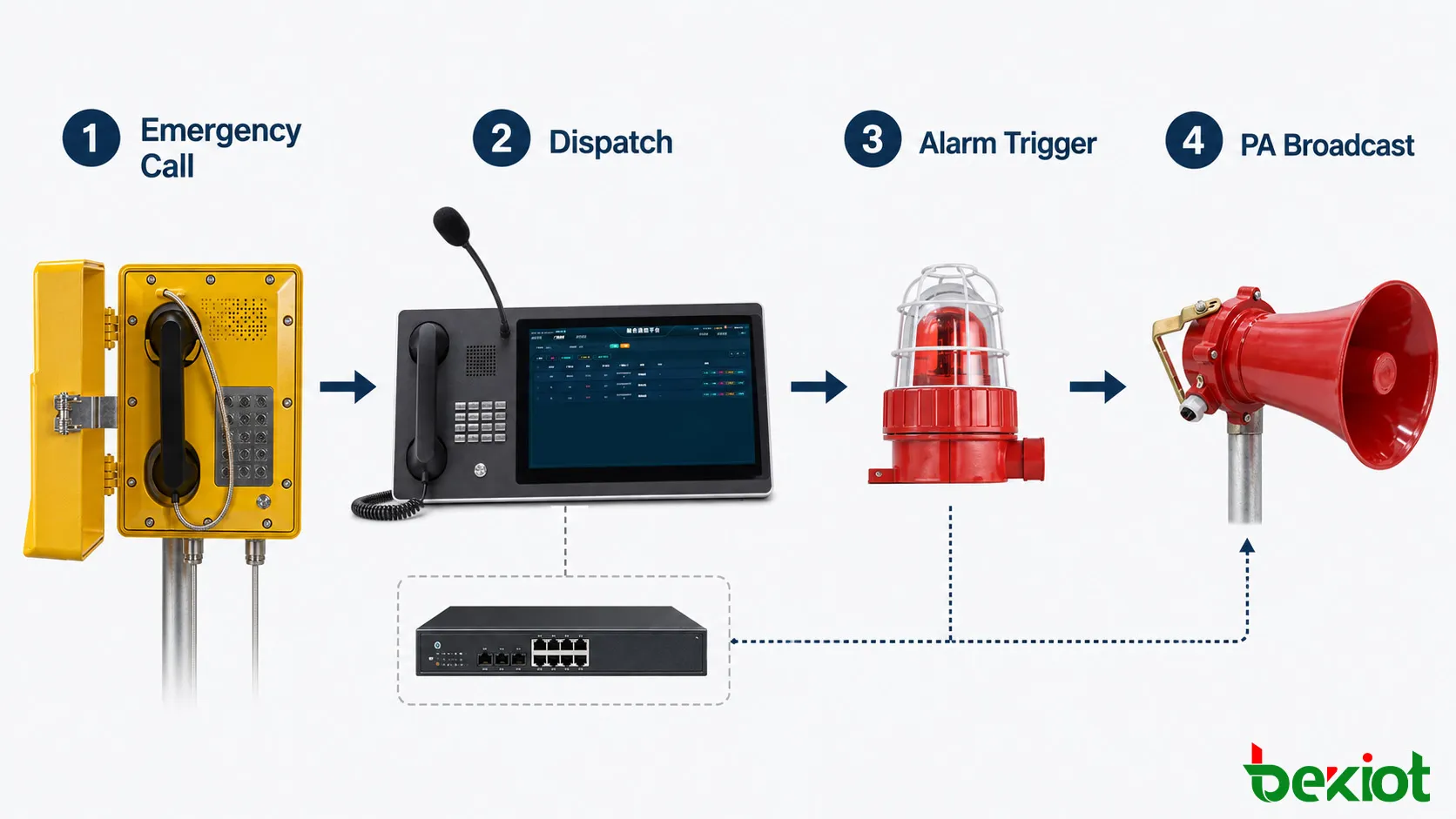
For example, a field operator detecting an abnormal condition can use an explosion-proof telephone to call the control room. The same event may activate a nearby sounder and beacon. Once the situation is confirmed, the dispatcher can issue instructions through the PA system to the affected area.
This creates three levels of communication: direct conversation with the person reporting the event, immediate local warning, and wider notification to personnel nearby.
Related Products: EX-BH621 Explosion-Proof SIP Telephone
2. System Architecture
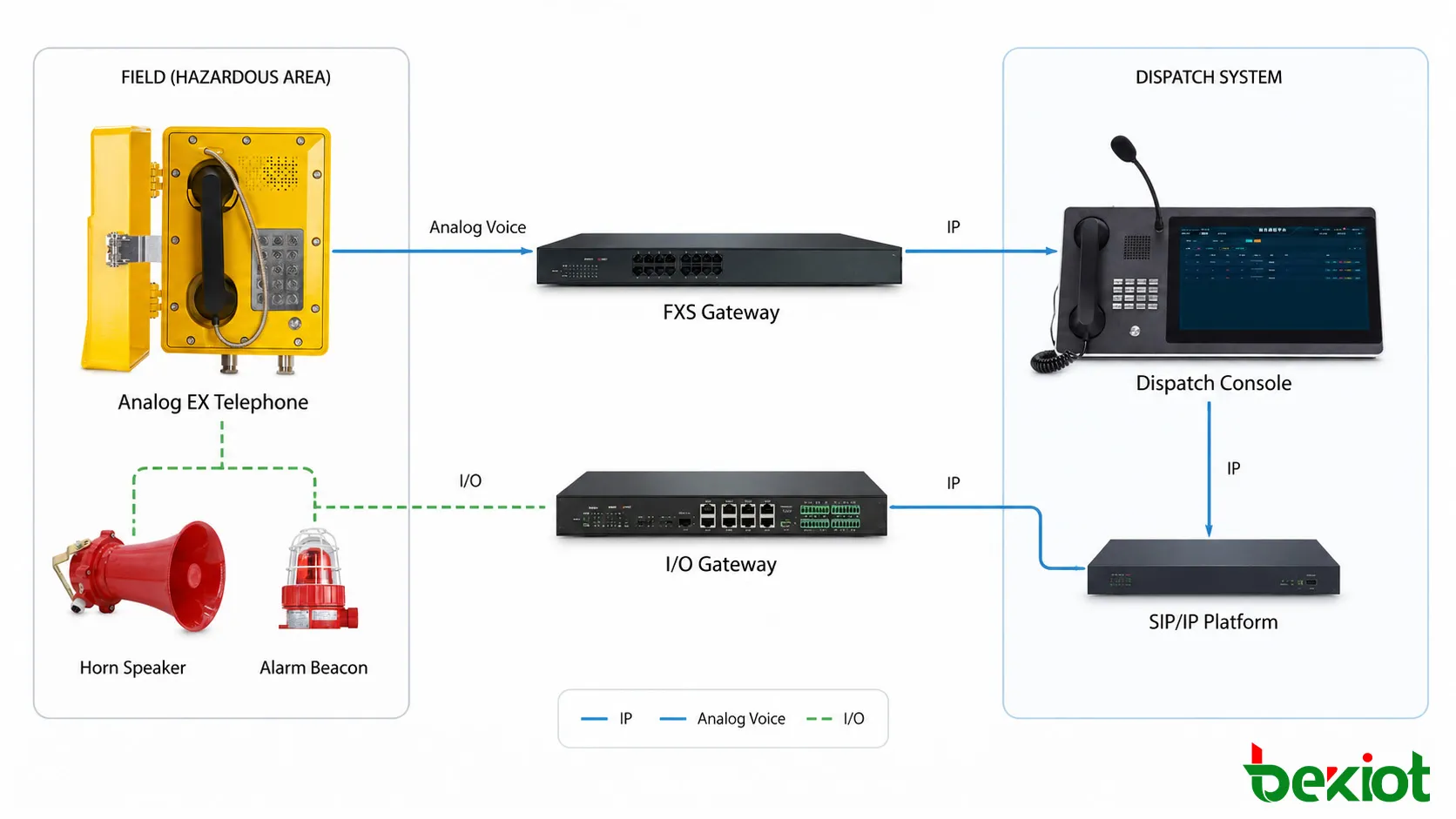
An integrated communication system normally consists of field terminals, communication access equipment, a control platform, and alarm or paging devices.
A SIP-based installation may connect explosion-proof telephones and network paging devices directly to an IP PBX, SIP server, or dispatch platform. Conventional alarm devices are usually controlled through relay outputs or an I/O gateway.
The system may include:
Explosion-proof SIP or analog telephones;
Industrial Ethernet or analog telephone lines;
IP PBX or SIP server;
Dispatch console;
SIP paging gateway or PA controller;
Explosion-proof horn speakers;
Audible and visual alarm devices;
Relay or I/O gateway;
Call and event recording.
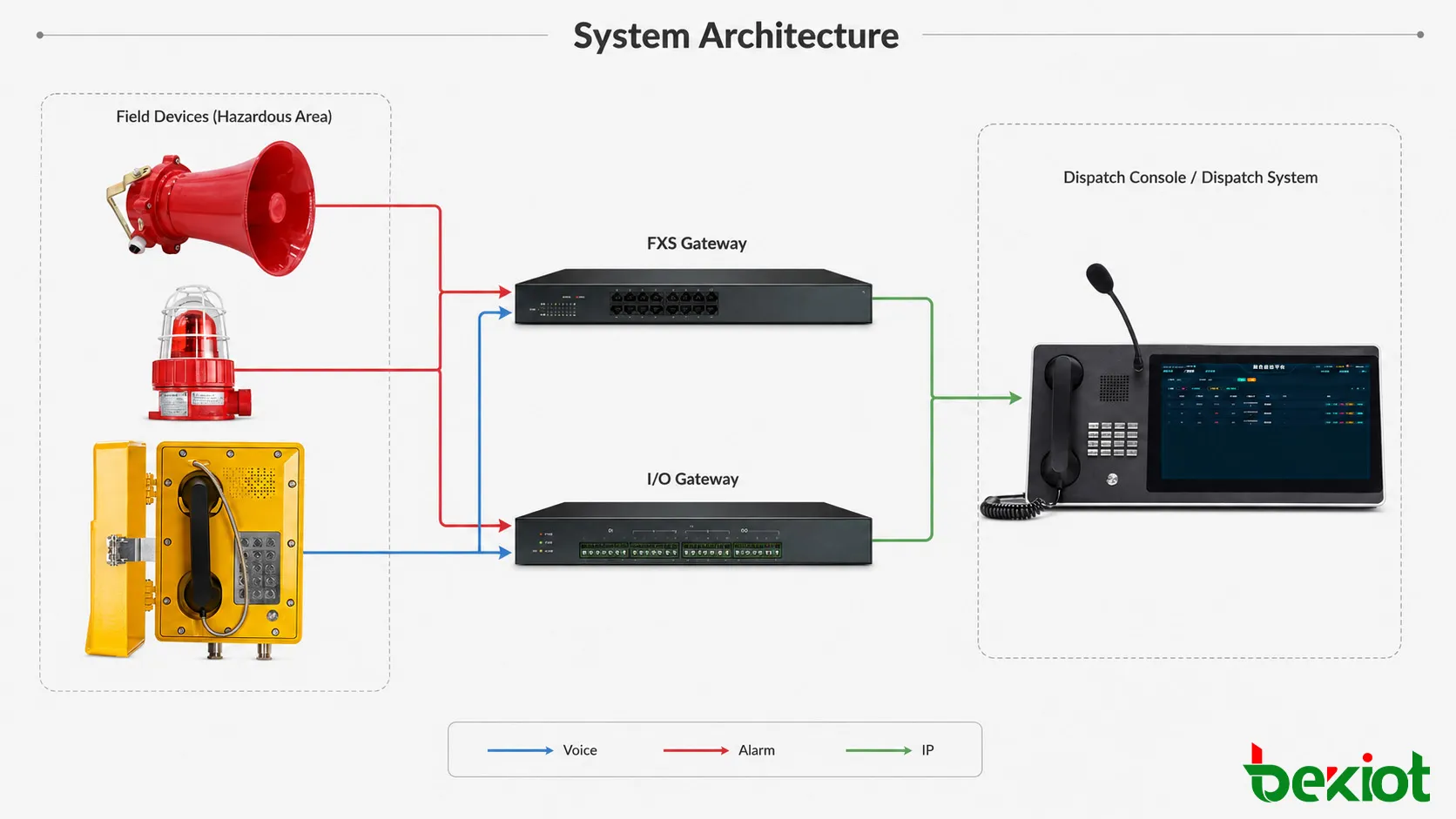
Existing industrial sites do not always need to replace all field equipment during an IP upgrade. Analog telephones, amplifiers, and other usable devices can remain in service where appropriate, with gateways providing the required interface to the newer communication platform.
3. Alarm Triggering
Audible and visual alarms can be triggered locally from the field telephone or centrally through the communication platform. The correct method depends on the available interfaces and the required alarm logic.
Relay or Dry Contact
A relay output is one of the simplest ways to create local linkage. Pressing an emergency button or generating a predefined telephone event changes the relay state, which can then provide a control signal to an alarm controller.
The signal path may be:
Emergency Button → Relay Output → Alarm Controller → Sounder / Beacon
The relay should be treated as a control interface unless its electrical rating is specifically suitable for the connected load. High-power sounders, beacons, or other field devices may require an intermediate controller or relay module.
SIP and I/O Control
In a centralized SIP system, the field telephone can first place a call or generate a supported event. The dispatch platform identifies the originating terminal and applies the configured alarm rule.
For example:
SIP Telephone → Dispatch Platform → I/O Gateway → Alarm Device
This allows different rules to be assigned to individual areas. A call from one pump station may activate only its local beacon, while a plant emergency can trigger alarms across several zones.
An I/O gateway is particularly useful when the control platform uses IP communication but the field alarm equipment accepts conventional relay or contact inputs.
4. PA Integration
The PA system handles one-to-many communication. After receiving a field call, the control room can use paging to send instructions to a production unit, building, tunnel section, or the entire facility.
SIP Paging
SIP speakers, paging terminals, and SIP PA gateways can be registered to the same SIP communication environment as telephone endpoints.
The operator selects a paging endpoint or predefined group from the dispatch console and starts the announcement:
Dispatch Console → SIP Server → SIP Paging Endpoint → Speaker
Depending on the platform, paging can be arranged by individual device, group, zone, or all-call. Emergency paging may also be assigned a higher priority than routine announcements.
Existing PA Systems
Industrial plants with existing amplifiers and horn speakers can connect them to the IP communication system through a SIP paging or audio gateway.
The connection may be:
Dispatch Platform → SIP PA Gateway → PA Amplifier → Field Speakers
This is useful for phased modernization because existing speakers and amplifiers can continue to operate while dispatch and paging control move onto the IP network.
5. Local or Central Control?
Local linkage normally uses a direct electrical connection between the telephone and nearby alarm equipment. It is simple, fast, and suitable for isolated pump stations, equipment rooms, remote sites, or other locations where a local warning must operate independently of complex platform logic.
Centralized linkage moves more control functions to the dispatch or alarm platform. The system can identify the source of a call, select the corresponding alarm zone, control paging, and record the event.
Large industrial sites often combine both methods. A telephone relay may activate a local beacon immediately, while the central platform handles the wider response, including PA announcements, additional alarms, call recording, and operator dispatch.
The central platform can also exchange information with CCTV, gas detection, fire alarm interfaces, or other operational systems where the project requires wider event linkage.
6. Industrial Applications
Oil and Gas
Tank farms, compressor stations, loading areas, and processing facilities often need fixed communication points together with local alarm and area-wide notification. Explosion-proof telephones allow personnel to report incidents directly, while PA and alarm devices extend the warning to the surrounding work area.
Chemical Plants
Chemical processing areas often combine hazardous zones, high ambient noise, and multiple production units. Fixed telephones provide direct communication with the control room, while sounders, beacons, and PA speakers improve emergency notification across the plant.
Mining
Mining projects may use fixed telephones, dispatch communication, alarms, and paging at key operating locations. Equipment selection needs to consider the specific hazardous-area requirements, dust, background noise, mechanical conditions, and available communication network.
Tunnels and Underground Facilities
Tunnels and underground industrial spaces often have long communication distances and distributed emergency points. Fixed telephones provide a known location for emergency calls, while zone-based PA and alarm devices can notify personnel across a larger section.
Where a particular area is classified as hazardous, the telephone and associated electrical equipment should be selected according to the corresponding project requirements.
7. Deployment Checklist
Before field installation, the communication and alarm interfaces should be confirmed as part of the system design rather than after the equipment has arrived on site.
| Item | What to Confirm |
|---|---|
| Hazardous area | Area classification and gas or dust conditions |
| Communication interface | SIP, analog, Ethernet, relay or GPIO |
| Alarm trigger | Dry contact, relay, I/O gateway or platform control |
| PA interface | SIP paging, analog audio or PA gateway |
| Alarm device | Input type, voltage, current and control method |
| Network | Industrial Ethernet, fiber, LAN or existing telephone lines |
| Control platform | IP PBX, SIP server, dispatch system and paging zones |
| Power | PoE, DC, local power and backup requirements |
| Recording | Call records, alarm events and operator logs |
For existing facilities, the first step should also include documenting the installed telephone lines, PA amplifiers, field speakers, alarm circuits, network resources, and available interfaces. This makes it easier to determine where existing equipment can remain and where a gateway or controller is required.
A reliable linkage design depends on how calls, alarms, and PA zones are expected to respond during a real event. Hazardous-area requirements, electrical interfaces, network availability, alarm priority, and failure behavior should therefore be confirmed before commissioning.
Becke provides explosion-proof telephones, industrial telephones, communication gateways, dispatch, and PA-related equipment for hazardous and industrial environments. These products can be used in SIP, analog, or hybrid communication architectures, with the final configuration determined by the site network, hazardous-area requirements, and required alarm and paging functions.