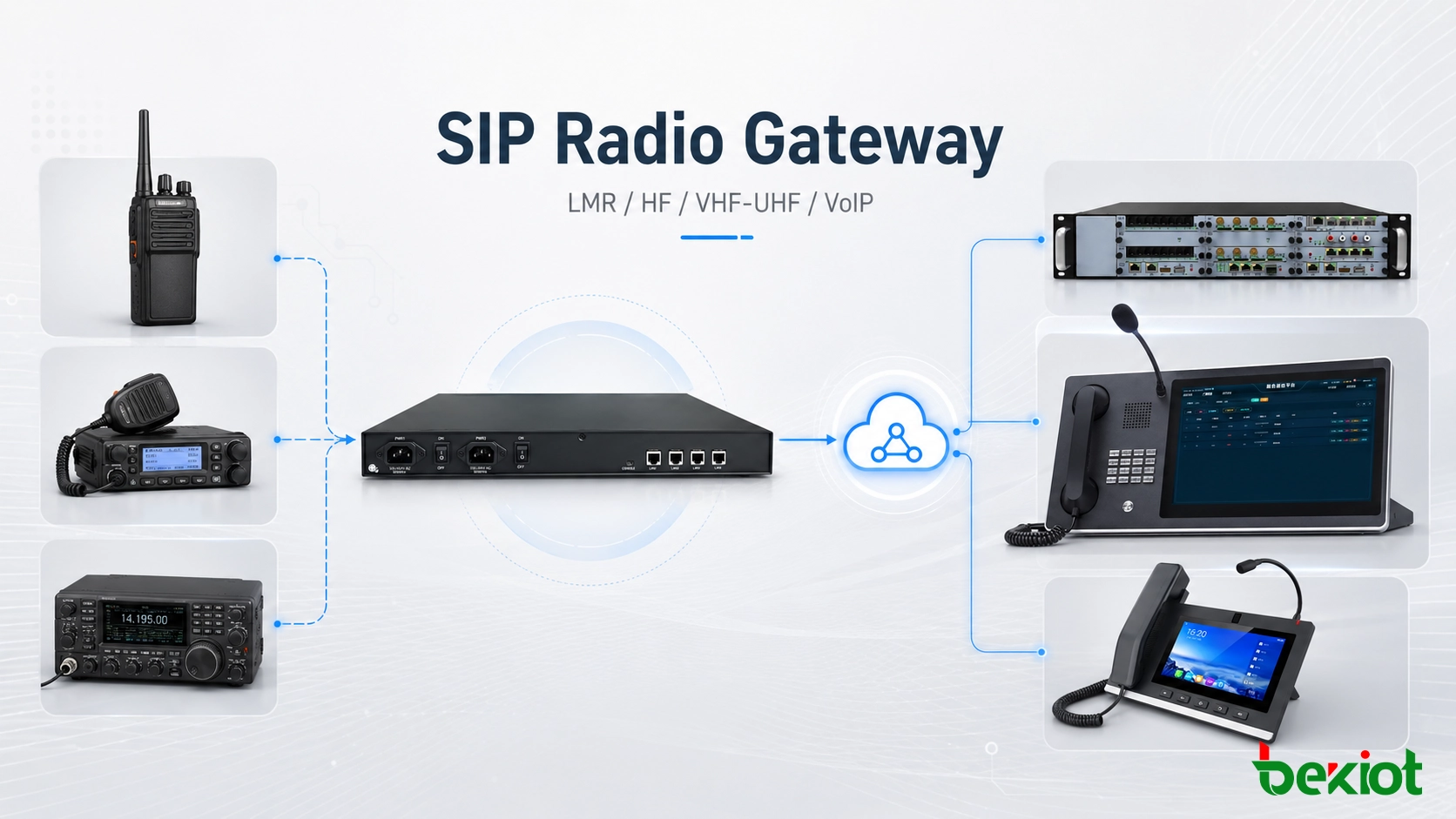
LMR, HF and VHF/UHF radio systems remain important in industrial plants, transportation networks, utilities, public safety operations and emergency communications. Field personnel may depend on two-way radios for daily operations, while control rooms, offices and remote command centers increasingly use SIP phones, IP PBX systems and software-based dispatch platforms.
The challenge is that these systems often operate independently. Radio users communicate within an RF network, while telephone users and dispatchers work on an IP network. A SIP Radio Gateway provides an interface between the two environments, allowing existing radio channels to become accessible from SIP-based communication systems without replacing the radio infrastructure.
A practical integration involves more than converting analog audio into IP packets. The gateway must also manage transmit and receive audio, PTT control, carrier detection, radio interface levels and the half-duplex behavior of conventional radio systems.
Why Connect Radio Systems to a SIP Network?
A conventional radio system is normally designed around its own coverage area. A dispatcher may operate a control radio or base station, while office personnel use a separate telephone system. If several facilities are involved, each site may also maintain its own radio equipment and local dispatch position.
Related Product Information: RoIP Gateway Solutions
This creates communication gaps when a control-room operator needs to contact radio users, when a remote office needs access to a local radio channel, or when several radio systems must be monitored from one dispatch center.
Connecting radio resources to a SIP network makes it possible to extend existing channels beyond their original operating position. Depending on the system architecture, a radio channel can be accessed from a dispatch console, SIP extension, IP PBX or remote control center through an IP network.
The radio network itself does not need to change. Existing base radios, repeaters and control radios can remain in service while the gateway provides the connection to the IP communication layer.
SIP Radio Gateway Architecture and Radio Interfaces
A radio gateway sits between two systems that use different communication methods. The radio side normally relies on physical audio and control interfaces, while the IP side uses signaling and packet-based voice transmission.
RX and TX Audio
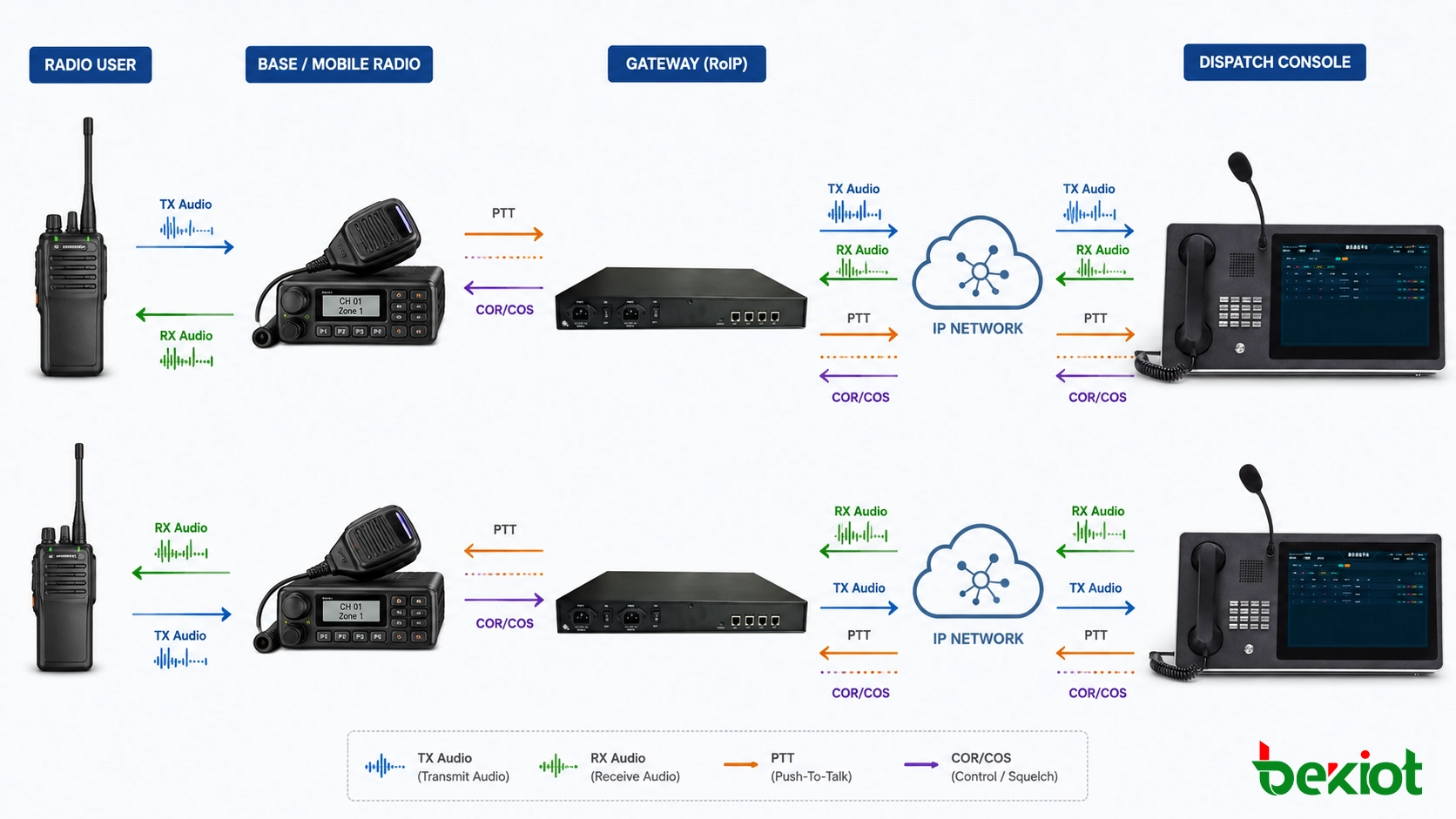
Most radio integrations require separate receive and transmit audio paths. When a radio receives a transmission, RX audio is delivered to the gateway. The gateway converts the signal into digital audio and sends it across the IP network.
In the opposite direction, voice received from the SIP or dispatch system is converted into a radio-compatible audio signal and sent to the radio's TX audio input.
The electrical characteristics of these interfaces should be checked before installation. Audio level, impedance, grounding and whether the interface is balanced or unbalanced can affect voice quality.
PTT Control
A two-way radio normally cannot transmit and receive simultaneously on the same channel. Before audio from the IP side can be transmitted over RF, the radio must first be placed into transmit mode.
The gateway performs this operation through PTT control. Depending on the equipment, PTT may use a dedicated control pin, relay contact, GPIO or E&M interface.
When the dispatcher starts transmitting, the gateway activates PTT and applies TX audio to the radio. When transmission ends, the gateway releases PTT and the radio returns to receive mode.
COR and COS
The gateway also needs to determine whether the radio channel is active. Many base and mobile radios provide COR or COS outputs that change state when a valid carrier or received signal is detected.
This information can be used to open the receive audio path, indicate channel activity on a dispatch console or prevent an operator from transmitting while the channel is already busy.
GPIO, E&M and Serial Control
Professional radio gateways may provide configurable GPIO or E&M interfaces for PTT, busy indication, alarms and external control. Some radios also expose RS-232 or other serial interfaces.
Where both the gateway and radio support the required commands, serial control can be used for functions such as channel selection, frequency changes or status monitoring. These capabilities depend on the specific radio model and should not be assumed simply because the gateway supports SIP.
How Radio Audio and PTT Work over SIP and IP
SIP, voice transport and radio control perform different functions within the same communication path.
SIP is used to establish and manage the communication session between IP endpoints. Media information is negotiated when the session is created, while real-time voice is normally transported through RTP.
Codecs such as G.711 PCMA or PCMU are commonly used in LAN and managed WAN environments where sufficient bandwidth is available and straightforward interoperability is required.
Radio-specific functions such as PTT and COR remain the responsibility of the gateway. SIP does not directly replace the electrical PTT or carrier-detect interfaces of a radio. Instead, the gateway translates the operating state of the IP communication system into the control actions required by the radio.
Radio-to-IP Communication
When a field user transmits through a VHF, UHF or other connected radio, the receiving radio provides RX audio to the gateway. A COR or COS signal may simultaneously indicate that the channel is active.
The gateway processes the audio and sends it over the IP network to the designated dispatch console, SIP endpoint or communication platform.
IP-to-Radio Communication
When a dispatcher replies, the gateway first activates the connected radio's PTT control. Audio from the IP side is then delivered to the TX audio interface and transmitted over the radio channel.
After the operator releases PTT, the gateway removes the transmit command and returns the channel to receive mode.
PTT over IP Requires Compatible Control Logic
PTT control is not implemented in exactly the same way by every radio gateway or dispatch system.
Some gateway systems use internal control signaling between gateway units. Others expose radio channels to a SIP server and manage PTT through their own application logic. A dispatch platform may also communicate with the gateway through a dedicated API or manufacturer-specific control protocol.
For this reason, interoperability should be checked at both the voice and control levels. Successful SIP registration does not automatically guarantee that PTT, channel busy indication or remote radio control will operate correctly with every third-party platform.
Connecting LMR, HF and VHF/UHF Radio Systems
The basic gateway architecture can be used with several types of radio systems, but the actual interface requirements depend on the radio equipment rather than the RF band alone.
LMR Radio Integration
Land Mobile Radio systems are widely used by industrial facilities, transportation operators, utilities, security organizations and emergency services.
A SIP Radio Gateway can typically connect to an LMR base station, control radio, mobile radio or another suitable radio interface. Voice and control signals are taken from the radio and made available to the IP communication system.
This approach is particularly useful where an organization wants to retain its existing radio infrastructure but move the dispatch position to a centralized or remote location.
For digital radio technologies such as DMR, P25 or TETRA, it is important to distinguish between audio-level integration and protocol-level integration.
If the gateway connects through RX audio, TX audio, PTT and COR, it can provide radio voice interoperability, but it does not automatically gain access to all native digital-radio functions.
Subscriber identities, talkgroups, emergency signaling, GPS information, encryption control and other digital features may require protocol integration or a dedicated interface provided by the radio system manufacturer.
HF Radio Integration
HF radio is commonly used where communication must cover long distances or remain available when cellular and terrestrial communication networks are limited. Applications include remote industrial sites, maritime communication, emergency networks and isolated infrastructure.
A radio gateway allows an HF transceiver to remain close to its antenna system while the operator works from a remote control center.
Voice and PTT control can travel between the two locations through an IP network. If the HF radio provides a compatible remote-control interface, functions such as channel or frequency selection may also be available.
VHF and UHF Radio Integration
VHF and UHF systems are frequently used for local communication in factories, mines, ports, railways, airports, utility sites and large campuses.
A gateway connected to the base or control radio can extend the channel into the IP network so that a dispatcher does not need to remain physically beside the radio equipment.
Where several sites or channels are involved, multiple radio resources can also be presented on one dispatch workstation, reducing the need for separate control radios at the operator position.
Common SIP Radio Gateway Deployment Architectures
Radio to SIP Phone
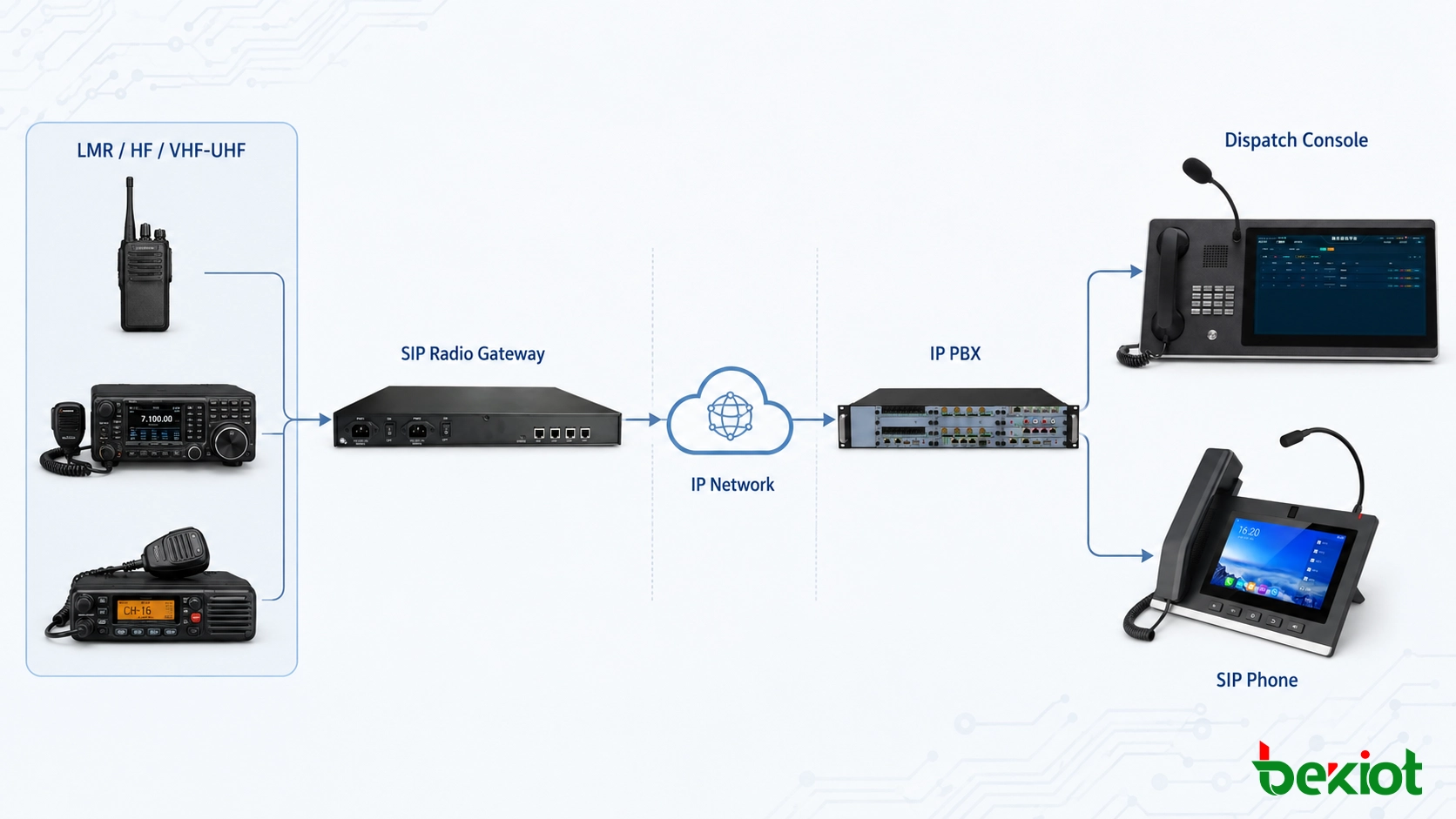
In a relatively simple deployment, a radio gateway can be registered to an IP PBX and assigned a SIP account or extension.
Authorized SIP users can then access the connected radio channel according to the routing and control rules configured in the system.
This arrangement is useful where supervisors, maintenance personnel or security staff only need occasional access to the radio network and do not require a complete dispatch console.
Radio to Dispatch Console
Control-room deployments normally require more than one communication resource. The operator may need to monitor several radio channels while also handling SIP extensions, emergency calls or external telephone connections.
A dispatch platform can present these resources through one operator interface, allowing the dispatcher to select the required radio channel and control PTT without using a separate microphone or control radio for every network.
Remote Radio over WAN
The radio and dispatcher do not need to be located at the same site. A base radio can be installed where antenna coverage is best, while its gateway connects the radio to a remote dispatch center through a private WAN, VPN, fiber network, microwave link or other suitable IP connection.
This architecture is useful for unmanned radio sites, distributed industrial facilities and communication networks that cover a large geographical area.
Multiple Radio Networks on One Dispatch Platform
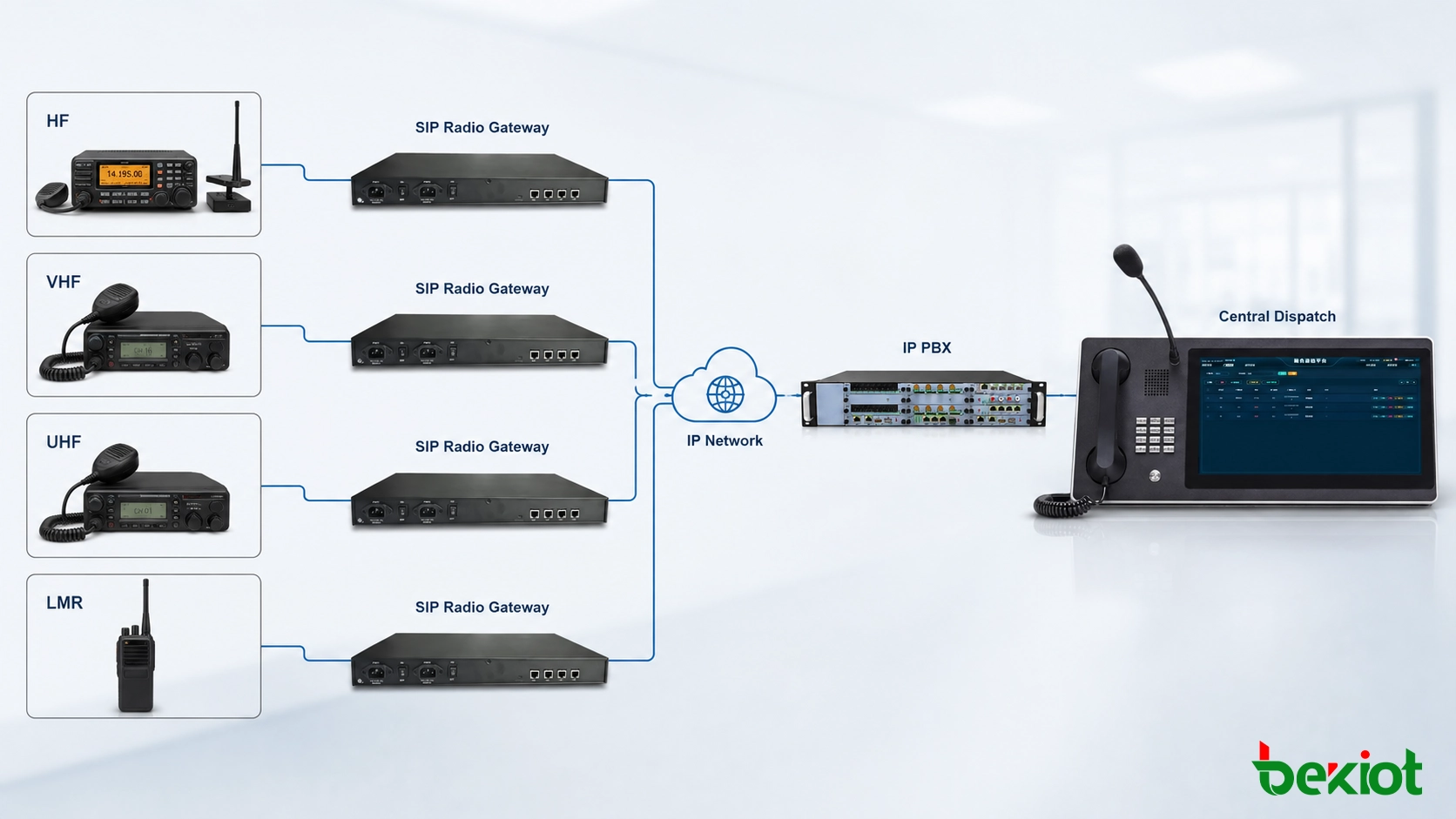
Some organizations operate several independent radio systems. A facility may use VHF for maintenance, UHF for security and HF as a long-distance backup communication method.
Each radio can be connected through an appropriate gateway channel and delivered to the same dispatch environment over IP.
The RF networks remain independent, but operators can access them from a common control interface.
What to Check Before Deploying a SIP Radio Gateway
Most radio integration problems are caused by interface mismatches, control logic or network conditions rather than by SIP registration itself. The radio and network environment should therefore be checked before installation.
Radio Interface Compatibility
Confirm that the radio provides suitable RX audio, TX audio, PTT and, where required, COR or COS connections.
The accessory connector pinout, audio voltage, impedance and control logic should be verified against the radio documentation. Integration through a dedicated accessory or system connector is normally preferable to using microphone and loudspeaker connections.
PTT and Carrier Detection
PTT may operate as active-high, active-low, dry contact, relay, GPIO or E&M control. The gateway must be configured to match the radio.
COR or COS polarity should also be checked. Incorrect configuration can cause a radio channel to appear permanently active or prevent the gateway from recognizing incoming radio traffic.
Audio Level Adjustment
TX and RX audio levels should be tested during commissioning using normal radio traffic. Excessive level can produce distortion, while insufficient level may result in weak or difficult-to-understand speech.
Ground loops, electrical isolation and balanced or unbalanced connections should also be considered where the radio and gateway are installed in different racks or powered from separate sources.
Latency, Jitter and QoS
Radio dispatch is sensitive to delay because operators frequently switch between receive and transmit states. High network latency can make conversations feel unnatural and may lead to clipped speech at the beginning of a transmission.
A stable network path, appropriate QoS configuration and suitable jitter-buffer settings are therefore important, especially when gateways operate across a WAN.
SIP Server and Call Routing
The system design should determine whether the gateway communicates directly with a dispatch platform or registers to an IP PBX or SIP server.
In PBX-based deployments, individual radio channels can be assigned SIP accounts or extensions so that access permissions and call routing can be managed alongside other communication endpoints.
Network Security and Reliability
When radio traffic passes through remote or untrusted networks, firewall rules, NAT behavior and RTP media paths should be considered together.
VPNs, encrypted SIP signaling, secure RTP or other protection methods may be used where supported by the equipment and required by the project.
Critical installations should also consider redundant power, backup network paths and local radio operation in case the IP network or central communication platform becomes unavailable.
FAQ About SIP Radio Gateway Integration
What is the difference between a SIP Radio Gateway and a RoIP Gateway?
RoIP Gateway is a broader term for equipment that transfers radio voice and related control information over an IP network. A SIP Radio Gateway specifically provides SIP connectivity so that radio resources can interact with SIP servers, IP PBX systems, SIP phones or compatible dispatch platforms.
Many professional gateways support both SIP and other RoIP communication methods, so the two terms may overlap in practical applications.
Can a SIP phone communicate with a VHF or UHF radio?
Yes. A suitable radio gateway is required between the SIP network and the radio. The gateway handles voice conversion and the PTT control needed to place the radio into transmit mode.
Can one gateway be used with HF, VHF and UHF radios?
Frequency band alone does not determine compatibility. The more important factors are the radio's audio interface, control signals, electrical characteristics and any remote-control requirements.
If a radio provides compatible RX audio, TX audio and PTT interfaces, it may be connected to an appropriate radio gateway regardless of whether it operates on HF, VHF or UHF.
Does SIP directly transmit the radio PTT signal?
Not necessarily. SIP manages the communication session, while the gateway handles the relationship between the IP communication state and the physical PTT control required by the radio.
The PTT implementation may use GPIO, E&M, relay contacts, serial control or gateway-specific signaling depending on the equipment.
Can DMR, P25 or TETRA radios connect to a SIP system?
Yes, but the available functions depend on how the radio is connected.
An audio and PTT connection can provide basic voice interoperability. Native functions such as radio ID, talkgroups, emergency signaling, location or encryption normally require a deeper protocol-level interface.
Can radio and SIP calls be recorded together?
Yes. Once the radio audio is available within the IP communication environment, a compatible recording platform can centrally record radio and telephone communications. The recording method depends on the radio gateway, SIP platform and overall dispatch architecture.
A well-designed SIP Radio Gateway deployment allows organizations to retain existing LMR, HF, VHF and UHF radio infrastructure while extending those communication resources into modern IP networks. The key is to verify the radio interface, PTT and carrier-control logic, audio levels and network conditions rather than treating radio integration as a simple SIP registration task.
Becke Telcom develops communication solutions for radio, SIP telephony and dispatch integration. For projects that require existing two-way radio systems to work with VoIP, IP PBX or centralized dispatch platforms, the system can be designed around the actual radio interfaces and operating requirements of each site rather than replacing established radio infrastructure unnecessarily.