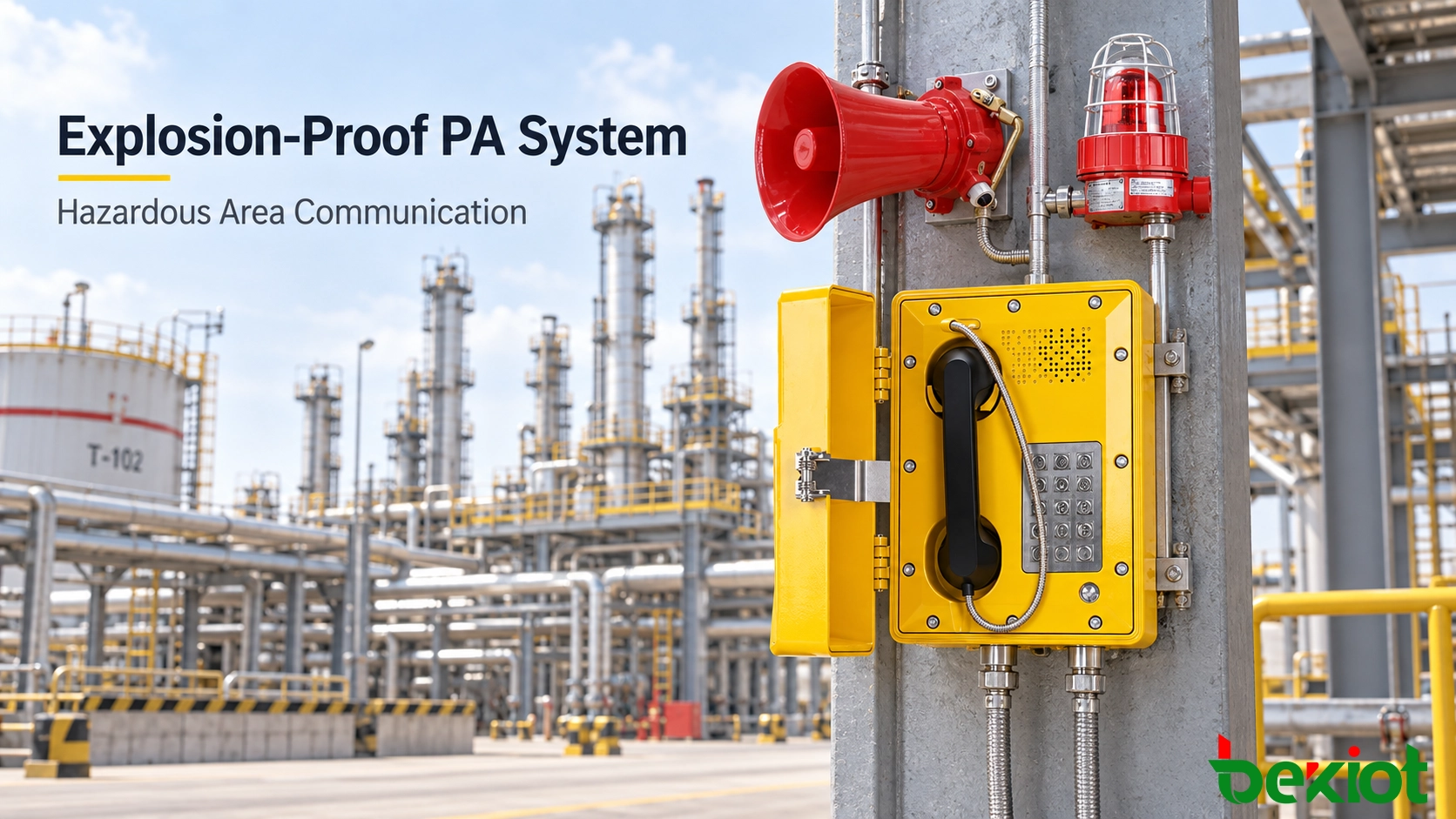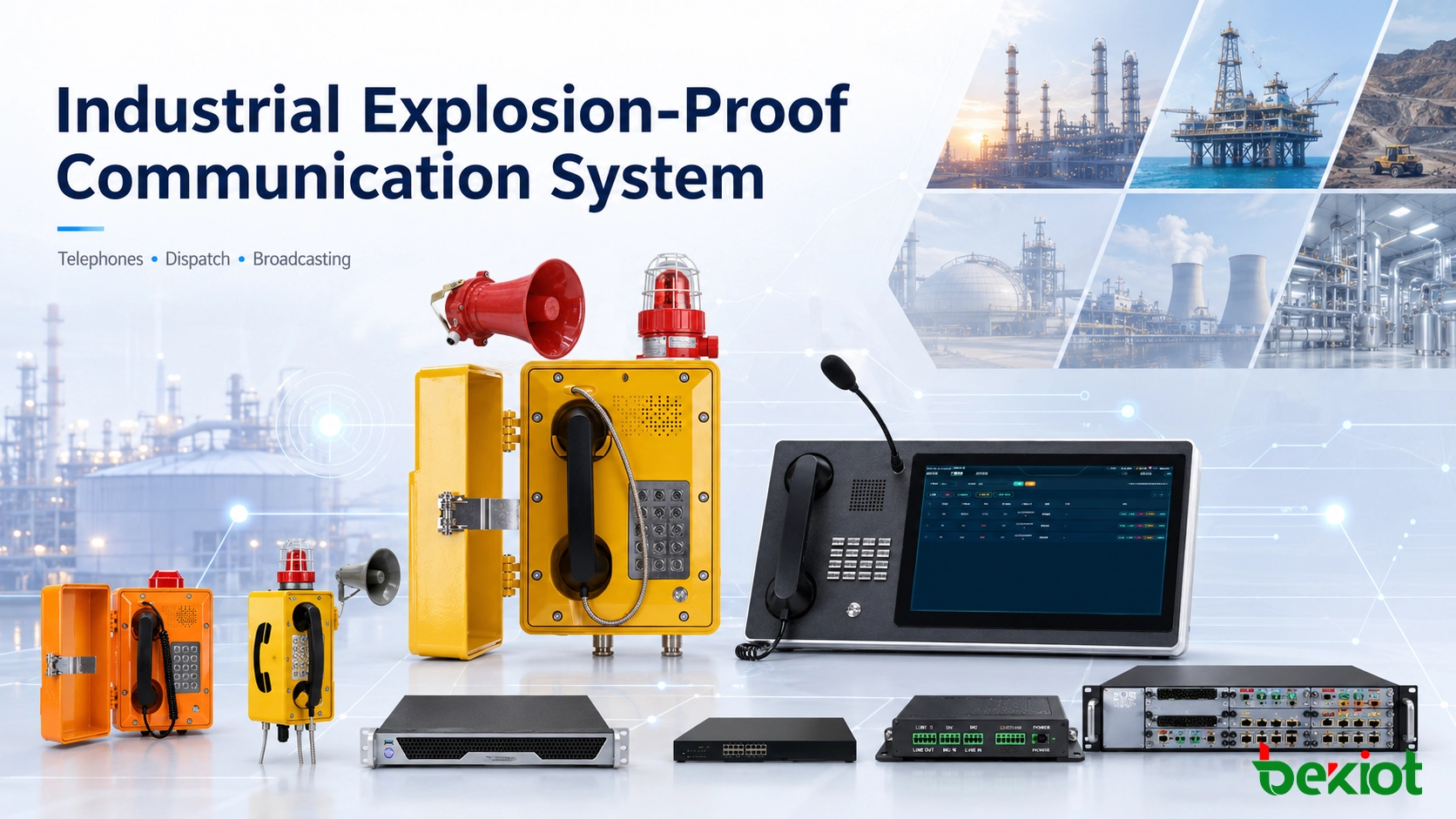
In industrial environments such as petrochemical plants, natural gas facilities, mining and metallurgy sites, power and energy projects, pharmaceutical and chemical facilities, and offshore engineering operations, on-site communication supports more than routine production coordination. It is also essential for reporting equipment failures, requesting assistance, and responding to emergencies. When a leak, fire, equipment shutdown, or personnel injury occurs in a hazardous area, field workers must be able to contact the control room quickly, while dispatch personnel need to identify the location, coordinate relevant teams, and continue issuing response instructions.
In many traditional projects, explosion-proof telephones, analog lines, public address systems, radio communication, and dispatch platforms are built separately. Without unified numbering, a common operating interface, or centralized records, organizations may experience difficulties identifying the source of a field call, contacting responsible personnel, distributing emergency notifications, and troubleshooting communication failures.
The Becke Telcom industrial explosion-proof communication solution is built around explosion-proof telephones and an industrial dispatch system. It brings SIP terminals, analog telephones, public address and intercom systems, recording services, and existing communication resources onto one platform, forming an industrial communication system that covers field calls, dispatch operations, zoned broadcasting, communication records, and system maintenance.
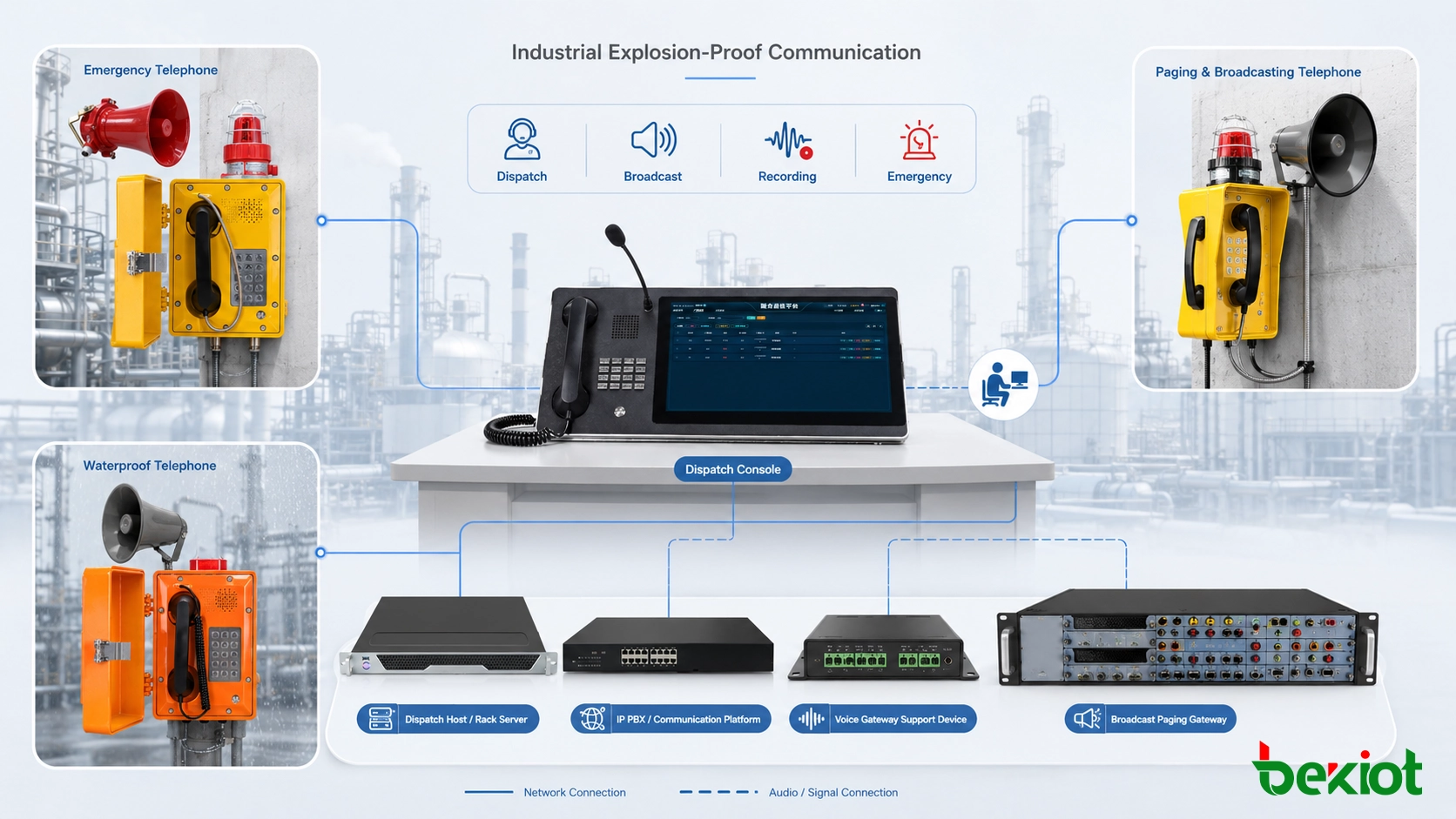
Industrial explosion-proof communication system connecting hazardous-area telephones, dispatch consoles, broadcasting, recording, and emergency response resources.
Related Product: EX-BH621 Explosion-Proof SIP Telephone
1. Why Integrated Communication Is Needed
Problems with Separate Legacy Systems
Independent systems: Explosion-proof telephones, broadcasting systems, analog exchanges, and radio systems operate separately, requiring dispatchers to switch between different devices and interfaces.
Fragmented numbering: Different areas and systems use separate numbers and operating procedures, making it difficult to locate the correct responsible position during an emergency.
Limited emergency coordination: Field calls, alarms, video systems, and broadcasting cannot be handled through one workflow, so information still depends heavily on manual relay.
Incomplete records: Call recordings, alarm records, and dispatch operations are stored separately, making incident review and accountability more difficult.
Difficult expansion and maintenance: Adding terminals or upgrading legacy lines requires separate changes across multiple systems, increasing implementation and troubleshooting work.
Practical Benefits of System Integration
After explosion-proof telephones are connected to the dispatch system, each field terminal becomes a fixed communication point on the dispatch platform. Dispatchers can view numbers, areas, and assigned positions through one interface, call field telephones directly, and contact production, safety, maintenance, and emergency personnel as required.
New SIP explosion-proof telephones can register directly with the communication server, while existing analog explosion-proof telephones can be connected through voice gateways. The system does not require every terminal to use the same communication interface. Integration is achieved through unified numbering, call routing, and dispatch operations.
2. System Architecture and Connection Methods
The Becke Telcom industrial explosion-proof communication solution generally consists of field terminals, an industrial network, communication core equipment, dispatch positions, and supporting access devices. The architecture can be adjusted for a single plant, multiple sites, or distributed remote stations.
Basic communication path:
Explosion-proof telephones and field terminals → Industrial switches or communication lines → SIP server or industrial dispatch host → Dispatch console, recording platform, and broadcasting system
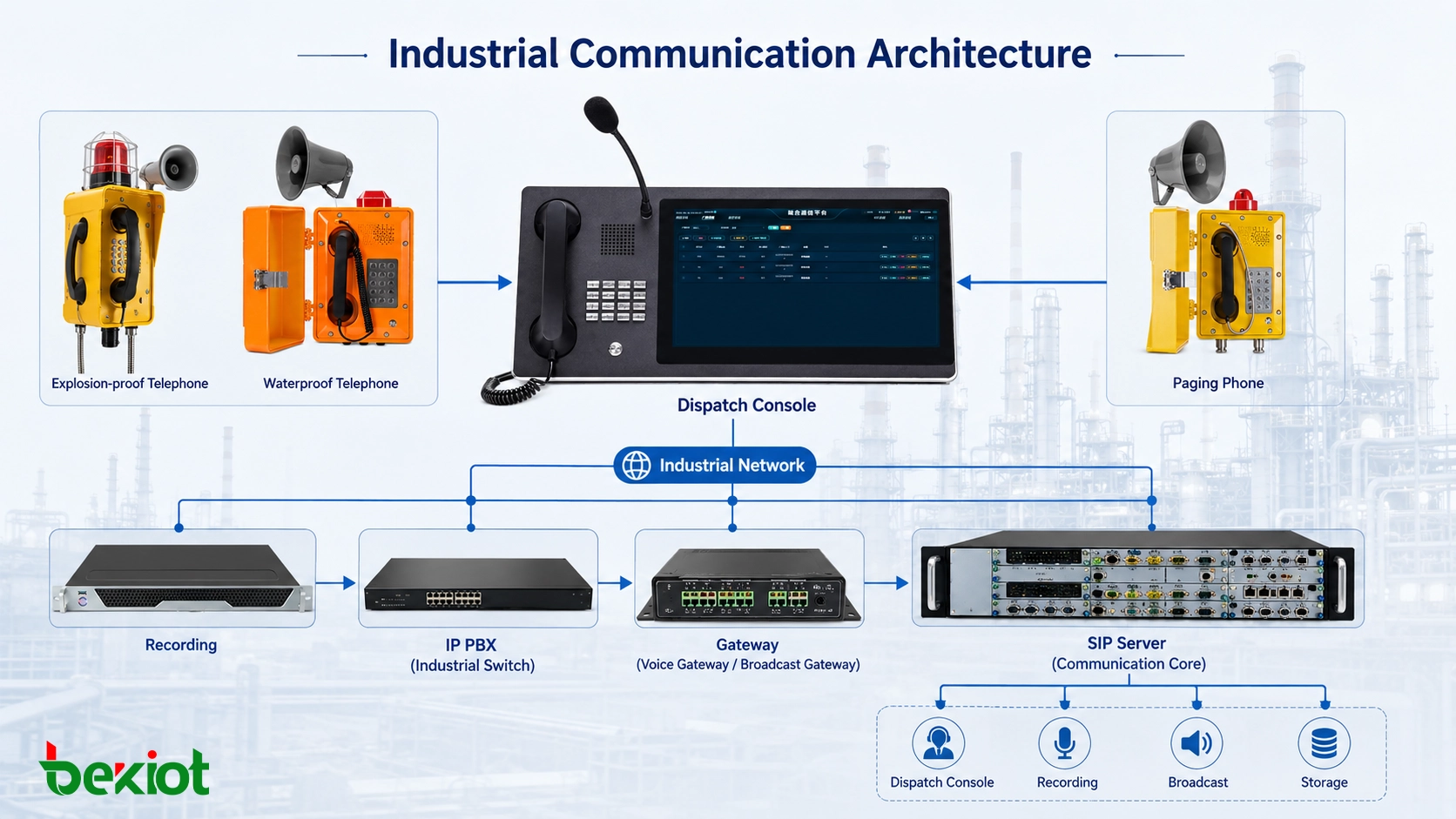
Industrial communication architecture showing explosion-proof telephones, industrial switches, SIP servers, dispatch consoles, recording platforms, and broadcasting systems.
Field Terminal Layer
Field terminals should be selected according to the classification and operating conditions of each installation area. Ordinary industrial telephones must not be used as substitutes for explosion-proof telephones in hazardous locations.
Explosion-hazardous areas: Install explosion-proof telephones, explosion-proof amplified telephones, and explosion-proof sound and light devices that meet project requirements.
General industrial areas: Industrial weatherproof telephones, IP telephones, paging telephones, and network broadcasting terminals may be used.
Emergency points: Off-hook hotline calling, one-touch calling, or a dedicated emergency button can reduce the number of steps required during an incident.
High-noise areas: High-volume ringing, amplified terminals, loudspeakers, or sound and light indicators can be selected according to the measured site noise level.
Telephones, junction boxes, cable glands, blanking plugs, external loudspeakers, and sound and light devices installed in hazardous areas should all be selected according to the area classification, hazardous substances, and project design requirements.
Network Transmission Layer
SIP terminals connect to the communication server through an industrial Ethernet network. Industrial switches, fiber-optic rings, or enterprise private networks may be used for transmission. Depending on reliability requirements, the core network can include ring protection, self-healing, redundant links, and VLAN segmentation.
Both SIP signaling and RTP media streams must remain reachable in both directions. For connections across subnets, sites, or firewalls, signaling ports, media ports, address translation, and traffic priority should be checked to prevent situations in which a terminal registers successfully but only one-way audio is available.
Communication Core Layer
The communication core normally includes SIP servers, dispatch hosts, recording services, databases, and management software. Its main functions include:
Terminal registration and number management;
Call routing and permission control;
Hotline, forwarding, group call, and conference configuration;
Storage of call records, recordings, and operation logs;
Management of terminal status and overall system operation;
Interface integration with broadcasting, alarm, video, and business platforms.
Standard servers, core switches, recording equipment, and dispatch hosts are generally installed in a safe equipment room and do not follow the same installation requirements as terminals located in hazardous areas.
Dispatch and Command Layer
Dispatch consoles can be installed in central control rooms, production dispatch centers, emergency duty rooms, or security centers. Dispatchers use a graphical interface to view areas, positions, and terminal status, and to perform calling, transferring, conferencing, broadcasting, and record searches.
Video phones, office IP telephones, or paging telephones can also be installed in management offices, duty rooms, and other positions as supplementary answering terminals outside the primary dispatch console.
3. Core Operational Capabilities
Unified Calling and Dispatch
Individual call: A dispatcher calls a specified explosion-proof telephone or industrial telephone directly.
Group call: Communication groups can be created by workshop, production unit, team, or responsibility area.
Conference: Production, safety, maintenance, and emergency personnel can be joined in the same call.
Call forwarding: If the primary dispatch position does not answer, the call can be forwarded in sequence to a backup position or duty supervisor.
Priority dispatch: Authorized users may perform functions such as call intrusion and forced call release.
Call intrusion, monitoring, whispering, and other dispatch control functions involve permissions and operational auditing. Authorized positions, permitted use cases, and log retention policies should therefore be clearly defined.
Zoned Broadcasting and Field Intercom
The dispatch platform can provide zoned announcements through SIP broadcasting terminals, paging gateways, or an existing public address system. Broadcasting zones can be organized by plant, workshop, production unit, or responsibility area.
Make live announcements to one terminal or a selected area;
Select multiple zones or the entire plant for emergency announcements;
Play scheduled safety reminders and production notices;
Convert text into voice announcements through TTS;
Interrupt routine broadcasts according to priority and play emergency content.
Telephone amplification, zoned broadcasting, and plant-wide broadcasting have different coverage requirements. Loudspeaker power, zoning methods, audio routing, and on-site sound pressure should be checked before implementation.
Alarm and Third-Party System Integration
When supported by the terminal and third-party interfaces, the platform can link field calls with video surveillance, alarm systems, sound and light devices, and emergency response plans.
When a field worker presses an emergency button, the terminal calls a specified dispatch position;
The dispatch interface displays the terminal name, number, and installation location;
Video from the associated area can be retrieved according to terminal information;
Relevant supervisors or higher-level duty positions can be notified;
Telephone calls, broadcasts, or text-message notifications can be initiated according to predefined procedures.
The scope of integration depends on the terminal model, dispatch software version, third-party interfaces, and project authorization settings. Support for SIP alone does not guarantee that every integrated function will be available.
Recording and Incident Traceability
The system can record calling and called numbers, call time, connection status, call duration, and audio files. Records can be searched by number, area, dispatch position, or time.
When integration with alarm systems, work-order platforms, production management systems, or emergency event systems is required, communication records can be linked to event numbers according to the available interfaces. This supports duty inspections, incident reviews, and evaluation of response procedures.
Status and Permission Management
The platform can display the registration and online status of SIP terminals. Depending on the configuration, alerts can be generated when terminals go offline, servers fail, or network connections are interrupted.
Different permissions can be assigned to dispatchers, administrators, and duty personnel. Standard users may perform routine calls, while higher-level dispatch positions may be authorized to initiate broadcasts, conferences, and emergency dispatch operations.
An online terminal status only confirms that the account has registered successfully. Automatic answering, group calling, broadcasting, status reporting, and dispatch control must still be verified through actual interoperability testing between the terminal, server, and dispatch software.
4. Project Implementation and Commissioning
Site Survey
Verify hazardous-area classification, hazardous substances, and project design documents;
Investigate ambient temperature, noise, rain, dust, and corrosion conditions;
Confirm existing analog lines, industrial networks, switches, and equipment-room conditions;
Review field positions, dispatch workflows, and emergency call destinations;
Determine installation locations for telephones, loudspeakers, and sound and light devices.
Solution and Number Planning
Plan extension numbers by plant, production unit, floor, and position;
Design hotline, one-touch call, and no-answer forwarding rules;
Define broadcasting zones and dispatch communication groups;
Determine connection methods for SIP, analog lines, broadcasting, and third-party systems;
Produce the system topology, equipment list, wiring relationships, and permission table.
Platform and Terminal Deployment
Deploy SIP servers, industrial dispatch hosts, and recording services;
Create extension accounts, user groups, and dispatch-position permissions;
Configure IP addresses, SIP accounts, and audio parameters for explosion-proof telephones;
Connect retained analog telephones through voice gateways;
Configure broadcasting gateways, paging devices, and related zones.
Operational Scenario Testing
Test two-way calls between field telephones and the dispatch console;
Verify off-hook hotline calls, one-touch calls, and no-answer forwarding;
Test group calls, conferences, and authorized dispatch controls;
Verify zoned broadcasting, emergency broadcasting, and sound and light alerts;
Check whether recordings, logs, and event records are complete;
Verify interoperability between analog telephones, SIP terminals, and legacy systems.
Reliability and Acceptance Testing
System acceptance should not be limited to checking whether two extensions can call each other. Real production and emergency workflows should also be simulated to verify:
Whether terminals register automatically after restarting;
Whether communication recovers automatically after a network interruption;
Whether primary and backup servers switch according to the design;
Whether servers, switches, and terminals recover normally after a short power outage;
Whether the system remains stable when several areas call simultaneously;
Whether recordings, logs, and configuration data can be searched and backed up.
5. Core Products and Configuration Recommendations
Hazardous-Area Terminals
EX-BH621 Explosion-Proof Amplified Telephone: IIC explosion-proof certification, IP66 protection, and an integrated high-power loudspeaker. It is suitable for hazardous areas in petrochemical plants, natural gas facilities, mines, and similar sites, supporting field calls, emergency communication, and amplified announcements.
When selecting hazardous-area terminals, the telephone, wiring accessories, cable glands, blanking plugs, and external explosion-proof devices should be reviewed together rather than checking only the telephone itself.
General Industrial-Area Terminals
EX-BT27 Industrial Weatherproof Telephone: Features a fiberglass enclosure and IP66 dust and water protection. It is suitable for general outdoor industrial areas, humid locations, and dusty non-hazardous points, supporting production communication and fixed-position calling.
BT25 Wall-Mounted Paging and Broadcasting Telephone: Designed for duty communication, paging, and broadcast intercom applications. It supports sound and light output, automatic answering, and one-touch calling.
Dispatch and Communication Platform
BK-RCS Series Dispatch Host: A rack-mounted system supporting multiple terminal connections and primary-backup redundancy. It handles terminal registration, number switching, call routing, and dispatch service management. Capacity and redundancy can be configured according to the number of users and reliability requirements.
DSC-BD215S Touchscreen Dispatch Console: Features a 21.5-inch touchscreen, a graphical operating interface, and dual-handset dispatch communication. It provides dispatchers with access to calling, transferring, group calling, conferencing, broadcasting, and communication record searches.
BK-SIP Series Recording Service: Stores call recordings and communication records. Concurrent recording capacity, retention period, and storage capacity should be determined according to the project scale.
Supporting Access Equipment
IPGA Series Voice Gateway: Connects existing analog explosion-proof telephones, standard analog telephones, or private branch exchanges.
BPA2S Paging and Broadcasting Gateway: Connects loudspeakers, amplifiers, or existing public address systems.
Network switches: Provide network access for SIP terminals. DIN-rail, wide-temperature, or ring-network models can be selected according to the site environment.
UPS and backup power: Provide short-term power protection for core servers, switches, and dispatch positions.
SBC or SIP trunk: Supports SIP interconnection and boundary control between multiple plants, headquarters, and branch sites.
6. Solution Advantages
Terminal Configuration by Area
Explosion-hazardous areas use explosion-proof terminals that match the area classification, while safe and general industrial areas use industrial telephones, IP phones, and paging terminals according to environmental conditions. This avoids confusing water and dust resistance with explosion protection.
Integration of SIP and Analog Systems
SIP explosion-proof telephones can register directly with the dispatch platform, while existing analog telephones connect through voice gateways. Enterprises can retain serviceable copper cabling and analog terminals while upgrading the system in stages.
Unified Numbering and Dispatch Interface
Explosion-proof telephones, industrial telephones, office IP phones, analog terminals, and broadcasting devices can be managed according to unified numbers, areas, and permissions, reducing the need to switch between multiple communication systems.
Configurable Reliability
Depending on project requirements, the system can include primary-backup servers, redundant switches, fiber rings, backup links, and UPS protection. Remote sites can also be equipped with local communication capability so that internal calls remain available when the central connection is interrupted.
Easier Expansion and Maintenance
New points can be added within the existing numbering, network, and permission structure. Centralized management of terminal status, call records, and system logs also helps maintenance personnel locate network, account, or device faults.
7. Typical Applications
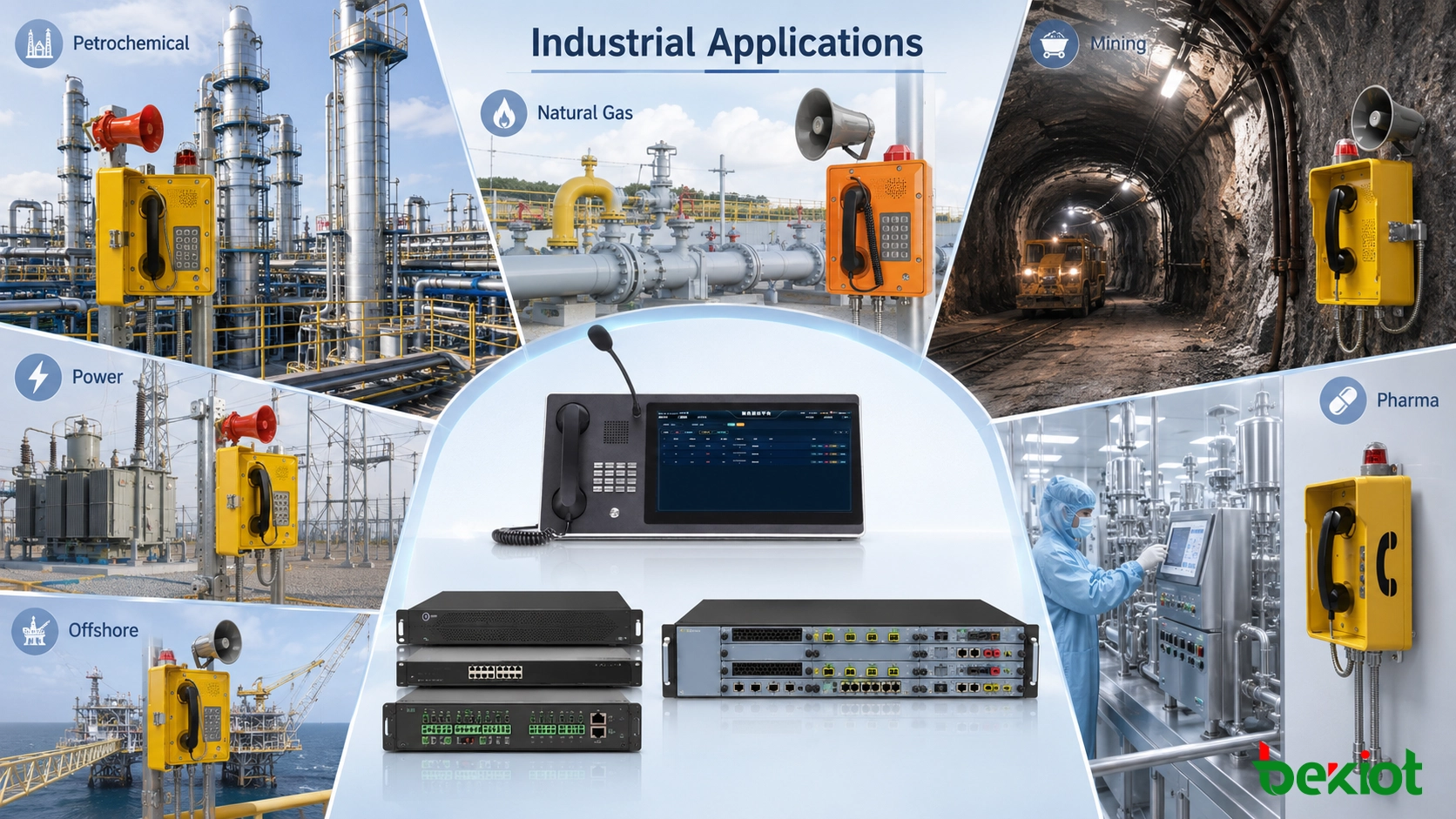
Explosion-proof communication applications across petrochemical plants, natural gas facilities, mines, power stations, pharmaceutical sites, and offshore engineering projects.
Petrochemical industry: Refining units, tank farms, pump rooms, loading areas, and production dispatch centers.
Natural gas and energy: LNG stations, gas facilities, oil and gas pipelines, hydrogen refueling stations, and energy bases.
Mining and metallurgy: Underground roadways, mineral processing plants, crushing areas, smelters, and dispatch centers.
Power industry: Power plants, substations, fuel conveying areas, and remote stations.
Pharmaceutical and chemical production: Raw-material workshops, synthesis areas, solvent storage areas, and hazardous-material warehouses.
Offshore engineering: Offshore platforms, ports, vessels, and coastal industrial facilities.
Integrating explosion-proof telephones with an industrial dispatch system involves more than simply adding field telephones. It requires a unified communication structure built around installation areas, operational workflows, communication networks, and emergency response procedures. Only when terminal selection matches site conditions, call routes are clearly defined, dispatch permissions are properly assigned, and realistic scenarios are tested can the system perform reliably during routine production and emergency events.
Becke Telcom provides explosion-proof telephones, explosion-proof amplified telephones, industrial weatherproof telephones, industrial dispatch hosts, dispatch consoles, voice gateways, recording services, and broadcasting and intercom equipment. Based on hazardous-area requirements, ambient noise, existing communication lines, and operational workflows, Becke Telcom can support terminal deployment, number planning, system connection, and functional commissioning to establish a stable, manageable, and traceable communication channel for industrial sites.