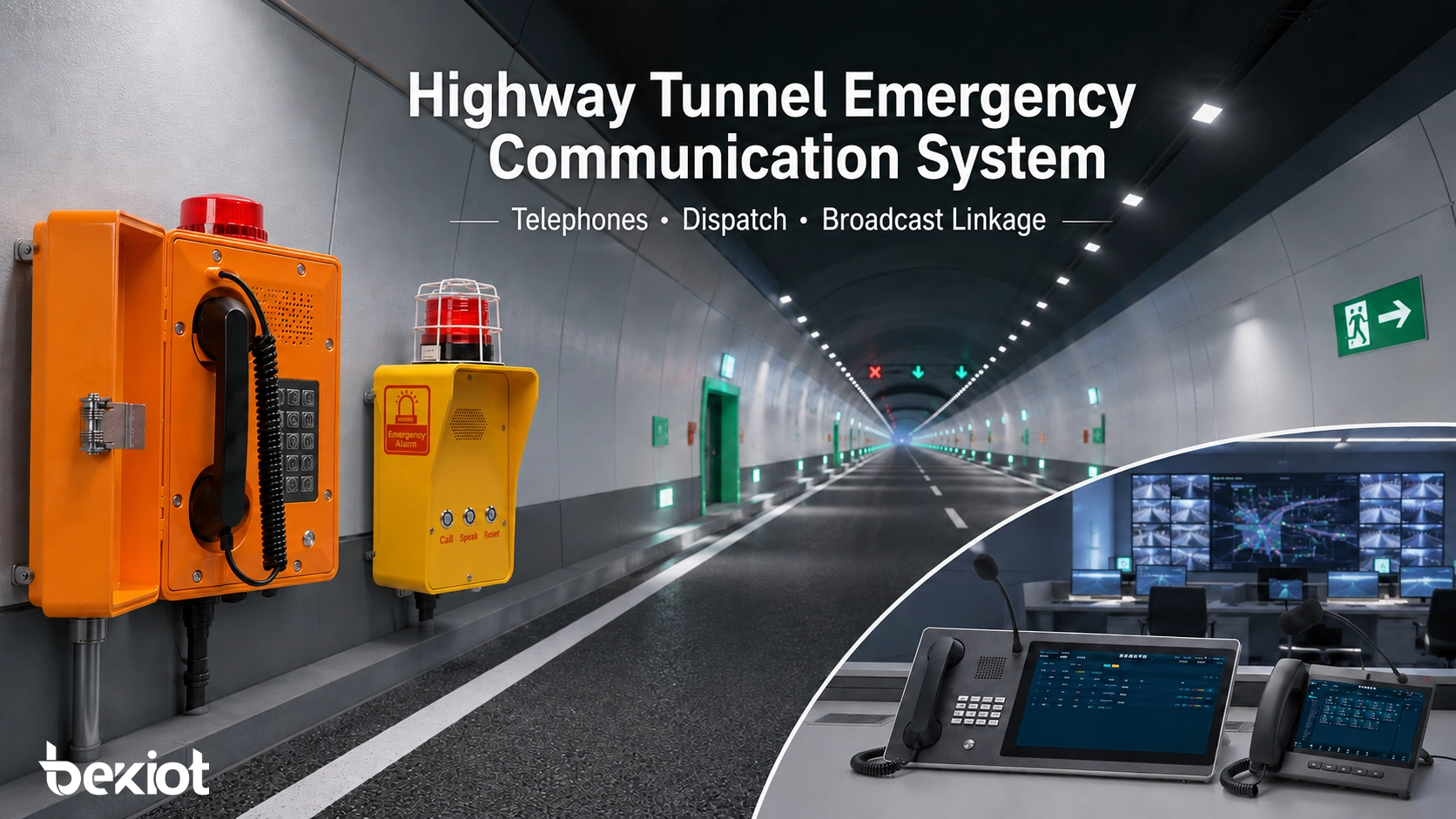
Highway tunnels are long, enclosed environments containing emergency parking bays, vehicular cross passages, pedestrian cross passages, substations, ventilation rooms, firefighting points, and communication equipment rooms. When a vehicle collision, fire, equipment failure, or request for assistance occurs, people at the scene need to contact the tunnel control center quickly. Operators must also identify the incident location and notify inspection, maintenance, firefighting, and traffic management personnel.
Mobile phones are affected by network coverage, battery condition, and operating conditions at the scene, so they should not serve as the tunnel’s only emergency communication method. Standard office telephones are also unsuitable for prolonged exposure to humidity, dust, vehicle vibration, and continuous noise. A tunnel emergency communication system therefore requires fixed industrial telephones connected through a SIP dispatch platform to broadcasting, video surveillance, and recording systems, allowing every field call to enter the control center’s incident-handling workflow directly.
Communication Challenges in Highway Tunnels
Tunnel communication points are distributed along the roadway, often far from the control center. After an incident occurs, a caller may be unable to provide the exact chainage or travel direction. In smoke, darkness, or a stressful situation, relying only on a verbal location description can delay assessment.
When telephones, public address systems, video surveillance, and fire alarms operate independently, an operator receiving an emergency call must separately locate the relevant camera, broadcast zone, and response-team contact. Repeatedly switching between platforms adds unnecessary steps and increases the risk of matching the wrong device or location.
Tunnel ventilation fans, traffic, and electromechanical equipment also generate continuous noise, making an ordinary telephone ringer difficult to hear. Equipment rooms, areas associated with dangerous-goods vehicles, or other special locations identified through a risk assessment may require explosion-proof telephones selected according to the hazardous-area classification.
System Components and Access Architecture
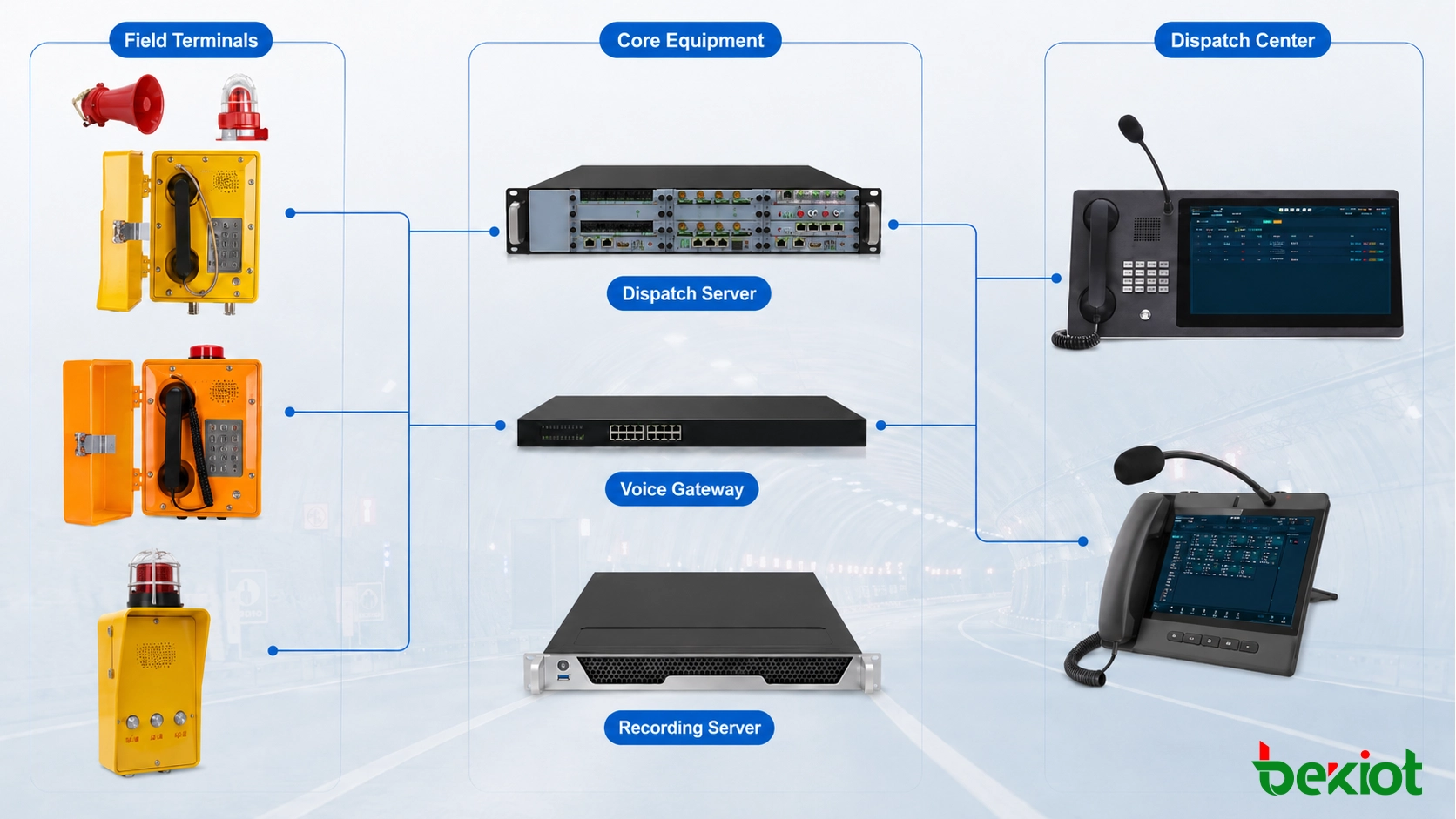
A highway tunnel emergency communication system generally consists of field communication terminals, a transmission network, a dispatch platform, broadcasting and alarm equipment, and a recording management system. Telephones installed along the tunnel connect to the control center through an industrial Ethernet network, fiber-optic ring, or dedicated communication network. Operators use a centralized interface to answer calls, check terminal status, and initiate communications.
| System Section | Main Equipment | Primary Purpose |
|---|---|---|
| Field Communication | Industrial weatherproof telephones, emergency help phones, explosion-proof telephones | Incident reporting, equipment fault reporting, and field communication |
| Dispatch Communication | Dispatch console, SIP dispatch telephone, dispatch server | Incoming call handling, personnel calling, and emergency command |
| Broadcasting and Alarm | Horn loudspeakers, paging terminals, audible and visual alarms | Zone announcements, traffic warnings, and evacuation instructions |
| Recording Management | Recording server, operations management platform | Storage of calls, broadcasts, and dispatch operation records |
| Legacy System Access | Voice gateway | Integration of existing analog telephones and communication lines |
Each field telephone should be registered with the tunnel name, traffic direction, chainage, equipment number, and installation location. When a call reaches the dispatch console, the operator can see the terminal identity immediately instead of spending additional time asking where the call originated.
Related Systems: Integrated Command and Dispatch Solution for Expressways
Existing analog emergency telephones can connect to the SIP dispatch system through a voice gateway. Existing equipment does not need to be replaced all at once, allowing new and renovated tunnel sections to be implemented in stages according to network conditions.
Field Communication Terminal Deployment
Main Tunnel and Emergency Parking Bays
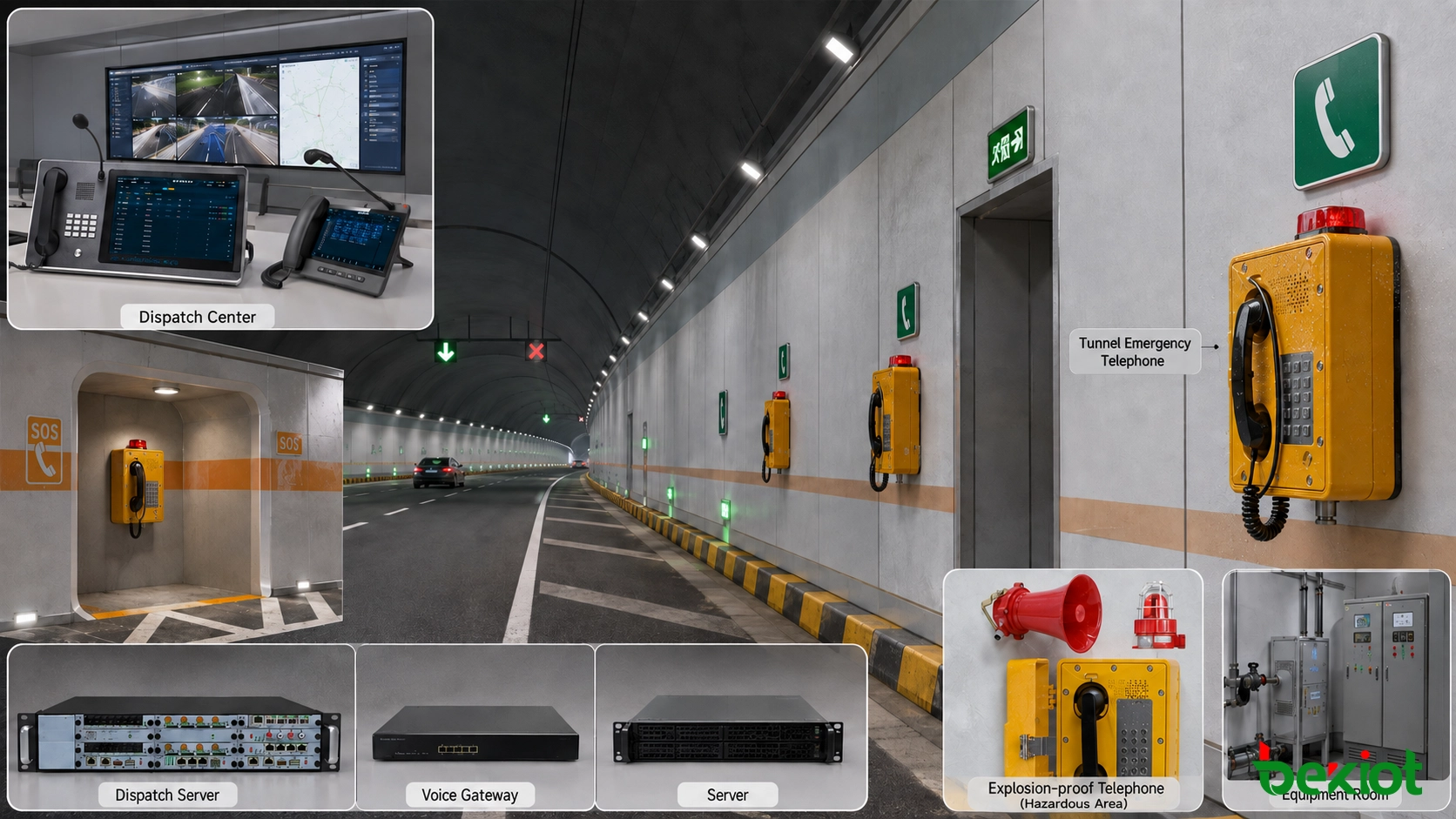
Industrial weatherproof telephones or emergency help phones are suitable for emergency parking bays, tunnel portals, and fixed assistance points along the roadway. Terminals should have highly visible markings, simple operation, and reliable environmental protection so that motorists or tunnel users can contact the control center during a vehicle breakdown or emergency.
Vehicular and Pedestrian Cross Passages
Cross passages support vehicle transfer, personnel evacuation, and emergency rescue. One-touch calling terminals can be installed at these locations. After receiving a call, the operator can identify the exact cross passage from the terminal name and issue evacuation or waiting instructions through the nearby broadcast zone.
Equipment Rooms and Substations
Industrial telephones can be installed in ventilation rooms, pump rooms, substations, and communication equipment rooms, allowing maintenance personnel to contact the control center. Enclosure material, ingress protection, operating temperature, and installation method should be selected according to local humidity, dust, and equipment noise.
Special Hazardous Locations
Explosion-proof telephones are not a standard requirement for every highway tunnel location. They are necessary only where a risk assessment confirms the presence of flammable gases, combustible dust, or another explosive atmosphere. The selected communication terminal must have certification matching the hazardous substance, area classification, and temperature group.
Control Rooms and Management Stations
The tunnel control center should use a visual dispatch console, while management stations and duty rooms can be equipped with SIP dispatch telephones. Both types of terminals connect to the same numbering system, supporting routine communication, call transfer, and coordination between operational roles.
Communication Control at the Dispatch Center
The dispatch console displays communication targets according to tunnel section, chainage, traffic direction, and job role. It also shows whether each terminal is online, offline, idle, ringing, or in a call. Operators can select a location directly without memorizing large numbers of telephone extensions.
When a field telephone calls the control center, the dispatcher can answer directly or transfer the call to an inspection, maintenance, or management position. When several departments need to participate, the dispatcher can connect field personnel, the maintenance team, and the responsible manager to the same call, reducing repeated relaying of information.
Emergency help calls can be assigned a higher calling priority. When an important communication line is occupied, authorized personnel may use call intrusion, forced release, or monitoring functions where these capabilities are included in the project. Access should be limited to designated positions, and every operation should be recorded.
The management platform should generate an alert when a terminal goes offline, loses its network connection, or fails to register. Maintenance personnel can then use the equipment number and installation location to arrange an inspection, preventing a field telephone from remaining unavailable without being noticed.
Telephone, Broadcasting, and Video Integration
Emergency communication cannot stop after a telephone call is answered. After receiving a request for assistance, the control center must use nearby video feeds to determine the nature of the incident, notify the relevant response personnel, and issue announcements to the affected tunnel section.
A vehicle collision inside a tunnel can be handled through the following process:
A driver or person at the scene calls the control center using an emergency telephone;
The dispatch console displays the tunnel, travel direction, and chainage of the telephone;
The operator answers the call and opens nearby camera feeds to verify the situation;
Inspection, rescue, or maintenance personnel are notified according to the incident conditions;
The nearby broadcast zone instructs approaching vehicles to slow down or stop;
If evacuation is required, broadcasting and audible-visual alarms near the cross passage are activated;
Field feedback, dispatch calls, and broadcasting operations are written into the same incident record;
After the incident is resolved, the operator confirms that the event is closed.
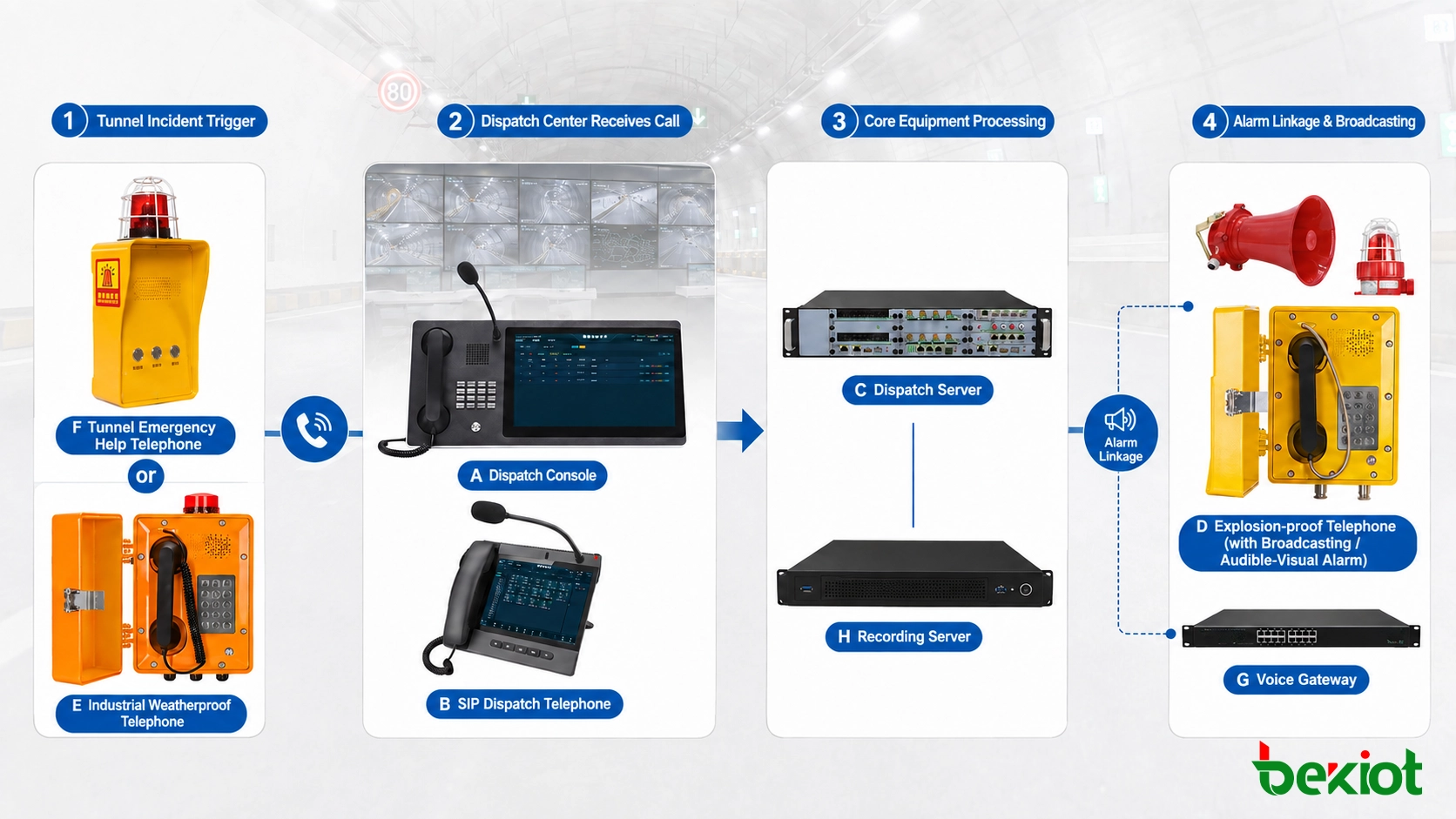
Telephone points, camera numbers, and broadcast zones should be mapped during system construction. When a call arrives, the operator can then open the nearest video feed and select the relevant broadcast area without searching for equipment numbers again.
When integrating with a fire alarm, traffic incident detection, or tunnel supervisory platform, the interface method, trigger conditions, and control permissions should be defined in advance. Actions involving lane closures, personnel evacuation, or equipment shutdown should retain a manual confirmation step.
Call Recording and Incident Records
The recording system stores important calls between field telephones, dispatch consoles, and management positions. It also records the calling number, called number, call time, connection status, call duration, and operator position.
Managers can search records by tunnel name, telephone number, chainage, time, or incident number. When one incident involves several calls, transfers, broadcasts, and field updates, the records can be arranged chronologically to reconstruct the complete response process.
Recordings support more than incident reviews. They can also be used for duty inspections, equipment fault tracking, and confirmation of operational instructions. For example, records can show when the maintenance team received a task, whether a traffic warning was issued, and when the tunnel was reported ready to reopen.
Recording retention periods, backup locations, search permissions, and export rules should be configured according to tunnel operating procedures. Important records should be protected from deletion or modification by ordinary user accounts.
Reliability and Project Implementation
A highway tunnel communication system must operate continuously. Long tunnels, tunnel groups, and important transport routes can be equipped with redundant dispatch servers, redundant application servers, fiber-optic rings, UPS power supplies, and network operation alarms according to their management level.
If a core device fails, the standby equipment should take over the main communication services as quickly as possible. Numbering data, terminal configurations, and recording files require regular backups to prevent a single equipment failure from causing the simultaneous loss of system settings and historical records.
Before formal deployment, the project should test terminal registration, voice quality, hotline calling, automatic answering, call transfer, broadcasting, recording, and offline alarms. SIP equipment also requires verification of audio codecs, DTMF transmission, call control, and interoperability between devices from different manufacturers.
Field installation should include a final check of telephone numbers, actual installation locations, chainage markings, and platform names. The control center can identify the correct location during an emergency only when the terminal information matches the physical site.
Operational Results After Deployment
After implementation, the tunnel has fixed emergency calling points along the route, allowing people at the scene to contact the control center from a nearby terminal. Operators can identify the travel direction and chainage from the incoming call information, open the nearest video feed, contact the appropriate response personnel, and issue broadcast instructions.
Centralized terminal monitoring makes offline devices and network faults easier to detect. Storing telephone, broadcasting, and dispatch records under the same incident also reduces the need to manually collect data from several independent systems during duty inspections or incident reviews.
Becke Telcom can configure industrial weatherproof telephones, explosion-proof telephones, SIP dispatch telephones, dispatch consoles, dispatch servers, voice gateways, recording servers, and broadcasting terminals according to tunnel length, point distribution, environmental conditions, and existing network resources. The system provides reliable fixed communication for routine tunnel operation, electromechanical maintenance, and emergency response.