


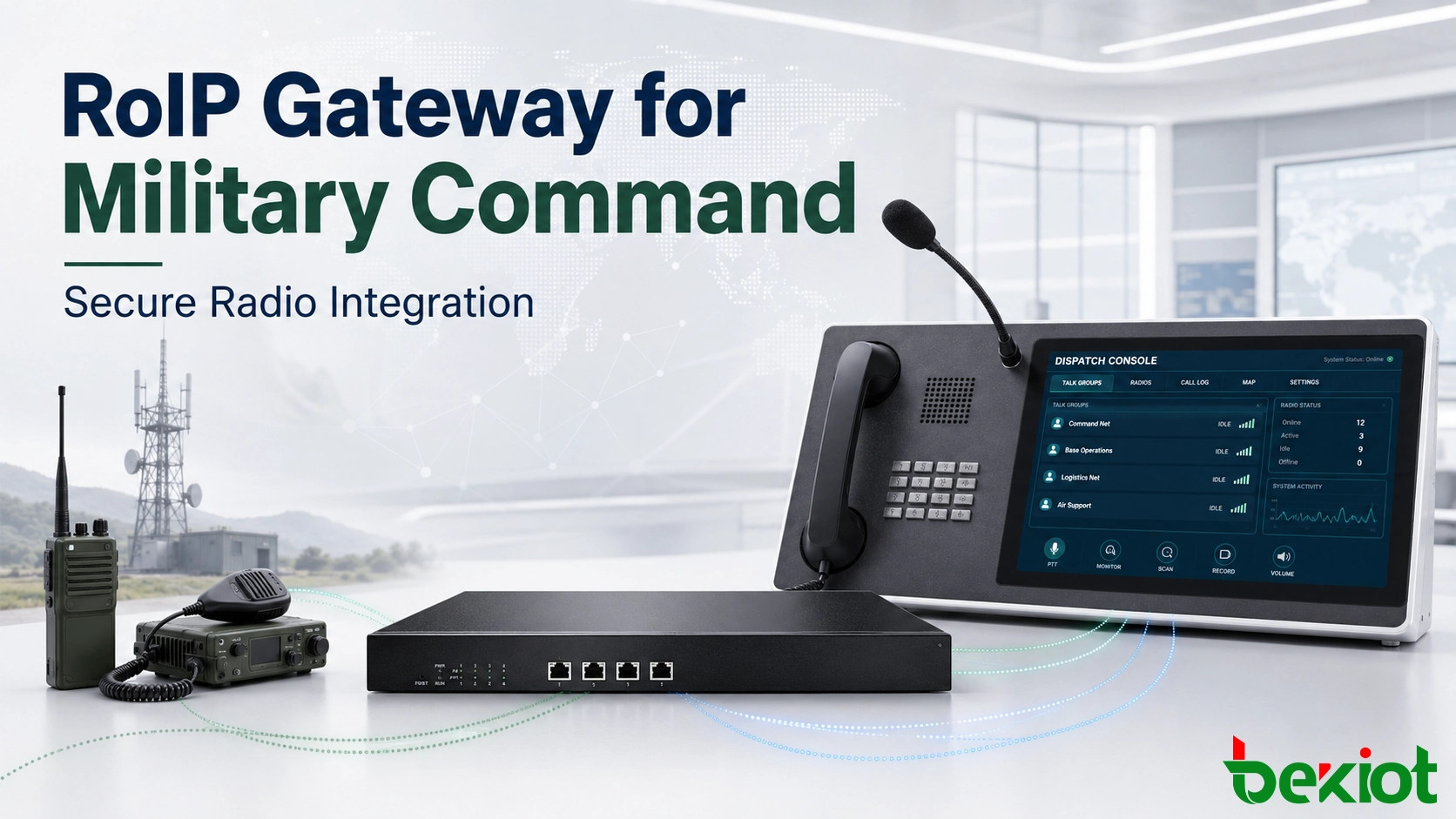
Field radio remains essential when teams need immediate, group-based and half-duplex voice communication. The difficulty appears when separate units use different radio systems, command personnel work far from the radio site, or a telephone and dispatch network must communicate with users who only carry radios. A Radio over IP gateway provides the bridge: it takes radio audio and control signals, carries them across an IP network, and presents the channel to another radio site, a dispatch platform or a compatible voice system.
The value of this approach is not that it replaces the radio network. It extends existing radio assets into a distributed command environment. Radios can remain close to the coverage area while operators monitor and control them from a protected operations center connected by fiber, a private network, VPN, cellular backhaul, microwave or satellite. When correctly engineered, the same framework can also connect selected radio channels with telephones, recording services and authorized command applications.
From isolated radio networks to a coordinated voice layer
A command organization may inherit several generations of communications equipment. Conventional analog radios can operate alongside digital systems, vehicle-mounted radios, base stations, handheld terminals and shortwave or VHF/UHF equipment. Each network may have its own frequency plan, signaling method, access policy and operational group structure. Even when every system performs well on its own, users on one network may be unable to speak directly with users on another.
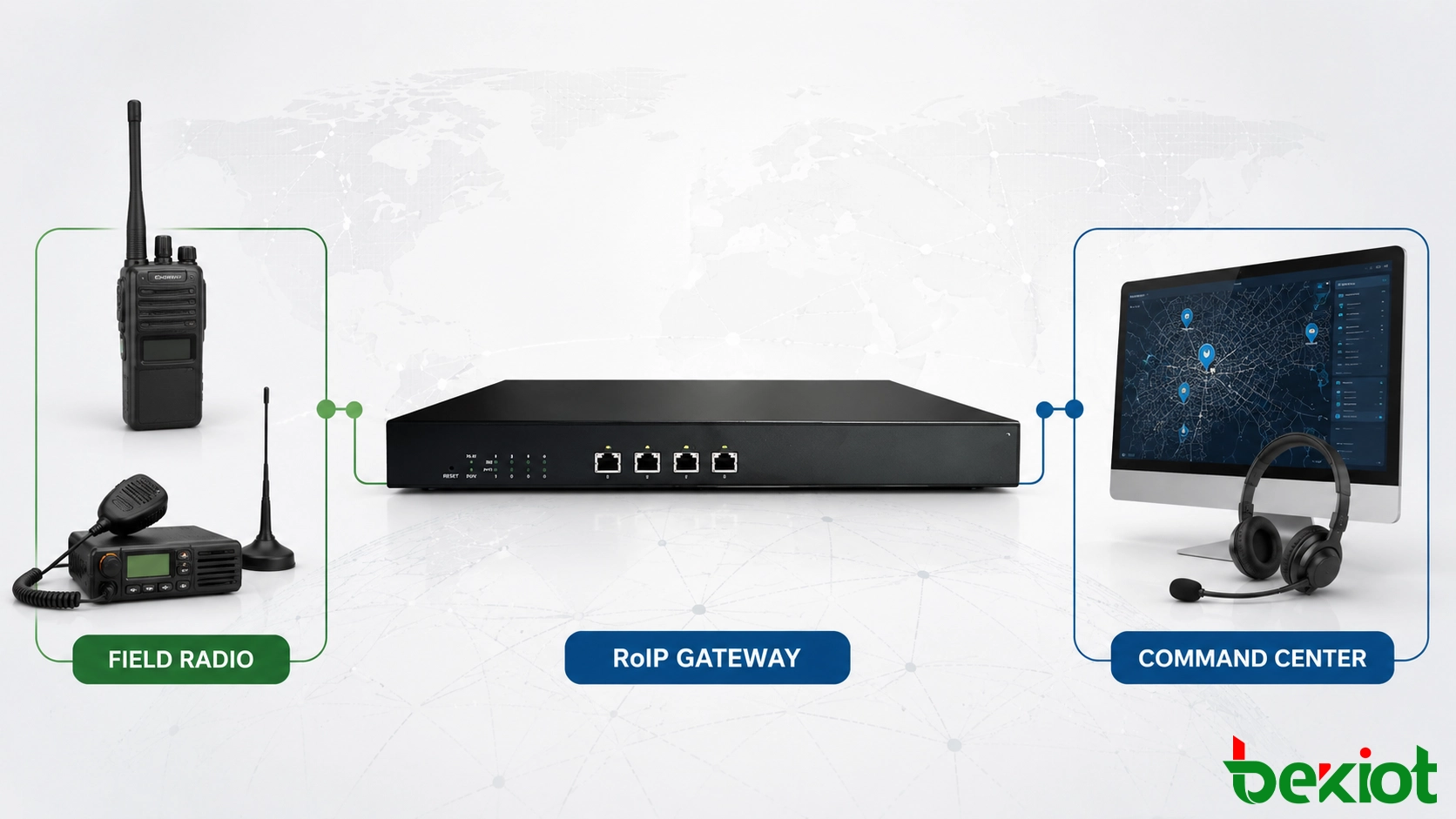
A RoIP gateway creates a controlled voice path between these otherwise separated environments. At the radio side, the gateway connects to audio, Push-to-Talk and channel-status signals exposed by a base radio, mobile radio or other suitable interface. At the network side, it packetizes the audio and carries the associated control state over IP. A remote endpoint can reconstruct the audio and PTT operation or deliver the stream to a command platform.
This approach is especially useful when replacing every field radio is neither practical nor desirable. Existing terminals, coverage plans and operating procedures can remain in service while the command layer gains wider access. Integration can be introduced channel by channel, allowing the project team to verify behavior before connecting additional radio networks.
RoIP should not be described as universal protocol translation. Audio-and-control bridging can connect communication paths, but it does not automatically reproduce every native feature of a digital trunked radio system. Unit identity, emergency signaling, location, text messaging, encryption state and talk-group management may require dedicated protocol interfaces or support from the radio infrastructure. A reliable design begins by separating the voice interoperability requirement from these higher-level services.
How voice and PTT move across the network
The communication path begins with a radio interface selected for the specific equipment. Audio from the receiver enters the gateway together with a receive-state indication such as COR, COS or squelch status. The gateway encodes the audio, attaches the necessary session and control information, and transmits it to the authorized IP endpoint.
In the opposite direction, an operator presses PTT on a dispatch console, telephone interface or remote control application. The remote gateway or radio interface asserts the transmit control, waits for the radio to enter transmit state when required, and then sends the operator's audio to the radio. Release timing is also important: if PTT drops before the final audio packets are played, the last words may be clipped.
The network path may use a local area network, a managed wide area network or an encrypted tunnel over another bearer. Fiber is useful for fixed sites requiring predictable capacity. Private cellular, 4G/5G, microwave and satellite can extend coverage where fixed infrastructure is unavailable, but each bearer introduces different latency, jitter, availability and security considerations. The gateway cannot remove those limitations; it must be configured as part of an end-to-end network design.
Where the gateway supports SIP integration, the radio channel can be presented to a softswitch, IP PBX or dispatch server. This allows an authorized telephone user to monitor or speak to the radio channel through a controlled call route. The system must still preserve half-duplex discipline: telephone users are accustomed to simultaneous speech, while radio users generally take turns transmitting. Clear PTT indication and talk-permission logic prevent both sides from speaking over one another.
Capabilities that matter inside the command center
A military command communication solution should be designed around operational workflows rather than a list of gateway ports. The following capabilities determine whether the radio-to-IP path is useful during routine coordination and high-pressure events.
Radio and telephone interworking: approved telephone extensions or command voice terminals can access selected radio channels without giving every staff member a separate radio.
Shared channel monitoring: authorized personnel can hear field radio traffic through headsets, operator positions or a controlled room audio system, improving common situational awareness.
Remote PTT operation: command operators can transmit through a radio located at another site while retaining the radio network's familiar push-to-talk behavior.
Cross-network voice patches: two otherwise incompatible radio channels can be connected for a defined mission or coordination period, subject to interface and policy approval.
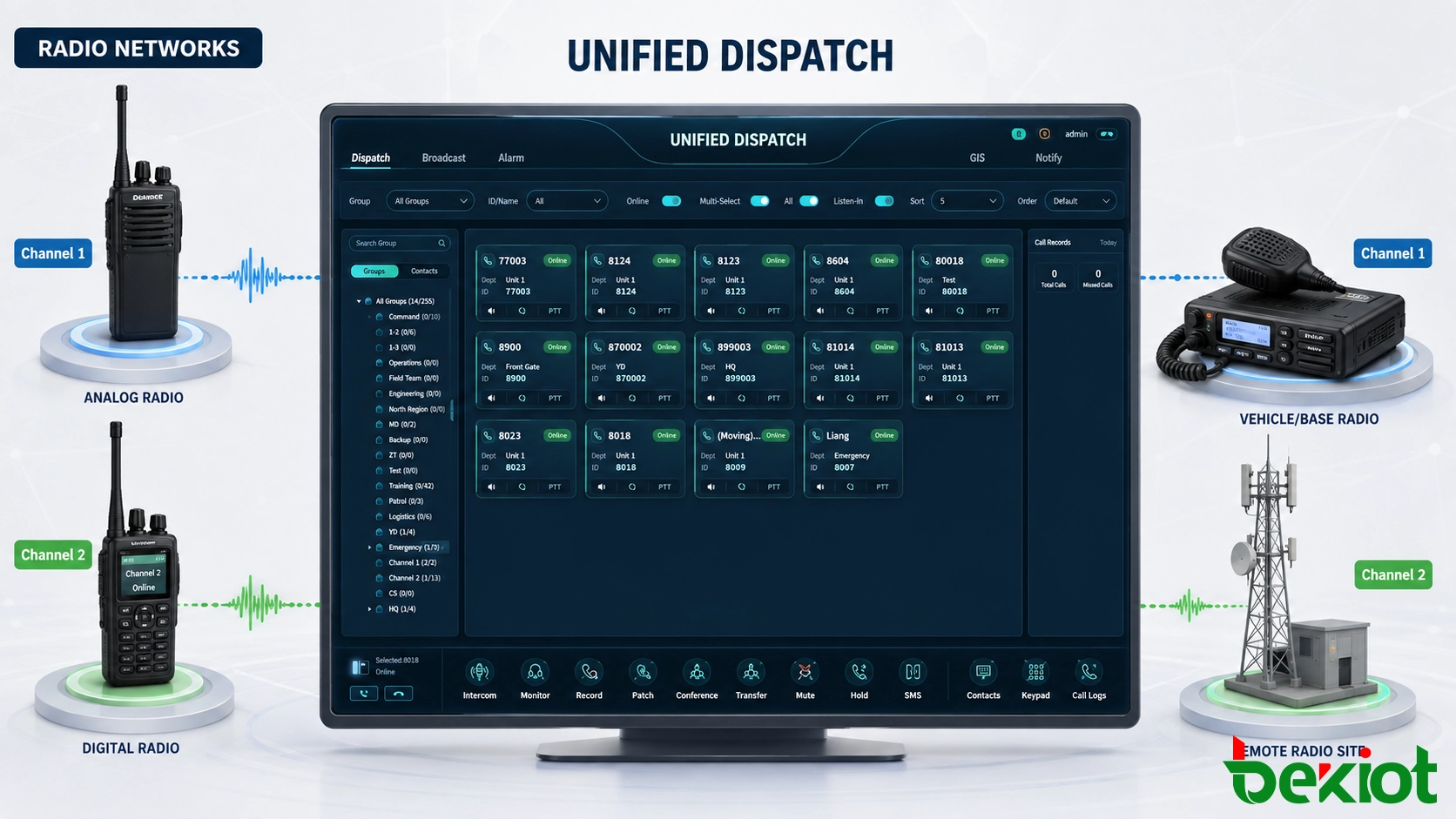
Central dispatch access: multiple radio channels can appear on one operator interface alongside compatible voice services, reducing the need to monitor several standalone control stations.
Recording and event review: when policy permits, radio audio, operator actions and time information can be captured by the dispatch or recording layer for incident reconstruction and training.
Distributed site management: gateway and radio-link status can be supervised from the center so communication faults are identified before a channel is urgently needed.
The Becke RoIP gateway solution is intended for voice-to-IP conversion, PTT control, remote dispatch access and radio-network bridging across fiber, VPN, cellular or satellite-backed IP connections. It can form the radio access layer of a broader command and dispatch system without requiring the article to depend on a specific model or port count.
A distributed design keeps radio coverage close to the field
One of the strongest arguments for RoIP is the ability to separate the radio site from the main command center. Antennas and base radios can be placed where terrain, coverage and radio-frequency planning require them. The command platform, operator positions and voice services can remain at another location connected through the operational IP network.
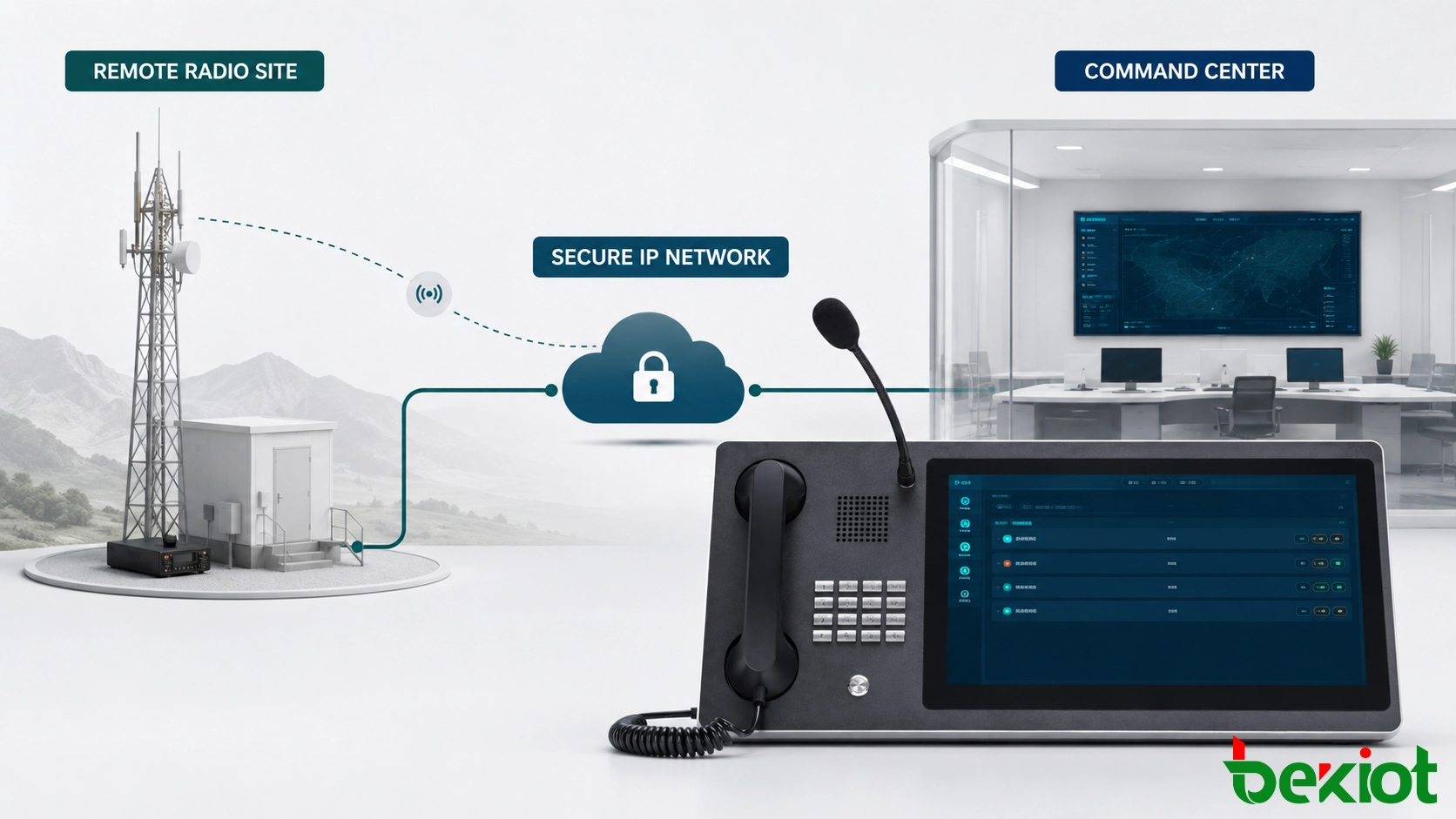
A typical distributed design contains three layers:
Remote radio layer. A base or vehicle radio provides access to the local radio network. The RoIP gateway interfaces with audio, PTT and receive-state signals. Local power, antenna protection and environmental requirements are handled at the site.
Transport layer. One or more IP paths carry encoded audio, control and management traffic. Network segmentation, traffic priority, encryption and route failover are applied according to the security design.
Command layer. Dispatch consoles, approved telephones, recording services and management tools provide operators with controlled access to the connected radio channels.
Keeping radio equipment at remote sites helps the organization choose better antenna locations and extend coverage without relocating the command staff. It also prevents the loss of one radio site from automatically removing every command function. This is a resilience benefit, not a guarantee of survivability: power, network routes, antennas, gateway nodes and command applications all require independent protection and fallback planning.
Multiple sites can be connected to one command center, and an alternate center can be prepared to assume access when the primary location is unavailable. The design should define which center controls PTT, how conflicting requests are handled and whether local personnel can retain radio access when the WAN is interrupted. Without clear ownership rules, redundant connectivity can create contention rather than resilience.
Reliability and security must be engineered together
Moving radio audio onto IP expands operational reach, but it also introduces dependencies that do not exist in a standalone radio. The project team must protect the voice path without making it too complex to operate. Security controls, network quality and radio behavior should therefore be tested as one system.
Protect the management and media paths
Gateways should be placed on controlled network segments with access limited to approved endpoints and administrators. Management services that are not required should be disabled. Strong authentication, secure administration, encrypted tunnels and centralized logging should follow the organization's security policy. If SIP is used, registration, call authorization and routing rules must prevent an unauthorized extension from reaching a radio channel.
Prioritize intelligibility over nominal bandwidth
Voice quality depends on more than codec selection. Packet loss, variable delay, incorrect audio levels, echo, electrical noise and poor PTT timing can make a technically connected channel difficult to use. Quality of Service should protect radio voice and control traffic during network congestion. Jitter buffering must balance smooth playback against added delay, especially on cellular or satellite paths.
Preserve local operation during network failure
A remote radio site should have a defined behavior when its link to the command center fails. Depending on the mission and system design, local radio users may continue communicating normally even though remote dispatch access is unavailable. Critical sites may require redundant power, two independent network bearers, alternate gateways or a secondary command path. Failover tests should include loss and restoration, because recovery behavior often reveals problems that a simple link-down test misses.
Control temporary interoperability
Cross-network patches should be created only by authorized operators and should have clear start, stop and timeout rules. Permanent bridging can unintentionally expand who hears a channel, create audio loops or tie up half-duplex resources. An operational interface should show which channels are connected and who initiated the patch.
Implementation steps and acceptance checks
A staged deployment reduces the risk of discovering radio-interface or workflow problems after the system reaches operational use.
Inventory the radio networks. Record radio type, channel use, audio interface, PTT method, receive indication, impedance, signal level and any restrictions on external control.
Define the interoperability boundary. State whether the requirement is remote radio access, telephone interworking, a temporary voice patch, centralized monitoring or full dispatch integration. Do not assume that voice bridging includes native trunking data.
Map roles and permissions. Decide who may monitor, transmit, create patches, change channels, review recordings and administer the gateways.
Design the transport network. Select primary and backup bearers, addressing, segmentation, VPN policy, QoS, time synchronization and monitoring. Include the expected behavior during partial network loss.
Configure audio and control timing. Set transmit and receive levels, PTT lead time, release delay, silence handling and jitter buffer values using the actual radios and endpoints.
Test one channel end to end. Verify radio-to-dispatch and dispatch-to-radio audio, busy-channel behavior, telephone access, talk permission, call release and recovery from interrupted links.
Expand in controlled stages. Add remaining radio channels only after the initial path meets acceptance criteria. Document each interface so replacement equipment can be commissioned consistently.
Acceptance should use intelligible operational messages rather than test tones alone. Operators should confirm that the first and last words are not clipped, channel changes are visible, PTT state is unambiguous and simultaneous requests are handled predictably. Network tests should introduce delay variation, congestion, packet loss and bearer failover while the radio path is active.
The final documentation should include the approved topology, radio-interface wiring, network routes, access roles, backup procedures and a fault-isolation guide. This turns the gateway from a standalone converter into a maintainable part of the command communications system.
Frequently asked questions
Does adding RoIP require replacing existing handheld radios?
Usually not. The gateway commonly connects to a compatible base, mobile or control radio, allowing existing field users to continue using their current terminals. Compatibility must be confirmed for the selected radio interface.
Who should own permission changes for connected radio channels?
Permission ownership should be shared between the radio operations authority, the command platform administrator and the network security team. No single technical administrator should change operational channel access without an approved process.
Can a deployment begin with only one remote radio site?
Yes. A single-site pilot is often the best way to validate audio levels, PTT timing, operator workflow and network behavior. The same design can then be repeated or adapted for additional sites.
What information should be retained in an audit log?
Subject to policy, useful records include administrator sign-ins, configuration changes, channel access, PTT actions, patch creation and removal, device alarms and time-synchronization status. Retention periods should be defined by the organization rather than by the gateway alone.
Should training traffic share the same permissions as operational traffic?
No. Training should use separate user roles, channel assignments or scheduled profiles wherever possible. This prevents exercises from occupying or exposing operational communication paths.







