Emergency response teams rarely arrive with a single radio system. Fire services, rescue teams, utilities, security units, contractors, and local agencies may use different radio standards, channels, or talk groups. Even when the radios are technically compatible, users assigned to different groups may still be unable to communicate directly. The result is a familiar operational problem: every team has a working radio, but the incident commander still lacks a unified voice channel.
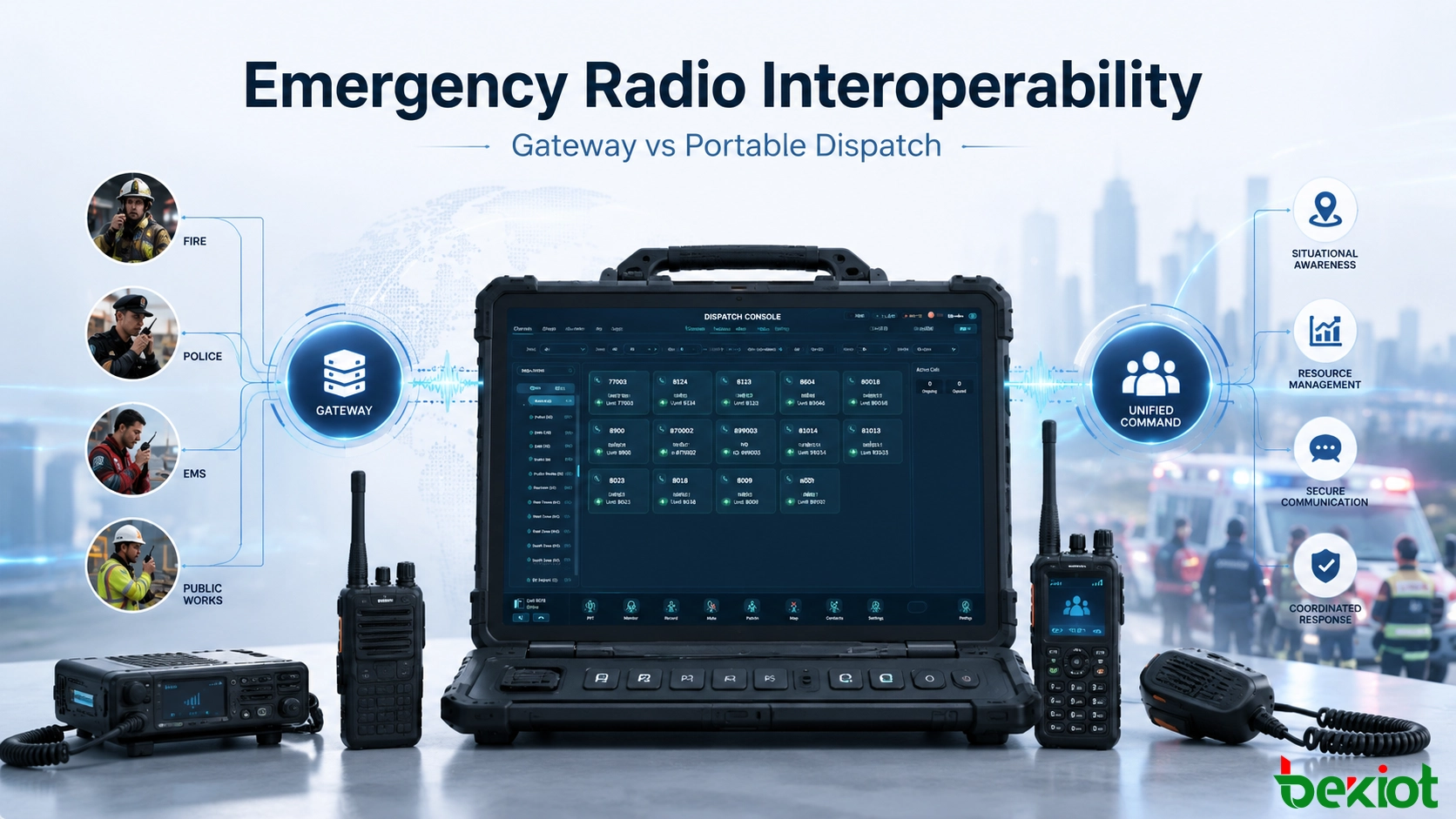
Two approaches are commonly used to solve this problem: an interoperability gateway and a portable integrated voice dispatch console. Both can connect otherwise separated radio resources, but they are designed for different levels of operational complexity. A gateway focuses primarily on establishing fixed communication paths, while a portable dispatch console adds dynamic grouping, operator control, field-to-command-center voice backhaul, and more flexible incident coordination.
Why Radio Networks Become Isolated
Radio interoperability problems are not always caused by a lack of equipment. In many emergency operations, there may already be several available radio networks. The difficulty is that these networks were originally deployed for different organizations, operating procedures, frequency plans, or technical standards.
One response team may use one radio system while another team uses a different system. Even users operating radios of the same general type may be assigned to separate channels or talk groups. Under normal conditions, that separation helps each organization manage its own communications. During a joint emergency, however, the same separation can slow coordination.
A simple incident illustrates the problem. A rescue unit reaches the site first and establishes its own radio group. A utility repair team arrives later using another radio network. A third agency is then assigned to traffic or perimeter control. All three teams can communicate internally, but no common channel exists across the entire response operation.
Without an interworking layer, information may have to be repeated manually from one radio system to another. An operator listens to one network and then retransmits the message over another. This introduces several risks:
instructions may be delayed while they are being relayed;
important details may be lost or changed during repeated transmission;
the command center may not hear the same conversation as field personnel;
new response teams may require additional communication arrangements after they arrive;
changing task groups can make manually coordinated radio channels increasingly difficult to manage.
The technical goal is therefore not simply to add another radio. The system needs a way to connect existing voice resources and, in more complex situations, reorganize those resources according to the operational structure of the incident.
Where a Fixed Gateway Fits
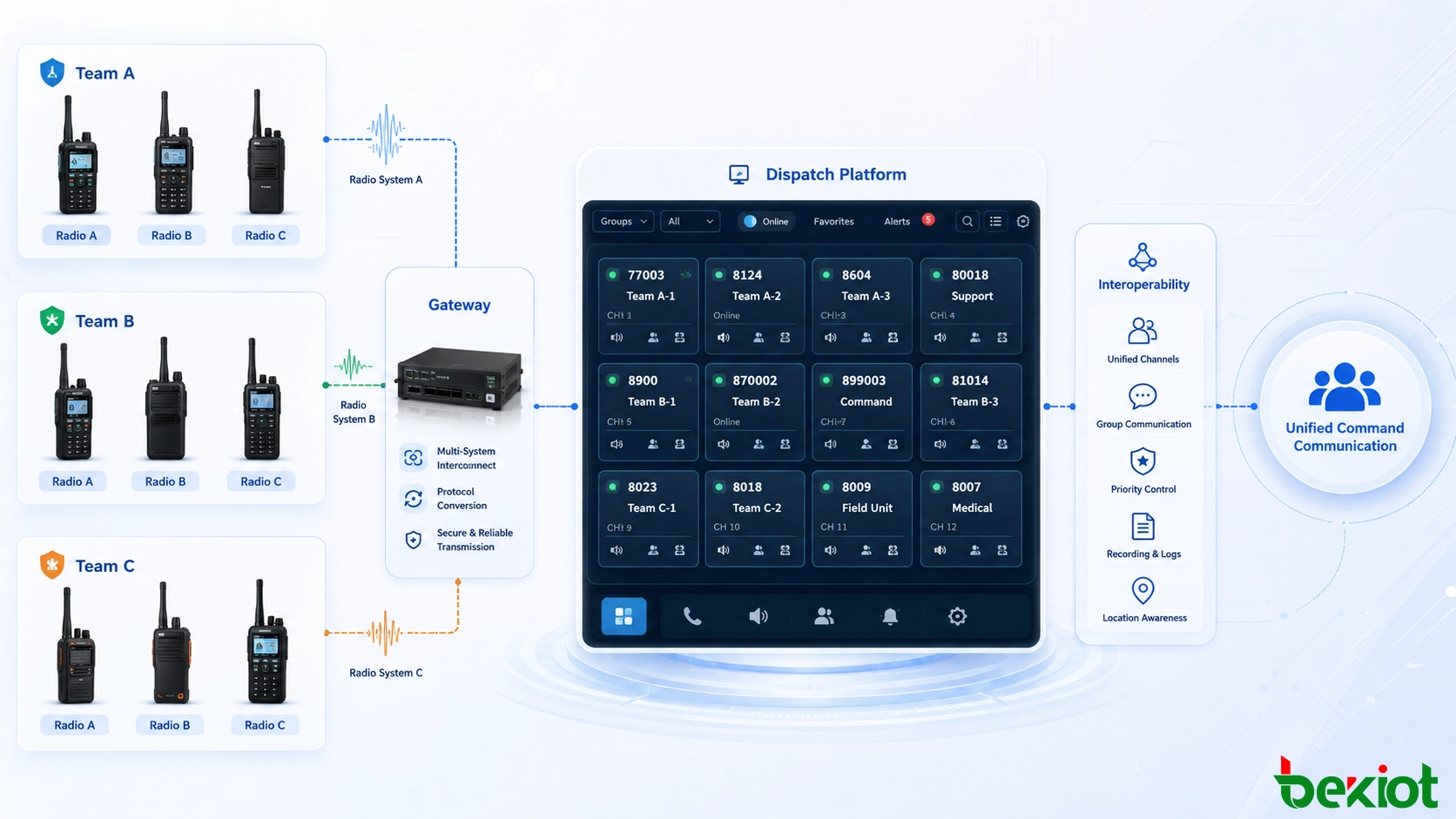
An interoperability gateway can be understood as a connection layer between otherwise separated radio systems. Multiple radios are connected to gateway ports through suitable interface cables, and the required ports are associated through system configuration.
Once two communication paths are connected, audio received from one radio can be transferred to the other side. This enables users on different radio systems to hear each other without replacing their existing handheld radios.
For a fixed application, this approach is straightforward. Suppose two departments operate independent radio networks but need permanent cross-communication. A gateway can connect one radio from each network and maintain that relationship continuously.
This architecture is particularly suitable when the communication requirement has three characteristics:
only a small number of radio systems need to be interconnected;
the relationship between those systems rarely changes;
the main requirement is basic voice interoperability rather than active dispatch management.
Its strength is simplicity of purpose. The gateway answers one fundamental question: can these separated radio networks communicate with each other?
That same simplicity also defines its limitations. A conventional gateway configured for back-to-back interworking generally does not provide the incident commander with a complete operational view of all connected voice channels. Individual paths are established according to predefined relationships, but the system is not primarily intended to act as a live command interface.
If the response structure changes, the original interconnection may no longer match the operational requirement. A pair of channels that needed to communicate during the first stage of an incident may need to be separated later, while three new teams may need to form another temporary group.
With a fixed gateway architecture, such changes can require a return to the configuration interface. This is manageable in a stable installation but less convenient at an emergency scene where communication relationships can change repeatedly within a short period.
There is also an operational distinction between interconnection and dispatch. A gateway can make two radio systems mutually audible, but it does not automatically provide the operator with the ability to reorganize every connected voice resource according to changing tasks.
Dynamic Control Changes the Workflow
A portable integrated voice dispatch console takes the radio interworking concept further. It can connect different radio systems while also accepting radios of the same general system that operate on different channels. More importantly, the connected voice paths are presented as controllable communication resources rather than only fixed port-to-port links.
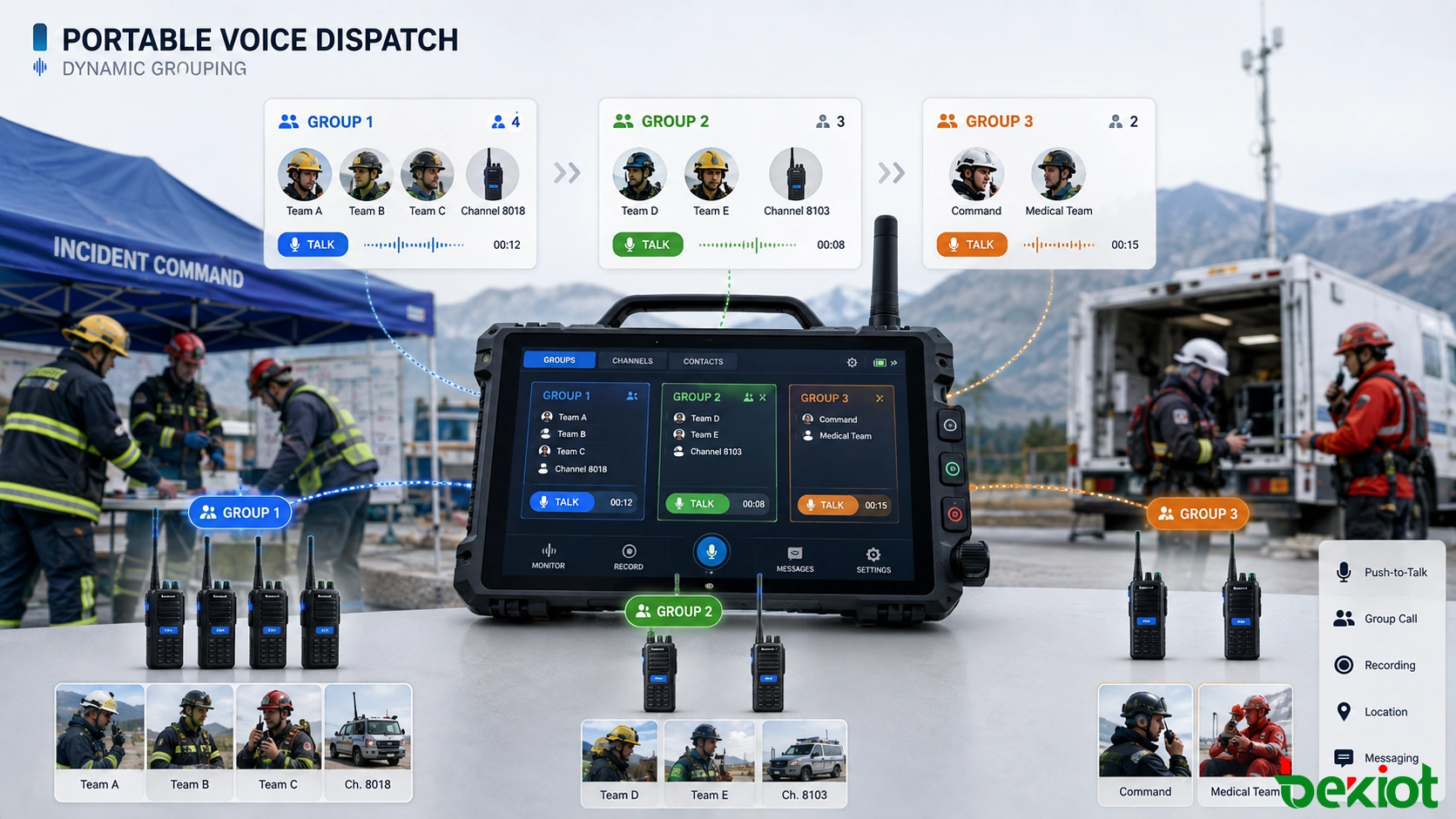
A useful analogy is an audio mixing console. Each connected radio acts like an individual audio channel. The incident operator can see the available channels through a local control interface and combine selected channels into a temporary communication group.
If Rescue Team A, Medical Team B, and Utility Team C need to coordinate for one task, the operator can place those channels into a common group. When the task is completed, the group can be separated again. Another combination can then be created for a different operational objective.
The important point is that the physical radios do not need to be reorganized every time the command structure changes. The grouping logic is handled at the dispatch layer.
This becomes valuable during incidents with repeated changes in personnel and responsibilities. Emergency operations are rarely static. Teams arrive at different times, temporary task forces are created, operating areas are divided, and responsibilities shift as the event develops.
A flexible dispatch interface allows the communication structure to follow those changes. Instead of configuring radio interworking once and assuming the relationship will remain unchanged, the operator can continually adjust the voice groups according to the current mission.
This also changes the role of the person managing communications. With a fixed gateway, configuration may require personnel familiar with backend settings. A portable dispatch console is designed to move more of the required operation to a direct field interface, reducing the number of configuration steps required during the incident.
Connecting the Scene with Command
Local interoperability solves only one part of emergency communication. Teams at the incident scene may now be able to talk to each other, but the higher-level command center may still need direct access to those conversations.
A portable dispatch architecture can combine local radio interoperability with voice backhaul to the command center. This creates an important operational difference.
Instead of requiring an on-site operator to listen to field radio traffic and repeatedly relay information to headquarters, the relevant field voice channels can be extended over an available backhaul connection. The remote command position can then participate in the same communication group.
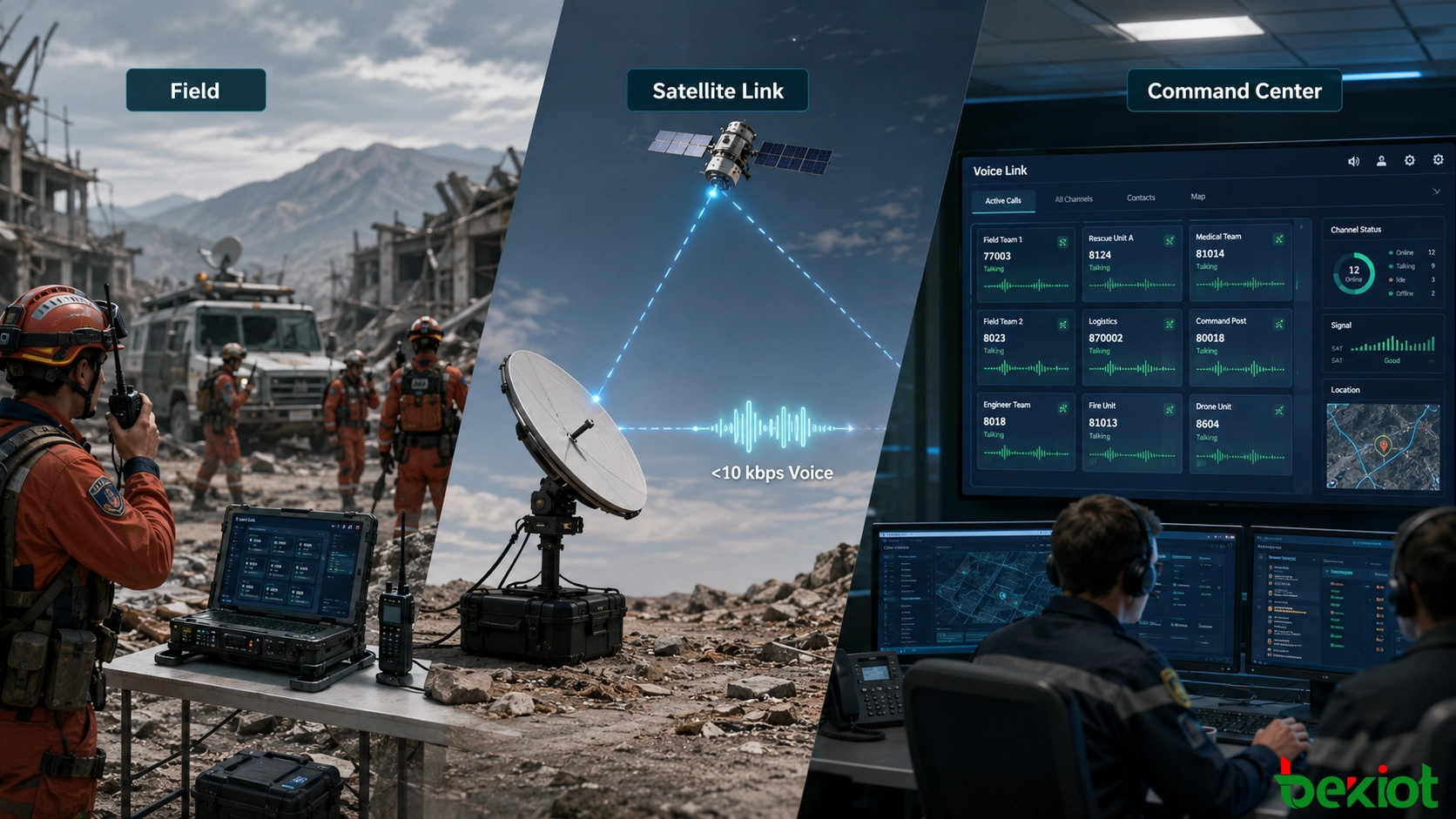
Depending on the available infrastructure, the backhaul may use a public mobile connection when terrestrial networks remain available. Where normal infrastructure is unavailable, satellite communication equipment can provide an alternative path.
This arrangement creates three communication layers within one workflow:
Field radio access: existing radios from different teams continue to provide local mobile voice communication.
On-site dispatch: connected radio channels are organized and controlled according to current tasks.
Remote command backhaul: selected field voice groups can be extended to an off-site command center.
The value is not merely technical connectivity. It reduces the number of people who must manually relay information between the field and headquarters.
When front-line personnel and remote commanders can participate in the same voice process, the command center receives information closer to its original context. Questions can be asked directly, instructions can be issued without an additional relay step, and changes in the situation can be communicated more quickly.
Voice Continuity When Infrastructure Fails
Major disasters can damage exactly the infrastructure that ordinary communication depends on. Power failures, disrupted transport routes, and loss of terrestrial network services can occur at the same time. This type of environment creates a much more difficult requirement than everyday radio interoperability.
The first challenge is local communication. Teams arriving from different organizations still need to establish a common voice environment even though fixed telecommunications infrastructure may no longer be available.
The second challenge is backhaul. A remote emergency operations center may be located far outside normal handheld-radio range, while public cellular and wired networks are unavailable at the incident site.
Satellite links can provide an alternative, but emergency satellite capacity may be limited. Voice communication therefore needs to use the available bandwidth efficiently rather than assuming a broadband connection.
In low-bandwidth emergency configurations, voice can be compressed to below 10 Kbps. Silence suppression can further reduce bandwidth consumption by avoiding continuous transmission during periods when nobody is speaking.
This approach is significant because some narrowband satellite or IoT-oriented links are designed primarily for low-rate data rather than conventional high-bandwidth voice. Reducing the voice stream makes it possible to use very limited satellite capacity more effectively when no ordinary terrestrial connection is available.
The resulting path can be viewed as an emergency voice chain:
Field Radio → Portable Dispatch Layer → Low-Bandwidth Link → Satellite Network → Remote Command Center
The exact quality and capacity available in a real deployment depend on the communications link and project configuration, but the underlying design principle is clear: when bandwidth becomes scarce, voice transport must adapt to the available emergency bearer rather than assuming normal network conditions.
Choosing the Right Architecture
Neither approach is automatically better for every project. The correct selection depends on whether the communication relationship is fixed or operationally dynamic.
| Requirement | Interoperability Gateway | Portable Voice Dispatch Console |
|---|---|---|
| Cross-system radio communication | Supported | Supported |
| Fixed back-to-back interworking | Well suited | Supported |
| Same-system radios on different channels | Depends on fixed connection design | Can be integrated as separate voice channels |
| Temporary task groups | Limited by predefined configuration | Designed for dynamic grouping |
| Frequent regrouping during an incident | Less convenient | Better suited |
| Local operator dispatch interface | Not the primary purpose | Core function |
| Field-to-command voice integration | Requires additional system design | Can be incorporated into the dispatch workflow |
| Changing multi-team response operations | Best for simpler fixed relationships | Better suited to dynamic operations |
If the requirement is simply to keep two or three known radio systems connected over a long period, a fixed interoperability gateway can be a practical and economical choice. There is little benefit in adding a more complex dispatch layer when the communication relationship rarely changes.
The decision changes when the field environment becomes dynamic. Multiple response teams, changing task groups, different radio channels, direct command-center participation, or satellite backhaul all create requirements beyond simple port-to-port interconnection.
In those scenarios, a portable dispatch console functions as a temporary voice coordination center. It does not merely answer whether two networks can communicate. It provides a way to decide which resources should communicate, when they should be grouped, and how those field communications should connect with the wider command structure.
This distinction is especially important when evaluating emergency communications. A system can be technically interoperable while still being operationally difficult to manage. The objective should therefore be to match the communication architecture to the command workflow rather than choosing equipment only by the number of available radio interfaces.
Key Takeaways
An interoperability gateway and a portable voice dispatch console solve related but different problems.
The gateway is best understood as an interconnection tool. It links selected radio paths so that previously isolated systems can exchange voice. For stable communication relationships with only a few radio networks, this can be sufficient.
A portable dispatch console adds an operational control layer. Connected radios become individually manageable voice resources that can be combined into temporary groups, separated when tasks change, and connected with remote command positions through available mobile or satellite backhaul.
The difference can be summarized simply: a gateway focuses on making communication possible, while a dispatch console focuses on making that communication manageable during a changing operation.
In emergency response, this distinction matters because the scarce resource is often not the number of available communication technologies. The real challenge is how quickly different technologies can be organized into one usable command structure.
A well-designed interoperability solution should therefore minimize the time responders spend solving communication problems and maximize the time available for the emergency mission itself.
FAQ
Does low-bitrate voice mean every satellite connection will perform the same way?
No. A sub-10 Kbps voice mode reduces bandwidth requirements, but actual communication quality still depends on the available satellite link, latency, stability, network configuration, and operating environment. These conditions should be validated during system testing.
What should be prepared before deploying radio interworking equipment in the field?
Teams should identify the radio resources expected at the incident, prepare the required radio-to-system connections, and establish a clear naming method for channels or participating units. This reduces identification errors when several radio networks are connected at the same time.
Why is silence suppression useful on constrained links?
A voice channel does not need to consume the same transmission capacity when nobody is speaking. Silence suppression can reduce unnecessary bandwidth usage during idle periods, which is particularly useful when the available backhaul is narrowband.
Should interoperability procedures be included in emergency exercises?
Yes. Technical connectivity alone does not guarantee efficient coordination. Exercises help operators verify radio connections, identify channels correctly, practice creating communication groups, and confirm that field-to-command communication works under realistic operating conditions.
Can a fixed installation and a portable dispatch capability serve different roles?
Yes. A stable site may use fixed interworking for long-term communication relationships, while a portable dispatch layer can be reserved for temporary operations where teams, channels, and command relationships change rapidly.