In routine telephone communication, an occupied line usually means the caller has to wait. That behavior is acceptable in offices, but it can become a serious limitation in production control, emergency response, transportation operations, utilities, industrial facilities and other command environments. When an operator needs to deliver an urgent instruction, a busy tone should not prevent communication with the person responsible for the situation.
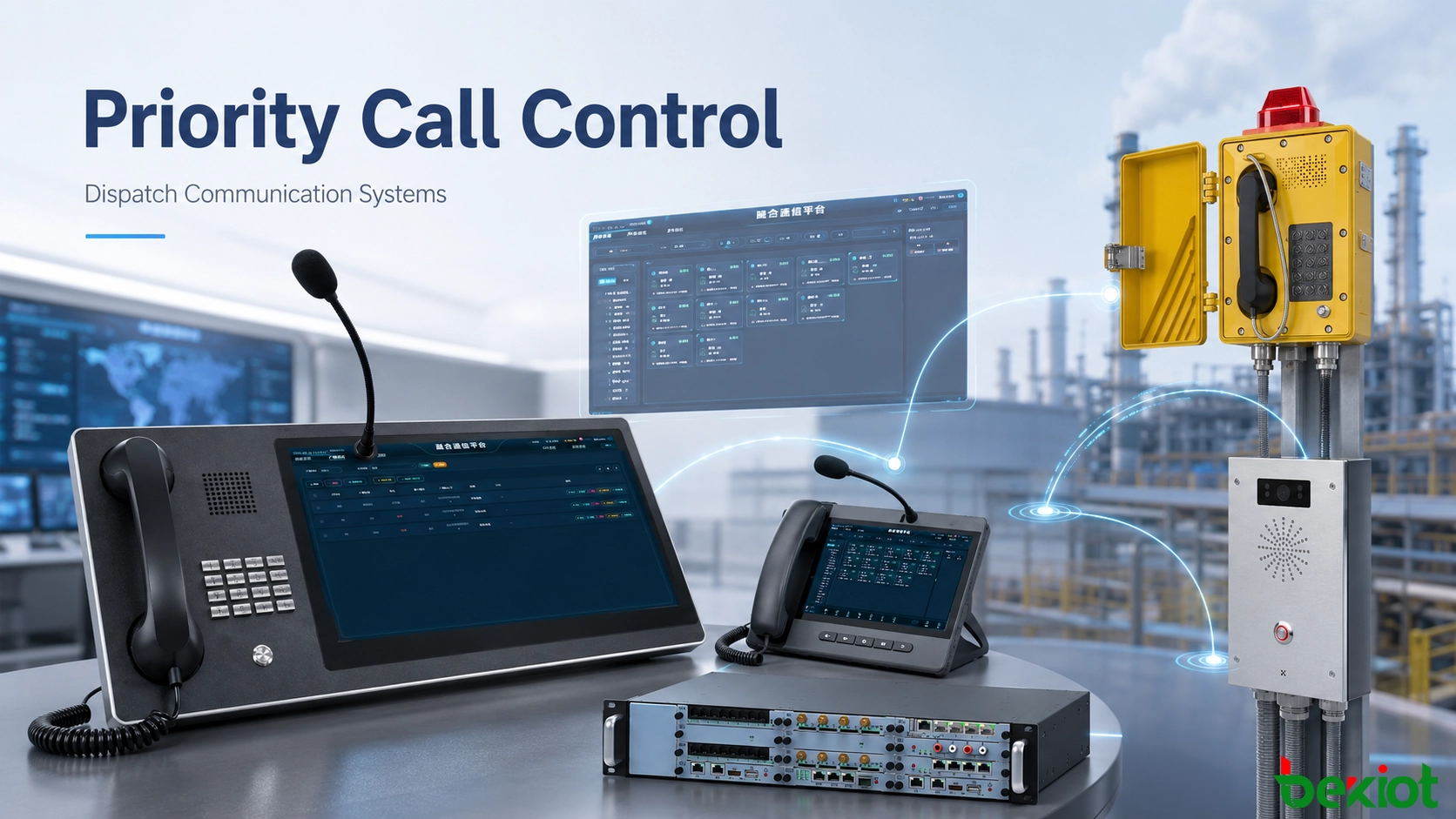
A dispatch communication system addresses this problem by adding priority call-control functions to conventional voice communication. Three of the most important are barge-in, forced release and call monitoring. They allow authorized dispatchers to enter an existing conversation, release an occupied connection when a higher-priority call must be established, or listen to an active call for operational supervision.
These functions are not intended to replace normal calling behavior. Instead, they create an additional control layer for situations where communication priority must reflect operational responsibility. During normal operation, calls can proceed in the same way as ordinary telephone communication. When an abnormal event occurs, authorized dispatch personnel can intervene according to predefined permissions and the urgency of the situation.
Why Normal Calling Is Not Enough
Most telephone communication is based on a simple one-to-one model. User A calls User B, a voice connection is established, and both extensions remain occupied until the conversation ends. If User C calls either party during that time, a conventional telephone system will normally report that the destination is busy.
This behavior protects ordinary conversations from interruption, but emergency and operational communication follows a different priority model. A control-room dispatcher may need to reach a field supervisor immediately. A production coordinator may have to deliver a shutdown instruction. An incident commander may need to contact personnel who are already speaking with another department.
Waiting for the existing call to finish can delay the flow of information. During a time-sensitive event, even a relatively short communication delay may affect coordination between the control room and personnel at the scene.
The issue becomes more obvious when several departments are involved at the same time. Maintenance teams may be discussing equipment status, security personnel may be handling access control, and production staff may already be reporting operating conditions. If the communication platform treats every active call as equally protected, the control center may have no effective way to reach a critical user at the exact moment that a higher-priority instruction must be delivered.
For this reason, dispatch communication is not simply about connecting more telephones. The system must also determine who has communication priority, under what circumstances that priority can be exercised, and how an existing call should be handled when a more important instruction arrives.
A practical dispatch architecture therefore combines ordinary call processing with user status, permission levels and intervention controls. The purpose is to maintain predictable communication during routine operation while still providing a controlled escalation path when normal busy-line behavior is no longer sufficient.
How Barge-In Preserves Urgent Coordination
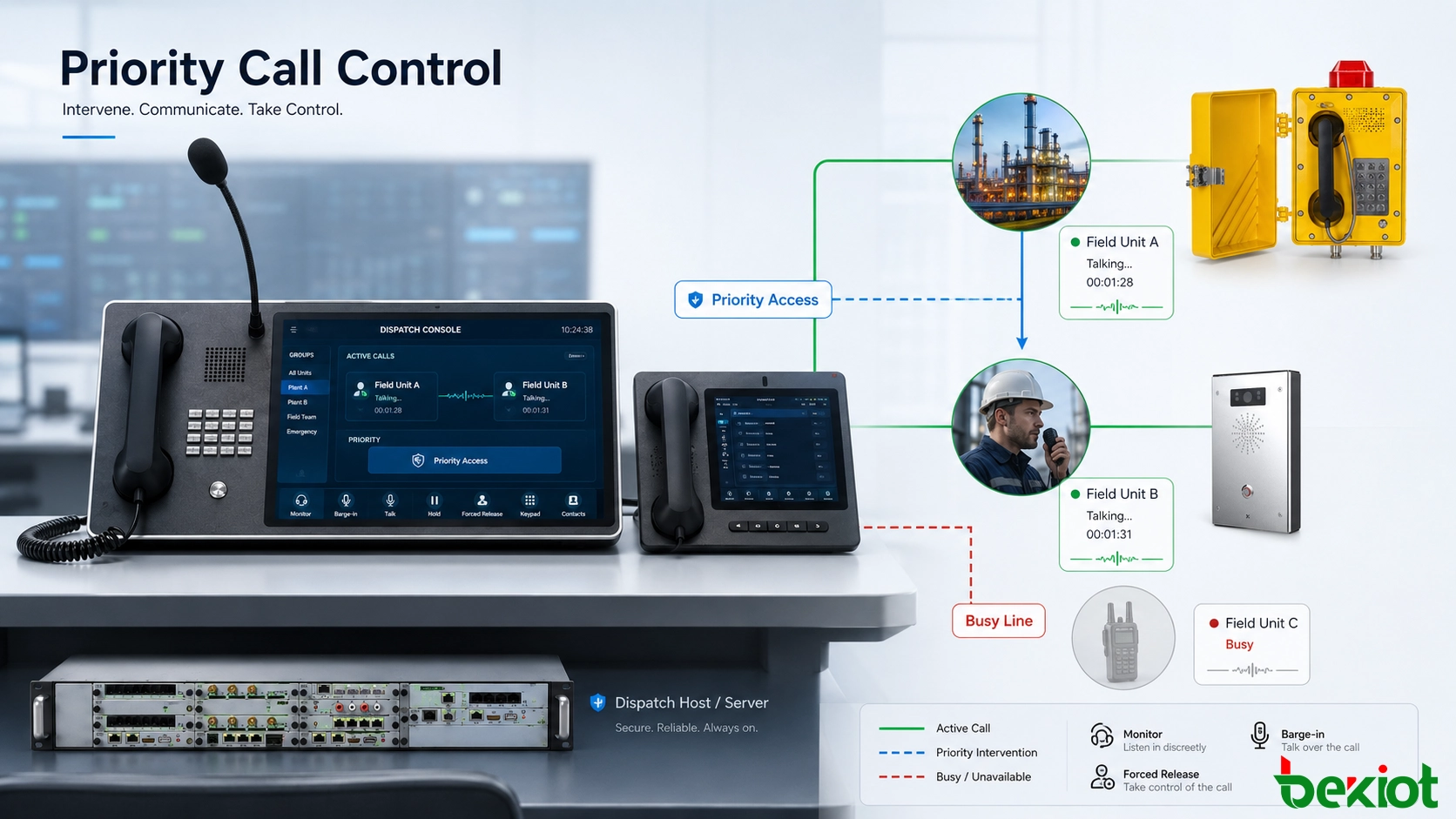
Barge-in is designed for situations where an existing conversation should continue, but another authorized participant needs to join immediately.
Consider a simple example. User A and User B are already speaking. User C is a dispatcher or another user with a higher communication permission level. Under normal telephone rules, C would receive a busy indication when attempting to call A or B.
With barge-in enabled, C can use an assigned feature code or select the corresponding control on the dispatch console. Instead of waiting for the original conversation to end, the system inserts C into the active call.
The existing A-to-B connection remains active, while the communication becomes an A-B-C multi-party conversation. This allows the dispatcher to provide instructions, request information or coordinate both parties without first breaking the communication already taking place.
This approach is particularly useful when the existing call contains information that remains relevant to the incident. Rather than disconnecting the participants and starting a separate conversation, the dispatcher can become part of the same communication path.
Typical situations include coordination between control-room personnel and field teams, production incidents involving several departments, maintenance operations requiring immediate supervisory involvement, and emergency events where several responsible personnel need to exchange information at the same time.
From an operational perspective, barge-in is often the least disruptive priority action because it preserves the original conversation. The dispatcher should still confirm that participation is necessary and avoid unnecessary intervention during routine calls. In a well-configured system, barge-in permission can be limited to specific dispatch roles, departments or communication groups so that the function remains aligned with actual command authority.
When Forced Release Becomes Necessary
Barge-in is useful when all participants should remain connected. Some situations, however, require a more direct communication path.
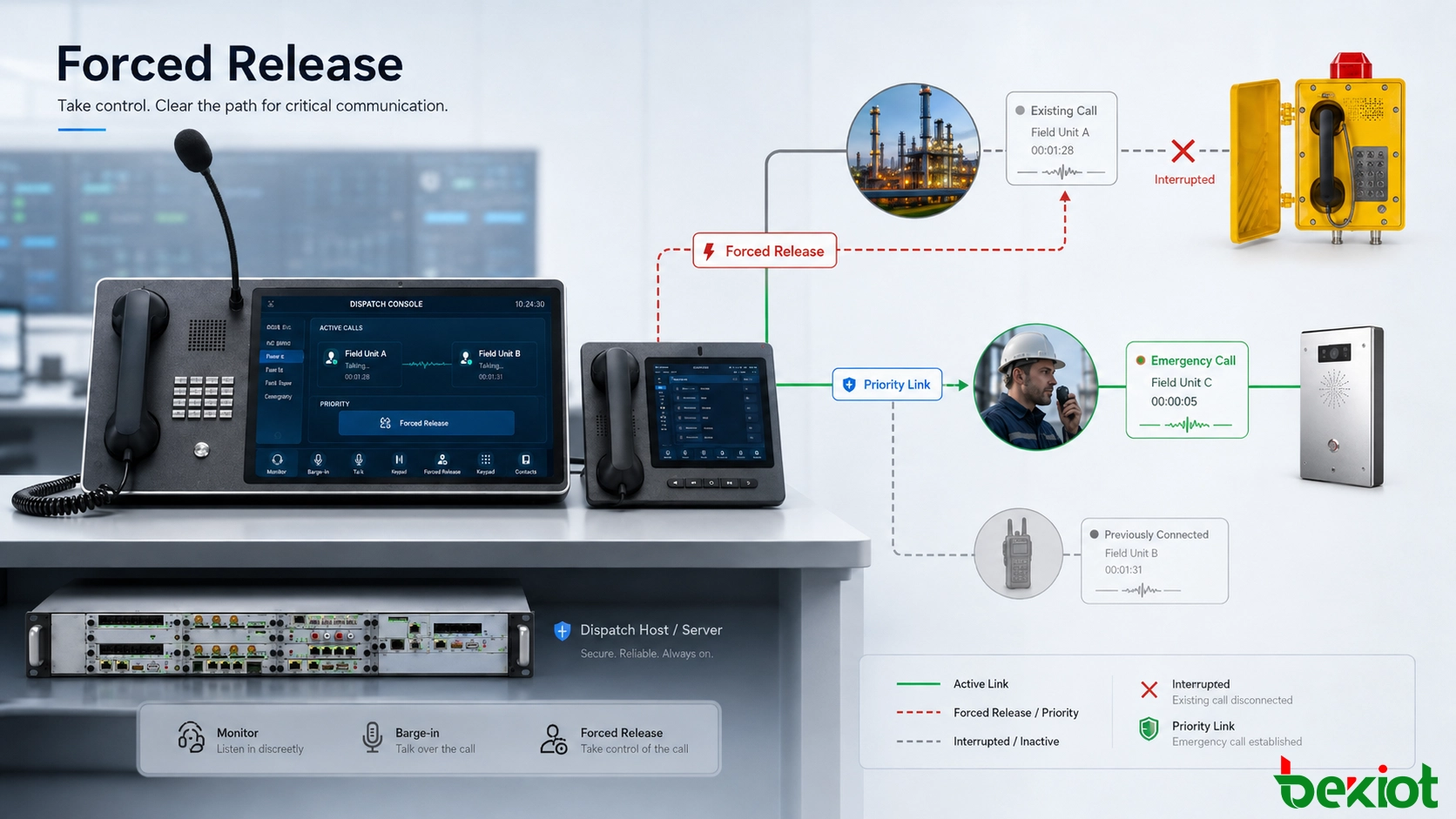
Suppose A is an important contact at an emergency site and is already speaking with B. Dispatcher C now has a critical instruction that must be delivered directly to A. Keeping B in the conversation may be unnecessary, or the existing call may be preventing a higher-priority dispatch connection from being established.
In this case, an authorized dispatcher can use forced release.
After the dispatcher enters the appropriate feature command or selects the forced-release function on the dispatch interface, the system terminates the existing A-to-B connection. A new call can then be established between A and C.
The important difference is the treatment of the occupied call:
Barge-in keeps the existing call active and adds the dispatcher to it.
Forced release ends the existing connection so that a higher-priority communication path can be established.
This capability addresses a practical weakness of ordinary telephony. During emergency coordination, a critical contact may remain busy for an extended period while the command center repeatedly attempts to reach that person. A dispatch system with priority control changes the process from passive waiting to active communication management.
Because forced release directly changes an active communication session, it normally requires stricter authority than standard calling. The organization should define which dispatch positions are permitted to use it and in which situations it is appropriate. For example, it may be reserved for emergency instructions, process shutdown commands, safety-related coordination or other clearly defined high-priority events.
This prevents the function from becoming a routine shortcut for reaching busy users. The objective is not to make every dispatch call more important than a normal call, but to provide a controlled way to establish communication when operational urgency clearly overrides the current conversation.
Silent Monitoring for Operational Awareness
Monitoring serves a different purpose. Barge-in and forced release actively change an existing conversation, while monitoring is intended primarily for supervision and situational awareness.
Using the same A-B-C example, A and B are communicating while C is an authorized dispatcher or supervisor. C selects the monitoring function through a feature code or the dispatch interface and listens to the ongoing conversation.
C does not become an active speaking participant in the call. The communication between A and B continues without being converted into a three-party conversation.
This distinction matters in command environments. Supervisors do not always need to interrupt personnel who are already exchanging information. In some cases, listening to the communication is enough to understand the situation, confirm progress or determine whether further intervention is necessary.
Monitoring can therefore support operational supervision while avoiding unnecessary interruption of an active field conversation. It may also help a duty supervisor determine whether the current communication should continue normally, whether barge-in is required, or whether the situation has developed to the point where a direct priority connection should be established.
Because it is a privileged capability, monitoring should be controlled through system permissions and organizational procedures. Deployment practices should also be aligned with applicable privacy requirements and internal policies. Where projects require stronger operational traceability, administrators can combine monitoring permissions with account management, access logs and communication records so that privileged operations remain reviewable.
Designing Permission-Based Call Control
Priority communication functions should not be available indiscriminately. Their value comes from combining communication capability with a clear authority structure.
A practical deployment normally separates ordinary users from dispatchers, supervisors or other designated personnel. Standard users continue to make and receive normal calls, while selected accounts or dispatch positions receive permission to perform specific priority actions.
These permissions can reflect operational responsibilities. A central dispatcher may require access to barge-in and forced release, while a supervisor may require monitoring permissions. Other extensions may only need conventional call functions.
Larger systems can further divide authority by department, production area, operating zone or management level. A local dispatcher may control only terminals in one workshop, while a central control room may be authorized to intervene across several areas during major incidents. This hierarchy helps prevent unnecessary cross-department interference while retaining centralized command capability when escalation is required.
This approach prevents priority communication from becoming uncontrolled interruption. The purpose is not to allow any user to override another call. It is to ensure that personnel responsible for command and coordination can reach the right person when operational urgency requires it.
The operating method should also remain simple. Authorized users may execute functions through predefined feature codes, while dispatch consoles can provide direct controls that reduce the need to remember individual codes during a fast-moving event.
A well-designed interface is especially valuable during emergency response. When several calls are active simultaneously, the dispatcher should be able to identify the required user and select the appropriate action without navigating through unnecessary steps.
Real-time status information can strengthen this process. If the console shows whether a terminal is online, idle, ringing or currently in a call, the dispatcher can first understand the communication state and then choose the appropriate intervention. This reduces unnecessary forced operations and helps priority control become part of a structured decision process rather than a blind command.
Related Solution: Becke Command and Dispatch System
Building a Reliable Dispatch Workflow
Barge-in, forced release and monitoring are most effective when they are treated as parts of a broader communication workflow rather than isolated telephone features.
During ordinary operations, users can communicate through standard point-to-point calls. When a higher-priority event occurs, the dispatcher evaluates the communication state before choosing how to intervene.
If an occupied conversation remains relevant and both participants should receive the new information, barge-in may be the more appropriate option. If a specific person must receive a direct command immediately, forced release provides a way to clear the occupied connection. If the dispatcher only needs greater situational awareness, monitoring can provide information without actively changing the conversation.
In a mature deployment, this decision can also be combined with communication records and dispatch logs. The system can retain information such as call start time, participating extensions, call duration and authorized dispatch operations. When an incident is later reviewed, these records help reconstruct the communication sequence and determine how the command process developed.
This is particularly useful in environments where voice communication is part of a wider incident-response procedure. An emergency may begin with an alarm, incoming call or field report, continue through dispatch intervention and personnel coordination, and then move into follow-up actions such as broadcasting, group calling, technical support or event closure. Priority call control becomes one stage within that larger response chain.
This creates a simple decision framework:
Identify the person or group involved in the event.
Check whether the required user is available or already communicating.
Determine whether the existing conversation should remain active.
Select normal calling, barge-in, forced release or monitoring according to the situation.
Deliver the required instruction and confirm that the responsible personnel have received it.
Continue communication or escalate to group coordination, broadcast notification or other response procedures when required.
The result is a communication system that responds to operational priority rather than relying entirely on first-come, first-served call handling.
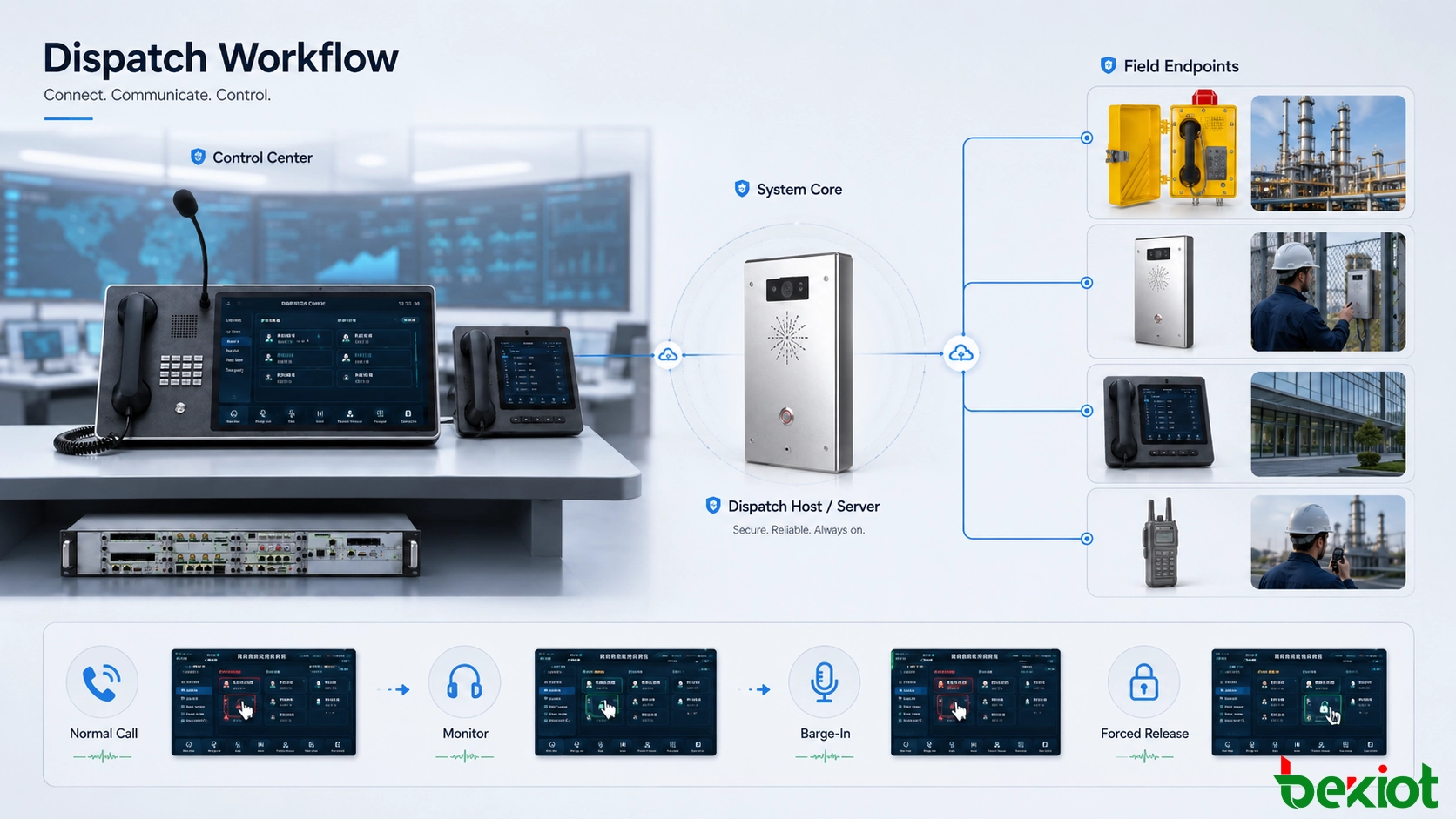
The same principle can support production dispatch, industrial control rooms, transportation management, utilities, security operations and emergency command environments. The exact communication terminals may differ from one project to another, but the operational objective remains consistent: important instructions should not be blocked simply because a required user is already on another call.
For larger projects, priority call control can also work alongside recording, group calling, conference communication, public address or alarm notification functions. Direct priority communication reaches the responsible individual first, while wider communication tools can then distribute instructions to additional personnel or operating areas. This layered approach helps the control center move from individual verification to broader coordination without losing the communication context of the original event.
Key Takeaways
A dispatch communication system extends ordinary telephone communication by introducing controlled communication priority. Barge-in, forced release and monitoring represent three different ways of handling an occupied connection.
Barge-in allows an authorized dispatcher to join an active call without ending it. Forced release clears an existing connection when a more important direct call must be established. Monitoring allows authorized personnel to follow an ongoing conversation without becoming an active participant.
Their real value appears during time-sensitive coordination. Instead of repeatedly calling a busy extension and waiting for the conversation to finish, the command center can select an appropriate intervention based on operational urgency.
For a reliable deployment, these functions should be linked to user roles, permission levels, terminal status, communication records and clear operating procedures. Dispatchers should understand not only how to activate each function, but also when one intervention method is more appropriate than another.
When communication priority and dispatch authority are designed together, the system becomes more than a telephone network. It provides a structured command mechanism for maintaining access to critical personnel, reducing communication delays and supporting traceable coordination during abnormal or emergency operations.
FAQ
Should every extension receive priority call-control permissions?
No. Priority controls are most useful when assigned according to operational responsibility. Limiting them to dispatchers, supervisors or other designated roles reduces unnecessary interruption and keeps communication authority clear.
What should be tested before a dispatch system is put into service?
Acceptance testing should include occupied-line situations, different permission levels and the expected result of each priority action. Testing both authorized and unauthorized users helps confirm that the configured communication hierarchy works as intended.
Should forced release be the default response to every busy line?
No. The communication method should match the situation. If the existing conversation remains useful, interrupting it may create unnecessary disruption. Priority intervention should use the least disruptive action that still delivers the required instruction in time.
Why retain ordinary call handling if priority functions are available?
Most daily communication does not require intervention. Standard calling provides a predictable workflow for routine operations, while priority controls remain available for the smaller number of situations in which urgency justifies overriding normal call behavior.