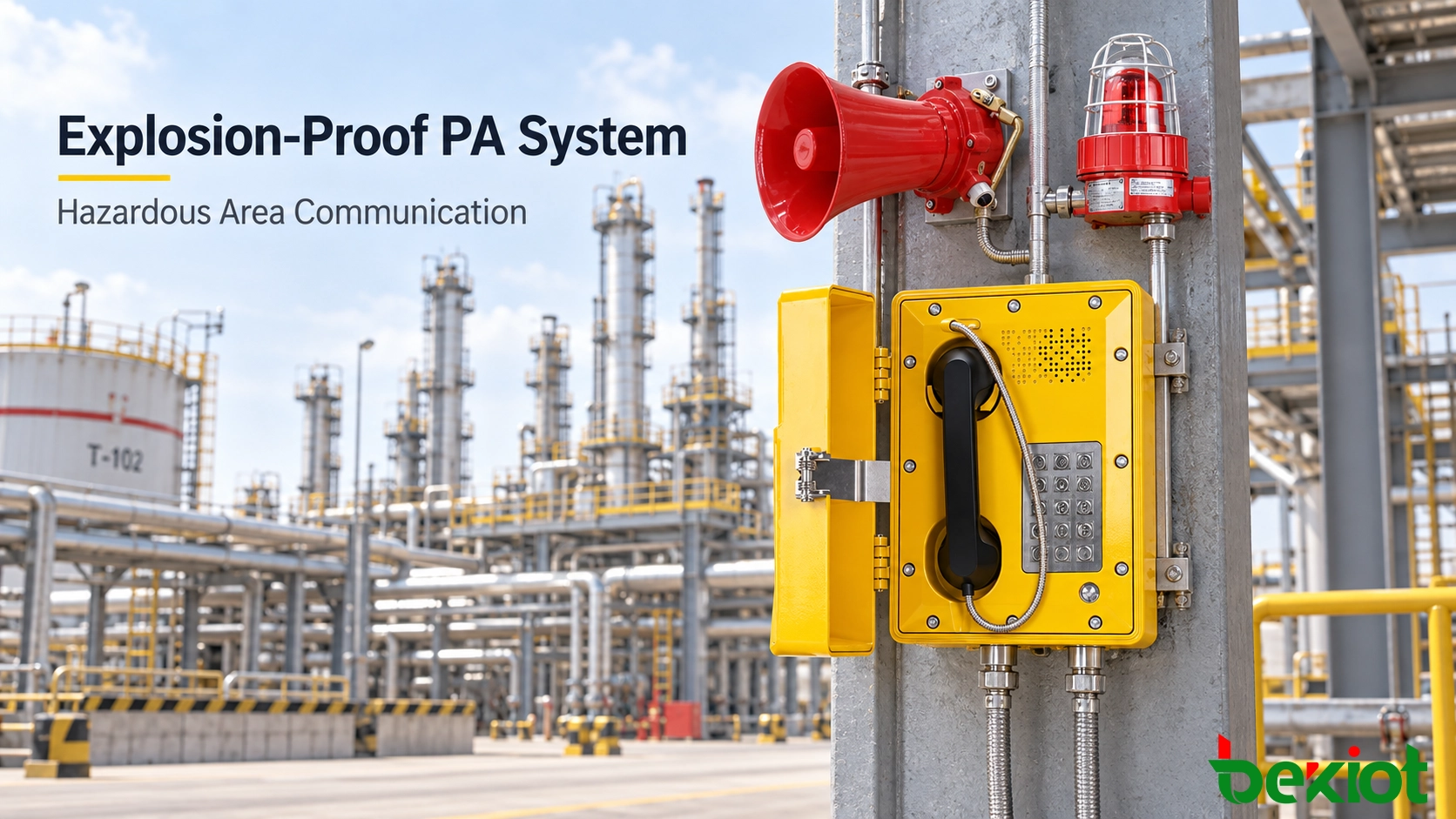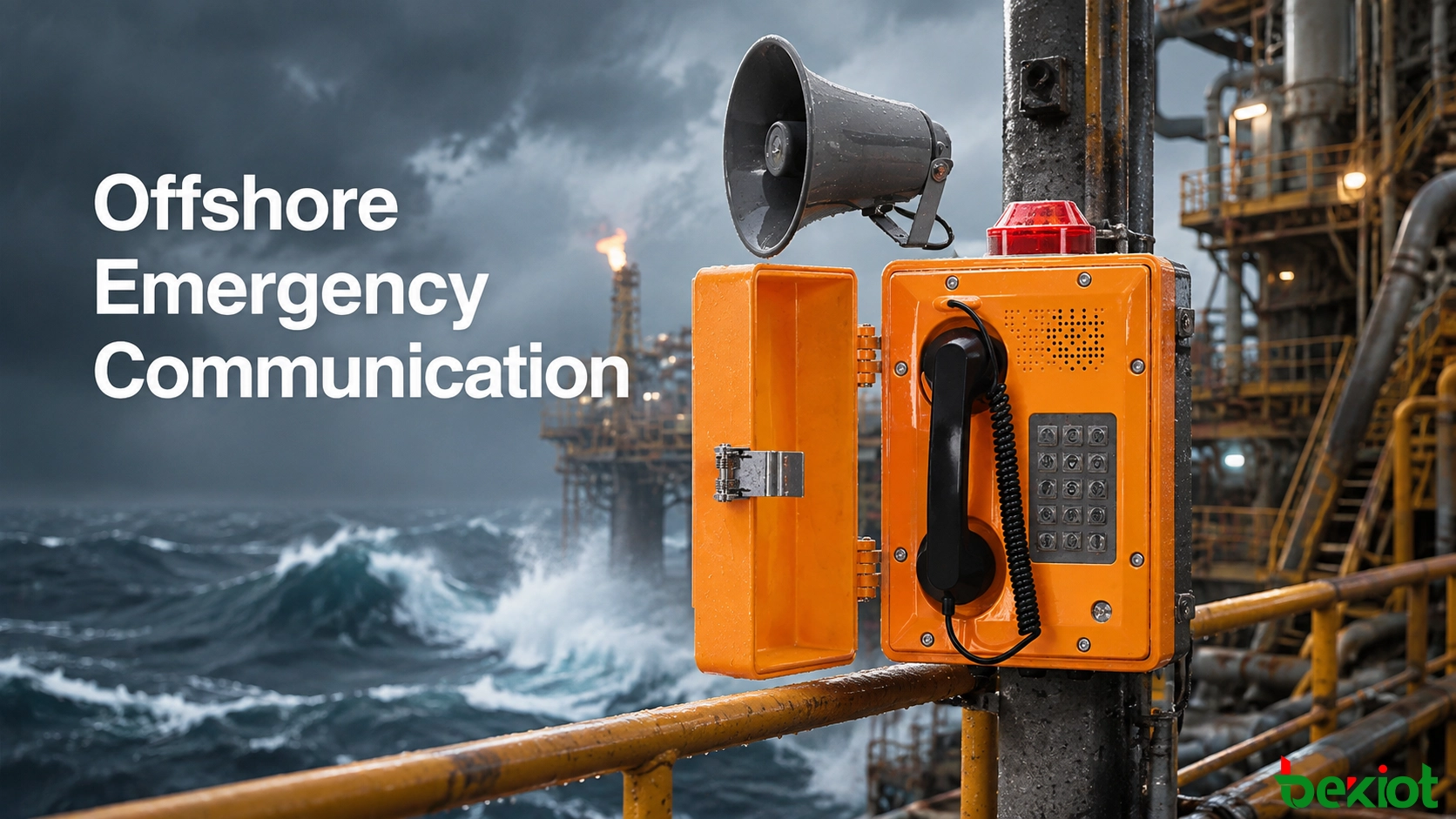
Offshore oil platforms, natural gas processing platforms, and other offshore energy facilities operate far from shore, with communication equipment continuously exposed to salt spray, humidity, strong winds, rain, and persistent machinery noise. Some production areas may also contain flammable gases or other hazardous media. When equipment failures, gas leaks, fires, personnel injuries, or severe weather occur, field personnel need a reliable way to contact the control room, while operators must be able to deliver dispatch instructions and emergency information to production decks, equipment areas, helidecks, and evacuation zones.
For this reason, the design of an offshore emergency telephone system should not focus only on the protection rating of individual terminals. Terminal type, installation location, hazardous-area suitability, high-noise notification, dispatch integration, public address coordination, network architecture, and emergency power all need to be planned around the platform's actual operating conditions.
Communication Requirements in Marine Environments
Communication terminals installed on offshore platforms are exposed to environmental stresses that are significantly more severe than those encountered by ordinary indoor equipment. Salt, moisture, wind, rain, and vibration can continuously affect the telephone enclosure, handset, keypad, loudspeaker, fasteners, wiring terminals, and cable entries. Terminal selection should therefore begin with the actual installation area and operating environment.
Salt Spray and Long-Term Corrosion
Salt-laden air deposited on equipment surfaces can accelerate corrosion of metal components, connectors, and exposed wiring points. Telephones installed on open decks, walkways, equipment-area entrances, and other outdoor locations should therefore be selected with attention to enclosure corrosion resistance, sealing structure, cable-entry protection, and long-term outdoor operation.
Installation practices are equally important. Cable entries and connection points should not be positioned where water can accumulate or where they are continuously exposed to direct rain or sea spray. Mounting brackets, bolts, and other exposed metal parts also require suitable corrosion protection for marine environments.
How Strong Wind Affects Voice Communication
Helidecks, outer decks, and elevated work areas can be exposed to persistent wind noise. Compared with fully hands-free communication, a fixed industrial telephone with a handset can help reduce the distance between the user's mouth and the microphone, improving speech pickup and listening performance under windy conditions.
Telephone placement should also take operator usability into account. Personnel wearing safety helmets and industrial gloves should still be able to lift the handset, dial, and hang up easily. Locations where strong airflow blows directly toward the microphone should be avoided where practical.
Ingress Protection and Explosion Protection
Different areas of an offshore platform present different environmental and safety requirements. Outdoor non-hazardous locations are mainly exposed to salt spray, rain, humidity, and mechanical stress, making industrial waterproof telephones suitable for many of these positions. Oil and gas processing areas, selected pump rooms, and other classified hazardous zones require communication terminals designed for the applicable hazardous-area requirements.
Ingress protection ratings describe how effectively an enclosure resists the entry of water and solid particles, while explosion protection addresses safe equipment operation in potentially explosive atmospheres. These requirements solve different problems and should be reviewed independently during system design and equipment selection.
Related Product: Becke Industrial Waterproof Telephone
Planning Communication Points by Area
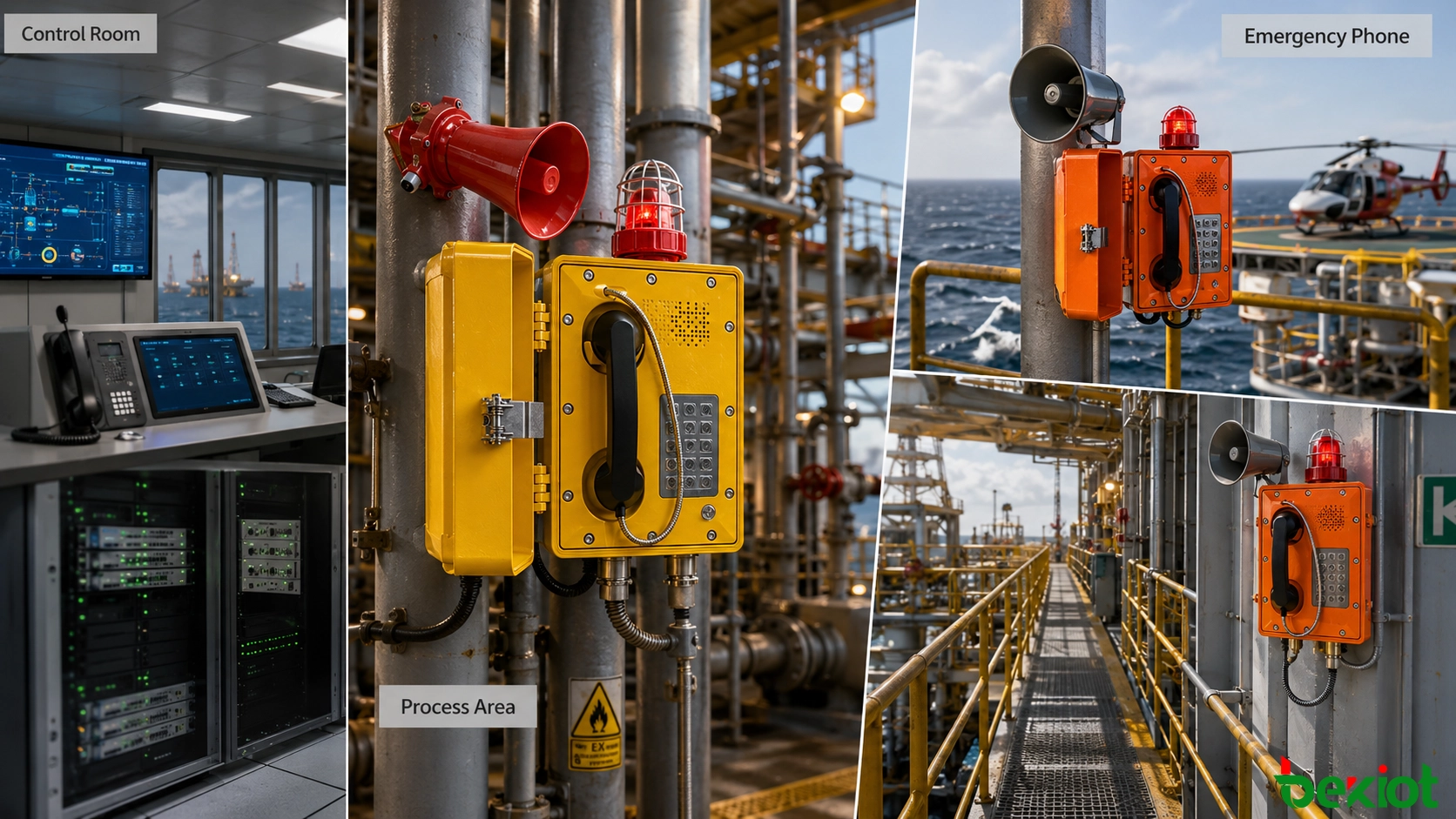
Offshore platforms are compact structures, but operating conditions, personnel activity, and communication requirements vary considerably between zones. The control room, production deck, equipment rooms, helideck, and evacuation areas should therefore not all use the same terminal configuration. Communication points are better planned according to work function and environmental risk.
| Deployment Area | Recommended Terminal | Main Purpose |
|---|---|---|
| Control Room | Dispatch Console / SIP Dispatch Phone | Centralized calling, status monitoring, and command |
| Production Deck | Industrial Waterproof Telephone / Suitable Explosion-Proof Telephone | Production coordination, fault reporting, and field assistance |
| Oil and Gas Processing Area | Explosion-Proof Telephone | Fixed communication in hazardous areas |
| Pump Room / Compressor Area | Explosion-Proof or Amplified Communication Terminal | Communication in high-noise work areas |
| Helideck | Outdoor Industrial Telephone | Aviation support and deck-operation communication |
| Machinery and Equipment Rooms | Industrial Telephone | Equipment operation, maintenance, and fault reporting |
| Living Quarters | SIP Telephone | Duty and internal communication |
| Lifeboat and Evacuation Areas | Emergency Telephone | Fixed communication during evacuation |
Communication-point planning should also reflect personnel movement and emergency evacuation routes. After an equipment abnormality occurs, operators should be able to reach a communication point without crossing into a higher-risk area. Remote equipment zones, muster stations, and evacuation points should also retain clearly identified fixed communication access.
Compared with simply installing telephones at uniform distances, positioning them around critical workstations, equipment-area entrances, personnel gathering points, and evacuation routes better reflects the actual operating needs of offshore facilities.
Improving Call Awareness in Noisy Areas
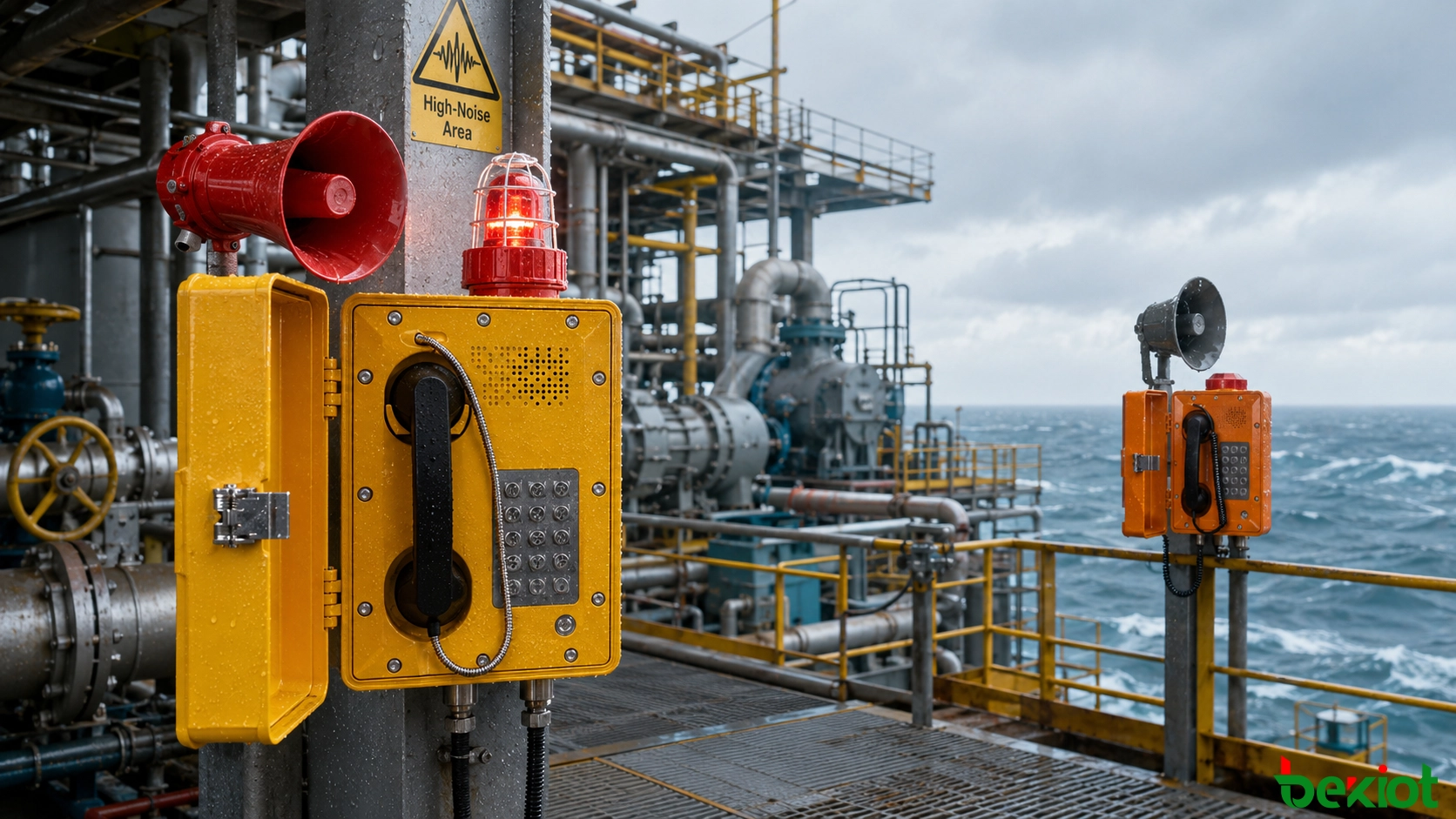
Compressor areas, generator rooms, pump stations, and locations containing large rotating machinery may be exposed to continuously high background noise. A standard telephone can still place and receive calls, but its ringing tone may be masked by machinery noise, preventing personnel from noticing an incoming call from the control room.
In these areas, fixed telephones can be supplemented with horn loudspeakers and audible-and-visual alarm devices according to the actual acoustic environment. When the control room initiates a call or emergency notification, additional sound coverage and visual indication can attract the attention of nearby personnel, who can then use the nearest fixed telephone for two-way confirmation.
Fixed telephones, horn loudspeakers, and visual alarms perform different functions. The telephone supports point-to-point communication and field feedback, the horn extends audible coverage, and the visual alarm supplements audible notification when background noise is too high.
Production areas containing multiple pieces of equipment can also be divided into communication groups, such as compressor, pump, or loading zones. During an abnormal event, the control room can contact the required area directly rather than dialing individual positions one by one.
Dispatch Access and Network Design
Once field telephones are connected to a unified dispatch platform, the control room can organize communication resources by platform area, production unit, and job function instead of relying on independent extension numbers. Production decks, pump rooms, compressor areas, machinery spaces, helidecks, and living quarters can all be represented in a clear communication directory.
Centralized Management of Field Terminals
Within the assigned user permissions, dispatch operators can perform individual calls, transfers, call pickup, conferences, and group calls. During an incident, relevant positions, maintenance personnel, and emergency coordinators can be placed into a temporary communication group, reducing delays caused by sequential communication between departments.
The system can also retain calling time, calling and called numbers, call duration, and recording files for duty inspection, fault investigation, and incident review. Recording records should remain associated with the relevant extension, job position, and event time so that they can be retrieved efficiently later.
IP Deployment for New Platforms
For newly built platforms with industrial Ethernet and fiber backbones, SIP telephones, dispatch servers, and related voice services can be planned as part of the IP communication network. Field terminals connect through the platform network, while numbering, user permissions, and terminal status are maintained centrally in the control room.
A SIP-based architecture also simplifies interconnection with IP PBX systems, recording platforms, and other standards-based IP voice resources, making it suitable for platforms where communication nodes may continue to expand.
Preserving Existing Analog Resources
Some operating platforms still rely on analog telephones and existing copper cabling. If these lines remain stable and complete rewiring would increase construction difficulty, downtime, or project cost, voice gateways can be used to connect analog terminals to a newer IP dispatch platform.
The existing analog telephones continue to use their original access lines, while the voice gateway performs interface conversion between the analog side and the SIP network. The dispatch server then handles numbering, switching, dispatch functions, and recording in a centralized manner.
This approach preserves communication assets that still have operational value while gradually introducing centralized dispatch and IP-based management, making it suitable for phased upgrades on platforms that must remain in service.
Coordinating Telephones with PA and Alarms
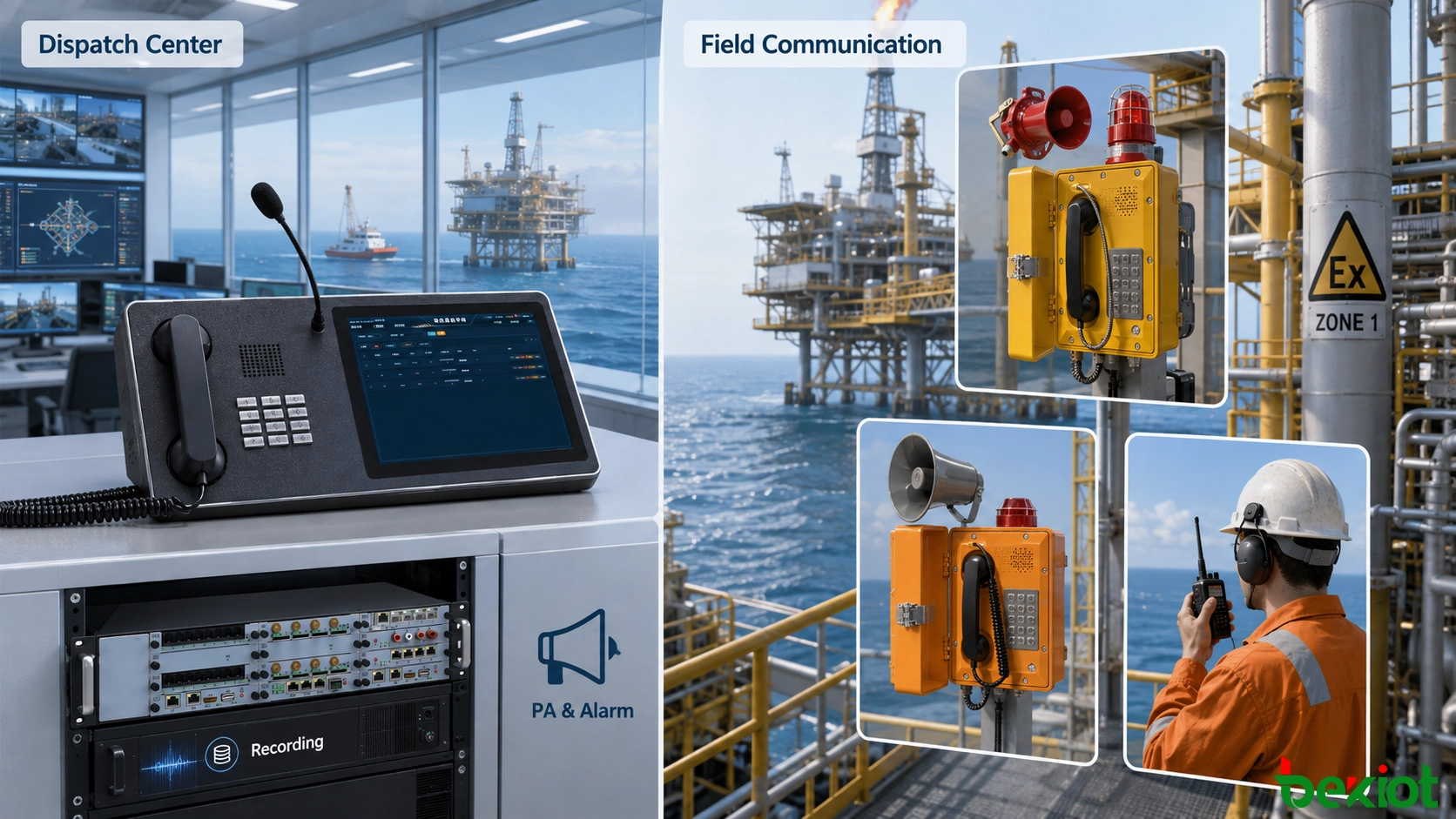
Offshore emergencies often require both point-to-point confirmation and wider-area notification. Fixed telephones are suitable for two-way communication between field positions and the control room, while PAGA or public address systems distribute information across larger areas. Audible-and-visual alarms help attract the attention of personnel working in high-noise environments.
For example, if field personnel identify a gas leak, they can use a nearby fixed telephone to report the exact area, equipment location, and initial conditions to the control room. After verifying the information, the control room can activate the appropriate area announcement or alarm according to the emergency procedure while notifying maintenance, firefighting, medical, and other relevant teams.
At the system level, industrial and explosion-proof telephones can connect to the dispatch server through the platform IP network or existing lines. The control-room dispatch position manages voice communication while coordinating with PA, alarm, and recording systems. Each subsystem retains its own function, but the emergency communication process is organized centrally.
This division of responsibilities reduces the need for information to be passed manually between separate systems. Telephones support situation confirmation, public address handles wider notification, alarm devices reinforce field awareness, and the recording system preserves the communication history.
Reliability Across the Communication Chain
Because offshore platforms are far from shore, maintenance and external support can be more difficult after equipment failures. Emergency communication reliability therefore needs to cover terminals, networks, servers, switching equipment, and power systems rather than being judged only by the protection level of the telephone enclosure.
Reducing Network Single Points of Failure
Depending on platform size and reliability requirements, the backbone communication network can use industrial Ethernet rings, dual links, or other redundant topologies. A local cable or network-device failure should not cause an entire production area to lose communication with the control room.
The actual fault boundaries of dispatch servers and core switching equipment should also be reviewed. Two servers that still depend on the same power circuit, switching node, or uplink continue to share a significant single point of failure.
Emergency Power for Critical Communication Equipment
Dispatch servers, core switches, voice gateways, and critical communication terminals should be incorporated into the platform's UPS or emergency power design. During a local power failure, basic communication between the control room, critical production areas, and evacuation zones should remain available for the required period.
Maintaining Multiple Communication Methods
Fixed telephones provide clearly defined locations, straightforward operation, and do not depend on personnel carrying a mobile terminal. However, offshore emergency communication should not rely on a single method. Fixed telephones, radio communication, PAGA, audible-and-visual alarms, and other available communication systems can complement one another and reduce the impact of a failure in any one network or device.
Field Installation Determines Usability
Parameters and locations defined during the design stage should be validated again under actual operating conditions. Offshore platforms often combine dense equipment, high noise levels, and limited working space. Whether communication equipment can be found, reached, and operated quickly has a direct effect on its usefulness during an emergency.
Telephones should be installed where personnel can reach them quickly and safely.
Ringing, amplified audio, and speech quality in high-noise areas should be tested while machinery is operating normally.
Outdoor locations exposed to strong wind should be checked for the actual effect of wind noise on the microphone and handset.
Keypads, handsets, and other controls should remain usable while personnel are wearing industrial gloves.
Cable entries, connectors, mounting brackets, and fasteners should receive appropriate sealing and corrosion protection.
Communication terminals, accessories, and installation methods in hazardous areas should comply with the applicable area requirements.
Communication points near muster stations, lifeboat areas, and primary evacuation routes should correspond with the platform emergency plan.
System acceptance testing should also reflect realistic operating conditions. High-noise areas should not be tested only while machinery is stopped, outdoor terminals should be verified under practical communication conditions, and critical locations should be tested for incoming calls, group calls, PA coordination, and recovery after communication faults.
Final Notes
The reliability of an offshore emergency telephone system depends on two fundamental factors: whether field terminals can withstand long-term marine exposure, and whether effective communication paths between field personnel and the control room remain available during abnormal conditions. Waterproofing, corrosion resistance, and explosion protection provide the equipment foundation, while point placement, noise adaptation, dispatch integration, network redundancy, and emergency power determine how the overall system performs in an actual incident.
System planning should therefore begin with platform zoning, personnel positions, production workflows, and emergency procedures before terminal types and backend resources are finalized. The objective is to ensure that personnel can locate communication equipment quickly, hear critical information clearly, and maintain stable contact with the control room during both normal operation and emergency response.
FAQ
How should the maintenance interval for offshore telephones be determined?
The maintenance interval should reflect the platform's equipment-management procedures, installation location, and actual corrosion conditions. Outdoor positions exposed to heavy salt spray, rain, or sea-water splash require particular attention to handsets, keypads, seals, wiring terminals, cable entries, and mounting hardware.
Do all outdoor telephones need an additional protective enclosure?
Not necessarily. The need for a protective enclosure depends on the telephone's own environmental protection, installation orientation, exposure to rain or sea spray, and maintenance access. Poor drainage or condensation inside an enclosure can itself create equipment problems.
Are hotline functions suitable for critical positions?
Yes. The control room, firefighting duty station, medical point, and other critical locations can use hotline or speed-dial functions according to the platform emergency procedure. This reduces the time required to locate and enter a number during an emergency. The configured destinations should correspond with actual job responsibilities and emergency plans.
How should new telephone numbers be managed when a platform is expanded?
Before adding new areas or terminals, the numbering plan, area names, job-position names, and dispatch groups should be defined consistently. New terminals can then be added to the existing organizational structure. A standardized numbering system simplifies daily dispatching, maintenance, recording searches, and incident review.