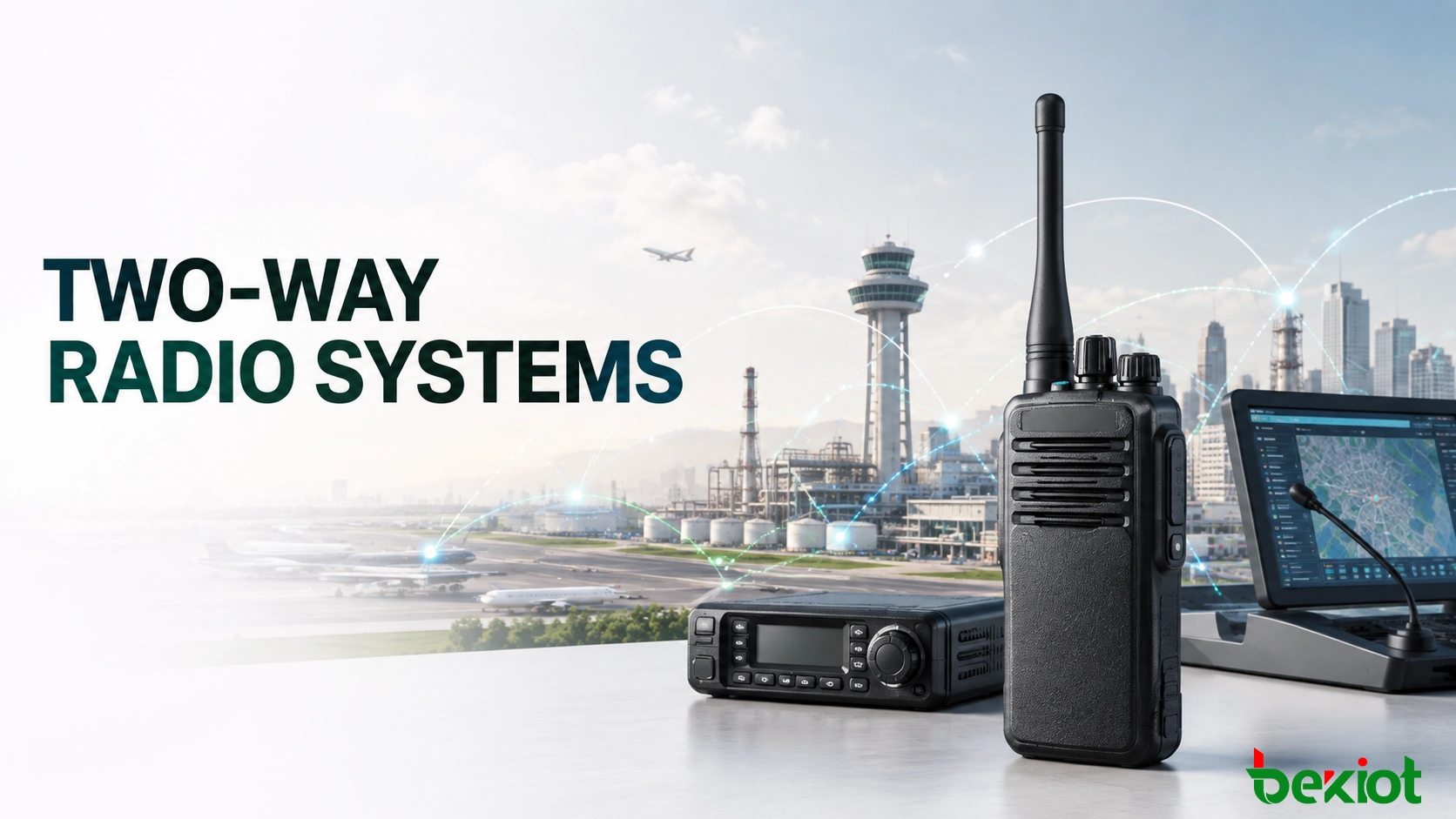
Two-way radios developed along different technical paths because an airport, a construction site, a police department and a hotel do not have the same operational priorities. Some teams need simple local voice communication. Others require managed talk groups, encryption, priority calls, location data or cooperation between several agencies. That is why analog radio remains in service while DMR, P25, TETRA and PDT continue to serve distinct markets.
For a new project, the useful question is not which standard is newest. The real task is to select a system that fits the coverage area, user roles, spectrum rules, security policy and emergency workflow—and then decide how it will communicate with other radio and dispatch networks.
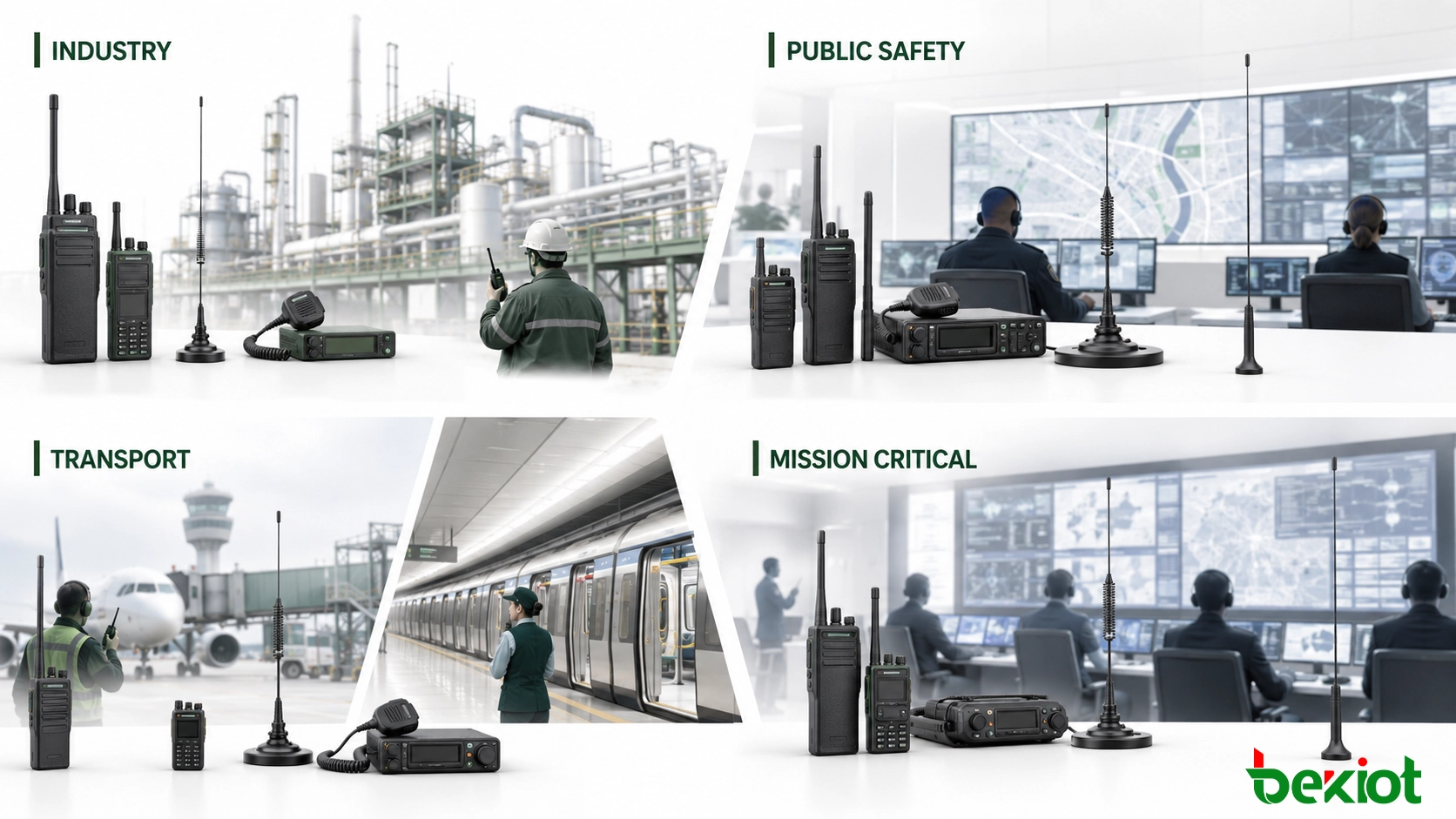
Different operating models created different radio standards
A two-way radio normally uses half-duplex communication: one user presses the push-to-talk button, speaks and then releases the channel for another user. The operating principle is straightforward, but the network behind it can range from a pair of analog handheld radios to a multi-site digital trunked system with centralized control.
The radio standard affects much more than audio format. It can determine how channels are assigned, whether users can make individual and group calls, how identities are managed, what security functions are available and whether equipment from different suppliers can interoperate. Coverage also depends on frequency, antenna design, site topology, repeater placement and link budget—not simply on whether the system is analog or digital.
Frequency allocations vary by country and service. Civil aviation voice communication commonly uses the VHF range from 118.000 MHz to 136.975 MHz. Marine VHF channel plans include ship-station transmit frequencies from 156.025 MHz to 157.425 MHz. In China, public walkie-talkies are assigned 20 channels within the 409–410 MHz range. These figures are examples of regulated allocations, not universal licence-free bands. Every project must confirm the current local spectrum and equipment-approval requirements before deployment.
Where analog communication still earns its place
Analog radio is the simplest form in this comparison. Voice modulates a radio-frequency carrier, commonly using frequency modulation in land-mobile applications and amplitude modulation in civil aviation voice services. It does not require the receiving radio to decode a digital voice stream, which makes the communication path easy to understand and troubleshoot.
Cost, mature hardware and predictable operation keep analog systems in use across security teams, construction sites, hotels, retail facilities and amateur radio. Analog communication also remains important in aviation and marine services, where internationally understood channel plans and broad accessibility support communication between users who may not belong to the same organization.
Its limitations become more apparent as a system grows. Analog networks provide fewer built-in tools for user identity, encryption, text data, location services and managed talk groups. Background noise also becomes progressively stronger near the edge of coverage. A digital receiver may maintain intelligible audio longer before dropping out, although digital technology does not create extra RF coverage by itself.
Analog therefore remains a reasonable choice when the requirement is uncomplicated local voice, the existing coverage is satisfactory and advanced management is unnecessary. It is less suitable when a project needs structured fleet control, secure multi-agency operation or detailed dispatch integration.
Four digital paths and what each was designed to do
DMR for commercial and industrial radio networks
Digital Mobile Radio (DMR) is an open standard developed by ETSI. It is widely used in commercial, industrial, utility, transport and municipal communication systems. DMR uses a two-slot TDMA structure on a 12.5 kHz radio channel, allowing two logical communication paths to share one carrier under the defined operating modes.
The standard is commonly divided into three tiers:
Tier I covers low-power, licence-exempt operation where permitted by regional regulation.
Tier II supports licensed conventional operation, including direct radio-to-radio communication and repeater-based systems.
Tier III adds trunked operation, where a controller assigns available channel resources according to user and talk-group requests.
DMR is often selected because it provides a practical balance of capacity, cost and digital features. However, an open standard does not guarantee that every optional or proprietary feature will work across brands. Basic voice may interoperate while encryption, roaming, data applications or extended signalling do not. A mixed-vendor project needs an agreed feature profile and an interoperability test before procurement is finalized.
P25 for public-safety interoperability
Project 25 (P25) is a suite of TIA-102 standards developed for digital voice and data systems used by public-safety and first-responder organizations. Its central purpose is interoperability: compliant equipment and infrastructure can provide common communication interfaces for agencies that must work together during routine operations, mutual aid and major incidents.
P25 systems can support conventional or trunked operation, individual and group communication, emergency functions, data services and security capabilities. The standard is most strongly associated with North America and is widely used by police, fire, emergency medical and government organizations. For a P25 project, compliance with a named interface or phase should be verified rather than accepting a general statement that equipment is “P25 compatible.”
TETRA for managed, high-availability group communication
Terrestrial Trunked Radio (TETRA) is another ETSI standard. It was designed for professional and mission-critical users that need fast group calls, individual calls, voice and short-data services, mobility management, priority handling and security within a centrally managed network.
TETRA is used in public safety, airports, metro systems, rail operations, utilities and other environments where large user groups must share radio resources efficiently. Some deployments in China operate in 800 MHz allocations and are therefore described locally as “800 MHz trunked radio,” but 800 MHz is not part of the technical definition of TETRA. Actual spectrum assignments depend on national regulation and the licensed network.
PDT for Chinese public-security communications
Police Digital Trunking (PDT) is a digital trunked radio system standardized for Chinese public-security applications. It uses TDMA technology and supports functions such as group communication, individual calling, network management, terminal identity, positioning and protected voice services, subject to the system profile and security configuration.
PDT is mainly relevant to police and related government communication projects in China. Its value lies in aligning radio operation with local public-security requirements rather than serving as a general global replacement for DMR, P25 or TETRA.
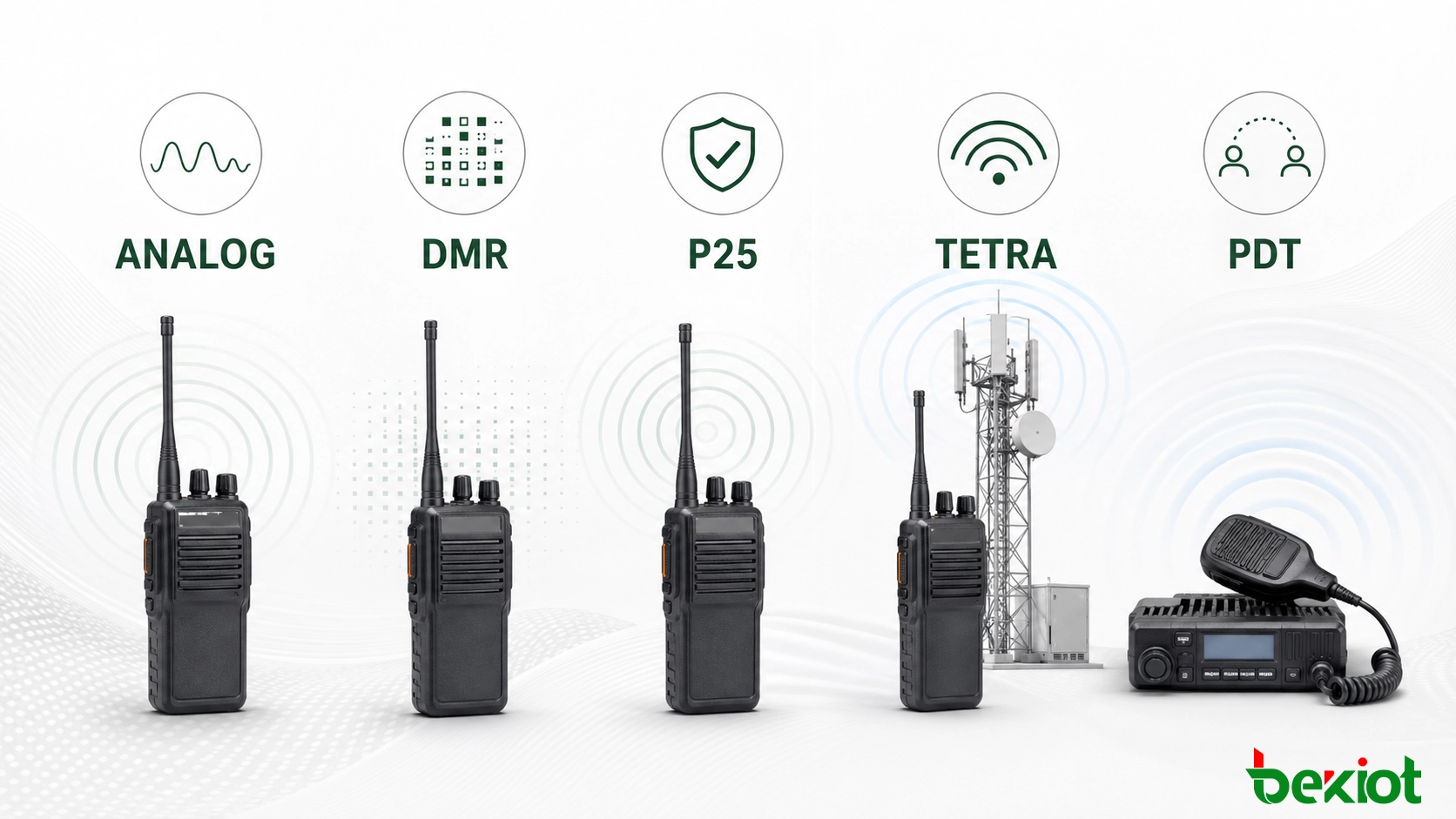
Match the network to the operating environment
A standards list is useful, but project decisions should begin with the operating workflow. A small facility with one security team does not need the same infrastructure as a metropolitan transit network or a regional emergency service.
| Radio system | Typical fit | Main strengths | Points to verify |
|---|---|---|---|
| Analog | Local voice, aviation, marine, small operational teams | Simple operation, mature equipment, easy fault isolation | Spectrum authorization, privacy limits, future capacity |
| DMR | Commercial, industrial, utility and transport fleets | Efficient channel use, broad ecosystem, conventional and trunked options | Tier, feature profile and cross-vendor compatibility |
| P25 | Public safety and first responders, especially in North America | Public-safety interfaces, mutual-aid interoperability, security options | Phase, interface compliance, encryption and key management |
| TETRA | Airports, metro, rail, utilities and mission-critical organizations | Fast group communication, priority services, managed trunking, voice and data | Licensed spectrum, coverage design, network resilience and terminal profile |
| PDT | Chinese police and public-security networks | Local public-security alignment, trunking, group control and positioning | Applicable GA/T specifications, authorization and platform compatibility |
Before selecting equipment, document the number of users, simultaneous call demand, talk-group structure, indoor and outdoor coverage, emergency priority rules, recording requirements, encryption policy and expected service life. Coverage surveys and capacity estimates should be completed before the system architecture is fixed.
The decision should also account for existing assets. A functioning analog or digital radio network may still have years of useful life. Replacing every repeater, vehicle radio and handheld simply to add centralized dispatch can create unnecessary cost and operational disruption.
Interworking is often more practical than full replacement
Many organizations operate more than one communication network. An airport may use TETRA for operational teams, an aviation VHF system for air-band communication and a cellular push-to-talk service for contractors. A city may need temporary coordination between police, fire, transport and utility teams. An industrial site may have an established analog radio network while the control room uses an IP-based dispatch platform.
A radio interoperability gateway can connect selected radio channels to an IP dispatch environment without changing the air interface used by field personnel. On the radio side, the gateway exchanges transmit audio, receive audio, push-to-talk control and channel-activity information with a mobile radio, base station or supported radio interface. On the IP side, it presents that channel to the dispatch system through the configured voice and control method.
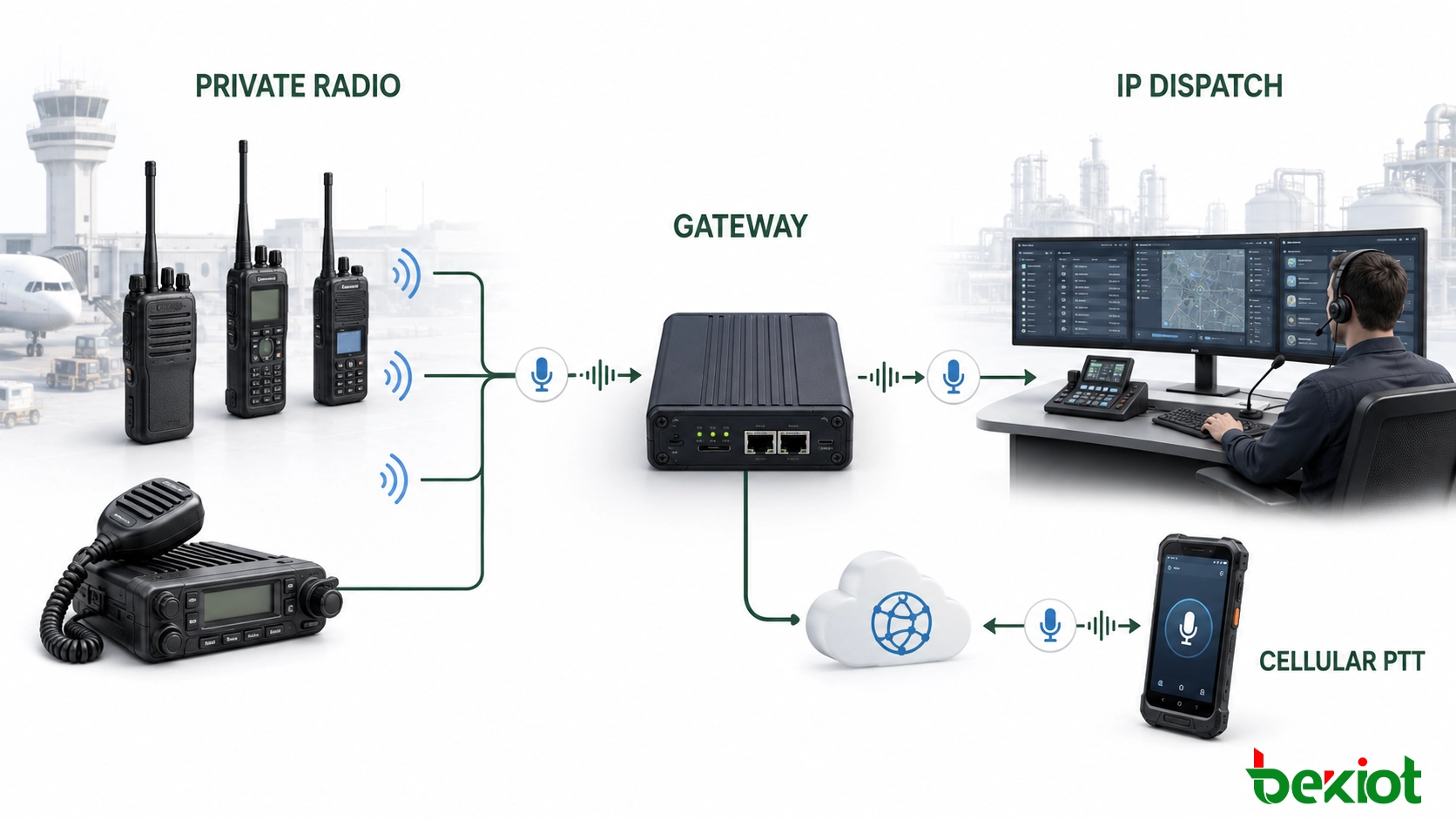
In an airport integration, for example, a controlled gateway path can bridge an authorized TETRA talk group with a public-network push-to-talk group. The private radio network continues to provide local mission-critical coverage, while the cellular service extends access to personnel who are outside that fleet. Dispatchers gain a common operational point instead of monitoring unrelated devices on the desk.
This approach does not make unlike standards natively compatible. It creates a managed communication bridge between approved channels. The project must therefore define who is allowed to activate the bridge, whether it is permanent or event-based, which direction calls may travel and how emergency priority is handled.
Commissioning should test more than basic audio. Engineers need to verify PTT activation and release, channel-busy detection, audio levels in both directions, clipping, background noise, end-to-end delay, talk-group mapping, call recording, access permissions and recovery after an IP or radio-side interruption. Encrypted systems require particular care: a gateway must not be assumed to preserve end-to-end encryption across different networks.
The strongest solution is not necessarily a single radio standard across every user. It is an architecture in which each network performs the job it was selected for, while authorized interworking paths give command staff the coordination they actually need.
Questions to settle before procurement
Is frequency licensing determined by the radio standard?
No. The standard defines communication technology, while national regulators assign spectrum and licensing conditions. The same standard may operate in different frequency bands in different countries. Confirm the applicable allocation, channel plan, licence and equipment approval locally.
Will encrypted talk groups remain end-to-end encrypted through a gateway?
Not automatically. Many gateways interconnect decoded audio rather than transporting the original encrypted air-interface traffic. Security teams must review where audio is decrypted, how the IP link is protected and whether the design is permitted by the relevant operational policy.
Does a digital radio network always cover farther than an analog one?
No. Range depends on frequency, transmit power, antenna system, terrain, building loss, receiver performance and network design. Digital audio may remain clearer near the coverage edge and then fail abruptly; analog audio usually becomes noisier more gradually.
Can analog and digital channels appear on the same dispatch interface?
Yes, when compatible channel interfaces and an integration layer are provided. The dispatch system can present both as managed communication resources, but the available controls depend on what each radio interface exposes.
What documentation should be delivered after commissioning?
The handover package should include the channel and talk-group map, interface wiring, access rules, audio-level baseline, PTT timing results, network addressing, recording route, failover procedure, backup configuration and an approved change log. These records make later maintenance and fault isolation much faster.