A gas detector trips near a loading rack. The control room must verify the location, contact the nearest operator, view the relevant camera, warn personnel in the affected zone and notify the response team. When telephones, radios, public address, video surveillance and alarm systems operate independently, every step requires a different console, contact list or operating procedure.
A unified communications solution brings these channels into one controlled operating environment. It does not need to replace every existing network. Instead, it allows fixed telephones, radio systems, paging equipment, mobile terminals, cameras and industrial alarms to exchange approved information and support a coordinated response.
Communication Gaps Across Distributed Operations
Oil and gas operations combine hazardous process areas, remote production sites and continuously staffed control rooms. A refinery may depend on industrial telephones and plant-wide paging, while an oilfield uses mobile radio, private cellular coverage and satellite links. Pipeline personnel can be hundreds of kilometres from the main dispatch center.
These resources are often installed during different project phases. They may use separate numbering plans, radio groups, management platforms and maintenance procedures. Operators can usually work around these differences during routine production. During a gas release, fire, power failure or pipeline incident, however, switching between isolated systems can delay verification and response.
A communication assessment should trace the operational path for each type of event:
How a field worker reports an abnormal condition
Which control-room position receives the first call
How the caller’s site and equipment area are identified
Which response groups must be contacted
Which public address zones receive safety instructions
Which cameras and process signals support verification
Which communication path remains available if the primary network fails
Routine coordination and emergency handling should not follow the same workflow. A maintenance call may use a standard extension route. A confirmed gas release may trigger priority calling, zoned paging, video display, event recording and escalation to several departments.
Build the Architecture Around Five Operational Layers
A layered design makes system responsibilities easier to define and prevents the platform from becoming an uncontrolled collection of interfaces.
Field and Sensing Layer
The field layer contains the devices that generate calls, audio, video and alarm information. Typical equipment includes industrial telephones, explosion-proof telephones, radio handsets, intercom stations, paging speakers, cameras, emergency buttons and environmental sensors.
Process instruments and safety sensors may report temperature, pressure, liquid level, flow rate, smoke or combustible-gas concentration. The communications platform does not replace a process-control or safety-instrumented system. It receives approved event information and converts it into operator notifications, calls or broadcast actions.
Personnel-positioning tags and vehicle-location devices can add useful context. When an alarm or emergency call is received, the dispatcher can identify nearby teams instead of contacting every field group.
Transmission Layer
The transmission layer may combine industrial Ethernet, fibre rings, private 4G or 5G, digital trunked radio, industrial wireless networks and satellite communication. Each technology addresses a different operating condition.
Fibre provides stable capacity within refineries and terminals. Private cellular networks support mobile voice, video and data across large production areas. Digital radio remains valuable for immediate group communication, while satellite links extend essential services to offshore platforms, isolated well sites and locations beyond terrestrial coverage.
Network technologies should be selected according to coverage, latency, availability and recovery requirements. Specialized deterministic networking should only be considered when it supports a clearly defined operational application.
Platform Layer
The platform layer provides call control, media processing, user management, recording, device monitoring and system integration. It can present communication resources under practical names such as “Tank Farm Radio,” “Jetty Hotline” or “Pipeline Sector 4” instead of exposing technical port numbers to dispatchers.
Gateways can connect analog telephones, radio networks and legacy paging equipment to an IP environment. This supports phased migration and allows operational equipment to remain in service when it is still suitable for the site.
Application Layer
Applications turn communication functions into operating workflows. They may include voice dispatch, video calling, GIS display, emergency paging, incident conferencing, recording, duty management and alarm linkage.
Integration with SCADA or DCS should use approved and clearly defined interfaces. The communications platform may receive an alarm state, equipment identifier or location reference, but control commands must remain subject to the plant’s safety and authorization rules.
Operator and Presentation Layer
Dispatch consoles, workstation clients, large displays and authorized mobile devices form the presentation layer. The control-room interface should organize resources by site, unit and operational function rather than by protocol or technical address.
During an incident, the dispatcher should be able to identify the source, establish voice communication, view available video and contact the correct response group without searching through unrelated device lists.
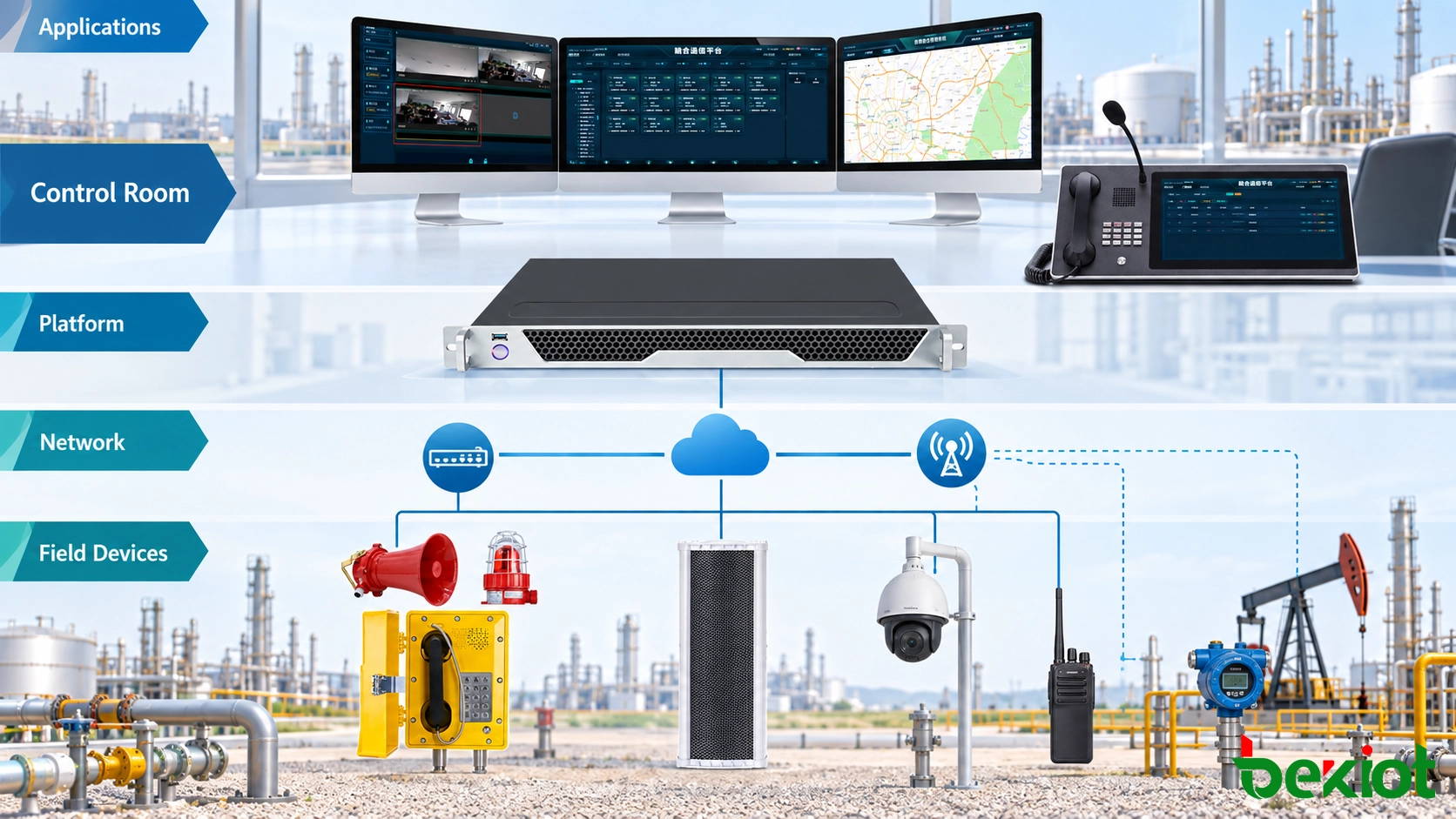
A layered architecture connects field telephones, radio, video, sensors and paging resources while preserving the operational boundaries between communication and process-control systems.
Connect Voice, Video, Data and Field Alerts
Unify Fixed and Mobile Voice
Fixed telephones remain important at pump rooms, loading stations, control buildings and emergency reporting points. In hazardous areas, the telephone, cable entries, power arrangement and accessories must meet the certification requirements of the installation zone.
Radio systems provide mobility and immediate group communication. A radio gateway or supported system interface can expose selected talk groups to the dispatch platform. Authorized dispatchers can monitor activity, initiate push-to-talk and connect a radio group with telephone or mobile users when required.
Integration must preserve radio discipline. Not every telephone user should have access to every talk group, and telephone-to-radio conferences should not occupy a critical channel longer than necessary.
Associate Calls with Video and Location
A telephone number identifies an endpoint, but a location-based device record gives the operator more useful context. Each field device can be associated with a site, process unit, floor, access route, nearby camera and responsible department.
When an emergency call arrives, the platform can display the registered location and provide access to the relevant camera view. Video helps the dispatcher assess visible conditions, but it does not replace confirmation from process-control personnel or workers at the scene.
GIS is particularly useful for pipelines, well sites and widely distributed facilities. It can display the reporting point, nearby teams, access roads and available communication coverage. The map should focus on information required for response instead of duplicating the complete asset-management system.
Turn Alarm Signals into Targeted Notifications
Fire panels, gas detection systems, emergency buttons and perimeter alarms can provide event signals to the communications platform. Each approved signal should be mapped to a defined workflow rather than triggering a generic site-wide notification.
A combustible-gas alarm near a loading rack might initiate the following sequence:
Display the alarm source and associated operating zone.
Notify the designated control-room positions.
Open the relevant camera group where integration is available.
Establish contact with the local operator or response team.
Send a pre-approved message to the affected paging zone.
Record acknowledgement, escalation and closure times.
Automatic broadcasting should be limited to events with a verified source and a clearly defined response. Events requiring interpretation can first appear at the dispatch console for operator confirmation.
Keep the Incident Active Until Resolution
An emergency record should remain active until the responsible operator confirms the outcome. A green device icon, an acknowledged alarm or a completed broadcast task does not prove that the field situation has been resolved.
The incident record can connect the original alarm with calls, paging tasks, video references, operator actions and field feedback. This creates a chronological record for post-event review and helps identify delays in acknowledgement or escalation.
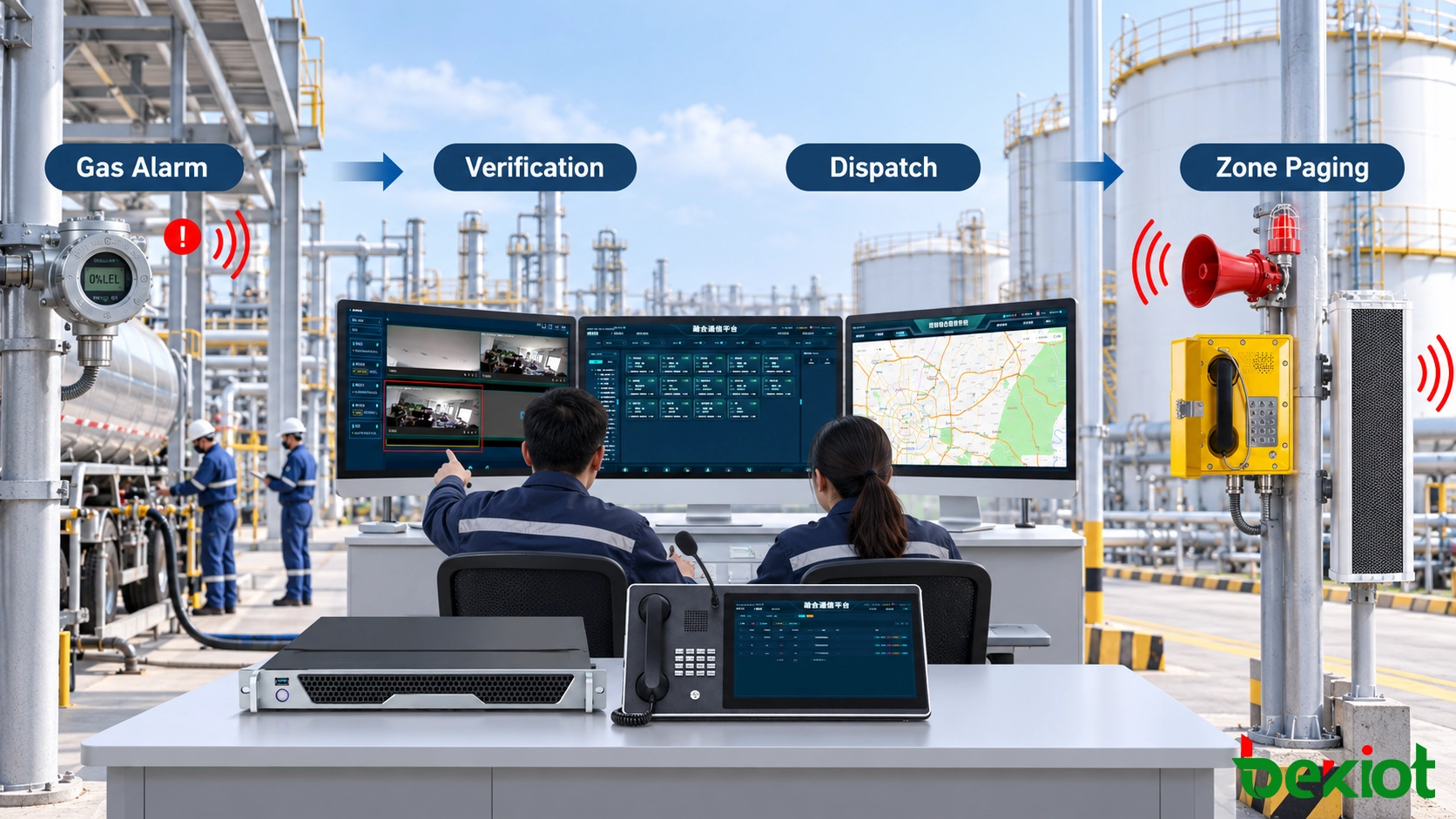
An approved workflow links the event source with operator verification, field communication, targeted paging and response tracking.
Design for Failure Before an Incident Occurs
Oil and gas communication systems must continue operating through equipment faults, damaged links and temporary loss of external connectivity. Redundancy should address credible failure scenarios rather than simply adding duplicate equipment.
Define Recovery Targets for the Complete Service
Recovery time, service availability and radio-coverage targets should be defined for each project according to operational risk, network architecture and the selected equipment. Rapid fibre-ring recovery or high server availability does not by itself guarantee that a field user can complete a call after a fault.
Acceptance testing should verify the complete communication path, including network recovery, server failover, media-session restoration, gateway reconnection and endpoint registration. These stages may recover at different speeds.
Heartbeat monitoring can detect the loss of a server, gateway or network path. The selected interval and failure threshold should balance timely recovery against unnecessary switching caused by short network disturbances.
Message-integrity checks can detect transmission errors, while acknowledgement mechanisms confirm whether an endpoint or operator has received an event. For high-impact manual actions, the project may also require role-based approval or confirmation by a second authorized operator.
Delivery criteria must be defined precisely. Depending on the application, successful delivery may mean acceptance by the server, receipt by the endpoint, confirmed playback in the field or acknowledgement by an operator.
Remove Shared Points of Failure
Two servers connected to one switch and one power circuit do not provide complete redundancy. The system review should cover:
Server and database availability
Core and access-switch paths
Fibre routes and building entry points
UPS capacity and generator-backed power
Radio controllers and gateway connections
WAN, private cellular and satellite dependencies
DNS, NTP, authentication and certificate services
Remote facilities can retain a local communication node or predefined fallback route. If the wide-area connection is unavailable, local personnel should still be able to contact the site control room and issue essential warnings.
Apply Security at Every Interface
Communication, process-control and enterprise networks should be separated according to the site’s security architecture. Firewalls and industrial security gateways can limit traffic to approved signaling, media and management services.
Each terminal should use an individual account or device identity. Operator, maintenance and administrator roles require separate permissions. Remote management should pass through controlled access paths rather than exposing field-device web interfaces directly to the internet.
Encryption can protect signaling, media and management traffic where it is supported across the complete path. Compatibility testing remains essential because a transport, certificate or codec mismatch can interrupt communication even when individual components operate correctly.
Critical records can remain on premises or within an approved private environment. The final arrangement should follow the organization’s cybersecurity, data-classification and regulatory requirements rather than applying the same storage model to every project.
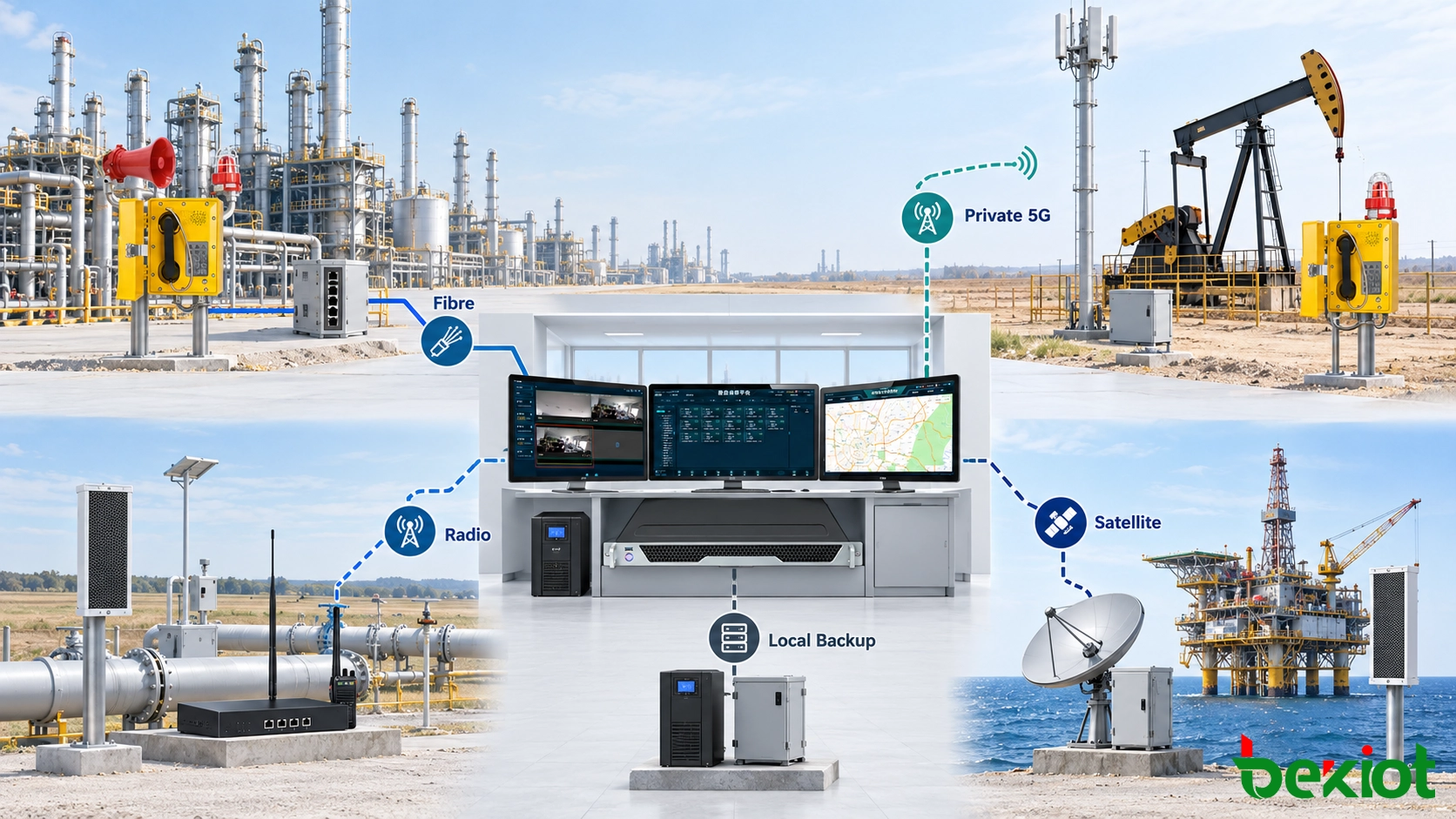
Fibre, private cellular, radio and satellite links provide different forms of resilience, while local communication preserves essential service when a remote connection is lost.
Adapt the Deployment to Each Operating Environment
Oilfields and Remote Production Stations
Wellheads, metering stations and gathering facilities may be spread across large areas with limited fixed infrastructure. Private cellular or industrial wireless links can carry voice, video and field data, while digital radio supports group communication for mobile personnel.
Remote stations can use industrial CPE to connect local IP devices to the available wide-area network. Where terrestrial coverage is unreliable, satellite communication may provide a backup path for essential voice and incident reporting.
Refineries and Processing Plants
Refineries combine control rooms, process units, tank farms, utilities and loading areas. Fixed industrial telephones and public address terminals provide predictable communication points, while radio handsets support operators moving between work areas.
Alarm integration must respect the plant’s process and safety boundaries. A pressure or gas alarm can identify the affected unit and notify the communications platform, but the message, recipients and broadcast range should be defined in an approved response matrix.
Offshore Facilities
Offshore platforms require reliable local communication even when their connection to shore is unavailable. On-platform telephony, radio, paging and general-alarm functions should not depend solely on a remote data center.
Satellite or microwave links can connect the platform with shore-based operations. Bandwidth policies should prioritize voice, alarm information and operational video during congestion. Non-essential traffic can be limited so that critical communication remains available.
Storage Terminals and Loading Areas
Tank farms, pump rooms, truck-loading racks and marine jetties require clear communication between field operators and the control room. Fixed call points are useful where personnel wear gloves, mobile devices are restricted or machinery noise makes ordinary phones unsuitable.
Zoned paging prevents a routine loading instruction from disturbing the entire terminal. During a confirmed emergency, the operator can expand the target from one loading rack to the surrounding tank area and then to the complete facility when required.
Long-Distance Pipelines
Pipeline communication must support control centers, pump stations, valve sites and mobile inspection teams. GIS can associate calls and alarms with kilometre markers, access roads and nearby personnel.
Field teams may use private cellular, public mobile service, digital radio or satellite terminals according to local coverage. The dispatch platform can present these resources through one operational directory while preserving their different availability, access and priority rules.
Related Solution: Becke Converged Communication System
Commission the Complete Response Chain
Commissioning should reproduce the way personnel communicate during routine operations and emergencies. Testing only SIP registration, radio signal strength or server status leaves unverified gaps between individual subsystems.
The acceptance plan should cover:
Calls between field telephones, control rooms and authorized external destinations
Radio-group selection, push-to-talk control and telephone-to-radio connections
Public address coverage under normal and high-noise operating conditions
Caller name, equipment area and map-location accuracy
Alarm-source mapping and selection of the correct paging zone
Video display and recording associated with an incident
Operator acknowledgement, escalation and event closure
Recovery after server, network, gateway or power failure
Local communication during WAN or private cellular interruption
Restoration of device identity, priority and recording after failover
Coverage must be verified in the actual operating environment. Steel structures, storage tanks, process equipment, weather and machinery noise can produce results that differ significantly from desktop calculations.
A successful failover test must confirm more than network recovery. Engineers should verify that field calls still reach the correct operator, radio groups remain available, alarms retain their location data, recordings continue and emergency broadcasts override routine traffic.
Final documentation should record device identities, network connections, radio resources, paging zones, alarm mappings, operator permissions and backup routes. It should also identify where each routing rule is stored so that future changes do not leave conflicting configurations in terminals, gateways and servers.
The effectiveness of an oil and gas communications solution depends on operational continuity. It must connect the right field user with the right control-room function, preserve essential communication when part of the infrastructure fails and provide a clear record of how each incident was handled.
FAQ
Should Emergency Paging Remain Available If the Central Platform Fails?
Essential paging should have a documented fallback method appropriate to the facility. Depending on the architecture, this may involve a local paging controller, emergency microphone, hardwired input or predefined edge-level broadcast function. The fallback path should be included in routine drills and acceptance testing.
How Should Communication Priorities Be Assigned During an Incident?
Priority should follow an approved response matrix. Emergency calls, alarm notifications and evacuation messages may override routine paging or non-critical conversations, while access to critical radio groups remains limited to authorized operators. These rules should be tested under simultaneous traffic conditions.
How Much Bandwidth Does a Remote Site Require?
Bandwidth depends on the number of simultaneous voice calls, video streams, radio connections and data applications. The calculation should include protocol overhead, peak usage and sufficient reserve for emergency operation. Voice and alarm traffic should receive priority when the available link is limited.
What Communication Records Should Be Retained?
Retained information may include call records, operator actions, alarm acknowledgements, paging history, configuration changes and authorized voice recordings. The retention period should follow company policy, contractual obligations and applicable privacy or industry requirements.
How Should Contractors Receive Temporary System Access?
Contractors should receive individual, time-limited accounts restricted to the sites and functions required for their work. Shared administrator credentials should not be used. Temporary permissions should expire automatically, and their creation, use and removal should remain visible in the security audit log.