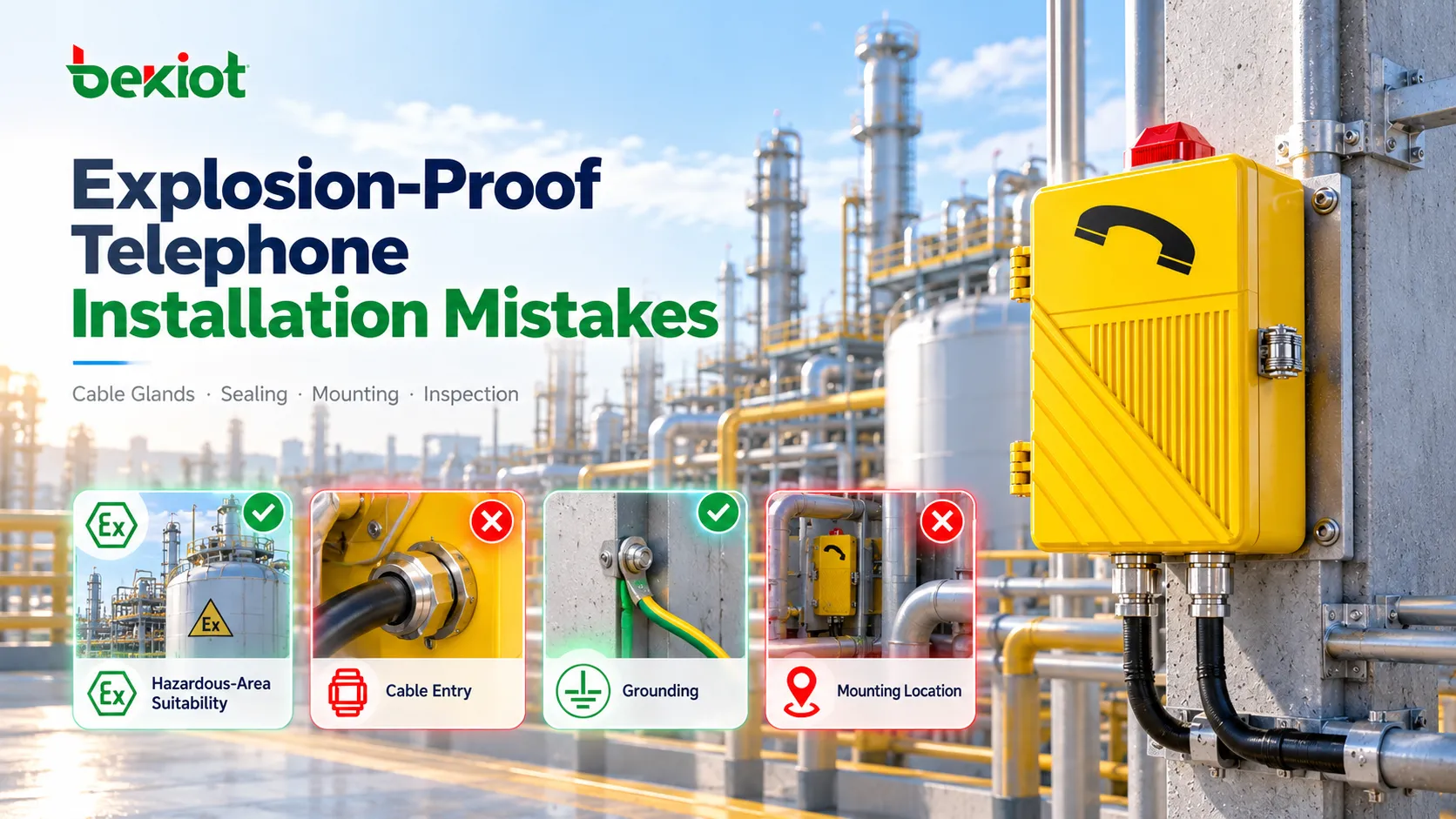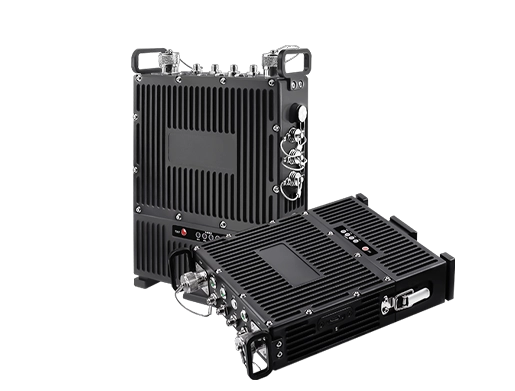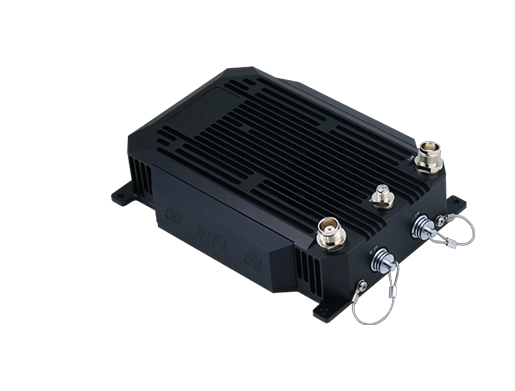
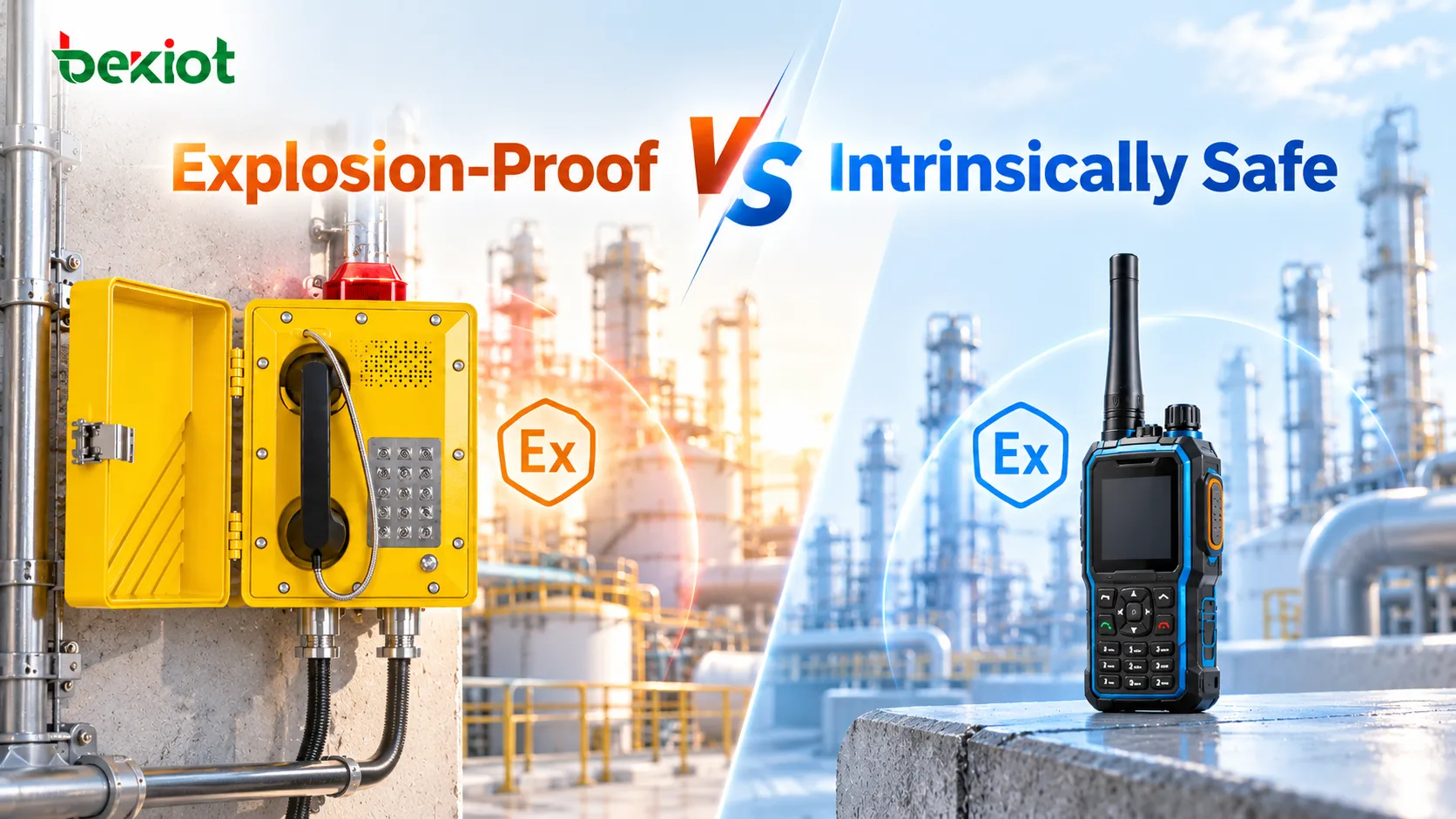
In hazardous-area communications, two very different types of devices are commonly seen. One may be a heavy-duty telephone, intercom terminal or control station built around a robust metal enclosure with substantial fasteners and cable entries. The other may look much closer to a conventional handheld device, such as a hazardous-area mobile phone, radio or low-power field terminal. Both may be certified for use in explosive atmospheres, but they achieve protection in very different ways.
From a design perspective, one approach accepts that sparks, arcs or high-temperature components capable of igniting a gas mixture may exist inside the equipment, then relies on a specially designed and tested enclosure to contain an internal explosion. The other approach limits voltage, current, power and stored energy at circuit level so that the exposed electrical circuit does not contain sufficient energy to become an effective ignition source under specified conditions.
For communication terminals, these two approaches can affect device size, loudspeaker output, battery design, displays, interfaces, cabling, maintenance procedures and even the overall network architecture. The real selection questions are therefore: What communication functions are required? How much power is needed? Is the device fixed or mobile? What hazardous-area classification applies? And what protection concept is used across the complete communications circuit?
What Do “Explosion-Proof” and “Intrinsically Safe” Mean?
Terms such as “explosion-proof telephone,” “explosion-proof radio” and “explosion-proof terminal” are often used as broad product categories for equipment certified for use in explosive atmospheres. Under the IEC 60079 series, however, explosion protection includes several distinct protection concepts, such as flameproof enclosure Ex d, increased safety Ex e, intrinsic safety Ex i, pressurization Ex p and encapsulation Ex m. They pursue the same overall objective—reducing the risk that electrical equipment will ignite the surrounding explosive atmosphere—but they do so in different ways.
For a more technically precise comparison, the two concepts are better described as: Flameproof Communication Terminals (Flameproof Enclosure, Ex d) vs Intrinsically Safe Communication Terminals (Intrinsic Safety, Ex i). Within the IECEx framework, IEC 60079-1 applies to Flameproof Enclosures “d”, while IEC 60079-11 applies to Intrinsic Safety “i”. IEC 60079-0 defines general requirements for Ex equipment, including construction, testing and marking. This distinction matters because seeing “Ex” on a nameplate does not by itself identify the protection concept. The following markings—such as db, ia, ib and ic—need to be read as well.
Two Different Protection Principles
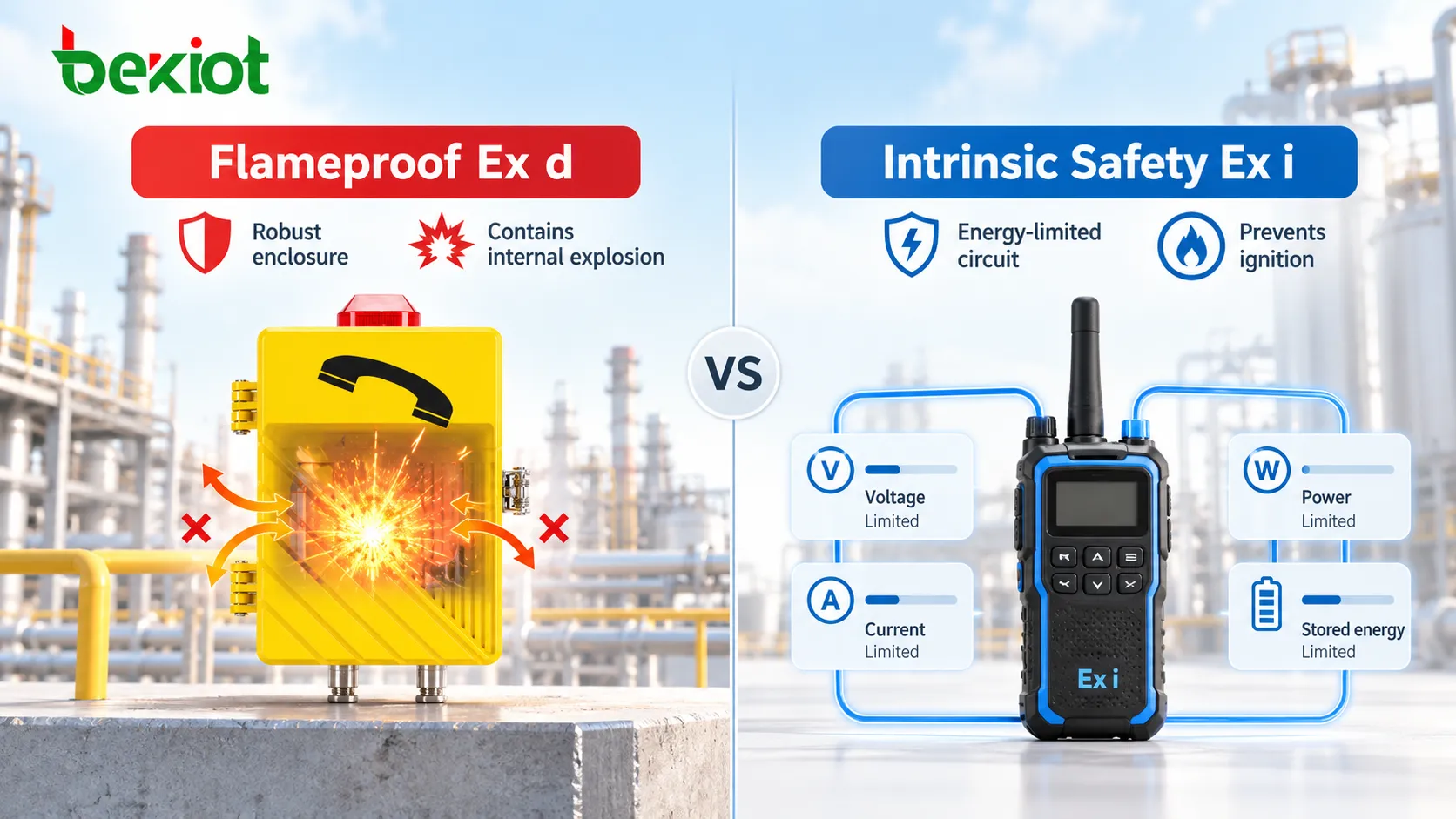
The fundamental difference between flameproof and intrinsically safe equipment is straightforward: one controls the propagation of an explosion, while the other limits ignition energy.
Ex d: Containing the Hazard Inside the Enclosure
The principle of a Flameproof Enclosure is not to guarantee that an arc, spark or ignition can never occur inside the equipment. Instead, the enclosure is designed to withstand the pressure of an internal explosion under specified conditions and to prevent flame propagation into the surrounding explosive atmosphere through carefully designed joints and structural features.
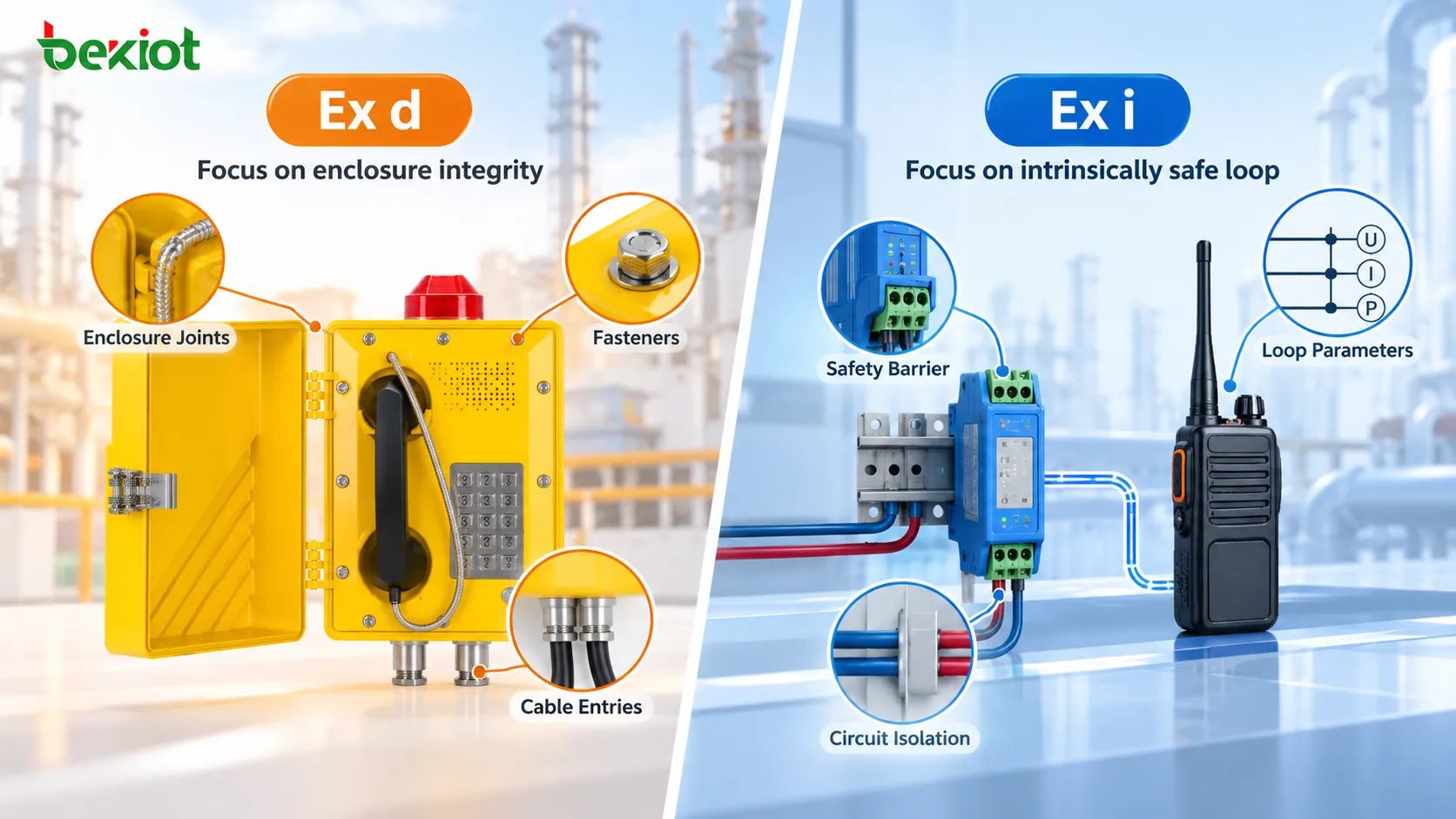
Enclosure strength, flamepaths or joints, fasteners, cable entries and other elements associated with enclosure integrity therefore become part of the protection system.
For fixed communication terminals, this approach has an important practical advantage: the enclosure can contain conventional communications electronics, relays, amplifiers and comparatively higher-power components, provided the complete equipment has been designed and certified using the appropriate protection concept.
Ex i: Keeping the Circuit Below Ignition Energy
Intrinsic Safety follows a fundamentally different approach. Instead of relying on a heavy enclosure to contain an internal explosion, it limits voltage, current, power and stored energy in capacitance and inductance so that electrical sparks and thermal effects remain below the level capable of igniting the specified explosive atmosphere under defined normal and fault conditions.
The assessment therefore extends beyond the enclosure itself to the electrical circuit and the complete intrinsically safe loop connected to it.
| Comparison Item | Flameproof Ex d | Intrinsic Safety Ex i |
|---|---|---|
| Core Principle | Withstands an internal explosion and prevents flame propagation to the outside atmosphere | Limits electrical and thermal energy to avoid creating an effective ignition source |
| Main Design Focus | Enclosure, joints, fasteners, cable entries and related structures | Voltage, current, power, stored energy and complete loop parameters |
| Typical Characteristics | Robust construction with greater flexibility for higher-power electronics | Controlled energy, well suited to low-power electronics and signal circuits |
| Common Communication Devices | Fixed telephones, amplified intercoms, control stations and audible/visual terminals | Handheld terminals, radios and low-power field devices |
Why Are the Enclosures So Different?
The two protection principles are reflected directly in product appearance and mechanical construction.
A typical flameproof fixed telephone often uses a robust aluminum alloy, stainless steel or other suitably engineered metal enclosure together with specified covers, fasteners and cable-entry arrangements. It is generally heavier and bulkier than an ordinary office telephone because the enclosure is not simply there to withstand impact—it may be an integral part of the Explosion Protection concept. Even a seemingly minor structural change therefore requires careful consideration. Replacing bolts with a different type, machining a joint, drilling a new hole on site or substituting a Cable Gland can affect the original protection arrangement.
An intrinsically safe terminal places more emphasis on the internal circuit design. When the circuitry, components, PCB spacing, stored energy, battery and external connections meet the applicable intrinsic-safety requirements, the device does not necessarily depend on a heavy flameproof enclosure for protection. This is one reason many certified hazardous-area handheld radios, mobile terminals and instruments can remain relatively compact. However, this does not mean that a plastic enclosure automatically indicates intrinsic safety, or that a metal enclosure automatically indicates Ex d. The actual protection concept must be confirmed from the certification marking and certificate rather than from appearance alone.
Power Requirements Can Determine the Selection
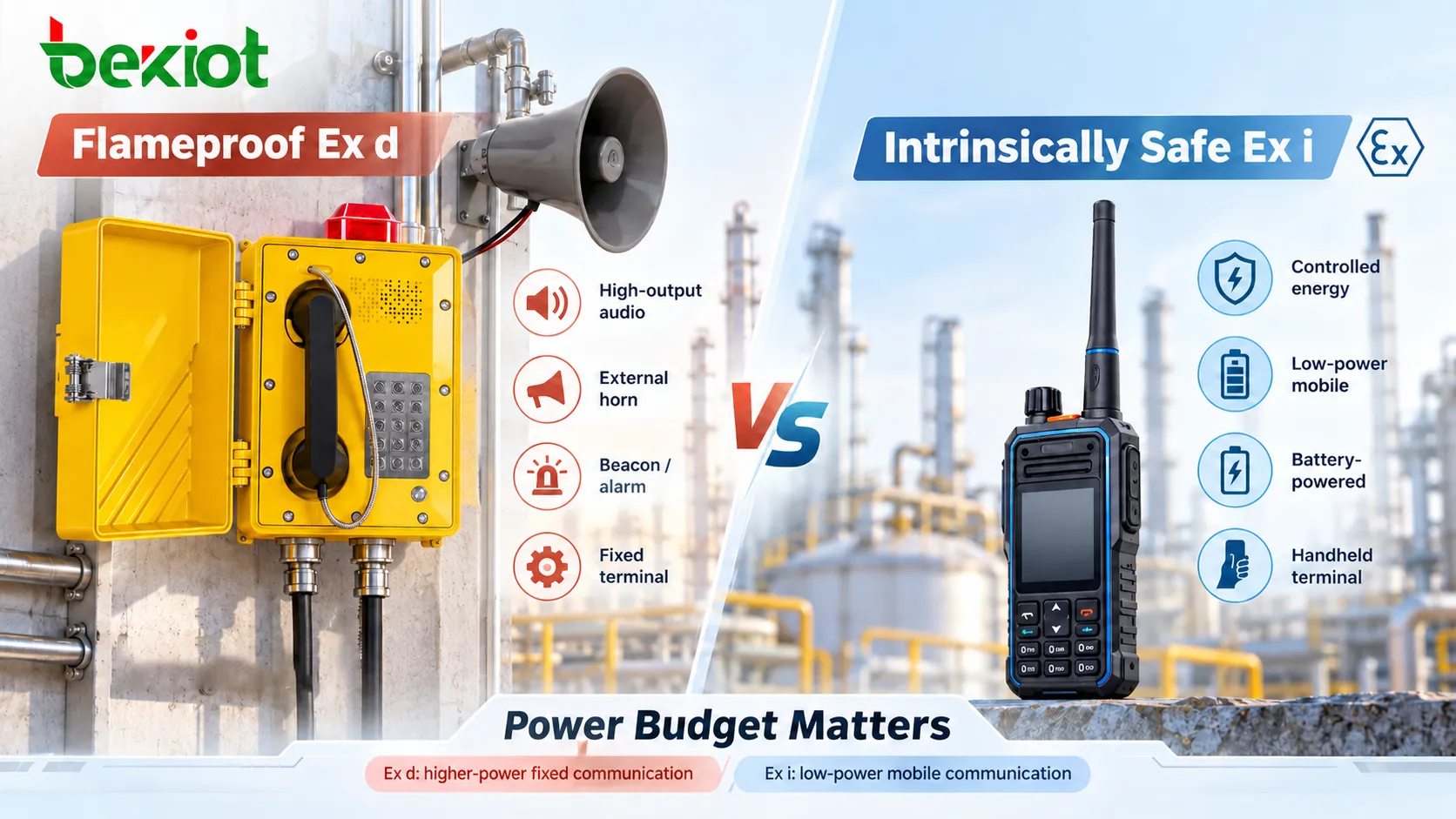
For communication equipment, one of the most practical differences between Ex d and Ex i is not found on the certificate—it is found in the power budget.
A communication terminal is not simply a sensor. It may need to drive a handset, loudspeaker, display, backlight, camera, wireless module, processor, relay, visual beacon or even an external horn. All of these functions consume energy.
A flameproof design can accommodate circuits and power devices required by the communications application, while the certified enclosure and overall construction manage the associated hazard. This is why fixed telephones, amplified intercom terminals, call stations and alarm devices used in high-noise areas often employ flameproof or combined protection concepts.
Intrinsic Safety limits energy at its source. This is highly valuable for sensors, signal devices, handheld communications equipment and specially designed low-power electronics. However, when a terminal needs continuous high audio output, a high-power loudspeaker or energy-intensive peripheral devices, the intrinsic-safety design becomes more challenging.
This is why it is not practical to assume that every hazardous-area telephone should simply be made intrinsically safe. A fixed telephone in a high-noise chemical process area may require a high-volume ringer, powerful hands-free audio, an external horn or audible and visual alarm integration. Those power requirements are part of the selection decision.
| Communication Requirement | Flameproof / Combined Protection Design | Intrinsically Safe Design |
|---|---|---|
| Standard Two-Way Voice | Relatively straightforward to implement | Can be implemented depending on the certified design |
| High-Output Hands-Free Audio | Greater flexibility for higher output power | More strongly constrained by energy limitations |
| External High-Power Horn | Can be implemented through an appropriately certified system | Usually requires additional consideration of power and interface design |
| Audible and Visual Alarming | Common in fixed industrial terminals | Energy must be evaluated as part of the complete intrinsically safe design |
| Battery-Powered Mobile Device | Possible, although construction may be more complex | Common in purpose-designed low-power mobile terminals |
Installation and Maintenance Requirements Differ
Neither type of equipment should be installed or maintained like an ordinary industrial terminal, but the most vulnerable points are different.
Flameproof Equipment Is Particularly Sensitive to Structural Modification
With an Ex d terminal, maintenance personnel need to preserve the enclosure structure. Flamepaths and joints should not be casually ground or machined, specified fasteners should not be substituted simply because another bolt appears to be the same size, and Cable Glands, Adapters and Blanking Plugs cannot be selected only on the basis that the thread fits.
Drilling an additional opening on site for easier cabling, or replacing original structural components with unverified alternatives during maintenance, can affect the original protection conditions.
Intrinsically Safe Systems Are Particularly Sensitive to Changes in Loop Parameters and Isolation
With an Ex i system, the main risk is often not modification of the enclosure but modification of the circuit. Replacing a safety barrier, combining different circuits, changing cable type or length, adding unassessed equipment, or failing to maintain the required separation between intrinsically safe and non-intrinsically safe circuits can alter the conditions under which the system was designed.
Maintenance of an intrinsically safe communications circuit therefore cannot be reduced to asking whether the replacement equipment uses the same voltage. The system parameters and applicable installation documentation also need to be checked again.
Another common misunderstanding is that “because the circuit is intrinsically safe, it can always be disconnected or worked on while energized.” Intrinsic Safety can provide important advantages in certain maintenance situations, but whether live work is permitted still depends on the equipment certificate, site procedures, applicable standards and the work-permit system. Intrinsic Safety does not mean unrestricted Live Work is automatically permitted.
The Protection Concept Must Ultimately Serve the Communication Task
In hazardous-area communications, Ex d and Ex i are not competing product labels. They are two different engineering tools. Ex d addresses the question of how equipment containing circuits with potentially sufficient ignition energy can use a certified structure to contain the hazard. Ex i addresses a different question: how to limit electrical and thermal energy at circuit level so that it remains below an effective ignition threshold. The former offers more flexibility for fixed communications equipment requiring high audio output, higher power and complex field interfaces. The latter is particularly well suited to low-power circuits, mobile terminals, instrumentation and applications where circuit energy must be tightly controlled. Neither conclusion, however, can be separated from the actual Ex Marking, certification and field conditions of the specific product.
What industrial communication systems should avoid is forcing every device to use the same Protection Concept simply for the sake of standardization. A chemical plant may reasonably use flameproof fixed telephones, intrinsically safe mobile radios, hazardous-area loudspeakers and conventional dispatch equipment installed in the safe area at the same time. As long as each device is suitable for its installation environment and the communications platform brings them into a unified calling, PTT, dispatch and alarm workflow, such a mixed architecture is often better aligned with real operational requirements.
Becke Telcom provides explosion-proof telephones, industrial communication terminals, IP PBX systems, SIP servers, RoIP gateways and command-and-dispatch systems for oil and gas, chemical, energy, storage and other hazardous-area applications.
FAQ
Are Explosion-Proof and Intrinsically Safe Two Protection Levels of the Same Type?
No. “Explosion-proof” is often used as a broad description for equipment intended for hazardous areas, while Ex i is a specific Protection Concept based on Intrinsic Safety. In strict technical comparisons, Flameproof Ex d and Intrinsic Safety Ex i are more directly comparable. They use different protection principles and should not be ranked simply as higher or lower levels.
Which Is More Suitable for Zone 1, Ex d or Ex i?
Both protection concepts can be used for Zone 1 applications when the equipment meets the required protection level and the specific certificate permits the application. Ex db is common among fixed communication terminals used in appropriate Zone 1 locations, while intrinsically safe equipment may use Ex ib or a higher level of protection. Final selection also depends on gas group, temperature class, environmental conditions and required device functions.
Are Intrinsically Safe Devices Always Lighter?
Not necessarily. Because intrinsic safety does not depend on a heavy flameproof enclosure to contain an internal explosion, low-power handheld and field devices can often be designed in a compact form. Final weight, however, still depends on the battery, mechanical protection, IP rating, display and communication functions. The protection concept cannot be identified from weight alone.
Can Intrinsically Safe Equipment Be Connected Directly to a Standard Switch or Power Supply?
Not in every case. Intrinsically safe equipment may depend on safety barriers, galvanic isolators, associated apparatus and parameter matching across the complete intrinsically safe circuit. The equipment certificate, control drawing and system design should be used to verify Uo, Io and Po against Ui, Ii and Pi, together with the capacitance and inductance of the connected equipment and cabling.
Which Protection Concept Is More Suitable for a Fixed Telephone in a High-Noise Hazardous Area?
Where the communications point requires a high-volume ringer, high-output hands-free audio, an external horn, audible and visual alarming or other higher-power functions, flameproof or another suitable combined protection concept generally provides more design flexibility. Final selection should still be based on the equipment certificate, site Zone, ambient noise level and actual functional requirements rather than the Protection Concept alone.