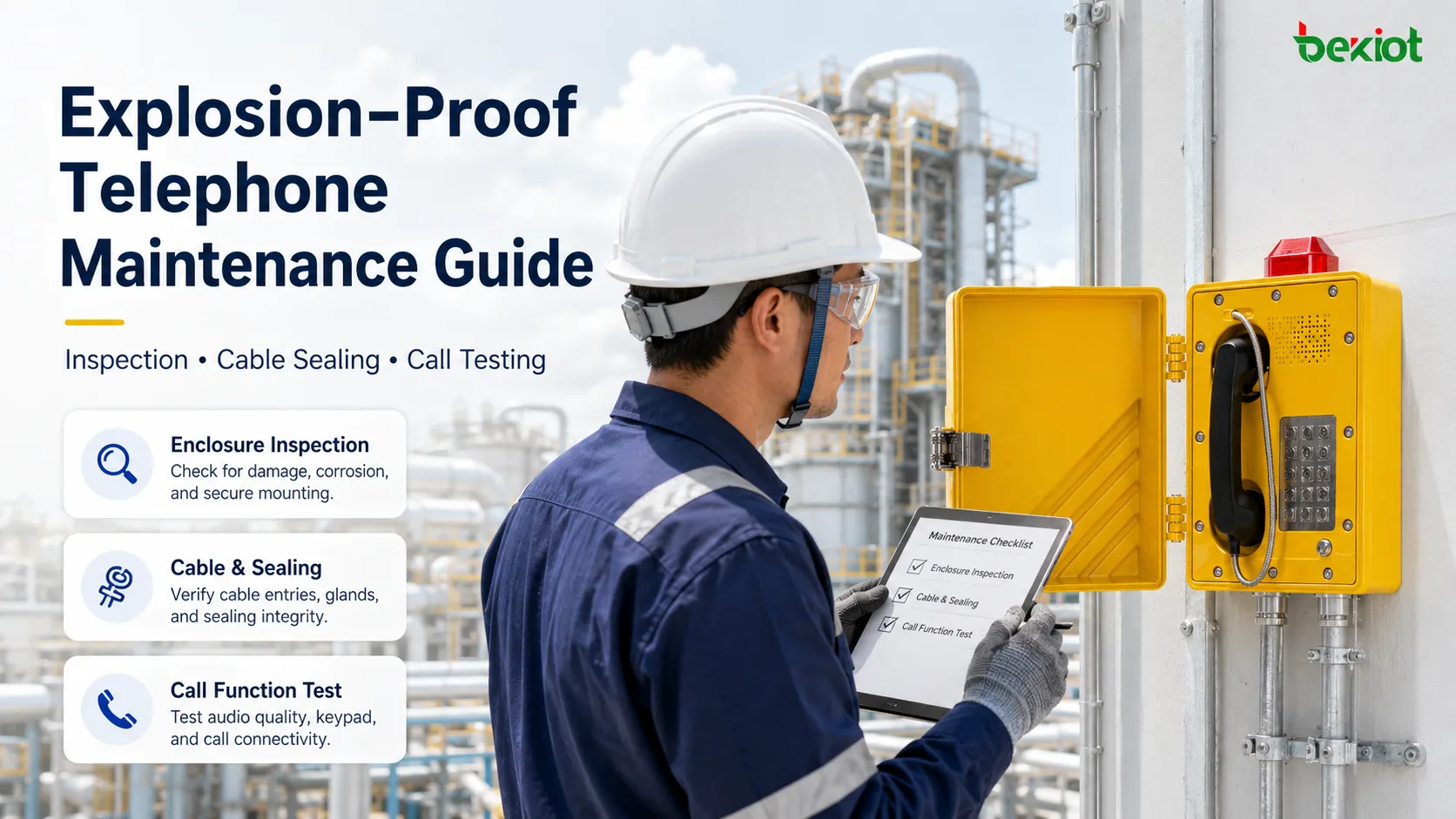
Explosion-proof telephones installed in chemical plants, oil and gas facilities, mines, storage sites, and other industrial environments with potentially explosive atmospheres require a different maintenance approach from ordinary office phones. In addition to ensuring normal dialing, answering, and voice communication, maintenance personnel should regularly inspect the enclosure, sealing components, cable entries, and mounting condition to prevent corrosion, loosening, aging, or improper repairs from affecting the telephone's original explosion protection.
Routine maintenance does not mean frequently opening the enclosure. Many checks on explosion-proof telephones installed in hazardous areas can be completed through visual inspection and functional testing. Work involving enclosure opening, internal wiring, component replacement, or repairs to explosion-protection-related structures should follow the manufacturer's instructions, site safety procedures, and applicable hazardous-area requirements, and should be carried out by appropriately qualified personnel.
What Should Be Checked During Routine Maintenance?
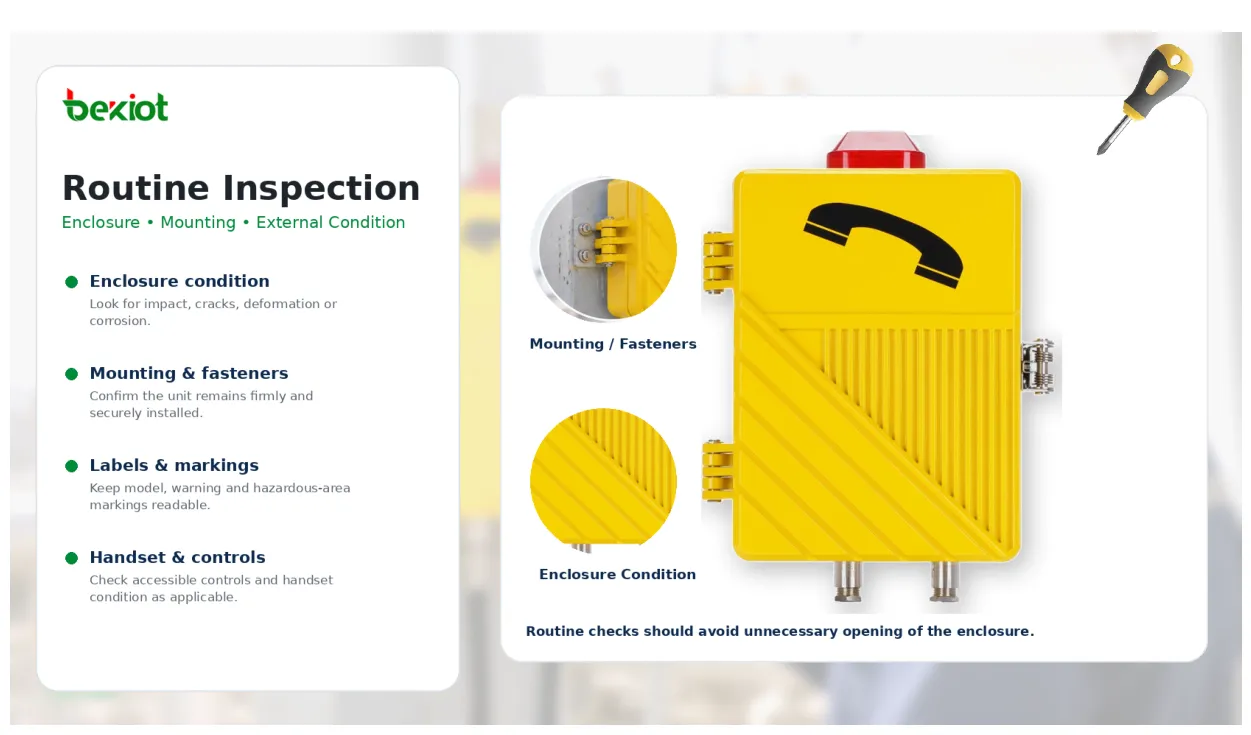
After an explosion-proof telephone has been installed in the field for an extended period, the parts most exposed to environmental conditions are typically the enclosure, mounting hardware, cable entries, handset, keypad, and external connections. Routine inspection should therefore begin with the overall condition of the telephone rather than immediately opening the enclosure.
Check for obvious impact damage, cracks, deformation, severe corrosion, or loose components, and confirm that the telephone remains securely mounted on the wall, column, or support structure. For outdoor installations, also check whether prolonged exposure to rain, salt spray, dust, or strong sunlight has affected the enclosure, labels, or sealing components.
Explosion-protection markings, nameplates, model information, and warning labels should remain legible. If a nameplate becomes badly damaged, the original equipment documentation should be retained so that future maintenance personnel can still identify the equipment's type of protection and intended operating conditions.
How Should the Enclosure, Fasteners, and Sealing Components Be Inspected?
The enclosure of an explosion-proof telephone does more than provide mechanical protection. Depending on the equipment design, its explosion-protection performance may also depend on the enclosure construction, joints, fasteners, and sealing arrangements. An enclosure inspection should therefore involve more than simply checking whether the surface is clean.
Pay particular attention to unusual cracks, obvious mechanical damage, severe corrosion, and abnormal gaps between enclosure sections. If mounting bolts or external fasteners are loose, missing, or heavily corroded, they should be handled in accordance with the manufacturer's requirements. Fasteners of a different specification should not be substituted without confirmation.
For equipment using a flameproof enclosure, particular care is required when working with flameproof joints. During routine cleaning or maintenance, these surfaces should not be ground, cut, machined, or otherwise altered. Materials not approved for the equipment should not be applied to these areas without authorization. If the enclosure must be opened, the work should follow site hazardous-area procedures and the manufacturer's maintenance requirements.
What Should Be Checked at Cable Entries and Wiring Connections?
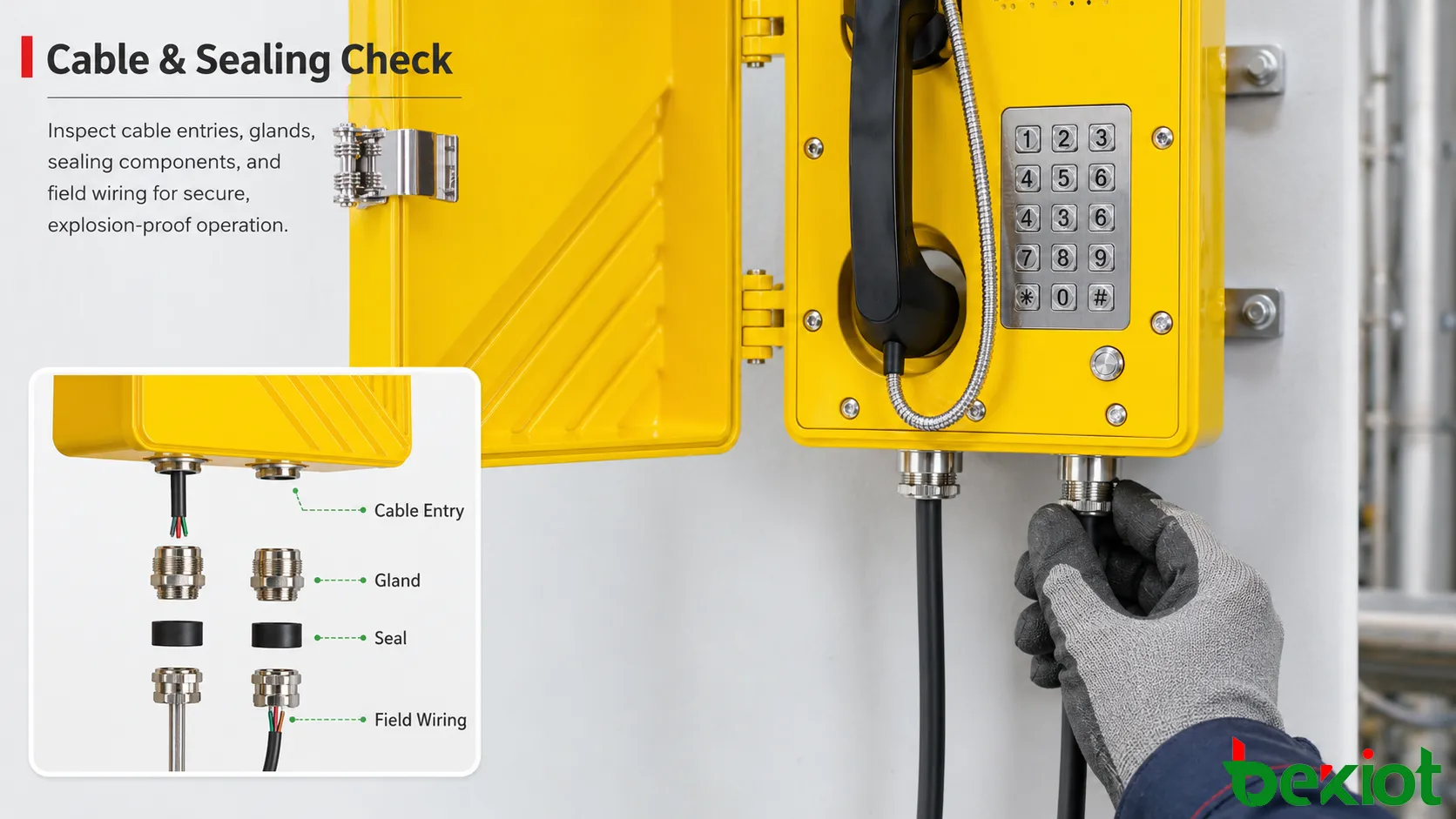
Cable entries are easily overlooked during explosion-proof telephone maintenance. An undamaged telephone enclosure does not necessarily mean that the complete installation remains in acceptable condition. If a cable seal, gland, or blanking element becomes loose or damaged, both the environmental protection and the integrity of the explosion-protection arrangement may be affected.
During inspection, check cables for obvious pulling, aging, cracking, abrasion, or mechanical damage, and confirm that there is no abnormal looseness around the cable entry. Unused cable entries should remain properly sealed using components that meet the original equipment requirements. Blanking elements should not be removed casually to accommodate temporary wiring.
For a SIP explosion-proof telephone, the network condition can also be checked through the Ethernet switch, PoE equipment, or communication platform. For an analog telephone, line condition, dialing, and ringing can be tested. If the telephone frequently goes offline, fails to register, or experiences interrupted calls, first determine whether the cause is related to the network, cabling, power supply, or the telephone itself before opening the enclosure.
How Should the Handset, Keypad, and Call Functions Be Tested?
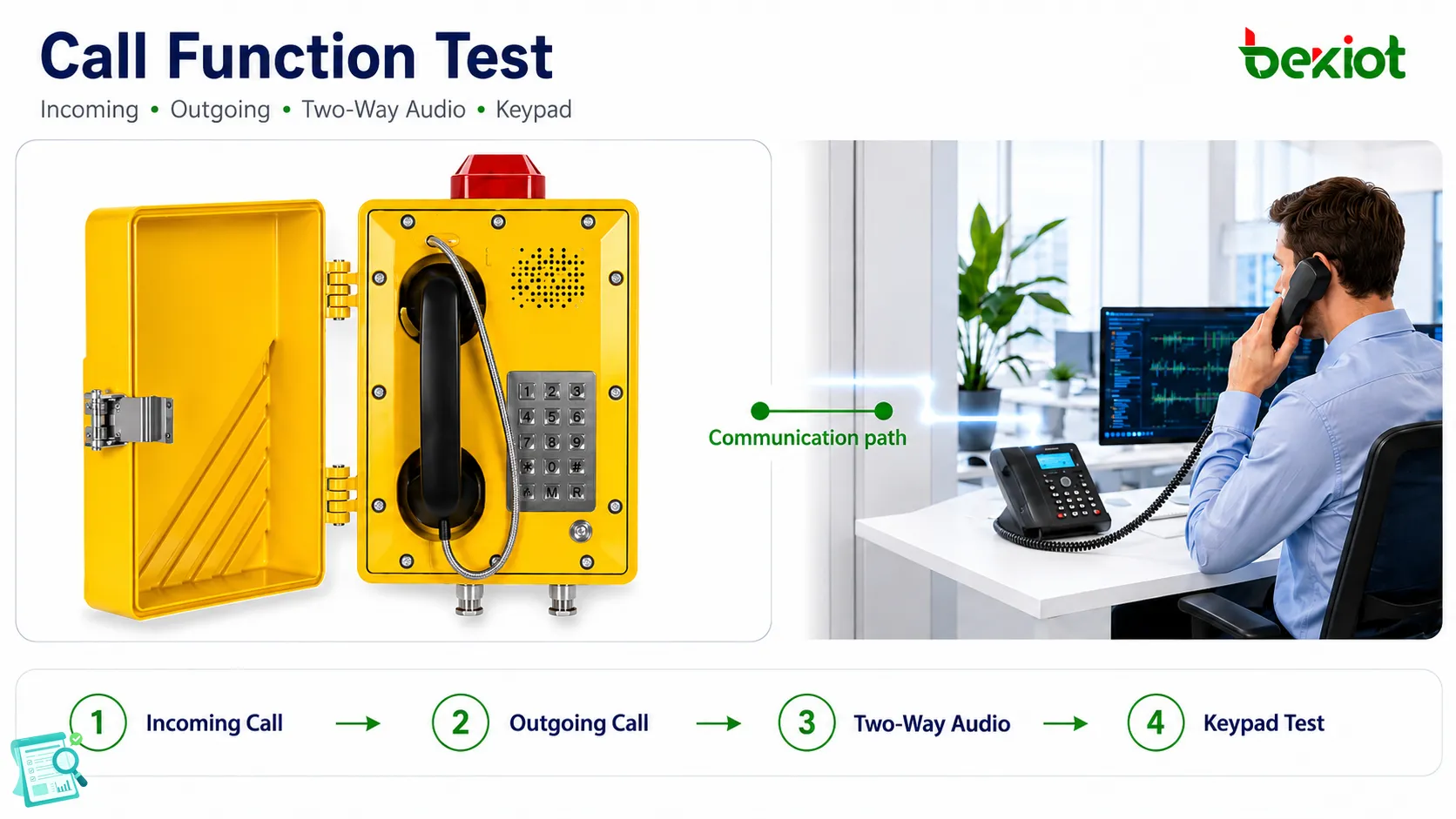
An explosion-proof telephone is ultimately a field communication terminal, so functional testing should form part of routine maintenance. Simply confirming that the device powers on is not enough to determine whether it is operating correctly.
Regular call tests can be used to verify outgoing calls, incoming calls, ringing, off-hook and on-hook operation, two-way audio, and keypad input. If the telephone includes hands-free calling, one-touch calling, emergency calling, paging, or connections to audible and visual alarm devices, these functions should also be tested according to the actual system configuration.
In high-noise industrial environments, attention should also be paid to noticeable reductions in handset or microphone volume, static noise, intermittent audio, or feedback. For telephones with coiled handset cords, inspect the cable jacket for wear and check whether the handset connection has become loose due to repeated pulling.
If the telephone is connected to a dispatch platform, IP PBX, or another communication system, maintenance should include more than a local call test. Terminal registration, number routing, and dispatch calling should also be verified. This helps determine more quickly whether a fault is located in the terminal, the network, or the central communication platform.
What Should Be Considered When Cleaning an Explosion-Proof Telephone?
Telephones installed in chemical plants, mines, ports, and production facilities can accumulate dust, oil, salt deposits, and other contaminants. Long periods without cleaning can affect keypad and handset operation and may also accelerate corrosion of metal components, fasteners, and external connection points.
Routine cleaning should follow the cleaning methods specified in the equipment documentation. In many cases, a soft cloth can be used to remove surface dust and dirt. Strong corrosive cleaning agents or unapproved solvents that could damage the enclosure, sealing components, or equipment markings should be avoided.
Even when a telephone has a water-resistant enclosure, it should not be pressure-washed simply because it is described as waterproof. The IP rating, mounting orientation, condition of the cable entries, and cleaning methods permitted by the manufacturer should all be considered.
After cleaning, inspect the handset cradle, areas around the keypad, and enclosure joints for trapped water, foreign material, or abnormal corrosion. Combining cleaning with visual inspection makes routine maintenance more efficient.
Can the Telephone Be Opened and Repaired Immediately After a Fault Occurs?
When a standard telephone develops a keypad or audio fault, maintenance personnel may be accustomed to opening the device immediately for inspection. The same approach should not automatically be applied to an explosion-proof telephone. Internal repair work involving the explosion-proof enclosure, joints, sealing components, terminals, or certified critical components may affect the equipment's original explosion-protection performance.
When a fault is detected, a better approach is to document the symptoms first and then check the external cabling, power supply, network, and system status. If the fault is confirmed to originate from the telephone itself, further inspection should be arranged in accordance with the product maintenance documentation and site safety procedures.
In particular, if the enclosure is cracked, severely corroded, the cable seal has failed, fasteners are missing, water has entered the unit, or other internal abnormalities are suspected, maintenance should not focus solely on restoring communication. After repair, the safety-related structure and components should also be confirmed to remain consistent with the original equipment requirements.
How Should Maintenance Intervals and Records Be Established?
There is no single fixed maintenance interval suitable for every explosion-proof telephone installation. Maintenance frequency varies according to the installation location, level of corrosion, dust conditions, frequency of use, and the site's own hazardous-area management procedures. Rather than applying a rigid rule such as opening every telephone once a month, it is generally more practical to establish inspection levels based on equipment condition and environmental exposure.
| Inspection Type | Main Checks | Primary Purpose |
|---|---|---|
| Routine Visual Inspection | Enclosure condition, mounting, handset, and visible damage | Quickly identify looseness, damage, or abnormal conditions |
| Periodic Functional Test | Incoming calls, outgoing calls, ringing, two-way audio, and emergency calling | Confirm that communication functions remain fully operational |
| Periodic Detailed Inspection | Cable entries, fasteners, seals, and explosion-protection-related structures | Arrange technical inspection according to the environment and equipment requirements |
| Post-Fault Inspection | Fault cause, repair work, replaced components, and restoration testing | Confirm that both communication functions and equipment condition have been restored |
Maintenance records should include at least the equipment identification number, installation location, inspection date, detected problems, corrective actions, and test results. Where a site has many explosion-proof telephones, an equipment register can be maintained to link fault records with maintenance history and identify recurring issues such as corrosion, water ingress, cable damage, or unstable network connections at a particular location.
The purpose of keeping records is not simply to prove that maintenance has been completed. More importantly, records help maintenance personnel recognize changes in equipment condition. For example, if the same telephone repeatedly develops enclosure corrosion or line faults, the installation environment should be investigated rather than replacing the damaged component each time.
Core Principles of Explosion-Proof Telephone Maintenance
Routine maintenance of an explosion-proof telephone can be summarized in two objectives: keeping the telephone available for reliable field communication and ensuring that maintenance work does not compromise its original explosion protection. The enclosure, cable entries, seals, fasteners, handset, and communication functions should all be included in the inspection process, but not every problem requires the enclosure to be opened.
Routine visual inspections and functional tests can be carried out through a structured maintenance program. Work involving enclosure opening, internal wiring, explosion-protection-related structures, or replacement of critical components should follow the equipment certification information, manufacturer's documentation, and the site's hazardous-area procedures. Combining routine inspections, functional testing, periodic technical checks, and maintenance records is more effective for long-term reliability than relying only on reactive repairs after a failure occurs.
For explosion-proof communication projects in chemical plants, oil and gas facilities, mines, and other industrial environments, suitable telephones and supporting communication systems should be selected according to the hazardous-area classification, communication method, and site conditions. Becke Telecom provides explosion-proof telephones, industrial communication terminals, and related communication system solutions for demanding industrial applications.
Explosion-Proof Telephone Maintenance FAQ
How Often Should an Explosion-Proof Telephone Be Inspected?
There is no universal inspection interval suitable for every installation. The actual frequency should be determined according to the hazardous-area environment, equipment usage, degree of corrosion and dust exposure, indoor or outdoor installation conditions, and the site's safety management procedures. Telephones installed in harsh environments or used frequently will generally require more frequent inspection, while periodic maintenance intervals should also take the manufacturer's recommendations into account.
Can Standard Telephone Parts Be Used to Repair an Explosion-Proof Telephone?
Standard telephone parts should not be used as substitutes without confirmation. The enclosure, fasteners, sealing components, cable entries, and certain internal parts may be associated with the telephone's original explosion-protection design and certification. When components need to be replaced, the replacement parts should comply with the original equipment design and the manufacturer's requirements so that communication functionality is not restored at the expense of explosion-protection performance.
Can an Explosion-Proof Telephone Be Washed Directly with Water?
Whether water washing is appropriate cannot be determined simply from the term "explosion-proof telephone." The equipment's IP rating, installation method, and manufacturer's cleaning instructions should also be considered. Even when the telephone has a high level of water protection, the condition of cable entries, seals, and the enclosure should be checked, and high-pressure water should not be used when the installed condition is uncertain.
Does a SIP Registration Failure Mean the Explosion-Proof Telephone Is Faulty?
Not necessarily. A SIP explosion-proof telephone may fail to register because of network connectivity, PoE power, switch port configuration, VLAN settings, IP address configuration, SIP server settings, account authentication, or cabling faults. The network and communication platform should be checked first before determining that the terminal hardware itself has failed. This can reduce unnecessary enclosure opening and internal inspection.