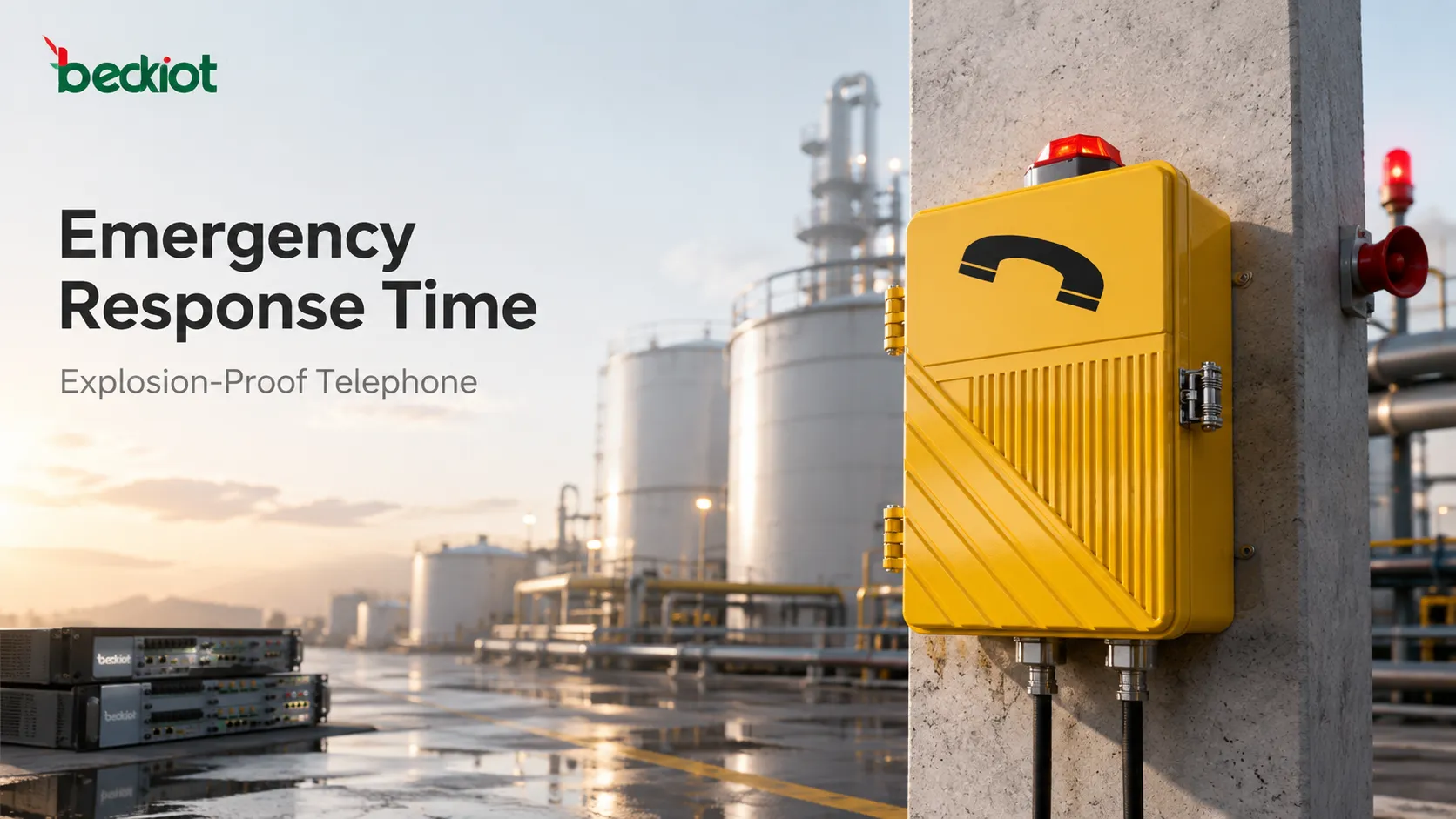
The starting point of emergency response time is not the moment when the dispatch room receives an alarm. In many field incidents, time is already lost before the report reaches the control room: personnel cannot quickly access a communication point after detecting an abnormal condition, public mobile networks may have insufficient coverage, radio channels may be occupied, high-noise environments may distort information, the control room may need repeated location verification, and response instructions may not reach frontline personnel in time.
The core value of explosion-proof telephones is that they reduce delay at these easily overlooked points. Their role is not simply to replace ordinary office telephones in hazardous areas, but to build compliant, fixed, identifiable, and directly connected emergency communication nodes inside explosive-risk zones. For high-risk environments such as petrochemical plants, oil and gas fields, mines, tunnels, tank farms, loading platforms, compressor rooms, and power facilities, the ability of explosion-proof telephones to improve response efficiency depends on how deeply they are integrated into the site’s emergency workflow.
Emergency Response Time Has Multiple Stages
Evaluating the emergency response capability of an explosion-proof telephone should not rely only on call connection time. In real industrial environments, a complete emergency response cycle consists of multiple linked stages: abnormal condition detection, arrival at the communication point, call initiation, dispatch-side answering, location verification, hazard description, response instruction delivery, field execution, and result feedback. Delay in any stage will extend the overall response time.
Take a tank farm leakage scenario as an example. If an inspector detects an unusual odor and must walk to a safe area before finding a communication method, or depends on a public mobile phone that repeatedly searches for signal, the early-stage delay alone may exceed dozens of seconds. If the dispatch side then needs to confirm the incident area, nearby equipment, and personnel status one by one, the decision-making process will be further delayed.
The contribution of explosion-proof telephones to response efficiency lies in reducing unnecessary delay across these stages. Devices are usually deployed at fixed points along high-risk areas. Their locations are planned in advance, and terminal identifiers are mapped to physical areas. Once field personnel pick up the handset or press the call button, the dispatch side can quickly identify the source of the call, shortening the interval from “abnormal condition detected” to “effective information generated.”
Compared with product descriptions that focus mainly on environmental adaptability, the deeper value of these devices lies in their ability to improve the full emergency workflow, enabling alarm reporting, verification, dispatching, and response actions to enter an effective execution state more quickly.
Fixed-Point Deployment Reduces Site Search Time
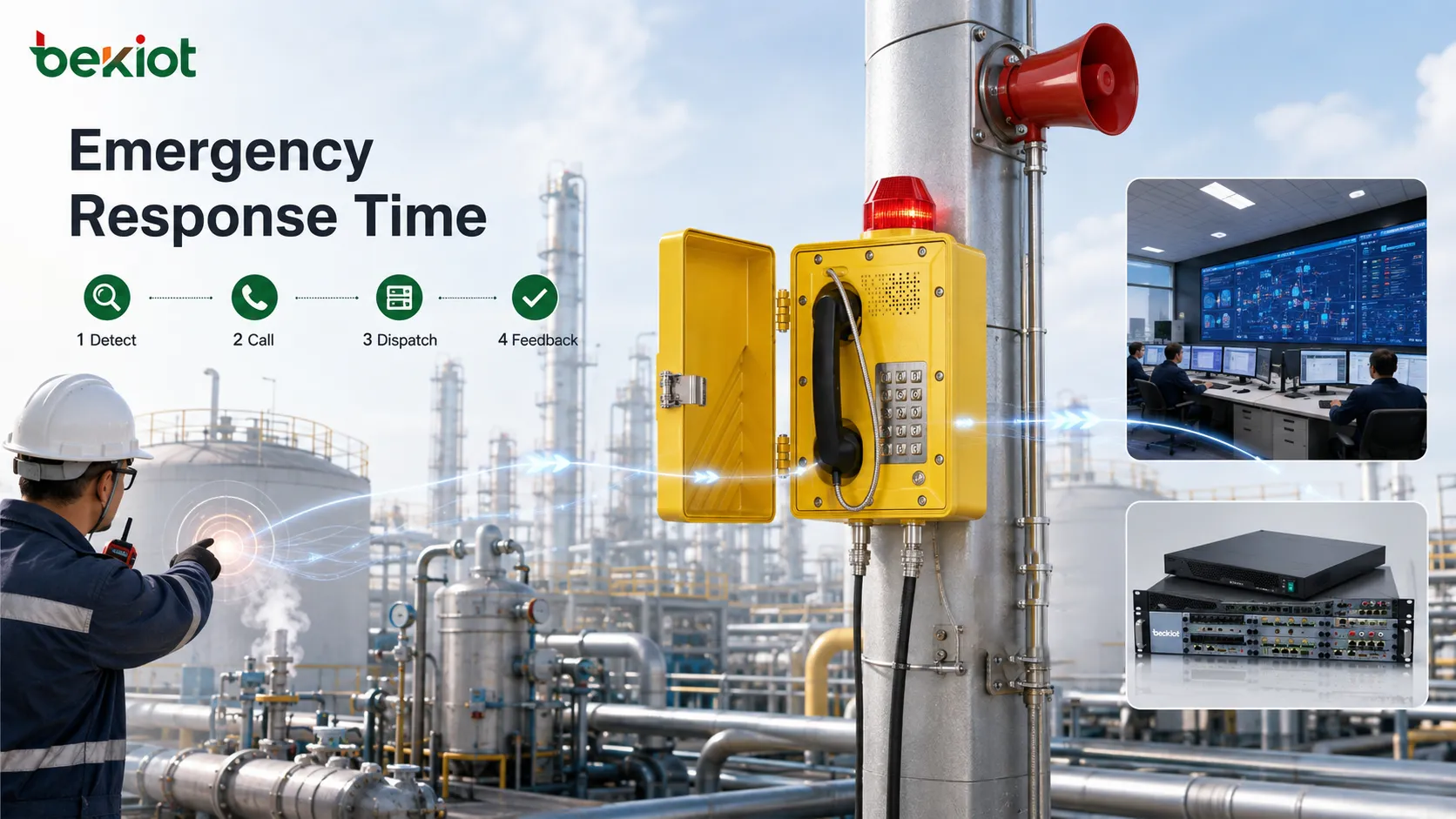
A common pain point in high-risk workplaces is that a hazard has been identified, but the communication entrance cannot be reached quickly. In office environments, access to communication tools is easy. In chemical process areas, mine roadways, tunnel sections, oil and gas well sites, utility corridors, or outdoor storage and transportation areas, personnel movement may be restricted, the communication environment may be complex, and equipment may be distributed across large spaces. Finding a communication terminal can itself create significant delay.
The primary value of fixed-point deployment is that it removes the need for field personnel to decide which communication method to use. The equipment is installed at a defined location and usually supported by clear warning or identification signage. During inspection, maintenance, loading, commissioning, emergency repair, or evacuation, workers can quickly reach the nearest communication node. This predictability reduces decision-making loss under emergency pressure.
Fixed points also provide natural spatial anchoring. A call from “East Tank Farm Explosion-proof Telephone” or “Compressor Room Entrance Explosion-proof Telephone” already carries location information. Even if the caller speaks urgently or background noise is strong, the dispatch side can first establish spatial positioning and then confirm the type of hazard, risk level, and personnel status.
For large industrial sites, the value of binding points to areas is even more obvious. A plant may deploy dozens or even hundreds of communication nodes. If terminal names correspond to areas, equipment, corridors, or job positions, dispatchers can identify the incident location faster. At this point, the explosion-proof telephone is no longer an isolated communication terminal; it becomes part of the site’s spatial information system.
In engineering implementation, point planning often has a greater impact on response efficiency than the technical parameters of a single device. Explosion-proof telephones should be deployed in locations that are easy to reach, relatively safe, clearly accessible, and visibly marked, rather than being installed only according to wiring convenience. Excessive distance, equipment obstruction, unclear signage, or poor access routes will greatly weaken the improvement in emergency response efficiency.
Direct Calling Optimizes the Reporting Chain
The second key way explosion-proof telephones improve response efficiency is by simplifying the reporting chain. Many field hazards are detected in time, but the reporting path has too many layers: frontline personnel first notify the team leader, the team leader contacts the duty room, and the duty room then forwards the information to the dispatch center. Each additional layer introduces extra delay and increases the probability of information distortion or omission.
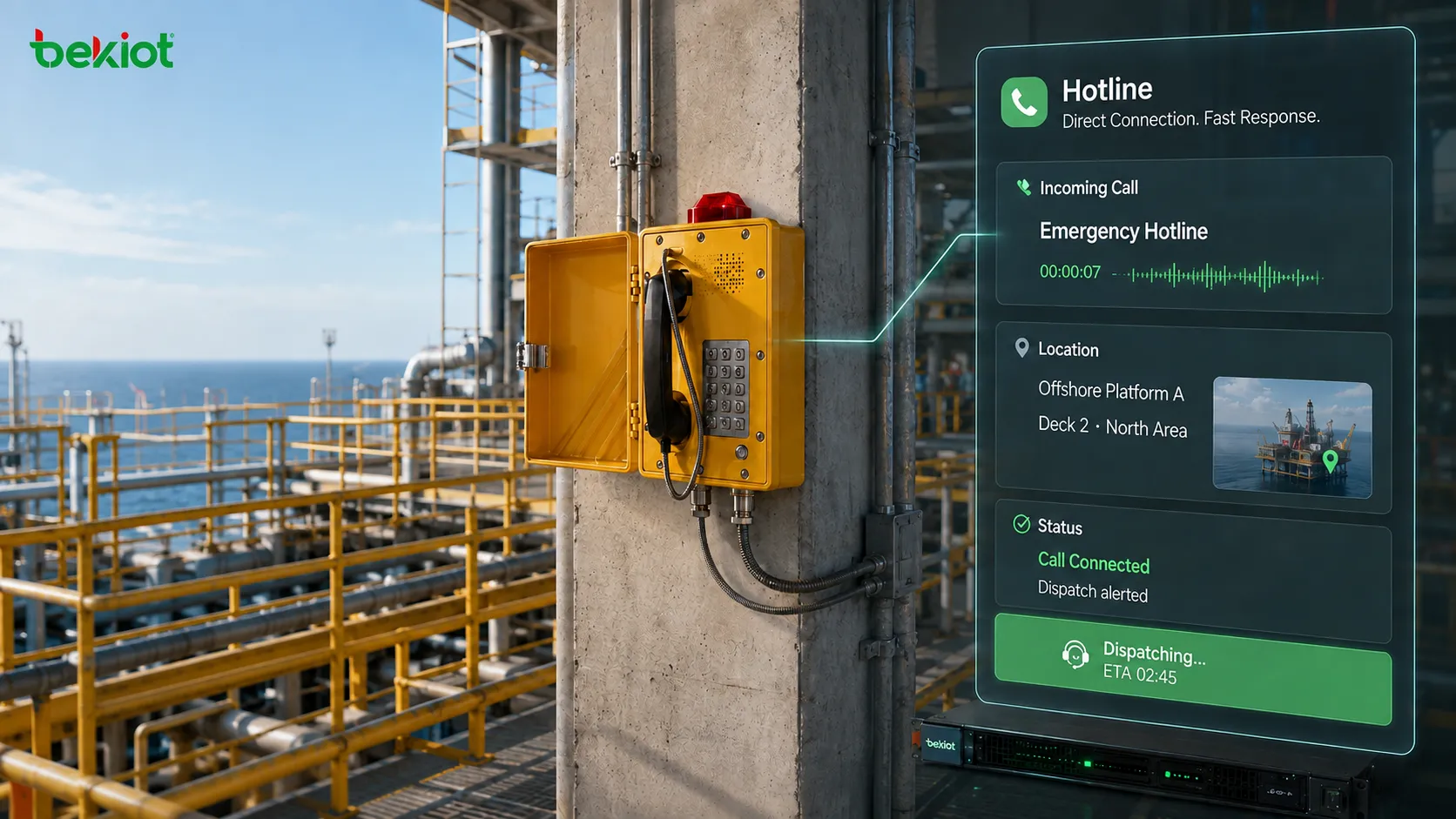
Explosion-proof telephones can be configured with direct calling, hotline calling, speed dialing, or direct access to a dispatch communication platform according to project needs. Field personnel do not need to memorize complex numbers or decide which department to contact. Once the handset is lifted or the dedicated button is triggered, the call can connect directly to the dispatch center, duty seat, or emergency post, compressing the process of “finding the right person” into “one-step connection.”
Direct calling also reduces the chance of operational error during emergencies. When a hazard occurs, field personnel may be wearing protective gloves and facing high noise, insufficient lighting, and time pressure. If they must enter a long number or perform multi-level transfer operations, the probability of mistakes rises significantly. A preconfigured hotline is better suited to real hazardous-area usage.
When explosion-proof telephones are connected to a unified dispatch system, response efficiency can be further improved. The dispatch platform can display the calling point, associated area, terminal status, and call record in real time. After receiving the call, dispatchers can directly initiate a conference, transfer the call, start area broadcasting, record the conversation, or coordinate related personnel. At this stage, the call from a single point becomes part of a standardized emergency handling process.
The EX-BH621 explosion-proof SIP telephone from Becke Telcom can be used as a reference option for fixed voice access projects in hazardous areas. It is suitable for field calling, dispatch center communication, and emergency reporting. Equipment selection should be evaluated together with the site’s explosion-proof requirements, calling mode, dispatch platform compatibility, installation location, and long-term maintenance plan.
High-Fidelity Voice Improves Information Verification
The core requirement of emergency communication is not merely call connection, but ensuring that dispatchers can hear information clearly, make accurate judgments, and deliver precise instructions. High-risk sites commonly have strong background noise: pumps, compressors, ventilation equipment, crushers, conveyor belts, vehicles, alarm tones, wind, rain, and tunnel reverberation can all interfere with call quality. Distorted voice transmission forces the dispatch side to repeatedly verify information, directly extending the response cycle.
The audio performance of explosion-proof telephones supports emergency efficiency in two directions. On one hand, the microphone and handset structure at the field reporting end should effectively reduce background noise and transmit speech clearly to the dispatch side. On the other hand, handling instructions issued by the dispatch side, such as stopping work, moving to the assembly point, closing a specific valve, or waiting for inspection personnel, must be accurately delivered to field personnel.
In strong-noise environments, speech clarity has higher priority than simple volume increase. If the volume is high but distortion is severe, field personnel may still be unable to understand the instruction. Moderate volume with clear speech characteristics is often more useful for fast confirmation. The handset acoustic structure, receiver gain, microphone layout, enclosure acoustic openings, line transmission stability, and platform audio parameter settings all influence the final call quality.
During engineering implementation, voice performance testing should be carried out under real working conditions. After installation, calls should be tested during equipment operation, personnel activity, fan startup and shutdown, vehicle movement, and other typical noise scenarios. Only then can the actual contribution to information verification efficiency be judged. Testing only call connection status in a quiet environment may ignore the real influence of site noise on emergency response.
If the explosion-proof telephone is linked with a broadcasting system, audible and visual alarms, and the dispatch platform, the value of clear voice becomes even greater. The dispatch side can first verify the field situation through the explosion-proof telephone and then issue unified instructions through area broadcasting. The faster the telephone enables situation confirmation, the earlier broadcast warnings and response measures can be activated.
System Linkage and Traceability Ensure Closure
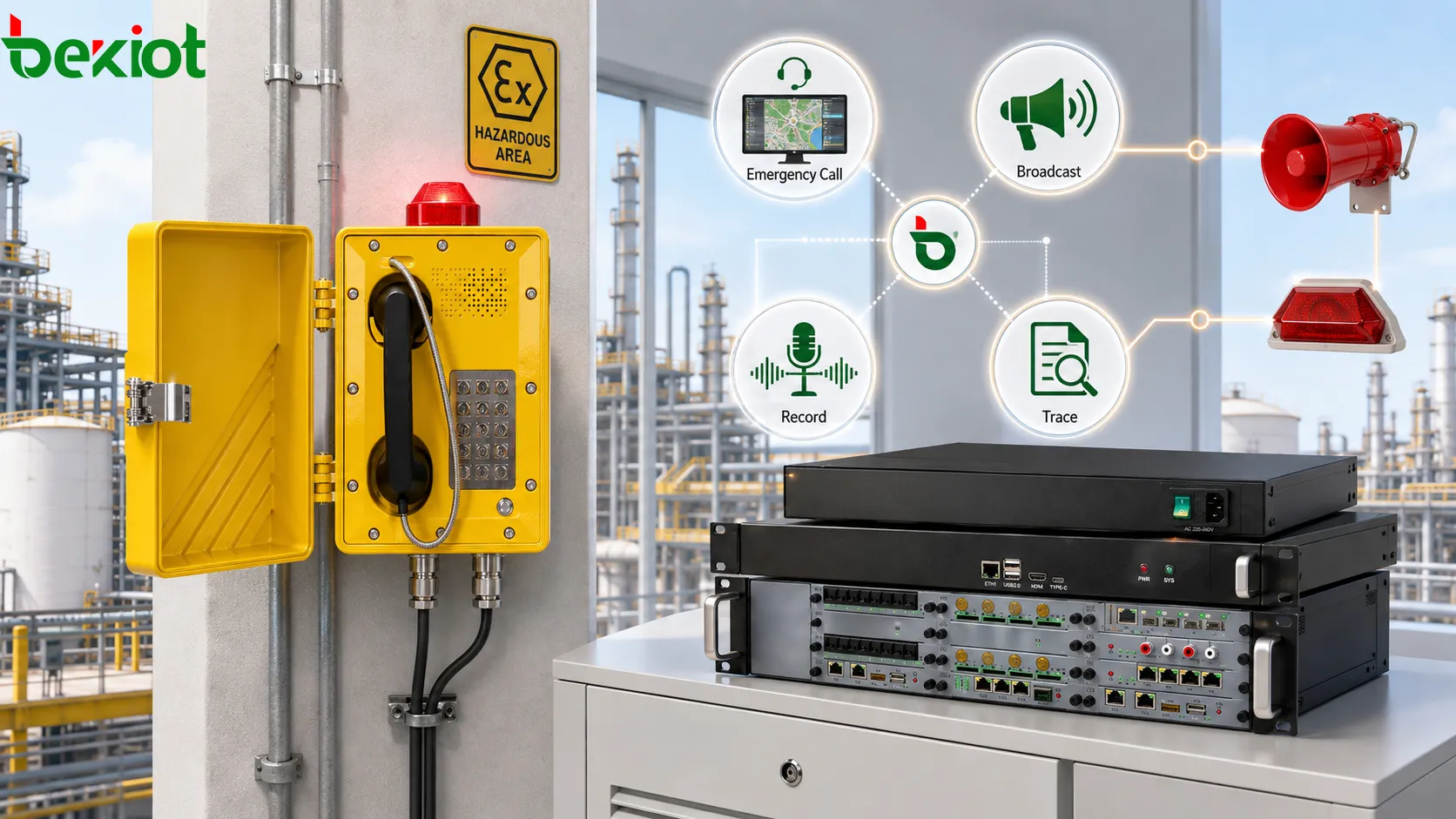
The extended value of explosion-proof telephones in an emergency response system lies in system-level linkage. A single device can only provide point-to-point calling. Once connected to dispatch, recording, broadcasting, alarm, and integrated management platforms, it can become part of a complete emergency handling loop. For high-risk scenarios, the efficiency of closed-loop handling is far more important than the connection speed of a single call.
When explosion-proof telephones are connected to a unified dispatch platform, the dispatch center can view terminal locations, call status, duty seats, and handling records globally. After a certain point initiates a call, dispatchers can notify maintenance, safety, inspection, and emergency teams according to the hazard type. When necessary, they can also link the broadcasting system to issue avoidance instructions to nearby areas.
Call recording and operation logs are not only useful for post-event responsibility clarification; they also provide data support for response process optimization. Managers can review dimensions such as call initiation time, dispatch answering time, number of location confirmations, clarity of instructions, follow-up callback status, and broadcast trigger timing to accurately locate delay bottlenecks in the response chain.
Explosion-proof telephones require routine testing mechanisms. Most emergency communication terminals remain on standby for long periods, but they must be immediately available when an incident occurs. Regular testing should cover call routing, answering delay, voice clarity, terminal online status, cable connection reliability, button function, handset condition, recording storage, and dispatch platform display. Terminals without routine testing cannot be considered reliable nodes in an emergency response system.
Daily maintenance quality also directly affects response efficiency. Loose cable glands, aging handset cables, poor button contact, blocked microphone openings, water ingress, and missing labels may all cause delay at critical moments. The long-term value of explosion-proof telephones is not only reflected in meeting acceptance requirements after installation, but also in their ability to maintain fast connection, clear communication, and accurate positioning throughout the full lifecycle.
Key Takeaways
The improvement of emergency response efficiency by explosion-proof telephones does not come only from the device’s connection speed. It comes from systematic delay reduction across the entire communication chain: fixed-point deployment reduces site search cost, direct calling simplifies reporting layers, point-to-area binding reduces location verification time, high-fidelity voice lowers repeated communication loss, system-level linkage improves handling coordination, and full-chain records support continuous process optimization.
For petrochemical plants, oil and gas production, mines, tunnels, power facilities, warehousing and logistics areas, ports, and various high-noise industrial environments, explosion-proof telephones should be regarded as part of the emergency communication system rather than isolated terminals. Their response efficiency value can be fully released only when they are deeply integrated with site point planning, dispatch platforms, broadcasting systems, alarm processes, and maintenance rules.
For fixed voice calling, emergency reporting, and dispatch linkage terminal deployment in hazardous areas, Becke Telcom can provide a full range of industrial explosion-proof communication products, including the EX-BH621 explosion-proof telephone. Actual selection should be based on site risk level, emergency response workflow, installation points, communication interfaces, voice performance, and long-term maintenance requirements.