In tank farms, pump stations, loading areas, compressor rooms and other hazardous industrial zones, the first communication task after a leak, equipment failure, fire or personnel injury is usually to establish reliable contact with the control center. Field personnel need to report where the problem occurred, what they can see or hear, whether equipment is still operating and whether anyone is at immediate risk. Explosion-proof telephones provide a fixed two-way communication point for this purpose.
Once the situation is understood, communication may need to expand beyond the person making the call. Maintenance teams may need to be dispatched, nearby work may need to stop, and personnel in one or more areas may need to receive the same warning. Connecting telephones, dispatch consoles and PA resources through a unified command environment allows these actions to be handled as one operational process instead of several isolated communication tasks.
Where Telephone and PA Functions Differ
Explosion-proof telephones and industrial PA systems serve different operational purposes. A telephone supports point-to-point, two-way communication. Field personnel can describe abnormal equipment behavior, confirm whether an area is occupied and answer questions from the control room. The dispatcher can then issue instructions specific to that person or location.
A PA system is designed for one-to-many communication. Instead of contacting personnel individually, the control center can deliver the same warning, shutdown instruction, evacuation message or operational notice to everyone within a defined broadcast zone.
The two functions complement each other. A telephone provides detail and confirmation; broadcasting extends a verified message to a wider audience. The dispatch layer coordinates the change from a field conversation to a broader notification when the situation requires it.
This distinction is particularly important in hazardous plants. A local equipment problem does not automatically justify interrupting the entire site, while an incident affecting several work areas cannot be handled efficiently through a series of individual calls. The communication method should match the actual scope of the event.
How Field Calls Reach the Control Center
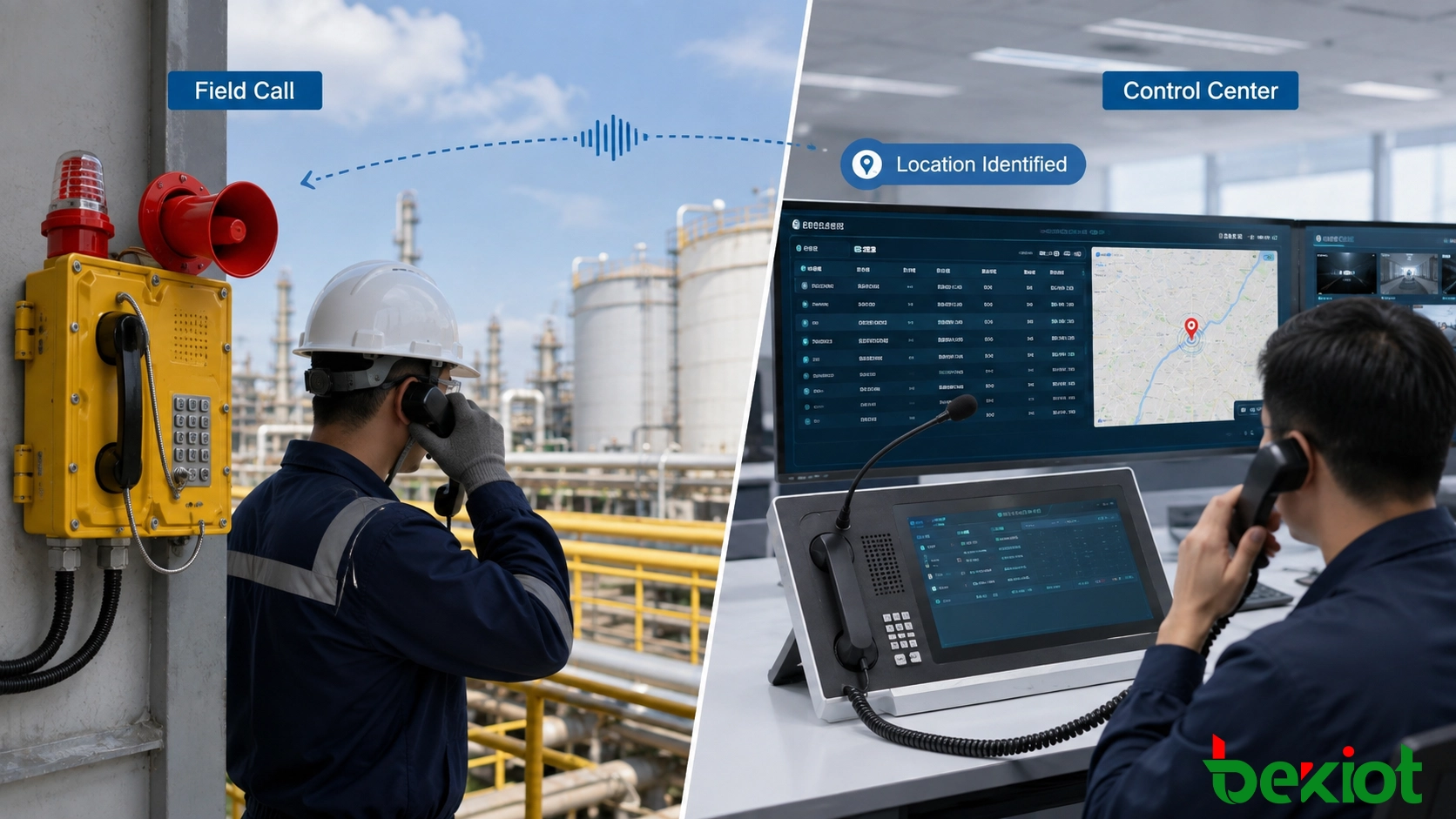
Explosion-proof telephones are commonly installed near critical equipment, production-area entrances, inspection routes, loading points and other locations where permanent communication access is required. Because the terminal is fixed, its physical position can become part of the incident information.
Terminal names and extension numbers should follow a consistent site structure. A dispatch database may identify field points as:
Tank Farm 01
Pump Station 03
Loading Area 02
Compressor Room 01
Utility Building 04
When a call arrives, the operator can immediately see which registered point is calling. In a large refinery, mine or multi-unit industrial site, this saves valuable time compared with asking every caller to explain their location before the actual problem can be discussed.
The dispatcher can then concentrate on the information needed for a response: the equipment involved, current operating condition, personnel status, visible or suspected hazards, the direction in which the situation may be developing and which teams should be contacted.
Where recording and event traceability are required, the system can retain call time, caller and destination information, call duration and associated recordings. This gives operators and supervisors a usable communication history without having to recreate the sequence later from handwritten notes.
Connecting Field Resources on One Platform
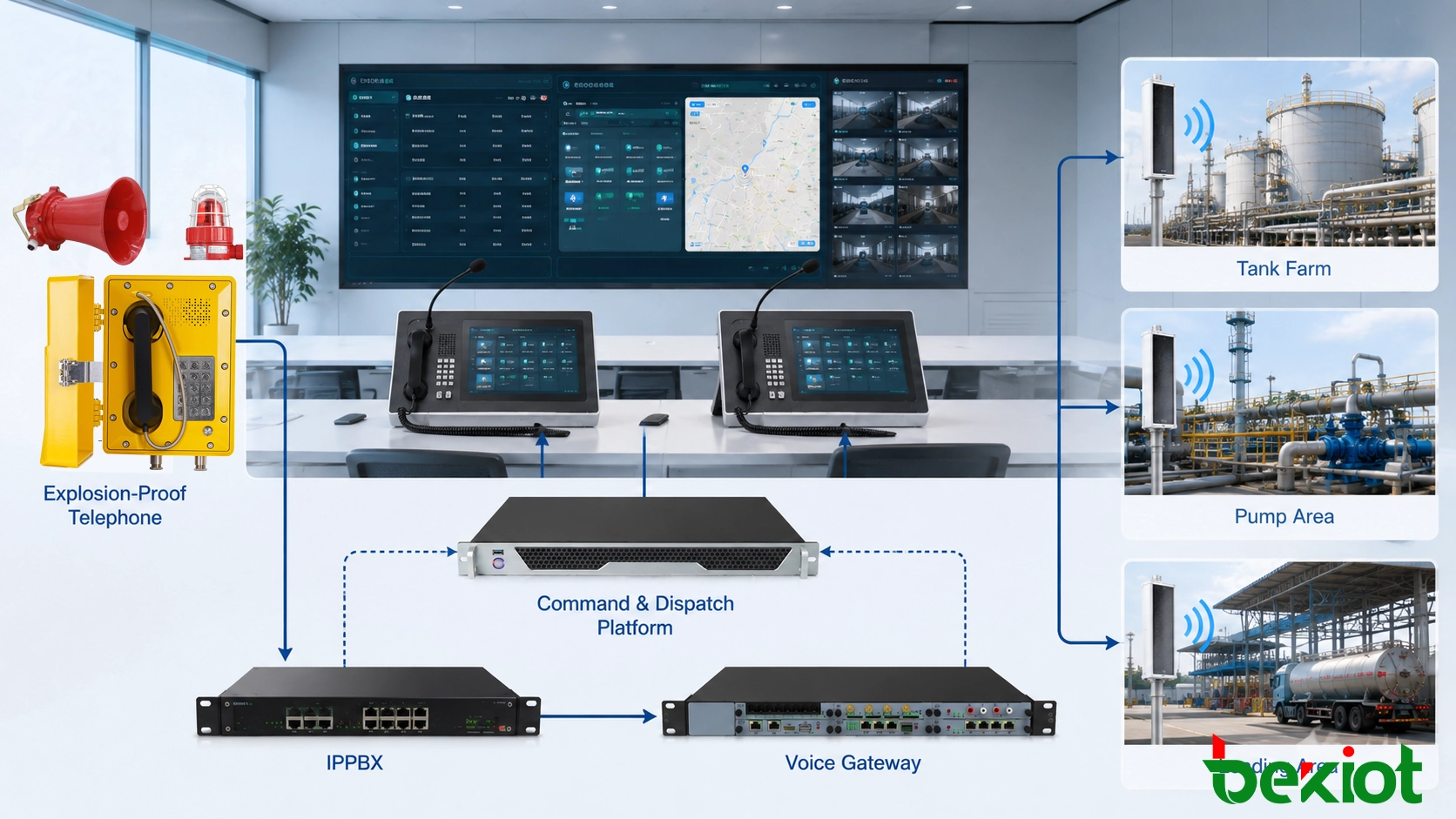
Telephone-to-PA integration works best when field terminals, control-room positions and broadcast resources are managed through the same communication structure. The Becke Telcom Command and Dispatch System can be used to organize telephones, SIP endpoints, dispatch consoles and PA resources according to plant areas, departments and operating responsibilities.
Related Product: Becke Telcom Command and Dispatch System
SIP and IP-based field terminals can connect over the IP network. Existing analog explosion-proof telephones may also remain in service through suitable IP PBX systems, voice gateways or other interfaces. This is useful in brownfield projects where large numbers of installed field telephones are still serviceable and replacing them only to modernize the control platform would add unnecessary cost and construction work.
Inside the dispatch interface, communication objects can be grouped by production area, department or job function. Operators can select a pump station, safety team, maintenance group or control room directly instead of memorizing numerous extension numbers.
During incident handling, the platform can support ordinary call operations such as answering, calling, holding and transferring, together with multi-party coordination where required. The dispatcher can speak with the reporting point, contact the responsible maintenance or safety personnel and manage the communication sequence without losing track of the original call.
PA resources can be organized in the same operational structure. Once the field condition has been verified, the dispatcher selects the required broadcast zone and issues the message from the control environment. This reduces the need to leave the incident workflow and search for the same area again in an unrelated PA interface.
Broadcast Coverage Should Match the Risk
A large industrial site should rarely treat every loudspeaker as one permanent broadcast group. Tank farms, process units, loading areas, compressor rooms, warehouses, utilities and administrative buildings often have different operating conditions and different levels of exposure to the same event.
Broadcast zoning should follow physical production boundaries, personnel distribution and credible hazard propagation paths. The control center can then increase the notification range as the event develops.
Local notification: the affected unit and immediately adjacent work positions receive the first warning.
Expanded notification: neighboring zones are added when monitoring or field reports indicate that the risk is moving beyond the original area.
Wide-area notification: larger production sections or the entire site are included when the emergency response plan requires broader action.
This structure avoids unnecessary plant-wide announcements for isolated events while preserving the ability to escalate rapidly. It also gives the dispatcher a clearer relationship between the incident location and the personnel who actually need the message.
User permissions should follow the same logic. A routine operator may be authorized to page only designated process areas, while safety supervisors or senior dispatch positions can access wider zones. Site-wide or cross-area broadcasting can be restricted to users with the appropriate operational authority.
Manual Dispatch and Preset Response Plans
Not every announcement has to be assembled manually after an alarm occurs. Where the plant already operates fire detection, combustible-gas detection, audible and visual alarm systems or other safety platforms, alarm information can be linked with communication resources when suitable interfaces are available.
A gas detector alarm, for instance, can identify the relevant plant area on the dispatch screen and help the operator locate nearby telephone points and associated PA zones. The operator can move directly into the response procedure instead of manually searching several independent systems for the same location.
Repetitive emergency messages can also be prepared in advance. Warning, evacuation or assembly announcements may be stored as preset broadcast tasks so that the dispatcher only needs to verify the event, select or confirm the required zone and initiate the appropriate message.
Full automation should be used carefully in complex industrial processes. An alarm signal can indicate an abnormal condition without necessarily requiring immediate evacuation. Production state, redundancy, field confirmation and company procedures may all affect the correct response.
For many applications, a controlled sequence of alarm indication, operator verification and preset-plan activation provides a practical operating model. It shortens the time required to find the correct communication resources while keeping the final broadcast decision under authorized control.
Acoustic Performance Must Be Proven On Site
Online status on a dispatch screen confirms network availability, not speech intelligibility. Refineries, mines, metallurgical plants, ports and large manufacturing sites contain compressors, pumps, fans, vehicles and process machinery that can mask both telephone audio and PA announcements.
Explosion-proof telephones should be positioned where personnel can reach and operate them under real working conditions. A technically compliant unit may still be difficult to use if it is too far from the work position, hidden behind pipework or installed away from normal inspection routes.
Operators may also be wearing protective gloves, hearing protection or other PPE. Low light, dust, rain and high background noise can further affect how quickly a field user finds the terminal, lifts the handset and communicates with the control room.
PA design requires a separate acoustic assessment. Different spaces create different coverage problems:
Open tank farms require sufficient outdoor coverage while accounting for environmental exposure.
Compressor rooms need speech levels that remain intelligible above continuous machinery noise.
Pipe racks and dense process structures can create physical shadowing.
Large enclosed workshops may produce reflection and reverberation.
Long passages require controlled loudspeaker direction and spacing.
Rated loudspeaker power alone does not determine useful coverage. Sound pressure level, speaker type, mounting height, orientation, listening distance, background noise and local acoustic conditions all affect the result. Equipment installed in classified hazardous areas must also comply with the applicable explosion-protection requirements for that installation.
Commissioning should include real voice tests while major equipment is running wherever practical. Operators should verify both sides of the communication chain: whether field personnel can understand the control center and whether the control center can clearly understand callers from critical locations.
A Complete Incident Workflow in Practice
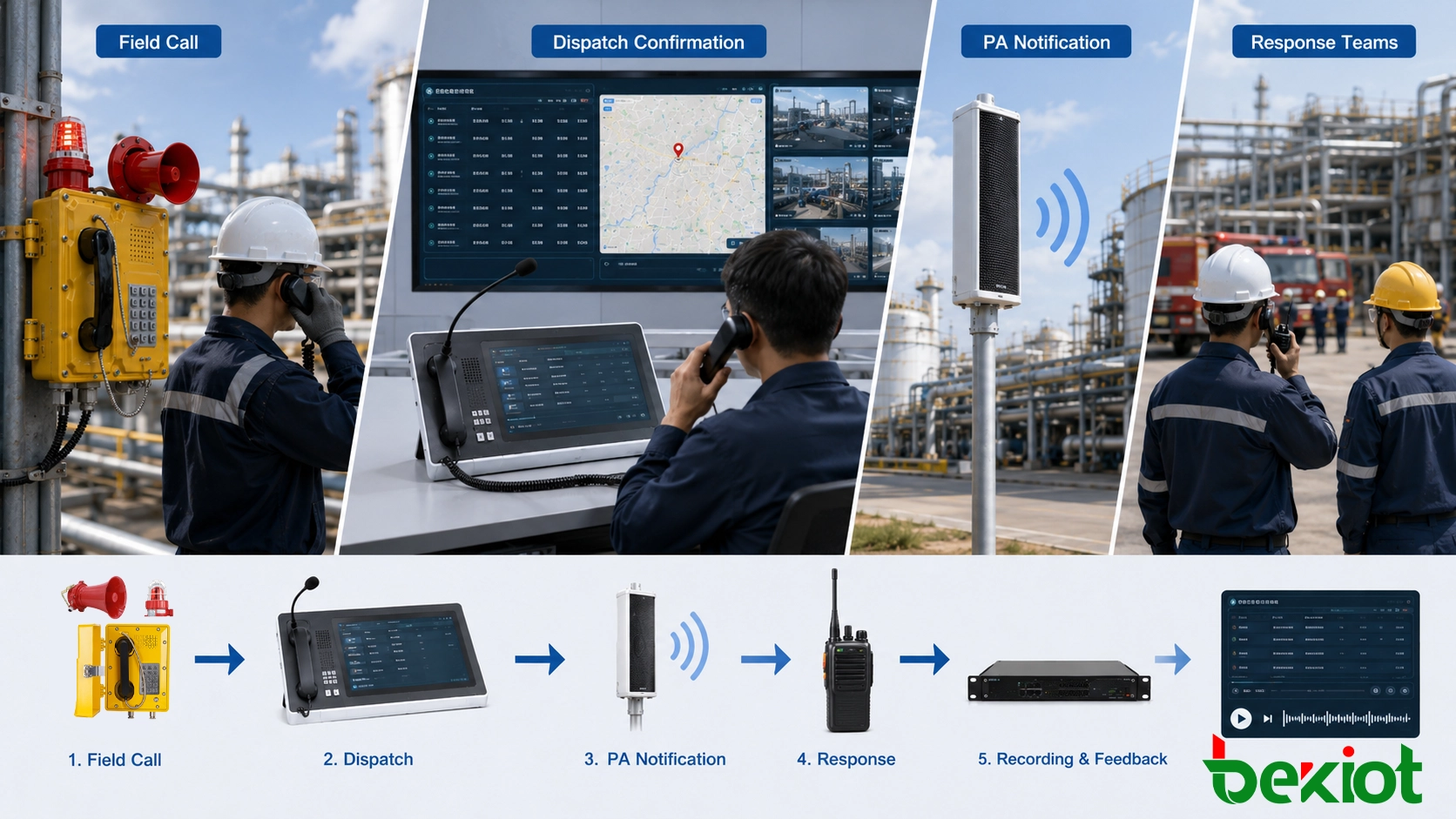
Consider a pipeline abnormality in a petrochemical loading area. A field operator notices the problem and uses the nearest explosion-proof telephone to contact the control center. The dispatch console identifies the calling point, so the duty operator can immediately focus on the condition of the pipeline, nearby equipment and personnel rather than first determining where the caller is located.
The dispatcher keeps the field user on the line while contacting the safety and maintenance teams. Based on the initial report, the loading-area PA zone is activated and unrelated personnel are instructed to suspend work and leave the affected area.
When the safety team reaches the location, they continue reporting through available telephones, radios or other connected communication terminals. Monitoring data and field feedback then determine whether the original broadcast zone remains sufficient or whether adjacent areas must also be notified.
The original caller does not need to find a different communication method as the event develops. The control center can continue coordinating several groups while maintaining a clear relationship between the first report, subsequent instructions and changing broadcast coverage.
After the event is closed, recorded calls and dispatch records can be reviewed together. This gives supervisors a clearer timeline of when the first report was received, who was contacted, how the notification area changed and how field teams responded.
Integrating Additional Site Systems
Once telephone and PA resources share a common dispatch environment, other site systems can provide additional context without replacing their existing roles.
Video surveillance can help operators verify visible conditions near the calling location. A field caller may report odor, sound, vibration or conditions outside the camera view, while nearby video provides a broader picture of personnel movement and equipment status.
GIS becomes useful on large plants, mines, ports and multi-site facilities where physical distance affects response decisions. Telephone points, PA zones and other communication resources can be associated with actual locations, helping operators see what lies close to an alarm or emergency call.
Fire alarms, combustible-gas detection and other alarm systems can supply the event location or alarm type to the dispatch environment. This information can guide operators toward the appropriate field contacts and notification zones without turning the communication platform into a replacement for the dedicated safety system.
The result is a clearer division of responsibility: alarm systems identify abnormal conditions, video provides visual context, GIS shows spatial relationships, telephones support two-way field communication and the PA system delivers wider instructions. The dispatch layer brings these resources into the same operational view.
Conclusion
Explosion-proof telephone and PA integration is most effective when it is designed around incident handling rather than device connectivity alone. The field telephone provides a dependable reporting point, the dispatch console helps operators identify and verify the event, and the PA system extends confirmed instructions to the people who need them.
The Becke Telcom Command and Dispatch System can provide the communication control layer for this architecture while allowing existing analog and IP resources to be integrated in stages. Video, GIS and alarm information can also be introduced where required, giving the control center more context without changing the fundamental role of each system.
For petrochemical, oil and gas, mining, metallurgical, port and other hazardous industrial sites, this arrangement supports a practical sequence from field reporting to targeted notification, coordinated response and final communication review.
FAQ
Do Existing Analog Explosion-Proof Telephones Need to Be Replaced?
Not necessarily. Serviceable analog terminals may continue to operate through suitable IP PBX systems, voice gateways or other interfaces, depending on the existing line architecture. New areas can adopt SIP or IP terminals while older sections are upgraded in stages.
Must Telephone Locations Match Broadcast Zones Exactly?
No. Telephone points are usually defined by work positions or equipment locations, while PA zones are based on acoustic coverage, personnel distribution and production boundaries. The important requirement is a clear relationship between the calling point and the broadcast area that operators are likely to need during an incident.
What Should Be Tested During PA Integration Commissioning?
Commissioning should include real field calls, calling-point identification, broadcast-zone selection, permission control, intelligibility testing, recovery after network interruptions and operator workflow checks. High-noise locations should be tested while representative production equipment is operating.
Can Multiple Industrial Sites Be Managed from One Dispatch Center?
Yes, if the network and system architecture support centralized operation. Extension plans, site names, broadcast permissions, inter-site links and local communication resilience should be defined clearly so that operators can distinguish destinations and avoid cross-site selection errors.