


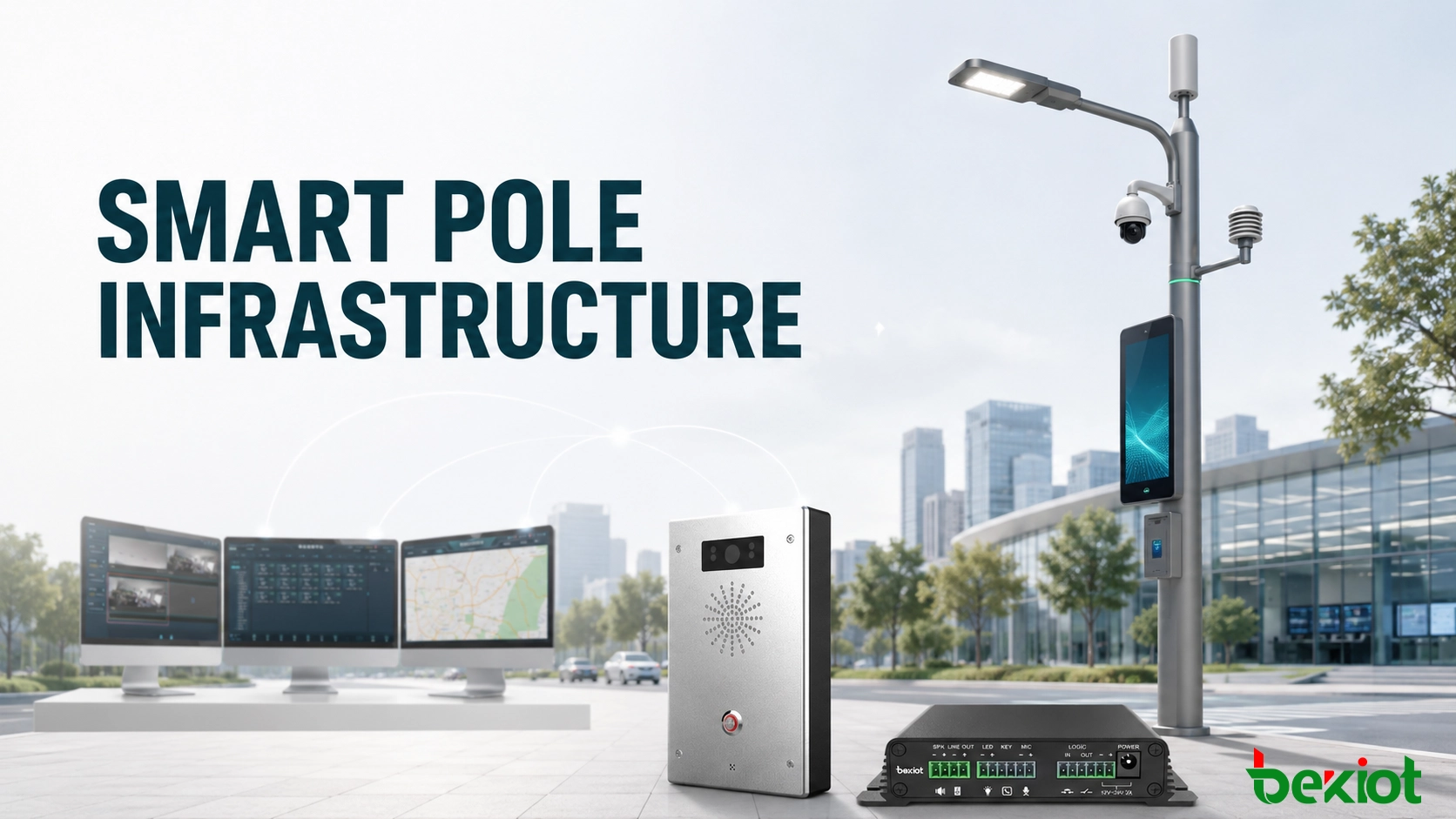
A city cannot become connected through software alone. Cameras, wireless access points, loudspeakers, help points, displays and environmental sensors all need power, network access, mounting positions and a maintenance route at street level. If each department installs its own roadside equipment, the result is often duplicated construction, crowded streets, isolated data and rising operating costs.
Streetlights already form a distributed physical network along roads, parks, transport corridors and public spaces. A smart pole program can turn that network into shared urban edge infrastructure—provided that lighting remains reliable and every added service is planned as part of one governed system rather than a collection of devices attached to a pole.
Why the streetlight network is a practical urban foundation
Streetlights have three characteristics that are difficult to reproduce with a new standalone system. They are widely distributed, positioned close to roads and public activity, and already associated with an electrical supply and a responsible maintenance organization. These advantages make the pole a practical host for city technologies that need dense or location-specific coverage.
The value does not come from loading every pole with every device. It comes from creating a repeatable mounting, power and communications framework, then assigning different modules according to the location. A junction may need traffic cameras and a roadside communication unit. A park may need lighting, public address, environmental sensing and an emergency help point. A transport hub may require video, passenger information, wireless coverage and two-way assistance.
This location-based approach reduces unnecessary equipment and makes the network easier to operate. It also protects the primary purpose of the asset: street lighting must remain available even if an optional camera, display or application platform fails.
Start with the shared layer before adding applications
A successful deployment begins below the visible devices. Pole structure, electrical capacity, network topology, cabinet space, grounding, lightning protection and maintenance access determine whether the system will remain reliable after several years of field operation.
Structure and modular mounting
The pole must be evaluated for equipment weight, wind load, vibration, corrosion, cable routing and safe maintenance. Standardized mounting positions can simplify later expansion, but they should not weaken the structure or create conflicts between cameras, antennas, speakers and lighting fixtures. Modules that require an unobstructed view or radio path need to be positioned according to their actual field of operation.
Power distribution and energy control
LED lighting and automated dimming can reduce energy use and support time-based, light-based or traffic-responsive control. Solar power may be suitable in selected locations, but it must be designed around seasonal generation, battery autonomy and the full load of every attached module.
Lighting, communications and optional services should use separated and protected power branches. Energy metering, surge protection, residual-current protection and remote fault reporting make the pole safer and easier to maintain. Backup power should be reserved for services that must continue during an outage, such as emergency calling or critical communication, rather than being assumed for every function.
Backhaul and edge connectivity
Fiber provides predictable capacity for high-density video and long-term expansion, while 4G or 5G can accelerate deployment where fixed backhaul is unavailable. Ethernet, Wi-Fi and low-power IoT connectivity can coexist, but they should be segmented according to security and performance requirements.
Bandwidth calculations must include normal traffic, peak simultaneous use, recording policy and future modules. A pole carrying several high-resolution cameras has a very different backhaul requirement from one collecting environmental sensor data. Local edge processing can reduce unnecessary upstream traffic by filtering events, buffering data and continuing selected functions during temporary backhaul interruptions.
Services that can share the same roadside asset
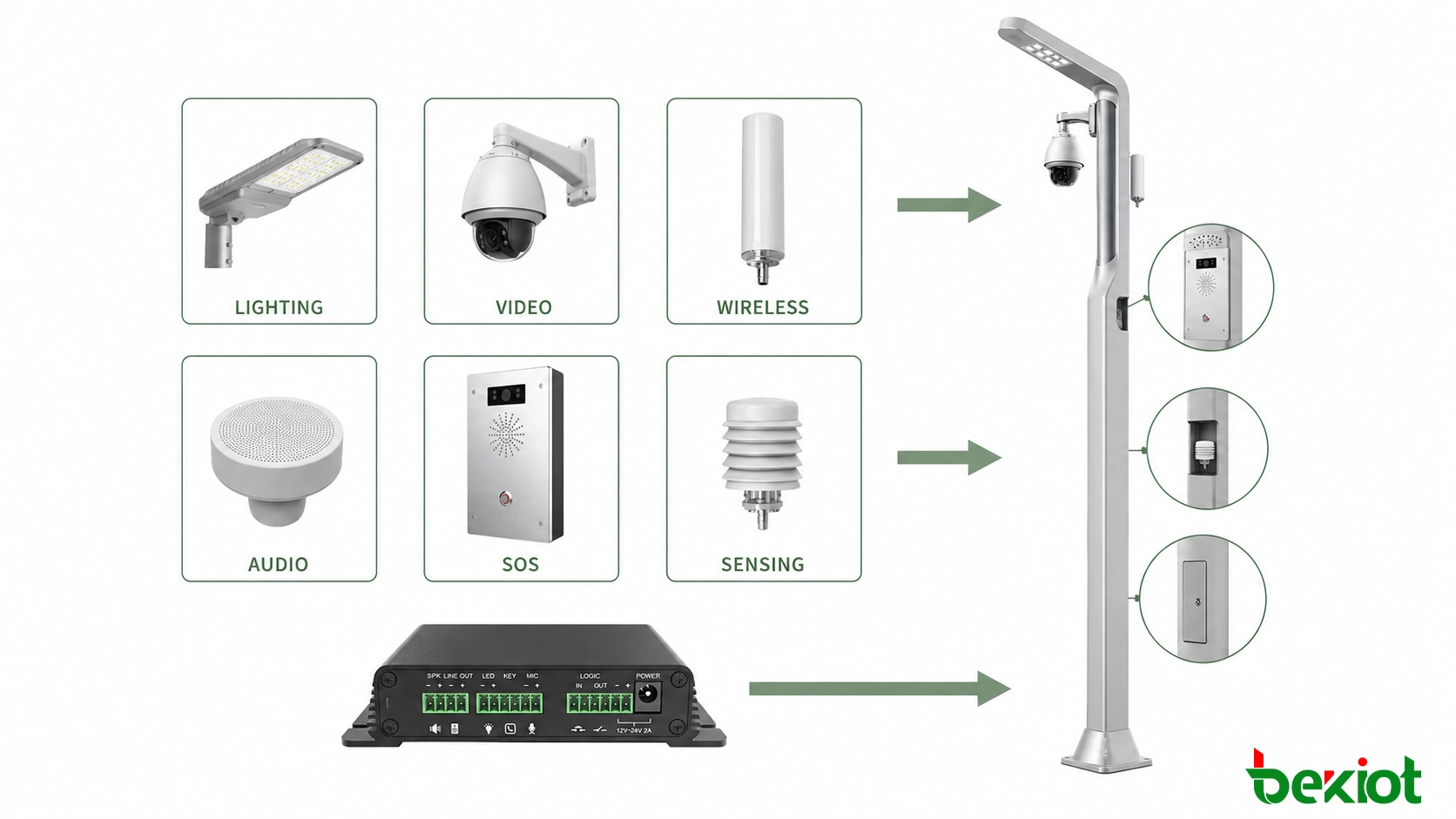
Once the common layer is defined, the project team can select the services that make sense for each area. The following functions reflect the most common smart pole use cases, but they should be deployed as modules rather than a compulsory package.
Adaptive lighting
Lighting remains the base service. LED luminaires, remote switching, dimming, energy monitoring and automatic fault alarms can improve efficiency and maintenance visibility. Schedules may be adjusted by sunrise and sunset, pedestrian activity, traffic conditions or local policy, while minimum safety illumination remains protected.
Video coverage and shared media access
Poles provide useful positions for cameras serving public safety, traffic observation, parking management and municipal operations. The physical design can reserve mounting points, power and network capacity so that cameras do not require separate roadside structures.
A unified video layer can register and manage authorized camera resources, then make approved video available to different departments without duplicating the same front-end installation. Depending on the application, integration may use RTSP or RTMP contribution, HLS or FLV-based web delivery, WebRTC for low-latency browser viewing, and SIP-based signalling and media workflows. Access control, audit logs, retention rules and privacy boundaries must be defined before cross-department sharing begins.
Wireless access and IoT collection
Small cellular sites and Wi-Fi access points can use the pole for power, elevation and backhaul. This is especially useful where denser radio coverage is required but new standalone sites are difficult to approve. Antenna placement, radio-frequency exposure, interference, operator access and equipment ownership still require formal engineering and regulatory review.
For low-power sensing, a LoRaWAN gateway or another suitable IoT access technology can collect data from nearby devices monitoring manholes, drainage, utility corridors, parking spaces or other municipal assets. The pole supplies a stable location and upstream connection; the IoT platform handles device identity, data ingestion, alarms and lifecycle management.
Public information, audio and emergency assistance
IP-connected loudspeakers can support routine public information, local announcements and authorized emergency messages. Zones and priorities should be designed so that an urgent message can override routine audio in the affected area without unnecessarily broadcasting across the entire city.
Digital displays can present traffic conditions, service notices and emergency instructions. Commercial content may also be possible where policy permits, but public information and emergency messaging should have defined priority. Brightness, viewing angle and nighttime light impact must be considered as part of the street environment.
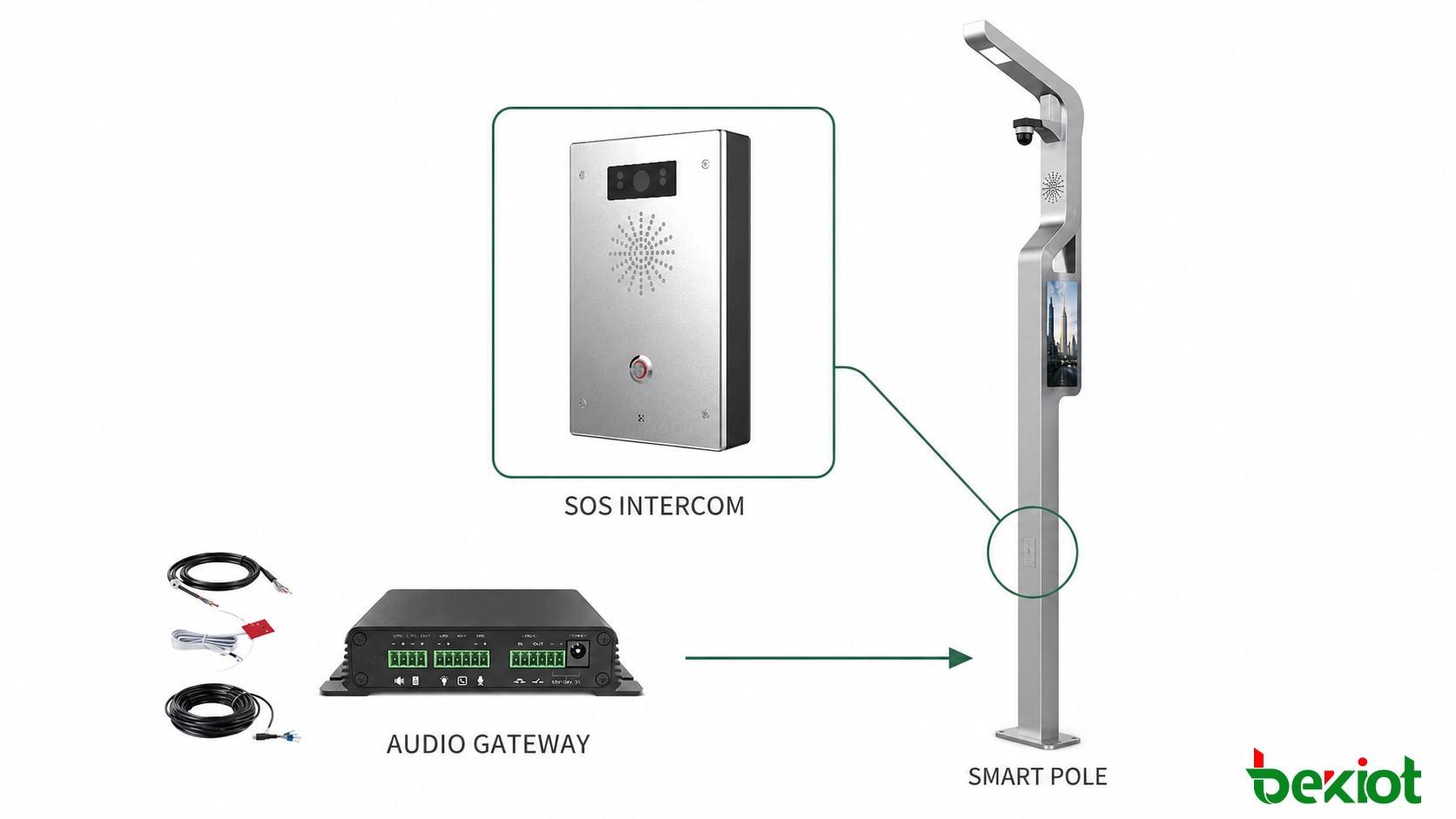
An emergency help point adds a direct communication path for the public. A one-button call can send voice, device identity and location to the responsible control room. Where video is authorized, the platform can display the nearby camera view to help an operator assess the incident. The workflow should specify who answers, how an unanswered call escalates and how the field terminal is tested.
Environmental and public-service modules
A compact weather or environmental station can collect air-quality indicators, temperature, humidity, wind speed, ambient light and rainfall. Dense local measurements can reveal differences between districts that a small number of conventional stations may not show. Sensor calibration, placement and data-quality flags are essential if the information will support official decisions.
Citizen-service terminals may provide local information, accessibility assistance, transport connections or links to municipal service platforms. The design should account for older users and people with disabilities through readable displays, simple interaction, reachable controls and clear audio.
Charging and connected-road functions
Selected locations may support charging for electric vehicles, e-bikes or personal devices. Charging should not be treated as a simple accessory: available grid capacity, billing, electrical isolation, fire safety, parking management and maintenance responsibility all need to be resolved before installation.
For intelligent transport, poles can host traffic sensors, cameras and vehicle-to-infrastructure roadside equipment. These systems may support traffic measurement, signal coordination, hazard warnings and connected-vehicle applications. They should complement vehicle sensors and traffic-control infrastructure rather than be presented as a standalone solution for automated driving.
A common platform turns devices into usable city services
Mounting equipment is only the visible part of the project. Without unified management, a smart pole becomes several unrelated systems sharing the same metal structure. The control platform must therefore organize assets, alarms, permissions, data and maintenance across the entire deployment.
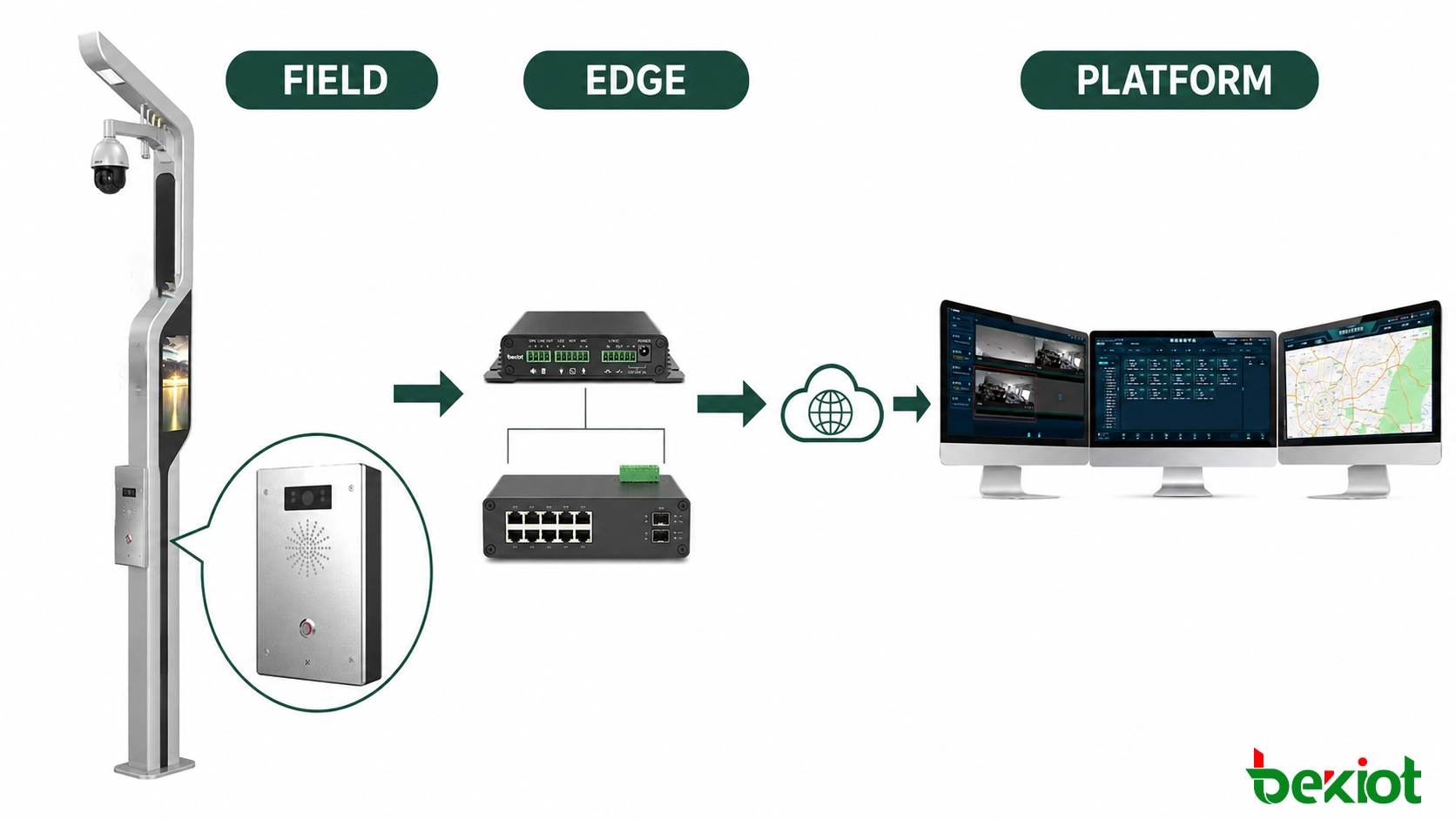
A practical architecture can be divided into five layers:
| Layer | Main responsibility | Typical elements |
|---|---|---|
| Field devices | Sense, communicate and act at street level | Luminaires, cameras, speakers, displays, help points, sensors and chargers |
| Pole edge | Provide local control, protocol adaptation and temporary buffering | Industrial switch, edge controller, IoT gateway and protected power distribution |
| Access network | Carry separated service traffic to city platforms | Fiber, Ethernet, 4G/5G, Wi-Fi and low-power wireless access |
| Operations platform | Manage assets, identities, alarms, work orders and service health | Device management, GIS, video services, IoT data, logs and dashboards |
| Department applications | Use authorized capabilities without taking over the physical infrastructure | Traffic, public safety, environment, emergency management and municipal services |
GIS should link every device to a pole identity, location, owner, service status and maintenance history. A fault alarm should identify not only that a device is offline but also whether the cause is power, backhaul, edge equipment or the endpoint itself. This reduces site visits and prevents several departments from dispatching separate teams to the same pole.
Cross-system linkage should follow clear events and permissions. An emergency call may open the associated location and camera view for an authorized operator. An environmental threshold may create an alert for the responsible department. A traffic incident may trigger an approved local message on a display or loudspeaker. These workflows need audit records, manual override and failure handling; they should not depend on uncontrolled automation.
Governance and operating design decide whether the project scales
Smart pole projects involve lighting authorities, transport agencies, public-safety teams, telecom operators, environmental departments, emergency services and commercial partners. The technical components are available; the difficult part is deciding who owns the pole, who approves new modules, who pays for backhaul and power, and who is accountable when a shared service fails.
One workable approach is to separate infrastructure operation from department applications. A designated operator builds and maintains the shared pole, power, network and management layer. Authorized departments consume defined services—such as a camera feed, an IoT data set, an emergency communication point or a mounting position—under service-level and security agreements. This can turn front-end resources into managed city assets instead of leaving each department to build a parallel network.
Shared video illustrates the model. A camera is installed once, maintained through one asset system and made available to approved users through controlled interfaces. This can reduce duplicate field construction, but only if purpose limitation, privacy, retention, access logging and operating cost are agreed in advance.
A phased rollout is safer than a citywide installation based on a single standard configuration. The first stage should select representative streets and test structural design, power use, coverage, night visibility, video quality, audio clarity, sensor accuracy, alarm routing and maintenance time. Results from the pilot can then define several repeatable pole profiles for intersections, parks, transport corridors, commercial districts and residential areas.
Acceptance should cover the complete service path rather than individual devices. A camera is not accepted merely because it powers on; authorized users must be able to retrieve the correct stream. A help point must be tested from button press through operator answer and escalation. A loudspeaker must deliver an intelligible message in the actual ambient noise. The long-term goal is not to install more equipment—it is to make urban services easier to reach, coordinate and maintain.
FAQ: Decisions to make before installation
Should every smart pole carry the same equipment?
No. Standardize the pole interface and management method, then create several location-based profiles. Installing every module everywhere increases cost, visual clutter, energy use and maintenance without guaranteeing additional public value.
Can an existing streetlight be upgraded instead of replaced?
Sometimes. The existing pole, foundation, cable route and electrical supply must be assessed for structural reserve, wind load, grounding, cabinet space and added power demand. A retrofit should proceed only when the original lighting function and public safety are not compromised.
What happens if the connection to the central platform is lost?
Essential local functions should have defined offline behavior. Lighting control may continue on a local schedule, an edge device may buffer sensor data, and an emergency terminal may use a backup route where required. Each service needs a recovery and data-resynchronization procedure.
How much spare capacity should be reserved?
Reserve capacity according to the expansion plan rather than an arbitrary percentage. Review spare power, switch ports, fiber cores, cabinet space, thermal load, mounting positions and backhaul bandwidth together. Physical space without electrical or network headroom does not create useful expansion capacity.
How can privacy be protected when cameras and sensors are shared?
Define the permitted purpose of each data source, collect only what the service requires, separate department permissions, encrypt management and backhaul links, log access and enforce retention rules. Privacy review should be part of system design and procurement, not added after deployment.







