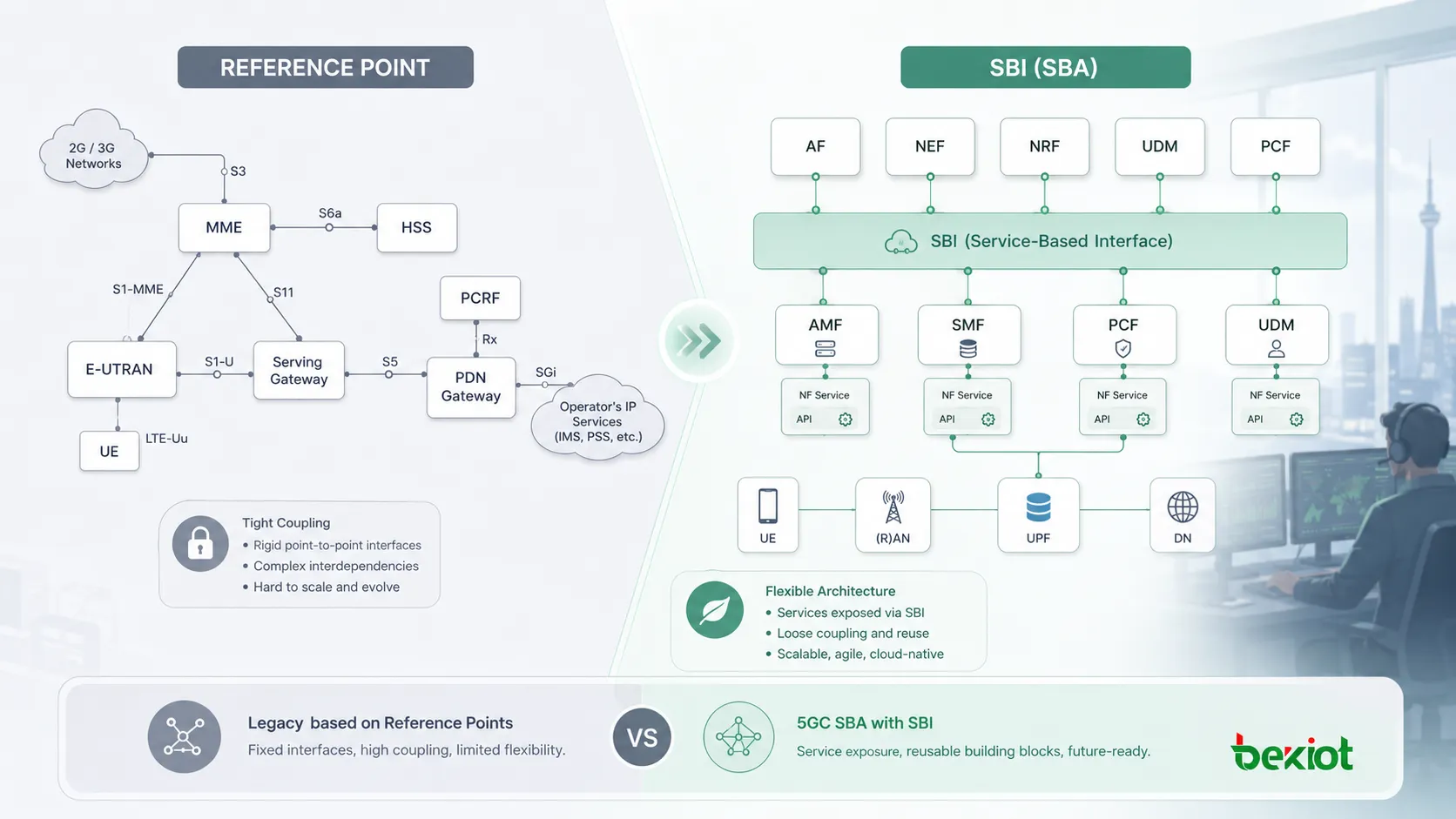
The easiest way to understand the 5GC SBI interface is to begin with a practical question: why did the 5G Core need a new interaction model at all? Before 5G, mobile core networks were usually described through reference point architecture. Each pair of network elements communicated through a defined interface, such as S6a between MME and HSS in LTE/EPC. This point-to-point model was simple to draw and easy to discuss, but it became less flexible as network functions and service requirements became more diverse.
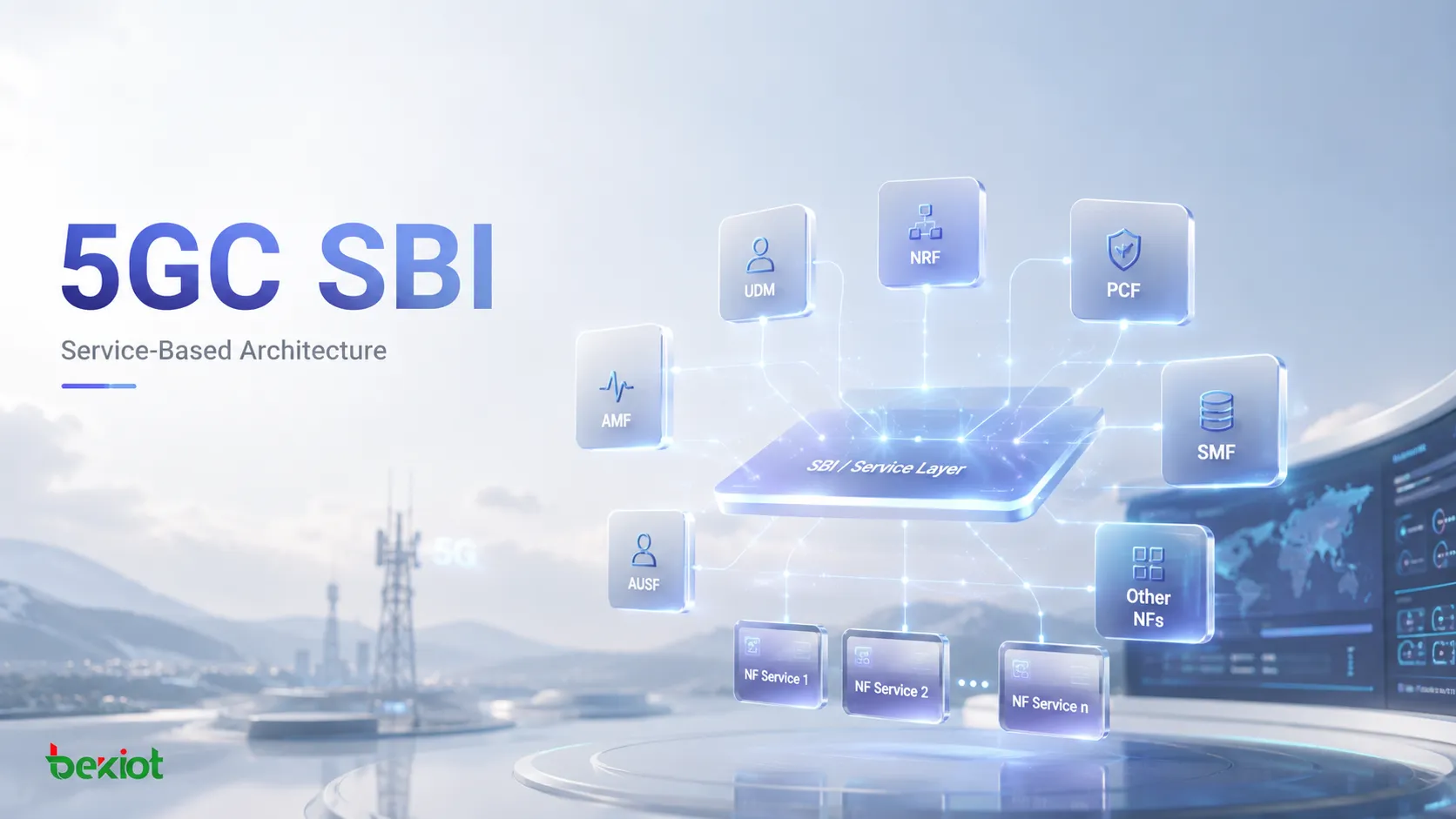
5G Core takes a different path. Instead of treating every network element as a closed box connected only through fixed reference points, it introduces a service-based architecture. Network functions expose services, and other authorized network functions consume those services through service-based interfaces. This is the main idea behind SBI.
Why Reference Points Became Limited
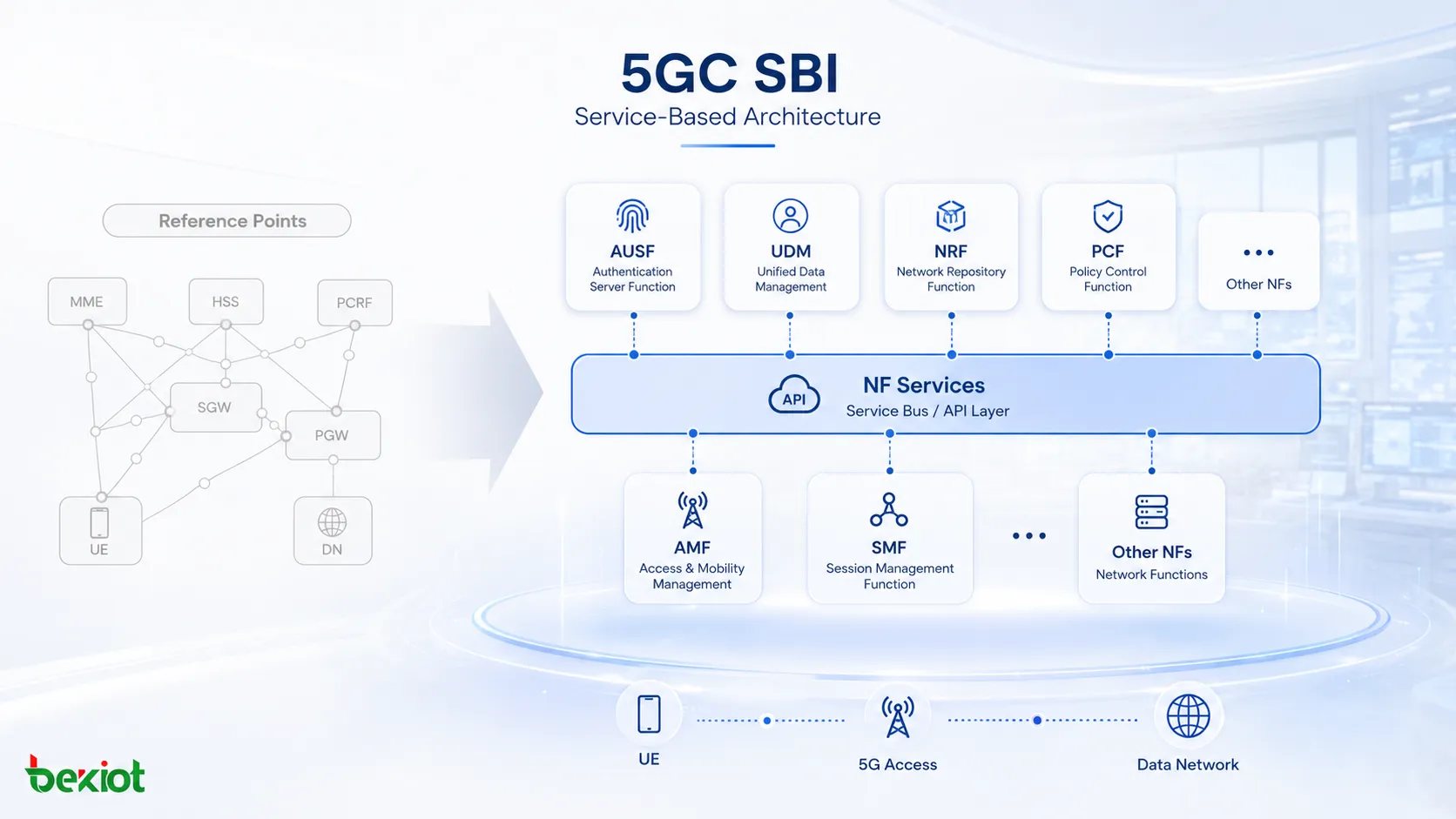
Reference point architecture worked well when the interaction relationship between network elements was stable and predictable. If MME needed to communicate with HSS, the S6a reference point described that relationship. If SGW needed to communicate with PGW, another reference point described that path. This model made the architecture visible and direct.
The problem is extensibility. Once an architecture and its reference points are frozen in a specification release, adding new communication relationships becomes difficult. For example, if a new requirement appears between two network functions that do not already have a defined interface, the standard architecture may not provide a clean way to support it. Vendors can build private solutions, but private solutions reduce interoperability and make network evolution harder.
5G Core was designed for a wider range of services, including mobile broadband, IMS, slicing, policy control, edge services, exposure functions and flexible subscriber data handling. A rigid point-to-point model would make this evolution complicated. SBI helps solve this by letting a network function provide multiple services that can be called by authorized consumers when needed.
How Microservices Explain SBI
A useful analogy is a bank counter. From a customer’s perspective, the counter provides a cash withdrawal service. The customer does not need to know whether the internal process is handled by an accountant, a cashier, a manager or several people together. The customer only cares that the request is accepted, processed and completed.
From the bank’s internal view, however, the service may be divided into several roles. One role checks the account and records the transaction. Another prepares the cash. A manager may approve abnormal or high-value business. These roles may be handled by different people, or combined when the branch is small. The important point is that the external service remains clear even when the internal division changes.
5GC applies the same type of thinking. A network function can be seen as the service provider, while its internal capabilities are divided into several service modules. Other network functions call the needed service through standardized API-style interaction. This improves flexibility because the consumer does not need a dedicated one-to-one reference point for every possible function relationship.
UDM is a good example. In 4G, many HSS functions were reached through the S6a interface by MME. In 5G, related capabilities are exposed as different UDM services, such as UECM for UE registration information, SDM for subscription data management and UEAuthentication for authentication-related data. These services can be consumed by authorized network functions according to defined rules.
What SBI Means In 5GC
In 5GC terminology, an NF, or Network Function, is a defined processing function such as AMF, SMF, UDM, AUSF, PCF, NRF or NEF. An NF Service is a function exposed by an NF and consumed by other authorized NFs. A Service Based Interface describes how a set of services is exposed by a given network function.
SBI names usually use an uppercase N followed by the lowercase network function name. For example, Nudm represents the SBI exposed by UDM, Namf represents the SBI exposed by AMF, and Nsmf represents the SBI exposed by SMF. This naming method makes it easier to understand which network function provides the service interface.
The difference between reference point and SBI is important. A reference point describes a relationship between two network functions. An SBI describes how one network function exposes services that may be used by different authorized consumers. This changes the architectural focus from fixed pairwise links to reusable service capabilities.
SBA Keeps Architecture Flexible
5GC defines an SBA model based on SBI. In an SBA diagram, many control-plane network functions appear as service providers connected through service-based interfaces. This does not mean that reference point diagrams disappear completely. They are still retained for transition, compatibility and easier communication, especially when engineers need to discuss familiar relationships such as N1, N2, N3, N4, N6 or N11.
The two views serve different purposes. The reference point view is useful when explaining connection relationships and procedure paths. The SBA view is useful when explaining service exposure, service consumption and API-based interaction among network functions. A complete 5GC understanding usually needs both views.
For engineering work, SBI is not only an architecture drawing. It affects how services are searched, named and understood in 3GPP specifications. Network function services are listed in 3GPP TS 23.501 Section 7.2. For example, AMF services such as Namf_Communication, Namf_EventExposure, Namf_MT and Namf_Location can be found there.
Specific service operations, message names, parameters and known consumers are described in 3GPP TS 23.502 Section 5.2.2. For example, AMF service operations may include UEContextTransfer, CreateUEContext, ReleaseUEContext, N1MessageNotify, N1N2MessageTransfer and related operations. This lookup method helps engineers move from a high-level SBI concept to real procedure analysis.
FAQ
Why does 5GC still show reference point diagrams?
Reference point diagrams remain useful for transition, compatibility and procedure explanation. They help engineers discuss familiar paths even when the control-plane design is service based.
Is SBI only used by UDM?
No. UDM is only one example. AMF, SMF, PCF, AUSF, NRF, NEF and other 5GC control-plane functions can expose services through their own service-based interfaces.
What is the difference between NF and NF Service?
NF refers to the network function itself, such as AMF or UDM. NF Service refers to a specific capability exposed by that network function for authorized consumers to use.
How should engineers read SBI names?
The name usually begins with uppercase N followed by the network function name in lowercase. Nudm means UDM’s service-based interface, while Namf means AMF’s service-based interface.
Where are SBI operations usually checked?
Network function service lists are commonly checked in 3GPP TS 23.501 Section 7.2, while detailed service operations and related parameters are commonly checked in TS 23.502 Section 5.2.2.