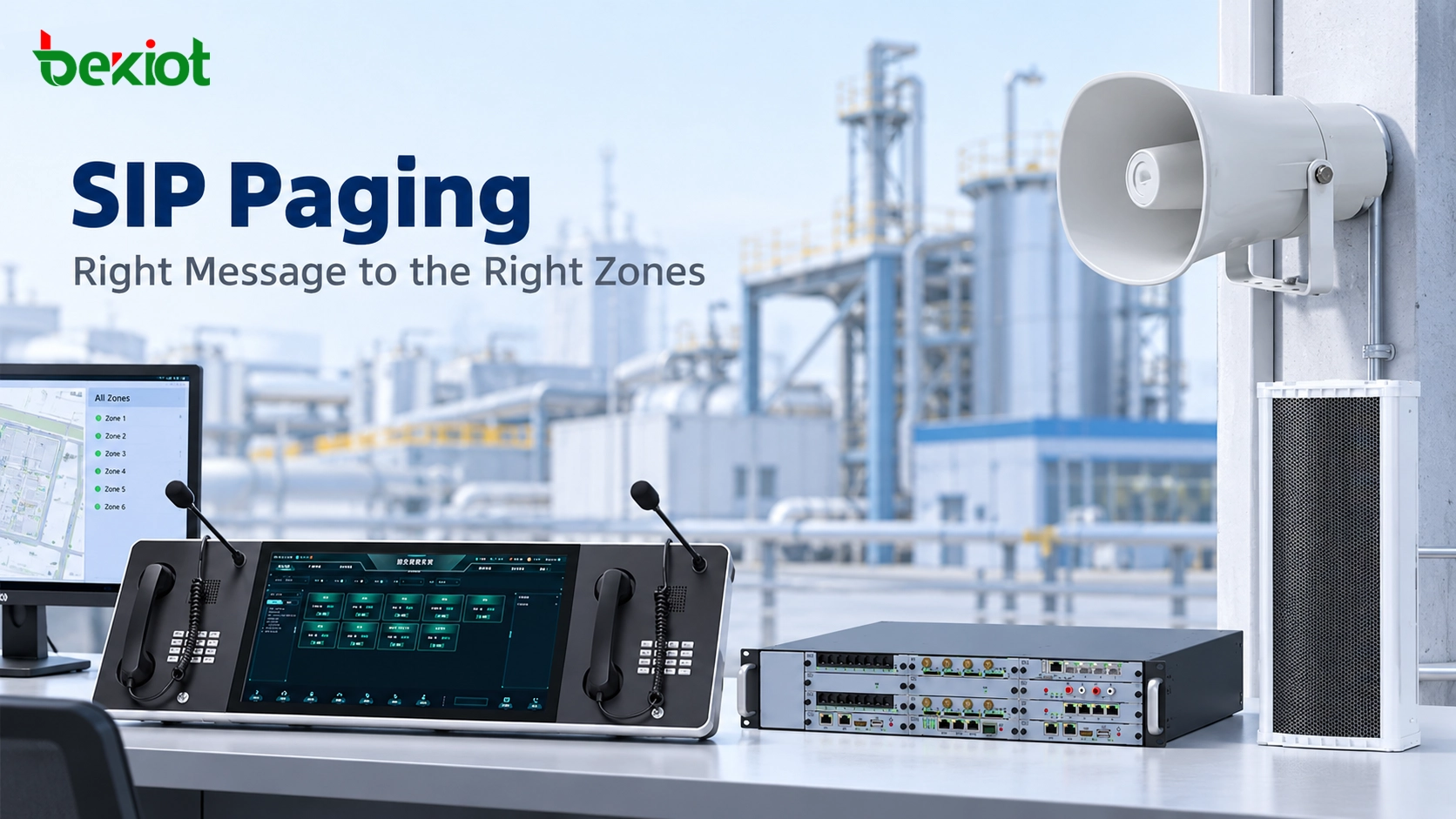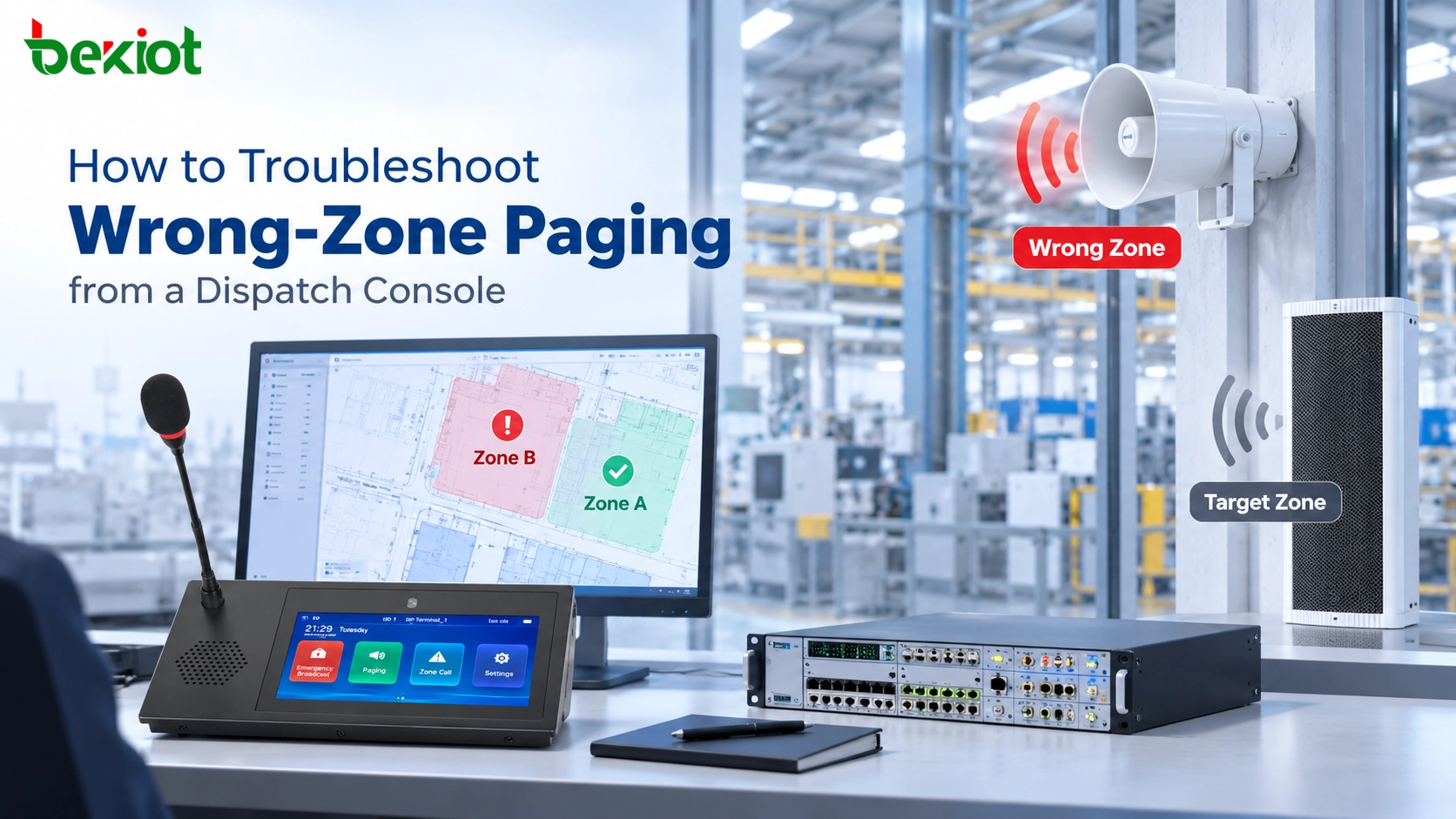
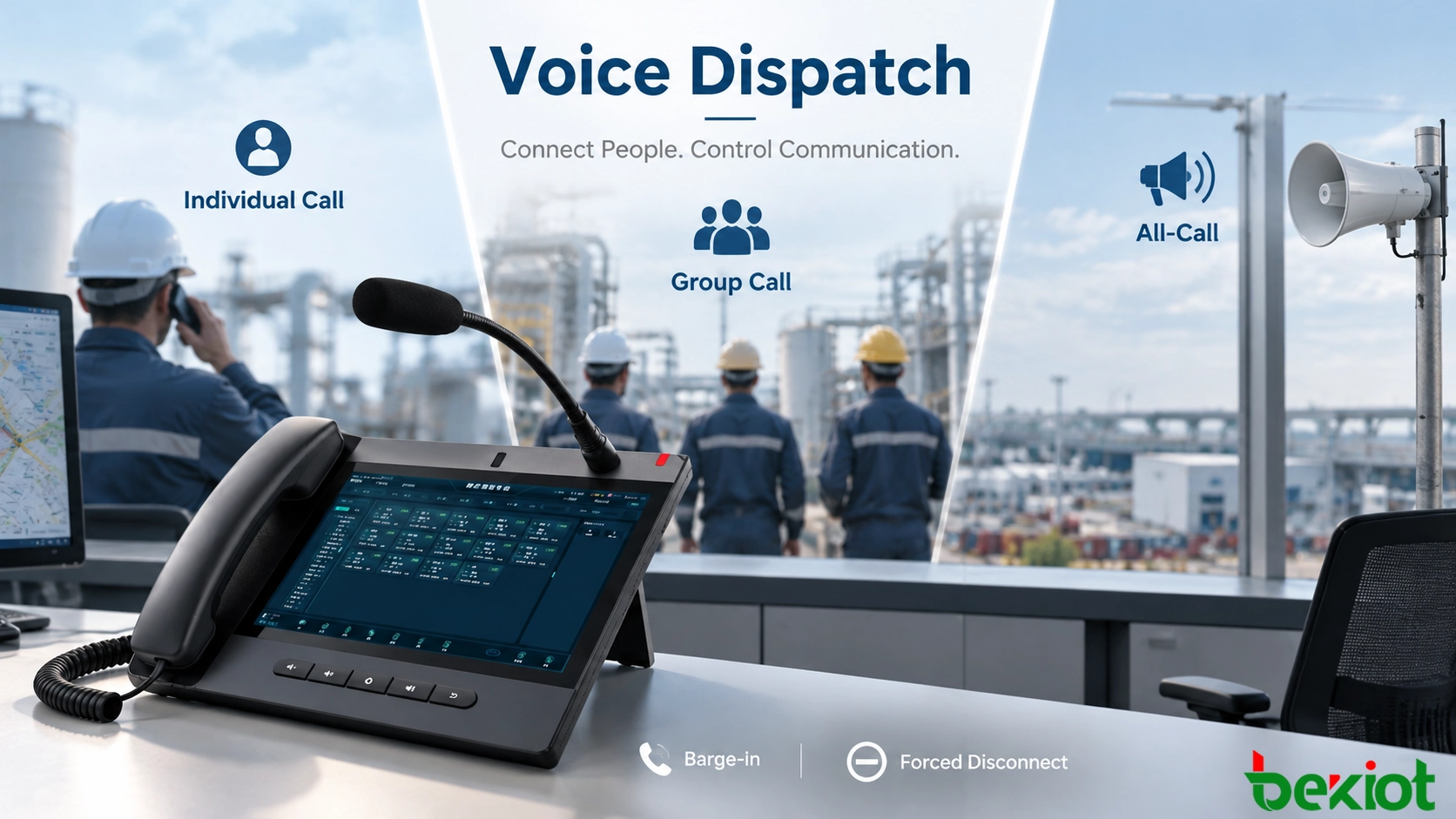
A dispatcher calls a maintenance engineer to confirm a fault, then contacts the repair team, and finally sends one instruction to several operating groups. During the response, a supervisor may need to join an ongoing conversation or release a lower-priority call. Each action changes the target audience, the audio path or the state of an existing session. Understanding those changes is essential when specifying a voice dispatch system that connects SIP telephones, radio networks and IP paging equipment. In this article, individual call, group call and all-call describe the intended communication scope; barge-in and forced disconnect describe interventions in calls already under platform control.
Who Receives the Call and Who Can Speak?
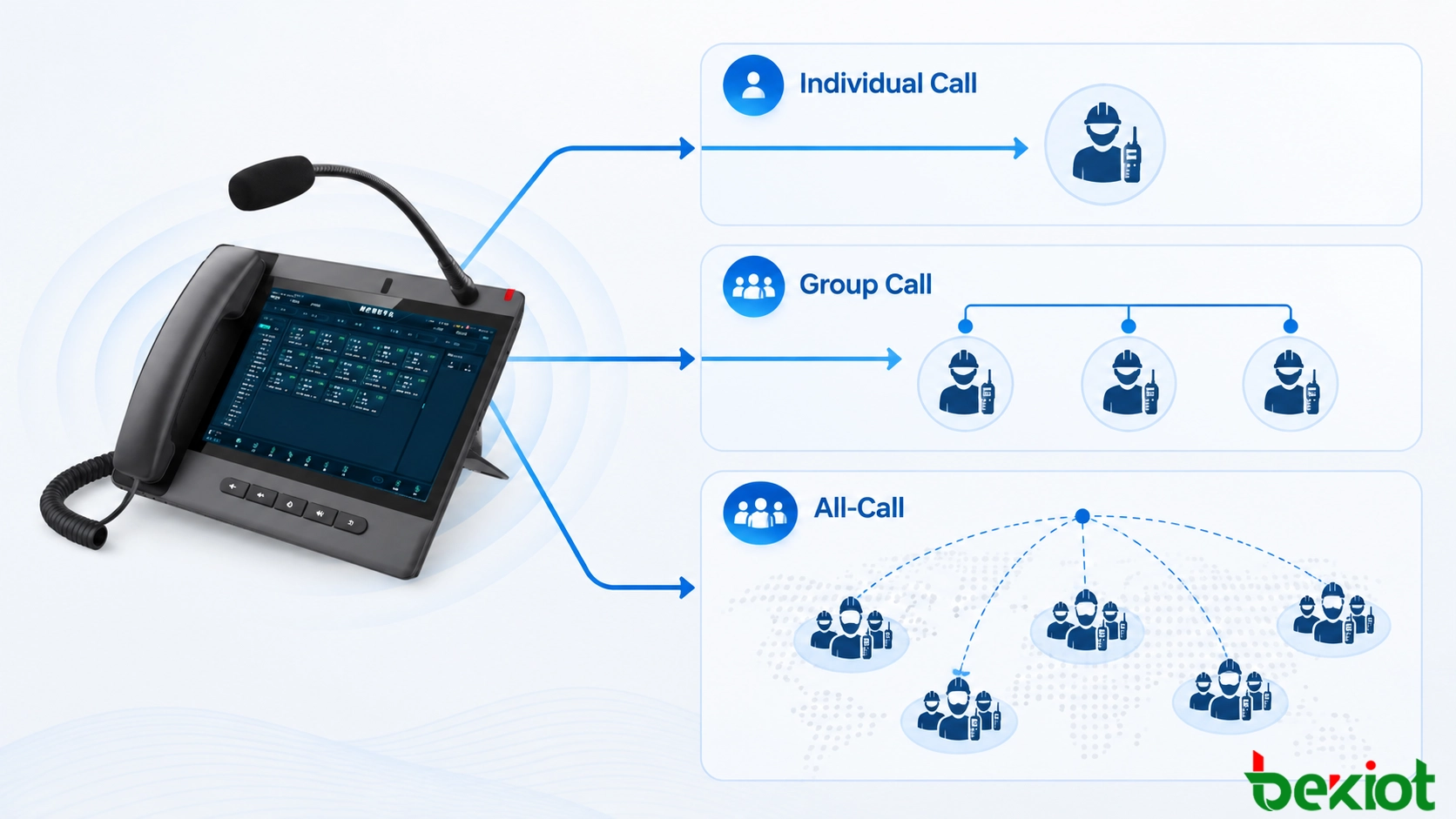
Individual Call: One Selected Destination
An individual call connects a dispatcher to a particular user, extension or field terminal. The dispatcher selects a destination from the directory or dials its number; the platform then attempts to reach that resource. Once the call is answered, the participants normally have a two-way conversation. This suits a private fault report, an instruction to one engineer or a call back to an emergency help point.
A busy, offline or unanswered destination is not equivalent to a completed conversation. The configured response might be a busy indication, a queue, an alternate duty extension or a retry. For operational records, the system should distinguish an attempted call from a connected call and a successfully completed conversation.
Group Call: A Defined Team
A group call addresses an assigned set of communication resources, such as a maintenance crew, security patrol or station team. The operator selects the group once instead of calling each member separately. Membership may follow fixed terminal assignments or a live duty roster, so the group configuration should reflect who is responsible for the work at that time.
A group call is not necessarily a telephone conference. In an interactive conference, participants can speak through a media bridge. In a radio talk group, transmission may be half-duplex and controlled by push-to-talk or floor arbitration. In a SIP paging group, most members listen while the authorized operator speaks. The audio and speaking rules determine the real behavior, not the name of the group on the console.
All-Call and Multi-Group Call: Broader Coverage
An all-call reaches every endpoint or group within a defined, authorized operating scope. A multi-group call combines selected groups for one coordinated instruction. For example, a rail depot may address its maintenance, security and traffic-control teams together without including unrelated office extensions. These terms are used differently across dispatch products, so the intended recipients and permission boundaries should be explicit in the system design.
All-call is frequently implemented as one-to-many voice distribution rather than an unrestricted conference in which everyone speaks at once. Where a reply or acknowledgment is required, the design should provide a return-call path, a moderated conference or a separate acknowledgment mechanism. A routine all-call is not automatically an approved emergency voice-evacuation function.
From a Dispatch Command to an Audio Path
The platform must resolve four questions before distributing audio: who initiated the request, which resources are targeted, which parties are permitted to speak, and whether an existing session or channel is already occupied. A typical operation begins with directory and permission checks, continues through call setup or media distribution, and ends with a recorded result for each relevant destination. One group request can therefore produce several connection outcomes rather than a single universal success state.
With SIP endpoints, signaling typically establishes or modifies sessions while RTP carries voice. An individual call can be routed as a point-to-point media session or through a controlled media server. An interactive group conversation may use a conference bridge to combine participant audio. Paging can use separate SIP sessions or another supported distribution method, including multicast where both endpoints and the network are configured for it. A group with ten members does not necessarily require ten identical SIP dialogs; the actual design depends on the call server and media topology.
Consider a dispatcher calling a five-person maintenance group. Three terminals answer, one is busy and one has lost network access. The dispatch screen should represent these states without reporting that all five members participated. If the same worker belongs to two selected groups, the system also needs a rule for overlapping membership so the worker does not receive competing copies of the announcement.
How an Authorized Supervisor Joins a Live Call
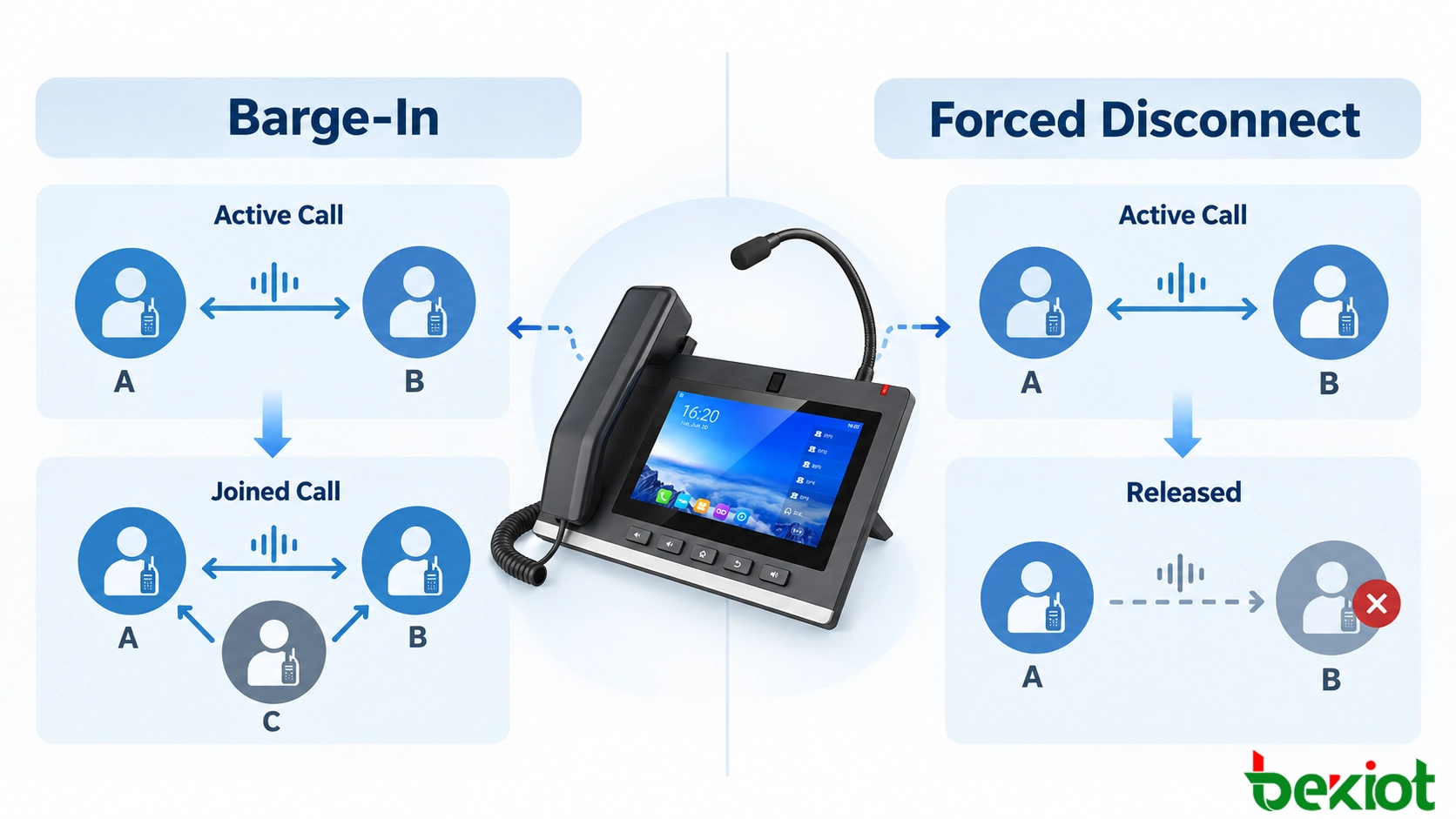
Call barge-in changes an active conversation rather than starting an unrelated call. Suppose operator A is talking with field engineer B. Supervisor C sees the live session on an authorized dispatch interface and selects Barge-In. The platform identifies the target call and checks whether C has permission to join it. If the request is accepted, the media function connects C to the existing conversation, for example by placing the parties on a controlled conference bridge. A and B remain in the call while C can hear and speak to them.
A successful intervention is more than a button press. The console should identify the affected call, show that C has joined and reflect any changes to the participants or media state. Depending on the operating policy, the existing parties may receive a tone or visual notice. When C leaves, the platform should restore the intended two-party or remaining conference state rather than accidentally releasing the original call.
Barge-in is also distinct from monitoring, in which a supervisor listens, and whisper coaching, in which guidance is sent to only one participant. These modes require different media routing. A standard SIP telephone does not automatically provide third-party intervention authority; the call-control or media system must support the requested operation. For a separate discussion of the operational reasons for intervention, see the Forced Barge-In overview.
How Forced Disconnect Releases a Selected Session
Forced disconnect, also called forced release, ends a specified call or participant connection under authorized dispatch control. Suppose a routine group conference is occupying a resource needed for an urgent operation. The dispatcher selects the affected session, requests a release and receives confirmation of what was actually cleared. The scope matters: removing one participant, ending a conference and releasing a radio channel are different operations.
The control sequence is straightforward: identify the active session, validate the operator's role and the target's protection status, request termination through the controlling platform, update the connected endpoints and media resources, and record the resulting state. If only one member of a bridged conference is selected, a participant-level release may leave the other members connected. If the platform controls only the conference as a whole, ending it may disconnect everyone. The user interface must make that consequence clear before execution.
In a SIP system managed by a call server or back-to-back user agent, established session legs are normally ended using the appropriate SIP BYE exchanges. A call attempt that has not yet been established may instead be cancelled. The server must control the relevant dialogs; one ordinary endpoint cannot terminate an unrelated third-party call simply by issuing its own BYE. A disconnected network endpoint also creates a distinction between clearing server-side state and confirming that the remote audio path has stopped.
Forced disconnect should not be confused with priority preemption. Forced disconnect is the action of releasing a selected session. Preemption is a resource policy under which a higher-priority request may displace a lower-priority one. Depending on resource availability and rules, an urgent request might be connected immediately, queued or allowed to preempt a session. Higher priority does not always result in a forced release.
Priority, Permissions and Competing Requests
A dispatch project needs a defined decision order when routine calls, team coordination and urgent instructions compete for the same resources. Ordinary users may be permitted to call their own work groups, while designated supervisors can intervene in certain sessions. Some destinations, such as active emergency communication paths, may be protected against routine interruption regardless of how many groups an operator is allowed to address.
Authorization should consider the initiating role, target resource, current call state, requested action and priority. For example, when supervisor C attempts to join A's call with B, an expired session or insufficient authority should produce a visible rejection. If two supervisors request intervention simultaneously, the platform needs a consistent arbitration rule instead of allowing unpredictable media changes. A similar rule is needed when two operators request the same half-duplex radio channel or paging zone.
SIP session signaling and operational priority are separate concerns. RFC 4412 defines SIP Resource-Priority signaling for systems that recognize the relevant priority namespaces and enforce associated policies; it does not make all SIP phones capable of barge-in or guarantee preemption between unrelated vendors. Network QoS likewise helps protect audio transport but does not grant an operator the right to interrupt someone else's call.
An auditable intervention record should include the requesting account, target session, action, time and result. Where required, it should also capture the stated reason, participant notification and recording status. These records are particularly useful when the visible console state and the actual state of a remote endpoint differ after a network failure.
Where SIP, Radio and Paging Systems Meet
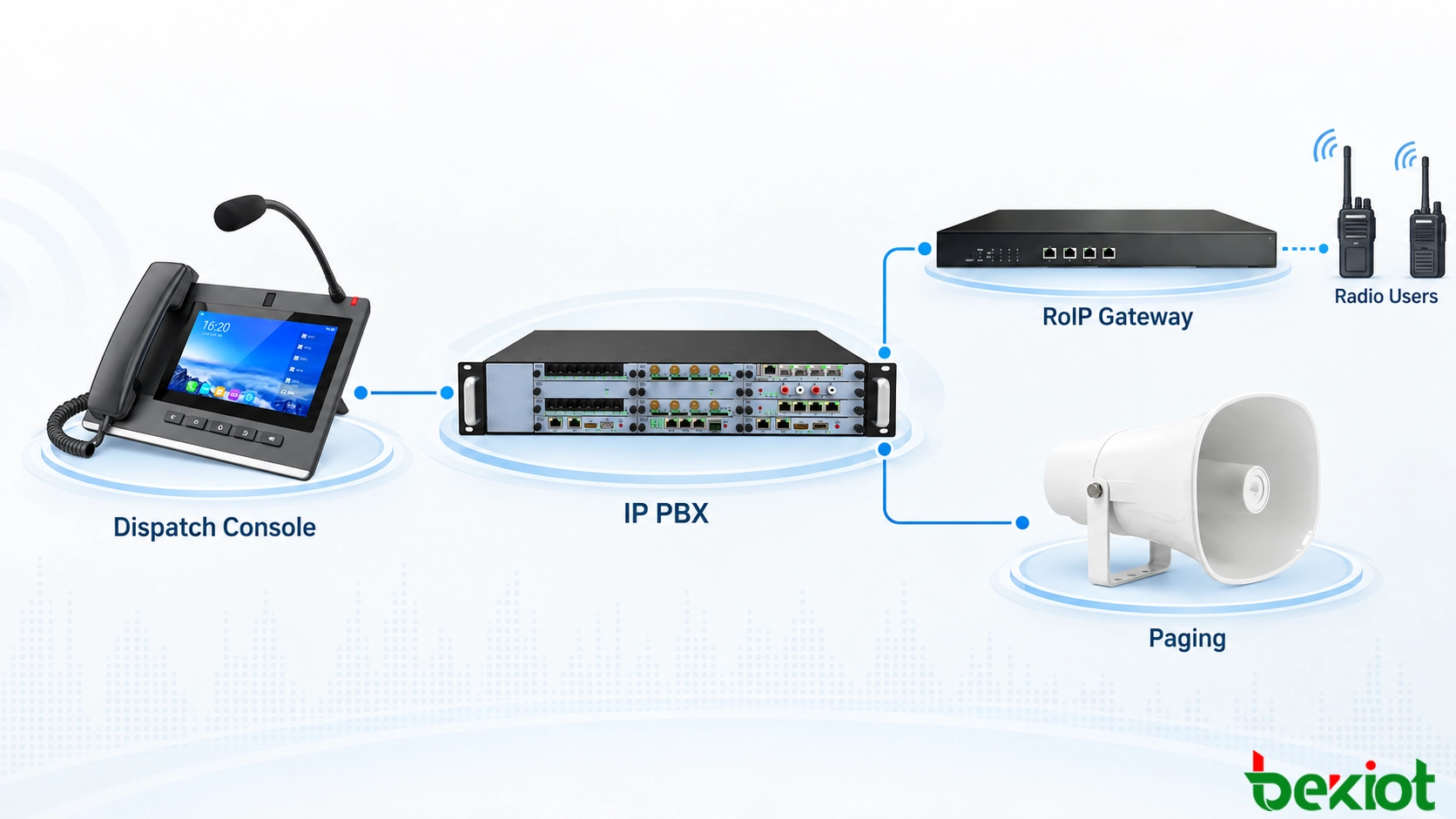
A mixed voice dispatch installation may bring together SIP telephones, a central call-control platform, radio channels and IP paging zones. The command and dispatch system manages operational requests, while each connected network retains its own media characteristics. An interactive SIP conference, a one-way paging announcement and a push-to-talk radio group cannot simply be treated as identical audio destinations.
For operator-side calling, group communication and paging, see Becke Telcom's SIP Dispatch Consoles and Paging Microphones.
A compatible RoIP gateway can connect selected radio resources to an IP dispatch workflow. Radio channel occupancy, push-to-talk timing and transmit permissions still have to be coordinated through the gateway and the radio system. If a supervisor barges into a call involving a half-duplex radio channel, adding another SIP speaker does not create a second radio transmitter or allow two radio users to talk over one channel simultaneously. Similarly, SIP speakers and IP paging equipment can distribute announcements without becoming ordinary two-way conference participants.
Acceptance testing should follow realistic communication states rather than just confirming that each endpoint can register. The following checks reveal most call-control mismatches before handover:
Place an individual call to an available, busy and offline destination; check the resulting states and alternate routing.
Call a group with an unavailable member; verify which parties connect and who can speak.
Send an all-call to overlapping groups; confirm the intended coverage and check for duplicate audio.
Join an active A-to-B call as authorized supervisor C; verify audio, notification and the state after C leaves.
Attempt barge-in and forced release using an account without permission; confirm rejection and audit records.
Release one participant and then a full session; verify which connections remain active and which resources are freed.
Repeat the critical operations across a RoIP link and a paging zone, including link failure, recovery and protected emergency calls.
The resulting configuration should make call scope, speaking rights and intervention outcomes predictable for operators and field personnel. That is the practical distinction between a collection of SIP devices and a voice dispatch system with controlled calling and release behavior.
Frequently Asked Questions
Can a worker join a group call after it has started?
A live conference may allow late participants to join, while a group paging operation may deliver only audio transmitted after the endpoint connects. The group service needs an explicit late-join rule; adding an extension to a directory does not automatically insert it into an existing conversation.
Will an offline terminal receive an all-call later?
Not by default. A live announcement normally reaches endpoints that are connected and able to receive it at the time. Delayed playback, message storage or missed-announcement notification requires additional functionality and should be specified separately.
Can a supervisor barge into a direct SIP call that bypasses the server?
Not through a generic SIP feature alone. The deployment needs a supported way for an authorized platform or endpoint function to identify and change the live media path. Direct peer-to-peer sessions without such control may not support barge-in.
Can two separate dispatch platforms share one priority hierarchy?
Only when the integrated platforms have compatible identity, authorization and resource-control rules. Local priority numbers do not automatically carry the same meaning on another server or across a radio gateway; the mapping must be configured and tested.
Can group paging reach existing analog loudspeakers?
Yes, if an appropriate paging gateway or audio interface connects the SIP side to the existing amplifier and speaker circuits. The design must account for zone selection, audio levels, amplifier capacity and any emergency-system certification requirements.