In dispatch, emergency response, security command, contact center supervision, industrial communication, and public facility management, some calls cannot wait for a polite transfer or a delayed callback. A field operator may be speaking with the wrong department during an emergency, a new agent may be unable to handle a critical service call, a security desk may need to intervene in a live conversation, or a commander may need to join a call immediately to give an authoritative instruction. Forced Barge-In is designed for these high-control communication situations.
Forced Barge-In is a priority-based call intervention function that allows an authorized user to enter an active call without waiting for the original parties to invite them manually. Depending on system configuration, the barging user may join the call as a three-party participant, speak to all parties, take command of the conversation, convert the call into a conference, or escalate the call into an emergency handling process. Its value lies not only in technical call intrusion, but also in faster intervention, stronger command authority, reduced response delay, clearer accountability, and better control of critical communication workflows.
Why call intervention becomes necessary
In ordinary communication, a call is usually controlled by the people already involved. If a third person is needed, one party can transfer the call, invite another participant, or place the caller on hold while asking for help. This is acceptable in routine service, but it may not be enough in time-sensitive or high-risk communication. When seconds matter, waiting for manual transfer can create delay.
Forced Barge-In exists because some roles require immediate intervention authority. A dispatcher may need to interrupt a field call to issue a safety instruction. A supervisor may need to assist an agent who is handling a difficult customer. A security commander may need to join a live call linked to an incident. A control room operator may need to override a routine conversation to provide emergency guidance.
The key idea is controlled priority. Forced Barge-In should not mean that anyone can intrude into any call at any time. It should be limited to authorized roles, defined scenarios, logged actions, and clear operating rules. When used properly, it becomes a command and support tool. When used carelessly, it can create privacy, trust, and compliance problems.
This is why the function is often found in dispatch systems, contact center platforms, enterprise PBX systems, emergency communication platforms, security operations, and industrial command environments. It gives selected users the ability to intervene when ordinary call handling is too slow or insufficient.
The working logic behind forced intervention
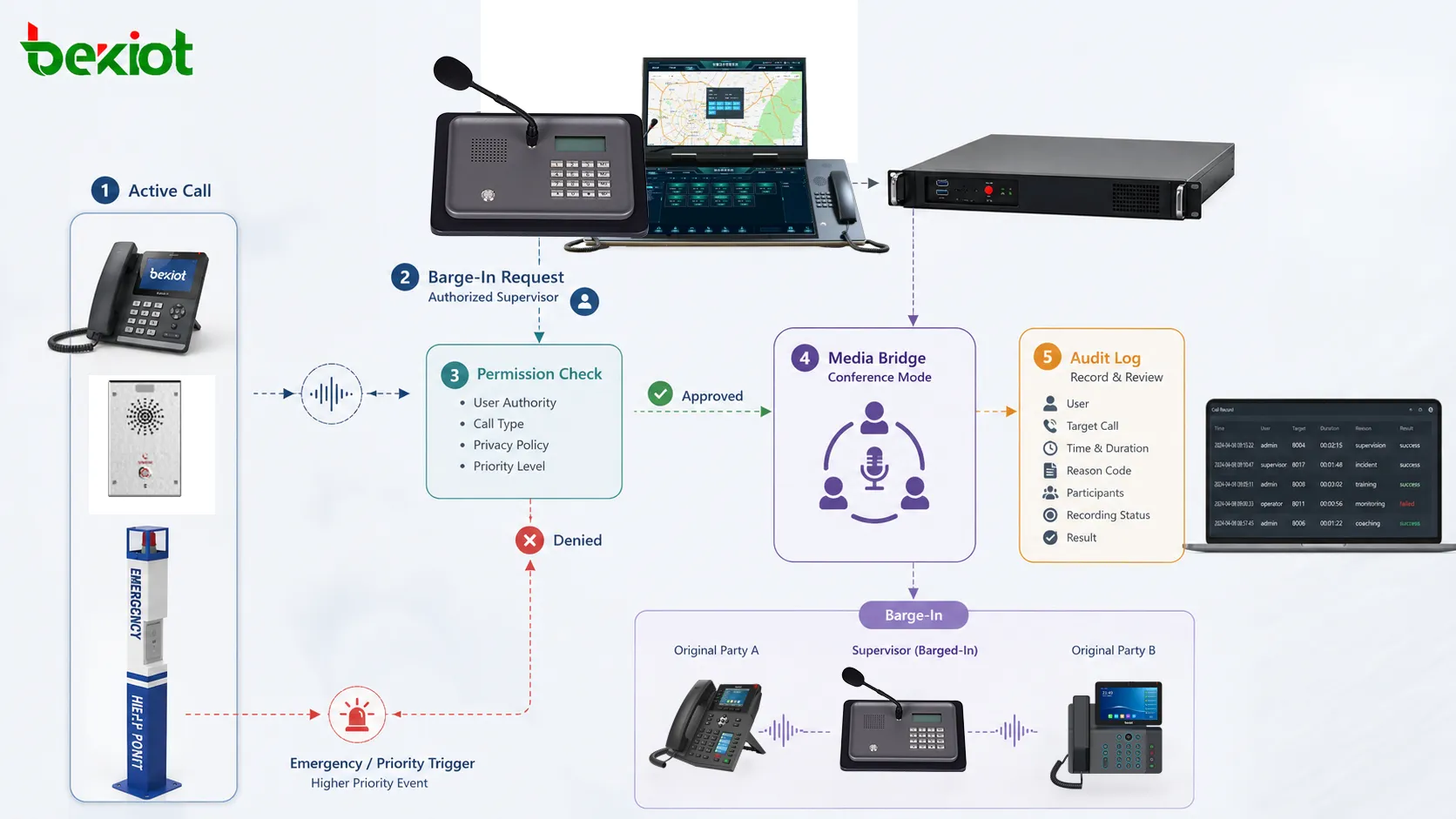
Forced Barge-In begins with an active call. The system must know that two or more parties are already connected. This may be an internal extension call, outside line call, SIP call, dispatch call, intercom call, help point call, customer service call, or emergency communication session. The active call becomes the target of intervention.
The authorized user then sends a barge-in request. This may be done from a dispatch console, supervisor interface, feature access code, softphone button, PBX command, monitoring dashboard, emergency command terminal, or system workflow. The request usually identifies the target extension, call session, agent, field device, queue, line group, or incident-related call.
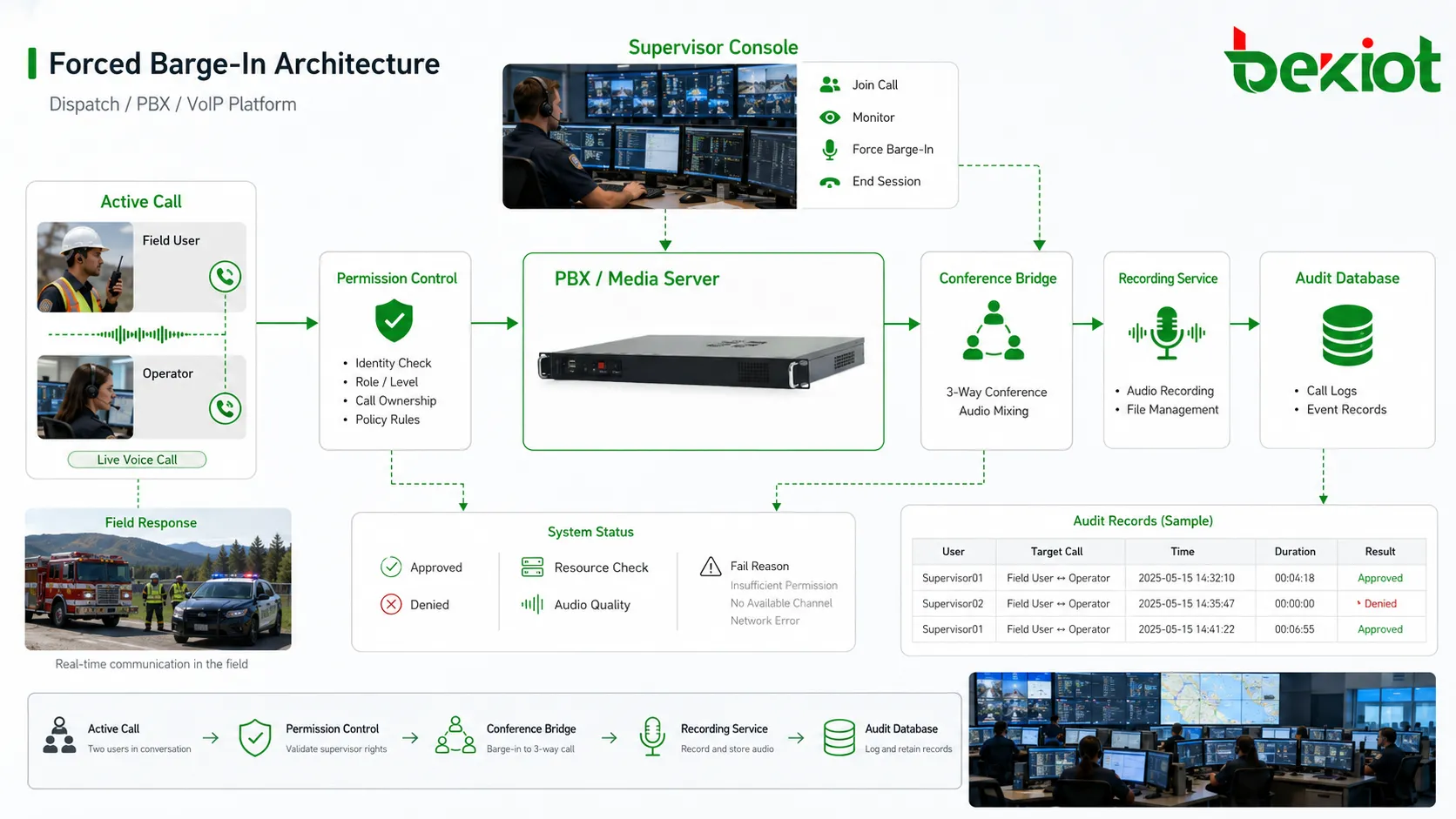
Before allowing the intrusion, the system checks permission. It verifies whether the user has the authority to barge into that call, whether the target call type allows intervention, whether privacy restrictions apply, whether the user role has sufficient priority, and whether another higher-priority event is already controlling the call. This permission check is essential because Forced Barge-In is a sensitive function.
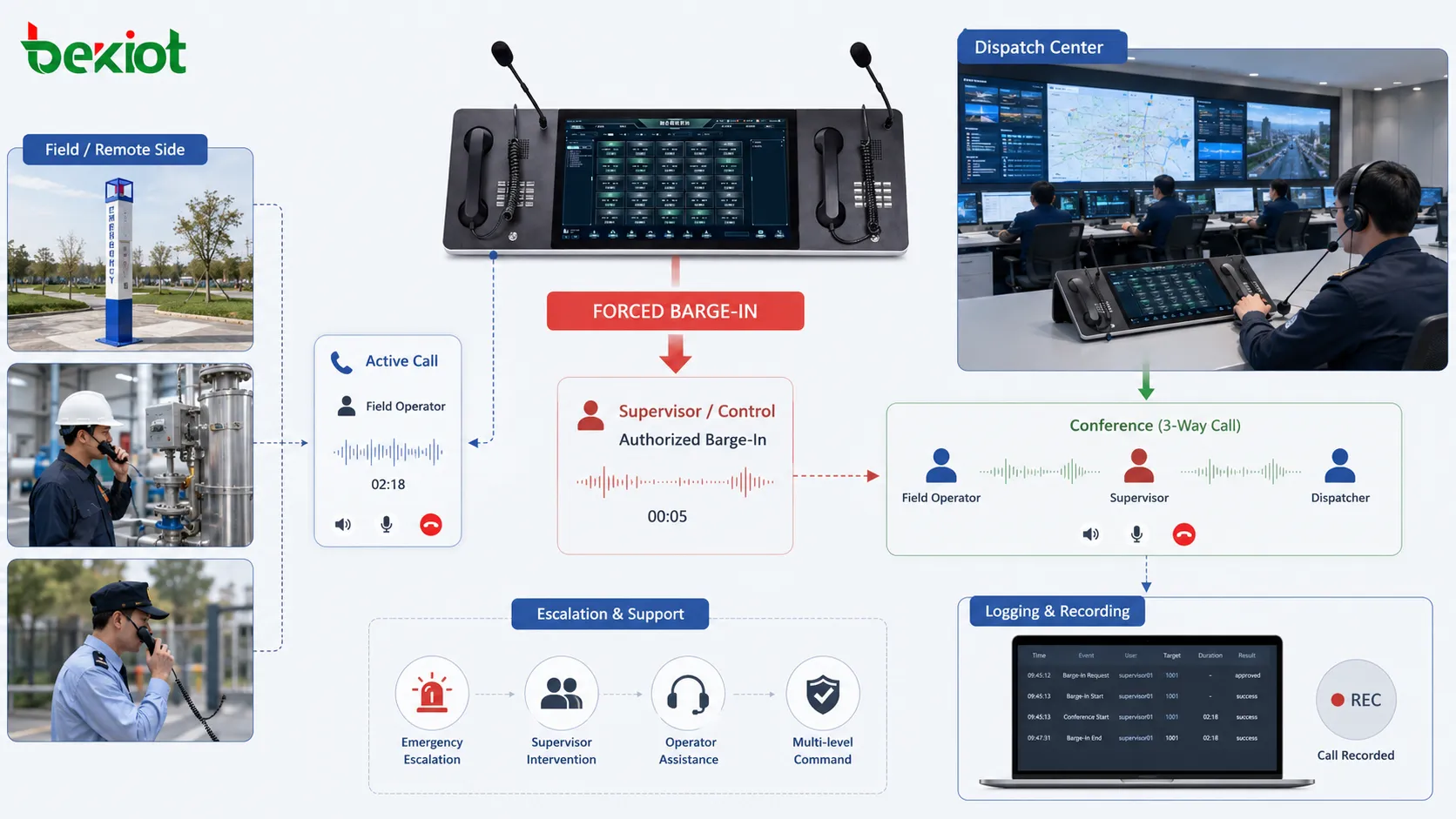
If the request is accepted, the voice platform modifies the media path. In many systems, the active call is converted into a three-way bridge or conference so that the barging user can hear and speak. In some configurations, the original parties may hear an intrusion tone, receive a display prompt, or see a status indicator. In other controlled environments, the intervention may be silent at first and then become audible depending on policy.
After the barge-in starts, the system should create a record. A useful record includes the barging user, target call, time, duration, reason code, call participants, recording status, intervention mode, and result. This record supports accountability, compliance, training, and incident review.
Priority control is the core function
The core function of Forced Barge-In is priority control over an active communication session. Ordinary users may not be able to interrupt a call, but authorized users with higher priority can enter when the situation requires it. This gives the communication system a hierarchy of authority.
Priority control is important in emergency and dispatch environments. A field operator may be engaged in a routine call when an emergency instruction must be delivered. A dispatcher may need to interrupt and redirect the conversation. A commander may need to join a call between a field team and a local operator to provide unified instructions.
In contact center environments, priority control allows supervisors to intervene when an agent is struggling, when a customer requests escalation, when a high-value case needs expert support, or when a call is becoming risky. The supervisor does not need to wait until the agent transfers the call manually.
Priority should be designed by role and scenario. A team leader may have permission to barge into calls within a department. A security commander may have wider permission for incident-related calls. A system administrator should not automatically have operational barge-in authority unless that role is explicitly required. Technical access and communication command authority should be separated.
Priority control also prevents conflicts between multiple intervening users. If two supervisors try to barge into the same call, the system should define whether both may join, whether the higher-priority user takes control, or whether the second request is rejected. Without clear rules, forced intervention can become chaotic.
Real-time support during difficult conversations
One of the most practical functions is real-time support. When a person handling a call lacks experience, information, authority, or confidence, a supervisor can join immediately. This is common in customer service, technical support, emergency assistance, visitor management, security communication, and field dispatch.
Real-time support prevents the call from being broken into several steps. Without barge-in, the call handler may need to put the caller on hold, call a supervisor separately, explain the situation, return to the caller, and possibly transfer the call. Each step consumes time and increases the chance of misunderstanding. Forced Barge-In allows a qualified person to enter the conversation directly.
This is useful when the caller is upset, the issue is complex, the information is sensitive, or the response requires authority. A supervisor can clarify the situation, correct wrong information, approve an exception, ask necessary questions, or take over the tone of the conversation. The call continues without restarting from the beginning.
In technical environments, real-time support may help a field worker describe a fault while an expert joins the call. In emergency assistance, a commander may join to confirm location, provide instructions, or coordinate response. In security communication, a control center supervisor may join a call between a gate operator and a visitor when the situation becomes suspicious.
The value is not only faster problem solving. It also protects the original call handler. New staff, field operators, and front-line users can receive live support during difficult calls instead of being left alone under pressure.
Emergency escalation and command intervention
Forced Barge-In has strong value in emergency escalation. In an emergency system, communication can quickly move from routine reporting to command-level response. A local operator may receive a call from a field terminal, help point, emergency phone, tunnel station, industrial workshop, gatehouse, or security area. If the event is serious, a higher-level dispatcher or commander may need to enter the call immediately.
Command intervention helps reduce information delay. Instead of waiting for the local operator to summarize and relay the call, the commander can hear the caller directly. This reduces the risk of information loss and allows faster decision-making. In emergencies, direct listening and immediate questioning can be more effective than second-hand reporting.
Forced Barge-In can also help unify instructions. If several people are discussing the incident and the situation is becoming unclear, a command user can enter and provide a single authoritative direction. This is useful during evacuation, security response, equipment failure, hazardous area management, medical assistance, traffic disruption, or public safety incidents.
The function should be tied to escalation rules. Not every call should allow emergency barge-in. The system may limit this authority to calls tagged as emergency, calls from specific devices, calls within certain zones, or calls involving certain roles. Strong systems combine technical capability with operational policy.
Emergency barge-in should also be logged and, where required, recorded. After the incident, reviewers may need to know who intervened, what instruction was given, and how the call progressed. This supports incident reconstruction and procedural improvement.
Call takeover and controlled transfer
In some systems, Forced Barge-In can lead to call takeover. Barge-in usually means joining the call while the original parties remain connected. Takeover means the intervening user may assume primary control or remove one party from the conversation depending on configuration and policy. This is a stronger action and should be used carefully.
Call takeover is useful when the original call handler cannot continue effectively. The caller may demand a supervisor, the issue may exceed the agent’s authority, the field operator may be unable to answer, or the situation may require a specialist. Instead of ending the call and starting a new one, the supervisor can take over inside the existing session.
Controlled transfer can also be supported. The barging user may enter first, understand the situation, speak with both sides, and then transfer the call to a specialist, emergency desk, technical expert, or command group. This avoids blind transfer because the intervening user can assess the call before deciding where it should go.
Takeover should be separated from ordinary barge-in by permission. A user who can join a call should not automatically be able to remove another participant or take full control. These are different risk levels. The system should define which roles can listen, whisper, barge, conference, transfer, or take over.
When takeover occurs, the system should record the action clearly. The log should show that the call was not simply joined, but that control changed. This matters for quality management, incident review, and accountability.
Difference from monitoring and whisper functions
Forced Barge-In is often discussed together with monitoring and whisper functions, but they are not the same. Monitoring usually means that an authorized user listens to an active call without speaking to the participants. Whisper usually means that the supervisor can speak to one party, often the agent, while the other party does not hear the supervisor. Barge-in means the supervisor joins the call and can speak to all relevant parties.
The difference matters because each mode has a different level of visibility and intervention. Monitoring is useful for evaluation, quality assurance, training observation, and silent supervision. Whisper is useful for coaching or guiding an agent without interrupting the customer or caller. Barge-in is used when direct intervention is needed.
Forced Barge-In is more intrusive than monitoring or whisper. It changes the active call experience because another person enters the conversation. For this reason, it should have stricter permission, clearer logging, and stronger policy control. The more intrusive the function, the more carefully it should be governed.
In some workflows, the supervisor may start with monitoring, then use whisper, and finally barge in if the situation requires direct intervention. In emergency dispatch, the user may skip monitoring and use immediate forced barge-in because delay is unacceptable. The correct mode depends on urgency and policy.
Good system design makes these modes easy to distinguish. Users should know whether they are listening silently, whispering privately, joining openly, or taking over the call. Ambiguous controls can create serious privacy and operational mistakes.
System value for dispatch centers
Dispatch centers benefit from Forced Barge-In because they handle live communication under time pressure. Operators may receive calls from field teams, emergency terminals, public help points, guards, maintenance staff, drivers, station workers, production areas, or service desks. Not every operator can handle every situation alone.
When a call escalates, a senior dispatcher can barge in and assist immediately. This can improve response speed and reduce call handling mistakes. If a field worker is describing a safety issue, a senior operator can ask clarifying questions directly. If a local operator misunderstands an instruction, the supervisor can correct it before the situation worsens.
Forced Barge-In also supports multi-level command. A local dispatch desk may handle routine calls, while a central command user can enter calls during major incidents. This helps large organizations maintain control without requiring every call to be routed to the highest-level command center from the beginning.
The function also improves continuity during shift work. If an operator needs help during a handover or if a call continues across shift change, another authorized user can join and understand the situation in real time. This reduces information loss.
For dispatch centers, the system value comes from faster escalation, stronger supervision, better command visibility, and reduced reliance on manual transfer. The function turns live calls into controllable communication events within the dispatch workflow.
System value for emergency communication
Emergency communication requires speed, clarity, and authority. Forced Barge-In supports all three. Speed comes from immediate intervention. Clarity comes from direct participation in the live conversation. Authority comes from allowing the right command role to enter the call when needed.
During an emergency, information may be incomplete or changing quickly. A caller may be nervous, injured, confused, or unfamiliar with the site. A local operator may not know the full emergency plan. A commander may need to ask direct questions about location, hazard, number of people affected, available exits, equipment status, or immediate needs. Forced Barge-In allows this without waiting for a call transfer.
It also helps avoid communication chain distortion. If one person reports to another, and that person reports to a commander, details may be lost. By entering the original call, the commander hears the source directly. This can improve decision quality.
Emergency use should be supported by strict rules. Only authorized roles should have this power. The system should record the intervention. The reason for barge-in may need to be selected or documented. If the call contains sensitive information, access should be reviewed after the event.
In emergency systems, Forced Barge-In should be tested during drills. Teams should confirm that command users can enter active calls, that audio remains clear, that logs are produced, and that lower-priority users cannot interfere with the intervention. A feature that is never tested may fail when urgently needed.
System value for contact centers and service teams
Contact centers use Forced Barge-In to improve service quality, support agents, handle escalations, and protect customer experience. A supervisor can enter a live call when an agent is struggling, when the customer requests escalation, when the issue is sensitive, or when a mistake needs immediate correction.
This is different from post-call review. Recording review can identify problems after the call ends, but Forced Barge-In allows intervention while the call is still happening. The supervisor can help resolve the issue before the customer hangs up or before incorrect information causes further problems.
For training, the function can help new agents gain confidence. A supervisor can monitor, whisper, or barge in depending on the situation. If the call becomes too difficult, the supervisor can join and demonstrate how to handle it. This creates real-time learning instead of only classroom instruction.
For service teams outside traditional contact centers, the value is similar. Property management, healthcare support, field service, transportation service, public facility help desks, and technical hotlines may all need live supervisory support. Forced Barge-In gives supervisors a way to assist without restarting the conversation.
The function should be used respectfully. Customers and callers may need notification depending on policy and legal requirements. Agents should understand when supervisors may intervene. Clear rules prevent the feature from feeling like hidden surveillance or arbitrary intrusion.
System value for industrial and field operations
Industrial and field operations often involve distributed workers, equipment rooms, outdoor areas, control points, and safety procedures. A call from the field may concern equipment failure, maintenance work, restricted-area access, abnormal noise, power conditions, hazardous materials, or worker safety. In these situations, a supervisor or expert may need to join quickly.
Forced Barge-In allows technical experts to enter ongoing communication without forcing the field user to repeat the full description. A control room operator can start handling the call, and if the issue requires deeper knowledge, a maintenance engineer or safety supervisor can join. This shortens the information path.
The function is useful for complex troubleshooting. A field technician may describe symptoms while an expert asks questions. The original operator remains in the call to coordinate dispatch or record the event. The conversation becomes a collaborative problem-solving session rather than a series of disconnected calls.
In safety-related work, forced intervention can help stop unsafe action. If a field team is about to perform a wrong operation or if an operator hears a dangerous misunderstanding, an authorized supervisor can enter the call and issue a correction immediately. This can reduce risk in high-consequence environments.
Industrial use should consider noise, device type, and recording. If the original call uses an intercom terminal or rugged field phone, audio conditions may be difficult. The barging user must hear clearly and be heard clearly. Otherwise, intervention may add confusion instead of solving it.
System value for security and access control
Security operations often require live judgment. A guard may be speaking with a visitor at a gate, a control room operator may be handling a parking entrance call, or a help point may connect to a security desk during a suspicious event. Forced Barge-In allows a supervisor or security commander to join the call when risk increases.
This is useful when the caller’s identity is unclear, when the situation involves restricted access, when the local operator needs authorization, or when the conversation becomes confrontational. A supervisor can ask additional questions, approve or deny access, or instruct the operator on the next step.
When combined with video or access control systems, Forced Barge-In becomes part of a broader security workflow. A supervisor may view the camera, join the call, speak with the visitor, and decide whether to open a gate or dispatch a patrol. The live voice channel supports decision-making alongside visual information.
Security systems should log these interventions carefully. Access-related calls may later need review. The record should show who entered the call, when the intervention occurred, and what action followed. This supports accountability and helps resolve disputes.
Privacy and proportionality matter in security use. The function should be used for legitimate operational reasons, not casual listening or unnecessary intrusion. Permission levels and audit logs are essential.
System value for transport and public facilities
Transport systems and public facilities often use communication terminals, help points, dispatch phones, intercoms, and control room calls. When a passenger, driver, staff member, or field worker calls for help, the first operator may not always be the final decision-maker. Forced Barge-In allows a higher-level operator to join when the issue escalates.
In railway stations, metro systems, airports, ports, tunnels, bus terminals, parking facilities, and public buildings, live calls may involve passenger safety, equipment faults, access issues, crowd movement, lost persons, platform incidents, elevator assistance, or emergency guidance. Immediate intervention can reduce response delay.
Transport environments also require coordinated announcements and field response. A supervisor joining the call may decide to trigger a public announcement, notify maintenance, dispatch security, or escalate to emergency services. The barge-in call becomes part of the incident workflow.
Public facilities must balance intervention with privacy. Calls from help points or service terminals may include personal information. Access to forced intervention should be limited to responsible roles, and records should be retained according to policy.
Audit, recording, and accountability
Because Forced Barge-In affects an active call, it should be auditable. The system should record not only the call content where policy allows, but also the intervention action itself. This includes who barged in, which call was targeted, when it happened, how long it lasted, what mode was used, and whether the call was taken over or transferred afterward.
Audit records protect both users and organizations. They discourage misuse because every intervention can be reviewed. They help supervisors understand how the feature is being used. They support incident investigation when a call becomes part of an emergency or complaint. They also provide evidence that escalation procedures were followed.
Recording policy should be clear. In some environments, all dispatch or service calls may be recorded. In others, recording may require notification or consent. Some calls may include sensitive information and need stricter retention and access rules. Forced Barge-In should follow the same or higher recording policy as the original call.
Audit logs should be protected from tampering. If a user can delete or modify barge-in records, the accountability value is weakened. Access to logs should be role-based, and export actions should be recorded.
For emergency systems, barge-in records may be linked to incident timelines. A reviewer can see when the call started, when the supervisor entered, what instruction was given, whether another system was triggered, and how the event ended. This supports continuous improvement.
Privacy and compliance boundaries
Forced Barge-In is powerful because it can override normal call boundaries. That same power creates privacy and compliance risks. Organizations should not enable the function without clear rules. Users and call participants may have expectations about who can hear or join a call, and those expectations may be affected by local law, industry policy, labor agreements, or customer communication rules.
The system should define when barge-in is allowed. Valid reasons may include emergency response, supervisor escalation, training support, safety command, security incident handling, quality assurance, or technical troubleshooting. Casual use should be prohibited. The more sensitive the call environment, the stricter the rule should be.
Notification policy should also be considered. Some environments may require a tone, display message, or verbal notice when a supervisor joins. Other emergency environments may allow immediate command intervention. The correct policy depends on the organization, jurisdiction, and risk category.
Access should follow least privilege. Only users who need the function should have it. Permission should be reviewed periodically. Former supervisors, temporary project users, or inactive accounts should not retain barge-in authority.
Compliance is not only legal. It also affects trust. Agents, operators, field users, and customers are more likely to accept the function when they understand its purpose, boundaries, and safeguards. Clear policy makes the system safer to use.
Permission design and role separation
Permission design is one of the most important parts of Forced Barge-In deployment. The system should separate different levels of call control. A user may be allowed to monitor but not whisper. Another may be allowed to whisper but not barge. A senior role may be allowed to barge into selected departments. An emergency commander may have broader authority during incidents.
Role separation reduces risk. If every supervisor can barge into every call, misuse becomes more likely. If no one can intervene during emergencies, response may be delayed. The correct design depends on organizational structure and call sensitivity.
Permissions may be based on department, queue, extension group, line group, call type, incident type, location, time period, or emergency status. For example, a customer service supervisor may barge into service agent calls but not HR calls. A security commander may barge into gate and help point calls but not private administrative calls.
Temporary permissions should be controlled. During drills, special events, major incidents, or project commissioning, extra users may need intervention authority. After the event, these permissions should be removed. Long-term leftover permissions create unnecessary exposure.
Permission changes should be logged. Administrators should know who granted barge-in rights, when they were changed, and which users currently have access. This prevents hidden privilege growth.
Technical implementation in communication systems
Technically, Forced Barge-In can be implemented in different ways depending on the communication platform. In PBX or VoIP systems, the platform may create a conference bridge that adds the barging user to the active call. In dispatch systems, the console may control the media server and insert the command user into the call path. In contact center systems, the supervisor interface may use call monitoring capabilities to join the session.
In SIP-based systems, implementation may involve call session control, media bridging, conference resources, feature codes, call permissions, and server-side signaling. The exact mechanism depends on the platform design. Some systems treat barge-in as a conference function. Others treat it as a monitoring feature that escalates into an active call participant.
Audio quality must be considered. Adding a third participant changes the media path. The system should prevent echo, delay, volume imbalance, or codec mismatch. If the barging user cannot hear clearly or if the original parties hear distortion, the intervention becomes less effective.
System capacity also matters. Barge-in may use conference resources or media server capacity. If many supervisors intervene at the same time, the system must be able to support the load. Emergency systems should verify capacity under realistic conditions.
Fail behavior should be defined. If the barge-in attempt fails, the user should receive a clear reason. The failure may be caused by permission denial, call ending, unavailable conference resource, privacy restriction, network problem, or unsupported call type. Clear feedback helps operators choose the next action.
Relationship with recording and call quality systems
Forced Barge-In often works together with recording and call quality systems. When a supervisor joins a call, the recording should show the complete communication event if recording is enabled. The system should indicate when the supervisor entered and whether the call changed from two-party to three-party communication.
For quality management, barge-in records can show how often supervisors intervene, which teams need support, what types of calls require escalation, and whether intervention improves resolution. This helps managers identify training needs and process weaknesses.
For emergency and dispatch review, recording can preserve the command instruction given during intervention. If the barging user changed the direction of the call, that decision may be important later. The recording provides evidence of the actual conversation rather than relying on memory.
Call quality monitoring should consider the effect of barge-in. If audio becomes worse after intervention, the system may need media tuning, codec adjustment, bandwidth improvement, or echo control. A feature that harms audio clarity may reduce operational value.
Recording access should be controlled. Calls involving forced intervention may contain sensitive information, command decisions, personal data, or incident details. Access to these recordings should follow role-based policy and retention rules.
Use in training and performance improvement
Forced Barge-In can support training when used carefully. New agents, operators, dispatchers, and field communication staff may face situations that are difficult to simulate fully in classroom training. A supervisor can join a real call when assistance is needed and guide the conversation directly.
This provides immediate learning. The trainee hears how the supervisor asks questions, controls tone, confirms details, handles pressure, and resolves conflict. After the call, the supervisor can review what happened and explain why the intervention was necessary.
Training use should not make staff feel constantly watched or undermined. Monitoring, whisper, and barge-in should be explained as support tools. Clear training policies help employees understand when intervention may occur and how it benefits service quality and safety.
Performance improvement can also be based on data. If one type of call frequently requires barge-in, the organization may need better scripts, knowledge base content, escalation rules, or technical training. If one team rarely requires intervention, their practices may be used as examples.
The goal is not to replace staff judgment with supervisor control. The goal is to help staff handle difficult situations more effectively and reduce risk when live support is needed.
Common misuse and configuration mistakes
One common mistake is enabling Forced Barge-In too broadly. If too many users can intrude into calls, privacy risk increases and staff trust decreases. The function should be limited to roles with a genuine operational need.
Another mistake is failing to distinguish barge-in from monitor, whisper, and takeover. These are different levels of intervention. If users do not understand the difference, they may enter a call when they only intended to listen, or take over when they only intended to assist.
Poor logging is also a serious weakness. If the system cannot show who barged in and why, the feature becomes difficult to audit. Every forced intervention should leave a trace, especially in emergency, security, and service environments.
Some systems fail to define notification behavior. Participants may be unaware that another person joined, or they may hear an unexplained tone. The organization should define whether notification is required and how it should be presented.
Finally, some deployments ignore capacity and audio testing. Barge-in may work in a small test but fail under high call volume or produce poor audio in real conditions. Testing should include actual devices, real networks, and realistic call scenarios.
How to evaluate a strong Forced Barge-In design
A strong Forced Barge-In design should begin with a clear purpose. The organization should define why the function is needed: emergency command, supervisor escalation, agent support, security response, field troubleshooting, quality management, or dispatch control. The purpose determines permission, notification, recording, and audit rules.
The second evaluation point is role control. Only authorized users should have access, and access should be limited by department, call type, queue, zone, or incident role where appropriate. Emergency authority should be separated from routine supervisory authority.
The third point is operational clarity. Users should know how to activate barge-in, what happens when they do, whether the original parties are notified, whether the call becomes a conference, and whether takeover is possible. Ambiguous behavior creates risk.
The fourth point is auditability. The system should record intervention time, user, target call, mode, duration, result, and related incident or queue where applicable. For critical calls, audio recording and metadata should be available according to policy.
The fifth point is compliance and trust. The feature should respect privacy rules, internal policy, customer communication standards, and legal requirements. A technically powerful function is only valuable if it can be used responsibly.
Closing Insights
Forced Barge-In provides functions such as priority call intervention, real-time supervisor support, emergency command escalation, call takeover support, dispatch assistance, field troubleshooting, security intervention, training guidance, recording linkage, and audit traceability. It gives authorized users a way to enter active calls when ordinary transfer or delayed escalation is not enough.
Its system value is strongest in environments where communication timing, authority, and accountability matter. Dispatch centers, emergency systems, contact centers, industrial sites, security operations, transport facilities, healthcare support, public help points, and service teams can all benefit when the function is carefully governed and technically reliable.
The key is controlled use. Forced Barge-In should be supported by role-based permissions, priority rules, notification policy, recording, audit logs, privacy safeguards, capacity planning, audio testing, and clear operating procedures. When these elements are in place, it becomes a valuable command and support function rather than an uncontrolled intrusion tool.
FAQ
Is Forced Barge-In the same as call monitoring?
No. Call monitoring usually allows an authorized user to listen to an active call. Forced Barge-In allows the user to enter the call and speak, often turning the original call into a three-party conversation.
Who should be allowed to use Forced Barge-In?
Only users with a clear operational need should have access. This may include supervisors, dispatch commanders, emergency operators, security managers, or technical support leaders. Permissions should be limited by role, department, call type, and policy.
Can Forced Barge-In be used for emergency communication?
Yes. It is useful when a commander or senior operator must join a live call immediately to give instructions, confirm details, or take control during an emergency. Emergency use should be logged and tested during drills.
Does Forced Barge-In require notification to call participants?
It depends on system policy, legal requirements, and application scenario. Some environments use tones or display prompts when a supervisor joins. Emergency or command environments may use different rules. The notification policy should be defined before deployment.
What should be logged when Forced Barge-In is used?
The system should log the barging user, target call, time, duration, intervention mode, permission result, call outcome, recording reference, and related incident or service record where applicable. These logs support accountability and review.