


Imagine a Monday morning at a branch office. The finance team is uploading month-end reports, a software deployment is pushing patches to every workstation, and someone in the back has started a cloud backup that nobody scheduled. Meanwhile, the sales director is on a customer call. Without any way to tell the network which packets matter most, that call competes on equal footing with every background transfer — and the caller starts hearing gaps, robotic syllables, and awkward delays.
This is the problem QoS priority marking was built to solve. It is a way of attaching a label to packets so that switches, routers, firewalls, and wireless controllers can recognize which traffic deserves faster, more predictable forwarding when resources get tight. In voice networks, that usually means separating real-time audio and call-control messages from bulk transfers so the timing-sensitive packets do not get stuck behind a large file download.
The reason this matters comes down to one simple fact: voice quality is governed by timing, not just bandwidth. A phone call can survive a small amount of packet loss without anyone noticing. But when latency creeps up, jitter becomes erratic, or packets arrive too late to be played out, the conversation falls apart. QoS marking gives network equipment the signal it needs to keep those time-critical packets moving.
It is worth saying upfront that marking alone is not a complete solution. A well-designed voice network still needs adequate bandwidth, stable switching, proper VLAN layout, sensible trust boundaries, and the right queueing policies. What marking does is provide the information those other mechanisms depend on. Think of it as the luggage tag on a suitcase — the tag does not carry the bag, but it tells the airline where it should go and how urgently it should be handled.

Why Voice Calls Break When the Network Gets Busy
Voice packets have a personality of their own. They are small, they arrive at a steady rhythm, and they are extremely unforgiving about delay. A large software download might consume far more bandwidth, but it can pause for a few hundred milliseconds and resume without anyone caring. Voice cannot. If too many audio packets linger in a queue, the listener hears clipped speech, long pauses between sentences, or that characteristic underwater distortion people recognize immediately as a bad call.
This is why voice bearer traffic is almost always separated from general application traffic in enterprise designs. The actual speech media — carried over RTP — gets a high-priority marker, while call signaling gets a different but still protected class. The network can then keep the conversation flowing smoothly while also ensuring that call setup, registration, and teardown messages arrive reliably.
What surprises many teams is how little bandwidth voice actually uses. A single G.711 call consumes roughly 80 to 100 kbps including overhead. The problem is never the volume; it is the timing. Even on a gigabit link, a few megabits of bursty traffic can introduce enough queuing delay to degrade a call, because voice packets need consistent, low-latency forwarding rather than raw throughput.
How QoS Priority Marking Protects Real-Time Audio
QoS is often described as if it were a single button you press, but in practice it is a sequence of decisions. First, traffic is identified and classified — is this voice media, signaling, or something else? Then it is marked with a priority value. Only after that can downstream devices decide whether to place it in a priority queue, shape it, police it, or protect it during congestion.
This chain is important because a marking that nobody honors is just a label gathering dust. A packet correctly tagged at the phone but ignored by the next switch gains almost nothing. Conversely, a well-marked packet traveling through a network that consistently trusts and acts on that marking can receive dramatically better treatment from end to end. The value is in the chain, not in any single link.
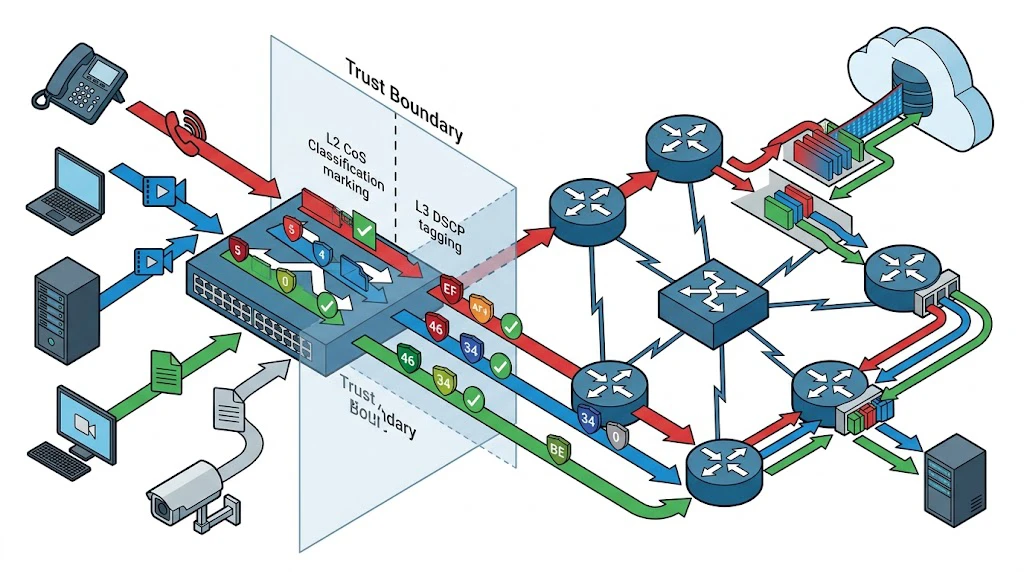
At Layer 3, the most common mechanism is DSCP — Differentiated Services Code Point — carried in the IP header. For voice media, the standard recommendation is EF, or Expedited Forwarding, which maps to DSCP value 46. EF does not reserve bandwidth by itself; it signals that the traffic should receive low-delay, low-jitter treatment. When policies are configured correctly, EF packets are directed into low-latency queues or strict-priority scheduling so they can cross congested links with minimal disruption.
At Layer 2, within switched Ethernet domains, traffic can also be marked using Class of Service values in 802.1Q tags — often called 802.1p priority marking. In many IP telephony environments, voice traffic is associated with CoS 5 at the access layer. This gives the switch an immediate signal before any routing decision is involved. The access switch can then preserve that marking, translate it to a DSCP value, or rewrite it according to campus or WAN policy.
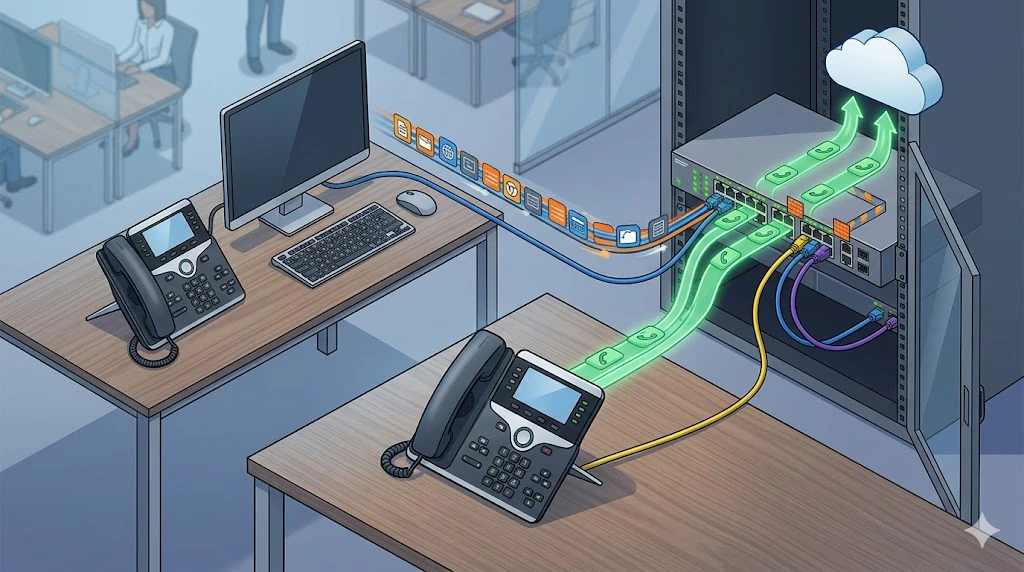
The point where a device decides whether to accept an incoming marking or overwrite it is called the trust boundary, and it is one of the most consequential decisions in voice QoS design. Not every endpoint should be allowed to declare its own packets as mission-critical — if any laptop can mark its cloud sync as top priority, the entire classification system collapses. In voice deployments, the network typically trusts markings from known IP phones while applying stricter rules to PCs connected behind them. Switches often use CDP or LLDP-MED to identify a phone port, trust its voice marking, and classify workstation traffic separately.
Where Marking Makes the Biggest Difference
The most familiar setting is the enterprise IP phone environment. Desk phones mark speech and signaling traffic, and campus switches plus routed uplinks are expected to honor those markings. This use case is well understood because the call flow is predictable and the business expectation for call quality is high. IP PBX platforms, SIP servers, and voice gateways all perform better when the network treats their traffic consistently.
What is often overlooked is that the phone marking correctly is only the first step. The access switch still needs the right trust state, VLAN configuration, queueing policy, and uplink behavior to preserve that benefit beyond the desk port. A phone can send perfectly marked packets, but if the switch port is configured to ignore them, the effort is wasted.
Marking becomes even more critical when voice leaves the local LAN. Branch routers classify and preserve marked media toward data centers, hosted PBX platforms, or SIP trunk providers. On slower WAN links — where congestion is a regular occurrence rather than an exception — queueing and shaping policies work far better when traffic arrives in clearly defined classes. Correct marking lets voice compete fairly against cloud backups, software distribution, video streams, and normal business application flows.
Beyond desk phones, the same principles apply to SIP paging systems, IP intercom terminals, emergency help points, industrial telephones, and dispatch consoles. These systems may not carry constant traffic, but when they are activated, the audio path often needs immediate, intelligible delivery. In transportation hubs, school campuses, industrial plants, healthcare facilities, and public safety environments, a paging announcement or emergency call that arrives late or distorted is more than an inconvenience — it can affect coordination, safety, and response speed.
Common Mistakes That Undermine QoS
The single most frequent error is assuming that marking packets EF or CoS 5 solves the problem. It does not. Markings must be trusted, preserved, and mapped into the correct queues. If an uplink is oversubscribed and no low-latency queue exists, the tags are essentially decorative. Proper voice optimization combines marking with queueing, scheduling, capacity planning, and ongoing verification. Marking is the start of the process, not the finish line.
A second pitfall is failing to track what happens to markings at boundaries. Traffic behavior often changes at routing edges, WAN handoffs, firewalls, SD-WAN overlays, Wi-Fi controllers, and cloud connections. Some devices preserve DSCP faithfully; others rewrite it; some strip it or ignore it unless explicitly configured. A voice flow can leave the phone correctly marked and arrive at the WAN in a weaker class than expected. This is why end-to-end validation matters — teams should verify not only what the phone sends, but what the access switch trusts, what the router queues, and what the service provider actually honors.
The third common mistake is over-marking. When media, signaling, video, management, backups, and application syncs are all labeled with premium priority, the priority queue loses its meaning. Over-marking can actually harm the very traffic the policy was intended to protect, because the high-priority queue becomes congested with traffic that does not need it. Disciplined QoS design reserves top-tier treatment for traffic that genuinely depends on low delay and low jitter, and assigns everything else to appropriate classes based on business value and technical sensitivity.
FAQ
Can QoS marking improve voice quality on a fully saturated link?
Marking helps devices prioritize within available capacity, but it cannot create bandwidth that does not exist. On a completely saturated link, even EF-marked voice will eventually degrade if the total offered load exceeds the link capacity. QoS works best when it prevents voice from being delayed by other traffic — it cannot overcome a fundamental capacity shortfall on its own.
Do wireless access points honor DSCP markings the same way wired switches do?
Not always. Wi-Fi uses its own QoS mechanism called WMM, which maps DSCP values to access categories (voice, video, best effort, background). The mapping is not always one-to-one, and some access points or controllers may reclassify traffic unless configured otherwise. Teams deploying voice over Wi-Fi should verify the DSCP-to-WMM mapping at the controller level rather than assuming it mirrors the wired network.
How do you verify that markings are preserved end to end?
The most reliable method is to take packet captures at multiple points along the path — at the phone, after the access switch, at the router egress, and at the WAN handoff if possible. Comparing the DSCP values in each capture reveals where remarking or stripping occurs. Many vendors also offer QoS policy hit counters and interface statistics that show how much traffic was matched to each class, which can corroborate what the captures show.
Should video conferencing traffic use the same marking as voice?
Generally no. Video is also real-time, but it has different characteristics — larger packets, variable bit rates, and greater tolerance for occasional delay compared with voice. Most enterprise models place video in a separate class (often AF41 or similar) rather than the same EF queue as voice. Mixing high-bitrate video with voice in the same strict-priority queue can cause video bursts to starve voice packets of their guaranteed low-latency treatment.
What happens when two QoS policies conflict on the same network path?
Conflicting policies typically produce inconsistent behavior — one device may preserve a marking while the next device rewrites it, or a queue may be configured for 30 percent bandwidth on one link and 10 percent on another. The result is often subtle: calls work, but quality fluctuates depending on which path traffic takes. Resolving conflicts requires documenting the intended policy end to end and auditing each device's actual configuration against that baseline, rather than checking devices in isolation.







